Results by title
4038 books match the query 'Social aspects' and 233 start with p

Performing the Greek Crisis
Navigating National Identity in the Age of AusterityNatalie Zervou
University of Michigan Press, 2024
Winner of the 2025 Dance Studies Association de la Torre Bueno Book Prize
Performing the Greek Crisis explores the impact of the Greek financial crisis (2009–19) on the performing arts sector in Greece, and especially on contemporary concert dance. When Greece became the first European Union member to be threatened with default, the resulting budget cuts pushed dance to develop in unprecedented directions. The book examines the repercussions that the crisis had on artists’ daily lives and experiences, weaving the personal with the political to humanize a phenomenon that, to date, had been examined chiefly through economic and statistical lenses. Informed by the author’s experience of growing up in Greece and including interviews and rich descriptions of performances, the book offers a glimpse into a pivotal moment in Greek history.
In Greece, dance (and, by extension, the body) has historically held a central role in the process of national identity construction. When the crisis broke out, artists had to navigate through a precariously fluctuating landscape, with their bodies as their only stable referent. By centering the analysis of the Greek crisis on the dancing bodies, Performing the Greek Crisis is able to examine the various ways that artists reconceptualized their history and reframed ideas of national belonging, race, citizenship, and immigration.
Performing the Intercultural City
Ric Knowles
University of Michigan Press, 2017
Performing the News
Identity, Authority, and the Myth of NeutralityElia Powers
Rutgers University Press, 2024
Performing the News: Identity, Authority, and the Myth of Neutrality explores how journalists from historically marginalized groups have long felt pressure to conform when performing for audiences. Many speak with a flat, “neutral” accent, modify their delivery to hide distinctive vocal attributes, dress conventionally to appeal to the “average” viewer, and maintain a consistent appearance to avoid unwanted attention. Their aim is what author Elia Powers refers to as performance neutrality—presentation that is deemed unobjectionable, reveals little about journalists’ social identity, and supposedly does not detract from their message. Increasingly, journalists are challenging restrictive, purportedly neutral forms of self-presentation. This book argues that performance neutrality is a myth that reinforces the status quo, limits on-air diversity, and hinders efforts to make newsrooms more inclusive. Through in-depth interviews with journalists in broadcasting and podcasting, and those who shape their performance, the author suggests ways to make journalism more inclusive and representative of diverse audiences.
Performing the Progressive Era
Immigration, Urban Life, and Nationalism on StageMax Shulman and J. Chris Westgate
University of Iowa Press, 2019
Peripheral Nerve
Health and Medicine in Cold War Latin AmericaAnne-Emanuelle Birn and Raúl Necochea López
Duke University Press, 2020
Contributors. Cheasty Anderson, Anne-Emanuelle Birn, Katherine E. Bliss, Gilberto Hochman, Jennifer L. Lambe, Nicole Pacino, Carlos Henrique Assunção Paiva, Jadwiga E. Pieper Mooney, Raúl Necochea López, Marco A. Ramos, Gabriela Soto Laveaga
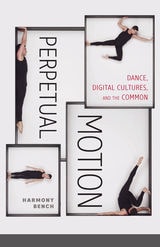
Perpetual Motion
Dance, Digital Cultures, and the CommonHarmony Bench
University of Minnesota Press, 2020
A new exploration of how digital media assert the relevance of dance in a wired world
How has the Internet changed dance? Dance performances can now be seen anywhere, can be looped endlessly at user whim, and can integrate crowds in unprecedented ways. Dance practices are evolving to explore these new possibilities. In Perpetual Motion, Harmony Bench argues that dance is a vital part of civil society and a means for building participation and community. She looks at how, after 9/11, it became a crucial way of recuperating the common character of public spaces. She explores how crowdsourcing dance contributes to the project of performing a common world, as well as the social relationships forged when we look at dance as a gift in the era of globalization. Throughout, she asks how dance brings people together in digital spaces and what dance’s digital travels might mean for how we experience and express community.
From original research on dance today to political economies of digital media to the philosophy of dance, Perpetual Motion provides an ambitious, invigorating look at a commonly shared practice.
Personal Demons
Possession Narratives of Late LiberalismGrace Lavery
Duke University Press, 2026

Personal Effects
edited by Deborah H. Holdstein & David Bleich
Utah State University Press, 2002
With this volume, then, these scholars move us to explore the intersections of the social with subjectivity, with voice, ideology, and culture, and to consider the roles of these in the work of academics who study writing and literature. Taken together, the essays in this collection carry forward the idea that the personal, the candidly subjective and intersubjective, must be part of the subject of study in humanities scholarship. They propose an understanding of the personal in scholarship that is more helpful because more clearly anchored in human experience.
Personalities on the Plate
The Lives and Minds of Animals We EatBarbara J. King
University of Chicago Press, 2017
Yet that realization hasn’t yet made its presence felt to any great degree in our most intimate relationship with animals: at the dinner table. Sure, there are vegetarians and vegans all over, but at the same time, meat consumption is up, and meat remains a central part of the culinary and dining experience for the majority of people in the developed world.
With Personalities on the Plate, Barbara King asks us to think hard about our meat eating--and how we might reduce it. But this isn’t a polemic intended to convert readers to veganism. What she is interested in is why we’ve not drawn food animals into our concern and just what we do know about the minds and lives of chickens, cows, octopuses, fish, and more. Rooted in the latest science, and built on a mix of firsthand experience (including entomophagy, which, yes, is what you think it is) and close engagement with the work of scientists, farmers, vets, and chefs, Personalities on the Plate is an unforgettable journey through the world of animals we eat. Knowing what we know--and what we may yet learn--what is the proper ethical stance toward eating meat? What are the consequences for the planet? How can we life an ethically and ecologically sound life through our food choices?
We could have no better guide to these fascinatingly thorny questions than King, whose deep empathy embraces human and animal alike. Readers will be moved, provoked, and changed by this powerful book.

Peruvian Lives across Borders
Power, Exclusion, and HomeM. Cristina Alcalde
University of Illinois Press, 2018
Alcalde draws on interviews, surveys, participant observation, and textual analysis to argue that to belong is to exclude. To that end, transnational Peruvians engage in both subtle and direct policing along the borders of belonging. These acts allow them to claim and maintain the social status they enjoyed in their homeland even as they profess their openness and tolerance. Alcalde details these processes and their origins in Peru's gender, racial, and class hierarchies. As she shows, the idea of return—whether desired or rejected, imagined or physical—spurs constructions of Peruvianness, belonging, and home.
Deeply researched and theoretically daring, Peruvian Lives across Borders answers fascinating questions about an understudied group of migrants.

Petrochemical Fantasies
The Art and Energy of American ComicsDaniel Worden
The Ohio State University Press, 2024
Finalist, Comics Studies Society Charles Hatfield Book Prize 2025
Nominee, Eisner Award for Best Academic/Scholarly Work 2025
In Petrochemical Fantasies, Daniel Worden reveals the entwined history of comics and fossil fuels in the United States. From the 1840s to the present, comics have depicted the power, pollution, and rapid expansion of energy systems—especially the explosive growth of coal and oil. In the 1930s, some of the first comic books were the gas station giveaways Gulf Funny Weekly and Standard Oil Comics. And in recent years, comics have become one of the major sites for visualizing life after oil, a striking reversal of the medium’s early boosterism.
Surveying the work of acclaimed artists such as Nell Brinkley, George Herriman, Jack Kirby, Winsor McCay, and R. F. Outcault and recovering little-known works, Worden advances a new history of American comics in the Anthropocene. From late nineteenth- and early twentieth-century editorial cartoons and superhero comics that visualize our modern energy culture to contemporary comics grappling with climate crises, Petrochemical Fantasies places comics, environmental humanities, and energy studies in conversation with each other to unearth the crucial but overlooked history of comics’ place in US energy culture.
Petroforms
Oil and the Shaping of Nigerian AestheticsHelen Kapstein
West Virginia University Press, 2025
2026 PROSE Award Finalist, Humanities: Literature
Petroforms contributes a much-needed theory of form and genre to the cutting-edge field of petrocriticism, itself an offshoot of developments in postcolonial ecocriticism. Studies of resource fiction and inquiries in the energy humanities have recently taken their rightful place as necessary reflections on the role of the literary imagination in intervening in the Anthropocene as we find ourselves precariously placed in the face of a fossil fuel crisis, climate change, and mass extinctions.
With Petroforms, Helen Kapstein undertakes close readings of a range of Nigerian aesthetic forms: short stories, romance novels, documentary film, the “Nollywood” film industry, fine art sculpture, and poetry. She uses these forms to argue that the demands of paying attention to petroleum extraction, production, consumption, and distribution in the creation of resource fictions must necessarily alter and affect conventional forms and structures. What results is a new set of genre-bending forms, like documentary film that we can read as horror, in response to the forceful and fluid demands of the petroleum industry and its master narrative.
Nigeria is one of the world’s largest oil-producing nations, in which that production is concentrated in the Niger Delta, resulting in a local environment that has been steadily degraded by oil spills, flares, pollution, and contamination, and a local culture shaped by false scarcity in a space of abundance, murderous politics, and escalating violence. At the same time as the Niger Delta grounds Kapstein’s argument in its own political realities and cultural responses, Nigeria’s participation in a global economy of petrodependency allows her theory of petroforms to be extended and applied more generally.
What Peter Hitchcock calls “oil’s generative law” is that it is “everywhere and obvious, it must be opaque or otherwise fantastic.” He means the coexistence of oil’s taken-for-granted qualities is something constitutive of every level of everyday life and its spectacular displays—gushers, spills, explosions. Oil’s nature, the fact that it is everywhere, unctuously oozing into every corner of everyday life, means that it constantly spills over out of our existing forms, genres, and systems, demanding accommodation. To try to contain it, we create new forms. Thus, a petroform is simultaneously reactionary (a necessary response to oil’s pressures, a by-product of the commodity itself) and resistant (an attempt at containment, at generating a retort to the very thing that shapes it). Each form figures oil and then configures and reconfigures itself in reaction to it.

Phenomenal Justice
Violence and Morality in ArgentinaEva van Roekel
Rutgers University Press, 2020
Short-listed for the Juan E. Méndez Book Award for Human Rights in Latin America from Duke University Libraries
How do victims and perpetrators of political violence caught up in a complicated legal battle experience justice on their own terms? Phenomenal Justice is a compelling ethnography about the reopened trials for crimes against humanity committed during the brutal military dictatorship that ruled Argentina between 1976 and 1983. Grounded in phenomenological anthropology and the anthropology of emotion, this book establishes a new theoretical basis that is faithful to the uncertainties of justice and truth in the aftermath of human rights violations. The ethnographic observations and the first-person stories about torture, survival, disappearance, and death reveal the enduring trauma, heartfelt guilt, happiness, battered pride, and scratchy shame that demonstrate the unreserved complexities of truth and justice in post-conflict societies. Phenomenal Justice will be an indispensable contribution to a better understanding of the military dictatorship in Argentina and its aftermath.

Philanthropy and the Business Corporation
Marion R. Fremont-Smith
Russell Sage Foundation, 1972
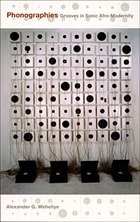
Phonographies
Grooves in Sonic Afro-ModernityAlexander G. Weheliye
Duke University Press, 2005
Weheliye surveys literature, film, and music to focus on engagements with recorded sound. He offers substantial new readings of canonical texts by W. E. B. Du Bois and Ralph Ellison, establishing dialogues between these writers and popular music and film ranging from Louis Armstrong’s voice to DJ mixing techniques to Darnell Martin’s 1994 movie I Like It Like That. Looking at how questions of diasporic belonging are articulated in contemporary black musical practices, Weheliye analyzes three contemporary Afro-diasporic musical acts: the Haitian and African American rap group the Fugees, the Afro- and Italian-German rap collective Advanced Chemistry, and black British artist Tricky and his partner Martina. Phonographies imagines the African diaspora as a virtual sounding space, one that is marked, in the twentieth century and twenty-first, by the circulation of culture via technological reproductions—records and tapes, dubbing and mixing, and more.
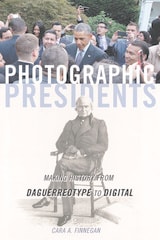
Photographic Presidents
Making History from Daguerreotype to DigitalCara A. Finnegan
University of Illinois Press, 2021
Lincoln’s somber portraits. Lyndon Johnson’s swearing in. George W. Bush’s reaction to learning about the 9/11 attacks. Photography plays an indelible role in how we remember and define American presidents. Throughout history, presidents have actively participated in all aspects of photography, not only by sitting for photos but by taking and consuming them. Cara A. Finnegan ventures from a newly-discovered daguerreotype of John Quincy Adams to Barack Obama’s selfies to tell the stories of how presidents have participated in the medium’s transformative moments. As she shows, technological developments not only changed photography, but introduced new visual values that influence how we judge an image. At the same time, presidential photographs—as representations of leaders who symbolized the nation—sparked public debate on these values and their implications.
An original journey through political history, Photographic Presidents reveals the intertwined evolution of an American institution and a medium that continues to define it.

Photographic Returns
Racial Justice and the Time of PhotographyShawn Michelle Smith
Duke University Press, 2020
Photographies East
The Camera and Its Histories in East and Southeast AsiaRosalind C. Morris, ed.
Duke University Press, 2009
The contributors analyze how in specific cultural and historical contexts, the camera has affected experiences of time and subjectivity, practices of ritual and tradition, and understandings of death. They highlight the links between photography and power, looking at how the camera has figured in the operations of colonialism, the development of nationalism, the transformation of monarchy, and the militarization of violence. Moving beyond a consideration of historical function or effect, the contributors also explore the forms of illumination and revelation for which the camera has offered itself as instrument and symbol. And they trace the emergent forms of alienation and spectralization, as well as the new kinds of fetishism, that photography has brought in its wake. Taken together, the essays chart a bravely interdisciplinary path to visual studies, one that places the particular knowledge of a historicized anthropology in a comparative frame and in conversation with aesthetics and art history.
Contributors. James L. Hevia, Marilyn Ivy, Thomas LaMarre, Rosalind C. Morris, Nickola Pazderic, John Pemberton, Carlos Rojas, James T. Siegel, Patricia Spyer

Photography's Other Histories
Christopher Pinney and Nicolas Peterson, eds.
Duke University Press, 2003
Richly illustrated with over 100 images, Photography’s Other Histories explores from a variety of regional, cultural, and historical perspectives the role of photography in raising historical consciousness. It includes two first-person pieces by indigenous Australians and one by a Seminole/Muskogee/Dine' artist. Some of the essays analyze representations of colonial subjects—from the limited ways Westerners have depicted Navajos to Japanese photos recording the occupation of Manchuria to the changing "contract" between Aboriginal subjects and photographers. Other essays highlight the visionary quality of much popular photography. Case studies centered in early-twentieth-century Peru and contemporary India, Kenya, and Nigeria chronicle the diverse practices that have flourished in postcolonial societies. Photography’s Other Histories recasts popular photography around the world, as not simply reproducing culture but creating it.
Contributors. Michael Aird, Heike Behrend, Jo-Anne Driessens, James Faris, Morris Low, Nicolas Peterson, Christopher Pinney, Roslyn Poignant, Deborah Poole, Stephen Sprague, Hulleah Tsinhnahjinnie, Christopher Wright

Photography, History, Difference
Edited by Tanya Sheehan
Dartmouth College Press, 2014

Photography, Trace, and Trauma
Margaret Iversen
University of Chicago Press, 2017
Examining photography and film, molds, rubbings, and more, Margaret Iversen considers how these artistic processes can be understood as presenting or simulating a residue, trace, or “index” of a traumatic event. These approaches, which involve close physical contact or the short-circuiting of artistic agency, are favored by artists who wish to convey the disorienting effect and elusive character of trauma. Informing the work of a number of contemporary artists—including Tacita Dean, Jasper Johns, Mary Kelly, Gabriel Orozco, and Gerhard Richter—the concept of the trace is shown to be vital for any account of the aesthetics of trauma; it has left an indelible mark on the history of photography and art as a whole.
Physical Attractiveness and the Theory of Sexual Selection
Results from Five PopulationsDoug Jones with a foreword by Donald Symons
University of Michigan Press, 1996
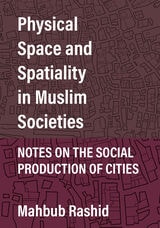
Physical Space and Spatiality in Muslim Societies
Notes on the Social Production of CitiesMahbub Rashid
University of Michigan Press, 2021
Mahbub Rashid embarks on a fascinating journey through urban space in all of its physical and social aspects, using the theories of Foucault, Bourdieu, Lefebvre, and others to explore how consumer capitalism, colonialism, and power disparity consciously shape cities. Using two Muslim cities as case studies, Algiers (Ottoman/French) and Zanzibar (Ottoman/British), Rashid shows how Western perceptions can only view Muslim cities through the lens of colonization—a lens that distorts both physical and social space. Is it possible, he asks, to find a useable urban past in a timeline broken by colonization? He concludes that political economy may be less relevant in premodern cities, that local variation is central to the understanding of power, that cities engage more actively in social reproduction than in production, that the manipulation of space is the exercise of power, that all urban space is a conscious construct and is therefore not inevitable, and that consumer capitalism is taking over everyday life. Ultimately, we reconstruct a present from a fragmented past through local struggles against the homogenizing power of abstract space.

Physicians of the Future
Doctor-Influencers, Patient-Consumers, and the Business of Functional MedicineRosalynn A. Vega
University of Texas Press, 2024
The first scholarly exploration of the forums, practice, and economics of functional medicine.
Physicians of the Future interrogates the hidden logics of inclusion and exclusion in functional medicine (FM), a holistic form of personalized medicine that targets chronic disease. Rosalynn Vega uncovers how, as “wounded healers,” some FM practitioners who are former chronic disease sufferers turn their illness narratives into a form of social capital, leveraging social media to relate to patients and build practices as “doctor-influencers.” Arguing that power and authority operate distinctly in FM when compared to conventional medicine, largely because FM services are paid for out of pocket by socioeconomically privileged “clients,” Vega studies how FM practitioners engage in entrepreneurship of their own while critiquing the profit motives of the existing healthcare system, pharmaceutical industry, and insurance industry. Using data culled from online support groups, conferences, docuseries, blogs, podcasts, YouTube, and TED Talks, as well as her own battles with chronic illness, Vega argues that FM practices prioritize the individual while inadvertently reinscribing inequities based on race and class. Ultimately, she opens avenues of possibility for FM interlocutors wrestling with their responsibility for making functional medicine accessible to all.
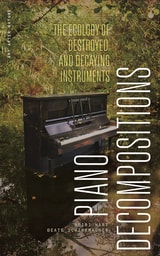
Piano Decompositions
The Ecology of Destroyed and Decaying InstrumentsHeidi Hart
University of Minnesota Press, 2026
Examining musical instrument destruction through an ecological and intermedial lens
Musical instruments are typically seen as objects both used and maintained with ritualistic care. But what happens when they’re tossed from homes in mudslides, burned during ecstatic parties, or waterlogged by pop stars in viral videos—and how do these elemental interactions transform the way we see and play instruments? Piano Decompositions asks what happens when we let go of controlling musical instruments. What kind of meanings start to sound when instruments are moved out of the protected cultural space and engage with their surrounding elements?
Heidi Hart and Beate Schirrmacher trace the history of destroyed and decaying pianos, both sorting them within the realm of artistic violence against instruments and following their return journeys into water, sand, and soil. They parse the artistic vision of Annea Lockwood, whose iconic burning, drowning, and decaying Piano Transplants presented a novel means of drawing attention to the increasing threats of climate change in the 1960s and ’70s. Turning to instruments made from found materials and others played collaboratively with wind and water, they demonstrate how human sound making is entangled in the more-than-human world.
Showing how the piano can transform conversations around the Anthropocene and environmental destruction, Hart and Schirrmacher find the instrument to be a potent creative and ecological force, a medium to connect with environments in an explorative, attentive way. Piano Decompositions unearths new ways to relate our concepts of curiosity, pleasure, and music to the natural world.
Retail e-book files for this title are screen-reader friendly with images accompanied by short alt text and/or extended descriptions.
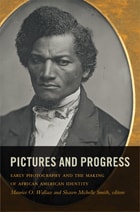
Pictures and Progress
Early Photography and the Making of African American IdentityMaurice O. Wallace and Shawn Michelle Smith, eds.
Duke University Press, 2012
Contributors. Michael A. Chaney, Cheryl Finley, P. Gabrielle Foreman, Ginger Hill, Leigh Raiford, Augusta Rohrbach, Ray Sapirstein, Suzanne N. Schneider, Shawn Michelle Smith, Laura Wexler, Maurice O. Wallace
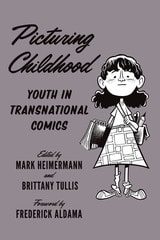
Picturing Childhood
Youth in Transnational ComicsEdited by Mark Heimermann and Brittany Tullis, Foreword by Frederick Aldama
University of Texas Press, 2017
Comics and childhood have had a richly intertwined history for nearly a century. From Richard Outcault’s Yellow Kid, Winsor McCay’s Little Nemo, and Harold Gray’s Little Orphan Annie to Hergé’s Tintin (Belgium), José Escobar’s Zipi and Zape (Spain), and Wilhelm Busch’s Max and Moritz (Germany), iconic child characters have given both kids and adults not only hours of entertainment but also an important vehicle for exploring children’s lives and the sometimes challenging realities that surround them.
Bringing together comic studies and childhood studies, this pioneering collection of essays provides the first wide-ranging account of how children and childhood, as well as the larger cultural forces behind their representations, have been depicted in comics from the 1930s to the present. The authors address issues such as how comics reflect a spectrum of cultural values concerning children, sometimes even resisting dominant cultural constructions of childhood; how sensitive social issues, such as racial discrimination or the construction and enforcement of gender roles, can be explored in comics through the use of child characters; and the ways in which comics use children as metaphors for other issues or concerns. Specific topics discussed in the book include diversity and inclusiveness in Little Audrey comics of the 1950s and 1960s, the fetishization of adolescent girls in Japanese manga, the use of children to build national unity in Finnish wartime comics, and how the animal/child hybrids in Sweet Tooth act as a metaphor for commodification.
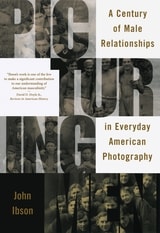
Picturing Men
A Century of Male Relationships in Everyday American PhotographyJohn Ibson
University of Chicago Press, 2006
Such is the time John Ibson evokes in Picturing Men, a striking visual record of changes in attitudes about relationships between gentlemen, soldiers, cowboys, students, lumberjacks, sailors, and practical jokers. Spanning from 1850 to 1950, the 142 everyday photographs that richly illustrate Picturing Men radiate playfulness, humor, and warmth. They portray a lost world for American men: a time when their relationships with each other were more intimate than they commonly are today, regardless of sexual orientation. Picturing Men starkly contrasts the calm affection displayed in earlier photographs with the absence of intimacy in photos from the mid-1950s on. In doing so, this lively, accessible book makes a significant contribution to American history and cultural studies, gender studies, and the history of photography.
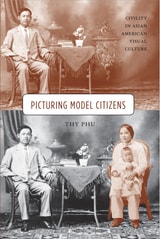
Picturing Model Citizens
Civility in Asian American Visual CultureThy Phu
Temple University Press, 2012
At the heart of the model minority myth—often associated with Asian Americans—is the concept of civility. In this groundbreaking book, Picturing Model Citizens, Thy Phu exposes the complex links between civility and citizenship, and argues that civility plays a crucial role in constructing Asian American citizenship.
Featuring works by Arnold Genthe, Carl Iwasaki, Toyo Miyatake, Nick Ut, and others, Picturing Model Citizens traces the trope of civility from the nineteenth to the twenty-first centuries. Through an examination of photographs of Chinese immigrants, Japanese internment camps, the Hiroshima Maidens project, napalm victims, and the SARS epidemic, Phu explores civility's unexpected appearance in images that draw on discourses of intimacy, cultivation, apology, and hygiene. She reveals how Asian American visual culture illustrates not only cultural ideas of civility, but also contests the contradictions of state-defined citizenship.

Pink Gold
Women, Shrimp, and Work in MexicoMaria L. Cruz-Torres
University of Texas Press, 2023
A rich, long-term ethnography of women seafood traders in Mexico.
The "shrimp ladies," locally known as changueras in southern Sinaloa, Mexico, sell seafood in open-air markets, forming an extralegal but key part of the economy built around this "pink gold.” Over time, they struggled to evolve from marginalized peddlers to local icons depicted in popular culture, even as they continue to work at an open-air street market.
Pink Gold documents the shrimp traders' resilience and resourcefulness, from their early conflicts with the city, state, and federal authorities and forming a union, to carving out a physical space for a seafood market, and even engaging in conflicts with the Mexican military. Drawing from her two decades of fieldwork, María L. Cruz-Torres explores the inspiring narrative of this overlooked group of women involving grassroots politics, trans-border and familial networking, debt and informal economic practices, personal sacrifices, and simple courage. She argues that, amid intense economic competition, their success relies on group solidarity that creates interlocking networks of mutual trust, or confianza, that in turn enable them to cross social and political boundaries that would typically be closed to them. Ultimately, Pink Gold offers fresh insights into issues of gender and labor, urban public space, the street economy, commodities, and globalization.
Pink and Blue
Gender, Culture, and the Health of ChildrenElena Conis
Rutgers University Press, 2021
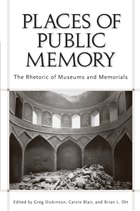
Places of Public Memory
The Rhetoric of Museums and MemorialsEdited by Greg Dickinson, Carole Blair, and Brian L. Ott
University of Alabama Press, 2010
A sustained and rigorous consideration of the intersections of memory, place, and rhetoric
Though we live in a time when memory seems to be losing its hold on communities, memory remains central to personal, communal, and national identities. And although popular and public discourses from speeches to films invite a shared sense of the past, official sites of memory such as memorials, museums, and battlefields embody unique rhetorical principles.
Places of Public Memory: The Rhetoric of Museums and Memorials is a sustained and rigorous consideration of the intersections of memory, place, and rhetoric. From the mnemonic systems inscribed upon ancient architecture to the roadside accident memorials that line America’s highways, memory and place have always been deeply interconnected. This book investigates the intersections of memory and place through nine original essays written by leading memory studies scholars from the fields of rhetoric, media studies, organizational communication, history, performance studies, and English. The essays address, among other subjects, the rhetorical strategies of those vying for competing visions of a 9/11 memorial at New York City’s Ground Zero; rhetorics of resistance embedded in the plans for an expansion of the National Civil Rights Museum; representations of nuclear energy—both as power source and weapon—in Cold War and post–Cold War museums; and tours and tourism as acts of performance.
By focusing on “official” places of memory, the collection causes readers to reflect on how nations and local communities remember history and on how some voices and views are legitimated and others are minimized or erased.

Planet Management
Limits to Growth, Computer Simulation, and the Emergence of Global SpacesFernando Elichirigoity
Northwestern University Press, 1999

Plantation Life
Corporate Occupation in Indonesia's Oil Palm ZoneTania Murray Li and Pujo Semedi
Duke University Press, 2021

Plastic Bodies
Sex Hormones and Menstrual Suppression in BrazilEmilia Sanabria
Duke University Press, 2016

Plastic Matter
Heather Davis
Duke University Press, 2022

Play Redux
The Form of Computer GamesDavid Myers
University of Michigan Press, 2010
"Play Redux excels in tying together intellectual traditions that are rooted in literary studies, cognitive science, play studies and several other fields, thereby creating a logical whole. Through this, the book makes service to several academic communities by pointing out their points of contact. This is clearly an important contribution to a growing academic field, and will no doubt become important in many future discussions about digital games and play."
---Frans Mäyrä, University of Tampere, Finland
"David Myers has researched video games longer than anyone else. Play Redux shows him continually relevant, never afraid of courting controversy."
---Jesper Juul, IT University of Copenhagen, Denmark
Play Redux is an ambitious description and critical analysis of the aesthetic pleasures of video game play, drawing on early twentieth-century formalist theory and models of literature. Employing a concept of biological naturalism grounded in cognitive theory, Myers argues for a clear delineation between the aesthetics of play and the aesthetics of texts. In the course of this study, Myers asks a number of interesting questions: What are the mechanics of human play as exhibited in computer games? Can these mechanisms be modeled? What is the evolutionary function of cognitive play, and is it, on the whole, a good thing? Intended as a provocative corrective to the currently ascendant, if not dominant, cultural and ethnographic approach to game studies and play, Play Redux will generate interest among scholars of communications, new media, and film.
David Myers is Reverend Aloysius B. Goodspeed Distinguished Professor at the School of Mass Communication, Loyola University New Orleans.
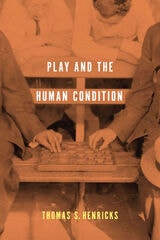
Play and the Human Condition
Thomas S. Henricks
University of Illinois Press, 2015
Imaginative and stimulating, Play and the Human Condition shows how play allows us to learn about our qualities and those of the world around us--and in so doing make sense of ourselves.

Play in the Age of Goethe
Theories, Narratives, and Practices of Play around 1800Edgar Landgraf
Bucknell University Press, 2020
Published by Bucknell University Press. Distributed worldwide by Rutgers University Press.
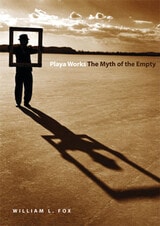
Playa Works
The Myth of the EmptyWilliam L. Fox
University of Nevada Press, 2024
In eight brilliant essays, Fox explores many of the major playas of the American West , examining locations as diverse as Nellis Air Force Base and Frenchman Flat, where the federal government has tested experimental aircraft and atomic weaponry; the Great Salt Lake Desert, where land-speed records have been broken; and the Black Rock Desert of Northern Nevada, site of the colorful Burning Man arts festival. He analyzes the geological and climatological conditions that created the playas and the historical role that playas played in the exploration and settlement of the West. And he offers lucid and keenly perceptive discussions of the ways that artists have responded to the playas, from the ancient makers of geoglyphs to the work of contemporary artists who have found inspiration in these enigmatic spaces, including earthworks builder Michael Heizer, photographer Richard Misrach, and painter Michael Moore. The ensemble is a compelling combination of natural history, philosophy, and art criticism, a thoughtful meditation on humankind's aversion to and fascination with the void.

Played Out on the Strip
The Rise and Fall of Las Vegas Casino BandsJanis L. McKay
University of Nevada Press, 2016
From 1940 to 1989, nearly every hotel on the Las Vegas Strip employed a full-time band or orchestra. After the late 1980s, when control of the casinos changed hands from independent owners to corporations, almost all of these musicians found themselves unemployed. Played Out on the Strip traces this major shift in the music industry through extensive interviews with former musicians.
In 1989, these soon-to-be unemployed musicians went on strike. Janis McKay charts the factors behind this strike, which was precipitated by several corporate hotel owners moving to replace live musicians with synthesizers and taped music, a strategic decision made in order to save money. The results of this transitional period in Las Vegas history were both long-lasting and far-reaching for the entertainment industry. With its numerous oral history interviews and personal perspectives from the era, this book will appeal to readers interested in Las Vegas history, music history, and labor issues.
Players and Pawns
How Chess Builds Community and CultureGary Alan Fine
University of Chicago Press, 2015
Full of idiosyncratic characters and dramatic gameplay, Players and Pawns is a celebration of the fascinating world of serious chess.

Playgrounds to the Pros
Legends of Peoria BasketballJeff Karzen
University of Illinois Press, 2023
Howard Nathan. A. J. Guyton. Sergio McClain. Marcus Griffin. Frank Williams. Shaun Livingston. This dazzling constellation of talent helped make Peoria a prep basketball hotbed from the 1980s to the 2000s. Jeff Karzen takes readers inside the lives of the players, coaches, and others who defined an era that produced six state titles and four Illinois Mr. Basketball winners.
Drawing on dozens of in-depth interviews, Karzen tells the stories behind the on-court triumphs while providing a panorama of the entire Peoria scene--the rivalries and relationships, the families and friendships, the hopes and hard work. Karzen also follows the players into their Division 1 and NBA careers and pays special attention to the pipeline that, by connecting Peoria to Champaign-Urbana, powered one of the most successful periods in Fighting Illini basketball history.
Intense and intimate, Playgrounds to the Pros chronicles a basketball golden age in America’s quintessential blue collar town.

Playing Dead
Mock Trauma and Folk Drama in Staged High School Drunk Driving TragediesMontana Miller
Utah State University Press, 2012
As the Grim Reaper pulls a student out of class to be a “victim” of drunk driving in a program called “Every 15 Minutes,” Montana Miller observes the ritual through a folklorist’s lens. Playing Dead examines why hundreds of American schools and communities each year organize these mock tragedies without any national sponsorship or coordination. Often, the event is complete with a staged accident in the parking lot, a life-flight helicopter, and faux eulogies for the “dead” students read in school assemblies. Grounding her research in play theory, frame theory, and theory of folk drama, Miller investigates key aspects of this emergent tradition, paying particular attention to its unplanned elements—enabled by the performance’s spontaneous nature and the participants’ tendency to stray from the intended frame. Miller examines such variations in terms of the program as a whole, analyzing its continued popularity and weighing its success as perceived by participants. Her fieldwork reveals a surprising aspect of Every 15 Minutes that typical studies of ritual do not include: It can be fun. Playing Dead is volume two of the series Ritual, Festival, and Celebration, edited by Jack Santino.

Playing Dolly
Technocultural Formations, Fantasies, and Fictions of Assisted ReproductionKaplan, E. Ann
Rutgers University Press, 1999
Reproductive technology spans techniques ranging from cloning, surrogate motherhood, egg donation, and prenatal testing. In the early nineties, when public debate about this topic was new, the discourse focused on the moral and ethical issues that these new technologies evoked. Less than a decade later, the editors in Playing Dolly state, ethical questions seem less urgent. Enormous changes have taken place in the way that reproduction is represented, understood, and discussed.
The pieces, which range from the biomedical to the sociocultural and include even fiction, reflect the shift in public perception of these complex topics. They testify to the increasing acceptance of reproductive technology, and the resulting reduction in concern over the ethical issues raised by technological intervention.

Playing Fans
Negotiating Fandom and Media in the Digital AgePaul Booth
University of Iowa Press, 2015
In Playing Fans, Paul Booth argues that the more attention entertainment businesses pay to fans, the more mainstream fans have become popularized. But such mainstreaming ignores important creative fan work and tries to channel fandom into activities lucrative for the companies. Offering a new approach to the longstanding debate about the balance between manipulation and subversion in popular culture, the author argues that we can understand the current moment best through the concepts of pastiche and parody. This sophisticated alternative to conceiving of fans as either dupes of the media industry or rebels against it takes the discussion of “transformative” and “affirmative” fandom in a productive new direction.
With nuanced analyses of the Doctor Who Experience in Cardiff, the representations of fans in TV shows like Community and films like Fanboys, SuperWhoLock fans’ use of gifs, and the similarities in discussions of slash fandom and pornographic parody films, this book reveals how fans borrow media techniques and media industries mimic fan activities. Just as the entertainment industry needs fans to succeed, so too do fans need—and desire—the media, and they represent their love through gif fics, crowdfunding, and digital cosplay. Everyone who wants to understand how consumers are making themselves at home in the brave new world being built by the contemporary media should read this book.
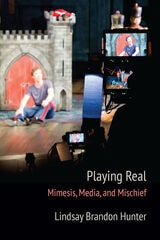
Playing Real
Mimesis, Media, and MischiefLindsay Brandon Hunter
Northwestern University Press, 2021
Playing Real: Mimesis, Media, and Mischief explores the integration and interaction of mimetic theatricality and representational media in twentieth- and twenty‑first-century performance. It brings together carefully chosen sites of performance—including live broadcasts of theatrical productions, reality television, and alternate-reality gaming—in which mediatization and mimesis compete and collude to represent the real to audiences. Lindsay Brandon Hunter reads such performances as forcing confrontation between notions of authenticity, sincerity, and spontaneity and their various others: the fake, the feigned, the staged, or the rehearsed.
Each site examined in Playing Real purports to show audiences something real—real theater, real housewives, real alternative scenarios—which is simultaneously visible as overtly constructed, adulterated by artifice and artificiality. The integration of mediatization and theatricality in these performances, Hunter argues, exploits the proclivities of both to conjure the real even as they risk corrupting the perception of authenticity by imbricating it with artifice and overt manipulation.
Although the performances analyzed obscure boundaries separating actual from virtual, genuine from artificial, and truth from fiction, Hunter rejects the notion that these productions imperil the “real.” She insists on uncertainty as a fertile site for productive and pleasurable mischief—including relationships to realness and authenticity among both audience and participants.

Playing Sociology
Theory and Games for Coping with Mimetic Crisis and Social ConflictMartino Doni
Michigan State University Press, 2024
Playing for Keeps
Improvisation in the AftermathDaniel Fischlin and Eric Porter
Duke University Press, 2020
Contributors. Randy DuBurke, Rana El Kadi, Kevin Fellezs, Daniel Fischlin, Kate Galloway, Reem Abdul Hadi, Vijay Iyer, Mark Lomanno, Moshe Morad, Eric Porter, Sara Ramshaw, Matana Roberts, Darci Sprengel, Paul Stapleton, Odeh Turjman, Stephanie Vos
Playing for Power
Black Resistance in Amateur Basketball and Football in Jim Crow VirginiaMarvin T. Chiles
University of Alabama Press, 2025
Reveals the role of amateur Black football and basketball in Virginia before integration as a form of resistance to white supremacy
In Playing for Power, Marvin T. Chiles offers a fascinating account of amateur sports in Jim Crow Virginia, revealing how, in addition to churches, workspaces, and civil rights organizations, sports were also a key arena for Black resistance to white supremacy. Drawing from a rich trove of primary sources, Chiles recounts the development of Black football and basketball culture at the high school and college levels in Virginia from the 1890s to the early 1970s. Looking beyond their role as leisure pastimes, Chiles demonstrates how amateur sports strengthened education, neutralized class divisions, shaped Black masculinity, mentored Black male leadership, cultivated race pride, and reflected Black desires for urban modernity.
Illuminating the ways Black athletes created a world that pushed for racial progress through objective, meritocratic achievement anchored by masculine leadership and institutional success, Playing for Power traces how amateur sports coalesced into a key cultural institution that fostered Black Virginians’ collective sense of community, achievement, and purpose during segregation, cornerstones of later advances in the Civil Rights Movement. Playing for Power also contributes to a larger understanding of sports history and how amateur sports became favorite American spectacles and markers of Southern identity. Chiles’s groundbreaking work will interest historians, scholars, and individuals interested in the intersection of sports and civil rights and the history of Black sports during the Jim Crow era.