Results by title
3576 books match the query 'American' and 162 start with p
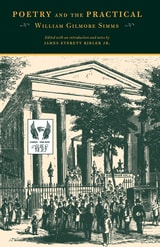
Poetry and the Practical
William Gilmore Simms
University of Arkansas Press, 1998
Delivered as a three-part lecture series in 1854 at the famous Hibernian Society Hall in Charleston, South Carolina, Simms’s spirited defense of poetry stands in the nobel line of poetic credos from poets such as Sir Philip Sidney and Percy Bysshe Shelley. It is the only full-length work of its kind in American literature, and it has never before been published.
Seventh in the University of Arkansas Press’s Simms Series, Poetry and the Practical is a clear, forceful rebuttal of arguments that would relegate poetry to the margins of life. It proclaims the high calling of poets as spokesmen and romantic visionaries, underscoring their mission to reveal truth and passion, mind and heart and to transcend the limiting bounds of the empirical. In proving poetry’s utility and worth, Simms uses all the tools of persuasion open to him: his wide reading, his considerable knowledge of the history of culture and civilizations, his understanding of the values of place and tradition, and, above all, an oratorical eloquence, which allows his words to leave the page in a rush of inspiration.
These lectures, which still retain their identity as scripts prepared and punctuated for performance, provide profound insight into Simms the poet and into the effects of industrialization, the southern sensibility, and the influence of European thought on southern literature at a critical point in that literature’s development.
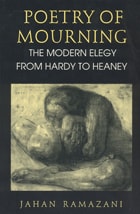
Poetry of Mourning
The Modern Elegy from Hardy to HeaneyJahan Ramazani
University of Chicago Press, 1994
Through subtle readings of elegies, self-elegies, war poems, and the blues, Ramazani greatly enriches our critical understanding of a wide range of poets, including Thomas Hardy, Wilfred Owen, Wallace Stevens, Langston Hughes, W. H. Auden, Sylvia Plath, and Seamus Heaney. He also interprets the signal contributions to the American family elegy of Robert Lowell, Allen Ginsberg, Anne Sexton, John Berryman, Adrienne Rich, Michael Harper, and Amy Clampitt. Finally, he suggests analogies between the elegy and other kinds of contemporary mourning art—in particular, the AIDS Memorial Quilt and the Vietnam Veterans Memorial.
Grounded in genre theory and in the psychoanalysis of mourning, Ramazani's readings also draw on various historical, formal, and feminist critical approaches. This book will be of interest to anyone concerned with the psychology of mourning or the history of modern poetry.
"Consists of full, intelligent and lucid exposition and close reading. . . . Poetry of Mourning is itself a welcome contribution to modern poetry's search for a 'resonant yet credible vocabulary of grief in our time."—Times Literary Supplement
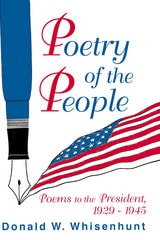
Poetry of the People
Poems to the President, 1929–1945Donald W. Whisenhunt
University of Wisconsin Press, 1996
The poets of the era voiced their opinions on virtually every subject. They wrote about New Deal agencies, they praised and condemned Hoover and Roosevelt. They expressed their views about the Supreme Court, the third term, and the approaching war in Europe. The resulting study, arranged topically rather than chronologically, provides a unique perspective on American popular culture and American politics.
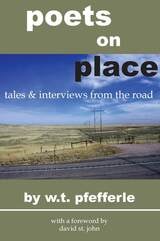
Poets On Place
W. T. Pfefferle
Utah State University Press, 2005
Out to see America and satisfy his travel bug, W. T. Pfefferle resigned from his position as director of the writing program at Johns Hopkins University and hit the road to interview sixty-two poets about the significance of place in their work. The lively conversations that resulted may surprise with the potential meanings of a seemingly simple concept. This gathering of voices and ideas is illustrated with photo and word portraits from the road and represented with suitable poems.
The poets are James Harms, David Citino, Martha Collins, Linda Gregerson, Richard Tillinghast, Orlando Ricardo Menes, Mark Strand, Karen Volkman, Lisa Samuels, Marvin Bell, Michael Dennis Browne, David Allan Evans, David Romtvedt, Sandra Alcosser, Robert Wrigley, Nance Van Winckel, Christopher Howell, Mark Halperin, Jana Harris, Sam Hamill, Barbara Drake, Floyd Skloot, Ralph Angel, Carol Muske-Dukes, David St. John, Sharon Bryan, Donald Revell, Claudia Keelan, Alberto Rios, Richard Shelton, Jane Miller, William Wenthe, Naomi Shihab Nye, Peter Cooley, Miller Williams, Beth Ann Fennelly, Natasha Trethewey, Denise Duhamel, Campbell McGrath, Terrance Hayes, Alan Shapiro, Nikki Giovanni, Charles Wright, Rita Dove, Henry Taylor, Dave Smith, Nicole Cooley, David Lehman, Lucie Brock-Broido, Michael S. Harper, C. D. Wright, Mark Wunderlich, James Cummins, Frederick Smock, Mark Jarman, Carl Phillips, Scott Cairns, Elizabeth Dodd, Jonathan Holden, Bin Ramke, Kenneth Brewer, and Paisley Rekdal.
Poets Teaching Poets
Self and the WorldGregory Orr and Ellen Bryant Voigt, Editors
University of Michigan Press, 1996
Points of Contact
Disability, Art, and CultureSusan Crutchfield and Marcy Epstein, Editors
University of Michigan Press, 2000
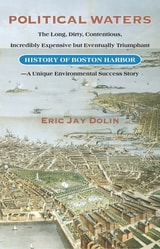
Political Waters
The Long, Dirty, Contentious, Incredibly Expensive but Eventually Triumphant History of Boston Harbor-A Unique Environmental Success StoryEric Jay Dolin
University of Massachusetts Press, 2004
Boston Harbor served as a colonial gateway to the world, witnessed the Boston Tea Party, and helped the community transform itself from an outpost of a few hardy settlers into a bustling metropolis and self-proclaimed hub of the universe. Yet for hundreds of years Boston Harbor was also a cesspool. Long before Bostonians dumped tea into the harbor to protest English taxes, they dumped sewage there.
As the Boston area grew and prospered, its sewage problems worsened, as did the harbor's health, to the point where in the 1980s it was considered the most polluted harbor in the country and ridiculed as the “harbor of shame.” Then, in one of the most impressive environmental comebacks in American history, Boston Harbor was dramatically cleaned up. All it took was two lawsuits, two courts, dozens of lawyers, the creation of a powerful sewage authority, thousands of workers, millions of labor hours, and billions of dollars.
Sewage management is rarely as compelling and exciting as higher profile environmental issues such as global climate change, preserving endangered species, or protecting tropical rainforests. But it can be, as Eric Jay Dolin shows in this engaging narrative account. Boston's struggle to deal with its sewage is an epic story of failure and success, replete with colorful characters, political, bureaucratic, and legal twists and turns, engineering feats, and massive amounts of money. In the end, success hinged on the often overlooked yet monumentally important act of responsibly disposing of the waste people produce every day.
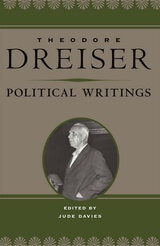
Political Writings
Edited by Jude Davies
University of Illinois Press, 2011
Politics, Desire, and the Hollywood Novel
Chip Rhodes
University of Iowa Press, 2008
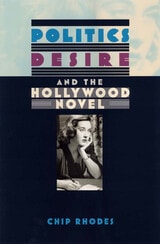
Rhodes considers how novels about the film industry changed between the studio era of the 1930s and 1940s and the era of deregulated film making that has existed since the 1960s. He asserts that Americans are now driven by cultural, rather than class, differences and that our mainstream notion of love has gone from repressed desire to “abnormal desire” to, finally, strictly business.
Politics, Desire, and the Hollywood Novel pays close attention to six authors—Nathanael West, Raymond Chandler, Budd Schulberg, Joan Didion, Bruce Wagner, and Elmore Leonard—who have toiled in the film industry and written to tell about it. More specifically, Rhodes considers both screenplays and novels with an eye toward the different formulations of sexuality, art, and ultimately political action that exist in these two kinds of storytelling.

Pony
A PlaySylvan Oswald
Northwestern University Press, 2025
When Pony, a formerly incarcerated trans guy, moves to a small rural town to start a new life, he quickly becomes entangled with its isolated community. He starts to fall for a waitress who is obsessed with a local murder; he must comply with a butch social worker who doesn’t understand him; and he is pursued by a young trans man who thinks Pony could be the father he always wanted. Amid this whirlwind of fear and desire, Pony must find the strength to confront the stories he's been told about masculinity, violence, and self-worth. With a new preface by the author on searching for queer and trans community in the theater, and an afterword by critic Miriam Felton-Dansky contextualizing its place in contemporary theater, Pony is a seminal work of trans theater exploring questions of generational difference, class, and gender on an epic scale.
Poor Things
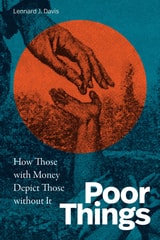
How Those with Money Depict Those without ItLennard J. Davis
Duke University Press, 2024

Popular History and the Literary Marketplace, 1840–1920
Gregory M. Pfitzer
University of Massachusetts Press, 2008
Prior to the mid-nineteenth century, most Americans “heard” rather than “read” national history. They absorbed lessons from the past more readily by attending Patriots' Day orations and anniversary commemorations than by reading expensive, multivolume works of patrician historians. By the 1840s, however, innovations in publishing led to the marketing of inexpensive, mass-produced “popular” histories that had a profound influence on historical literacy and learning in the United States. In this book, Gregory M. Pfitzer charts the rise and fall of this genre, demonstrating how and why it was born, flourished, and then became unpopular over time.
Pfitzer begins by exploring how the emergence of a new literary marketplace in the mid-nineteenth century affected the study of history in America. Publishers of popular works hoped to benefit from economies of scale by selling large numbers of inexpensive books at small profit. They hired authors with substantial literary reputations to make the past accessible to middle-class readers. The ability to write effectively for wide audiences was the only qualification for those who dominated this field. Privileging narration and effusive literary style over dispassionate prose, these artists adapted their favorite fictional and poetic conventions with an ease that suggests the degree to which history was viewed as literary art in the nineteenth century.
Beginning as a small cottage industry, popular histories sold in the hundreds of thousands by the 1890s. In an effort to illuminate the cultural conditions for this boom, Pfitzer focuses on the business of book making and book promotion. He analyzes the subscription sales techniques of book agents as well as the aggressive prepublication advertising campaigns of the publishers, including the pictorial embellishments they employed as marketing devices.
He also examines the reactions of professional historians who rejected the fictionalizing and poetic tendencies of popular history, which they equated with loose and undisciplined scholarship. Pfitzer explains how and why these professionals succeeded in challenging the authority of popular histories, and what the subsequent “unpopularity of popular history” meant for book culture and the study of history in the twentieth century.

Popular Print and Popular Medicine
Almanacs and Health Advice in Early AmericaThomas A. Horrocks
University of Massachusetts Press, 2008
In this innovative study of the relationship between popular print and popular attitudes toward the body, health, and disease in antebellum America, Thomas A. Horrocks focuses our attention on a publication long neglected by scholars—the almanac.
Approaching his subject as both a historian of the book and a historian of medicine, Horrocks contends that the almanac, the most popular secular publication in America from the late eighteenth century to the first quarter of the nineteenth, both shaped and was shaped by early Americans' beliefs and practices pertaining to health and medicine. Analyzing the astrological, therapeutic, and regimen advice offered in American almanacs over two centuries, and comparing it with similar advice offered in other genres of popular print of the period, Horrocks effectively demonstrates that the almanac was a leading source of health information in America prior to the Civil War. He contends that the almanac was an integral component of a complicated, fragmented, semi-vernacular health literature of the period, and that the genre played a leading role in disseminating astrological health advice as well as shaping contemporary and future perceptions of astrology.
In terms of therapeutic and regimen advice, Horrocks asserts that the almanac performed a complementary role, confirming and reinforcing traditional beliefs and practices. By analyzing the almanac as a cultural artifact that represents a time, a place, and a certain set of assumptions and beliefs, he demonstrates that the genre can provide a lens through which scholars may examine early American attitudes and practices concerning their health in particular and American popular culture in general.
Portrait of Us Burning
PoemsSebastián H. Páramo
Northwestern University Press, 2024
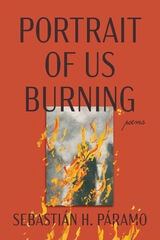
Sebastián H. Páramo renders a semi-autobiographical collection, utilizing self-portraiture and memory to uncover how his Texan, working-class, Mexican American identity shapes his relationship to his half brother and to his family’s burning desire to become American.
Portrait of Us Burning begins with the humble picture of an immigrant American family. This picture starts to disintegrate—and, ultimately, burns—with the need to understand an inciting event that haunts the family throughout the second half of the collection. As the poems gather force and the picture dissolves further, Páramo asks us again and again: What does it mean to burn while becoming a part of a whole?
Portrait of Your Niece
And Other PoemsCarol Hall
University of Minnesota Press, 1959
Portulans
Jason Sommer
University of Chicago Press, 2021
to say? Your eyes, though, scanning upward in their sockets,
do seem to search memory, but for what may be gone already,
gone to where it goes—wherever it came from—gone as can be imagined,
down into things, in past flesh and bark, marrow and pith, and down,
down into molecule, atom, particle, vanishing into theory.
Through this collection, Sommer takes us to the ocean floor, into the basement, out the front door, through multiverses, and in and out of dreams. Along the way, he considers whether art—the beauty of the map—can provide momentary meaning against a backdrop of oblivion. Drawing on history and myth, the voices in these poems consider what can and cannot be known of the self and the other, of our values, and of what we insist has permanence. These are poems of searching. Like ancient cartographers who lent lavish decoration to their maps, the poems in Portulans illuminate possibilities of beauty in each journey.
Post-Modern Aura
The Act of Fiction in an Age of InflationCharles Newman
Northwestern University Press, 1985
In the twenty-first century as an interest in Marxist thought again coincides with the specter of financial inflation, The Post-Modern Aura is timely again.

Post-Postmodernist Fiction and the Rise of Digital Epitexts
Virginia Pignagnoli
The Ohio State University Press, 2023

Postcolonialisms
An Anthology of Cultural Theory and CriticismDesai, Gaurav
Rutgers University Press, 2005
Bringing together thirty-seven essays that have helped define the study of colonial and postcolonial cultures, this expansive and thoughtfully organized anthology offers an up-to-date and in-depth overview of this rapidly developing field.
Canonical articles, most unexcerpted, explore postcolonialism’s key themes—power and knowledge—while articles by contemporary scholars expand the discipline to include discussions of the discovery of the New World, Native American and indigenous identities in Latin America and the Pacific, settler colonies in Africa and Australia, English colonialism in Ireland, and feminism in Nigeria and Egypt. The inclusion of a broad sampling of histories and theories attests to multiple, even competing postcolonialisms, while the skillful organization of the volume provides a useful map of the field in terms of recognizable patterns, shared family resemblances, and common genealogies.
The book is divided into nine sections: Ideologies of Imperialism, The Critique of Colonial Discourse, The Politics of Language and Literary Studies, Nationalisms and Nativisms, Hybrid Identities, Gender and Sexualities, Reading the Subaltern, Comparative (Post)colonialisms, and Globalization and Postcoloniality. Detailed introductions to each section serve to develop key themes, encourage debate, and contextualize the wide-ranging voices that contribute to the topic.
The most cogent and teachable collection of postcolonial texts yet compiled, this anthology is equally suitable for undergraduate students and seasoned scholars.
Postliterary America
From Bagel Shop Jazz to MicropoetriesMaria Damon
University of Iowa Press, 2011
Postmodern/Postwar and After
Rethinking American LiteratureJason Gladstone, Andrew Hoberek, and Daniel Worden
University of Iowa Press, 2016
The first section of essays returns to the category of the “post-modern” and argues for the usefulness of key concepts and themes from postmodernism to the study of contemporary literature, or reevaluates postmodernism in light of recent developments in the field and historical and economic changes in the late twentieth and early twenty-first centuries. These essays take the contemporary abandonments of postmodernism as an occasion to assess the current states of postmodernity. After that, the essays move to address the critical shift away from postmodernism as a description of the present, and toward a new sense of postmodernism as just one category among many that scholars can use to describe the recent past. The final section looks forward and explores the question of what comes after the postwar/postmodern.
Taken together, these essays from leading and emerging scholars on the state of twenty-first-century literary studies provide a number of frameworks for approaching contemporary literature as influenced by, yet distinct from, postmodernism. The result is an indispensable guide that seeks to represent and understand the major overhauling of postwar American literary studies that is currently underway.
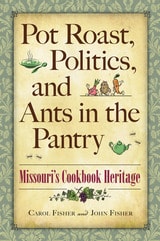
Pot Roast, Politics, and Ants in the Pantry
Missouri's Cookbook HeritageCarol Fisher & John Fisher
University of Missouri Press, 2008
When is a cookbook more than just a cookbook? When it’s a gateway to our culinary heritage. For well over a hundred years, Missouri’s cookbooks have helped readers serve up tasty dishes to the state’s tables, but these publications also document the evolution of our kitchens and households.
Pot Roast,Politics, and Ants in the Pantry, a treasure trove of anecdotes and nuggets of historical information about cookery in the Show-Me State, draws from more than 150 publications to reveal Missouri’s cookbook heritage and to deliver a generous sampling of recipes. Carol Fisher and John Fisher look back to manuscript cookbooks from 1821 St. Louis, then progress through the years and around Missouri before arriving at today’s online recipes. Along the way, they dish out servings of kitchen medicine, household hints, and cookbook literature gleaned from the state’s cache of culinary gems.
From handwritten family recipe collections and mimeographed publications to glossy color editions, the texts the Fishers have obtained from libraries and historical societies as well as their own extensive cookbook collection include such curiosities as the Julia Clark Household Memoranda Book from the William Clark papers, an 1880 production by the Ladies of St. Louis called My Mother’s Cookbook, Mary Foote Henderson’s Practical Cooking and Dinner Giving, and Albert E. Brumley’s All-Day Singin’ and Dinner on the Ground. They tell how various ethnic communities raised money by creating cookbooks, how the state’s Beef Council and Pork Association put recipes on the Internet, and how restaurants like the Blue Owl in Kimmswick and Stephenson’s Apple Farm Restaurant near Kansas City enhanced their reputations with their own cookbooks. Festival cookbooks, company cookbooks, even cookbooks tied to world events—they’re all here in one delightful book.
In this vastly entertaining review, readers will learn where to find recipes for dandelion wine, mock turtle soup (requiring a large calf’s head split open by the butcher), and vinegar pie—as well as the curative properties of potato water, tips for raising chickens in the basement, and even “how to cook a husband.” An extensive bibliography includes information to help readers track down the books discussed and also those on their own wish lists.
Pot Roast, Politics, and Ants in the Pantry: Missouri’s Cookbook Heritage shows how, instead of being just collections of recipes, cookbooks provide history lessons, document changing food ways, and demonstrate the cultural diversity of the state. From Julia Clark’s simple frontier recipes for puddings and preserves to Irma Rombauer’s encyclopedic Joy of Cooking—originally self-published in Missouri—Carol Fisher and John Fisher have laid out a smorgasbord of reading pleasure for cookbook collectors, nostalgia buffs, and gourmands alike.
Potential Stranger
Killarney Clary
University of Chicago Press, 2003
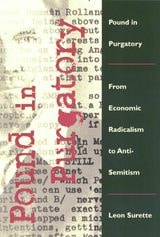
Pound in Purgatory
From Economic Radicalism to Anti-SemitismLeon Surette
University of Illinois Press, 1999
From 1931 to 1945 Pound's poetry took a back seat to his activities as an economic reformer and propagandist for the corporate state. Pound believed he had a simple and practical solution for the economic woes of the world brought on by the Great Depression, and he became increasingly preoccupied with capturing political power for the economic reform he envisioned.
As the world spiraled toward war, Pound's program of economic reform foundered and he gradually succumbed to a paranoid belief in a Jewish conspiracy. Through an incisive analysis of Pound's correspondence and writings, much of it previously unexamined, Surette shows how this belief fostered the virulent anti-Semitism that pervades his work-–both poetry and prose-–from this time forward.
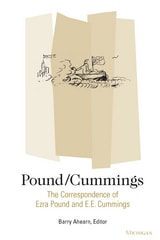
Pound/Cummings
The Correspondence of Ezra Pound and E.E. CummingsBarry Ahearn, Editor
University of Michigan Press, 1996
Throughout the correspondence both poets reveal themselves and their beliefs to a remarkable degree. Pound entrusted to Cummings details of his political outlook in the 1930s and 1940s, including his opinions about Mussolini's Italy. The letters to Cummings also shed new light on the question of Pound's sanity after World War II. Although he was diagnosed as mentally unfit, the letters generally show no evidence of paranoia, only of his characteristic eccentricity.
Similarly, these letters should provoke a reevaluation of Cummings. Critics have treated Cummings's political views as either strictly private matters or merely incidental to his art. The letters, however, show that Cummings's radically conservative political opinions are wholly consistent with his poetics, and raise the question of the relation between Cummings's political principles and his enthusiasm for particular forms (and particular stars) of mass entertainment.
In addition to their political revelations, the letters are steeped in the literary climate--and literary gossip--of the times. Pound comments often and candidly on Cummings's poetry and prose; both Pound and Cummings send light verse to each other. And the poets exchange anecdotes about such figures as Henry James, Wyndham Lewis, T. S. Eliot, Edmund Grosse, Max Eastman, and Aldous Huxley, among other writers.
There is much here to interest and delight both fans and foes of Pound and Cummings. The book will be of primary importance to students and scholars of modern poetry, especially those who emphasize the intersection of literary works and political history.
Barry Ahearn is Associate Professor of English, Tulane University.
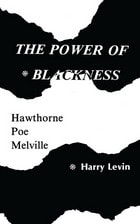
Power Of Blackness
Hawthorne, Poe, MelvilleHarry Levin
Ohio University Press, 1980
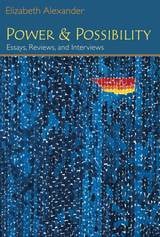
Power and Possibility
Essays, Reviews, and InterviewsElizabeth Alexander
University of Michigan Press, 2007
A volume in the Poets on Poetry series, which collects critical works by contemporary poets, gathering together the articles, interviews, and book reviews by which they have articulated the poetics of a new generation.
Elizabeth Alexander is considered one of the country's most gifted contemporary poets, and the publication of her essays in The Black Interior in 2004 established her as an astute critic and cultural commentator as well. Arnold Rampersad has called Alexander "one of the brightest stars in our literary sky . . . a superb, invaluable commentator on the American scene." In this new collection of her essays, reviews, and interviews, Alexander again focuses on African American artistic production, particularly poetry, and the cultural contexts in which it is created and experienced.
The book's first section, "Black Arts 101," takes up the poetry of Paul Laurence Dunbar, Sterling Brown, Lucille Clifton, Gwendolyn Brooks, and Rita Dove (among others); artist Romare Bearden; dancer Bill T. Jones; and dramatist August Wilson. A second section, "Black Feminist Thinking," provides engaging meditations ranging from "My Grandmother's Hair" and "A Very Short History of Black Women and Food" to essays on the legacies of Toni Cade, Audre Lorde, and June Jordan. The collection's final section, "Talking," includes interviews, a commencement address---"Black Graduation"---and the essay "Africa and the World."
Elizabeth Alexander received a B.A. from Yale University, an M.A. from Boston University, and a Ph.D. in English from the University of Pennsylvania. She has published four books of poems: The Venus Hottentot (1990); Body of Life (1996); Antebellum Dream Book (2001); and, most recently, American Sublime (2005), which was one of three finalists for the Pulitzer Prize. Her play, Diva Studies, was produced at the Yale School of Drama. She is presently Professor of American and African American Studies at Yale University.
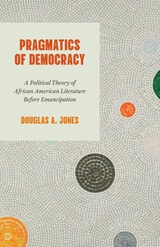
Pragmatics of Democracy
A Political Theory of African American Literature Before EmancipationDouglas A. Jones
University of Chicago Press, 2025
Douglas A. Jones’s Pragmatics of Democracy reads African American literature, from its beginnings through the mid-nineteenth century, to theorize how we have come to regard democracy as the most excellent form of political life. Jones notes that the aims of democracy, especially consent of the governed and equality under the law, can seem like tenets of governance that humans desire instinctively. But human nature does not correlate absolutely to politics. Jones argues that political selfhood is formed by “bodily events.” He proposes a typology of such experiences that dispose persons toward democratic subjectivity: ecstasy, impersonality, violence, respectability, and care.
African American literature before Emancipation reveals the democratic features of these categories that conventional political philosophy ignores or obscures. Given their lives as enslaved persons or the descendants of enslaved persons, early black writers crafted narratives about achieving democratic subjectivity that were missing in other Anglo-American canons. Pragmatics of Democracy discusses the works of well-known figures such as Phillis Wheatley, Harriet E. Wilson, and Frederick Douglass as well as those of more neglected writers such as Richard Allen, Peter Paul Simmons, James McCune Smith, and Frank J. Webb.
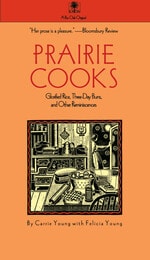
Prairie Cooks
Glorified Rice Three-Day BunsCarrie Young
University of Iowa Press, 1993
Growing up in a Norwegian American community imbued with the customs and foods of the Old Country, Carrie Young recalls how her mother and her neighbors skillfully blended Scandinavian with what they always called the American style of cooking. Young recounts how her mother, Carrine Gafkjen—after homesteading as a single woman in 1904—cooked for a large threshing crew during harvest season. Living and cooking around the clock in a cook car the size of a Pullman kitchen, she delighted the crew with her soda pancakes and her sour cream doughnuts, her fattigman (Poor Man's Cookies) and her fabulous North Dakota Lemon Meringue Pie.
During holidays lutefisk and lefse reigned supreme, but when the Glorified Rice fad swept the country in the thirties women broke new ground with inventive variations. And the short-lived but intensely experienced Three-Day Bun Era (when the buns became so ethereal they were in danger of floating off the plate) kept the Ladies Aid luncheons competitive. Whatever the times, in good years or bad, there was always the solace ofKaffe Tid, the forenoon and afternoon coffee time, when the table was set with smor og brod (butter and bread) and something sweet, like a Whipped Cream Cake or Devil's Food Cake with Rhubarb Sauce.
This book will appeal to those who feel nostalgia for a parent's or grandparent's cooking, to those who have a longing for the heartier fare of times past. The author's daughter, Felicia Young, who has "cooked Scandinavian since she was old enough to hold a lefse stick," has compiled and tested the seventy-two recipes accompanying this joyful memoir.

Preaching and the Rise of the American Novel
Dawn Coleman
The Ohio State University Press, 2013
Presence and Resistance
Postmodernism and Cultural Politics in Contemporary American PerformancePhilip Auslander
University of Michigan Press, 1994
Present Past
Ava Kadishson Schieber
Northwestern University Press, 2016
The focus of Present Past is her life after the Shoah. Rejecting stereotypes of survivors as traumatized or broken, Schieber is stark yet exuberant, formidable yet nuanced. The woman who emerges in Schieber’s Present Past is a multifaceted, heterogeneous figure—poet, artist, and survivor. In it, she plays the passionate observer who dispassionately curates the kaleidoscopic memories of her tumultuous personal and professional life in Belgrade, Prague, Tel Aviv, New York, and Chicago.
Organized into thirteen chapters, each a blend of images, poems, and narrative, this moving new work offers myriad points of entry to readers of these genres, those fascinated in the relationship between the Holocaust and art, as well as readers interested in memory and survivorship.
Pressing the Fight
Print, Propaganda, and the Cold WarGreg Barnhisel
University of Massachusetts Press, 2010
In this volume, scholars from a variety of disciplines explore the myriad ways print was used in the Cold War. Looking at materials ranging from textbooks and cookbooks to art catalogs, newspaper comics, and travel guides, they analyze not only the content of printed matter but also the material circumstances of its production, the people and institutions that disseminated it, and the audiences that consumed it. Among the topics discussed are the infiltration of book publishing by propagandists East and West; the distribution of pro-American printed matter in postwar Japan through libraries, schools, and consulates; and the collaboration of foundations, academia, and the government in the promotion of high culture as evidence of the superiority of Western values.
At the same time, many of the qualities that made print the preferred medium of official propaganda also made it an effective instrument for challenging Cold War orthodoxies at home and abroad. Because printed materials were relatively easy to transport, to copy, and to share, they could just as well be used to bridge differences among people and cultures as to exploit them. They also provided a vehicle for disseminating satire and other expressions of dissent.
In addition to the volume editors, contributors include Ed Brunner, Russell Cobb, Laura Jane Gifford, Patricia Hills, Christian Kanig, Scott Laderman, Amanda Laugesen, Martin Manning, Kristin Matthews, Hiromi Ochi, Amy Reddinger, and James Smith. Together their essays move beyond traditional Cold War narratives to gauge the role of a crucial cultural medium in the ideological battle between the superpowers and their surrogates.
Previously Owned
Nathan McClain
Four Way Books, 2022
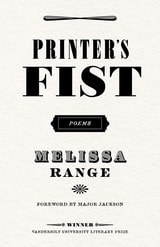
Printer's Fist
PoemsMelissa Range
Vanderbilt University Press, 2026
Melissa Range’s Printer’s Fist, awarded the 2025 Vanderbilt University Literary Prize, is a collection that tells the story of a political movement—its strides and setbacks, its unity and fractures—with a particular emphasis on print culture. Drawing upon more than a decade’s worth of archival research into nineteenth-century antislavery newspapers, pamphlets, broadsides, and more, Range highlights the expansiveness of the movement by focusing not on one, but a chorus of abolitionist voices. Her investment in celebrating Black and women’s histories, in particular, offers an inclusive account of American history, informed not only by thorough research but through a formal, poetic engagement with the past. In exploring how enslaved people’s self-emancipation was a form of resistance that preceded, operated alongside, and intertwined with organized networks of antislavery activists, Printer’s Fist will help facilitate discussions surrounding race, gender, and activism that are grounded in historical fact and emotional truth.
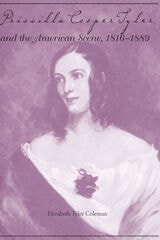
Priscilla Cooper Tyler and the American Scene, 1816-1889
Elizabeth Tyler Coleman
University of Alabama Press, 2006
A study illuminating the cultural intersections of gender, performance, and national identity in nineteenth-century America.
Priscilla Cooper Tyler and the American Scene, 1816–1889 by Elizabeth T. Coleman is a historical and cultural study that brings renewed attention to a remarkable yet often overlooked figure in nineteenth-century American life. The daughter of renowned actor Thomas Cooper, Priscilla Tyler occupied a unique position at the intersection of theatrical culture, literary expression, and political society during a period of profound national transformation.
Tracing Tyler’s life from her early involvement in the stage to her later roles within influential social and political circles, Coleman situates her subject within the broader cultural landscapes of antebellum America, the Civil War, and Reconstruction. Through letters, performances, and social connections, Tyler emerges as an astute observer and participant in the evolving American scene, offering insight into the roles women played in shaping artistic, intellectual, and public life.
The book explores themes of identity, performance, gender, and cultural change, revealing how Tyler’s experiences illuminate the complex interplay between private life and public history. Coleman’s study not only reconstructs the biography of a significant historical figure but also contributes to a deeper understanding of nineteenth-century American theater, literature, and society.
This volume is an important resource for scholars and readers interested in American studies, women’s history, and the cultural history of the nineteenth century.
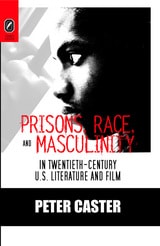
Prisons, Race, and Masculinity in Twentieth-Century U.S. Literature and Film
Peter Caster
The Ohio State University Press, 2008
In Prisons, Race, and Masculinity, Peter Caster demonstrates the centrality of imprisonment in American culture, illustrating how incarceration, an institution inseparable from race, has shaped and continues to shape U.S. history and literature in the starkest expression of what W. E. B. DuBois famously termed “the problem of the color line.”
A prison official in 1888 declared that it was the freeing of slaves that actually created prisons: “we had to establish means for their control. Hence came the penitentiary.” Such rampant racism co ntributed to the criminalization of black masculinity in the cultural imagination, shaping not only the identity of prisoners (collectively and individually) but also America’s national character. Caster analyzes the representations of imprisonment in books, films, and performances, alternating between history and fiction to describe how racism influenced imprisonment during the decline of lynching in the 1930s, the political radicalism in the late 1960s, and the unprecedented prison expansion through the 1980s and 1990s. Offering new interpretations of familiar works by William Faulkner, Eldridge Cleaver, and Norman Mailer, Caster also engages recent films such as American History X, The Hurricane, and The Farm: Life Inside Angola Prison alongside prison history chronicled in the transcripts of the American Correctional Association. This book offers a compelling account of how imprisonment has functioned as racial containment, a matter critical to U.S. history and literary study.
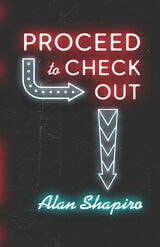
Proceed to Check Out
Alan Shapiro
University of Chicago Press, 2022
Alan Shapiro’s fourteenth collection of poetry, Proceed to Check Out, is a kind of summing up, or stock-taking, by an aging poet, of his precarious place in a world dominated by the ever-accelerating pace of technological innovation, political disruption, personal loss, and racial strife. These poems take on fundamental subjects—like the nature of time and consciousness and how or why we become who we are—but Shapiro presses them into becoming urgent and timely.
Employing idiomatic range and formal variety, Shapiro’s poems move through recurring dreams, the coercions of childhood, and the mysterious connections of mind and matter, pleasure and memory. They meet an abiding need to find empathy and understanding in even the most challenging places—amid disaffection, public discord, and estrangement. His grasp of contemporary life—in all its insidious violence and beauty—is distinct, comprehensive, and profound.
Process
A NovelKay Boyle. Edited and with an Introduction by Sandra Spanier
University of Illinois Press, 2006
Three quarters of a century after the manuscript of Kay Boyle’s first novel disappeared, a carbon copy of it was discovered by Sandra Spanier, the preeminent Boyle authority. Set off by Spanier’s substantial introduction, Process is published here for the first time in paperback.
A classic bildungsroman, Process tells the story of Kerith Day, who is in search of her own identity and place in the world. A keenly critical observer of the dreary industrial landscape and the beaten-down inhabitants of her native Cincinnati, Ohio, Kerith is determined to discover something better. She places her faith in art and politics and sets off for France, where workers and radicals are on the same side.
Producing American Races
Henry James, William Faulkner, Toni MorrisonPatricia McKee
Duke University Press, 1999
McKee provides close readings of six novels—James’s The Wings of the Dove and The Golden Bowl, Faulkner’s The Sound and the Fury and Light in August, and Morrison’s Sula and Jazz—interspersed with excursions into Lacanian and Freudian theory, critical race theory, epistemology, and theories of visuality. In James and Faulkner, she finds, race is represented visually through media that highlight ways of seeing and being seen. Written in the early twentieth century, the novels of James and Faulkner reveal how whiteness depended on visual culture even before film and television became its predominant media. In Morrison, the culture is aural and oral—and often about the absence of the visual. Because Morrison’s African American communities produce identity in nonvisual, even anti-visual terms, McKee argues, they refute not just white representations of black persons as objects but also visual orders of representation that have constructed whites as subjects and blacks as objects.
With a theoretical approach that both complements and transcends current scholarship about race—and especially whiteness—Producing American Races will engage scholars in American literature, critical race theory, African American studies, and cultural studies. It will also be of value to those interested in the novel as a political and aesthetic form.
Producing Local Color
Art Networks in Ethnic ChicagoDiane Grams
University of Chicago Press, 2010
In big cities, major museums and elite galleries tend to dominate our idea of the art world. But beyond the cultural core ruled by these moneyed institutions and their patrons are vibrant, local communities of artists and art lovers operating beneath the high-culture radar. Producing Local Color is a guided tour of three such alternative worlds that thrive in the Chicago neighborhoods of Bronzeville, Pilsen, and Rogers Park.
These three neighborhoods are, respectively, historically African American, predominantly Mexican American, and proudly ethnically mixed. Drawing on her ethnographic research in each place, Diane Grams presents and analyzes the different kinds of networks of interest and support that sustain the making of art outside of the limelight. And she introduces us to the various individuals—from cutting-edge artists to collectors to municipal planners—who work together to develop their communities, honor their history, and enrich the experiences of their neighbors through art. Along with its novel insights into these little examined art worlds, Producing Local Color also provides a thought-provoking account of how urban neighborhoods change and grow.
Producing Mass Entertainment
The Serial Life of the Yellow KidChristina Meyer
The Ohio State University Press, 2019
Producing Mass Entertainment: The Serial Life of the Yellow Kid offers a new take on the emergence of the Yellow Kid comic figure, looking closely at the mass appeal and proliferation of the Yellow Kid across different media. Christina Meyer identifies the aesthetic principles of newspaper comics and examines the social agents—advertising agencies, toy manufacturers, actors, retailers, and more—responsible for the Yellow Kid’s successful career. In unraveling the history of comic characters in capitalist consumer culture, Meyer offers new insights into the creation and dissemination of cultural products, reflecting on modern artistic and merchandising phenomena.
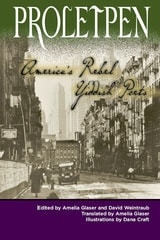
Proletpen
America’s Rebel Yiddish PoetsEdited by Amelia Glaser and David Weintraub
University of Wisconsin Press, 2005
This anthology presents a rich but little-known body of American Yiddish poetry from the 1920s to the early 1950s by thirty-nine poets who wrote from the perspective of the proletarian left. Presented on facing pages in Yiddish and English translation, these one hundred poems are organized thematically under such headings as Songs of the Shop, United in Struggle, Matters of the Heart, The Poet on Poetry, and Wars to End All Wars. One section is devoted to verse depicting the struggles of African Americans, including several poems prompted by the infamous Scottsboro trial of nine African American men falsely accused of rape. Home to many of the writers, New York City is the subject of a varied array of poems. The volume includes an extensive introduction by Dovid Katz, a biographical note about each poet, a bibliography, and a timeline of political, social, and literary events that provide context for the poetry.
Winner of the Fenia and Yaakov Leviant Memorial Prize in Yiddish Studies for Outstanding Translation
A Choice Outstanding Academic Title
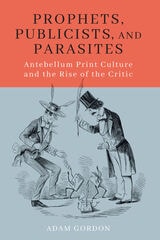
Prophets, Publicists, and Parasites
Antebellum Print Culture and the Rise of the CriticAdam Gordon
University of Massachusetts Press, 2020
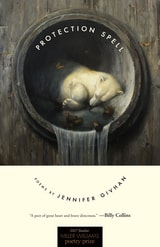
Protection Spell
PoemsJennifer Givhan
University of Arkansas Press, 2017
Finalist, 2017 Miller Williams Poetry Prize, edited by Billy Collins
“A poet of great heart and brave directness.”
—Billy Collins
In Protection Spell Jennifer Givhan explores the guilt, sadness, and freedom of relationships: the sticky love that keeps us hanging on for no reason other than love, the inky place that asks us to continue revising and reimagining, tying ourselves to this life and to each other despite the pain (or perhaps because of it). These poems reassemble safe spaces from the fissures cleaving the speaker’s own biracial home and act as witnesses speaking to the racial iniquity of our broader social landscape as well as to the precarious standpoint of a mother-woman of color whose body lies vulnerable to trauma and abuse. From insistent moments of bravery, a collection of poems arises that asks the impossible, like the childhood chant that palliates suffering by demanding nothing less than magical healing: sana sana colita de rana, si no sanas hoy, sanas mañana (the frog who loses his tail is commanded to grow another). In the end, Givhan’s verse offers a place where healing may begin.
Protocols of Liberty
Communication Innovation and the American RevolutionWilliam B. Warner
University of Chicago Press, 2013

Prowess
A PlayIke Holter
Northwestern University Press, 2019
Avenging Chicagoans form a league for justice in Ike Holter’s superhero-inspired play, Prowess. In this heartfelt yet fantastical homage to Chicago, award-winning playwright Ike Holter introduces us to a quartet of “average” citizens who have been the victims of violence and felt powerless because of it.
In the face of the city’s seemingly intractable ills, the play’s characters join forces to rescue Chicago—and themselves. But how? With heart, wit, and wisdom, Holter explores how one responds to violence. Does a person focus on self-defense and personal survival? Or fight back—with more violence? Pulsating and physical, Prowess is about vulnerability, vigilantism, heroism, and self-knowledge.
Prowess is one of seven plays in Holter’s Rightlynd Saga, all to be published by Northwestern University Press. The other plays in the cycle are Rightlynd, Exit Strategy, Sender, The Wolf at the End of the Block, Red Rex, and Lottery Day.

Psycho Paths
Tracking the Serial Killer Through Contemporary American Film and FictionPhilip L. Simpson
Southern Illinois University Press, 2000
Philip L. Simpson provides an original and broad overview of the evolving serial killer genre in the two media most responsible for its popularity: literature and cinema of the 1980s and 1990s.
The fictional serial killer, with a motiveless, highly individualized modus operandi, is the latest manifestation of the multiple murderers and homicidal maniacs that haunt American literature and, particularly, visual media such as cinema and television. Simpson theorizes that the serial killer genre results from a combination of earlier genre depictions of multiple murderers, inherited Gothic storytelling conventions, and threatening folkloric figures reworked over the years into a contemporary mythology of violence. Updated and repackaged for mass consumption, the Gothic villains, the monsters, the vampires, and the werewolves of the past have evolved into the fictional serial killer, who clearly reflects American cultural anxieties at the start of the twenty-first century.
Citing numerous sources, Simpson argues that serial killers’ recent popularity as genre monsters owes much to their pliability to any number of authorial ideological agendas from both the left and the right ends of the political spectrum. Serial killers in fiction are a kind of debased and traumatized visionary, whose murders privately and publicly re-empower them with a pseudo-divine aura in the contemporary political moment. The current fascination with serial killer narratives can thus be explained as the latest manifestation of the ongoing human fascination with tales of gruesome murders and mythic villains finding a receptive audience in a nation galvanized by the increasingly apocalyptic tension between the extremist philosophies of both the New Right and the anti-New Right.
Faced with a blizzard of works of varying quality dealing with the serial killer, Simpson has ruled out the catalog approach in this study in favor of in-depth an analysis of the best American work in the genre. He has chosen novels and films that have at least some degree of public name-recognition or notoriety, including Red Dragon and The Silence of the Lambs by Thomas Harris, Manhunter directed by Michael Mann, Henry: Portrait of a Serial Killer directed by John McNaughton, Seven directed by David Fincher, Natural Born Killers directed by Oliver Stone, Zombie by Joyce Carol Oates, and American Psycho by Bret Easton Ellis.
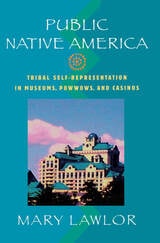
Public Native America
Tribal Self-Representations in Museums, Powwows, and CasinosLawlor, Mary
Rutgers University Press, 2006
The Native American casino and gaming industry has attracted unprecedented American public attention to life on reservations. Other tribal public venues, such as museums and powwows, have also gained in popularity among non-Native audiences and become sites of education and performance.
In PublicNative America, Mary Lawlor explores the process of tribal self-definition that the communities in her study make available to off-reservation audiences. Focusing on architectural and interior designs as well as performance styles, she reveals how a complex and often surprising cultural dynamic is created when Native Americans create lavish displays for the public’s participation and consumption.
Drawing on postcolonial and cultural studies, Lawlor argues that these venues serve as a stage where indigenous communities play out delicate negotiations—on the one hand retaining traditional beliefs and rituals, while on the other, using what they have learned about U.S. politics, corporate culture, tourism, and public relations to advance their economic positions.