Results by title
4030 books match the query 'Language Arts & Disciplines' and 204 start with p
Politics for Everybody
Reading Hannah Arendt in Uncertain TimesNed O'Gorman
University of Chicago Press, 2020
This is an auto-narrated audiobook edition of this book.
In this age of nearly unprecedented partisan rancor, you’d be forgiven for thinking we could all do with a smaller daily dose of politics. In his provocative and sharp book, however, Ned O’Gorman argues just the opposite: Politics for Everybody contends that what we really need to do is engage more deeply with politics, rather than chuck the whole thing out the window. In calling for a purer, more humanistic relationship with politics—one that does justice to the virtues of open, honest exchange—O’Gorman draws on the work of Hannah Arendt (1906–75). As a German-born Jewish thinker who fled the Nazis for the United States, Arendt set out to defend politics from its many detractors along several key lines: the challenge of separating genuine politics from distorted forms; the difficulty of appreciating politics for what it is; the problems of truth and judgment in politics; and the role of persuasion in politics. O’Gorman’s book offers an insightful introduction to Arendt’s ideas for anyone who wants to think more carefully

Politics for People
Finding a Responsible Public VoiceDavid Mathews
University of Illinois Press, 1999
Politics of Writing Studies
Reinventing Our Universities from BelowRobert Samuels
Utah State University Press, 2017
A friendly critique of the field, The Politics of Writing Studies examines a set of recent pivotal texts in composition to show how writing scholarship, in an effort to improve disciplinary prestige and garner institutional resources, inadvertently reproduces structures of inequality within American higher education. Not only does this enable the exploitation of contingent faculty, but it also puts writing studies—a field that inherently challenges many institutional hierarchies—in a debased institutional position and at odds with itself.
Instead of aligning with the dominant paradigm of research universities, where research is privileged over teaching, theory over practice, the sciences over the humanities, and graduate education over undergraduate, writing studies should conceive itself in terms more often associated with labor. By identifying more profoundly as workers, as a collective in solidarity with contingent faculty, writing professionals can achieve solutions to the material problems that the field, in its best moments, wants to address. Ultimately, the change compositionists want to see in the university will not come from high theory or the social science research agenda; it must come from below.
Offering new insight into a complex issue, The Politics of Writing Studies will be of great interest to writing studies professionals, university administrators, and anyone interested in the political economy of education and the reform of institutions of higher education in America.
Politics, Language, and Thought
The Somali ExperienceDavid D. Laitin
University of Chicago Press, 1977
Twelve years after independence, a military government was able to settle the acrimonious controversy by announcing that Somali would be the official language and Latin the basic script. It was hoped that this choice would foster political equality and strengthen the national culture. Politics, Language, and Thought is an exploration of how language and politics interrelate in the Somali Republic. Using both historical and experimental evidence, David D. Laitin demonstrates that the choice of an official language may significantly affect the course of a country's political development.
Part I of Laitin's study is an attempt to explain why the parliamentary government was incapable of reaching agreement on a national script and to assess the social and political consequences of the years of nondecision. Laitin shows how the imposition of nonindigenous languages produced inequalities which eroded the country's natural social basis of democracy.
Part 2 attempts to relate language to political thought and political culture. Analyzing interviews and role-playing sessions among Somali bilingual students, Laitin demonstrates that the impact of certain political concepts is quite different when expressed in different languages. He concludes that the implications of choosing a language are far more complex than previously thought, because to change the language of a people is to change the ways they think and act politically.
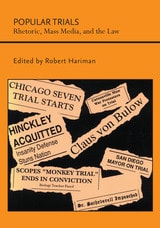
Popular Trials
Rhetoric, Mass Media, and the LawRobert Hariman
University of Alabama Press, 1993
Examining how landmark trials become public dramas that shape law, culture, and collective memory.
Contemporary scholarship illustrates the law’s increasingly powerful role in American life; legal education, in turn, has focused on the problems and techniques of communication. This book addresses these interests through critical study of eight popular trials: the 17th-century trial of Dr. Henry Sacheverell, and the 20th-century trials of Scopes, the Rosenbergs, the Chicago Seven, the Catonsville Nine, John Hinckley, Claus von Bulow, and San Diego Mayor Larry Hedgecock. Such trials spark major public debates, become symbols of public life, and legitimize particular beliefs and institutions. Despite high visibility and drama, however, the popular trial has not received sufficient study as persuasive event. Lying at the intersection of the institutional practices of law and the mass media, the popular trial has confounded study according to the conventional assumptions of scholarship in both law and communication studies.
This volume defines popular trials as a genre of public communication, a genre that includes trials unusually prominent within public discourse. Further, popular trials are often characterize by special media presentations through televised coverage of the trial itself and news analysis, intense audience identification with the principal actors, and political and social consequences independent of the legal action. The essays in this volume stress the rhetorical functions of popular trials. Contributors in addition to the editor include Lawrance M. Bernabo, Barry Brummett, Celeste Michelle Condit, Juliet Dee, Susan J. Drucker, J. Justin Gustainis, Janice Platt Hunold, William Lewis, John Louis Lucaites, and Larry A. Williamson.

Porcupine, Picayune, & Post
How Newspapers Get Their NamesJim Bernhard
University of Missouri Press, 2007
Why a Gazette? When one stops to think about it, Times or News is easy to understand, but why do some newspapers have strange names such as Jimplecute or Bazoo? And not to be picayune, but why Picayune?
Word sleuth Jim Bernhard stopped to consider such questions and began a quest that resulted in the only book-length account of the history of newspaper titles. Cataloging names from the most common to the most bizarre, Porcupine, Picayune, & Post explores the history and etymology of newspapers’ names—names that, by their very peculiarity, cry out for explanation.
Bernhard focuses on printed general-interest English-language dailies and weeklies, from the Choteau (Montana) Acantha to the Moab (Utah) Zephyr, with everything in between—including the Gondolier of Venice, Florida, and the Iconoclast of Crawford, Texas. He explains why there are more Heralds, Journals, Posts, and Tribunes than you can shake a typestick at. He also goes beyond America’s borders to consider such oddities as the Banbury Cake in England and the Gawler Bunyip in Australia.
As Bernhard shows, the reasons for newspaper names vary: sometimes their origins are political or historical, sometimes personal or simply whimsical. Many names have lost their original purposes over time but were chosen with care to symbolize a philosophy or mission or else were created by word association with the paper’s location or community role.
This book is bursting with little-known facts that will delight anyone who picks up a daily paper: how the Oil City Derrick in Pennsylvania got its name from a seventeenth-century English hangman, why a Londoner printed a newspaper on calico and named it the Handkerchief, and what meaning lurks behind the Unterrified Democrat of Linn, Missouri. There’s even a chapter on noteworthy fictional newspapers, from Superman’s Daily Planet to Lake Wobegon’s Herald-Star.
With the naming of newspapers fast becoming a lost art, Porcupine, Picayune, & Post tells what’s behind the banners we see each day but probably never stop to think about. Thanks to Bernhard, we may never see them in the same way again.
Possessive Descriptions
Chris Barker
CSLI, 1995
Post-Digital Rhetoric and the New Aesthetic
Justin Hodgson
The Ohio State University Press, 2019
Post-Digital Rhetoric and the New Aesthetic takes stock of these reconfigurations and their implications for rhetorical studies by taking up the New Aesthetic—a movement introduced by artist/digital futurist James Bridle that was meant to capture something of a digital way of seeing by identifying aesthetic values that could not exist without computational and digital technologies. Bringing together work in rhetoric, art, and digital media studies, Hodgson treats the New Aesthetic as a rhetorical ecology rather than simply an aesthetic movement, allowing him to provide operative guides for the knowing, doing, and making of rhetoric in a post-digital culture.
Post-Ethical Society
The Iraq War, Abu Ghraib, and the Moral Failure of the SecularDouglas V. Porpora, Alexander G. Nikolaev, Julia Hagemann May, and Alexander Jenkins
University of Chicago Press, 2013
In this singular examination of the American discourse over war and torture, Douglas V. Porpora, Alexander Nikolaev, Julia Hagemann May, and Alexander Jenkins investigate the opinion pages of American newspapers, television commentary, and online discussion groups to offer the first empirical study of the national conversation about the 2003 invasion of Iraq and the revelations of prisoner abuse at Abu Ghraib a year later. Post-Ethical Society is not just another shot fired in the ongoing culture war between conservatives and liberals, but a pensive and ethically engaged reflection of America’s feelings about itself and our actions as a nation. And while many writers and commentators have opined about our moral place in the world, the vast amount of empirical data amassed in Post-Ethical Society sets it apart—and makes its findings that much more damning.
Post-Process Theory
Beyond the Writing-Process ParadigmEdited by Thomas Kent
Southern Illinois University Press, 1999
Breaking with the still-dominant process tradition in composition studies, post-process theory—or at least the different incarnations of post-process theory discussed by the contributors represented in this collection of original essays—endorses the fundamental idea that no codifiable or generalizable writing process exists or could exist. Post-process theorists hold that the practice of writing cannot be captured by a generalized process or a "big" theory.
Most post-process theorists hold three assumptions about the act of writing: writing is public; writing is interpretive; and writing is situated. The first assumption is the commonsensical claim that writing constitutes a public interchange. By "interpretive act," post-process theorists generally mean something as broad as "making sense of" and not exclusively the ability to move from one code to another. To interpret means more than merely to paraphrase; it means to enter into a relationship of understanding with other language users. And finally, because writing is a public act that requires interpretive interaction with others, writers always write from some position or some place. Writers are never nowhere; they are "situated."
Leading theorists and widely published scholars in the field, contributors are Nancy Blyler, John Clifford, Barbara Couture, Nancy C. DeJoy, Sidney I. Dobrin, Elizabeth Ervin, Helen Ewald, David Foster, Debra Journet, Thomas Kent, Gary A. Olson, Joseph Petraglia, George Pullman, David Russell, and John Schilb.
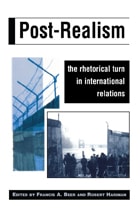
Post-Realism
The Rhetorical Turn in International RelationsFrancis A. Beer
Michigan State University Press, 1996
These essays demonstrate how realism operates rhetorically and point the way toward a richer understanding of world politics.
Post-Truth Rhetoric and Composition
Bruce Mccomiskey
Utah State University Press, 2017
Post-Truth Rhetoric and Composition is a timely exploration of the increasingly widespread and disturbing effect of “post-truth” on public discourse in the United States. Bruce McComiskey analyzes the instances of bullshit, fake news, feigned ethos, hyperbole, and other forms of post-truth rhetoric employed in recent political discourse.
The book frames “post-truth” within rhetorical theory, referring to the classic triad of logos, ethos, and pathos. McComiskey shows that it is the loss of grounding in logos that exposes us to the dangers of post-truth. As logos is the realm of fact, logic, truth, and valid reasoning, Western society faces increased risks—including violence, unchecked libel, and tainted elections—when the value of reason is diminished and audiences allow themselves to be swayed by pathos and ethos. Evaluations of truth are deferred or avoided, and mendacity convincingly masquerades as a valid form of argument.
In a post-truth world, where neither truth nor falsehood has reliable meaning, language becomes purely strategic, without reference to anything other than itself. This scenario has serious consequences not only for our public discourse but also for the study of composition.
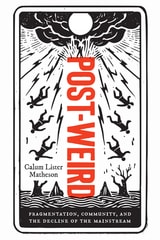
Post-Weird
Fragmentation, Community, and the Decline of the MainstreamCalum Lister Matheson
Rutgers University Press, 2026
An ambitious look at rhetoric and psychosis that explores how communities form when society collapses
American society seems to have fractured. Common touchpoints of authority have receded in recent decades and beliefs that were once taboo are now openly shared, from neo-Nazism to occultism to conspiracy thinking. In this book, Calum Lister Matheson goes beyond the fraying of contemporary American culture to ask how splinter communities form in our current media environment, what keeps them together, and what they build from the ruins of shared language.
In his stirring exploration of how people communicate when old forms of authority and meaning collapse, Matheson examines far-flung groups that have departed the mainstream—Sandy Hook deniers, Appalachian serpent handlers, pro-anorexia bloggers, incels, transvestigators, pseudoscientific reactionaries, and more—and finds unexpected similarities among their many differences. Key among their parallels is the insistence that the symbols shared by each community represent a hidden truth that cannot be questioned or interpreted but is revealed through signs—words, images, videos, and texts. By documenting American fringe cultures, extremism, and the social functions of language, this book rethinks concepts like irony, psychosis, propriety, and what it means to be normal in weird times.

Postcards from Stanland
Journeys in Central AsiaDavid H. Mould
Ohio University Press, 2015
Central Asia has long stood at the crossroads of history. It was the staging ground for the armies of the Mongol Empire, for the nineteenth-century struggle between the Russian and British empires, and for the NATO campaign in Afghanistan. Today, multinationals and nations compete for the oil and gas reserves of the Caspian Sea and for control of the pipelines. Yet “Stanland” is still, to many, a terra incognita, a geographical blank.
Beginning in the mid-1990s, academic and journalist David Mould’s career took him to the region on Fulbright Fellowships and contracts as a media trainer and consultant for UNESCO and USAID, among others. In Postcards from Stanland, he takes readers along with him on his encounters with the people, landscapes, and customs of the diverse countries—Kazakhstan, Kyrgyzstan, Tajikistan, and Uzbekistan—he came to love. He talks with teachers, students, politicians, environmental activists, bloggers, cab drivers, merchants, Peace Corps volunteers, and more.
Until now, few books for a nonspecialist readership have been written on the region, and while Mould brings his own considerable expertise to bear on his account—for example, he is one of the few scholars to have conducted research on post-Soviet media in the region—the book is above all a tapestry of place and a valuable contribution to our understanding of the post-Soviet world.

Postcards, Translators and Esperanto Pioneers
An Alternative History of International CommunicationGuilherme Fians, Bernhard Struck, and Claire Taylor
University of London Press, 2025
The early twentieth century was a time when steamships, international postal services and the telephone were setting the pace of an early wave of globalisation in Europe. In this increasingly international scenario, what role did language play? To address the geopolitical problem of cross-border linguistic (mis)understanding, international auxiliary languages like Esperanto were created. But what happened to a constructed language when it travelled to different places?
This book tackles these questions by exploring the letters, postcards and activities of John Beveridge (1857–1943) and his family. This Scottish clergyman was a proficient Esperanto speaker, translator and co-founder of several Esperanto organisations. His long-standing engagement with the language left a unique archive that reveals how many Esperanto speakers exchanged letters across borders, produced literature for an international readership, organised congresses and used this language as an entry point into modernity and globalisation from their ‘marginal’ positions in the world.
By tracing this language-based form of grassroots internationalism, the book uncovers wide-reaching networks connecting a corner of Scotland with rural settings and villages in Finland, Bulgaria and Brazil. Ultimately, it asks: what do we learn about international communication and globalisation through the lens of Esperanto and postcards? Focusing on a constructed language and communication technologies that preceded the dominance of global English and social media, this book offers an alternative vantage point on the history of international communication.
Postcomposition
Sidney I. Dobrin
Southern Illinois University Press, 2011
Dobrin evaluates the current state of composition studies, underscoring the difference between composition and writing and arguing that the field's focus on the administration of writing students and its historically imposed prohibition on theory greatly limit what can be understood about writing. Instead he envisions a more significant approach to writing, one that questions the field's conservative allegiance to subject and administration and reconsiders writing as spatial and ecological. Using concepts from ecocomposition, spatial theory, network theory, complexity theory, and systems theory, Postcomposition lays the groundwork for a networked theory of writing, and advocates the abandonment of administration as a useful part of the field. He also challenges the usefulness of rhetoric in writing studies, showing how writing exceeds rhetoric.
Postcomposition is a detailed consideration of how posthumanism affects the field's understanding of subjectivity. It also tears at the seams of the "contingent labor problem." As he articulates his own frustrations with the conservatism of composition studies and builds on previous critiques of the discipline, Dobrin stages a courageous-and inevitably polemical-intellectual challenge to the entrenched ideas and assumptions that have defined composition studies.
Postprocess Postmortem
M. Kristopher Lotier
University Press of Colorado, 2021
In Postprocess Postmortem, Kristopher M. Lotier surveys the postprocess era-that-never-was, its end, and its after-lives. Employing cutting-edge digital research tools to track the circulation of texts and shifting scales from the global to the local and back again, he offers a revisionist history of a largely unchronicled past. From one perspective, the history of postprocess might seem to be a history of failure: what could have become The Next Big Thing in composition and writing studies during the 1990s and early 2000s never quite ascended. Today, few writing studies scholars apply the term postprocess to their own research or self-identify with a postprocess movement. And yet, as Lotier demonstrates, numerous core postprocess tenets have attained disciplinary centrality. The result: whether they admit to doing so or not, many contemporary scholars employ a postprocess vocabulary, allowing the ideas underlying this important movement/theory/period/attitude to live on.
Postverbal Behavior
Thomas Wasow
CSLI, 2002

Power Beyond Scrutiny
Media, Justice and AccountabilityJustin Schlosberg
Pluto Press, 2013
Power Beyond Scrutiny uncovers the forces which distort and limit public debate in the media. From the misuse of politicians' expenses to recent phone hacking scandals, establishment corruption has never been more in the headlines. Yet amidst the din there have been seismic silences.
Justin Schlosberg interrogates these silences - why did a plea bargain which allowed Britain’s biggest arms company to escape bribery prosecution go almost entirely unchallenged in television news? Why did journalists routinely endorse the official explanation of how intelligence analyst David Kelly died, whilst all but ignoring mounting evidence which undermined it? Why, in 2010, did broadcasters offer an unchallenged platform to critics of Wikileaks but not its supporters?
These are some of the questions and imbalances that Schlosberg seeks to address as he explains the nature of public debate in the digital age. In doing so he uncovers a range of news blockages that are more than just accidents of a fragmented, chaotic mediascape. They are ultimately ideological forces which ensure that contestability and dissent remain within definable limits.
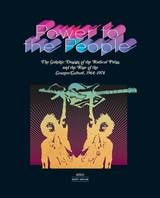
Power to the People
The Graphic Design of the Radical Press and the Rise of the Counter-Culture, 1964-1974Geoff Kaplan
University of Chicago Press, 2013

Powerful Public Relations
American Library Association, 2002
Practical Guide to Syntactic Analysis, 2nd Edition
Georgia M. Green and Jerry L. Morgan
CSLI, 2001

Practical Pedagogy For Library Instructors
17 InnovativeDouglas Cook
Assoc of College & Research Libraries, 2011
Practical Pedagogy for Library Instructors
17 Innovative Strategies to Improve Student LearningDouglas Cook
Assoc of College & Research Libraries, 2011
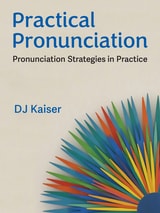
Practical Pronunciation
Pronunciation Strategies in PracticeDJ Kaiser
University of Michigan Press, 2026
CEFR Level: C1
Key Features
- A series of 210 audio recordings provides opportunities for learners to listen for key aspects of pronunciation and practice items from the book on their own.
- Twenty-nine videos provide short explanations and visual demonstrations of many of the strategies included throughout the book.
- Recommendations on ways to integrate digital tools into pronunciation exploration and practice provide learners and teachers with multiple ways to customize pronunciation practice to meet varied professional speaking contexts, academic goals, and personal interests.
- Practice items and exercises incorporate higher-frequency words from the Corpus of Contemporary American English.
- A glossary and several quick-reference charts make it easy to look up or clarify key terms and linguistic terminology or to visually review consonant and vowel charts.
Practical Strategies for Library Managers
American Library Association, 2001
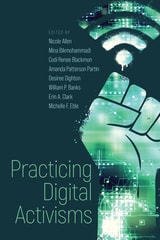
Practicing Digital Activisms
Nicole E. Allen
Utah State University Press, 2027
Practicing Digital Activisms reframes digital activism as embodied, situated work that extends across classrooms, communities, institutions, streets, and ecosystems. It develops frameworks for studying and practicing activism in an era shaped by social media, datafication, and artificial intelligence. At the heart of the collection is a rethinking of digital activism for the twenty-first century that traces activism through networks of people, platforms, infrastructures, and material practices.
Bringing together scholars in rhetoric, writing studies, technical communication, and community engagement, contributors show how activism now unfolds across interconnected media ecologies, through affective and material infrastructures, and at multiple tempos ranging from viral moments to the quieter practices of organizing, care, and persistence. Through case studies of food activism, environmental advocacy, reproductive health, social media movements, and emerging data practices, contributors demonstrate digital activism as a sustained practice of coalition building, circulation, documentation, and persistence. The chapters provide theoretical tools for making infrastructures visible, negotiating ethical responsibility, and designing interventions responsive to local needs and broader struggles for justice.
Attending to the risks that shape contemporary digital life—including surveillance, commodification, algorithmic bias, harassment, platform control, and unequal access—the collection offers language, methods, and examples for understanding how communities build power, sustain movements, and imagine just futures through digital practice. For scholars, teachers, students, organizers, and readers interested in digital rhetoric and social change, Practicing Digital Activisms invites attention to digital participation as a vital site where collective action is imagined, contested, and practiced.
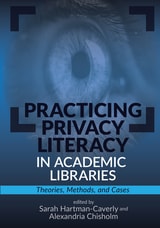
Practicing Privacy Literacy in Academic Libraries
Theories, Methods, and CasesSarah Hartman-Caverly
Assoc of College & Research Libraries, 2023
Practicing Privacy Literacy in Academic Libraries: Theories, Methods, and Cases can help you teach privacy literacy, evolve the privacy practices at your institution, and re-center the individuals behind the data and the ethics behind library work. Divided into four sections:
- What is Privacy Literacy?
- Protecting Privacy
- Educating about Privacy
- Advocating for Privacy

Pragmatic Theory of Rhetoric
Walter H. Beale
Southern Illinois University Press, 1987
Walter H. Beale offersthe most coherent treatment of the aims and modes of discourse to be presented in more than a decade. His development of a semiotic “grammar of motives” that relates the problems of meaning in discourse both to linguistic structure and ways of constructing reality stands as a provocative new theory of rhetoric sharply focused on writing.
He includes a comprehensive treatment of rhetoric, its classes and varieties, modes, and strategies. In addition, he demonstrates the importance of the purpose, substance, and social context of discourse, at a time when scholarly attention has become preoccupied with process. He fortifies and extends the Aristotelian approach to rhetoric and discourse at a time when much theory and pedagogy have yielded to modernist assumptions and methods. And finally, he develops a theoretical framework that illuminates the relationship between rhetoric, the language arts, and the human sciences in general.

Prague English Studies and the Transformation of Philologies
Edited by Martin Procházka and Ondrej Pilný
Karolinum Press, 2012
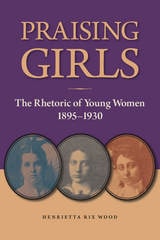
Praising Girls
The Rhetoric of Young Women, 1895-1930Henrietta Rix Wood
Southern Illinois University Press, 2016
The site of the study—Kansas City, Missouri—reflects the diverse rhetorical experiences of girls in cities across the United States at the beginning of the last century. Four case studies examine the writing of privileged white girls at a college preparatory school, Native American girls at an off-reservation boarding school, African American girls at a segregated high school, and working- and middle-class girls at a large whites-only public high school. Wood’s analysis reveals a contemporary concept of epideictic rhetoric that accounts for issues of gender, race, class, and age.
Pre- and Post-Retirement Tips for Librarians
Carol Smallwood
American Library Association, 2012
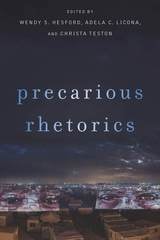
Precarious Rhetorics
Edited by Wendy S. Hesford, Adela C. Licona, and Christa Teston
The Ohio State University Press, 2018
This collection features cross-disciplinary contributions from leading scholars, including the editors of the volume as well as James J. Brown Jr., Gale Coskan-Johnson, Ronald Greene, Lavinia Hirsu, Arabella Lyon, Louis Maraj, Sara McKinnon, Alexandra Schultheis Moore, Kimberlee Pérez, Margaret Price, Amy Shuman, Kristin Swenson, Becca Tarsa, and Belinda Walzer. Chapters emphasize a materialist-rhetorical approach while also drawing on feminist studies, women of color feminisms, affect studies, critical disability studies, critical race and ethnic studies, medical humanities, sexuality studies, queer migration studies, and human rights and humanitarian studies. While theoretically rich, this volume intentionally features chapters that explore precarious rhetorics as they operate in practice—whether in borderlands, politics, public policy, or the quotidian spaces of human activity, such as school, work, social media, and medicine.
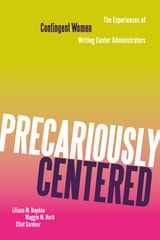
Precariously Centered
The Experiences of Contingent Women Writing Center AdministratorsLiliana M. Naydan
Utah State University Press, 2026
Precariously Centered confronts the troubling intersection of gender and contingency in administrative writing center work—an intersection that has haunted writing centers for decades. Featuring findings from a groundbreaking qualitative study of a diverse group of contingent women writing center administrators, Liliana M. Naydan, Maggie M. Herb, and Clint Gardner demonstrate that gender and its intersections have personal, professional, disciplinary, and pedagogical consequences in writing centers.
This report on interview-based qualitative research documents the experiences of sixteen writing center administrators—how their working lives are often complicated by the intersection of gender, contingency, and other identities. The authors address precarity, identity-based discrimination, extensive and invisible emotional labor, limited resources, lack of institutional support, and barriers to promotion. The words of these administrators come into conversation with scholarship on identity, feminist theory, and the current labor crisis in higher education and reveal challenges ranging from a dearth of resources to discrimination. Their words also reveal dire disciplinary and pedagogical consequences for our institutions and higher education.
Amid increasingly distressing labor conditions in the early twenty-first century, Precariously Centered addresses how writing center professionals—and all academics—can better address contingency, the corporatization of higher education, and the patriarchy. It emphasizes the value of discourse about working conditions, intersectional solidarity, and organizing for labor justice.

Predator Effect
Understanding the Past, Present and Future of Deceptive Academic JournalsSimon Linacre
Against the Grain, LLC, 2022
The Predator Effect concerns predatory publishing — it is the first to chart both the rise and impact of deceptive publishing. The author — a scientific communications expert with 20 years’ experience — looks at how predatory journals had become an accepted part of scholarly publishing, reviewing in turn the history, development and impact of predatory journals. The book also puts their rise in context of wider issues such as Open Access and publication ethics. Other issues it addresses include: defining predatory journals, the history of predatory publishing practices, Beall’s List, authors’ motivations and the future of predatory publishing practices.

Predatory Publishing and Global Scholarly Communications
Monica Berger
Assoc of College & Research Libraries, 2024
To fix what is broken in scholarly communications, academic librarians must act as both teachers and advocates and partner with other stakeholders who have the agency to change how scholarship is produced, assessed, and rewarded. Predatory Publishing and Global Scholarly Communications is a unique and comprehensive exploration of predatory publishing in four parts.
- Background
- Characteristics and Research
- The Geopolitics of Scholarly Publishing
- Responses and Solutions
Predatory Publishing and Global Scholarly Communications gives powerful insight into predatory publishing across the world, inside and outside of the library community, and provides tools for understanding and teaching its impact and contributing to its improvement.

Predicative Constructions
From the Fregean to a Montagovian TreatmentFrank Van Eynde
CSLI, 2015
Preliminaries to Linguistic Phonetics
Peter Ladefoged
University of Chicago Press, 1971
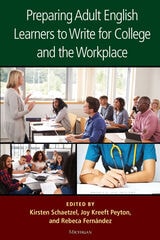
Preparing Adult English Learners to Write for College and the Workplace
Kirsten Schaetzel, Joy Kreeft Peyton, and Rebeca Fernández
University of Michigan Press, 2019
The volume is organized into four parts: Setting the Stage for Teaching Writing, Supporting the Writing Process, Working with Beginning Writers, and Aligning Writing with Accountability Systems. Chapters are written by current (or former) adult educators with experience across levels. Each chapter introduces an approach based on research that can guide writing instruction and provides specific guidance and tools for implementation. Questions open and close the chapters to guide reading and frame future exploration. JoAnn (Jodi) Crandall has written the Epilogue.
Readers will discover ways to move adults into higher education and careers by helping them be college and career ready, to integrate writing into the existing curriculum in adult education programs at all levels, including content classes, and to teach writing according to national and state standards.
Preprints
Their Evolving Role in Science CommunicationIratxe Puebla
Against the Grain, LLC, 2022
Preschool Favorites
35 Storytimes Kids LoveDiane Briggs
American Library Association, 2007
Preservation and Conservation for Libraries and Archives
ReissuedNelly Balloffet
American Library Association, 2009
Preservation
Issues and PlanningPaul Banks
American Library Association, 2000
Preserving Our Heritage
Perspectives from Antiquity to the Digital AgeMichele Valerie Cloonan
American Library Association, 2015
Presidents and Protestors
Political Rhetoric in the 1960sTheodore O. Windt
University of Alabama Press, 1990
The decade of the 1960s was a time of passionate politics and resounding rhetoric. The “resounding rhetoric,” from Kennedy’s celebrated inaugural address, to the outlandish antics of the Yippies, is the focus of this book. The importance of this volume is its consideration of both people in power (presidents) and people out of power (protesters), and its delineation of the different rhetorical bases that each had to work from in participating in the politics of the 1960s.
Presidents and Protesters places rhetorical acts within their specific political contexts, changing the direction of previous rhetorical studies from the sociological to the historical-political. Above all, this is an intellectual history of the 1960s as seen through the rhetoric of the participants, which ultimately shows that the major participants utilized every form of political discourse available and, consequently, exhausted not only themselves but the rhetorical forms as well.
Pressing the Police and Policing the Press
The History and Law of the U.S. Press-Police RelationshipScott Memmel
University of Missouri Press, 2024
What transpired during this troubled time cast a bright light on the contemporary relationship between the press and police in the United States. The relationship between these two fundamental institutions is, however, a long and complicated one, dating back to colonial British North America. In the mid-19th century, (1830s–1850s) both the press and the police began to take their modern forms, and since then have continued to develop, routinely interacting with each other as journalists and police officers often found themselves responding to the same crimes and events. At times, members of both institutions managed to co-exist or even cooperate and made efforts to help one another, while at other times they butted heads to the point of conflict, the professional boundaries between journalists and police officers seemingly blurred.
As both the press and the police have fallen under deep scrutiny in more modern times, the present moment marks what is, perhaps, an opportune time to focus on the political, economic, social, and technological problems they face. In “Pressing the Police and Policing the Press,” Scott Memmel offers the first book-length study of the history and legal landscape of the press-police relationship. Each chapter focuses on interactions between the press and the police during a particular era, introducing relevant societal context and how both institutions evolved and responded to that context. Memmel concludes his study with recommendations on how, going forward, the press and the police might work together to tackle some of the similar issues they face and better serve the public.
Presumptions and Burdens of Proof
An Anthology of Argumentation and the LawEdited by Hans V. Hansen, Fred J. Kauffeld, James B. Freeman, and Lilian Bermejo-Luque
University of Alabama Press, 2019
An anthology of the most important historical sources, classical and modern, on the subjects of presumptions and burdens of proof
In the last fifty years, the study of argumentation has become one of the most exciting intellectual crossroads in the modern academy. Two of the most central concepts of argumentation theory are presumptions and burdens of proof. Their functions have been explicitly recognized in legal theory since the middle ages, but their pervasive presence in all forms of argumentation and in inquiries beyond the law—including politics, science, religion, philosophy, and interpersonal communication—have been the object of study since the nineteenth century.
However, the documents and essays central to any discussion of presumptions and burdens of proof as devices of argumentation are scattered across a variety of remote sources in rhetoric, law, and philosophy. Presumptions and Burdens of Proof: An Anthology of Argumentation and the Law brings together for the first time key texts relating to the history of the theory of presumptions along with contemporary studies that identify and give insight into the issues facing students and scholars today.
The collection’s first half contains historical sources and begins with excerpts from Aristotle’s Topics and goes on to include the locus classicus chapter from Bishop Whately’s crucial Elements of Rhetoric as well as later reactions to Whately’s views. The second half of the collection contains contemporary essays by contributors from the fields of law, philosophy, rhetoric, and argumentation and communication theory. These essays explore contemporary understandings of presumptions and burdens of proof and their role in numerous contexts today. This anthology is the definitive resource on the subject of these crucial rhetorical modes and will be a vital resource to all scholars of communication and rhetoric, as well as legal scholars and practicing jurists.
Presupposition and Anaphora
Emiel Krahmer
CSLI, 1998
Presupposition and Assertion in Dynamic Semantics
A Critical Review of Linguistic Theories of Presupposition and a Dynamic AlternativeDavid I. Beaver
CSLI, 2001
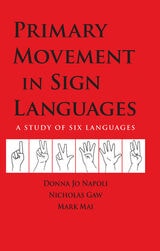
Primary Movement in Sign Languages
A Study of Six LanguagesDonna Jo Napoli
Gallaudet University Press, 2011
Is it possible to identify sign languages by their prosody, that is, the rhythm and stress of sign production, and then determine if they are related to each other or other sign languages? If so, reasoned authors Donna Jo Napoli, Mark Mai, and Nicholas Gaw, perhaps they could offer such identification as a new way to typologize, or categorize sign languages by their structural features. Their new collaboration Primary Movement in Sign Languages: A Study of Six Languages traces the process and findings from this unique investigation.
Resolving on the direction of movement as the prosodic factor to track, they began their research by comparing five sign languages: American Sign Language (ASL), British Sign Language (BSL), Italian Sign Language (LIS), French Sign Language (LSF), and Australian Sign Language (Auslan). They soon discovered that the languages in their study clustered with respect to several characteristics along genetic lines, with BSL and Auslan contrasting with LSF, LIS, and ASL. They learned that sign languages with the same geographic origin evolved differently when relocated, and they isolated differences in each individual sign language. They compared four of these established sign languages with the newly emerging Nicaraguan Sign Language (NSL), with the exception of ASL due to their past close contact, thereby validating their work as the first study to identify sign language relationships without depending on grammar.