Results by title
4917 books match the query 'Philosophy' and 321 start with p
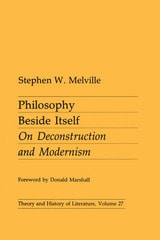
Philosophy Beside Itself
On Deconstruction and ModernismStephen W. MelvilleForeword by Donald Marshall
University of Minnesota Press, 1986
Philosophy Beside Itself was first published in 1986. Minnesota Archive Editions uses digital technology to make long-unavailable books once again accessible, and are published unaltered from the original University of Minnesota Press editions.
The writings of French philosopher Jacques Derrida have been the single most powerful influence on critical theory and practice in the United States over the past decade. But with few exceptions American philosophers have taken little or no interest in Derrida's work, and the task of reception, translation, and commentary has been left to literary critics. As a result, Derrida has appeared as a figure already defined by essentially literary critical activities and interests.
Stephen Melville's aim in Philosophy Beside Itself is to insist upon and clarify the distinctions between philosophy and criticism. He argues that until we grasp Derrida's philosophical project as such, we remain fundamentally unable to see his significance for criticism. In terms derived from Stanley Cavell's writings on modernism, Melville develops a case for Derrida as a modernist philosopher, working at once within and against that tradition and discipline.
Melville first places Derrida in a Hegelian context, the structure of which he explores by examining the work of Heidegger, Lacan, and Bataille. With this foundation, he is able to reappraise the project of deconstructive criticism as developed in Paul de Man's Blindness and Insight and further articulated by other Yale critics. Central to this critique is the ambivalent relationship between deconstructive criticism and Lacanian psychoanalysis. Criticism—radical self-criticism—is a central means through which the difficult facts of human community come to recognition, and Melville argues for criticism as an activity intimately bound to the ways in which we do and do not belong in time and in community. Derrida's achievement has been to find a new and necessary way to assert that the task of philosophy is criticism; the task of literary criticism is to assume the burden of that achievement.
Stephen Melville is an assistant professor of English at Syracuse University, and Donald Marshall is a professor of English at the University of Iowa.
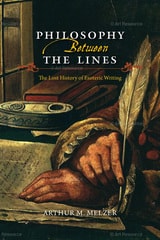
Philosophy Between the Lines
The Lost History of Esoteric WritingArthur M. Melzer
University of Chicago Press, 2014
Arthur M. Melzer serves as our deeply knowledgeable guide in this capacious and engaging history of philosophical esotericism. Walking readers through both an ancient (Plato) and a modern (Machiavelli) esoteric work, he explains what esotericism is—and is not. It relies not on secret codes, but simply on a more intensive use of familiar rhetorical techniques like metaphor, irony, and insinuation. Melzer explores the various motives that led thinkers in different times and places to engage in this strange practice, while also exploring the motives that lead more recent thinkers not only to dislike and avoid this practice but to deny its very existence. In the book’s final section, “A Beginner’s Guide to Esoteric Reading,” Melzer turns to how we might once again cultivate the long-forgotten art of reading esoteric works.
Philosophy Between the Lines is the first comprehensive, book-length study of the history and theoretical basis of philosophical esotericism, and it provides a crucial guide to how many major writings—philosophical, but also theological, political, and literary—were composed prior to the nineteenth century.
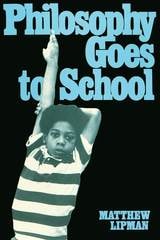
Philosophy Goes To School
Matthew Lipman
Temple University Press, 1988
Ten years ago Philosophy in the Classroom, by Lipman, Sharp, and Oscanyan, hailed the emergence of philosophy as a novel, although in some ways highly traditional, elementary school discipline. In this sequel, Matthew Lipman examines the impact that elementary school philosophy has had, and may yet have, upon the process of education. Going beyond his earlier work to describe the contribution that training in philosophy can make in the teaching of values, he shows the applications of ethics in civics education and the ways in which aesthetics can be incorporated into areas of the curriculum related to the development of creativity.
Making reference to the contemporary educational scene, Lipman compares the K-12 Philosophy for Children curriculum to the many unsatisfactory solutions being offered in our current drive for educational excellence. He addresses the relationship of elementary school philosophy to educational reform in the areas of science, language, social studies, and writing. And he shows how philosophy can be instrumental in the difficult task of teaching values to children while avoiding both ideological indoctrination and mindless relativism.

Philosophy Looks At The Arts
Joseph Margolis
Temple University Press, 1987
Philosophy and Art
Daniel O. Dahlstrom
Catholic University of America Press, 2018
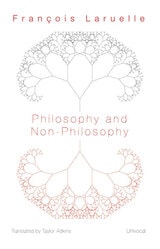
Philosophy and Non-Philosophy
François Laruelle
University of Minnesota Press, 2013
Each generation invents new practices and new writings of philosophy. Ours should have been able to introduce certain mutations that would at least be equivalent with those of cubism, abstract art, and twelve-tone serialism: it has only partially done so. But after all the deconstructions, after Wittgenstein, Heidegger, and Derrida, this demand takes on a different dimension: What do we do with philosophy itself? How do we globally change our relation to this thought, which keeps indicating that it is increasingly conservative and repetitive? These two questions together have prompted what we call “non-philosophy.”
Non-philosophy is not the negation of philosophy. It is the suspension of philosophy’s claim to think the real (Principle of Sufficient Philosophy), and it is the invention of new usages of thought and language that disrupt the rational narrative of the real, which is precisely what every philosophy is. Non-philosophy should rather be understood à la the “non-Euclidean,” namely, as a generalization of the philosophical beyond its traditional limitation by the unitary or “Heraclitean” postulate. From then on, an infinite number of philosophical decisions that are no longer mutually exclusive will correspond with any real phenomenon.
Philosophy and Non-Philosophy is widely considered the first fully explicit elaboration of non-philosophy and one of its most important introductory texts.
Philosophy and Non-Philosophy since Merleau-Ponty
Hugh J. Silverman
Northwestern University Press, 1997
Included in this volume is Silverman's translation of Merleau-Ponty's last course at the Collège de France in 1960-61 and an extensive research bibliography. Originally published in 1988, Philosophy and Non-Philosophy since Merleau-Ponty is a fascinating inquiry into the developments, directions, and ruptures in Continental philosophy since Merleau-Ponty's death in 1961.
Philosophy as Agôn
A Study of Plato’s Gorgias and Related TextsRobert Metcalf
Northwestern University Press, 2018
In Philosophy as Agôn: A Study of Plato's Gorgias and Related Texts, Robert Metcalf offers a fresh interpretation of Plato's dialogues as dramatic texts whose philosophy is not so much a matter of doctrine as it is a dynamic, nondogmatic, and open-ended practice of engaging others in agonistic dialogue.
Metcalf challenges prevailing interpretations according to which the agôn (contest or struggle) between the interlocutors in the dialogues is inessential to Plato's philosophical purpose, or simply a reflection of the cultural background of ancient Greek life. Instead, he argues that Plato understands philosophy as essentially agonistic—involving the adversarial engagement of others in dialogue such that one's integrity is put to the test through this engagement, and where the agôn is structured so as to draw adversaries together in agreement about the matters at issue, though that agreement is always open to future contest.
Based on a careful reading of the Gorgias and related Socratic dialogues, such as Apology and Theaetetus, Metcalf contends that agôn is indispensable to the critique of prevailing opinions, to the transformation of the interlocutor through shame-inducing refutation, and to philosophy as a lifelong training (askêsis) of oneself in relation to others.
Philosophy by Other Means
The Arts in Philosophy and Philosophy in the ArtsRobert B. Pippin
University of Chicago Press, 2021
The arts hold a range of values and ambitions, offering beauty, playfulness, and craftsmanship while deepening our mythologies and enriching the human experience. Some works take on philosophical ambitions, contributing to philosophy in ways that transcend the discipline’s traditional analytic and discursive forms. Pippin’s claim is twofold: criticism properly understood often requires a form of philosophical reflection, and philosophy is impoverished if it is not informed by critical attention to aesthetic objects. In the first part of the book, he examines how philosophers like Kant, Hegel, and Adorno have considered the relationship between art and philosophy. The second part of the book offers an exploration of how individual artworks might be considered forms of philosophical reflection. Pippin demonstrates the importance of practicing philosophical criticism and shows how the arts can provide key insights that are out of reach for philosophy, at least as traditionally understood.
Philosophy en noir
Miroslav Petrícek
Karolinum Press, 2020
Philosophy in Dialogue
Plato's Many DevicesGary Alan Scott
Northwestern University Press, 2007
The essays gathered here each examine vital aspects of Plato’s many methods, considering his dialogues in relation to Thucydides and Homer, narrative strategies and medical practice, images and metaphors. They offer surprising new research into such much-studied works as The Republic as well as revealing views of lesser-known dialogues like the Cratylus and Philebus. With reference to thinkers such as Heidegger, Gadamer, and Sartre, the authors place the Platonic dialogues in an illuminating historical context. Together, their essays should reinvigorate the scholarly examination of the way Plato’s dialogues “work”—and should prompt a reconsideration of how the form of Plato’s philosophical writing bears on the Platonic conception of philosophy.
Philosophy in a Time of Terror
Dialogues with Jurgen Habermas and Jacques DerridaGiovanna Borradori
University of Chicago Press, 2003
Philosophy in the Boudoir
or The Immoral InstructorsMarquis de Sade
University of Chicago Press, 2027
A freshly translated critical edition of the infamous eighteenth-century sadist’s sprawling work of eroticism that endures today as a serious philosophical argument.
The infamous libertine Marquis de Sade (1740–1814), from whose name we derive the word sadism, wove into his pornographic writings many strands of philosophical brilliance whose insights, interspersed between appalling descriptions of sexual deviance, have perplexed readers for centuries. First published in 1795, Philosophy in the Boudoir remains one of the most influential of these works, containing a powerful essay that distills Sade’s most illicit ideas into a compelling argument for personal freedom. In it, Sade experiments with forms drawn from sentimental fiction, pornography, philosophical dialogue, and drama to both satirize his contemporaries and champion the virtues of the heroic libertine—an important intellectual precursor to ideas further developed by Nietzsche, Freud, and others.
This new critical edition is freshly translated into contemporary English and includes a scholarly introduction and extensive notes that illuminate Sade’s myriad allusions and cultural connections, particularly to the larger world of Enlightenment Europe.
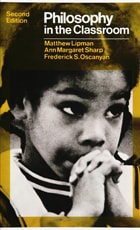
Philosophy in the Classroom
Matthew Lipman, Ann Margaret Sharp and Frederick S. Oscanyan
Temple University Press, 1980
This is a textbook for teachers that demonstrates how philosophical thinking can be used in teaching children. It begins with the assumption that what is taught in schools is not (and should not be) subject matter but rather ways of thinking. The main point is that the classroom should be converted into a community of inquiry, and that one can begin doing that with children. Based on the curriculum that Matt Lipman has developed at the Institute for the Advancement of Philosophy for Children, which he heads, this book describes the curriculum and explains its use. The text is self-contained, however.
This revision is thorough-going and incorporates new chapters, as well as new material in old chapters. Part One focuses on the need of educational change and the importance of philosophical inquiry in developing new approaches. Part Two discusses curriculum and teaching methodology, including teacher behavior conducive to helping children. Part Three deals with developing logic skills and moral judgment. It concludes with a chapter on the sorts of philosophical themes pertinent to ethical inquiry for children: the right and the fair, perfect and right, free will and determinism, change and growth, truth, caring, standards and rules, thinking and thinking for oneself. Education, in this sense, is not a matter of dispensing information; it is the process of assisting in the growth of the whole individual.

Philosophy in the First Person
A ManifestoHelena de Bres
University of Chicago Press, 0
A bold argument and model for how to bring one’s personal voice and experience into philosophical writing.
Contemporary philosophical writing is deeply impersonal: technical, abstract, and stripped of an individual human voice. In contrast, many of the historical philosophers we most admire saw emotion, style, narrative and humor as essential parts of doing philosophy well. What if they were on to something?
Philosophy in the First Person offers a deft and engaging case for the philosophical personal essay, a genre of writing that unites intimate revelation with intellectual depth and literary flair. As a manifesto, the book argues for a return to the more personal forms of philosophy that preceded academic professionalization. As a guide, it provides substantive advice for aspiring personal-philosophical writers, drawing on ideas from creative nonfiction. As a demonstration, the book is itself a set of philosophical personal essays, tracing one philosopher’s sentimental-intellectual journey through a vocation that frustrates and captivates her in equal measure.
Blending memoir, theory, and model, the book offers a roadmap for writing philosophy that’s enlightening as well as moving, gripping, and fun. Along the way, it makes a refreshing argument for reconnecting a philosophical vocation with a fully human way of life.
Philosophy in the Renaissance
An AnthologyPaul Richard Blum
Catholic University of America Press, 2022
Philosophy of Language
Vilém Flusser
University of Minnesota Press, 2016
In 1963 Vilém Flusser presented a series of lectures at the Brazilian Institute of Philosophy (IBF) in São Paulo concerning the philosophy of language. The resulting ten essays would eventually be published in 1965 in the annual magazine of the Brazilian Institute of Technology and Aeronautics (ITA), and published here for the first time in book form.
Flusser prepared each lecture as a response to the dialogs that followed the preceding lecture, thereby expanding and explicating his philosophy of language in an intense dialogical process. Despite the fact that the other side of the dialogue was not recorded, it becomes clear to the reader that the resulting discussions and polemics generated by the lectures progressively and profoundly changed Flusser’s intended trajectory for the course. This kind of philosophy in fieri was in part the result of a group effort between all of those present, and subsequently synthesized by Flusser in every essay. As a result of this experience, Flusser adopted this dialogic method as an integral part of his future work.
Philosophy of New Music
Theodor W. Adorno
University of Minnesota Press, 2019
An indispensable key to Adorno’s influential oeuvre—now in paperback
In 1949, Theodor W. Adorno’s Philosophy of New Music was published, coinciding with the prominent philosopher’s return to a devastated Europe after his exile in the United States. Intensely polemical from its first publication, every aspect of this work was met with extreme reactions, from stark dismissal to outrage. Even Arnold Schoenberg reviled it.
Despite the controversy, Philosophy of New Music became highly regarded and widely read among musicians, scholars, and social philosophers. Marking a major turning point in his musicological philosophy, Adorno located a critique of musical reproduction as internal to composition, rather than a matter of musical performance. Consisting of two distinct essays, “Schoenberg and Progress” and “Stravinsky and Reaction,” Philosophy of New Music poses the musical extremes in which Adorno perceived the struggle for the cultural future of Europe: between human emancipation and barbarism, between the compositional techniques and achievements of Schoenberg and Stravinsky.
In this translation, which is accompanied by an extensive introduction by distinguished translator Robert Hullot-Kentor, Philosophy of New Music emerges as an essential guide to the whole of Adorno's oeuvre.
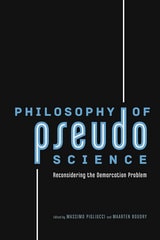
Philosophy of Pseudoscience
Reconsidering the Demarcation ProblemEdited by Massimo Pigliucci and Maarten Boudry
University of Chicago Press, 2013
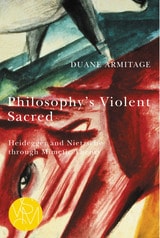
Philosophy's Violent Sacred
Heidegger and Nietzsche through Mimetic TheoryDuane Armitage
Michigan State University Press, 2021
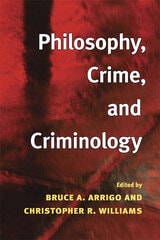
Philosophy, Crime, and Criminology
Edited by Bruce A. Arrigo and Christopher R. Williams
University of Illinois Press, 2006
Charting a provocative and original direction, editors Bruce A. Arrigo and Christopher R. Williams couple theoretically oriented chapters with those centered on application and case study. In doing so, they develop an insightful, sensible, and accessible approach for a philosophical criminology in step with the political and economic challenges of the twenty-first century. Revealing the ways in which philosophical conceits inform prevailing conceptions of crime, Philosophy, Crime, and Criminology is required reading for any serious student or scholar concerned with crime and its impact on society and in our lives.
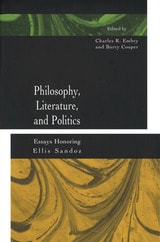
Philosophy, Literature, and Politics
Essays Honoring Ellis SandozEdited by Charles R. Embry & Barry Cooper
University of Missouri Press, 2005
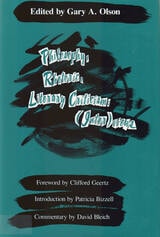
Philosophy, Rhetoric, Literary Criticism
(Inter)viewsGary A. Olson
Southern Illinois University Press, 1994
Susan Wells and Reed Way Dasenbrock provide distinctly divergent assessments of the application of Donald Davidson’ s language theory to rhetoric and composition, and especially to writing pedagogy. Patricia Bizzell and John Trimbur explore how Stanley Fish’ s neopragmatism might be useful both to composition theory and to literacy education. And Joyce Irene Middleton and Tom Fox discuss bell hooks’ s notions of how race and gender affect pedagogy. In two frank and sometimes angry responses, Patricia Harkin and Jasper Neel take J. Hillis Miller to task for seeming to support rhetoric and composition while continuing to maintain the political status quo. Similarly, Susan C. Jarratt and Elizabeth A. Flynn express skepticism about Jane Tompkins’ s vocal support of composition and of radical pedagogy particularly. And Arabella Lyon and C. Jan Swearingen analyze Stephen Toulmin’ s thoughts on argumentation and postmodernism.
Internationally respected anthropologist Clifford Geertz provides a foreword; literacy expert Patricia Bizzell contributes an introduction to the text; and noted reader-response critic David Bleich supplies critical commentary.
This book is a follow-up to the editor’ s (Inter)views: Cross-Disciplinary Perspectives on Rhetoric and Literacy, already a major work of scholarship in the field.
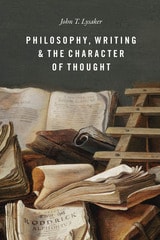
Philosophy, Writing, and the Character of Thought
John T. Lysaker
University of Chicago Press, 2018
Philosophy’s relation to the act of writing is John T. Lysaker’s main concern in Philosophy, Writing, and the Character of Thought. Whether in Plato, Montaigne, Nietzsche, Wittgenstein, or Derrida, philosophy has come in many forms, and those forms—the concrete shape philosophizing takes in writing—matter. Much more than mere adornment, the style in which a given philosopher writes is often of crucial importance to the point he or she is making, part and parcel of the philosophy itself.
Considering how writing influences philosophy, Lysaker explores genres like aphorism, dialogue, and essay, as well as logical-rhetorical operations like the example, irony, and quotation. At the same time, he shows us the effects of these rhetorical devices through his own literary experimentation. In dialogue with such authors as Benjamin, Cavell, Emerson, and Lukács, he aims to revitalize philosophical writing, arguing that philosophy cannot fulfill its intellectual and cultural promise if it keeps to professional articles and academic prose. Instead, philosophy must embrace writing as an essential, creative activity, and deliberately reform how it approaches its subject matter, readership, and the evolving social practices of reading and reflection.
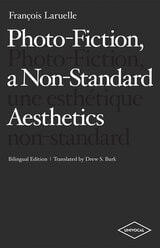
Photo-Fiction, a Non-Standard Aesthetics
François Laruelle
University of Minnesota Press, 2012
Twenty years after cultivating a new orientation for aesthetics via the concept of non-photography, François Laruelle returns, having further developed his notion of a non-standard aesthetics. Published for the first time in a bilingual edition, Photo-Fiction, a Non-Standard Aesthetics expounds on Laruelle’s current explorations into a photographic thinking as an alternative to the worn-out notions of aesthetics based on an assumed domination of philosophy over art. He proposes a new philosophical photo-fictional apparatus, or philo-fiction, that strives for a discursive mimesis of the photographic apparatus and the flash of the Real entailed in its process of image making. “A bit like if an artisan, to use a Socratic example, instead of making a camera based off of diagrams found in manuals, on the contrary had as his or her project the designing of a completely new apparatus of philo-fiction, thus capable of producing not simply photos, but photo-fictions.” One must enter into a space for seeing the vectorial and the imaginary number. Laruelle’s philo-fictions become not art installations, but “theoretical installations” calling for the consideration of the possibility of a non-standard aesthetics being of an equal or superior power to art and philosophy, an aesthetics in-the-last-instance that is itself an inventive and creative act of the most contemporary kind.
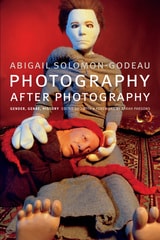
Photography after Photography
Gender, Genre, HistoryAbigail Solomon-Godeau
Duke University Press, 2017

Photography, Cinema, Memory
The Crystal Image of TimeDamian Sutton
University of Minnesota Press, 2009
A philosophical investigation into the differing sensations of time in cinema and photography
Cinema and photography are both intimately associated with time—cinema with time in passing, the photograph with the lost moment. In Photography, Cinema, Memory, Damian Sutton explores time in both media to present a radical new understanding of the photographic image as always coming into being.
Drawing on Gilles Deleuze’s concept of the crystal image to move beyond the tropes of immobility, stasis, and death, Sutton’s analysis reveals the open-endedness of time expressed in the photograph, either as a potential for an abundant future or as a depth of meandering remembrance. He presents an innovative taxonomy of time in the photograph, considering particular representations of time in the work of Nan Goldin, Eugène Atget, Andy Warhol, and others. He contrasts this taxonomy with representations of time in cinema since 1895, offering fresh readings of the films of the Lumière brothers and Mitchell & Kenyon, as well as more recent works, including Eternal Sunshine of the Spotless Mind, Amélie, and A Matter of Life and Death. Throughout this work, Sutton connects and grounds cinema and photography as starting points to comprehend how we come to terms, ultimately, with time itself as pure, immanent change.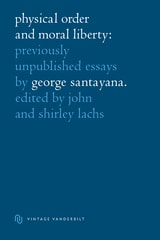
Physical Order and Moral Liberty
Previously Unpublished Essays of George SantayanaGeorge Santayana
Vanderbilt University Press, 1969
Although the essay included are largely philosophical in nature, none is narrowly technical. The general reader should be able to understand most of the pieces, as well as enjoy their literary quality and profit by the insights and wisdom they provide. The philosopher may draw courage from the speculative spirit of the essays and benefit by Santayana's steadfast vision and his sensitivity to distinctions.
For the serious student of Santayana's thought, this volume will prove indispensable. It contains sustained philosophical studies of causation (the only ones by Santayana anywhere), substantial elaborations of Santayana’s ideas on the relation of sensation to thought, and reflections on the nature of freedom and the spiritual life. In addition, Santayana develops here a new theory of “critical instants” and elaborates on his ideas of the nature of consciousness and its relations to time.
Sections on the philosophy of nature and the philosophy of mind are followed by groups of essays on ethics, the philosophy of politics, and the freedom of mind—in which, according to Santayana, the blessing of the good life consists. The book concludes with brief notes on Bergson, Democritus, and Leibniz and a longer essay on the thought of Vaihinger.
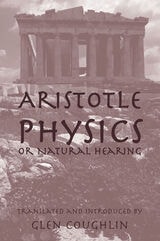
Physics Or Natural Hearing
Glen Aristotle
St. Augustine's Press, 2005
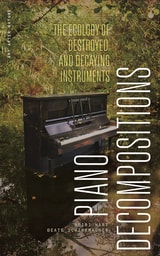
Piano Decompositions
The Ecology of Destroyed and Decaying InstrumentsHeidi Hart
University of Minnesota Press, 2026
Examining musical instrument destruction through an ecological and intermedial lens
Musical instruments are typically seen as objects both used and maintained with ritualistic care. But what happens when they’re tossed from homes in mudslides, burned during ecstatic parties, or waterlogged by pop stars in viral videos—and how do these elemental interactions transform the way we see and play instruments? Piano Decompositions asks what happens when we let go of controlling musical instruments. What kind of meanings start to sound when instruments are moved out of the protected cultural space and engage with their surrounding elements?
Heidi Hart and Beate Schirrmacher trace the history of destroyed and decaying pianos, both sorting them within the realm of artistic violence against instruments and following their return journeys into water, sand, and soil. They parse the artistic vision of Annea Lockwood, whose iconic burning, drowning, and decaying Piano Transplants presented a novel means of drawing attention to the increasing threats of climate change in the 1960s and ’70s. Turning to instruments made from found materials and others played collaboratively with wind and water, they demonstrate how human sound making is entangled in the more-than-human world.
Showing how the piano can transform conversations around the Anthropocene and environmental destruction, Hart and Schirrmacher find the instrument to be a potent creative and ecological force, a medium to connect with environments in an explorative, attentive way. Piano Decompositions unearths new ways to relate our concepts of curiosity, pleasure, and music to the natural world.
Retail e-book files for this title are screen-reader friendly with images accompanied by short alt text and/or extended descriptions.
Pictures, Quotations, and Distinctions
Fourteen Essays in PhenomenologyRobert Sokolowski
Catholic University of America Press, 2022
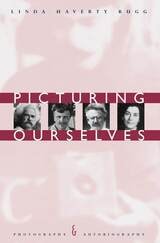
Picturing Ourselves
Photography and AutobiographyLinda Haverty Rugg
University of Chicago Press, 1997
Rugg tracks photography's impact on the formation of self-image through the study of four literary autobiographers concerned with the transformative power of photography. Obsessed with self-image, Mark Twain and August Strindberg both attempted (unsuccessfully) to integrate photographs into their autobiographies. While Twain encouraged photographers, he was wary of fakery and kept a fierce watch on the distribution of his photographic image. Strindberg, believing that photographs had occult power, preferred to photograph himself.
Because of their experiences under National Socialism, Walter Benjamin and Christa Wolf feared the dangerously objectifying power of photographs and omitted them from their autobiographical writings. Yet Benjamin used them in his photographic conception of history, which had its testing ground in his often-ignored Berliner Kindheit um 1900. And Christa Wolf's narrator in Patterns of Childhood attempts to reclaim her childhood from the Nazis by reconstructing mental images of lost family photographs.
Confronted with multiple and conflicting images of themselves, all four of these writers are torn between the knowledge that texts, photographs, and indeed selves are haunted by undecidability and the desire for the returned glance of a single self.
Picturing the Invisible
Exploring Interdisciplinary Synergies from the Arts and the SciencesEdited by Paul Coldwell and Ruth M. Morgan
University College London, 2022
Picturing the Invisible presents different disciplinary approaches to articulating the invisible, that which is not known or not provable. The challenge is how to articulate these concepts, not only to those within a particular academic field but beyond, to other disciplines and society at large. As our understanding of the complexity of the world grows incrementally, so does our realization that issues and problems can rarely be resolved within neat demarcations. Therefore, the authors argue, the importance of finding means of communicating across disciplines and fields must become a priority. This book brings together insights from leading academics from a wide range of disciplines, including art and design, curatorial practice, literature, forensic science, medical science, psychoanalysis and psychotherapy, philosophy, astrophysics, and architecture, who share an interest in exploring how in each discipline we strive to find expression for the invisible or unknown and to draw out and articulate some of the explicit and tacit ways of communicating those concepts that transcend traditional disciplinary boundaries.
Pierre Bourdieu's Political Economy of Being
Ghassan Hage
Duke University Press, 2025
Pierre Macherey and the Case of Literary Production
Edited by Warren Montag and Audrey Wasser
Northwestern University Press, 2022
This collection revisits A Theory of Literary Production (1966) to show how Pierre Macherey’s remarkable—and still provocative—early work can contribute to contemporary discussions about the act of reading and the politics of formal analysis. Across a series of historically and philosophically contextualized readings, the volume’s contributors interrogate Macherey’s work on a range of pressing issues, including the development of a theory of reading and criticism, the relationship between the spoken and the unspoken, the labor of poetic determination and of literature’s resistance to ideological context, the literary relevance of a Spinozist materialism, the process of racial subjectification and the ontology of Blackness, and a theorization of the textual surface. Pierre Macherey and the Case of Literary Production also includes three new texts by Macherey, presented here in English for the first time: his postface to the revised French edition of A Theory of Literary Production; “Reading Althusser,” in which Macherey analyzes the concept of symptomatic reading; and a comprehensive interview in which Macherey reflects on the historical conditions of his early work, the long arc of his career at the intersection of philosophy and literature, and the ongoing importance of Louis Althusser’s thought.
Recent translations of Macherey’s work into English have introduced new readers to the critic’s enduring power and originality. Timely in its questions and teeming with fresh insights, Pierre Macherey and the Case of Literary Production demonstrates the depths to which his work resonates, now more than ever.
Placing Aesthetics
Reflections on the Philosophic TraditionRobert E. Wood
Ohio University Press, 2000
Examining select high points in the speculative tradition from Plato and Aristotle through the Middle Ages and German tradition to Dewey and Heidegger, Placing Aesthetics seeks to locate the aesthetic concern within the larger framework of each thinker’s philosophy.
In Professor Robert Wood’s study, aesthetics is not peripheral but rather central to the speculative tradition and to human existence as such. In Dewey’s terms, aesthetics is “experience in its integrity.” Its personal ground is in “the heart,” which is the dispositional ground formed by genetic, cultural , and personal historical factors by which we are spontaneously moved and, in turn, are inclined to move, both practically and theoretically, in certain directions.
Prepared for use by the student as well as the philosopher, Placing Aesthetics aims to recover the fullness of humanness within a sense of the fullness of encompassing Being. It attempts to overcome the splitting of thought, even in philosophy, into exclusive specializations and the fracturing of life itself into theoretical, practical, and emotive dimensions.
Placing the Academy
Essays on Landscape, Work, and Identityedited by Jennifer Sinor and Rona Kaufman
Utah State University Press, 2007
Twenty-one writers answer the call for literature that addresses who we are by understanding where we are--where, for each of them, being in some way part of academia. In personal essays, they imaginatively delineate and engage the diverse, occasionally unexpected play of place in shaping them, writers and teachers in varied environments, with unique experiences and distinctive world views, and reconfiguring for them conjunctions of identity and setting, here, there, everywhere, and in between.
Contents
I Introduction Writing Place, Jennifer Sinor
II Here
Six Kinds of Rain: Searching for a Place in the Academy, Kathleen Dean Moore and Erin E. Moore
The Work the Landscape Calls Us To, Michael Sowder
Valley Language, Diana Garcia
What I Learned from the Campus Plumber, Charles Bergman
M-I-Crooked Letter-Crooked Letter, Katherine Fischer
On Frogs, Poems, and Teaching at a Rural Community College, Sean W. Henne
III There
Levittown Breeds Anarchists Film at 11:00, Kathryn T. Flannery
Living in a Transformed Desert, Mitsuye Yamada
A More Fortunate Destiny, Jayne Brim Box
Imagined Vietnams, Charles Waugh
IV Everywhere
Teaching on Stolen Ground, Deborah A. Miranda
The Blind Teaching the Blind: The Academic as Naturalist, or Not, Robert Michael Pyle
Where Are You From? Lee Torda
V In Between
Going Away to Think, Scott Slovic
Fronteriza Consciousness: The Site and Language of the Academy and of Life, Norma Elia Cantu
Bones of Summer, Mary Clearman Blew
Singing, Speaking, and Seeing a World, Janice M. Gould
Making Places Work: Felt Sense, Identity, and Teaching, Jeffrey M. Buchanan
VI Coda
Running in Place: The Personal at Work, in Motion, on Campus, and in the Neighborhood, Rona Kaufman
Planet Work
Rethinking Labor and Leisure in the AnthropoceneRyan Hediger
Bucknell University Press, 2023
Planning Matter
Acting with ThingsRobert A. Beauregard
University of Chicago Press, 2015
In the ambitious and provocative Planning Matter, Robert A. Beauregard sets out to offer a new materialist perspective on planning practice that reveals the many ways in which the nonhuman things of the world mediate what planners say and do. Drawing on actor-network theory and science and technology studies, Beauregard lays out a framework that acknowledges the inevitable insufficiency of our representations of reality while also engaging more holistically with the world in all of its diversity—including human and nonhuman actors alike.
Plants Beyond Borders
Edited by Courtney B. Ryan and Alicia Carroll
The Ohio State University Press, 2026
Centers vegetal life as a force that disrupts the borders of race, gender, sexuality, and colonial power.
Although plants are the most abundant life form on earth, the environmental humanities have paid them scant attention until recently, even as new challenges, such as the COVID-19 pandemic, climate change, war, and the global rise of the right have piqued interest in plants as signs of life that challenge the Anthropocene and the logic of extraction. In Plants Beyond Borders, Courtney B. Ryan and Alicia Carroll have marshalled a range of innovative contributions that focus on vegetal borderlands—or spaces in which plant and human life overlap—where vegetal life exceeds and uproots human borders. Containing perspectives from English, landscape architecture, Native American studies, performing arts, and more, Plants Beyond Borders foregrounds Indigenous sovereignty and plant knowledge; explores the shared transmutability of plants and trans, queer, and pregnant bodies; and investigates phytographia, or plant writing, as plants thinking beyond borders. No matter the objective, the essays in this interdisciplinary collection center vegetal life, considering how agentic plants not only rupture myths of settler colonialism, gender, and sexuality but also inscribe themselves and us in the world.
Contributors:
Cinthya Ammerman Muñoz, Alicia Carroll, Gwendolyn Cohen, Isaac Cohen, Xinyue Fu, Patrícia de Nóbrega Gomes, Katie Hogan, Kaley Makino, Melissa Parrish, MacKenzie Patterson, Courtney B. Ryan, John Charles Ryan, Saghar Safaeyan, Jeannette Schollaert, Kathryn Van Wert, Christina Welch
Plants, Animals, People, Aliens
An Aristotelian-Thomist Perspective on Life in the UniverseMarie I. George
Catholic University of America Press, 2026
Plastic Materialities
Politics, Legality, and Metamorphosis in the Work of Catherine MalabouBrenna Bhandar and Jonathan Goldberg-Hiller, editors
Duke University Press, 2015
Contributors. Brenna Bhandar, Silvana Carotenuto, Jonathan Goldberg-Hiller, Jairus Victor Grove, Catherine Kellogg, Catherine Malabou, Renisa Mawani, Fred Moten, Alain Pottage, Michael J. Shapiro, Alberto Toscano
Plato
Eric Voegelin
University of Missouri Press, 2000
Once again available in paperback, Plato is the first half of Eric Voegelin's Plato and Aristotle, the third volume of his five-volume Order and History, which has been hailed throughout the Western world as a monumental accomplishment of modern scholarship.
Plato and Aristophanes
Comedy, Politics, and the Pursuit of a Just LifeMarina Marren
Northwestern University Press, 2022
Marren makes this case by delving into Plato’s Republic, a foundational work of political philosophy. While the Republic straightforwardly condemns the decadence and greed of a tyrant, Plato’s attack on political idealism is both solemn and comedic. In fact, Plato draws on the same comedic stock and tropes as do Aristophanes’s plays. Marren’s book strikes up an innovative conversation between three works by Aristophanes—Assembly Women, Knights, and Birds—and Plato’s philosophy, prompting important questions about individual convictions and one’s personal search for justice. These dialogic works offer critiques of tyranny that are by turns brilliant, scathing, and exuberant, making light of faults and ideals alike. Philosophical comedy exposes despotism in individuals as well as systems of government claiming to be just and good. This critique holds as much bite against contemporary injustices as it did at the time of Aristophanes and Plato.
An ingenious new work by an emerging scholar, Plato and Aristophanes shows that comedy—in tandem with philosophy and politics—is essential to self-examination. And without such examination, there is no hope for a just life.
Plato and Tradition
The Poetic and Cultural Context of PhilosophyPatricia Fagan
Northwestern University Press, 2013
Plato’s dialogues are some of the most widely read texts in Western philosophy, and one would imagine them fully mined for elemental material. Yet, in Plato and Tradition, Patricia Fagan reveals the dialogues to be continuing sources of fresh insight. She recovers from them an underappreciated depth of cultural reference that is crucial to understanding their central philosophical concerns. Through careful readings of six dialogues, Fagan demonstrates that Plato’s presentation of Socrates highlights the centrality of tradition in political, erotic, and philosophic life. Plato embeds Socrates’s arguments and ideas in traditional references that would have been familiar to contemporaries of Socrates or Plato but that today’s reader typically passes over. Fagan’s book unpacks this cultural and literary context for the proper and full understanding of the philosophical argument of the Platonic dialogues. She concludes that, as Socrates demonstrates in word and deed, tradition is essential to successful living. But we must take up tradition with a critical openness to questioning its significance and future. Her original and compelling analyses may change the views of many readers who think themselves already well versed in the dialogues.
Plato the Myth Maker
Luc Brisson
University of Chicago Press, 1999
Gerard Naddaf's substantial introduction shows the originality and importance both of Brisson's method and of Plato's analysis and places it in the context of contemporary debates over the origin and evolution of the oral tradition.
"[Brisson] contrasts muthos with the logos found at the heart of the philosophical reading. [He] does an excellent job of analyzing Plato's use of the two speech forms, and the translator's introduction does considerable service in setting the tone."—Library Journal
Plato through Homer
Poetry and Philosophy in the Cosmological DialoguesZdravko Planinc
University of Missouri Press, 2003
Plato's "Laws"
The Discovery of BeingSeth Benardete
University of Chicago Press, 2001
An insightful commentary on Plato’s Laws, his complex final work.
The Laws was Plato’s last work, his longest, and one of his most difficult. In contrast to the Republic, which presents an abstract ideal, the Laws appears to provide practical guidelines for the establishment and maintenance of political order in the real world. Classicist Seth Benardete offers a rich analysis of each of the twelve books of the Laws, which illuminates Plato’s major themes and arguments concerning theology, the soul, justice, and education.
Most importantly, Benardete shows how music in a broad sense, including drama, epic poetry, and even puppetry, mediates between reason and the city in Plato’s philosophy of law. Benardete also uncovers the work’s concealed ontological dimension, explaining why it is hidden and how it can be brought to light. In establishing the coherence and underlying organization of Plato’s last dialogue, Benardete makes a significant contribution to Platonic studies.
Plato's Critique of Impure Reason
On Goodness and Truth in the RepublicD. C. Schindler
Catholic University of America Press, 2008
Plato's Moral Realism
The Discovery of the Presuppositions of EthicsJohn M. Rist
Catholic University of America Press, 2012