Results by title
4743 books match the query 'Religion' and 206 start with p
Priests
A Calling in CrisisAndrew M. Greeley
University of Chicago Press, 2004
No stranger to controversy himself, Greeley here challenges those analysts and the media who parrot them in placing the blame for recent Church scandals on the mandate of celibacy or a clerical culture that supports homosexuality. Drawing upon reliable national survey samples of priests, Greeley demolishes current stereotypes about the percentage of homosexual priests, the level of personal and professional happiness among priests, the role of celibacy in their lives, and many other issues. His findings are more than surprising: they reveal, among other things, that priests report higher levels of personal and professional satisfaction than doctors, lawyers, or faculty members; that they would overwhelmingly choose to become priests again; and that younger priests are far more conservative than their older brethren.
While the picture Greeley paints should radically reorient the public perception of priests, he does not hesitate to criticize the Church's significant shortcomings. Most priests, for example, do not think the sexual abuse problems are serious, and they do not think that poor preaching or liturgy is a problem, though the laity give them very low marks on their ministerial skills. Priests do not listen to the laity, bishops do not listen to priests, and the Vatican does not listen to any of them. With Greeley's statistical evidence and provocative recommendations for change—including a national "Priest Corps" that would offer young men a limited term of service in the Church—Priests offers a new vision for American Catholics, one based on real problems and solutions rather than on images of a depraved, immature, and frustrated priesthood.
Primacies
Experience, Expression, and the Jewish ImaginationMichael Fishbane
University of Chicago Press, 2025
Primacies begins with the assertion that our earliest preverbal experiences are accompanied by a primary language—a universal expression of tears, cries, and laughter offered long before we learn our distinctive, ordinary languages. For Michael Fishbane, these “primacies” release the raw feelings of our existential condition and catalyze our most powerful literary expressions of sorrow, joy, and fulfillment.
In this book, Fishbane explores how ancient, medieval, and modern literature and poetry express and transform these primal sensations. Building on his theological project begun in Sacred Attunement and Fragile Finitude, Fishbane offers here a radically new lived hermeneutics that seeks to do nothing less than redefine the relationship between experience and language.

Principles of Catholic Theology, Book 1
On the Nature of TheologyThomas Joseph White, OP
Catholic University of America Press, 2023
Principles of Catholic Theology, Book 2
On the Rational Credibility of ChristianityThomas Joseph White, OP
Catholic University of America Press, 2023
Principles of Catholic Theology, Book 3
On God, Trinity, Creation, and ChristThomas Joseph White
Catholic University of America Press, 2024
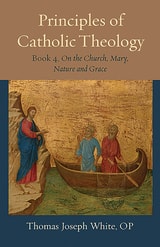
Principles of Catholic Theology, Book 4
On the Church, Mary, Nature and GraceThomas Joseph White
Catholic University of America Press, 2023
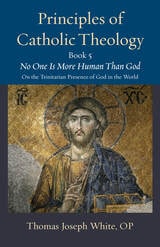
Principles of Catholic Theology, Book 5
No One is More Human Than God: On the Trinitarian Presence of God in the WorldThomas Joseph White
Catholic University of America Press, 2026

Print Passages
Colonial Book Culture in the Dutch East IndiesLisa Kuitert
National University of Singapore Press, 2026
Although printed material has become intertwined with everyday life in the twenty-first century, book culture has not always been ubiquitous. Print Passages researches the history of the arrival of the printed book in Indonesia, and the consequences this new technology brought with it. The introduction of the printing press during the Dutch occupation of the archipelago (then the Dutch East Indies) laid the foundation for a flourishing cultural and intellectual life centered on books and printed materials, especially after 1816. Though printed matter was used to colonize and control the land, it also gave the resistance a voice.
Through an exploration of selected themes, author Lisa Kuitert answers practical questions such as how Dutch language researchers and printers found their way to and within Indonesia, while also diving into the parallel printing culture that was entirely run by Indonesians, often with a Chinese background.
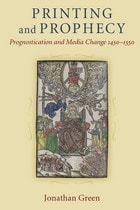
Printing and Prophecy
Prognostication and Media Change 1450-1550Jonathan Green
University of Michigan Press, 2011
Printing and Prophecy: Prognostication and Media Change 1450-1550 examines prognostic traditions and late medieval prophetic texts in the first century of printing and their effect on the new medium of print. The many prophetic and prognostic works that followed Europe's earliest known printed book---not the Gutenberg Bible, but the Sibyl's Prophecy, printed by Gutenberg two years earlier and known today only from a single page---over the next century were perennial best sellers for many printers, and they provide the modern observer with a unique way to study the history and inner workings of the print medium. The very popularity of these works, often published as affordable booklets, raised fears of social unrest. Printers therefore had to meet customer demand while at the same time channeling readers' reactions along approved paths. Authors were packaged---and packaged themselves---in word and image to respond to the tension, while leading figures of early modern culture such as Paracelsus, Martin Luther, and Sebastian Brant used printed prophecies for their own purposes in a rapidly changing society.
Based on a wide reading of many sources, Printing and Prophecy contributes to the study of early modern literature, including how print changed the relationship among authors, readers, and texts. The prophetic and astrological texts the book examines document changes in early modern society that are particularly relevant to German studies and are key texts for understanding the development of science, religion, and popular culture in the early modern period. By combining the methods of cultural studies and book history, this volume brings a new perspective to the study of Gutenberg and later printers.
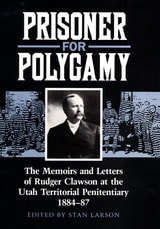
Prisoner for Polygamy
The Memoirs and Letters of Rudger Clawson at the Utah Territorial Penitentiary, 1884-87Edited by Stan Larson
University of Illinois Press, 1993
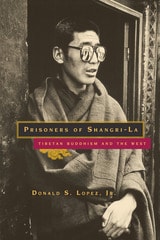
Prisoners of Shangri-La
Tibetan Buddhism and the WestDonald S. Lopez Jr.
University of Chicago Press, 1998
"Lopez lifts the veil on America's romantic vision of Tibet to reveal a country and a spiritual history more complex and less ideal than popular perceptions allow. . . . Lively and engaging, Lopez's book raises important questions about how Eastern religions are often co-opted, assimilated and misunderstood by Western culture."—Publishers Weekly
"Proceeding with care and precision, Lopez reveals the extent to which scholars have behaved like intellectual colonialists. . . . Someone had to burst the bubble of pop Tibetology, and few could have done it as resoundingly as Lopez."—Booklist
"Fascinating. . . [A] provocative exploration. Lopez conveys the full dizziness of the Western encounter with Tibet and Tibetan Buddhism."—Fred Pheil, Tricycle: The Buddhist Review
"A timely and courageous exploration. . . . [Lopez's] book will sharpen the terms of the debate over what the Tibetans and their observers can or should be doing about the place and the idea of Tibet. And that alone is what will give us all back our Shambhala."—Jonathan Spence, Lingua Franca Book Review
"Lopez's most important theme is that we should be wary of the idea . . . that Tibet has what the West lacks, that if we were only to look there we would find the answers to our problems. Lopez's book shows that, on the contrary, when the West has looked at Tibet, all that it has seen is a distorted reflection of itself."—Ben Jackson, Times Higher Education Supplement
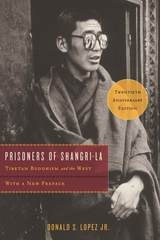
Prisoners of Shangri-La
Tibetan Buddhism and the WestDonald S. Lopez, Jr.
University of Chicago Press, 2018
Upon its original publication, Prisoners of Shangri-La sent shockwaves through the field of Tibetan studies—hailed as a timely, provocative, and courageous critique. Twenty years hence, the situation in Tibet has only grown more troubled and complex—with the unrest of 2008, the demolition of the dwellings of thousands of monks and nuns at Larung Gar in 2016, and the scores of self-immolations committed by Tibetans to protest the Dalai Lama’s exile.
In his new preface to this anniversary edition, Lopez returns to the metaphors of prison and paradise to illuminate the state of Tibetan Buddhism—both in exile and in Tibet—as monks and nuns still seek to find a way home. Prisoners of Shangri-La remains a timely and vital inquiry into Western fantasies of Tibet.
Privately Empowered
Expressing Feminism in Islam in Northern Nigerian FictionShirin Edwin
Northwestern University Press, 2016
Process-Relational Philosophy
An Introduction to Alfred North WhiteheadC. Robert Mesle
Templeton Press, 2008
Process thought is the foundation for studies in many areas of contemporary philosophy, theology, political theory, educational theory, and the religion-science dialogue. It is derived from Alfred North Whitehead's philosophy, known as process theology, which lays a groundwork for integrating evolutionary biology, physics, philosophy of mind, theology, environmental ethics, religious pluralism, education, economics, and more.
In Process-Relational Philosophy, C. Robert Mesle breaks down Whitehead's complex writings, providing a simple but accurate introduction to the vision that underlies much of contemporary process philosophy and theology. In doing so, he points to a "way beyond both reductive materialism and the traps of Cartesian dualism by showing reality as a relational process in which minds arise from bodies, in which freedom and creativity are foundational to process, in which the relational power of persuasion is more basic than the unilateral power of coercion."
Because process-relational philosophy addresses the deep intuitions of a relational world basic to environmental and global thinking, it is being incorporated into undergraduate and graduate courses in philosophy, educational theory and practice, environmental ethics, and science and values, among others. Process-Relational Philosophy: A Basic Introduction makes Whitehead's creative vision accessible to all students and general readers.
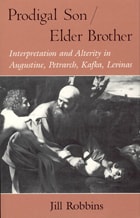
Prodigal Son/Elder Brother
Interpretation and Alterity in Augustine, Petrarch, Kafka, LevinasJill Robbins
University of Chicago Press, 1991
"Through a creative reading of the prodigal son parable, Jill Robbins demonstrates the hermeneutical impasse of the Christian exegete who must and yet cannot incorporate the Old Testament. Having disclosed the aporia at the heart of Christian hermeneutics, she proposes an alternative approach to the Hebrew Bible and new interpretations of Augustine, Petrarch, Kafka, and Levinas. Robbins brilliantly integrates the discourses of biblical texts, literary works, and critical analysis."—Mark C. Taylor, Williams College
Producing Ancient Scripture
Joseph Smith's Translation Projects in the Development of Mormon ChristianityEdited by Michael Hubbard MacKay, Mark Ashurst-McGee, and Brian M. Hauglid
University of Utah Press, 2020
This collaborative volume is the first to study Joseph Smith’s translation projects in their entirety. In this carefully curated collection, experts contribute cutting-edge research and incisive analysis. The chapters explore Smith’s translation projects in focused detail and in broad contexts, as well as in comparison and conversation with one another. Authors approach Smith’s sacred texts historically, textually, linguistically, and literarily to offer a multidisciplinary view. Scrupulous examination of the production and content of Smith’s translations opens new avenues for understanding the foundations of Mormonism, provides insight on aspects of early American religious culture, and helps conceptualize the production and transmission of sacred texts.

Producing the Sacred
AN ESSAY ON PUBLIC RELIGIONRobert Wuthnow
University of Illinois Press, 1994
Wuthnow uses as a guiding assumption the idea that cultural expressions, religious or otherwise, do not simply happen but are produced. He considers the major kinds of organizations that produce public religion--congregations, hierarchies, special interests, academies, and public rituals--showing how these organizational vehicles shape public religion's messages and how specific types of religious organization draw resources from their environments. He also reveals the implicit and unintended ways in which sacredness is expressed in modern society.
A volume in the series Public Expressions of Religion in America
Profaning Paul
Cavan W. Concannon
University of Chicago Press, 2021
The letters of Paul have been used to support and condone a host of evils over the span of more than two millennia: racism, slavery, imperialism, misogyny, and anti-Semitism, to name a few. Despite, or in some cases because of, this history, readers of Paul have felt compelled to reappropriate his letters to fit liberal or radical politics, seeking to set right the evils done in Paul’s name. Starting with the language of excrement, refuse, and waste in Paul’s letters, Profaning Paul looks at how Paul’s “shit” is recycled and reconfigured. It asks why readers, from liberal Christians to academic biblical scholars to political theorists and philosophers, feel compelled to make Paul into a hero, mining his words for wisdom. Following the lead of feminist, queer, and minoritized scholarship, Profaning Paul asks what would happen if we stopped recycling Paul’s writings. By profaning the status of his letters as sacred texts, we might open up new avenues for imagining political figurations to meet our current and coming political, economic, and ecological challenges.
Progress and Religion
An Historical Inquiry (The Works of Christopher Dawson)Christopher Dawson
Catholic University of America Press, 2001
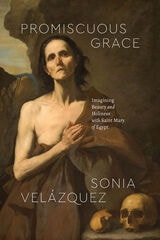
Promiscuous Grace
Imagining Beauty and Holiness with Saint Mary of EgyptSonia Velázquez
University of Chicago Press, 2023
Saint Mary of Egypt has fascinated theologians, poets, and artists since the seventh century. Her story is richly evocative, encompassing sin and sanctity, concupiscence and asceticism, youth and old age. In Promiscuous Grace, Sonia Velázquez thinks with Saint Mary of Egypt about the relationship between beauty and holiness. Drawing on an archive spanning Spanish medieval poetry, Baroque paintings, seventeenth-century hagiography, and Balzac’s Le chef-d’œuvre inconnu, Velázquez argues for the importance of the senses on the surface of religious texts on her way to revealing why the legend of Saint Mary of Egypt still matters today.
Promoting the Saints
Cults and Their Contexts from Late Antiquity until the Early Modern PeriodOttó Gecser
Central European University Press, 2010
Prophecy and Gender in the Hebrew Bible
L. Juliana Claassens
SBL Press, 2021
Multifaceted insights into female life in prophetic contexts
Both prophets and prophetesses shared God’s divine will with the people of Israel, yet the voices of these women were often forgotten due to later prohibitions against women teaching in public. This latest volume of the Bible and Women series focuses on the intersection of gender and prophecy in the Former Prophets (Joshua to 2 Kings) as well as in the Latter Prophets of the Hebrew Bible. Essays examine how women appear in the iconography of the ancient world, the historical background of the phenomenon of prophecy, political and religious resistance by women in the biblical text, and gender symbolism and constructions in prophetic material as well as the metaphorical discourse of God. Contributors Michaela Bauks, Athalya Brenner-Idan, Ora Brison, L. Juliana Claassens, Marta García Fernández, Irmtraud Fischer, Maria Häusl, Rainer Kessler, Nancy C. Lee, Hanne Løland Levinson, Christl M. Maier, Ilse Müllner, Martti Nissinen, Ombretta Pettigiani, Ruth Poser, Benedetta Rossi, Silvia Schroer, and Omer Sergi draw insight into the texts from a range of innovative gender-oriented approaches.
Prophecy in Islam
Philosophy and OrthodoxyFazlur Rahman
University of Chicago Press, 2011
This longstanding and highly regarded volume is the first to explore the doctrine of prophetic revelation, a critical and definitive area of Islamic religious and political thought. In it, the esteemed Islamic scholar Fazlur Rahman traces the inception of this doctrine from ancient Greek texts, its interpretation and elaboration by Muslim philosophers in order to suit their vision of the Prophet, and, finally, the varying degrees of acceptance of these convergent ideas by the Muslim orthodoxy.
The latest edition of this classic text includes a new foreword by Islamic studies expert Michael Sells, confirming Prophecy in Islam as the best source on its subject after more than half a century. This longstanding and highly regarded volume is the first to explore the doctrine of prophetic revelation, a critical and definitive area of Islamic religious and political thought. In it, the esteemed Islamic scholar Fazlur Rahman traces the inception of this doctrine from ancient Greek texts, its interpretation and elaboration by Muslim philosophers in order to suit their vision of the Prophet, and, finally, the varying degrees of acceptance of these convergent ideas by the Muslim orthodoxy.
The latest edition of this classic text includes a new foreword by Islamic studies expert Michael Sells, confirming Prophecy in Islam as the best source on its subject after more than half a century.
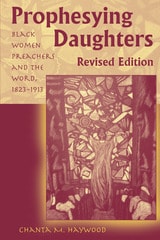
Prophesying Daughters
Black Women Preachers and the Word, 1823-1913Chanta M. Haywood
University of Missouri Press, 2003
In nineteenth-century America, many black women left their homes, their husbands, and their children to spread the Word of God. Descendants of slaves or former “slave girls” themselves, they traveled all over the country, even abroad, preaching to audiences composed of various races, denominations, sexes, and classes, offering their own interpretations of the Bible. When they were denied the pulpit because of their sex, they preached in tents, bush clearings, meeting halls, private homes, and other spaces. They dealt with domestic ideologies that positioned them as subservient in the home, and with racist ideologies that positioned them as naturally inferior to whites. They also faced legalities restricting blacks socially and physically and the socioeconomic reality of often being part of a large body of unskilled laborers.
Jarena Lee, Julia Foote, Maria Stewart, and Frances Gaudet were four women preachers who endured such hardships because of their religious convictions. Often quoting from the scripture, they insisted that they were indeed prophesying daughters whom God called upon to preach. Significantly, many of these women preachers wrote autobiographies in which they present images of assertive, progressive, pious women—steadfast and unmovable in their religious beliefs and bold in voicing their concerns about the moral standing of their race and society at large.
Chanta M. Haywood examines these autobiographies to provide new insight into the nature of prophesying, offering an alternative approach to literature with strong religious imagery. She analyzes how these four women employed rhetorical and political devices in their narratives, using religious discourse to deconstruct race, class, and gender issues of the nineteenth century.
By exploring how religious beliefs become an avenue for creating alternative ideologies, Prophesying Daughters will appeal to students and scholars of African American literature, women’s studies, and religious studies.
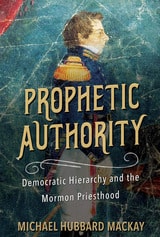
Prophetic Authority
Democratic Hierarchy and the Mormon PriesthoodMichael Hubbard MacKay
University of Illinois Press, 2020
Michael Hubbard MacKay traces the Church of Jesus Christ of Latter-day Saints' claim to religious authority and sets it within the context of its times. Delving into the evolution of the concept of prophetic authority, MacKay shows how the Church emerged as a hierarchical democracy with power diffused among leaders Smith chose. At the same time, Smith's settled place atop the hierarchy granted him an authority that spared early Mormonism the internal conflict that doomed other religious movements. Though Smith faced challenges from other leaders, the nascent Church repeatedly turned to him to decide civic plans and define the order of both the cosmos and the priesthood.
Prophetic Voices
Renewing and Reimagining HaftarahRabbi Barbara AB Symons
Central Conference of American Rabbis, 2023
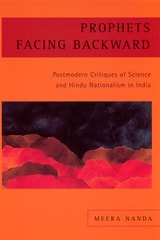
Prophets Facing Backward
Postmodern Critiques of Science and Hindu Nationalism in IndiaNanda, Meera
Rutgers University Press, 2003
The leading voices in science studies have argued that modern science reflects dominant social interests of Western society. Following this logic, postmodern scholars have urged postcolonial societies to develop their own “alternative sciences” as a step towards “mental decolonization”. These ideas have found a warm welcome among Hindu nationalists who came to power in India in the early 1990s. In this passionate and highly original study, Indian-born author Meera Nanda reveals how these well-meaning but ultimately misguided ideas are enabling Hindu ideologues to propagate religious myths in the guise of science and secularism.
At the heart of Hindu supremacist ideology, Nanda argues, lies a postmodernist assumption: that each society has its own norms of reasonableness, logic, rules of evidence, and conception of truth, and that there is no non-arbitrary, culture-independent way to choose among these alternatives. What is being celebrated as “difference” by postmodernists, however, has more often than not been the source of mental bondage and authoritarianism in non-Western cultures. The “Vedic sciences” currently endorsed in Indian schools, colleges, and the mass media promotes the same elements of orthodox Hinduism that have for centuries deprived the vast majority of Indian people of their full humanity.
By denouncing science and secularization, the left was unwittingly contributing to what Nanda calls “reactionary modernism.” In contrast, Nanda points to the Dalit, or untouchable, movement as a true example of an “alternative science” that has embraced reason and modern science to challenge traditional notions of hierarchy.
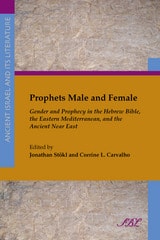
Prophets Male and Female
Gender and Prophecy in the Hebrew Bible, the Eastern Mediterranean, and theJonathan Stökl
SBL Press, 2013
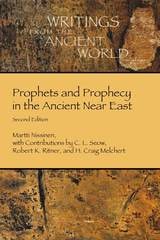
Prophets and Prophecy in the Ancient Near East
Martti Nissinen
SBL Press, 2019
A new, expanded edition of a classic reference tool
This volume of more than 170 documents of prophecy from the ancient Near East brings together a representative sample of written documents from Mesopotamia, the Levant, and Egypt dating to the second and first millennia BCE. Nissinen's collection provides nonspecialist readers clear translations, transliterations, and discussions of oracles reports and collections, quotations of prophetic messages in letters and literature, and texts that reference persons with prophetic titles. This second edition includes thirty-four new texts.
Features:
- Modern, idiomatic, and readable English translations
- Thirty-four new translations
- Contributions of West Semitic, Egyptian, and Luwian sources from C. L. Seow, Robert K. Ritner, and H. Craig Melchert
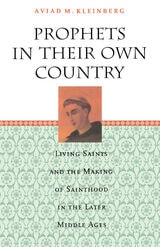
Prophets in Their Own Country
Living Saints and the Making of Sainthood in the Later Middle AgesAviad M. Kleinberg
University of Chicago Press, 1992
"[A] fascinating and sometimes iconoclastic view of saints in the medieval period." —Sandra R. O'Neal, Theological Studies
"[An] important new book. . . . [And] an excellent piece of scholarship." —Diane L. Mockridge, Method & Theory in the Study of Religion
"[Kleinberg's] style is clear and accessible and his observations insightful; the book is a pleasure to read." —Veronica Lawrence, Theological Book Review
"Original and interesting. . . . [Kleinberg] has made a major contribution." —Anne L. Clark, American Historical Review
"Kleinberg's concern is not just with perceptions of sanctity, but, refreshingly, with what actually happened: and he is especially good on the conflict of the two. . . . [This] is not just a book but a way of thought, and one that promises interesting conversations at all levels from the church porch to the tutorial and the academic conference." —Helen Cooper, Times Literary Supplement
Proportionalism and the Natural Law Tradition
Christopher Kaczor
Catholic University of America Press, 2002
In this book, Christopher Kaczor argues against the plausibility of proportionalism and its first proponents, namely Peter Knauer, Joseph Fuchs, Bruno Schüller, Louis Janssens, and Richard McCormick. Examining the genealogy of the movement, he disputes a received history that depicts proportionalism as a recovery of Thomas Aquinas. Instead, contends Kaczor, proportionalism is best seen as the organic successor to the moral manuals of the pre-Vatican II era. Proportionalism arises not from Thomas but rather extends many of the tendencies and presuppositions of the manuals. In particular, it retains their marginalizing of the account of human action as a knowing-willing involving a number of stages not always consciously recognized yet carefully described by Thomas in Summa theologiae, Prima Secundae, 6-17. Kaczor shows that a great deal of the plausibility of proportionalism rests on a fragile foundation that is rapidly eroding, an education in the moral manuals.
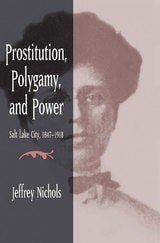
Prostitution, Polygamy, and Power
Salt Lake City, 1847-1918Jeffrey Nichols
University of Illinois Press, 2002
Jeffrey Nichols examines how prostitution became a focal point in the moral contest between Mormons and gentiles and aided in the construction of gender systems, moral standards, and the city's physical and economic landscapes. Gentiles likened polygamy to prostitution and accused polygamous Mormons of violating Christian norms of family structure and sexual behavior. Defending their church and its ideals, Mormons blamed gentiles for introducing the sinful business of prostitution into their honorable city. Nichols traces the interplay of prostitution and reform from the 1890s, when the Church of Jesus Christ of Latter-day Saints began to move away from polygamy, to World War I, when Mormon and gentile moral codes converged at the expense of prostitutes. He also considers how the conflict over polygamy distinguished Salt Lake City from other cities struggling to abolish prostitution in the Progressive Era.

Prostitution, Repentance and Social Welfare in Renaissance Florence
Gillian Jack
University of London Press, 2026
A study of the survival of Sant'Elisabetta delle Convertite, the Florence monastery for repentant prostitutes, during the long Renaissance.
From the fourteenth century, prostitutes in Florence were encouraged to leave their profession and spend their lives in repentance at the monastery of Sant’Elisabetta delle Convertite. Many did over its five hundred years, and the monastery was soon one of the most populous in Florence. As the longest enduring monastery for repentant prostitutes, Sant’Elisabetta is an integral part of the history of nuns and of prostitution in the medieval and early modern periods, and it had an important place in municipal responses to social welfare and civic morality. It is only by uncovering successive governments’ involvement in Sant'Elisabetta that we can fully understand how the city attempted to manage both prostitution and welfare.
This is the first book-length study to put Sant’Elisabetta into its full historical context. It establishes the place of this often-overlooked nunnery in the wider world of medieval penitential piety, renaissance charity, and early modern social welfare, exploring the myriad ways in which the Florentine authorities attempted to stabilize Sant’Elisabetta’s finances and ensure its continued survival. Drawing on diverse archival sources, the book’s long chronological scope offers valuable insights into the broader histories of the relationship between the Florentine state and monastic institutions, public policy, welfare, and women in the long Renaissance.

Protestant Nation
The Fragile Christian Roots of America's GreatnessAlain Besançon
St. Augustine's Press, 2017
Protestant and Roman Catholic Ethics
Prospects for RapprochementJames M. Gustafson
University of Chicago Press, 1978
Protestant--Catholic--Jew
An Essay in American Religious SociologyWill Herberg
University of Chicago Press, 1983
"In Protestant-Catholic-Jew Will Herberg has written the most fascinating essay on the religious sociology of America that has appeared in decades. He has digested all the relevant historical, sociological and other analytical studies, but the product is no mere summary of previous findings. He has made these findings the basis of a new and creative approach to the American scene. It throws as much light on American society as a whole as it does on the peculiarly religious aspects of American life. Mr. Herberg. . . illumines many facets of the American reality, and each chapter presents surprising, and yet very compelling, theses about the religious life of this country. Of all these perhaps the most telling is his thesis that America is not so much a melting pot as three fairly separate melting pots."—Reinhold Niebuhr, New Yorks Times Book Review

Protestantism and Politics in Eastern Europe and Russia
The Communist and Post-Communist ErasSabrina P. Ramet, ed.
Duke University Press, 1993
Based on extensive field research, including interviews with notable figures in the Protestant churches in the region, the essays in this volume address broad topics such as the church's involvment in environmentalism, pacifism, and other dissident movements, as well as issues particular to Russia, Poland, Czechoslovakia, East Germany, (1949–1989), Hungary, Yugoslavia (1945-1991), Bulgaria, and Romania. The final volume in the three-volume work "Christianity Under Stress," Protestantism and Politics in Eastern Europe and Russia will prove invaluable to anyone hoping to understand not only the workings of religion under Communism, but the historical and contemporary interactions of church and state in general.
Contributors. Paul Bock, Lawrence Klippenstein, Paul Mojzes, Earl A. Pope, Joseph Pungur, Sabrina Petra Ramet, Walter Sawatsky, N. Gerald Shenk, Gerd Stricker, Sape A. Zylstra
Proverbs
An Eclectic Edition with Introduction and Textual CommentaryMichael V. Fox
SBL Press, 2015
A new critical text for Proverbs drawing from many manuscripts
This first volume of The Hebrew Bible: A Critical Edition series, features a critical text of Proverbs with extensive text-critical introductions and commentaries. This and future HBCE volumes bring together a scholar’s critical decisions into a single text. construct an eclectic text, drawing from many manuscripts or placing entirely variant texts side by side. A common approach for critical editions of other ancient books, including the New Testament, the eclectic approach and scope used in the HBCE is a first of its kind for the Hebrew Bible.
Features:
- Emendations set in context rather than singly and marginally
- Introduction that sets out the method and purpose of the volume
- Extensive list of abbreviations and sigla
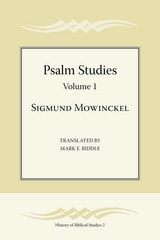
Psalm Studies, Volume 1
Sigmund Mowinckel
SBL Press, 2014
Sigmund Mowinckel is widely recognized as one of the leading forces in Psalms research during the twentieth century. Indeed, the culmination of Mowinckel’s thought and work, The Psalms in Israel’s Worship, continues to play a significant role in Psalms scholarship today. Not as well known are the seminal studies that prepared the ground for Mowinckel’s later work, the six Psalmenstudien that are translated here into English for the first time. In these studies Mowinckel explores with care and in detail such topics as: “'Awen and the Psalms of Individual Lament”; “YHWH’s Enthronement Festival and the Origin of Eschatology”; “Cultic Prophecy and Prophetic Psalms”; “The Technical Terms in the Psalm Superscriptions”; “Blessing and Curse in Israel’s Cult and Psalmody”; and “The Psalmists.” Anyone interested in Psalms study, especially the possible role of the New Year’s enthronement festival within Israel’s cult and its relation to the Psalter, will find much to consider in these classic works.
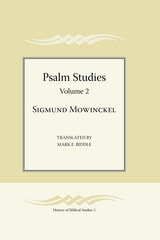
Psalm Studies, Volume 2
Sigmund Mowinckel
SBL Press, 2014
Sigmund Mowinckel is widely recognized as one of the leading forces in Psalms research during the twentieth century. Indeed, the culmination of Mowinckel’s thought and work, The Psalms in Israel’s Worship, continues to play a significant role in Psalms scholarship today. Not as well known are the seminal studies that prepared the ground for Mowinckel’s later work, the six Psalmenstudien that are translated here into English for the first time. In these studies Mowinckel explores with care and in detail such topics as: “'Awen and the Psalms of Individual Lament”; “YHWH’s Enthronement Festival and the Origin of Eschatology”; “Cultic Prophecy and Prophetic Psalms”; “The Technical Terms in the Psalm Superscriptions”; “Blessing and Curse in Israel’s Cult and Psalmody”; and “The Psalmists.” Anyone interested in Psalms study, especially the possible role of the New Year’s enthronement festival within Israel’s cult and its relation to the Psalter, will find much to consider in these classic works.
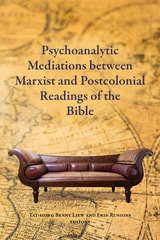
Psychoanalytic Mediations between Marxist and Postcolonial Reading of the Bible
Tat-siong Benny Liew
SBL Press, 2016
The first sustained conversation between Marxism, postcolonialism, and psychoanalysis in biblical studies
This volume pursues critical readings of the Bible that put psychoanalysis into conversation with Marxist and postcolonial criticism. In these essays psychoanalysis provides a way to mediate between Marxism's materialist groundings and postcolonialism's resistance against empire. The essays in the volume illuminate the way empire has shaped the biblical text by looking at the biblical texts' silences, ruptures, oversights, over-emphases, and inexplicable elements. These details are read as symptoms of a set of oppressive material relations that shaped and continue to haunt the text in the ascendancy of the text in the name of the West.
Features:
- Essays and responses from multiple perspectives and geographical locations, including Africa, Australia, Oceania, Latin America, and North America
- Psychoanalysis that considers how the traumas of colonialism manifest both materially and psychically
- Close readings of biblical texts
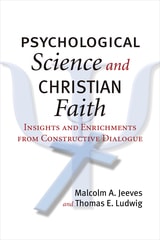
Psychological Science and Christian Faith
Insights and Enrichments from Constructive DialogueMalcolm A. Jeeves
Templeton Press, 2018
Because Christianity and psychology deal with different levels of truth and speak vastly different languages, efforts to unify them often create more problems than they solve. What is needed is a better way to think about the relationship—an approach that does justice to the emerging insights from psychological science and biblical scholarship and that can enrich our understanding of both. In this volume, two accomplished psychologists show how this complementary dialogue can unfold, giving us a broader, deeper understanding of ourselves, our relationships, and our place in the cosmos.
.

Psychopolitics
Conversations with Trevor Cribben MerrillJean-Michel Oughourlian
Michigan State University Press, 2012
For thousands of years, political leaders have unified communities by aligning them against common enemies. However, today more than ever, the search for “common” enemies results in anything but unanimity. Scapegoats like Saddam Hussein, for example, led to a stark polarization in the United States. Renowned neuropsychiatrist and psychologist Jean-Michel Oughourlian proposes that the only authentic enemy is the one responsible for both everyday frustrations and global dangers, such as climate change—ourselves. Oughourlian, who pioneered an “interdividual” psychology with René Girard, reveals how all people are bound together in a dynamic, contingent process of imitation, and shows that the same patterns of irrational mimetic desire that bring individuals together and push them apart also explain the behavior of nations.

Psychotherapy As Religion
The Civil Divine In AmericaWilliam M. Epstein
University of Nevada Press, 2006
A provocative look at America on the couch.In Psychotherapy as Religion, William Epstein sets out to debunk claims that psychotherapy provides successful clinical treatment for a wide range of personal and social problems. He argues that the practice is not a science at all but rather the civil religion of America, reflecting the principles of radical self-invention and self-reliance deeply embedded in the psyche of the nation. Epstein begins by analyzing a number of clinical studies conducted over the past two decades that purport to establish the effectiveness of psychotherapeutic treatments. He finds that each study violates in some way the standard criteria of scientific credibility and that the field has completely failed to establish objective procedures and measurements to assess clinical outcomes. Epstein exposes psychotherapy’s deep roots in the religious and intellectual movements of the early nineteenth century by demonstrating striking parallels between various types of therapy and such popular practices as Christian Science and spiritualism. Psychotherapy has taken root in our culture because it so effectively reflects our national faith in individual responsibility for social and personal problems. It thrives as the foundation of American social welfare policy, blaming deviance and misery on deficiencies of character rather than on the imperfections of society and ignoring the influence of unequal and deficient social conditions while requiring miscreants to undergo the moral reeducation that psychotherapy represents. This is a provocative, brilliantly argued look at America on the couch. Psychotherapy as Religion is essential reading for anyone interested in the history and current state of mental health.
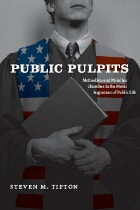
Public Pulpits
Methodists and Mainline Churches in the Moral Argument of Public LifeSteven M. Tipton
University of Chicago Press, 2008
Documenting a wide range of reactions to two radically different events—the invasion of Iraq and the creation of the faith-based initiatives program—Tipton charts the new terrain of religious and moral argument under the Bush administration from Pat Robertson to Jim Wallis. He then turns to the case of the United Methodist Church, of which President Bush is a member, to uncover the twentieth-century history of their political advocacy, culminating in current threats to split the Church between liberal peace-and-justice activists and crusaders for evangelical renewal. Public Pulpits balances the firsthand drama of this internal account with a meditative exploration of the wider social impact that mainline churches have had in a time of diverging fortunes and diminished dreams of progress.
An eminently fair-minded and ethically astute analysis of how churches keep moral issues alive in politics, Public Pulpits delves deep into mainline Protestant efforts to enlarge civic conscience and cast clearer light on the commonweal and offers a masterly overview of public religion in America.
Public Religions in the Modern World
José Casanova
University of Chicago Press, 1994
During the 1980s, religious traditions around the world, from Islamic fundamentalism to Catholic liberation theology, began making their way, often forcefully, out of the private sphere and into public life, causing the "deprivatization" of religion in contemporary life. No longer content merely to administer pastoral care to individual souls, religious institutions are challenging dominant political and social forces, raising questions about the claims of entities such as nations and markets to be "value neutral", and straining the traditional connections of private and public morality.
Casanova looks at five cases from two religious traditions (Catholicism and Protestantism) in four countries (Spain, Poland, Brazil, and the United States). These cases challenge postwar—and indeed post-Enlightenment—assumptions about the role of modernity and secularization in religious movements throughout the world.
This book expands our understanding of the increasingly significant role religion plays in the ongoing construction of the modern world.
Pulpits of the Lost Cause
The Faith and Politics of Former Confederate Chaplains during ReconstructionSteve Longenecker
University of Alabama Press, 2023
A comparison of the faith and politics of former Confederate chaplains with intriguing insights about the evolution of their postwar beliefs and the Lost Cause
Pulpits of the Lost Cause: The Faith and Politics of Former Confederate Chaplains during Reconstruction is the first in-depth study of former chaplains that juxtaposes their religion and politics, thereby revealing important insights about the Lost Cause movement. Steve Longenecker demonstrates that while some former chaplains vigorously defended the Lost Cause and were predictably conservative in the pulpit, embracing orthodoxy and resisting religious innovation, others were unexpectedly progressive and advocated on behalf of evolution, theological liberalism, and modern biblical criticism.
Former Confederate chaplains embodied both the distinctive white, Southern, regional identity and the variation within it. Most were theologically conservative and Lost Cause racists. But as with the larger South, variation abounded. The Lost Cause, which Longenecker interprets as a broad popular movement with numerous versions, meant different things to different chaplains. It ranged from diehard-ism to tempered sectional forgiveness to full reconciliation to a harmless once-a-year Decoration Day ritual.
This volume probes the careers of ten former chaplains, including their childhoods, wartime experiences, Lost Cause personas, and theologies, making use of manuscripts and published sermons as well as newspapers, diaries, memoirs, denominational periodicals, letters, and the books they themselves produced. In theology, many former chaplains were predictably conservative, while others were unexpectedly broad-minded and advocated evolution, theological liberalism, and modern Biblical criticism. One former chaplain became a social-climbing Harvard progressive. Another wrote innovative, liberal theology read by European scholars. Yet another espoused racial equality, at least in theory if not full practice. Additionally, former chaplains often exhibited the fundamental human trait of compartmentalization, most notably by extolling the past as they celebrated the Lost Cause while simultaneously looking to the future as religious progressives or New South boosters. The stereotypical preacher of the Lost Cause—a gray-clad Bible thumper—existed sufficiently to create the image but hardly enough to be universally accurate.

Pure Unlimited Love
An Eternal Creative Force and Blessing Taught by All ReligionsSir John Templeton
Templeton Press, 2000
Understanding and expressing unconditional love—also called agape love—can be a lifelong quest. First, however, we must ask ourselves and others what it is. Is it an action, a universal energy, or a creative principle? And if we understand it, can its expression ever be realized, or is it simply a divine attribute?
These and other questions are addressed in an inspirational and practical style in this philosophical essay from Sir John Templeton. He seeks to define pure, unlimited love as the "transcendent power of divine love that expresses itself through our hearts and minds when we are open and receptive to it." Its greatest attributes are love, joy, peace, patience, kindness, goodness, faithfulness, gentleness, and self-control.
Another important concept is that God's love is given to us because we seek and accept it, not because we deserve it. It is the humble and sincere person who is most receptive to God's perfect love. This love can be awakened in other people through the action of love itself. We learn what it is from those who have it, and we can begin to recognize it through loving service to others.
Basic reality seems to be that the more you try to be like God by radiating unlimited love, the more you become flooded by waves of love from others and from God. Sir John summarizes with the statement, "How wonderful it would be if we could begin to say whenever we meet or depart, 'God loves you and I do too.'" This, in fact, is the essence of pure, unlimited love—a concept we can understand and can begin to practice in our daily lives. This thoughtful book can serve as an inspiration as well as a step-by-step guide on how to put this into practice.
Puritan Rhetoric
The Issue of Emotion in ReligionEugene E. White. Foreword by David Potter
Southern Illinois University Press, 1972
The nature of Puritanism in America and the role of emotion in religion is the subject of this important and useful collection of five religious orations, discussed and appraised by Professor White for students of Puritanism and rhetoric. The five orations presented here consist of three by Jonathan Edwards, “Future Punishment,” “Distinguishing Marks,” and “The Nature of the Affections”; one by Charles Chauncy, “Enthusiasm Described and Caution’d Against”; and one by Ebenezer Gay, “Natural Religion, as Distinguished from Revealed.”
In the first or introductory part of the book, Professor White discusses in considerable detail the broader implications of the confrontation between rationalists and revivalists in New England, represented by the following orations, during this most important upheaval in the Colonies prior to the Revolution. The orations themselves are arranged to represent the force and counterforce of reason versus emotionalism and the precarious balance maintained momentarily and, eventually, lost. And in the third part of the book Professor White provides critical analysis and suggested appraisal for further interpretation and inquiry.
Puritan Spirits in the Abolitionist Imagination
Kenyon Gradert
University of Chicago Press, 2020
Puritan Spirits in the Abolitionist Imagination reveals how the leaders of the nineteenth-century abolitionist movement—from landmark figures like Ralph Waldo Emerson to scores of lesser-known writers and orators—drew upon the Puritan tradition to shape their politics and personae. In a striking instance of selective memory, reimagined aspects of Puritan history proved to be potent catalysts for abolitionist minds. Black writers lauded slave rebels as new Puritan soldiers, female antislavery militias in Kansas were cast as modern Pilgrims, and a direct lineage of radical democracy was traced from these early New Englanders through the American and French Revolutions to the abolitionist movement, deemed a “Second Reformation” by some. Kenyon Gradert recovers a striking influence on abolitionism and recasts our understanding of puritanism, often seen as a strictly conservative ideology, averse to the worldly rebellion demanded by abolitionists.