Results by title
8113 books match the query 'Literary Criticism' and 405 start with p
Poetry after Cultural Studies
Heidi R. Bean
University of Iowa Press, 2011
Poetry after Cultural Studies elucidates the potential of poetry scholarship when joined with cultural studies. In eight searching essays covering an astonishing range of poetic practices, geographical regions, and methodological approaches, this volume reflects on what poetry can accomplish in the broadest social and cultural contexts. From Depression-era Iowa to the postcolonial landscape of French-speaking Martinique, whether appearing in newspapers, correspondences, birders’ field guides, cross-stitches, or television and the internet, the poetry under consideration here is rarely a private, lyrical endeavor. For a great number of people writing, reading, publishing, and using poetry over the past 150 years, verse has not been a retreat from modern life, but a way of engaging with, and even changing, it.
Poetry and Its Others
News, Prayer, Song, and the Dialogue of GenresJahan Ramazani
University of Chicago Press, 2013
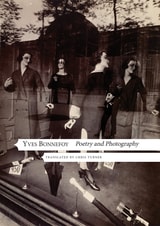
Poetry and Photography
Yves Bonnefoy
Seagull Books, 2017
Bonnefoy's compact essay focuses on one of the disturbing effects of the earliest photographs: their introduction of a notion of non-being—if not, indeed, nothingness—into the world of images. But it also foregrounds a tale which seems to have picked up figuratively on this effect and examined its dangers with a sense of horror: Guy de Maupassant’s extraordinary short story “The Night,” one of the nightmarish works of his last period of conscious creation.
Poetry and the Fate of the Senses
Susan Stewart
University of Chicago Press, 2001
Herself an acclaimed poet, Stewart not only brings the intelligence of a critic to the question of poetry, but the insight of a practitioner as well. Her new study draws on reading from the ancient Greeks to the postmoderns to explain how poetry creates meanings between persons. Poetry and the Fate of the Senses includes close discussions of poems by Stevens, Hopkins, Keats, Hardy, Bishop, and Traherne, of the sense of vertigo in Baroque and Romantic works, and of the rich tradition of nocturnes in visual, musical, and verbal art. Ultimately, Stewart explores the pivotal role of poetry in contemporary culture. She argues that poetry can counter the denigration of the senses and can expand our imagination of the range of human expression.
Poetry and the Fate of the Senses won the 2004 Truman Capote Award for Literary Criticism in Memory of Newton Arvin, administered for the Truman Capote Estate by the University of Iowa Writers' Workshop. It also won the Phi Beta Kappa Society's 2002 Christian Gauss Award for Literary Criticism.
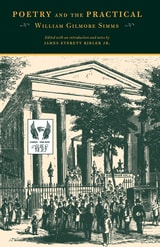
Poetry and the Practical
William Gilmore Simms
University of Arkansas Press, 1998
Delivered as a three-part lecture series in 1854 at the famous Hibernian Society Hall in Charleston, South Carolina, Simms’s spirited defense of poetry stands in the nobel line of poetic credos from poets such as Sir Philip Sidney and Percy Bysshe Shelley. It is the only full-length work of its kind in American literature, and it has never before been published.
Seventh in the University of Arkansas Press’s Simms Series, Poetry and the Practical is a clear, forceful rebuttal of arguments that would relegate poetry to the margins of life. It proclaims the high calling of poets as spokesmen and romantic visionaries, underscoring their mission to reveal truth and passion, mind and heart and to transcend the limiting bounds of the empirical. In proving poetry’s utility and worth, Simms uses all the tools of persuasion open to him: his wide reading, his considerable knowledge of the history of culture and civilizations, his understanding of the values of place and tradition, and, above all, an oratorical eloquence, which allows his words to leave the page in a rush of inspiration.
These lectures, which still retain their identity as scripts prepared and punctuated for performance, provide profound insight into Simms the poet and into the effects of industrialization, the southern sensibility, and the influence of European thought on southern literature at a critical point in that literature’s development.
Poetry as Re-Reading
American Avant-Garde Poetry and the Poetics of Counter-MethodMing-Qian Ma
Northwestern University Press, 2008
Rereading and rewriting our understanding of the poetics of modernism and postmodernism, this truly revisionary work identifies a significant counter-tradition in twentieth-century poetry. Postmodernism, Ming-Qian Ma argues, does not so much follow from modernism as coexist with it, with postmodernists employing the anarchic poetics introduced by Gertrude Stein in countering the rationalist method of high modernists such as T. S. Eliot and Ezra Pound.
Grounded in a detailed and compelling account of the philosophy guiding such a project, Ma’s book traces a continuity of thought and practice through the very different poetic work of objectivists Louis Zukofsky, George Oppen, Carl Rakosi, and John Cage and language poets Susan Howe, Lyn Hejinian, Bruce Andrews, and Charles Bernstein. His deft individual readings provide an opening into this notoriously difficult work, even as his larger critique reveals a new and clarifying perspective on American modernist and post-modernist avant-garde poetics. Ma shows how we cannot understand these poets according to the usual way of reading but must see how they deliberately use redundancy, unpredictability, and irrationality to undermine the meaning-oriented foundations of American modernism--and to force a new and different kind of reading.
With its unusually clear explanation of the philosophy informing postmodern practice, and its unique insights into some of the more interesting and vexing poets of our time, this book points to a reading of an important strain of postmodern American poetry that is likely to develop well into the twenty-first century.
Poetry as a Way of Life
Aesthetics and Askesis in the German Eighteenth CenturyGabriel Trop
Northwestern University Press, 2014
What would it mean to make a work of art the focal point of one’s life practice? Poetry as a Way of Life goes back to the origins of aesthetics as a philosophical discipline in the early eighteenth century in order to uncover an understanding of the work of art as an exercise of the self. Engaging in close readings of works by both canonical and less well-known eighteenth-century German poets such as Friedrich Holderlin, Novalis, Friedrich von Hagedorn, and Johann Wilhelm Ludwig Gleim, Gabriel Trop illustrates the ways in which these authors tap into the potential of poetic form to redefine the limits of human perception and generate alternative ways of being in the world.
Poetry from Spaceship Earth
Empire and Ecology in Post-1945 American PoetrySamia Rahimtoola
University of Iowa Press, 2026
In the early decades of the postwar period, the planetary metaphor of “spaceship Earth” was everywhere in the West. It exerted its power on sites as various as Caribbean research stations, the shipping lanes of the U.S.-occupied Pacific, Palestinian refugee camps, and the internal colonies of segregated nations. At its heart was a new ideology and infrastructure of managing, administering, and rationalizing nature through which Western powers sought to maintain their grip on a decolonizing planet.
Poetry from Spaceship Earth retrieves a diverse array of postwar American poets—Robert Duncan, June Jordan, Joanne Kyger, Lorine Niedecker, and Charles Olson—who contested and cultivated alternatives to this emergent mode of environmentalism. By placing the major innovations of postwar poetry into conversation with environmental politics, Cold War science and technology studies, and postcolonial and Black studies, Samia Rahimtoola develops an original theoretical and historical account of the racial and colonial logics that underpin the supposedly neutral project of managing nature.
Poetry in Exile
Czech Poets during the Cold War and the Western Poetic TraditionJosef Hrdlicka
Karolinum Press, 2021
Poetry in a Global Age
Jahan Ramazani
University of Chicago Press, 2020
Poetry in a Global Age builds on Ramazani’s award-winning A Transnational Poetics, a book that had a catalytic effect on literary studies. Ramazani broadens his lens to discuss modern and contemporary poems not only in relation to world literature, war, and questions of orientalism but also in light of current debates over ecocriticism, translation studies, tourism, and cultural geography. He offers brilliant readings of postcolonial poets like Agha Shahid Ali, Lorna Goodison, and Daljit Nagra, as well as canonical modernists such as W. B. Yeats, Wallace Stevens, T. S. Eliot, and Marianne Moore. Ramazani shows that even when poetry seems locally rooted, its long memory of forms and words, its connections across centuries, continents, and languages, make it a powerful imaginative resource for a global age. This book makes a strong case for poetry in the future development of world literature and global studies.
Poetry in a World of Things
Aesthetics and Empiricism in Renaissance EkphrasisRachel Eisendrath
University of Chicago Press, 2018
In Poetry in a World of Things, Rachel Eisendrath explores how poetry responded to this new detachment by becoming a repository for a more complex experience of the world. The book focuses on ekphrasis, the elaborate literary description of a thing, as a mode of resistance to this new empirical objectivity. Poets like Petrarch, Spenser, Marlowe, and Shakespeare crafted highly artful descriptions that recovered the threatened subjective experience of the material world. In so doing, these poets reflected on the emergence of objectivity itself as a process that was often darker and more painful than otherwise acknowledged. This highly original book reclaims subjectivity as a decidedly poetic and human way of experiencing the material world and, at the same time, makes a case for understanding art objects as fundamentally unlike any other kind of objects.
Poetry in the Museums of Modernism
Yeats, Pound, Moore, SteinCatherine Paul
University of Michigan Press, 2002
Although critics have attested to the importance of the visual arts to literary modernists and have begun to explore the relationships between literary production and social institutions, before now no one has examined the particular institutions in which modernist poets found the artworks, specimens, and other artifacts that inspired their literary innovations. Catherine Paul's book offers the reader a fresh encounter with modernism that will interest literary and art historians, literary theorists, critics, and scholars in cultural studies and museum studies.
Catherine Paul is Associate Professor of English, Clemson University.
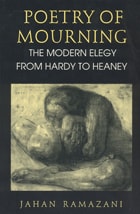
Poetry of Mourning
The Modern Elegy from Hardy to HeaneyJahan Ramazani
University of Chicago Press, 1994
Through subtle readings of elegies, self-elegies, war poems, and the blues, Ramazani greatly enriches our critical understanding of a wide range of poets, including Thomas Hardy, Wilfred Owen, Wallace Stevens, Langston Hughes, W. H. Auden, Sylvia Plath, and Seamus Heaney. He also interprets the signal contributions to the American family elegy of Robert Lowell, Allen Ginsberg, Anne Sexton, John Berryman, Adrienne Rich, Michael Harper, and Amy Clampitt. Finally, he suggests analogies between the elegy and other kinds of contemporary mourning art—in particular, the AIDS Memorial Quilt and the Vietnam Veterans Memorial.
Grounded in genre theory and in the psychoanalysis of mourning, Ramazani's readings also draw on various historical, formal, and feminist critical approaches. This book will be of interest to anyone concerned with the psychology of mourning or the history of modern poetry.
"Consists of full, intelligent and lucid exposition and close reading. . . . Poetry of Mourning is itself a welcome contribution to modern poetry's search for a 'resonant yet credible vocabulary of grief in our time."—Times Literary Supplement
Poetry of the Possible
Spontaneity, Modernism, and the MultitudeJoel Nickels
University of Minnesota Press, 2012
The Poetry of the Possible challenges the conventional image of modernism as a socially phobic formation, arguing that modernism’s abstractions and difficulties are ways of imagining unrealized powers of collective self-organization. Establishing a conceptual continuum between modernism and contemporary theorists such as Paulo Virno, Michael Hardt, Antonio Negri, and Alain Badiou, Joel Nickels rediscovers modernism’s attempts to document the creative potenza of the multitude.
By examining scenes of collective life in works by William Carlos Williams, Wyndham Lewis, Laura Riding, and Wallace Stevens, Nickels resurrects modernism’s obsession with constituent power: the raw, indeterminate capacity for reciprocal counsel that continually constitutes and reconstitutes established political regimes. In doing so, he reminds us that our own attempts to imagine leaderless networks of collective initiative are not so much breaks with modernist forms of knowledge as restagings of some of modernism’s most radical moments of political speculation.
Setting modernism’s individual and collective models of spontaneity in dialogue with theorists of political spontaneity such as Antonio Gramsci, Herbert Marcuse, and Theodor Adorno, Nickels retells the story of modernism as the struggle to represent powers of collective self-organization that lie outside established regimes of political representation.
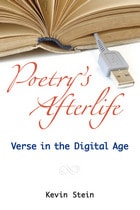
Poetry's Afterlife
Verse in the Digital AgeKevin Stein
University of Michigan Press, 2010
"The great pleasure of this book is the writing itself. Not only is it free of academic and ‘lit-crit' jargon, it is lively prose, often deliciously witty or humorous, and utterly contemporary. Poetry's Afterlife has terrific classroom potential, from elementary school teachers seeking to inspire creativity in their students, to graduate students in MFA programs, to working poets who struggle with the aesthetic dilemmas Stein elucidates, and to teachers of poetry on any level."
--- Beckian Fritz Goldberg, Arizona State University
"Kevin Stein is the most astute poet-critic of his generation, and this is a crucial book, confronting the most vexing issues which poetry faces in a new century."
---David Wojahn, Virginia Commonwealth University
At a time when most commentators fixate on American poetry's supposed "death," Kevin Stein's Poetry's Afterlife instead proposes the vitality of its aesthetic hereafter. The essays of Poetry's Afterlife blend memoir, scholarship, and personal essay to survey the current poetry scene, trace how we arrived here, and suggest where poetry is headed in our increasingly digital culture. The result is a book both fetchingly insightful and accessible. Poetry's spirited afterlife has come despite, or perhaps because of, two decades of commentary diagnosing American poetry as moribund if not already deceased. With his 2003 appointment as Illinois Poet Laureate and his forays into public libraries and schools, Stein has discovered that poetry has not given up its literary ghost. For a fated art supposedly pushing up aesthetic daisies, poetry these days is up and about in the streets, schools, and universities, and online in new and compelling digital forms. It flourishes among the people in a lively if curious underground existence largely overlooked by national media. It's this second life, or better, Poetry's Afterlife, that his book examines and celebrates.
Kevin Stein is Caterpillar Professor of English and Director of the Creative Writing Program at Bradley University and has served as Illinois Poet Laureate since 2003, having assumed the position formerly held by Gwendolyn Brooks and Carl Sandburg. He is the author of numerous books of poetry and criticism.
digitalculturebooksis an imprint of the University of Michigan Press and the Scholarly Publishing Office of the University of Michigan Library dedicated to publishing innovative and accessible work exploring new media and their impact on society, culture, and scholarly communication. Visit the website at www.digitalculture.org.
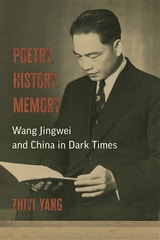
Poetry, History, Memory
Wang Jingwei and China in Dark TimesZhiyi Yang
University of Michigan Press, 2023
Wang Jingwei, poet and politician, patriot and traitor, has always been a figure of major academic and popular interest. Until now, his story has never been properly told, let alone critically investigated. The significance of his biography is evident from an ongoing war on cultural memory: modern mainland China prohibits serious academic research on wartime collaboration in general, and on Wang Jingwei in particular. At this critical juncture, when the recollection of World War II is fading from living memory and transforming into historical memory, this knowledge embargo will undoubtedly affect how China remembers its anti-fascist role in WWII. In Poetry, History, Memory: Wang Jingwei and China in Dark Times, Zhiyi Yang brings us a long overdue reexamination of Wang’s impact on cultural memory of WWII in China.
In this book, Yang brings disparate methodologies into a fruitful dialogue, including sophisticated methods of poetic interpretation. The author argues that Wang’s lyric poetry, as the public performance of a private voice, played a central role in constructing his political identity and heavily influenced the public’s posthumous memory of him. Drawing on archives (in the PRC, Taiwan, Japan, the USA, France, and Germany), memoires, historical journals, newspapers, interviews, and other scholarly works, this book offers the first biography of Wang that addresses his political, literary, and personal life in a critical light and with sympathetic impartiality.
Poetry, Pictures, and Popular Publishing
The Illustrated Gift Book and Victorian Visual Culture, 1855–1875Lorraine Janzen Kooistra
Ohio University Press, 2011
In Poetry, Pictures, and Popular Publishing eminent Rossetti scholar Lorraine Janzen Kooistra demonstrates the cultural centrality of a neglected artifact: the Victorian illustrated gift book. Turning a critical lens on “drawing-room books” as both material objects and historical events, Kooistra reveals how the gift book’s visual/verbal form mediated “high” and popular art as well as book and periodical publication.
A composite text produced by many makers, the poetic gift book was designed for domestic space and a female audience; its mode of publication marks a significant moment in the history of authorship, reading, and publishing. With rigorous attention to the gift book’s aesthetic and ideological features, Kooistra analyzes the contributions of poets, artists, engravers, publishers, and readers and shows how its material form moved poetry into popular culture. Drawing on archival and periodical research, she offers new readings of Eliza Cook, Adelaide Procter, and Jean Ingelow and shows the transatlantic reach of their verses. Boldly resituating Tennyson’s works within the gift-book economy he dominated, Kooistra demonstrates how the conditions of corporate authorship shaped the production and receptionof the laureate’s verses at the peak of his popularity.
Poetry, Pictures, and Popular Publishing changes the map of poetry’s place—in all its senses—in Victorian everyday life and consumer culture.
Poets Beyond the Barricade
Rhetoric, Citizenship, and Dissent after 1960Dale M. Smith
University of Alabama Press, 2012
Poets Teaching Poets
Self and the WorldGregory Orr and Ellen Bryant Voigt, Editors
University of Michigan Press, 1996

Poets and Playwrights
Shakespeare, Jonson, Spenser, MiltonElmer Edgar Stoll
University of Minnesota Press, 1967
Poets and Playwrights was first published in 1967. Minnesota Archive Editions uses digital technology to make long-unavailable books once again accessible, and are published unaltered from the original University of Minnesota Press editions.
Poets and Playwrights is a collection of nine essays by the eminent Shakespearean scholar and critic, the late Elmer Edgar Stoll. In this work, which was first published by the University of Minnesota Press in 1930, Professor Stoll presents his maturest consideration of the art of the poets and playwrights of his subtitle—Shakespeare, Jonson, Spenser, and Milton. The most extensive essay, "Shakespeare and the Moderns," includes, in Mr. Stoll's words, "a review of Shakespeare as I conceive him, in order the better to compare him with those who in some respect or other are his peers."
Poets and the Visual Arts in Renaissance England
By Norman K. Farmer, Jr.
University of Texas Press, 1984
In the twentieth century, the pioneering work of such art historians as Erwin Panofsky and Edgar Wind heightened our awareness of the relationship between Renaissance literature and the visual arts. By focusing on that relationship in the work of such poets as Sir Philip Sidney, John Donne, Richard Crashaw, Edmund Waller, and Robert Herrick, Norman K. Farmer, Jr., convincingly shows that they and other writers of the late sixteenth and early seventeenth centuries in England wrote with a lively and creative sense of the visual—a sense richly informed by the theory and practice of Renaissance art.
Farmer begins by describing the powerful visual matrix that underlies the narrative structure of Sidney's New Arcadia. He compares the role of the visual in the poetry of Donne and Ben Jonson, and demonstrates how works by both Thomas Carew and Lord Herbert exhibit poetic invention according to familiar Renaissance pictorial themes. Herrick's Hesperides is shown to be the major seventeenth-century poetic application of the Horatian idea ut pictura poesis.
A special feature of this gracefully written and enlightening volume is Farmer's discussion of Lady Drury's oratory at Hawstead Hall. Published here for the first time are photographs of this uniquely decorated oratory, in which themes from a variety of English and Continental emblem books were painted on the walls of a room apparently designed for private meditation.

Poets as Readers in Nineteenth-Century France
Critical ReflectionsEdited by Joseph Acquisto, Adrianna M. Paliyenko, and Catherine Witt
University of London Press, 2015
Poiesis and Modernity in the Old and New Worlds
Anthony J. Cascardi
Vanderbilt University Press, 2012
Points of Contact
Disability, Art, and CultureSusan Crutchfield and Marcy Epstein, Editors
University of Michigan Press, 2000
Points of Departure
Samuel Weber between Spectrality and ReadingEdited by Peter Fenves, Kevin McLaughlin, and Marc Redfield
Northwestern University Press, 2016
Poisonous Muse
The Female Poisoner and the Framing of Popular Authorship in Jacksonian AmericaSara L. Crosby
University of Iowa Press, 2016
This difference in outcome doesn’t mean that poisonous women didn’t preoccupy Americans. In the decades following Andrew Jackson’s first presidential bid, Americans buzzed over women who used poison to kill men. They produced and devoured reams of ephemeral newsprint, cheap trial transcripts, and sensational “true” pamphlets, as well as novels, plays, and poems. Female poisoners served as crucial elements in the literary manifestos of writers from Nathaniel Hawthorne and Edgar Allan Poe to George Lippard and the cheap pamphleteer E. E. Barclay, but these characters were given a strangely positive spin, appearing as innocent victims, avenging heroes, or engaging humbugs.
The reason for this poison predilection lies in the political logic of metaphor. Nineteenth-century Britain strove to rein in democratic and populist movements by labeling popular print “poison” and its providers “poisoners,” drawing on centuries of established metaphor that negatively associated poison, women, and popular speech or writing. Jacksonian America, by contrast, was ideologically committed to the popular—although what and who counted as such was up for serious debate. The literary gadfly John Neal called on his fellow Jacksonian writers to defy British critical standards, saying, “Let us have poison.” Poisonous Muse investigates how they answered, how they deployed the figure of the female poisoner to theorize popular authorship, to validate or undermine it, and to fight over its limits, particularly its political, gendered, and racial boundaries.
Poisonous Muse tracks the progress of this debate from approximately 1820 to 1845. Uncovering forgotten writers and restoring forgotten context to well-remembered authors, it seeks to understand Jacksonian print culture from the inside out, through its own poisonous language.
Polish Literature and the Holocaust
Eyewitness Testimonies, 1942–1947Rachel Feldhay Brenner
Northwestern University Press, 2019
Polish Literature and the Holocaust: Eyewitness Testimonies,1942–1947 is a particularly timely book in view of the continuing debate about the attitudes of Poles toward the Jews during the war. The literary voices from the past that Brenner examines posit questions that are as pertinent now as they were then. And so, while this book speaks to readers who are interested in literary responses to the Holocaust, it also illuminates the universal issue of the responsibility of witnesses toward the victims of any atrocity.
Political Aesthetics in the Era of Shakespeare
Edited by Christopher Pye
Northwestern University Press, 2020
Taking up this expansive conception of aesthetics, Political Aesthetics in the Era of Shakespeare suggests that the political stakes of the literary work—and Shakespeare’s work in particular—extend from the most intimate dimensions of affective response to the problem of the grounds of political society. The approaches to aesthetic thought included in this volume explore the intersections between the literary work and the full range of concerns animating the field today: political philosophy, affect theory, and ecocritical analysis of environs and habitus.
Political Affairs of the Heart
Female Travel Writers, the Sentimental Travelogue, and Revolution, 1775-1800Linda Van Netten Blimke
Bucknell University Press, 2022
Political Appetites
Food in Medieval English RomanceAaron Hostetter
The Ohio State University Press, 2017
If humanity has attempted through its brief history to render the material world edible, then food and food practice not only influence our aspirations but also shift focus to the limits of human existence on this planet. In studying the foodways of the past as a fundamental economic activity, Political Appetites questions contemporary attitudes towards consumption as their proliferation and abuses create social inequities, menace ecosystems, and threaten to bring about the end of the Anthropocene Era.
Political Discourse in Exile
Karl Marx and the Jewish QuestionDennis Fischman
University of Massachusetts Press, 1991
Political Fictions
Jean-Paul Sartre
Seagull Books, 2021
Iconic French novelist, playwright, and essayist Jean-Paul Sartre is widely recognized as one of the most important philosophers of the twentieth century, and his work has remained relevant and thought-provoking through the decades. The Seagull Sartre Library now presents some of his most incisive philosophical, cultural, and literary critical essays in twelve newly designed and affordable editions.
Political Fictions includes Sartre’s long foreword to André Gorz’s The Traitor, which has often been called the most intimate and profound book to emerge from the existentialist movement. Sartre also presents a detailed portrait of his friend and fellow writer Paul Nizan (1905–1940), once a committed communist, who died fighting the Nazis at the Battle of Dunkirk. Also featured here is Sartre’s famous foreword to Nizan’s novel The Conspiracy, which made the novel famous on its republication in the 1960s, when it was adopted as an iconic text during the events of May ’68.
Political Theology and Early Modernity
Edited by Graham Hammill and Julia Reinhard Lupton
University of Chicago Press, 2012
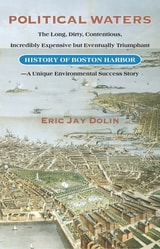
Political Waters
The Long, Dirty, Contentious, Incredibly Expensive but Eventually Triumphant History of Boston Harbor-A Unique Environmental Success StoryEric Jay Dolin
University of Massachusetts Press, 2004
Boston Harbor served as a colonial gateway to the world, witnessed the Boston Tea Party, and helped the community transform itself from an outpost of a few hardy settlers into a bustling metropolis and self-proclaimed hub of the universe. Yet for hundreds of years Boston Harbor was also a cesspool. Long before Bostonians dumped tea into the harbor to protest English taxes, they dumped sewage there.
As the Boston area grew and prospered, its sewage problems worsened, as did the harbor's health, to the point where in the 1980s it was considered the most polluted harbor in the country and ridiculed as the “harbor of shame.” Then, in one of the most impressive environmental comebacks in American history, Boston Harbor was dramatically cleaned up. All it took was two lawsuits, two courts, dozens of lawyers, the creation of a powerful sewage authority, thousands of workers, millions of labor hours, and billions of dollars.
Sewage management is rarely as compelling and exciting as higher profile environmental issues such as global climate change, preserving endangered species, or protecting tropical rainforests. But it can be, as Eric Jay Dolin shows in this engaging narrative account. Boston's struggle to deal with its sewage is an epic story of failure and success, replete with colorful characters, political, bureaucratic, and legal twists and turns, engineering feats, and massive amounts of money. In the end, success hinged on the often overlooked yet monumentally important act of responsibly disposing of the waste people produce every day.

Politicizing Gender
Narrative Strategies in the Aftermath of the French RevolutionKadish, Doris Y
Rutgers University Press, 1991
Politics Of Everyday Fear
Brian Massumi
University of Minnesota Press, 1993
The contemporary consumer is bombarded with fear-inducing images and information. This media shower of imagery is equaled only by the sheer quantity of fear-assuaging products offered for our consumption. The contributors address questions raised by the saturation of social space by capitalized fear.
Politics and History in William Golding
The World Turned Upside DownPaul Crawford
University of Missouri Press, 2002

Politics and Poetic Value
Edited by Robert von Hallberg
University of Chicago Press, 1987
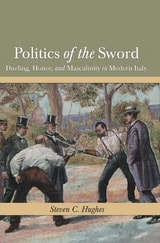
Politics of the Sword
Dueling, Honor, and Masculinity in Modern ItalySteven C. Hughes
The Ohio State University Press, 2007
Politics, Desire, and the Hollywood Novel
Chip Rhodes
University of Iowa Press, 2008
Rhodes considers how novels about the film industry changed between the studio era of the 1930s and 1940s and the era of deregulated film making that has existed since the 1960s. He asserts that Americans are now driven by cultural, rather than class, differences and that our mainstream notion of love has gone from repressed desire to “abnormal desire” to, finally, strictly business.
Politics, Desire, and the Hollywood Novel pays close attention to six authors—Nathanael West, Raymond Chandler, Budd Schulberg, Joan Didion, Bruce Wagner, and Elmore Leonard—who have toiled in the film industry and written to tell about it. More specifically, Rhodes considers both screenplays and novels with an eye toward the different formulations of sexuality, art, and ultimately political action that exist in these two kinds of storytelling.

Politics, Gender, and the Mexican Novel, 1968-1988
Beyond the PyramidBy Cynthia Steele
University of Texas Press, 1992
The student massacre at Tlatelolco in Mexico City on October 2, 1968, marked the beginning of an era of rapid social change in Mexico. In this illuminating study, Cynthia Steele explores how the writers of the next two decades responded to the massacre and to the social crisis it signaled in terms of political change and gender identity.
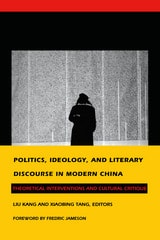
Politics, Ideology, and Literary Discourse in Modern China
Theoretical Interventions and Cultural CritiqueKang Liu and Xiaobing Tang, eds.
Duke University Press, 1993
With chapters by writers, scholars, and critics from mainland China, Hong Kong, and the United States, this volume explores the complexity of representing modernity within the Chinese context. Addressing the problem of finding a proper language for articulating fundamental issues in the historical experience of twentieth-century China, the authors critically re-examine notions of realism, the self/subject, and modernity and draw on perspectives from feminist criticism, ideological analysis, and postmodern theory. Among the many topics explored are subjectivity in Chinese cultural theory, Chinese gender relations, the viability of a Lacanian approach to Chinese identity, the politics of subversion in Chinese reportage, and the ambivalent status of the icon of paternity since Mao.
At the same time this book offers a probing look into the transformation that Chinese culture as well as the study of that culture is currently undergoing, it also reconfirms private discourse as an ideal site for an investigation into a real and imaginary, private and collective encounter with history.
Contributors. Liu Kang, Xiaobing Tang, Liu Zaifu, Stephen Chan, Lydia H. Liu, Wendy Larson, Theodore Huters, David Wang, Tonglin Lu, Yingjin Zhang, Yuejin Wang, Li Tuo, Leo Ou-fan Lee
Poor Things
How Those with Money Depict Those without ItLennard J. Davis
Duke University Press, 2024
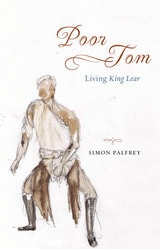
Poor Tom
Living "King Lear"Simon Palfrey
University of Chicago Press, 2014
In Poor Tom, Simon Palfrey asks us to go beyond any such received understandings—and thus to experience King Lear as never before. He argues that the part of Edgar is Shakespeare’s most radical experiment in characterization, and his most exhaustive model of both human and theatrical possibility. The key to the Edgar character is that he spends most of the play disguised, much of it as “Poor Tom of Bedlam,” and his disguises come to uncanny life. The Edgar role is always more than one person; it animates multitudes, past and present and future, and gives life to states of being beyond the normal reach of the senses—undead, or not-yet, or ghostly, or possible rather than actual. And because the Edgar role both connects and retunes all of the figures and scenes in King Lear, close attention to this particular part can shine stunning new light on how the whole play works.
The ultimate message of Palfrey’s bravura analysis is the same for readers or actors or audiences as it is for the characters in the play: see and listen feelingly; pay attention, especially when it seems as though there is nothing there.
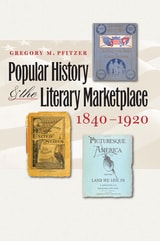
Popular History and the Literary Marketplace, 1840–1920
Gregory M. Pfitzer
University of Massachusetts Press, 2008
Prior to the mid-nineteenth century, most Americans “heard” rather than “read” national history. They absorbed lessons from the past more readily by attending Patriots' Day orations and anniversary commemorations than by reading expensive, multivolume works of patrician historians. By the 1840s, however, innovations in publishing led to the marketing of inexpensive, mass-produced “popular” histories that had a profound influence on historical literacy and learning in the United States. In this book, Gregory M. Pfitzer charts the rise and fall of this genre, demonstrating how and why it was born, flourished, and then became unpopular over time.
Pfitzer begins by exploring how the emergence of a new literary marketplace in the mid-nineteenth century affected the study of history in America. Publishers of popular works hoped to benefit from economies of scale by selling large numbers of inexpensive books at small profit. They hired authors with substantial literary reputations to make the past accessible to middle-class readers. The ability to write effectively for wide audiences was the only qualification for those who dominated this field. Privileging narration and effusive literary style over dispassionate prose, these artists adapted their favorite fictional and poetic conventions with an ease that suggests the degree to which history was viewed as literary art in the nineteenth century.
Beginning as a small cottage industry, popular histories sold in the hundreds of thousands by the 1890s. In an effort to illuminate the cultural conditions for this boom, Pfitzer focuses on the business of book making and book promotion. He analyzes the subscription sales techniques of book agents as well as the aggressive prepublication advertising campaigns of the publishers, including the pictorial embellishments they employed as marketing devices.
He also examines the reactions of professional historians who rejected the fictionalizing and poetic tendencies of popular history, which they equated with loose and undisciplined scholarship. Pfitzer explains how and why these professionals succeeded in challenging the authority of popular histories, and what the subsequent “unpopularity of popular history” meant for book culture and the study of history in the twentieth century.
Popular Print and Popular Medicine
Almanacs and Health Advice in Early AmericaThomas A. Horrocks
University of Massachusetts Press, 2008
In this innovative study of the relationship between popular print and popular attitudes toward the body, health, and disease in antebellum America, Thomas A. Horrocks focuses our attention on a publication long neglected by scholars—the almanac.
Approaching his subject as both a historian of the book and a historian of medicine, Horrocks contends that the almanac, the most popular secular publication in America from the late eighteenth century to the first quarter of the nineteenth, both shaped and was shaped by early Americans' beliefs and practices pertaining to health and medicine. Analyzing the astrological, therapeutic, and regimen advice offered in American almanacs over two centuries, and comparing it with similar advice offered in other genres of popular print of the period, Horrocks effectively demonstrates that the almanac was a leading source of health information in America prior to the Civil War. He contends that the almanac was an integral component of a complicated, fragmented, semi-vernacular health literature of the period, and that the genre played a leading role in disseminating astrological health advice as well as shaping contemporary and future perceptions of astrology.
In terms of therapeutic and regimen advice, Horrocks asserts that the almanac performed a complementary role, confirming and reinforcing traditional beliefs and practices. By analyzing the almanac as a cultural artifact that represents a time, a place, and a certain set of assumptions and beliefs, he demonstrates that the genre can provide a lens through which scholars may examine early American attitudes and practices concerning their health in particular and American popular culture in general.
Pornography, the Theory
What Utilitarianism Did to ActionFrances Ferguson
University of Chicago Press, 2004
Portrait of a Greek Imagination
An Ethnographic Biography of Andreas NenedakisMichael Herzfeld
University of Chicago Press, 1997
Herzfeld explores how personal vision intersects with national cultures by examining the Greek author's novels and recollections as historical accounts. Bringing together the methods of the novelist and the anthropologist in their common concern with both social and lived experience, Herzfeld shows how different perspectives shape the historical record. Nenedakis has endured persecution, exile, imprisonment, and torture under Greece's military dictatorship, and his novels—excerpted here in English for the first time—offer an individual version of historical events. As one of his characters ask, "For was not his life, and are not the lives of all of us, a novel?"
Portrait of a Marriage
Vita Sackville-West and Harold NicolsonNigel Nicolson
University of Chicago Press, 1998
Portraits of Shakespeare
Katherine Duncan-Jones
Bodleian Library Publishing, 2015
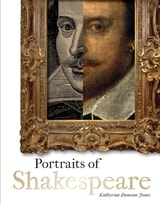
With Portraits of Shakespeare, Katherine Duncan-Jones poses a series of questions about the mysterious physical appearance of the brilliant writer of plays, poems, and sonnets: Why is it so difficult to find images of Shakespeare that were made during his lifetime? Which images are most likely to have been made by those close to the writer? And why do newly discovered images emerge with such startling regularity? With an eye toward answering these questions, the book begins with a broad analysis of the tradition of the “author portrait” before, during, and after Shakespeare’s lifetime. Duncan-Jones provides a detailed critique of three of the most widely accepted portraits: the engraving facing the First Folio’s title page; the sculptured stone bust that adorns Shakespeare’s funerary monument at Holy Trinity Church, Stratford-upon-Avon; and the “Chandos portrait,” an early seventeenth-century painting on canvas which is widely recognized as the best image. Through a painstaking historical analysis of the painting’s early history and provenance, Duncan-Jones arrives at a plausible new identification of both the artist and the artist’s personal connections with Shakespeare. Finally, taking the book into the present, she considers the afterlife of all three images in memorials, advertising, and in graphic art—all evidence of a continuing desire to put a face to one of literature’s most famous names.