Results by title
4917 books match the query 'Philosophy' and 321 start with p
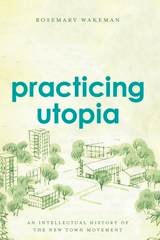
Practicing Utopia
An Intellectual History of the New Town MovementRosemary Wakeman
University of Chicago Press, 2016
In Practicing Utopia, Rosemary Wakeman gives us a sweeping view of the new town movement as a global phenomenon. From Tapiola in Finland to Islamabad in Pakistan, Cergy-Pontoise in France to Irvine in California, Wakeman unspools a masterly account of the golden age of new towns, exploring their utopian qualities and investigating what these towns can tell us about contemporary modernization and urban planning. She presents the new town movement as something truly global, defying a Cold War East-West dichotomy or the north-south polarization of rich and poor countries. Wherever these new towns were located, whatever their size, whether famous or forgotten, they shared a utopian lineage and conception that, in each case, reveals how residents and planners imagined their ideal urban future.

Practising Ethics
A poethic infrastructure for architectural and urban researchersEdited by Jane Rendell, David Roberts, and Yael Padan
University College London, 2026
This book presents a conceptual framework that introduces architectural and urban researchers and practitioners to core ethical concepts and principles.
Grappling with ethics can disorient and disturb your peace of mind in the small hours of the night. Practising Ethics transforms ethics from an obstacle to an opportunity by offering a poethic infrastructure to guide the development of ethical practice in architectural and urban research.
Practising Ethics bridges the gap between research volume and textbook. The book’s two-part structure creates a dialogue between ethical concepts derived from decolonial, ecological, feminist, and queer theory and lived ethical experiences that are explored through specific situations. A series of opening essays present hotspots, touchstones, keystones, blindspots, moonshots, and milestones as different ethical orientations in a six-point methodology. This is followed by six case studies in which practitioners and researchers navigate these orientations through narrative figurations that describe ethical deliberations arising from social science, humanities, practice-led and participatory art, and architectural design research in El Salvador, India, Nigeria, Peru, and the United Kingdom.
The book acts as a companion to an award-winning online toolkit and is illustrated by Judit Ferencz, who offers creative exercises for readers to develop their own poethic infrastructures.
Praeambula Fidei
Thomism and the God of the PhilosophersRalph McInerny
Catholic University of America Press, 2006
Pragmatic Naturalism
An IntroductionS. Morris Eames
Southern Illinois University Press, 1977
It is said that America came of age intellectually with the appearance of the pragmatic movement in philosophy. Pragmatic Naturalism presents a selective and interpretative overview of this philosophy as developed in the writings of its intellectual founders and chief exponents—Charles Sanders Peirce, William James, George Herbert Mead, and John Dewey. Mr. Eames groups the leading ideas of these pragmatic naturalists around the general fields of “Nature and Human Life,” “Knowledge,” “Value,” and “Education,” treating the primary concerns and special emphasis of each philosopher to these issues.
Philosophy students, teachers of philosophy, and general readers will find this book a comprehensive overview of American philosophy.
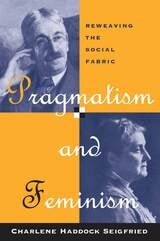
Pragmatism and Feminism
Reweaving the Social FabricCharlene Haddock Seigfried
University of Chicago Press, 1996
With careful attention to their interwoven histories and contemporary concerns, Pragmatism and Feminism effectively invigorates both traditions, opening them to new interpretations and appropriations and asserting their timely philosophical relevance. This foundational work in feminist theory simultaneously invites and guides future scholarship in an area of rapidly emerging significance.
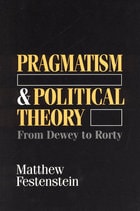
Pragmatism and Political Theory
From Dewey to RortyMatthew Festenstein
University of Chicago Press, 1997
The book's second part traces how Dewey's approach has been differently developed, especially in the work of three contemporary pragmatic thinkers: Richard Rorty, Jurgen Habermas, and Hilary Putnam. This first full-length critical study of the relationship between the pragmatist tradition and political philosophy fills a significant gap in contemporary thought.
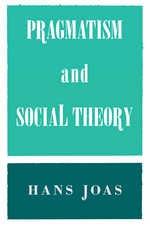
Pragmatism and Social Theory
Hans Joas
University of Chicago Press, 1993
Along with pragmatism's impact on American sociology and social research from 1895 to the 1940s, Joas traces its reception by French and German traditions during this century. He explores the influences of pragmatism—often misunderstood—on Emile Durkheim's sociology of knowledge, and on German thought, with particularly enlightening references to its appropriation by Nazism and its rejection by neo-Marxism. He also explores new currents of social theory in the work of Habermas, Castoriadis, Giddens, and Alexander, fashioning a bridge between Continental thought, American philosophy, and contemporary sociology; he shows how the misapprehension and neglect of pragmatism has led to systematic deficiencies in contemporary social theory.
From this skillful historical and theoretical analysis, Joas creates a powerful case for the enduring legacy of Peirce, James, Dewey, and Mead for social theorists today.
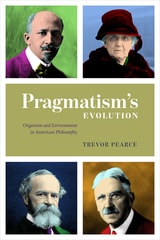
Pragmatism's Evolution
Organism and Environment in American PhilosophyTrevor Pearce
University of Chicago Press, 2020
Although the various thinkers associated with pragmatism—from Charles Sanders Peirce to Jane Addams and beyond—were towering figures in American intellectual life, few realize the full extent of their engagement with the life sciences. In his analysis, Pearce focuses on a series of debates in biology from 1860 to 1910—from the instincts of honeybees to the inheritance of acquired characteristics—in which the pragmatists were active participants. If we want to understand the pragmatists and their influence, Pearce argues, we need to understand the relationship between pragmatism and biology.
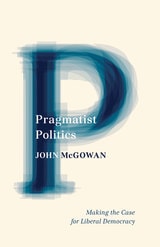
Pragmatist Politics
Making the Case for Liberal DemocracyJohn McGowan
University of Minnesota Press, 2012
In our current age of cynicism, John McGowan suggests that the time is right to take a fresh look at pragmatism, the philosophy of American democracy. As McGowan shows, pragmatism can be an inspiring alternative to the despair that seems to dominate contemporary American politics. Pragmatist Politics is passionate and convincing, both heartfelt and clear-eyed. It offers an expansive vision of what the United States could be and should be.
From John Dewey and William James, McGowan derives a history of democracy as a way of life, characterized by a distinctive ethos and based on an understanding of politics as potentially effective collective agency. That democratic ideal is wedded to a liberalism that focuses on extending the benefits of democracy and of material prosperity to all. Beyond the intellectual case for liberal democracy, McGowan turns to how James, especially, was attuned to the ways that emotional appeals often trump persuasion through arguments, and he examines the work of Kenneth Burke, among others, to investigate the link between liberal democracy and a comic view of human life. Comedy, McGowan notes, allows consideration of themes of love, forgiveness, and generosity that figure far too infrequently in philosophical accounts of politics.
In McGowan’s work, the combination of pragmatism and comedy takes us on a wide-ranging exploration of what American politics—and by extension American life—could actually be like if it truly reflected American values.
Prague, Jan Hus and Prague University
Martin Nodl
Karolinum Press, 2024
The Czech Reformation offered a radical solution to the spiritual and institutional crisis of the late medieval church at the end of the fourteenth century. The beginnings of this reform are distinctly connected with Prague University, which drew many educated people to Prague from across Europe. Through John Hus—a former Prague University student who became its rector in 1402—the Czech Reformation gave rise to a new, radical ecclesiology. Not only did Hus challenge the hierarchical system of the church, but under his influence, the Czech Reformation acquired a specific national shape, and elements of Czech messianism emerged with the university.
Prague, John Hus and Prague University explores that sentiment within Prague University, as well as its limits and restrictive consequences for the Czech Reformation and Czech medieval society. Emphasis is placed on showing how Prague and the university became a world that existed outside the Christian ecumenism of the time.
Pre-Modern Philosophy Defended
Josef Kleutgen
St. Augustine's Press, 2014
“Pre-modern philosophy” means the line of reflection that started with Plato andvAristotle, passed through Augustine and Boethius, and reached its acme in Aquinas, Scotus, and Suarez. The whole line was harshly judged by Descartes, then mocked by the empiricsts of the 18th Century. Why, then, did Pope Leo XII make a determined effort to revive it? And, more importantly, why was the revival a stunning success by the middle of the 20th Century?
The answers to both questions are found in a famous German book, Philosophie der Vorzeit by Josef Kleutgen, now available for the first time in English. Pre-ModernPhilosophy Defended shaped and strengthened Pope Leo’s resolve. It showed how inaccurate the harsh judgments had been and how sadly inferior the modern replacements from Descartes to Hegel had turned out to be in many respects.
Not in all. Kleutgen was no knee-jerk reactionary. He made no bones about the obsolete status of pre-Newtonian physics and cosmology. Rather, he focused on the central boast of “modern” thought, namely, that it had turned at least to the “subject” and had provided a long-needed thing called a “critique of knowledge.”
This book is must reading for intellectual historians and for philosophers working today in epistemology. But most of all, it is essential reading for laity and clergy concerned about revivals of modernism in the church. What was modernism, after all, but an attempt to make the Church revise her theology in the “light” of Kant or Hegel? This is why every Modernist knew Kleutgen’s name and hated this book.
Here is the first English translation (from the German) of the master work of Josef Kleutgen, the nineteenth century social philosopher whose thought lies at, or near, the heart of Catholic Social Thought. Kleutgen is widely and rightly seen as the shadow author of the social encyclicals of Leo XII. Leo’s Rerum Novarum remains the origin and constant reference point of all Catholic Social Teaching. And Popes since have dated their own social encyclicals from Rerum Novarum – hence, Quadragesimo anno and Centesimus annus. —Gerard V. Bradley, University of Notre Dame
Pre-Modern Philosophy Defended is must reading for intellectual historians and for philosophers working today in epistemology. And it is essential reading for laity and clergy concerned about revivals of modernism in the church. What was modernism, after all, but an attempt to make the Church revise her theology in the ‘light’ of Kant or Hegel? This is why every Modernist knew Kleutgen's name and hated Philosophie der Vorzeit (Pre-Modern Philosophy Defended).

Prefaces To Unwritten Works
Friedrich Nietzsche
St. Augustine's Press, 2005
Prefaces to Unwritten Works is a collection of five essays, prefaces to books that Nietzsche never went on to write. Nietzsche himself put these prefaces together in the form of a small leather-bound, handwritten book, and gave that book to Cosima Wagner as a Christmas present in 1872. The dedicatory letter indicates that Nietzsche sent this little book to Cosima "in heartfelt reverence and as an answer to verbal and epistolary questions." As such, this work is a window into Nietzsche's relations with the Wagners at the height of their association, but it is also a continuation of Nietzsche's radical confrontation with Greek antiquity that had begun with the then-recently published Birth of Tragedy. The Wagners read Nietzsche's book of prefaces on the evening of New Year's Day 1873, and Cosima records in her diary five days later that at night, "again" she reflected about the essence of art as a consequence of Nietzsche's work. A month later, Cosima sent Nietzsche a letter encouraging him to write at least two of the books promised by his prefaces.
Nietzsche did not go to write the books heralded by these prefaces, but the prefaces themselves provide substantial challenges of their own and intriguing clues as to the form and content of the books Nietzsche may have intended. Some of these prefaces are better known to students of Nietzsche than others and have attracted significant attention from scholars. The first essay is entitled On the Pathos of Truth, and it considers the relative value of truth and art for human life. The second essay, Thoughts on the Future of Our Educational Institutions, is the only preface in this collection regarding which Nietzsche did actually go on to write a book, albeit a book he did not publish (entitled On the Future of Our Educational Institutions, now available from St. Augustine's Press). This essay is a revised version of the preface Nietzsche wrote for that book, and the changes Nietzsche made are indicative of the plans he had for an improved version. The topic of the essay is almost entirely the art of careful reading. The third essay is entitled The Greek State, and it treats of the relation of slavery to culture and of the genius to the state. This essay is also an interpretation of Plato's Republic, in which Nietzsche claims to reveal everything he has "divined of this secret writing." The fourth essay, The Relation of Schopenhauerian Philosophy to a German Culture, neither assumes that there is in fact, at present, a German Culture, nor hardly mentions Schopenhauer at all, except to suggest that he is one about whom a culture could be built. The final essay is entitled Homer's Contest and is an exploration of the place of jealousy, strife, and agonistic competition in Greek culture.
Together these five essays show Nietzsche's continuing exploration into the differences between modern human beings and the Greeks of classical antiquity. He boldly asks, "Why did the whole Greek world exult at the images of battle of the Iliad?" The answers he offers reveal the dark and harrowing insights of the ancient world and also the sometimes cruel and violent, but also perhaps psychically healthy, character of the ancient Greek. Nietzsche's attention to and concern with classical antiquity raises in each of these essays broad and universal questions about the relation of society and culture to genius. Culture, he says, "rests upon a terrifying ground." And underneath it all, and present with varying explicitness in all of the essays, lies the problem of humanity's relation to time. We see "every disappearing and perishing . . . with dissatisfaction" and yet, "Every moment devours the one that went before, every birth is the death of countless beings."
This volume benefits from presenting all five prefaces together, translated literally and consistently. The appendices present preliminary drafts of various portions of the respective prefaces and a prolonged fragment Nietzsche wrote extending his thoughts from the Birth of Tragedy and containing text intimately related to some of the five prefaces.
Prescribing the Life of the Mind
An Essay on the Purpose of the University, the Aims of Liberal Education, the Competence of Citizens, and the Cultivation of Practical ReasonCharles W. Anderson
University of Wisconsin Press, 1996
Presence and Absence
A Philosophical Investigation of Language and BeingRobert Sokolowski
Catholic University of America Press, 2017
“A splendid, provocative and profound work, this book explores the manifold ways in which the contrast of presence and absence operate to establish the possibility of human discourse and truthfulness…belongs in every philosophy collection.” – Choice
“Quite simply a superb book, which deserves more than one careful reading. A fresh, unified treatment of a grand philosophical theme, the theme of the connections between thought, truth, and being.” – Man and World
“A thoughtful book about thoughtfulness and truthfulness and their ontological conditions. Simply put, this is a book that will reward its careful reader a hundredfold, for Sokolowski is a speaker who says things in ways that are provocative, exciting, and invariably insightful.” – Journal of the British Society for Phenomenology
“Has few peers in phenomenological literature.” – International Philosophical Quarterly
“[Sokolowski is] an original thinker of the first rank, who has significantly furthered the path of phenomenological philosophy. As well as being an exciting synthesis, a thinking of the previously unthought in predecessors, and a ground-breaking movement, this work is written with a sensitivity to language and its graceful use that one would hope for from one exploring its richness and power.” – Human Studies
Presenting Women Philosophers
Cecile Tougas
Temple University Press, 2000
Presocratics and Plato
Festschrift at Delphi in Honor of Charles KahnRichard Patterson
Parmenides Publishing, 2012
Charles Kahn taught Classics and Philosophy at Columbia University from 1957 to 1965, and has since been teaching in the Philosophy Department of the University of Pennsylvania. He spent a year as Visiting Professor at the American School of Classical Studies in Athens, and had additional Visiting Fellowships at Balliol College, Oxford and Clare Hall, Cambridge, and a term as Visiting Professor at Harvard. He is the recipient of several prestigious research grants, from the American Council of Learned Societies (1963/64 and 1984/85), the National Endowment for the Humanities (1974/75 and 1990/91), and the Guggenheim Foundation (1979/80). In 2000 he was elected Fellow of the National Academy of Arts and Sciences. He is the author of Anaximander and the Origins of Greek Cosmology, The Verb “Be” in Ancient Greek, The Art and Thought of Heraclitus, Plato and the Socratic Dialogue, Pythagoras and the Pythagoreans, and Essays on Being. His latest book,Plato and the Post-Socratic Dialogue, is forthcoming from Cambridge University Press.
Sarah Broadie
Lesley Brown
Tomás Calvo-Martínez
Diskin Clay
John M. Dillon
Dorothea Frede
Arnold Hermann
Carl A. Huffman
Enrique Hülsz Piccone
D. M. Hutchinson
Paul Kalligas
Vassilis Karasmanis
Aryeh Kosman
Anthony A. Long
Richard McKirahan
Susan Sauvé Meyer
Alexander P.D.Mourelatos
Satoshi Ogihara
Richard Patterson
Christopher J. Rowe
David Sedley
Richard Sorabji
Presumptions and Burdens of Proof
An Anthology of Argumentation and the LawEdited by Hans V. Hansen, Fred J. Kauffeld, James B. Freeman, and Lilian Bermejo-Luque
University of Alabama Press, 2019
An anthology of the most important historical sources, classical and modern, on the subjects of presumptions and burdens of proof
In the last fifty years, the study of argumentation has become one of the most exciting intellectual crossroads in the modern academy. Two of the most central concepts of argumentation theory are presumptions and burdens of proof. Their functions have been explicitly recognized in legal theory since the middle ages, but their pervasive presence in all forms of argumentation and in inquiries beyond the law—including politics, science, religion, philosophy, and interpersonal communication—have been the object of study since the nineteenth century.
However, the documents and essays central to any discussion of presumptions and burdens of proof as devices of argumentation are scattered across a variety of remote sources in rhetoric, law, and philosophy. Presumptions and Burdens of Proof: An Anthology of Argumentation and the Law brings together for the first time key texts relating to the history of the theory of presumptions along with contemporary studies that identify and give insight into the issues facing students and scholars today.
The collection’s first half contains historical sources and begins with excerpts from Aristotle’s Topics and goes on to include the locus classicus chapter from Bishop Whately’s crucial Elements of Rhetoric as well as later reactions to Whately’s views. The second half of the collection contains contemporary essays by contributors from the fields of law, philosophy, rhetoric, and argumentation and communication theory. These essays explore contemporary understandings of presumptions and burdens of proof and their role in numerous contexts today. This anthology is the definitive resource on the subject of these crucial rhetorical modes and will be a vital resource to all scholars of communication and rhetoric, as well as legal scholars and practicing jurists.
Pretexts for Writing
German Romantic Prefaces, Literature, and PhilosophyWilliams, Seán M
Bucknell University Press, 2019
Published by Bucknell University Press. Distributed worldwide by Rutgers University Press.
Primacies
Experience, Expression, and the Jewish ImaginationMichael Fishbane
University of Chicago Press, 2025
Primacies begins with the assertion that our earliest preverbal experiences are accompanied by a primary language—a universal expression of tears, cries, and laughter offered long before we learn our distinctive, ordinary languages. For Michael Fishbane, these “primacies” release the raw feelings of our existential condition and catalyze our most powerful literary expressions of sorrow, joy, and fulfillment.
In this book, Fishbane explores how ancient, medieval, and modern literature and poetry express and transform these primal sensations. Building on his theological project begun in Sacred Attunement and Fragile Finitude, Fishbane offers here a radically new lived hermeneutics that seeks to do nothing less than redefine the relationship between experience and language.
Primal Screams
How the Sexual Revolution Created Identity PoliticsEberstadt, Mary
Templeton Press, 2021
Who am I? The question today haunts every society in the Western world.
Legions of people—especially the young—have become unmoored from a firm sense of self. To compensate, they join the ranks of ideological tribes spawned by identity politics and react with frenzy against any perceived threat to their group.
As identitarians track and expose the ideologically impure, other citizens face the consequences of their rancor: a litany of “isms” run amok across all levels of cultural life, the free marketplace of ideas muted by agendas shouted through megaphones, and a spirit of general goodwill warped into a state of perpetual outrage.
How did we get here? Why have we divided against one another so bitterly? In Primal Screams, acclaimed cultural critic Mary Eberstadt presents the most provocative and original theory to come along in recent years. The rise of identity politics, she argues, is a direct result of the fallout of the sexual revolution, especially the collapse and shrinkage of the family.
As Eberstadt illustrates, humans have forged their identities within the kinship structure from time immemorial. The extended family, in a real sense, is the first tribe and teacher. But with its unprecedented decline across various measures, generations of people have been set adrift and can no longer answer the question Who am I? concerning primordial ties. Desperate for solidarity and connection, they claim membership in politicized groups whose displays of frantic irrationalism amount to primal screams for familial and communal loss.
Written in her impeccable style and with empathy rarely encountered in today’s divisive discourse, Eberstadt’s theory holds immense explanatory power that no serious citizen can afford to ignore. The book concludes with three incisive essays by Rod Dreher, Mark Lilla, and Peter Thiel, each sharing their perspective on the author’s formidable argument.
Primate People
Saving Nonhuman Primates through Education, Advocacy, and SanctuaryLisa Kemmerer
University of Utah Press, 2012
In the last 30 years the bushmeat trade has led to the slaughter of nearly 90 percent of West Africa’s bonobos, perhaps our closest relatives, and has recently driven Miss Waldron’s red colobus monkey to extinction. Earth was once rich with primates, but every species—except one—is now extinct or endangered because of one primate—Homo sapiens. How have our economic and cultural practices pushed our cousins toward destruction? Would we care more about their fate if we knew something of their individual lives and sufferings? Would we help them if we understood how our choices threaten their existence? This anthology helps to answer these questions.
The first section of Primate People introduces forces that threaten nonhuman primates, such as the entertainment and “pet” industries, the bushmeat trade, habitat destruction, and logging. The second section exposes the exploitation of primates in research facilities, including the painful memories of an undercover agent, and suggests models of more enlightened scientific methods. The final section tells the stories of those who lobby for change, educate communities, and tenderly care for our displaced cousins in sanctuaries.
Sometimes shocking and disturbing, sometimes poignant and encouraging, Primate People always draws the reader into the lives of nonhuman primates. Activists around the world reveal the antics and pleasures of monkeys, the tendencies and idiosyncrasies of chimpanzees, and the sufferings and fears of macaques. Charming, difficult, sensitive—these testimonies demonstrate that nonhuman primates and human beings are, indeed, closely related. Woven into the anthology’s lucid narratives are the stories of how we harm and create the conditions that endanger primates, and what we can and must do to prevent their ongoing suffering and fast-approaching extinction.
Primo Levi and the Politics of Survival
Frederic D. Homer
University of Missouri Press, 2001
At the age of twenty-five, Primo Levi was sent to Hell. Levi, an Italian chemist from Turin, was one of many swept up in the Holocaust of World War II and sent to die in the German concentration camp in Auschwitz. Of the 650 people transported to the camp in his group, only 15 men and 9 women survived. After Soviet liberation of the camp in 1945, Levi wrote books, essays, short stories, poetry, and a novel, in which he painstakingly described the horrors of his experience at Auschwitz. He also spent the rest of his life struggling with the fact that he was not among those who were killed.
In Primo Levi and the Politics of Survival, Frederic D. Homer looks at Primo Levi's life but, more important, shows him to be a significant political philosopher. In the course of his writings, Levi asked and answered his most haunting question: can someone be brutalized by a terrifying experience and, upon return to "ordinary life," recover from the physical and moral destruction he has suffered? Levi used this question to develop a philosophy positing that although man is no match for life, he can become better prepared to contend with the tragedies in life.
According to Levi, the horrors of the world occur because of the strength of human tendencies, which make relationships between human beings exceedingly fragile. He believed that we are ill-constituted beings who have tendencies toward violence and domination, dividing ourselves into Us and Them, with very shallow loyalties. He also maintained that our only refuge is in education and responsibility, which may counter these tendencies. Homer calls Levi's philosophy "optimistic pessimism."
As Homer demonstrates, Levi took his past experiences into account to determine that goodwill and democratic institutions do not come easily to people. Liberal society is to be earned through discipline and responsibility toward our weaknesses. Levi's answer is "civilized liberalism." To achieve this we must counter some of our most stubborn tendencies.
Homer also explores the impact of Levi's death, an apparent suicide, on the way in which his work and theories have been perceived. While several critics discount Levi's work because of the nature of his death, Homer argues that his death is consistent with his philosophy. A book rich in brutally honest philosophy, Primo Levi and the Politics of Survival compels one to look at serious questions about life, tragedy, optimism, solidarity, violence, and human nature.

Principles Of Interpretation
Continental Thought Series, V5Edward Goodwin Ballard
Ohio University Press, 1983
This is a major phenomenological work in which real learning works in graceful tandem with genuine and important insight. Yet this is not a work of scholarship; it is a work of philosophy, a work that succeeds both in the careful, descriptive massing of detail and in the power of its analysis of the conditions that underlie the possibility of such things as description, interpretation, perception, and meaning.
Principles of Interpretation formulates answers to these questions: How does the interpretative process proceed? What are its fundamentals? What assurance have we that our interpretations are in principal faithful to that which is to be interpreted? What conclusions are indicated concerning the past phases of our history and its present tendencies?
Principles of Green Bioethics
Sustainability in Health CareCristina Richie
Michigan State University Press, 2019
Principles of Instrumental Logic
John Dewey's Lectures in Ethics and Political Ethics, 1895-1896Donald F. Koch
Southern Illinois University Press, 1998
John Dewey delivered two sets of related lectures at the University of Chicago in the fall quarter 1895 and the spring quarter 1896. Designed for graduate students, the lectures show the birth of Dewey’s instrumentalist theory of inquiry in its application to ethical and political thinking.
From 1891 through 1903, Dewey attempted to develop a revolutionary experimentalist approach to ethical inquiry, designed to replace the more traditional ways of moral theorizing that relied on the fixed moral knowledge given in advance of the situations in which they were applied. In the lectures on the logic of ethics, he sets forth and defends the view that the "is" in a moral judgment such as "This is good" is a coordinating factor in an inquiry. Although the subject matter of the lectures is highly technical, its significance is paramount. It provides the key to and opens the door for a theory that preserves the difference between strictly scientific inquiry and moral inquiry even while it provides a "scientific treatment" of the latter.
Principles of Knowledge Representation
Gerhard Brewka
CSLI, 1996
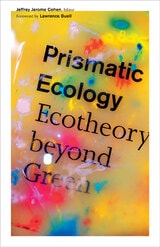
Prismatic Ecology
Ecotheory beyond GreenJeffrey Jerome Cohen
University of Minnesota Press, 2013
Emphasizing sustainability, balance, and the natural, green dominates our thinking about ecology like no other color. What about the catastrophic, the disruptive, the inaccessible, and the excessive? What of the ocean’s turbulence, the fecundity of excrement, the solitude of an iceberg, multihued contaminations? Prismatic Ecology moves beyond the accustomed green readings of ecotheory and maps a colorful world of ecological possibility.
In a series of linked essays that span place, time, and discipline, Jeffrey Jerome Cohen brings together writers who illustrate the vibrant worlds formed by colors. Organized by the structure of a prism, each chapter explores the coming into existence of nonanthropocentric ecologies. “Red” engages sites of animal violence, apocalyptic emergence, and activism; “Maroon” follows the aurora borealis to the far North and beholds in its shimmering alternative modes of world composition; “Chartreuse” is a meditation on postsustainability and possibility within sublime excess; “Grey” is the color of the undead; “Ultraviolet” is a potentially lethal force that opens vistas beyond humanly known nature.
Featuring established and emerging scholars from varying disciplines, this volume presents a collaborative imagining of what a more-than-green ecology offers. While highlighting critical approaches not yet common within ecotheory, the contributions remain diverse and cover a range of topics including materiality, the inhuman, and the agency of objects. By way of color, Cohen guides readers through a reflection of an essentially complex and disordered universe and demonstrates the spectrum as an unfinishable totality, always in excess of what a human perceives.
Contributors: Stacy Alaimo, U of Texas at Arlington; Levi R. Bryant, Collin College; Lowell Duckert, West Virginia U; Graham Harman, American U in Cairo; Bernd Herzogenrath, Goethe U of Frankfurt; Serenella Iovino, U of Turin, Italy; Eileen A. Joy; Robert McRuer, George Washington U; Tobias Menely, Miami U; Steve Mentz, St. John’s U, New York City; Timothy Morton, Rice U; Vin Nardizzi, U of British Columbia; Serpil Oppermann, Hacettepe U, Ankara; Margaret Ronda, Rutgers U; Will Stockton, Clemson U; Allan Stoekl, Penn State U; Ben Woodard; Julian Yates, U of Delaware.
Prison Abolition for Realists
Anna Terwiel
University of Minnesota Press, 2025
A lucid guide to the radical politics of prison abolitionists
There is growing recognition that mass incarceration is unjust and undemocratic, but prison abolition continues to be dismissed as naïve, idealistic, and out of touch with reality. Anna Terwiel challenges this view, carefully examining the work of abolitionist thinkers and activists since the 1960s to argue that prison abolition is a realist political project. Abolition, Terwiel shows, is oriented toward practical realities and offers concrete proposals for radical democratic change.
Based on insightful readings of renowned abolitionists such as Michel Foucault, Liat Ben-Moshe, and Angela Y. Davis, Prison Abolition for Realists illuminates the realist aspects of their approaches as well as the important differences between them. Distinguishing between paranoid, purist, and agonistic styles of abolitionism, Terwiel argues that an agonistic approach holds the most promise for democratic change to carceral systems. Embodied in the work of Davis, agonistic abolitionism combines radical critique with efforts to build new democratic institutions while accepting that all political achievements will be imperfect. Pursuing examples of what this looks like in practice, Terwiel explores grassroots transformative justice efforts, like those of Communities Against Rape and Abuse. She also proposes a “right to comfort” to support incarcerated people’s demands for air conditioners in extremely hot prisons, showing how state institutions, civil law, and rights claims can be potential resources for abolitionists.
Nuanced and illuminating, Prison Abolition for Realists affirms abolition’s viability during a time of multiple, ongoing crises. While many despair at the state of the world, Terwiel reveals how abolition offers an actionable politics of the possible. Far from being unrealistic, abolition is an indispensable part of a realist politics.
Retail e-book files for this title are screen-reader friendly with images accompanied by short alt text and/or extended descriptions.
Retail e-book files for this title are screen-reader friendly with images accompanied by short alt text and/or extended descriptions.
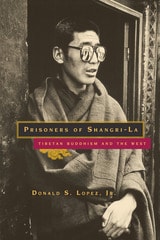
Prisoners of Shangri-La
Tibetan Buddhism and the WestDonald S. Lopez Jr.
University of Chicago Press, 1998
"Lopez lifts the veil on America's romantic vision of Tibet to reveal a country and a spiritual history more complex and less ideal than popular perceptions allow. . . . Lively and engaging, Lopez's book raises important questions about how Eastern religions are often co-opted, assimilated and misunderstood by Western culture."—Publishers Weekly
"Proceeding with care and precision, Lopez reveals the extent to which scholars have behaved like intellectual colonialists. . . . Someone had to burst the bubble of pop Tibetology, and few could have done it as resoundingly as Lopez."—Booklist
"Fascinating. . . [A] provocative exploration. Lopez conveys the full dizziness of the Western encounter with Tibet and Tibetan Buddhism."—Fred Pheil, Tricycle: The Buddhist Review
"A timely and courageous exploration. . . . [Lopez's] book will sharpen the terms of the debate over what the Tibetans and their observers can or should be doing about the place and the idea of Tibet. And that alone is what will give us all back our Shambhala."—Jonathan Spence, Lingua Franca Book Review
"Lopez's most important theme is that we should be wary of the idea . . . that Tibet has what the West lacks, that if we were only to look there we would find the answers to our problems. Lopez's book shows that, on the contrary, when the West has looked at Tibet, all that it has seen is a distorted reflection of itself."—Ben Jackson, Times Higher Education Supplement
Probabilistic Approaches to Linguistic Theory
Edited by Jean-Philippe Bernardy, Rasmus Blanck, Stergios Chatzikyriakidis, Shalom Lappin, and Aleksandre Maskharashvili
CSLI, 2022
During the last two decades, computational linguists, in concert with other researchers in AI, have turned to machine learning and statistical techniques to capture features of natural language and aspects of the learning process that are not easily accommodated in classical algebraic frameworks. These developments are producing a revolution in linguistics in which traditional symbolic systems are giving way to probabilistic and deep learning approaches. This collection features articles that provide background to these approaches, and their application in syntax, semantics, pragmatics, morphology, psycholinguistics, neurolinguistics, and dialogue modeling. Each chapter provides a self-contained introduction to the topic that it covers, making this volume accessible to graduate students and researchers in linguistics, NLP, AI, and cognitive science.
Probable Justice
Risk, Insurance, and the Welfare StateRachel Z. Friedman
University of Chicago Press, 2020
Probable Justice traces a history of social insurance from the eighteenth century to today, from the earliest ideas of social accountability through the advanced welfare state of collective responsibility and risk. At the heart of Rachel Z. Friedman’s investigation is a study of how probability theory allows social insurance systems to flexibly measure risk and distribute coverage. The political genius of social insurance, Friedman shows, is that it allows for various accommodations of needs, risks, financing, and political aims—and thereby promotes security and fairness for citizens of liberal democracies.
Problems of Dostoevsky’s Poetics
Mikhail Bakhtin
University of Minnesota Press, 1984
Process and Aesthetics
An Outline of Whiteheadian Aesthetics and BeyondOndrej Dadejík, Martin Kaplický, Miloš Ševcík, and Vlastimil Zuska
Karolinum Press, 2021
Though philosopher Alfred North Whitehead did not dedicate any books or articles specifically to aesthetics, aesthetic motifs nonetheless permeate his entire body of work. Despite this, aestheticians have devoted little attention to Whitehead. In this book, four scholars of aesthetics provide another angle from which Whiteheadian aesthetics might be reconstructed. Paying special attention to the notion of aesthetic experience, the authors analyze abstraction versus concreteness, immediacy versus mediation, and aesthetic contextualism versus aesthetic isolationism. The concepts of creativity and rhythm are crucial to their interpretation of Whiteheadian aesthetics. Using these concepts, the book interprets the motif of the processes by which experience is harmonized, the sensation of the quality of the whole, and directedness towards novelty.
Process-Relational Philosophy
An Introduction to Alfred North WhiteheadC. Robert Mesle
Templeton Press, 2008
Process thought is the foundation for studies in many areas of contemporary philosophy, theology, political theory, educational theory, and the religion-science dialogue. It is derived from Alfred North Whitehead's philosophy, known as process theology, which lays a groundwork for integrating evolutionary biology, physics, philosophy of mind, theology, environmental ethics, religious pluralism, education, economics, and more.
In Process-Relational Philosophy, C. Robert Mesle breaks down Whitehead's complex writings, providing a simple but accurate introduction to the vision that underlies much of contemporary process philosophy and theology. In doing so, he points to a "way beyond both reductive materialism and the traps of Cartesian dualism by showing reality as a relational process in which minds arise from bodies, in which freedom and creativity are foundational to process, in which the relational power of persuasion is more basic than the unilateral power of coercion."
Because process-relational philosophy addresses the deep intuitions of a relational world basic to environmental and global thinking, it is being incorporated into undergraduate and graduate courses in philosophy, educational theory and practice, environmental ethics, and science and values, among others. Process-Relational Philosophy: A Basic Introduction makes Whitehead's creative vision accessible to all students and general readers.
Processual Sociology
Andrew Abbott
University of Chicago Press, 2016
In Processual Sociology, Abbott first examines the endurance of individuals and social groups through time and then goes on to consider the question of what this means for human nature. He looks at different approaches to the passing of social time and determination, all while examining the goal of social existence, weighing the concepts of individual outcome and social order. Abbott concludes by discussing core difficulties of the practice of social science as a moral activity, arguing that it is inescapably moral and therefore we must develop normative theories more sophisticated than our current naively political normativism. Ranging broadly across disciplines and methodologies, Processual Sociology breaks new ground in its search for conceptual foundations of a rigorously processual account of social life.
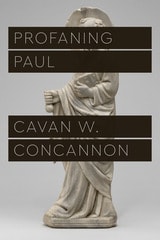
Profaning Paul
Cavan W. Concannon
University of Chicago Press, 2021
The letters of Paul have been used to support and condone a host of evils over the span of more than two millennia: racism, slavery, imperialism, misogyny, and anti-Semitism, to name a few. Despite, or in some cases because of, this history, readers of Paul have felt compelled to reappropriate his letters to fit liberal or radical politics, seeking to set right the evils done in Paul’s name. Starting with the language of excrement, refuse, and waste in Paul’s letters, Profaning Paul looks at how Paul’s “shit” is recycled and reconfigured. It asks why readers, from liberal Christians to academic biblical scholars to political theorists and philosophers, feel compelled to make Paul into a hero, mining his words for wisdom. Following the lead of feminist, queer, and minoritized scholarship, Profaning Paul asks what would happen if we stopped recycling Paul’s writings. By profaning the status of his letters as sacred texts, we might open up new avenues for imagining political figurations to meet our current and coming political, economic, and ecological challenges.
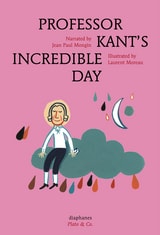
Professor Kant's Incredible Day
Jean Paul Mongin
Diaphanes, 2016
At its most basic, philosophy is about learning how to think about the world around us. It should come as no surprise, then, that children make excellent philosophers! Naturally inquisitive, pint-size scholars need little prompting before being willing to consider life’s “big questions,” however strange or impractical. Plato & Co. introduces children—and curious grown-ups—to the lives and work of famous philosophers, from Descartes to Socrates, Einstein, Marx, and Wittgenstein. Each book in the series features an engaging—and often funny—story that presents basic tenets of philosophical thought alongside vibrant color illustrations.
In Professor Kant’s Incredible Day, the philosopher Immanuel Kant wants only to be left in peace to consider life’s big questions: What can I know? What can I hope for? But, when a perfumed letter arrives one day, it interrupts his studies and sets off a series of events the dour professor could not possibly have predicted. But just when it seems as though all of Königsberg is plunged into chaos, he realizes that this perfect storm may hold the answers to his most pressing questions.
Plato & Co.’s clear approach and charming illustrations make this series the perfect addition to any little library.
Progress and Religion
An Historical Inquiry (The Works of Christopher Dawson)Christopher Dawson
Catholic University of America Press, 2001
Prolegomena to Any Future Materialism
A Weak Nature AloneAdrian Johnston
Northwestern University Press, 2019
Adrian Johnston’s trilogy Prolegomena to Any Future Materialism aims to forge a thoroughly materialist yet antireductive theory of subjectivity. In this second volume, A Weak Nature Alone, Johnston focuses on the philosophy of nature required for such a theory. This volume is guided by a fundamental question: How must nature be rethought so that human minds and freedom do not appear to be either impossible or inexplicable within it? Asked differently: How must the natural world itself be structured such that sapient subjects in all their distinctive peculiarities emerged from and continue to exist within this world?
In A Weak Nature Alone, Johnston develops his transcendental materialist account of nature through engaging with and weaving together five main sources of inspiration: Hegelian philosophy, Marxist materialism, Freudian-Lacanian metapsychology, Anglo-American analytic neo-Hegelianism, and evolutionary theory and neurobiology. Johnston argues that these seemingly (but not really) strange bedfellows should be brought together so as to construct a contemporary ontology of nature. Through this ontology, nonnatural human subjects can be seen to arise in an immanent, bottom-up fashion from nature itself.
Prolegomena to Any Future Materialism
The Outcome of Contemporary French PhilosophyAdrian Johnston
Northwestern University Press, 2013
Adrian Johnston’s Prolegomena to Any Future Materialism, planned for three volumes, will lay the foundations for a new materialist theoretical apparatus, his “transcendental materialism.” In this first volume, Johnston clears an opening within contemporary philosophy and theory for his unique position. He engages closely with Lacan, Badiou, and Meillassoux, demonstrating how each of these philosophers can be seen as failing to forge an authentically atheistic materialism. Johnston builds a new materialism both profoundly influenced by these brilliant comrades of a shared cause as well as making up for the shortcomings of their own creative attempts to bring to realization the Lacanian vision of an Other-less, One-less ontology. The Outcome of Contemporary French Philosophy yields intellectual weapons suitable for deployment on multiple fronts simultaneously, effective against the mutually entangled spiritualist and scientistic foes of our post-Enlightenment, biopolitical era of nothing more than commodities and currencies.
Prometheus Bedeviled
Science and the Contradictions of Contemporary CultureLevitt, Norman
Rutgers University Press, 1999
In this lucid critique, Norman Levitt examines the strained relations between science and contemporary society. For the most part, Levitt states, we idolize musicians and cheer on athletes, yet we view scientists with a mixture of awe and unease. Significantly, too, we are unsure how scientific discovery actually fits into the broader schemes of politics, and policy. Even beyond pragmatic questions, we remain anxious about the implications of science for our basic understanding of human values and purpose.
One result of this uncertainty about scientific work is an ill-informed crusade to “democratize” science. It has become fashionable lately, Levitt states, for non-scientists to attempt to intervene in science policy, which often results in methodologically unsound decisions. The embrace of "alternative medicine" is a particularly ominous example.
Levitt suggests that science, by virtue of its accuracy and reliability, deserves to be at the top of the hierarchy of knowledge, and that our social institutions ought to take this fact strongly into account. Levitt hopes that Americans will become aware of the limitations of unchecked populism and will be willing to yield a bit of “democratic” control over certain questions in order to minimize the danger that sound science will be ignored or overridden. However, this trust in scientific methodology must be part of a broader understanding. Science must not only act responsibly toward our democratic institutions; it must also concede that our society has the right to decide what kinds of research are most consistent with larger goals and therefore deserve the most support.
Promiscuous Knowledge
Information, Image, and Other Truth Games in HistoryKenneth Cmiel and John Durham Peters
University of Chicago Press, 2020
Promising
William Vitek
Temple University Press, 1993
William Vitek enlarges our understanding by treating the act of promising as a social practice and complex human experience. Citing engaging examples of promises made in everyday life, in extraordinary circumstances, and in literary works, Vitek grapples with the central paradox of promising: that human beings can intend a future to which they are largely blind.
Promising evaluates contemporary approaches to the topic by such philosophers as John Rawls, John Searle, Henry Sidgwick, P.S. Atiyah, and Michael Robbins but transcend their more limited focus on promissory obligation. Vitek's innovative approach moves beyond theories of language, ethics, and law to unveil a complex human activity subject to shifting interpretations and changes in nature.
Prophecy in Islam
Philosophy and OrthodoxyFazlur Rahman
University of Chicago Press, 2011
This longstanding and highly regarded volume is the first to explore the doctrine of prophetic revelation, a critical and definitive area of Islamic religious and political thought. In it, the esteemed Islamic scholar Fazlur Rahman traces the inception of this doctrine from ancient Greek texts, its interpretation and elaboration by Muslim philosophers in order to suit their vision of the Prophet, and, finally, the varying degrees of acceptance of these convergent ideas by the Muslim orthodoxy.
The latest edition of this classic text includes a new foreword by Islamic studies expert Michael Sells, confirming Prophecy in Islam as the best source on its subject after more than half a century. This longstanding and highly regarded volume is the first to explore the doctrine of prophetic revelation, a critical and definitive area of Islamic religious and political thought. In it, the esteemed Islamic scholar Fazlur Rahman traces the inception of this doctrine from ancient Greek texts, its interpretation and elaboration by Muslim philosophers in order to suit their vision of the Prophet, and, finally, the varying degrees of acceptance of these convergent ideas by the Muslim orthodoxy.
The latest edition of this classic text includes a new foreword by Islamic studies expert Michael Sells, confirming Prophecy in Islam as the best source on its subject after more than half a century.
Prophecy in Politics
Or, the Wigram AspectKenneth Weisbrode
Haus Publishing, 2026
Ralph Wigram was a minor British bureaucrat who is known to a small part of posterity only because Winston Churchill paid tribute to him as the man who warned of the Nazi threat with such persistence, conviction, and hard evidence that Churchill had the wherewithal to make the case to the British people. Wigram died at the end of 1936, just before the war he warned against had begun. He might have changed the course of history—if only people had believed him.
Prophets like Wigram are a permanent fixture of a world without certainty. Oracles, shamans, wiseacres, astrologers, and swamis of all shades populate our myths, legends, and Bibles. Today, our lives are inundated with the wisdom of professional forecasters, intelligence analysts, and threat mongers. Why do many of us, and especially our leaders, find it so difficult to heed warnings? We tend to underreact to some, overreact to others, and then point fingers when what “nobody ever anticipated” comes to pass. Why is prophecy so dogged?
Prophecy in Politics takes up a vast, complex, and well-worn subject—the future—and reduces it to its most essential aspects, especially belief. It revisits a half-dozen familiar and not-so-familiar incidents of prophecy, from the warnings given to Stalin about Operation Barbarossa to those given to Bill Clinton and George W. Bush about “terrorism,” to the Cassandras periodically promising collapse in the financial markets, to uncover a pattern of complacency and neglect. Finally, Ken Weisbrode proposes what all of us might do to overcome complacency and make prophecy work better for us. This is not a handbook or an attempt to stand in the vanguard of political or strategic thought on futurism, futures studies, or futurology; rather, it is a concise overview and an idiosyncratic but nevertheless useful guide to thinking about the past and present condition of prophecy.
Prophetic Politics
Emmanuel Levinas and the Sanctification of SufferingPhilip J. Harold
Ohio University Press, 2009
In Prophetic Politics, Philip J. Harold offers an original interpretation of the political dimension of Emmanuel Levinas’s thought. Harold argues that Levinas’s mature position in Otherwise Than Being breaks radically with the dialogical inclinations of his earlier Totality and Infinity and that transformation manifests itself most clearly in the peculiar nature of Levinas’s relationship to politics.
Levinas’s philosophy is concerned not with the ethical per se, in either its applied or its transcendent forms, but with the source of ethics. Once this source is revealed to be an anarchic interruption of our efforts to think the ethical, Levinas’s political claims cannot be read as straightforward ideological positions or principles for political action. They are instead to be understood “prophetically,” a position that Harold finds comparable to the communitarian critique of liberalism offered by such writers as Alasdair MacIntyre and Charles Taylor. In developing this interpretation, which runs counter to formative influences from the phenomenological tradition, Harold traces Levinas’s debt to phenomenological descriptions of such experiences as empathy and playfulness.
Prophetic Politics will highlight the relevance of the phenomenological tradition to contemporary ethical and political thought—a long-standing goal of the series—while also making a significant and original contribution to Levinas scholarship.
Prophets Facing Backward
Postmodern Critiques of Science and Hindu Nationalism in IndiaNanda, Meera
Rutgers University Press, 2003
The leading voices in science studies have argued that modern science reflects dominant social interests of Western society. Following this logic, postmodern scholars have urged postcolonial societies to develop their own “alternative sciences” as a step towards “mental decolonization”. These ideas have found a warm welcome among Hindu nationalists who came to power in India in the early 1990s. In this passionate and highly original study, Indian-born author Meera Nanda reveals how these well-meaning but ultimately misguided ideas are enabling Hindu ideologues to propagate religious myths in the guise of science and secularism.
At the heart of Hindu supremacist ideology, Nanda argues, lies a postmodernist assumption: that each society has its own norms of reasonableness, logic, rules of evidence, and conception of truth, and that there is no non-arbitrary, culture-independent way to choose among these alternatives. What is being celebrated as “difference” by postmodernists, however, has more often than not been the source of mental bondage and authoritarianism in non-Western cultures. The “Vedic sciences” currently endorsed in Indian schools, colleges, and the mass media promotes the same elements of orthodox Hinduism that have for centuries deprived the vast majority of Indian people of their full humanity.
By denouncing science and secularization, the left was unwittingly contributing to what Nanda calls “reactionary modernism.” In contrast, Nanda points to the Dalit, or untouchable, movement as a true example of an “alternative science” that has embraced reason and modern science to challenge traditional notions of hierarchy.
Propositional Attitudes
The Role of Content in Logic, Language, and MindEdited by C. Anthony Anderson and Joseph Owens
CSLI, 1990
Proslogion
including Gaunilo Objections and Anselm's RepliesSt. Anselm of Canterbury
St. Augustine's Press, 2013
Written for his brother Benedictine monks around 1077, Anselm’s Proslogion is perhaps the best-known partially-read book of the Middle Ages. Many readers are familiar only with Anselm’s well-known argument for God’s existence in Chapters 2–4, which is often called the “ontological argument,” a misleading appellation coined centuries later by Immanuel Kant. In this argument Anselm begins with the thought of “something than which nothing greater is able to be thought,” and subsequently he leads the reader to see that such a reality necessarily exists and cannot be thought not to be. This argument – which is, to be sure, crucial to the work constitutes – but a small portion of the whole. Preceding it is a profound but oft-overlooked opening chapter in which Anselm contemplates his all-too-human condition and disposes the reader to receive aptly his argument for God’s existence in the next three chapters. And following this argument are 20 chapters in which Anselm artfully unfolds the depth and breadth of God’s true existence as that than which nothing greater is able to be thought, showing God to be (among other things) able-to-sense, pity-hearted, just, good, and uncircumscribed. Indeed, if the reader is willing to give himself over to the work as whole, he will be compelled, under Anselm’s deft guidance, to “endeavor to straighten up his mind toward contemplating God,” which is how Anselm describes his own role in the work in his prefatory remarks.
This edition provides a faithful yet readable English rendering of the whole Proslogion, the objections raised to Anselm’s argument by his contemporary Gaunilo, and Anselm’s replies to those objections. (After responding to Gaunilo, Anselm himself requested that these objections and replies be included in subsequent editions of the Proslogion.) This edition also includes an introduction that contextualizes the Proslogion within the monastic, pre-Scholastic age in which it first made its appearance. In addition, by means of notes and commentary, this edition articulates how to contextualize Anselm’s famous argument in the Proslogion as a whole and in light of his replies to Gaunilo, how to appreciate the artistry whereby Anselm knit the Proslogion together into a coherent and concise unity, and how the work may be taught effectively to interested students. These features set this affordable English edition of the Proslogion apart from those currently available, which too often fail to capture accurately the beauty of Anselm’s prose, which often treat the work through the lens of either later Scholasticism or contemporary analytic philosophy of religion, and which take little note of the craftsmanship whereby Anselm constructed this masterfully integrated work that is remembered too often for too few of its 24 chapters.
Matthew Walz has taught in the interdisciplinary program at Thomas Aquinas College in California, and since 2008 he has been a professor in the Philosophy Department of the University of Dallas.
Prospects for Natural Theology
Eugene Thomas Long
Catholic University of America Press, 2018