Results by title
28167 books match the query 'History' and 1297 start with p

Perfect Motherhood
Science and Childrearing in AmericaApple, Rima
Rutgers University Press, 2006
Parenting today is virtually synonymous with worry. We want to ensure that our children are healthy, that they get a good education, and that they grow up to be able to cope with the challenges of modern life. In our anxiety, we are keenly aware of our inability to know what is best for our children. When should we toilet train? What is the best way to encourage a fussy child to eat? How should we protect our children from disease and injury?
Before the nineteenth century, maternal instinct—a mother’s “natural know-how”—was considered the only tool necessary for effective childrearing. Over the past two hundred years, however, science has entered the realm of motherhood in increasingly significant ways. In Perfect Motherhood, Rima D. Apple shows how the growing belief that mothers need to be savvy about the latest scientific directives has shifted the role of expert away from the mother and toward the professional establishment. Apple, however, argues that most women today are finding ways to negotiate among the abundance of scientific recommendations, their own knowledge, and the reality of their daily lives.
Perfect Wives, Other Women
Adultery and Inquisition in Early Modern SpainGeorgina Dopico Black
Duke University Press, 2001
Subject to the scrutiny of a remarkable array of gazes—inquisitors, theologians, religious reformers, confessors, poets, playwrights, and, not least among them, husbands—the bodies of perfect and imperfect wives elicited diverse readings. Dopico Black reveals how imperialism, the Inquisition, inflation, and economic decline each contributed to a correspondence between the meanings of these human bodies and “other” bodies, such as those of the Jew, the Moor, the Lutheran, the degenerate, and whoever else departed from a recognized norm. The body of the wife, in other words, became associated with categories separate from anatomy, reflecting the particular hermeneutics employed during the Inquisition regarding the surveillance of otherness.
Dopico Black’s compelling argument will engage students of Spanish and Spanish American history and literature, gender studies, women’s studies, social psychology and cultural studies.
Perfectly Average
The Pursuit of Normality in Postwar AmericaAnna G. Creadick
University of Massachusetts Press, 2010
At the end of World War II, many Americans longed for a return to a more normal way of life after decades of depression and war. In fact, between 1945 and 1963 the idea of “normality” circulated as a keyword in almost every aspect of American culture. But what did this term really mean? What were its parameters? Whom did it propose to include and exclude?
In Perfectly Average, Anna Creadick investigates how and why “normality” reemerged as a potent homogenizing category in postwar America. Working with scientific studies, material culture, literary texts, film, fashion, and the mass media, she charts the pursuit of the “normal” through thematic chapters on the body, character, class, sexuality, and community.
Creadick examines such evidence as the “Norm and Norma” models produced during the war by sexologists and anthropologists—statistical composites of “normal” American bodies. In 1945, as thousands of Ohio women signed up for a Norma Look-Alike contest, a “Harvard Study of Normal Men” sought to define the typical American male according to specific criteria, from body shape to upbringing to blood pressure. By the early 1950s, the “man in the gray flannel suit” had come to symbolize what some regarded as the stultifying sameness of the “normalized” middle class. Meanwhile, novels such as From Here to Eternity and Peyton Place both supported and challenged normative ideas about gender, race, and sexuality, even as they worked to critique the postwar culture of surveillance—watching and being watched—through which normalizing power functioned.
As efforts to define normality became increasingly personal, the tensions em-bedded in its binary logic multiplied: Was normal descriptive of an average or prescriptive of an ideal? In the end, Creadick shows, a variety of statistics, assumptions, and aspirations converged to recast “normality” not as something innate or inborn, but rather as a quality to be actively pursued—a standard at once highly seductive and impossible to achieve because it required becoming perfectly average.
Perfidy and Passion
Reintroducing the IliadMark Buchan
University of Wisconsin Press, 2012
Homer’s Iliad is often considered a poem of blunt truthfulness, his characters’ motivation pleasingly simple. A closer look, however, reveals a complex interplay of characters who engage in an awful lot of lies. Beginning with Achilles, who hatches a secret plot to destroy his own people, Mark Buchan traces motifs of deception and betrayal throughout the poem. Homer’s heroes offer bluster, their passion linked to and explained by their lack of authenticity. Buchan reads Homer’s characters between the lies, showing how the plot is structured individual denial and what cannot be said.
Perforated Indian Crania in Michigan
W. B. Hinsdale and Emerson F. Greenman
University of Michigan Press, 1936

Perform, Repeat, Record
Live Art in HistoryEdited by Amelia Jones and Adrian Heathfield
Intellect Books, 2012
Performance
Diana Taylor
Duke University Press, 2016
Performance Art in Ireland
A HistoryEdited by Áine Phillips
Intellect Books, 2015
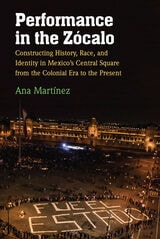
Performance in the Zócalo
Constructing History, Race, and Identity in Mexico's Central Square from the Colonial Era to the PresentAna Martínez
University of Michigan Press, 2020
A saying in Mexico City is “quien domina el centro, domina el país” (whoever dominates the center, dominates the country) as the Zócalo continues to act as the performative embodiment of Mexican society. This book highlights how particular performances build upon each other by recycling past architectures and performative practices for new purposes. Ana Martínez discusses the singular role of collective memory in creating meaning through space and landmarks, providing a new perspective and further insight into the problem of Mexico’s relationship with its own past. Rather than merely describe the commemorations, she traces the relationship between space and the invention of a Mexican imaginary. She also explores how indigenous communities, Mexico’s alienated subalterns, performed as exploited objects, exotic characters, and subjects with agency. The book’s dual purposes are to examine the Zócalo as Mexico’s central site of performance and to unmask, without homogenizing, the official discourse regarding Mexico’s natives. This book will be of interest for students and scholars in theater studies, Mexican Studies, Cultural Geography, Latinx and Latin American Studies.
Performance, Transparency, and the Cultures of Surveillance
James M. Harding
University of Michigan Press, 2018
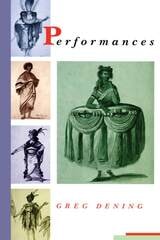
Performances
Greg Dening
University of Chicago Press, 1996
For Dening, history saturates every moment of our cultural and personal existence. Yet he is keenly aware that the actual past remains fundamentally irreplicable. All histories are culturally crafted artifacts, commensurate with folk tales, stage plays, or films. Whether derived from logbooks and letters, or displayed on music hall stages and Hollywood back lots, history is in essence our making sense of what has and continues to happen, creating for us a sense of our cultural and individual selves.
Through juxtapositions of actual events and creative reenactments of them—such as the mutiny on the Bounty in 1787 and the various Hollywood films that depict that event—Dening calls attention to the provocative moment of theatricality in history making where histories, cultures, and selves converge. Moving adeptly across varied terrains, from the frontiers of North America to the islands of the South Pacific, Dening marshals a striking array of diverse, often recalcitrant, sources to examine the tangled histories of cross-cultural clash and engagement. Refusing to portray conquest, colonization, and hegemony simply as abstract processes, Dening, in his own culturally reflexive performance, painstakingly evokes the flesh and form of past actors, both celebrated and unsung, whose foregone lives have become our history.
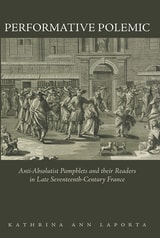
Performative Polemic
Anti-Absolutist Pamphlets and their Readers in Late Seventeenth-Century FranceKathrina Ann LaPorta
University of Delaware Press, 2021
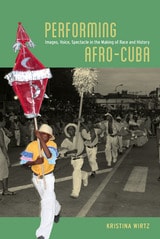
Performing Afro-Cuba
Image, Voice, Spectacle in the Making of Race and HistoryKristina Wirtz
University of Chicago Press, 2014
Wirtz analyzes a variety of performances and the ways they construct Cuban racial and historical imaginations. She offers a sophisticated view of performance as enacting diverse revolutionary ideals, religious notions, and racial identity politics, and she outlines how these concepts play out in the ongoing institutionalization of folklore as an official, even state-sponsored, category. Employing Bakhtin’s concept of “chronotopes”—the semiotic construction of space-time—she examines the roles of voice, temporality, embodiment, imagery, and memory in the racializing process. The result is a deftly balanced study that marries racial studies, performance studies, anthropology, and semiotics to explore the nature of race as a cultural sign, one that is always in process, always shifting.
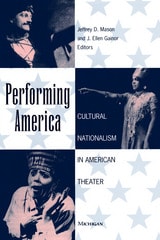
Performing America
Cultural Nationalism in American TheaterJeffrey D. Mason and J. Ellen Gainor, Editors
University of Michigan Press, 1999
Performing America provides fresh perspectives on the development of visions of both America and "America"--that is, the actual community and the constructed concept--on a variety of theatrical stages. It explores the role of theater in the construction of American identity, highlighting the tension between the desire to categorize American identity and the realization that such categorical uniformity may neither be desirable nor possible. The topics covered include the links between politics and the stage during the Federalist period, the appropriation of "Indian" artifacts, an exploration of early gender roles, and the metaphorical connections between the theater and western expansion. Other essays treat vaudeville's artistically colonized cultures; Chautauqua's attempt to homogenize culture and commercialize American ideals; W. E. B. Du Bois's pageant, The Star of Ethiopia, as a strategy for constructing "African-American" as "Other" in an attempt to promote a vision of black nationalism; and how theater was used to help immigrants form a new sense of community while joining the resident culture.The collection then turns to questions of how various ethnic minorities through their recent theatrical work have struggled to argue their identities, especially in relation to the dominant white culture. Two final essays offer critiques of contrasting aspects of the American male. Throughout, the collection addresses questions of marginality and community, exclusion and inclusion, colonialism and imperialism, heterogeneity and homogeneity, conflict and negotiation, repression and opportunity, failure and success, and, above all, the relationship of American stages at large. It will appeal to readers of a wide range of disciplines including history, American culture, gender studies, and theater studies.

Performing Captivity, Performing Escape
Cabarets and Plays from the Terezín/Theresienstadt GhettoEdited by Lisa Peschel
Seagull Books, 2014
The concentration camp and Jewish ghetto at Terezín, or Theresienstadt, in what is now the Czech Republic, was a site of enormous suffering, fear, and death. But amid this horrific period, there was also a thriving and desperately vibrant cultural life. While the children’s drawings and musical pieces created in the ghetto have become justly famous, the prisoners’ theatrical works, though a lesser-known aspect of their artistic endeavors, deserves serious attention as well.
Performing Captivity, Performing Escape collects twelve theatrical texts—cabaret songs and sketches, historical and verse dramas, puppet plays, and a Purim play—written by Czech and Austrian Jews. Together these works reveal the wide range of ways in which the prisoners engaged with and escaped from life in the ghetto through performance. The anthology opens with an insightful prologue by novelist Ivan Klíma, who was interned in the ghetto as a child and contains a detailed introduction by editor Lisa Peschel about the pre-war theatrical influences and wartime conditions that inspired the theater of the ghetto. The array of theatrical forms collected in this anthology speaks of the prisoners’ persistence of hope in a harrowing time and will be a moving read for students and scholars of the Holocaust.
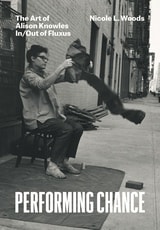
Performing Chance
The Art of Alison Knowles In/Out of FluxusNicole L. Woods
University of Chicago Press, 2026
Alison Knowles stands out as the sole female artist among the founders of Fluxus, yet she has remained an enigmatic, underrecognized figure in the history of art. Performing Chance fills a gap in the record, bringing to light Knowles’s transformative body of work as it evolved from abstract painting in the late 1950s, to silkscreens, print media, and performance in the early 1960s, to groundbreaking works in digital poetry, acoustical art, and large-scale installations in the late 1960s-70s.
Through her access to previously unpublished archival materials and direct interviews with the artist, Nicole L. Woods provides close readings of pivotal works, disclosing the ways Knowles instituted formal tactics that moved beyond modernist painting, championed principles of indeterminacy and chance, and fostered sociopolitical consciousness. Situating Knowles’s innovations in various media within the distinct cultural contexts of Wiesbaden, London, Paris, New York City, and Los Angeles, Performing Chance brings this key artist back to her rightful place as a leader of the postwar avant-garde and provides a nuanced history of the role of women artists in Fluxus and beyond.
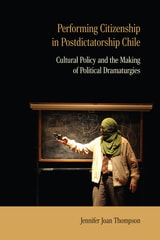
Performing Citizenship in Postdictatorship Chile
Cultural Policy and the Making of Political DramaturgiesJennifer Joan Thompson
Northwestern University Press, 2025
Offering a nuanced understanding of the performing arts’ relationship to politics
Through careful readings of key political performances in Chile's transition from military dictatorship to neoliberal democracy, Jennifer Joan Thompson examines how the production and aesthetics of theater are intertwined in processes of democratization, enactments of citizenship, and the development of cultural policy. Performing Citizenship in Postdictatorship Chile: Cultural Policy and the Making of Political Dramaturgies reveals how artists performed changing models of democratic citizenship. Thompson traces the ways artists confronted and resisted the military dictatorship of Augusto Pinochet, how they then reimagined the body politic during the early transitional period and challenged official constructions of history and memory as the transition to democracy progressed, how they critiqued Chile’s neoliberal economic model and its violence, and, finally, how they have made claims for feminist and Indigenous citizen subjectivities throughout Chile’s current social crisis. Incorporating archival and ethnographic research alongside readings of theatrical and political performances, this study offers a nuanced understanding of the performing arts’ relationship to politics, one that accounts for the ways artists and the state collaborate in the production of the political imagination.
Performing Commemoration
Musical Reenactment and the Politics of TraumaAnnegret Fauser and Michael A. Figueroa, editors
University of Michigan Press, 2020
Performing Drama/Dramatizing Performance
Alternative Theater and the Dramatic TextMichael Vanden Heuvel
University of Michigan Press, 1993

Performing Flight
From the Barnstormers to Space TourismScott Magelssen
University of Michigan Press, 2020
Performing History
Theatrical Representations of the Past in Conetmporary TheatreFreddie Rokem
University of Iowa Press, 2000
Performing Identities on the Restoration Stage
Cynthia Lowenthal
Southern Illinois University Press, 2002
In Performing Identities on the Restoration Stage, Cynthia Lowenthal explores identity—especially masculinity and femininity, English and “foreign,” middle-class and aristocratic—as it is enacted, idealized, deployed, and redefined on the late-seventeenth-century British stage. Particular emphasis is placed on the ways the theatre contributed to new and often shifting early modern definitions of the boundaries of nation, status, and gender.
The first portion of the book focuses on the playwrights’ presentations of idealized men and the comic ridicule of male bodies and behaviors that fall short of the ideal. Of special interest are those moments when playwrights use stereotypes of national character, particularly the Spaniards and Turks, as examples of the worst in male behavior, judgments that are always inflected with elements of class or status inconsistency.
The second portion of Lowenthal’s discussion focuses on playwrights’ attempts to redefine the idealized woman. Lowenthal investigates the ways that an extratheatrical discourse surrounding the actresses, one that essentialized them as sexual bodies demanding scrutiny and requiring containment, also serves to secure for them an equally essential aristocratic status. Anchored by Manley’s Royal Mischief, Lowenthal’s reading reveals that even a woman playwright’s attempts to represent female subjectivity or interiority at odds with the surfaces of the body are doomed to return to those same surfaces.
By focusing on a new, early modern lability of identity and by reading less canonical women playwrights, such as Manley and Pix, alongside established male playwrights such as Dryden and Wycherley, Performing Identities on the Restoration Stage yields both a more accurate and a more compelling picture of the cultural dynamics at work on the early modern stage.
Performing Math
A History of Communication and Anxiety in the American Mathematics ClassroomAndrew Fiss
Rutgers University Press, 2021
Performing Politics
Music and Theater in Berlin Around 1800Katherine Hambridge
University of Chicago Press, 2027
A new account of the emergence of modern cultural politics through a study of music and theater in Berlin around 1800.
Berlin around 1800 has been seen—at the time and since—as somewhat behind other major European cities in terms of its musical culture, peripheral to the momentous developments attributed to the period. By contrast, early nineteenth-century Berlin has been exhaustively studied as the site of a nascent German-national movement and the Prussian Reforms. In Performing Politics, Katherine Hambridge examines the confluence of music and politics in Berlin around 1800, engaging directly with the themes of being behind/ahead, central/peripheral, in order to tell new stories about nineteenth-century German history, musical and otherwise.
Performing Politics emphasizes events as much as repertoires, and non-canonical repertoires over the more familiar music of this period: dynastic birthday celebrations, the music of historical dramas, political song and communal singing, popular music theater. By focusing our attention on the unfamiliar specificity of Berlin Nationaltheater, Hambridge reenergizes our understanding of 1800–1815 as a key period in the development of musical and political modernity. Using sources largely unexploited by musicologists, and phenomena neglected by historians, she reveals the quotidian aesthetics, values, and practices that shaped both the sociopolitical narratives and musical developments of the time. Performing Politics is thus not only a history of music and theater in Berlin at a critical moment, but a music history of modern cultural politics.
Performing Populism
Visions of Spanish Politics from 15-M to PodemosRuben Perez Hidalgo
Vanderbilt University Press, 2023
The book's first part examines how the 15-M movement created a new way of seeing that in turn led to a new way of doing politics in Spain. Part Two focuses on the multiple ramifications of that new vision once the people stopped marching and the movement became less visible.
From electoral posters to fiction films, documentaries, and internet memes, Performing Populism traces the ways that collective Spanish identities evolved from a period when "the people" seemed to have been willingly subsumed under the apathetic ideation of the middle-class consumer to the moment in 2011 when a crisis of representation forced many into political consciousness. This rude awakening kickstarted the reconstruction of a Spanish "us" that staged exhibitions of popular will on par with and parallel to the Arab Spring, but in a European register that embraced the countercultural through art that disremembered its political past but could not escape the ghostly shadow of its history.
Performing Spanishness
History, Cultural Identity & Censorship in the Theatre of José María Rodríguez MéndezMichael Thompson
Intellect Books, 1995
José María Rodríguez Méndez is a noted playwright, an acerbic cultural critic, and a political dissident under Franco. In Performing Spanishness, the first English-language examination of Méndez’s life and work, Michael Thompson sets the playwright’s lifelong struggle against censorship in the context of Spain’s shifting national identity. Méndez’s work presents “Spanishness” not as a static trait, but as an ongoing performance; Performing Spanishness is an indispensable resource to those interested in theater, Spain, and the relationship between art and activism.
Performing Unification
History and Nation in German Theater after 1989Matt Cornish
University of Michigan Press, 2017
Performing the Greek Crisis
Navigating National Identity in the Age of AusterityNatalie Zervou
University of Michigan Press, 2024
Winner of the 2025 Dance Studies Association de la Torre Bueno Book Prize
Performing the Greek Crisis explores the impact of the Greek financial crisis (2009–19) on the performing arts sector in Greece, and especially on contemporary concert dance. When Greece became the first European Union member to be threatened with default, the resulting budget cuts pushed dance to develop in unprecedented directions. The book examines the repercussions that the crisis had on artists’ daily lives and experiences, weaving the personal with the political to humanize a phenomenon that, to date, had been examined chiefly through economic and statistical lenses. Informed by the author’s experience of growing up in Greece and including interviews and rich descriptions of performances, the book offers a glimpse into a pivotal moment in Greek history.
In Greece, dance (and, by extension, the body) has historically held a central role in the process of national identity construction. When the crisis broke out, artists had to navigate through a precariously fluctuating landscape, with their bodies as their only stable referent. By centering the analysis of the Greek crisis on the dancing bodies, Performing the Greek Crisis is able to examine the various ways that artists reconceptualized their history and reframed ideas of national belonging, race, citizenship, and immigration.
Performing the Intercultural City
Ric Knowles
University of Michigan Press, 2017
Performing the Progressive Era
Immigration, Urban Life, and Nationalism on StageMax Shulman and J. Chris Westgate
University of Iowa Press, 2019
Perfumed
The Story of Fragrance in the Ancient MediterraneanAnnette Giesecke
J. Paul Getty Trust, The, 0
A heady look at the fascinating world of perfumes, incense, and other aromatics in the ancient Mediterranean and their vibrant and sometimes violent history.
Perfumed invites you to breathe deeply and inhale the incense burning on the altars of the Greeks, perfumes sprinkled on spectators in Roman amphitheaters or wafting from the robes of Persian kings, and unguents filling Egyptian tombs. Though we don’t know who first burned a fragrant branch to perfume their dwelling or rubbed an aromatic petal against their skin, evidence demonstrates that such practices were ubiquitous by the Bronze Age.
- Opens with a richly illustrated overview of aromatics in Mesopotamia, Persia, Egypt, Greece, and Roman Italy.
- Explores the role fragrance played in all aspects of daily life and details major ingredients, including balsam, frankincense, rose, myrrh, saffron, and more.
- Features vivid passages from ancient sources, including perfume recipes and intriguing anecdotes such as the historian Herodotus’s account of winged serpents guarding frankincense trees in Arabia or Pliny the Elder’s claim that the emperor Nero burned a year’s harvest of frankincense for his wife’s funeral (after likely murdering her).
- Contains over 80 images drawn from a diverse range of ancient sources and archaeological evidence.
Experience the ancient world through its most evocative sense. Best-selling author Annette Giesecke’s Perfumed is essential reading for anyone with an interest in plants, perfumes, and other aromatics, as well as the rich, interrelated cultures of the Mediterranean.
Pericles on Stage
Political Comedy in Aristophanes' Early PlaysBy Michael Vickers
University of Texas Press, 1996
Since the eighteenth century, classical scholars have generally agreed that the Greek playwright Aristophanes did not as a matter of course write "political" plays. Yet, according to an anonymous Life of Aristophanes, when Dionysius the tyrant of Syracuse wanted to know about the government of Athens, Plato sent him a copy of Aristophanes' Clouds.
In this boldly revisionist work, Michael Vickers convincingly argues that in his earlier plays, Aristophanes in fact commented on the day-to-day political concerns of Athenians. Vickers reads the first six of Aristophanes' eleven extant plays in a way that reveals the principal characters to be based in large part on Pericles and his ward Alcibiades.
According to Vickers, the plays of Aristophanes—far from being nonpolitical—actually allow us to gauge the reaction of the Athenian public to the events that followed Pericles' death in 429 B.C., to the struggle for the political succession, and to the problems presented by Alcibiades' emergence as one of the most powerful figures in the state. This view of Aristophanes reaffirms the central role of allegory in his work and challenges all students of ancient Greece to rethink long-held assumptions about this important playwright.
Periklean Athens and Its Legacy
Problems and PerspectivesEdited by Judith M. Barringer and Jeffrey M. Hurwit
University of Texas Press, 2005
The late fifth century BC was the golden age of ancient Athens. Under the leadership of the renowned soldier-statesman Perikles, Athenians began rebuilding the Akropolis, where they created the still awe-inspiring Parthenon. Athenians also reached a zenith of artistic achievement in sculpture, vase painting, and architecture, which provided continuing inspiration for many succeeding generations.
The specially commissioned essays in this volume offer a fresh, innovative panorama of the art, architecture, history, culture, and influence of Periklean Athens. Written by leading experts in the field, the articles cover a wide range of topics, including:
- An evaluation of Perikles' military leadership during the early stages of the Peloponnesian War.
- Iconographical and iconological studies of vase paintings, wall paintings, and sculpture.
- Explorations of the Parthenon and other monuments of the Athenian Akropolis.
- The legacy of Periklean Athens and its influence upon later art.
- Assessments of the modern reception of the Akropolis.
As a whole, this collection of essays proves that even a well-explored field such as Periklean Athens can yield new treasures when mined by perceptive and seasoned investigators.
Perilous Memories
The Asia-Pacific War(s)T. Fujitani, Geoffrey M. White, Lisa Yoneyama, eds.
Duke University Press, 2001
Firmly based on the insight that memory is always mediated and that the past is not a stable object, the volume demonstrates that we can intervene positively yet critically in the recovery and reinterpretation of events and experiences that have been pushed to the peripheries of the past. The contributors—an international list of anthropologists, cultural critics, historians, literary scholars, and activists—show how both dominant and subjugated memories have emerged out of entanglements with such forces as nationalism, imperialism, colonialism, racism, and sexism. They consider both how the past is remembered and also what the consequences may be of privileging one set of memories over others. Specific objects of study range from photographs, animation, songs, and films to military occupations and attacks, minorities in wartime, “comfort women,” commemorative events, and postwar activism in pursuing redress and reparations.
Perilous Memories is a model for war memory intervention and will be of interest to historians and other scholars and activists engaged with collective memory, colonial studies, U.S. and Asian history, and cultural studies.
Contributors. Chen Yingzhen, Chungmoo Choi, Vicente M. Diaz, Arif Dirlik, T. Fujitani, Ishihara Masaie, Lamont Lindstrom, George Lipsitz, Marita Sturken, Toyonaga Keisaburo, Utsumi Aiko, Morio Watanabe, Geoffrey M. White, Diana Wong, Daqing Yang, Lisa Yoneyama
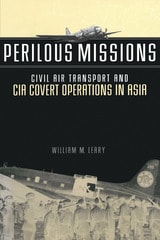
Perilous Missions
Civil Air Transport and CIA Covert Operations in AsiaWilliam M. Leary
University of Alabama Press, 2005
Civil Air Transport (CAT), founded in China after World War II by Claire Chennault and Whiting Willauer, was initially a commercial carrier specializing in air freight. Its role quickly changed as CAT became first a paramilitary adjunct of the Nationalist Chinese Air Force, then the CIA's secret "air force" in Korea, then "the most shot-at airline in the world" in French Indochina, and eventually becoming reorganized as Air America at the height of the Vietnam War. William M. Leary's detailed operational history of CAT sets the story in the perspective of Asian and Cold War geopolitics and shows how CAT allowed the CIA to operate with a level of flexibility and secrecy that it would not have attained through normal military or commercial air transportation.
Peripheral Nerve
Health and Medicine in Cold War Latin AmericaAnne-Emanuelle Birn and Raúl Necochea López
Duke University Press, 2020
Contributors. Cheasty Anderson, Anne-Emanuelle Birn, Katherine E. Bliss, Gilberto Hochman, Jennifer L. Lambe, Nicole Pacino, Carlos Henrique Assunção Paiva, Jadwiga E. Pieper Mooney, Raúl Necochea López, Marco A. Ramos, Gabriela Soto Laveaga
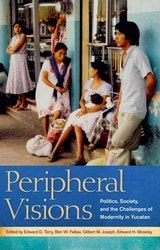
Peripheral Visions
Politics, Society, and the Challenges of Modernity in YucatanEdward D. Terry
University of Alabama Press, 2010
The essays in this collection illuminate both the processes of change and the negative reactions that they frequently elicited
Yucatan has been called “a world apart”—cut off from the rest of Mexico by geography and culture. Yet, despite its peripheral location, the region experienced substantial change in the decades after independence. As elsewhere in Mexico, apostles of modernization introduced policies intended to remold Yucatan in the image of the advanced nations of the day. Indeed, modernizing change began in the late colonial era and continued throughout the 19th century as traditional patterns of land tenure were altered and efforts were made to divest the Catholic Church of its wealth and political and intellectual influence. Some changes, however, produced fierce resistance from both elites and humbler Yucatecans and modernizers were frequently forced to retreat or at least reach accommodation with their foes.
Covering topics from the early 19th century to the late 20th century, the essays in this collection illuminate both the processes of change and the negative reactions that they frequently elicited. The diversity of disciplines covered by this volume—history, anthropology, sociology, economics—illuminates at least three overriding challenges for study of the peninsula today. One is politics after the decline of the Institutional Revolutionary Party: What are the important institutions, practices, and discourses of politics in a post-postrevolutionary era? A second trend is the scholarly demystification of the Maya: Anthropologists have shown the difficulties of applying monolithic terms like Maya in a society where ethnic relations are often situational and ethnic boundaries are fluid. And a third consideration: researchers are only now beginning to grapple with the region’s transition to a post-henequen economy based on tourism, migration, and the assembly plants known as maquiladoras. Challenges from agribusiness and industry will no doubt continue to affect the peninsula’s fragile Karst topography and unique environments.
Contributors: Eric N. Baklanoff, Helen Delpar, Paul K. Eiss, Ben W. Fallaw, Gilbert M. Joseph, Marie Lapointe, Othón Baños Ramírez, Hernán Menéndez Rodríguez, Lynda S. Morrison, Terry Rugeley, Stephanie J. Smith
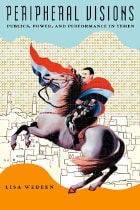
Peripheral Visions
Publics, Power, and Performance in YemenLisa Wedeen
University of Chicago Press, 2008
Lisa Wedeen, who spent a year and a half in Yemen observing and interviewing its residents, argues that national solidarity in such weak states tends to arise not from attachments to institutions but through both extraordinary events and the ordinary activities of everyday life. Yemenis, for example, regularly gather to chew qat, a leafy drug similar to caffeine, as they engage in wide-ranging and sometimes influential public discussions of even the most divisive political and social issues. These lively debates exemplify Wedeen’s contention that democratic, national, and pious solidarities work as ongoing, performative practices that enact and reproduce a citizenry’s shared points of reference. Ultimately, her skillful evocations of such practices shift attention away from a narrow focus on government institutions and electoral competition and toward the substantive experience of participatory politics.
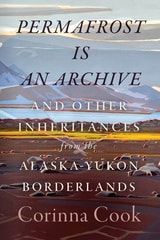
Permafrost Is an Archive
and Other Inheritances from the Alaska-Yukon BorderlandsCorinna Cook
West Virginia University Press, 2026
The Yukon Ice Patch Project reveals ancient lives. A road through the boreal forest reads like a map of climate upheaval. Those houses with broken doorknobs—a legacy of government regulation over Indigenous life. Corinna Cook, who was born white on Áak’w Kwáan Tlingit land in Juneau, Alaska, wrestles with the past and future into Canada’s Yukon Territory. With writing that blends research and reverie, her essays ask how we might come into right relations with our most difficult, shared histories. How can we carry the past together, in a good way, as the land melts? The answers—elusive as they are—carry global resonance, taking shape through a deeply personal lens combined with careful study of local arts, artifacts, maps, and the land we depend on.
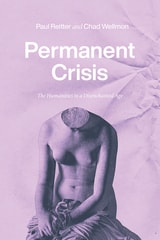
Permanent Crisis
The Humanities in a Disenchanted AgePaul Reitter and Chad Wellmon
University of Chicago Press, 2021
Leads scholars and anyone who cares about the humanities into more effectively analyzing the fate of the humanities and digging into the very idea of the humanities as a way to find meaning and coherence in the world.
The humanities, considered by many as irrelevant for modern careers and hopelessly devoid of funding, seem to be in a perpetual state of crisis, at the mercy of modernizing and technological forces that are driving universities towards academic pursuits that pull in grant money and direct students to lucrative careers. But as Paul Reitter and Chad Wellmon show, this crisis isn’t new—in fact, it’s as old as the humanities themselves.
Today’s humanities scholars experience and react to basic pressures in ways that are strikingly similar to their nineteenth-century German counterparts. The humanities came into their own as scholars framed their work as a unique resource for resolving crises of meaning and value that threatened other cultural or social goods. The self-understanding of the modern humanities didn’t merely take shape in response to a perceived crisis; it also made crisis a core part of its project. Through this critical, historical perspective, Permanent Crisis can take scholars and anyone who cares about the humanities beyond the usual scolding, exhorting, and hand-wringing into clearer, more effective thinking about the fate of the humanities. Building on ideas from Max Weber and Friedrich Nietzsche to Helen Small and Danielle Allen, Reitter and Wellmon dig into the very idea of the humanities as a way to find meaning and coherence in the world.
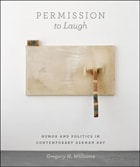
Permission to Laugh
Humor and Politics in Contemporary German ArtGregory H. Williams
University of Chicago Press, 2012
Permission to Laugh explores the work of three generations of German artists who, beginning in the 1960s, turned to jokes and wit in an effort to confront complex questions regarding German politics and history. Gregory H. Williams highlights six of them—Martin Kippenberger, Isa Genzken, Rosemarie Trockel, Albert Oehlen, Georg Herold, and Werner Büttner—who came of age in the mid-1970s in the art scenes of West Berlin, Cologne, and Hamburg. Williams argues that each employed a distinctive brand of humor that responded to the period of political apathy that followed a decade of intense political ferment in West Germany.
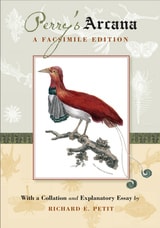
Perry's Arcana
A Facsimile EditionRichard E. Petit
Temple University Press, 2009
Now at last this neglected gem has been revived for scientists, students, and aficionados of natural history. New scholarship is combined with modern digital reproduction techniques to do full justice to the beautiful plates. An up-to-date account of all the species is given, along with a full collation and extensive notes, by the eminent natural historian Richard E. Petit.
The Arcana is technically interesting too, as its glowing plates were printed with variously colored inks to suppress their outlines. Its appeal will extend not only to academic libraries and scholars specializing in various branches of natural history and the history of science, but also to collectors of beautiful natural history books and enthusiasts of Regency Britain.

Persecution and Rescue
The Politics of the “Final Solution” in France, 1940-1944Wolfgang Seibel
University of Michigan Press, 2016
Drawing on German and French sources, Wolfgang Seibel traces the twisted process of political decision-making that shaped the fate of the Jews in German-occupied France during World War II. By analyzing the German-French negotiations, he reveals the underlying logic as well as the actual course of the bargaining process as both the Vichy Regime and the Germans sought a stable relationship. Yet that relationship was continually reshaped by the progress of the war, Germany’s deteriorating prospects, France’s economic and geopolitical position, and the Vichy government’s quest for domestic political support. The Jews’ suffering intensified when the Germans had the upper hand; but when the French felt empowered, the Vichy Regime stopped collaborating in the completion of the “final solution.” Persecution and Rescue: The Politics of the “Final Solution” in France, 1940–1944 demonstrates the ways in which political circumstances can mitigate—or foster—mass crime.
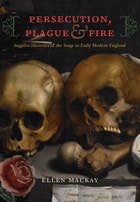
Persecution, Plague, and Fire
Fugitive Histories of the Stage in Early Modern EnglandEllen MacKay
University of Chicago Press, 2011
The theater of early modern England was a disastrous affair. The scant record of its performance demonstrates as much, for what we tend to remember today of the Shakespearean stage and its history are landmark moments of dissolution: the burning down of the Globe, the forced closure of playhouses during outbreaks of the plague, and the abolition of the theater by its Cromwellian opponents.
Persecution, Plague, and Fire is a study of these catastrophes and the theory of performance they convey. Ellen MacKay argues that the various disasters that afflicted the English theater during its golden age were no accident but the promised end of a practice built on disappearance and erasure—a kind of fatal performance that left nothing behind but its self-effacing poetics. Bringing together dramatic theory, performance studies, and theatrical, religious, and cultural history, MacKay reveals the period’s radical take on the history and the future of the stage to show just how critical the relation was between early modern English theater and its public.
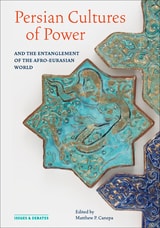
Persian Cultures of Power and the Entanglement of the Afro-Eurasian World
Matthew P. Canepa
J. Paul Getty Trust, The, 2024
With the rise of the Achaemenid Empire (550–330 BCE), Persian institutions of kingship became the model for legitimacy, authority, and prestige across three continents. Despite enormous upheavals, Iranian visual and political cultures connected an ever-wider swath of Afro-Eurasia over the next two millennia, exerting influence at key historical junctures. This book provides the first critical exploration of the role Persian cultures played in articulating the myriad ways power was expressed across Afro-Eurasia between the sixth century BCE and the nineteenth century CE.
Exploring topics such as royal cosmologies, fashion, banqueting, manuscript cultures, sacred landscapes, and inscriptions, the volume’s essays analyze the intellectual and political exchanges of art, architecture, ritual, and luxury material within and beyond the Persian world. They show how Perso-Iranian cultures offered neighbors and competitors raw material with which to formulate their own imperial aspirations. Unique among studies of Persia and Iran, this volume explores issues of change, renovation, and interconnectivity in these cultures over the longue durée.
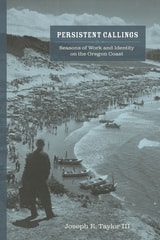
Persistent Callings
Seasons of Work and Identity on the Oregon CoastJoseph E. Taylor
Oregon State University Press, 2019
The Nestucca Valley is a small watershed, tucked away in one corner of a county in far western Oregon. There are no incorporated towns, and cows outnumber humans. It has long been a place without a written history, yet its past offers many surprising twists on received wisdom about rural economies. In crisp prose and succinct chapters, Persistent Callings carries readers from aboriginal times to the present, illustrating the wisdom of seasonal labor, the complex relationships between work and identity, and the resilience of rural economics across more than a century of almost continual change.
Life in this watershed, known to locals as “South County,” has always been demanding. Farming, fishing, and logging were difficult occupations, but work had deeper meanings. Challenges arrived in many forms, including climate shifts, market crashes, regulatory changes, and industry consolidations. Residents’ ability to innovate was their greatest resource, and their persistence helps us to recognize the callings they pursued.
During the late twentieth and early twenty-first centuries, disruptions came more quickly, and they coincided with infusions of capital that dramatically altered the structure of employment, with devastating results for the valley’s hardest working residents. Unemployment and poverty skyrocketed while health and life expectancy dropped to alarming levels. Moreover, the arrival of retirees and rise of environmental amenities actually exacerbated some ecological problems. Little in this history plays out as expected, and much of it will make readers reconsider how they think about the social, economic, and environmental contours of rural life in the American West.
Persistent Oligarchs
Elites and Politics in Chihuahua, Mexico 1910–1940Mark Wasserman
Duke University Press, 1993
Chihuahua boasted one of the strongest pre-revolutionary elite networks, the Terrazas-Creel family. Wasserman describes this group's efforts to maintain its power after the Revolution, including its use of economic resources and intermarriage to forge partnerships with the new, revolutionary elite. Together, the old and new elites confronted a national government that sought to reestablish centralized control over the states and the masses. Wasserman shows how the revolutionary government and the popular classes, joined in opposition to the challenge of the elites, finally formalized into a national political party during the 1930s.
Persistent Oligarchs concludes with an account of the Revolution's ultimate outcome, largely accomplished by 1940: the national government gaining central control over politics, the popular classes obtaining land redistribution and higher wages, and regional elites, old and new, availing themselves of the great opportunities presented by economic development. A complex analysis of revolution as a vehicle for both continuity and change, this work is essential to an understanding of Mexico and Latin America, as well as revolutionary politics and history.
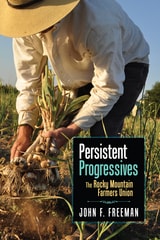
Persistent Progressives
The Rocky Mountain Farmers UnionJohn F. Freeman
University Press of Colorado, 2015
Using data spanning decades, author John Freeman covers the founding of the RMFU in 1907 until the present, demonstrating how members continually sought to control the means of production and marketing by forming cooperatives, providing consumer services, and engaging in politics. Powering this evolution was a group of “practical idealists”—the Farmers Union leaders and titular persistent progressives who shaped the organization’s growth and expansion. Initiated by Jim Patton, who brought the organization out of its oppositional roots and into its cooperative advocacy, the RMFU passed to John Stencel and then David Carter, joining hands with agricultural conservationists and small organic producers along the way to carry the torch for progressive agrarianism in today’s urbanized world. Shaken but undeterred by some notable failures, its leadership remains convinced of the efficacy of cooperatives as a means to achieve justice for all.
Discussing the broader social, economic, political, and environmental issues related to farming, ranching, and urbanization, Persistent Progressives seamlessly blends regional history with ongoing issues of agricultural and economic development.
Persisting Pandemics
Syphilis, AIDS, and COVIDPowel H. Kazanjian
Rutgers University Press, 2025
Person, Being, and History
Michael Baur
Catholic University of America Press, 2011