Results by title
5448 books match the query 'History and criticism' and 305 start with p
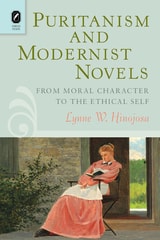
Puritanism and Modernist Novels
From Moral Character to the Ethical SelfLynne W. Hinojosa
The Ohio State University Press, 2015
In Puritanism and Modernist Novels: From Moral Character to the Ethical Self, Lynne W. Hinojosa complicates traditional interpretations of the novel and literary modernism as secular developments of modernity by arguing that the British novel tradition is fundamentally shaped by Puritan hermeneutics and Bible-reading practices. This tradition, however, simultaneously works to dismantle the categories associated with social morality and moral character, helping to form “Puritanism” into a fictional stereotype. Hinojosa demonstrates that the novel thus perpetuates a narrative that associates Puritanism with moral and religious confinement, on the one hand, and modern longing with escape, on the other—even as it remains tied to Puritan views of history and the self.
Puritanism and Modernist Novels offers new formal and contextual readings of early modernist novels by Oscar Wilde, E. M. Forster, James Joyce, and Ford Madox Ford. Hinojosa demonstrates that, while they long for escape, these authors still question the value of the novelistic narrative of confinement and escape. Bridging modernist and novel studies, Puritanism and Modernist Novels contributes to conversations about secularization and religion in both fields, highlighting the limitations created by the secularization narrative of modernity.
Puritanism and Modernist Novels offers new formal and contextual readings of early modernist novels by Oscar Wilde, E. M. Forster, James Joyce, and Ford Madox Ford. Hinojosa demonstrates that, while they long for escape, these authors still question the value of the novelistic narrative of confinement and escape. Bridging modernist and novel studies, Puritanism and Modernist Novels contributes to conversations about secularization and religion in both fields, highlighting the limitations created by the secularization narrative of modernity.
[more]
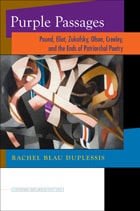
Purple Passages
Pound, Eliot, Zukofsky, Olson, Creeley, and the Ends of Patriarchal PoetryRachel Blau DuPlessis
University of Iowa Press, 2012
What is patriarchal poetry? How can it be both attractive and tempting and yet be so hegemonic that it is invisible? How does it combine various mixes of masculinity, femininity, effeminacy, and eroticism? At once passionate and dispassionate, Rachel Blau DuPlessis meticulously outlines key moments of choice and debate about masculinity among writers as disparate as Ezra Pound, T. S. Eliot, Louis Zukofsky, Charles Olson, Robert Creeley, and Allen Ginsberg, choices that construct consequential models for institutions of poetic practice.
As DuPlessis writes, “There are no genderless subjects in any relationship structuring literary culture: not in production, dissemination, or reception; not in objects, discourses, or practices; not in reading experiences or in interpretations.” And, as she reveals in careful and enthralling detail, for the poets at the center of this book, questions of masculinity loomed large and were continuously articulated in their self-creation as writers, in literary bonding, and in its deployment.
These gender-laden choices, debates, and contradictions all have a striking influence today. In this empathic yet critical historical polemic, DuPlessis reveals the outcomes of these many investments in the radical reconstruction of masculinity, in their strains, incompleteness, tensions—and failures. At the heart of modernist maleness and poetic practices are contradictions and urgencies, gender ideas both progressive and defensive.In a striking book on male behavior in poetic dyads, the third book in a feminist critical trilogy, DuPlessis tracks the poetic debates and arguments about gender that continuously affirm patriarchal poetry.
[more]
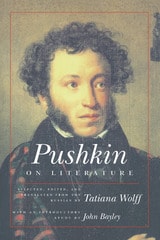
Pushkin on Literature
Tatiana Wolff
Northwestern University Press, 1998
Pushkin on Literature approaches Pushkin's literary accomplishment from a unique perspective: it focuses on Pushkin the critic, and on his passionate enthusiasm, volatile judgments, joy, frustration, and fascination with the literary world that surrounded him. This is the only English-language edition of the complete set of Pushkin's critical writing, both on his own work and on the wide range of European literature--Byron, Shakespeare, Voltaire, Milton--which he read and studied, and which so profoundly influenced his own writing.
[more]
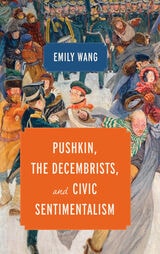
Pushkin, the Decembrists, and Civic Sentimentalism
Emily Wang
University of Wisconsin Press, 2023
In December 1825, a group of liberal aristocrats, officers, and intelligentsia mounted a coup against the tsarist government of Russia. Inspired partially by the democratic revolutions in the United States and France, the Decembrist movement was unsuccessful; however, it led Russia’s civil society to new avenues of aspiration and had a lasting impact on Russian culture and politics. Many writers and thinkers belonged to the conspiracy while others, including the poet Alexander Pushkin, were loosely or ambiguously affiliated. While the Decembrist movement and Pushkin’s involvement has been well covered by historians, Emily Wang takes a novel approach, examining the emotional and literary motivations behind the movement and the dramatic, failed coup.
Through careful readings of the literature of Pushkin and others active in the northern branch of the Decembrist movement, such as Kondraty Ryleev, Wilhelm Küchelbecker, and Fyodor Glinka, Wang traces the development of “emotional communities” among the members and adjacent writers. This book illuminates what Wang terms “civic sentimentalism”: the belief that cultivating noble sentiments on an individual level was the key to liberal progress for Russian society, a core part of Decembrist ideology that constituted a key difference from their thought and Pushkin’s. The emotional program for Decembrist community members was, in other ways, a civic program for Russia as a whole, one that they strove to enact by any means necessary.
Through careful readings of the literature of Pushkin and others active in the northern branch of the Decembrist movement, such as Kondraty Ryleev, Wilhelm Küchelbecker, and Fyodor Glinka, Wang traces the development of “emotional communities” among the members and adjacent writers. This book illuminates what Wang terms “civic sentimentalism”: the belief that cultivating noble sentiments on an individual level was the key to liberal progress for Russian society, a core part of Decembrist ideology that constituted a key difference from their thought and Pushkin’s. The emotional program for Decembrist community members was, in other ways, a civic program for Russia as a whole, one that they strove to enact by any means necessary.
[more]
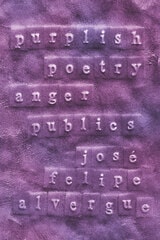
purplish
poetry anger publicsJosé Felipe Alvergue
University of Iowa Press, 2025
José Felipe Alvergue examines anger in American poetry, while reflecting on the permissible/policed cultural affects of our time. By way of BIPOC and QTPOC poets engaging with negativity—frustration, anger, distress—Alvergue argues that affects that reflect a counternarrative to benevolence challenge the colonial underpinnings of “American publics” as a concept of democratic participation and practice of community. Purple politics play out daily within spaces we rely on for shared comfort and belonging, namely neighborhoods, dinner tables, school board meetings, and social media. Purplish America describes the uncertain terrain of potential violence, potential conflict, distrust, and post-factualism upon which language and soma are still expected to thrive.
purplish challenges the idea of an objective or unbiased cultural rationale to purple regions in America by historicizing how anger has been systemically cleansed from the collective sentiments regarding nation-building throughout key moments of our national heritage.
purplish challenges the idea of an objective or unbiased cultural rationale to purple regions in America by historicizing how anger has been systemically cleansed from the collective sentiments regarding nation-building throughout key moments of our national heritage.
[more]