Results by title
22279 books match the query 'Social Science' and 1104 start with p

Personal Names in Asia
History, Culture and IdentityEdited by Yangwen Zheng and Chales J-H MacDonald
National University of Singapore Press, 2009

Personal Style Blogs
Appearances That FascinateRosie Findlay
Intellect Books, 2017
The book charts the development of the style blogosphere and its transformation from an alternative, experimental space to one dominated by the fashion industry. Complete with examples of several famous fashion bloggers, such as Susie Lau, Rumi Neely, and Tavi Gevinson, the author explores notions of individuality, aesthetics, and performance on both sides of the digital platform. Findlay asks: what can style blogging teach us about women’s writing and the performance of a private self online? And what drives style bloggers to carve a space for themselves online?
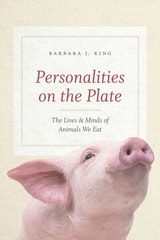
Personalities on the Plate
The Lives and Minds of Animals We EatBarbara J. King
University of Chicago Press, 2017
Yet that realization hasn’t yet made its presence felt to any great degree in our most intimate relationship with animals: at the dinner table. Sure, there are vegetarians and vegans all over, but at the same time, meat consumption is up, and meat remains a central part of the culinary and dining experience for the majority of people in the developed world.
With Personalities on the Plate, Barbara King asks us to think hard about our meat eating--and how we might reduce it. But this isn’t a polemic intended to convert readers to veganism. What she is interested in is why we’ve not drawn food animals into our concern and just what we do know about the minds and lives of chickens, cows, octopuses, fish, and more. Rooted in the latest science, and built on a mix of firsthand experience (including entomophagy, which, yes, is what you think it is) and close engagement with the work of scientists, farmers, vets, and chefs, Personalities on the Plate is an unforgettable journey through the world of animals we eat. Knowing what we know--and what we may yet learn--what is the proper ethical stance toward eating meat? What are the consequences for the planet? How can we life an ethically and ecologically sound life through our food choices?
We could have no better guide to these fascinatingly thorny questions than King, whose deep empathy embraces human and animal alike. Readers will be moved, provoked, and changed by this powerful book.
Personality and the Cultural Construction of Society
Edited by David K. Jordan and Marc J. Swartz
University of Alabama Press, 1990
Pyschological anthropology is a vital area of contemporary social science, and one of the field's most important and innovative thinkers is Melford E. Spiro. This volume brings together sixteen essays that review Spiro's theoretical insights and extend them into new areas. The essays center on several general problems: In what ways is it meaningful to speak of a social act as having "functions"? What elements and processes of human personality are universal, and why? What is the relationship between religion and personality? Why? What are the pyschological underpinnings of social manipulation?

Perspectives of Black Popular Culture
Harry B. Shaw
University of Wisconsin Press, 1990
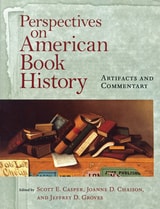
Perspectives on American Book History
Artifacts and CommentaryScott E. Casper
University of Massachusetts Press, 2002
A collection of primary source materials and original essays, Perspectives on American Book History is the first text designed for the growing number of courses in American print culture, as well as a unique supplement for courses in American literature and history. It seeks to fill the void that has developed as the expanding history of the book has moved out of the archive and scholarly journal and into the classroom. The volume includes an introductory essay by Robert A. Gross, chair of the program in the history of the book at the American Antiquarian Society, fourteen chapters composed of primary artifacts and original essays by rising scholars in the field, and an annotated bibliography of research sources.
Chapters trace topics in American print culture from Puritan New England to the future of newspapers in a digital age. The artifacts and documents, most of which have never before been anthologized, include excerpts from readers' diaries, accounts of the printing and publishing trades, materials from the alternative press, commentaries on authorship and reading, and visual images. The essays place these primary source materials in their historical, literary, and political contexts and model the ways students might approach them.
In addition to the editors and Robert A. Gross, the contributors are Nancy Cook, Patricia Crain, Ann Fabian, Alice Fahs, Ellen Gruber Garvey, Jen A. Huntley-Smith, Charles Johanningsmeier, Jill Lepore, Russell L. Martin, Trysh Travis, Glenn Wallach, and Susan S. Williams.
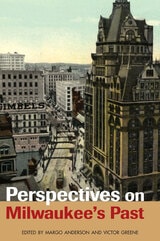
Perspectives on Milwaukee's Past
Edited by Margo Anderson and Victor Greene
University of Illinois Press, 2008
In this volume, a diverse group of scholars explores key themes in the distinctive history of Milwaukee, from settlement to the present, both in terms of the area's internal development and its comparative standing with other Great Lakes cities. Contributors discuss the importance of socialism and labor in local politics; Milwaukee's ethnic diversity, including long-standing African American, Latino, and Asian communities as well as an unusually large and significant German American population; the function and origins of the city's residential architecture; and the role of religious and ethnic culture in forming the city's identity. Rich in detail, the essays also challenge readers and researchers to pursue additional research on the city and the region by identifying critical areas and methods for future investigations into Milwaukee's past.
Contributors are Margo Anderson, Steven M. Avella, John D. Buenker, Jack Dougherty, Eric Fure-Slocum, Victor Greene, Thomas C. Hubka, Judith T. Kenny, Genevieve G. McBride, Aims McGuinness, Anke Ortlepp, Joseph A. Rodriguez, and N. Mark Shelley.
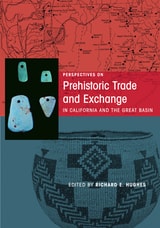
Perspectives on Prehistoric Trade and Exchange in California and the Great Basin
Richard E. Hughes
University of Utah Press, 2011
How does prehistoric material get from its place of origin to its location of archaeological recovery? While this question may seem basic, a moment’s reflection suggests that the answers carry important implications for arc-haeological interpretation about social organization, settlement, and subsistence practices. Archaeologists know much about the temporal and spatial distribution of materials in prehistoric western North America, but comparatively little has emerged regarding the causes of such distributions. Trade and exchange, mobility, and direct access all have been credited with observed distributions, but the reasons for settling on specific behavioral linkages is rarely made clear.
This volume investigates the circumstances and conditions under which trade/exchange, direct access, and/or mobility best account for material conveyance across varying distances at different times in the past. Each chapter contextualizes distributional and chemical data, evaluates competing distribution hypotheses, and addresses the reasoning and inferences employed to arrive at conclusions about the human behaviors responsible for the distributions of materials. Contributors showcase a range of diverse and creative ways of thinking about these issues in the California and Great Basin archaeological record, and why it matters.

Perspectives on the Human Genome Project and Genomics
Christopher R. Donohue
University of Minnesota Press, 2026
Interdisciplinary voices reflect on some of the most complex and consequential scientific undertakings of our time
Perspectives on the Human Genome Project and Genomics is a groundbreaking volume that examines the pivotal roles of the National Institutes of Health (NIH) and the National Human Genome Research Institute (NHGRI) in the Human Genome Project (HGP) and the development of other major genomics projects. Drawing on newly uncovered archival materials and oral histories from NHGRI, this volume offers a multifaceted narrative of transformative scientific achievements of the twentieth and twenty-first centuries.
Coeditors Christopher R. Donohue and Alan C. Love bring together a range of perspectives on the HGP’s progress and legacy, as well as other major genomics projects, to explore not only their scientific achievements but also their social and political dimensions. Presenting reflections from historians, philosophers, and sociologists alongside those of key NHGRI scientists like Eric Green, Mark Guyer, and Elise Feingold; experts like Nature editor-in-chief Magdalena Skipper and geneticist Eric Vilain; and scholars of the ethical, legal, and social implications of genomics like Jean McEwan and Joy Boyer, Perspectives on the Human Genome Project and Genomics highlights the international, interdisciplinary collaborations and collective long view that underpinned these genomics initiatives aimed at a better understanding of our basic biology and genetic diseases.
From genomic variation and sequencing technologies to the integration of big data and the influence of ancestry and gender, this book is an essential resource for deepening the discussion of the scientific, historical, and ethical impacts of genomics and a fascinating collection of insights into coordinated science in the making.
Contributors: Rina Bliss, Joy Boyer, Lisa D. Brooks, Michel Dubois, Elise A. Feingold, Adam Felsenfeld, Miguel García-Sancho, Eric D. Green, Catherine Guaspare, Chris Gunter, Stephan Guttinger, Mark Guyer, Elke Jordan, Jonathan E. LoTempio Jr., Jean McEwen, Jane Peterson, Anya Plutynski, Ramya M. Rajagopalan, Emanuele Ratti, Sahotra Sarkar, Jeffery A. Schloss, Magdalena Skipper, Alexandra Soulier, Thomas Stoeger, Eric Vilain, Kris A. Wetterstrand.
Retail e-book files for this title are screen-reader friendly with images accompanied by short alt text and/or extended descriptions.

Peruvian Lives across Borders
Power, Exclusion, and HomeM. Cristina Alcalde
University of Illinois Press, 2018
Alcalde draws on interviews, surveys, participant observation, and textual analysis to argue that to belong is to exclude. To that end, transnational Peruvians engage in both subtle and direct policing along the borders of belonging. These acts allow them to claim and maintain the social status they enjoyed in their homeland even as they profess their openness and tolerance. Alcalde details these processes and their origins in Peru's gender, racial, and class hierarchies. As she shows, the idea of return—whether desired or rejected, imagined or physical—spurs constructions of Peruvianness, belonging, and home.
Deeply researched and theoretically daring, Peruvian Lives across Borders answers fascinating questions about an understudied group of migrants.
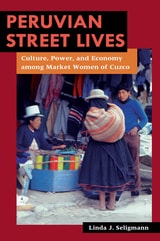
Peruvian Street Lives
Culture, Power, and Economy among Market Women of CuzcoLinda J. Seligmann
University of Illinois Press, 2004
In Peruvian Street Lives, Seligmann argues that the sometimes invisible and informal economic, social, and political networks market women establish may appear disorderly and chaotic, but in fact often keep dysfunctional economies and corrupt bureaucracies from utterly destroying the ability of citizens to survive from day to day. Seligmann asks why the constructive efforts of market women to make a living provoke such negative social perceptions from some members of Peruvian society, who see them as symbols and actual catalysts of social disorder. At the same time, Seligmann shows how market women eke out a living, combat discrimination, and transgress racial and gender ideologies within the rich and expressive cultural traditions they have developed.

Peruvians in Paterson
Building Businesses and CommunityGianncarlo Muschi
Rutgers University Press, 2027
Peruvians were among the first Latinos to arrive in Paterson and other cities in New Jersey during the post-WW II period. Over successive generations, they established a prosperous ethnic enclave that contributed to Paterson’s socioeconomic renewal. Yet their migration experience has remained relatively unexamined by scholars. This book examines the role of entrepreneurship and informality in the emergence and evolution of the Peruvian community of Paterson. It highlights the historical significance of the establishment of small businesses and social organizations as important cultural elements that validated their physical presence in the area. By uncovering the diverse strategies that Peruvians utilized for building a community, Muschi contends that their culture of informality and resourcefulness paved the way for their economic advancement and the consolidation of the Peruvian community. This book also shows that the informal economic practices introduced by Peruvians altered the social and economic landscape of Paterson and contributed to the revitalization of the local economy. Through the examination of oral histories, archival material from local newspapers, and memoirs declassified by the Peruvian consulate, the author challenges the oversimplified portrayal of Latinos as blue- collar workers with few opportunities for socioeconomic advancement. Peruvians in Paterson demonstrates that Latino migrants achieve wealth and ethnic empowerment in the process of adjustment and community building, suggesting new lines for future research.
Pervasive Prejudice?
Unconventional Evidence of Race and Gender DiscriminationIan Ayres
University of Chicago Press, 2001
In Pervasive Prejudice? Ian Ayres confronts these questions and more. In a series of important studies he finds overwhelming evidence that in a variety of markets—retail car sales, bail bonding, kidney transplantation, and FCC licensing—blacks and females are consistently at a disadvantage. For example, when Ayres sent out agents of different races and genders posing as potential buyers to more than 200 car dealerships in Chicago, he found that dealers regularly charged blacks and women more than they charged white men. Other tests revealed that it is commonly more difficult for blacks than whites to receive a kidney transplant because of federal regulations. Moreover, Ayres found that minority male defendants are frequently required to post higher bail bonds than their Caucasian counterparts.
Traditional economic theory predicts that free markets should drive out discrimination, but Ayres's startling findings challenge that position. Along with empirical research, Ayres offers game—theoretic and other economic methodologies to show how prejudice can enter the bargaining process even when participants are supposedly acting as rational economic agents. He also responds to critics of his previously published studies included here. These studies suggest that race and gender discrimination is neither a thing of the past nor merely limited to the handful of markets that have been the traditional focus of civil rights laws.
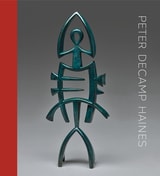
Peter DeCamp Haines
Sculpture, 1975–2024Peter DeCamp Haines
The Artist Book Foundation, 2025
The first major monograph on Peter DeCamp Haines, this title explores how the sculptor's interest in psychology and anthropology deeply informed his art.
This book is the first major monograph on the work of Peter DeCamp Haines (March 27, 1942–October 25, 2024), which builds on the evolution of Modernism as much as it harkens back to the Bronze Age. The clearest expression of this is a series of 1,000 elemental bronze “artifacts” he created over the course of nearly fifty years, to which he contributed yearly, ranging from palm-size pieces to colossal outdoor works. He called this output “a personal archaeology,” or “an archaeology of the subconscious,” referencing ancient tools, animal and human shapes, and the synchronicity of antique forms with the purely abstract.
Haines’s interest in psychology and anthropology deeply informed his art. Working in a Modernist tradition, his career pursued a continuing exploration of the formal attributes of sculpture: form, scale, negative space, and composition. As Haines saw it, one of the satisfactions of sculpture is that ideas such as wholeness, beauty, and timelessness can be expressed without words and one of the critical elements of this wordless communication is negative space. Thus, the doorways, windows, and silhouettes of his sculptures can suggest an area larger than the sculpture itself.
Petersburg
The Physiology of a CityThomas Gaiton Marullo
Northwestern University Press, 2009
Petrochemical Planet
Multiscalar Battles of Industrial TransformationAlice Mah
Duke University Press, 2023
Petroforms
Oil and the Shaping of Nigerian AestheticsHelen Kapstein
West Virginia University Press, 2025
2026 PROSE Award Finalist, Humanities: Literature
Petroforms contributes a much-needed theory of form and genre to the cutting-edge field of petrocriticism, itself an offshoot of developments in postcolonial ecocriticism. Studies of resource fiction and inquiries in the energy humanities have recently taken their rightful place as necessary reflections on the role of the literary imagination in intervening in the Anthropocene as we find ourselves precariously placed in the face of a fossil fuel crisis, climate change, and mass extinctions.
With Petroforms, Helen Kapstein undertakes close readings of a range of Nigerian aesthetic forms: short stories, romance novels, documentary film, the “Nollywood” film industry, fine art sculpture, and poetry. She uses these forms to argue that the demands of paying attention to petroleum extraction, production, consumption, and distribution in the creation of resource fictions must necessarily alter and affect conventional forms and structures. What results is a new set of genre-bending forms, like documentary film that we can read as horror, in response to the forceful and fluid demands of the petroleum industry and its master narrative.
Nigeria is one of the world’s largest oil-producing nations, in which that production is concentrated in the Niger Delta, resulting in a local environment that has been steadily degraded by oil spills, flares, pollution, and contamination, and a local culture shaped by false scarcity in a space of abundance, murderous politics, and escalating violence. At the same time as the Niger Delta grounds Kapstein’s argument in its own political realities and cultural responses, Nigeria’s participation in a global economy of petrodependency allows her theory of petroforms to be extended and applied more generally.
What Peter Hitchcock calls “oil’s generative law” is that it is “everywhere and obvious, it must be opaque or otherwise fantastic.” He means the coexistence of oil’s taken-for-granted qualities is something constitutive of every level of everyday life and its spectacular displays—gushers, spills, explosions. Oil’s nature, the fact that it is everywhere, unctuously oozing into every corner of everyday life, means that it constantly spills over out of our existing forms, genres, and systems, demanding accommodation. To try to contain it, we create new forms. Thus, a petroform is simultaneously reactionary (a necessary response to oil’s pressures, a by-product of the commodity itself) and resistant (an attempt at containment, at generating a retort to the very thing that shapes it). Each form figures oil and then configures and reconfigures itself in reaction to it.
Petroglyphs, Pictographs, and Projections
Native American Rock Art in the Contemporary Cultural LandscapeRichard A. Rogers
University of Utah Press, 2018
Neither archaeological interpretations nor commercial reproductions of rock art operate in a cultural vacuum. Both the motivation to seek out rock art and the specific meanings attached to it are deeply embedded in narratives about Native Americans already created by anthropologists, archaeologists, photographers, novelists, film and television producers, the tourism industry, and New Age discourse. For those interested in rock art as a window into indigenous cultures of the past, our contemporary projections of meanings are of great concern. Applying the tools of critical/cultural studies to both academic and popular discourse, Rogers explores the implications of such projections for rock art studies, contemporary gender dynamics, and the neocolonial relationship between Euro-Americans and Native Americans.
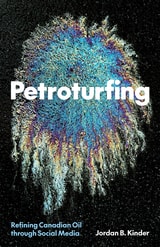
Petroturfing
Refining Canadian Oil through Social MediaJordan B. Kinder
University of Minnesota Press, 2024
How social media has become a critical tool for advancing the interests of the Canadian oil industry
Petroturfing presents an incisive look into how Canada’s pro-oil movement has leveraged social media to rebrand the extractive economy as a positive force. Adapting its title from the concept of astroturfing, which refers to the practice of disguising political and corporate media campaigns as grassroots movements, the book exposes the consequences of this mutually informed relationship between social media and environmental politics.
Since the early 2010s, an increasingly influential network of pro-oil groups, organizations, and campaigns has harnessed social media strategies originally developed by independent environmental organizations in order to undermine resistance to the fossil fuel industry. Situating these actions within the broader oil culture wars that have developed as an outgrowth of contemporary right-wing media, Petroturfing details how this coalition of groups is working to reform the public view of oil extraction as something socially, economically, and ecologically beneficial.
By uncovering these concerted efforts to influence the “energy consciousness,” Jordan B. Kinder reveals the deep divide between Canada’s environmentally progressive reputation and the economic interests of its layers of government and private companies operating within its borders. Drawing attention to the structures underlying online political expression, Petroturfing highlights the limitations of social media networks in the work of promoting environmental justice and contributing to a more equitable future.
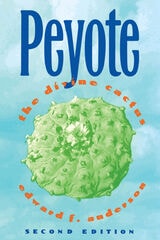
Peyote
The Divine CactusEdward F. Anderson
University of Arizona Press, 1996
What is it in peyote that causes such unusual effects? Can modern medical science learn anything from Native Americans’ use of peyote in curing a wide variety of ailments? What is the Native American Church, and how do its members use peyote? Does anyone have the legal right to use drugs or controlled substances in religious ceremonies?
Within this volume are answers to these and dozens of other questions surrounding the controversial and remarkable cactus. Greatly expanded and brought up-to-date from the 1980 edition, these pages describe peyote ceremonies and the users’ experiences, and also cover the many scientific and legal aspects of using the plant. Well written, informative, comprehensive, and enlightening, the book will be welcomed by counselors, anthropologists, historians, physicians, chemists, lawyers, and observers of the contemporary drug scene, as well as by interested general readers.
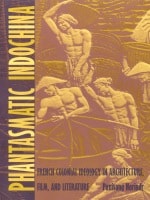
Phantasmatic Indochina
French Colonial Ideology in Architecture, Film, and LiteraturePanivong Norindr
Duke University Press, 1996
Analyzing the first Exposition Coloniale Internationale, held in Paris in 1931, Norindr shows how the exhibition’s display of architecture gave a vision to the colonies that justified France’s cultural prejudices, while stimulating the desire for further expansionism. He critiques the Surrealist counter-exposition mounted to oppose the imperialist aims of the Exposition Coloniale, and the Surrealist incorporation and appropriation of native artifacts in avant-garde works. According to Norindr, all serious attempts at interrogating French colonial involvement in Southeast Asia are threatened by discourse, images, representations, and myths that perpetuate the luminous aura of Indochina as a place of erotic fantasies and exotic adventures. Exploring the resilience of French nostalgia for Indochina in books and movies, the author examines work by Malraux, Duras, and Claudel, and the films Indochine, The Lover, and Dien Bien Phu.
Certain to impact across a range of disciplines, Phantasmatic Indochina will be of interest to those engaged in the study of the culture and history of Vietnam, Cambodia, Thailand, and Laos, as well as specialists in the fields of French modernism, postcolonial studies, cultural studies, and comparative literature.
Phantom Politics
Bots, Humans, AI, and Social MediaMina Momeni
Rutgers University Press, 2027
Phantom Politics develops a new framework for understanding how humans, bots, and AI systems interact on social media platforms and structure political communication. Focusing primarily on X (formerly Twitter), it analyzes three cases: the 2017 Women’s March, the 2019 “Build the Wall” discourse, and U.S. federal election discourse in 2024, to demonstrate how X functions not only as a mirror of political trends but also as a driver of change in the digital public sphere. The book shows how political participation is shaped by both authentic political expression and bot-driven narratives. It introduces new concepts to explain how AI-generated political speech can appear human while remaining detached from a human speaker, raising urgent questions about agency, accountability, and political voice. At a time when AI technologies are becoming increasingly integrated into public life, the book examines how emerging forms of automation are reshaping democratic discourse, challenging traditional understandings of participation, and transforming the ways political ideas circulate, gain visibility, and influence public debate.
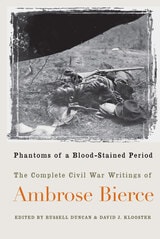
Phantoms of a Blood-Stained Period
The Complete Civil War Writings of Ambrose BierceJames Russell Duncan
University of Massachusetts Press, 2002
Pharmocracy
Value, Politics, and Knowledge in Global BiomedicineKaushik Sunder Rajan
Duke University Press, 2017
Phenomenal Blackness
Black Power, Philosophy, and TheoryMark Christian Thompson
University of Chicago Press, 2022
Phenomenal Blackness examines the changing interdisciplinary investments of key mid-century Black writers and thinkers, including the growing interest in German philosophy and critical theory. Mark Christian Thompson analyzes this shift in intellectual focus across the post-war decades, placing Black Power thought in a philosophical context.
Prior to the 1960s, sociologically oriented thinkers such as W. E. B. Du Bois had understood Blackness as a singular set of socio-historical characteristics. In contrast, writers such as Amiri Baraka, James Baldwin, Angela Y. Davis, Eldridge Cleaver, and Malcolm X were drawn to notions of an African essence, an ontology of Black being. With these perspectives, literary language came to be seen as the primary social expression of Blackness. For this new way of thinking, the works of philosophers such as Adorno, Habermas, and Marcuse were a vital resource, allowing for continued cultural-materialist analysis while accommodating the hermeneutical aspects of Black religious thought. Thompson argues that these efforts to reimagine Black singularity led to a phenomenological understanding of Blackness—a “Black aesthetic dimension” wherein aspirational models for Black liberation might emerge.

Phenomenal Justice
Violence and Morality in ArgentinaEva van Roekel
Rutgers University Press, 2020
Short-listed for the Juan E. Méndez Book Award for Human Rights in Latin America from Duke University Libraries
How do victims and perpetrators of political violence caught up in a complicated legal battle experience justice on their own terms? Phenomenal Justice is a compelling ethnography about the reopened trials for crimes against humanity committed during the brutal military dictatorship that ruled Argentina between 1976 and 1983. Grounded in phenomenological anthropology and the anthropology of emotion, this book establishes a new theoretical basis that is faithful to the uncertainties of justice and truth in the aftermath of human rights violations. The ethnographic observations and the first-person stories about torture, survival, disappearance, and death reveal the enduring trauma, heartfelt guilt, happiness, battered pride, and scratchy shame that demonstrate the unreserved complexities of truth and justice in post-conflict societies. Phenomenal Justice will be an indispensable contribution to a better understanding of the military dictatorship in Argentina and its aftermath.
Phenomenological Approaches to Popular Culture
Michael T. Carroll
University of Wisconsin Press, 2000
The fifteen essays in this volume demonstrate the way in which phenomenological approaches can illuminate popular culture studies, and in so doing they take on the entire range of popular culture.
Phenomenology's Material Presence
Video, Vision and ExperienceGabrielle A Hezekiah
Intellect Books, 2010
Phenomenology’s Material Presence draws on recent work in phenomenology, embodiment, and cinema and extends the field by examining metaphysical presence in postcolonial cinema. Where other scholarship has assimilated insight from individual phenomenological thinkers, Phenomenology’s Material Presence utilizes the methods of these thinkers—Husserl, Heidegger, and Merleau-Ponty—to produce a richly textured and poetic essay that brings them into conversation. Through a meditation on three experimental videos by Trinidadian filmmaker Robert Yao Ramesar, this book makes the case that video performs an act of phenomenological inquiry. Phenomenology’s Material Presence extends our theorizing in both film studies and philosophy.
Philadelphia Battlefields
Disruptive Campaigns and Upset Elections in a Changing CityJohn Kromer
Temple University Press, 2020
Should the surprisingly successful outcomes achieved by outsider candidates in Philadelphia elections be interpreted as representing fundamental changes in the local political environment, or simply as one-off victories, based largely on serendipitous circumstances that advanced individual political careers? John Kromer’s insightful Philadelphia Battlefields considers key local campaigns undertaken from 1951 to 2019 that were extraordinarily successful despite the opposition of the city’s political establishment.
Kromer draws on election data and data-mapping tools that explain these upset elections as well as the social, economic, and demographic trends that influenced them to tell the story of why these campaign strategies were successful. He deftly analyzes urban political dynamics through case studies of newcomer Rebecca Rhynhart’s landslide victory over a veteran incumbent for Philadelphia City Controller; activist Chaka Fattah’s effective use of grassroots organizing skills to win a seat in Congress; and Maria Quiñones-Sánchez’s hard-fought struggle to become the first Hispanic woman to win a City Council seat, among others.
Philadelphia Battlefields shows how these candidates’ efforts to increase civic engagement, improve municipal governance, and become part of a new generation of political leadership at the local and state level were critical to their successes.
Philadelphia Freedoms
Black American Trauma, Memory, and Culture after KingMichael Awkward
Temple University Press, 2013
Philadelphia and the Development of Americanist Archaeology
Edited by Don Fowler and David R. Wilcox
University of Alabama Press, 2003
For two and a half centuries, Philadelphians have been actively involved in archaeological research. In particular, three vital and venerable cultural institutions—the American Philosophical Society (founded 1743), the Academy of Natural Sciences (founded 1812), and the University Museum of the University of Pennsylvania (founded 1893)—have nurtured the "systematic study of antiquities."
The ten essays in this volume focus on Philadelphians who were concerned with Americanist archaeology, or the "archaeology of the New World." As Europeans, and later, Euroamericans, spread across North, Central, and South America in the 16th through the 19th centuries, they encountered a bewildering variety of native peoples, customs, and languages, as well as tens of thousands of ancient ruins attesting to a long endemic culture history of obvious complexity.
The essays examine most of the key players in the development of the methods to study these phenomena. Enlightenment scholars such as Benjamin Smith Barton, Peter S. Duponceau, Thomas Jefferson, Daniel Garrison Brinton, John Wesley Powell, and Benjamin Rush all contributed to the surge of scientific study of America's prehistoric cultures. So did two pioneering women who have received scant attention to date—Sara Yorke Stevenson and Lucy W. Wilson—but whose work is well treated in this study. Other essays detail the varied contributions of C. C. Abbott, Frank Hamilton Cushing, Clarence B. Moore, Edgar Lee Hewett, and John L. Cotter. This volume should stimulate continued interest in the origins and history of archaeology and the relationship of Philadelphia patrons and institutions to scientific inquiry.
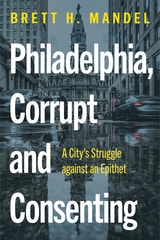
Philadelphia, Corrupt and Consenting
A City’s Struggle against an EpithetBrett H. Mandel
Temple University Press, 2023
He examines the costs of corruption, both financial and nonpecuniary, and considers the opportunity cost that corruption imposes. Mandel explores the nature and development of Philadelphia’s unique culture of corruption, emphasizing how machine politics and self-dealing are entwined with city history, creating a culture that allows corruption to thrive. In addition, he provides practical, achievable policies and actions that can produce positive change in Philadelphia and elsewhere.
Mandel seeks to provide insight into how our collective actions or inattention give consent to the corruption, as well as its roots and effects, and the reasons for its persistence. Philadelphia, Corrupt and Consenting is a critique, but above all, it is a call to action.
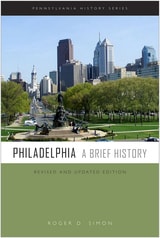
Philadelphia
A Brief HistoryRoger D. Simon
Temple University Press, 2017
Understanding Philadelphia’s history requires that we understand that nothing is inevitable; history is not made by abstract forces, but by the decisions of real individuals as they conduct their lives. With its insightful analysis and engaging prose, Philadelphia provides an accessible and readable overview of the history of the Quaker City from its founding by William Penn to the deindustrialization and gentrification of the early twenty-first century. Roger Simon asserts that the history of Philadelphia is a story of the efforts to sustain economic prosperity while fulfilling community needs, and the continued tension between those priorities.
Philadelphia devotes considerable attention to the evolving physical development of the city and to the social conditions and class structure of the people. Three dozen maps and illustrations enrich this edition, which has been fully updated and revised to reflect new scholarship on Philadelphia’s role in the post-industrial present and the diverse communities that incorporated women and minorities into the economic and social fabric of the city.
Published in association with the Pennsylvania Historical Association
Philadelphia
Neighborhoods, Division, and Conflict in a Post-Industrial CityCarolyn Adams
Temple University Press, 1993
Philanthropic Foundations in Latin America
Ann Stromberg
Russell Sage Foundation, 1956
Philanthropic Giving
Frank Emerson Andrews
Russell Sage Foundation, 1950
Philanthropy and the Business Corporation
Marion R. Fremont-Smith
Russell Sage Foundation, 1972
Philanthropy in Democratic Societies
History, Institutions, ValuesEdited by Rob Reich, Chiara Cordelli, and Lucy Bernholz
University of Chicago Press, 2016
The contributors balance empirical and normative approaches, exploring both the roles philanthropy has actually played in societies and the roles it should play. They ask a multitude of questions: When is philanthropy good or bad for democracy? How does, and should, philanthropic power interact with expectations of equal citizenship and democratic political voice? What makes the exercise of philanthropic power legitimate? What forms of private activity in the public interest should democracy promote, and what forms should it resist? Examining these and many other topics, the contributors offer a vital assessment of philanthropy at a time when its power to affect public outcomes has never been greater.

Philip Sparrow Tells All
Lost Essays by Samuel Steward, Writer, Professor, Tattoo ArtistSamuel Steward
University of Chicago Press, 2015
In Philip Sparrow Tells All, Jeremy Mulderig has collected thirty of these engaging but forgotten columns, prefacing them with revealing introductions that relate the essays to people and events in Steward’s life and to the intellectual and cultural contexts in which he wrote during the 1940s. In these essays we encounter such famous friends of Steward as Gertrude Stein, André Gide, and Thornton Wilder. We hear of his stint as a holiday sales clerk at Marshall Field’s (where he met and seduced fellow employee Rock Hudson), of his roles as an opera and ballet extra in hilariously shoddy costumes, of his hoarding tendencies, his disappointment with the drabness of men’s fashions, and his dread of turning forty. We go along with him to a bodybuilding competition and a pet cemetery, and together we wander the boulevards of Paris and the alleys of Algiers. Throughout, Mulderig’s entertaining annotations explain the essays’ wide-ranging allusions and also highlight their gay subtext, which constituted a kind of private game that Steward played with his mostly oblivious audience of Midwestern dentists.
The first collection of any of Samuel Steward’s writings to be republished since his death in 1993, Philip Sparrow Tells All makes these lost essays available to a broad readership that Steward imagined but never actually enjoyed when he wrote them. In doing so, it takes a major step toward documenting his important place in twentieth-century gay literature and history.

Philly Sports
Teams, Games, and Athletes from Rocky's TownRyan Swanson
University of Arkansas Press, 2016
Philadelphia sports—anchored by the Eagles, Flyers, Phillies, and 76ers—have a long, and sometimes tortured, history. Philly fans have booed more than their share and have earned a reputation as some of the most hostile in the country. They’ve been known, so the tales go, to jeer Santa Claus and cheer at the injury of an opposing player.
Strangely though, much of America’s perception of Philadelphia sports has been shaped by a fictional figure: Rocky. The series of Hollywood films named after their title character has told and retold the Cinderella story of an underdog boxer rising up against long odds. One could plausibly make the argument that Rocky is Philadelphia’s most famous athlete.
Beyond the major sports franchises and Rocky, lesser-known athletic competition in Philadelphia offers much to the interested observer. The city’s boxing culture, influence on Negro Leagues baseball, role in establishing interscholastic sport, and leadership in the rise of cricket all deserve and receive close investigation in this new collection. Philly Sports combines primary research and personal experiences—playing in the Palestra, scouting out the tombstones of the city’s best athletes, enjoying the fervor of a Philadelphia night with a local team in pursuit of a championship title. The essence of Philadelphia sport, and to a certain extent the city itself, is distilled here.
Philosophical Approaches to Communication
Claude Mangion
Intellect Books, 2011
A comprehensive introduction to the forms and various philosophical theories of communication, this volume is composed of three sections focusing on the production of culturally relevant communication, the interpretation of communicative messages, and the effects of communication on both speaker and listener. Each section draws on the work of key philosophers—from Foucault to Derrida to Habermas—and presents a detailed critical overview of the work in relation to the field of communication. Exhaustively researched, this book presents an up-to-date overview of thinking on communication theory in one inclusive volume.
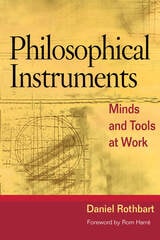
Philosophical Instruments
Minds and Tools at WorkDaniel Rothbart. Foreword by Rom Harré
University of Illinois Press, 2006
The surprising roles of instruments and experimentation in acquiring knowledge
In Philosophical Instruments Daniel Rothbart argues that our tools are not just neutral intermediaries between humans and the natural world, but are devices that demand new ideas about reality. Just as a hunter's new spear can change their knowledge of the environment, so can the development of modern scientific equipment alter our view of the world.
Working at the intersections of science, technology, and philosophy, Rothbart examines the revolution in knowledge brought on by recent advances in scientific instruments. Full of examples from historical and contemporary science, including electron scanning microscopes, sixteenth-century philosophical instruments, and diffraction devices used by biochemical researchers, Rothbart explores the ways in which instrumentation advances a philosophical stance about an instrument's power, an experimenter's skills, and a specimen's properties. Through a close reading of engineering of instruments, he introduces a philosophy from (rather than of) design, contending that philosophical ideas are channeled from design plans to models and from model into the use of the devices.
Philosophical Witnessing
The Holocaust as PresenceBerel Lang
Brandeis University Press, 2012
Philosophy en noir
Miroslav Petrícek
Karolinum Press, 2020
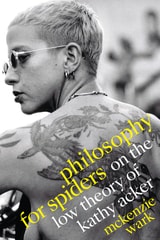
Philosophy for Spiders
On the Low Theory of Kathy AckerMcKenzie Wark
Duke University Press, 2021
Philosophy, Crime, and Criminology
Edited by Bruce A. Arrigo and Christopher R. Williams
University of Illinois Press, 2006
Charting a provocative and original direction, editors Bruce A. Arrigo and Christopher R. Williams couple theoretically oriented chapters with those centered on application and case study. In doing so, they develop an insightful, sensible, and accessible approach for a philosophical criminology in step with the political and economic challenges of the twenty-first century. Revealing the ways in which philosophical conceits inform prevailing conceptions of crime, Philosophy, Crime, and Criminology is required reading for any serious student or scholar concerned with crime and its impact on society and in our lives.
Phonographies
Grooves in Sonic Afro-ModernityAlexander G. Weheliye
Duke University Press, 2005
Weheliye surveys literature, film, and music to focus on engagements with recorded sound. He offers substantial new readings of canonical texts by W. E. B. Du Bois and Ralph Ellison, establishing dialogues between these writers and popular music and film ranging from Louis Armstrong’s voice to DJ mixing techniques to Darnell Martin’s 1994 movie I Like It Like That. Looking at how questions of diasporic belonging are articulated in contemporary black musical practices, Weheliye analyzes three contemporary Afro-diasporic musical acts: the Haitian and African American rap group the Fugees, the Afro- and Italian-German rap collective Advanced Chemistry, and black British artist Tricky and his partner Martina. Phonographies imagines the African diaspora as a virtual sounding space, one that is marked, in the twentieth century and twenty-first, by the circulation of culture via technological reproductions—records and tapes, dubbing and mixing, and more.
Phony Culture
Confidence and Malaise in Contemporary AmericaJames Combs
University of Wisconsin Press, 1994
As the United States nears the twenty-first century, many of its citizens are troubled by the sense that something is wrong. Even though it is argued that our national situation is good, there persists the widespread feeling that somehow we are on the wrong social and historical track. It is the contention of this book that much of this dis-ease stems from our construction of a phony culture, a culture dominated by the value of the confidence man and woman.
Photo Obscura
The Photographic in Post-PhotographyNatasha Chuk
Intellect Books, 2025
Photo Obscura brings a much-needed reflection on the radical transformations of photography in the digital age, where AI, computational media, and hybrid art practices challenge traditional definitions of the photographic image. Moving beyond nostalgia for analog or the simple embrace of digital, this book positions post-photography as a movement reshaping our visual culture. It is a movement in which images may no longer look like photographs but remain deeply influenced by photography’s logic and history.
Through discussions of key artworks and a variety of artists, the book explores themes including AI-generated imagery and the blurred line between representation and perception. Grounded in art history and media studies, Photo Obscura offers a new outlook on photography’s evolving role in contemporary art. Particularly suited for students, artists, and scholars of photography, digital arts, and visual culture, this work redefines what it means to see and believe in an era of infinite images.
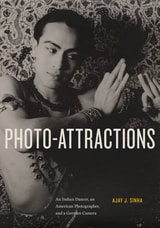
Photo-Attractions
An Indian Dancer, an American Photographer, and a German CameraAjay Sinha
Rutgers University Press, 2022
Art historian Ajay Sinha uses these hitherto unpublished photographs and archival research to raise provocative and important questions about photographic technology, colonial histories, race, sexuality and transcultural desires. Challenging the assumption that Gopal was merely objectified by Van Vechten’s Orientalist gaze, he explores the ways in which the Indian dancer co-authored the photos. In Sinha’s reading, Van Vechten’s New York studio becomes a promiscuous contact zone between world cultures, where a “photo-erotic” triangle is formed between the American photographer, Indian dancer, and German camera.
A groundbreaking study of global modernity, Photo-Attractions brings scholarship on American photography, literature, race and sexual economies into conversation with work on South Asian visual culture, dance, and gender. In these remarkable historical documents, it locates the pleasure taken in cultural difference that still resonates today.