Results by title
28164 books match the query 'History' and 80 start with q

Q. Aurelius Symmachus
A Political BiographyCristiana Sogno
University of Michigan Press, 2010
Symmachus was a brilliant orator, writer, and statesman, often flatly labeled as one of the last pagan senators. Cristiana Sogno offers a reconstruction of the political career of Symmachus through close analysis of his extensive writings, while also proposing a critical reevaluation of his historical importance. In contrast to traditional interpretation, Sogno's study demonstrates that Symmachus was primarily an influential politician, rather than a mere pagan zealot.
By portraying the individual experience of Symmachus, the book sets forth a new approach for interpreting the political aspirations, mentality, and attitudes of Roman senators. The much-studied question of the Christianization of the Western aristocracy has created the illusion of a Christian and a pagan aristocracy rigidly separated from each other. Through her study of Symmachus, Sogno demonstrates the primary importance of politics over religion in the public activity of the late Roman aristocracy. Although the book is specifically addressed to scholars and students of Late Antiquity, it will also be of interest to classicists, ancient historians, and non-specialists who wish to know more about this pivotal period in Roman history.
Cristiana Sogno received her Ph.D. in Classics and History from Yale University. Currently she is Townsend Assistant Professor of Classics at Cornell University. Visit Professor Sogno's website at: http://www.fordham.edu.

Qal'at Jabar Pottery
A Study of a Syrian Fortified Site in the Late 11th–14th CenturiesCristina Tonghini
Council for British Research in the Levant, 1999
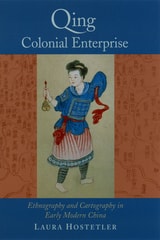
Qing Colonial Enterprise
Ethnography and Cartography in Early Modern ChinaLaura Hostetler
University of Chicago Press, 2001
Although mapping in China is almost as old as Chinese civilization itself, the Qing insistence on accurate, to-scale maps of their territory was a new response to the difficulties of administering a vast and growing empire. Likewise, direct observation became increasingly important to Qing ethnographic writings, such as the illustrated manuscripts known as "Miao albums" (from which twenty color paintings are reproduced in this book). These were intended to educate Qing officials about various non-Han peoples so that they could govern these groups more effectively.Hostetler's groundbreaking account will interest anyone studying the history of the early modern period and colonialism.
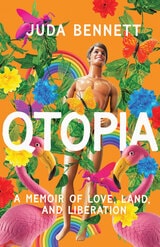
Qtopia
A Memoir of Love, Land, and LiberationJuda Bennett
University of Wisconsin Press, 2026
In the 1970s, while communes bloomed like wildflowers across the land, most had no room for queer members. The so-called counterculture still clung to heterosexual norms, even as it preached freedom from traditional gender roles and the nuclear family. Juda Bennett’s engrossing memoir follows his escape from suburbia into the back-to-the-land movement—and chronicles the efforts it took for him to “drop back in” to mainstream society and the ways in which he and his compatriots continued to honor their communal vision.
After enduring the hollow promises of “progressive” communes, Bennett finally found what he didn’t know he was looking for at Lavender Hill, a rural queer commune of visionaries carving out a life beyond heteronormativity, beyond capitalism, beyond shame. They didn’t just survive; they built something messy, luminous, and defiantly alive. And when the commune began to unravel, they didn’t vanish. They evolved. Qtopia is a story of chosen family and radical transformation. It is a reminder that queer utopia isn’t behind us—it’s still out there on the horizon, singing its song of joy, defiance, and fabulousness.
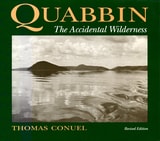
Quabbin
The Accidental WildernessThomas Conuel
University of Massachusetts Press, 1990
When one looks out on the quiet waters and forested hills of Quabbin Reservoir in west central Massachusetts, it is hard to imagine that the area was once dotted with buildings and farmlands or that it echoed with the activity of several villages and towns. Today, the daytime silence may be broken only by the cry of a hawk overhead or the slap of a plunging fish, and the evening calm, by the lonesome howl of a coyote. But in the nineteenth century, things were quite different.
In 1895, engineers for the Metropolitan Water Board began to search the state of Massachusetts for a site on which to construct a reservoir to supply water for the growing city of Boston. Sixty-five miles west of the city, in a region of high hills and running streams known as the Swift River Valley, they found what they were looking for. When Quabbin Reservoir was finally completed and filled in 1946, the engineers had created the third largest body of fresh water in New England and hand accomplished one of the larger public works projects of its time. They had also uprooted and displaced the valley's inhabitants, leveled and flooded four towns and six villages—and formed a magnificent wilderness on some 85,000 acres.
The valley that was once known for its picturesque villages and mill ponds is now, over forty years later, home to a wide array of wildlife. Coyote, bobcat, and deer flourish, and Quabbin's eagle restoration project, begun in 1982, produced the first nesting pair of bald eagles in Massachusetts in almost a century. Today, the bald eagle population at Quabbin is estimated at forty-one birds.
But this accidental wilderness is being increasingly threatened. As early as the 1950s, the sounds of power boats occasionally intruded on the peaceful silence of the waters. In more recent years, acid rain, ozone and other pollutants, the ravages of a herd of hungry deer, and demands for increased recreational use are all jeopardizing Quabbin's waters and forests.
This book tells the story of Quabbin, tracing Quabbin's history, describing its natural resources, and discussing the environmental challenges it currently faces. The original edition, issued by the Massachusetts Audubon Society in 1981, has now been expanded and updated.
Quaker Brotherhood
Interracial Activism and the American Friends Service Committee, 1917-1950Allan W. Austin
University of Illinois Press, 2012
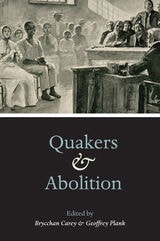
Quakers and Abolition
Edited by Brycchan Carey and Geoffrey Plank
University of Illinois Press, 2014
This collection of fifteen insightful essays examines the complexity and diversity of Quaker antislavery attitudes across three centuries, from 1658 to 1890. Contributors from a range of disciplines, nations, and faith backgrounds show Quaker's beliefs to be far from monolithic. They often disagreed with one another and the larger antislavery movement about the morality of slaveholding and the best approach to abolition.
Not surprisingly, contributors explain, this complicated and evolving antislavery sensibility left behind an equally complicated legacy. While Quaker antislavery was a powerful contemporary influence in both the United States and Europe, present-day scholars pay little substantive attention to the subject. This volume faithfully seeks to correct that oversight, offering accessible yet provocative new insights on a key chapter of religious, political, and cultural history.
Contributors include Dee E. Andrews, Kristen Block, Brycchan Carey, Christopher Densmore, Andrew Diemer, J. William Frost, Thomas D. Hamm, Nancy A. Hewitt, Maurice Jackson, Anna Vaughan Kett, Emma Jones Lapsansky-Werner, Gary B. Nash, Geoffrey Plank, Ellen M. Ross, Marie-Jeanne Rossignol, James Emmett Ryan, and James Walvin.
Quakers and Nazis
Inner Light in Outer DarknessHans A. Schmitt
University of Missouri Press, 1997
Why the title Quakers and Nazis, not Quakers against Nazis? Was not hostility part of the interaction between the two groups? On the contrary, Hans A. Schmitt's compelling story describes American, British, and German Quakers' attempts to mitigate the suffering among not only victims of Nazism but Nazi sympathizers in Austria and Lithuania as well.
With numerous poignant illustrations of the pressure and social cost involved in being a Quaker from 1933 to 1945, Quakers and Nazis: Inner Light in Outer Darkness reveals a facet of Nazi Germany that is entirely unknown to most people. The book focuses on the heroic acts foreign and German Quakers performed under the Nazi regime, offering fully documented and original information regarding the Quakers' commitment to nonviolence and the relief of the victims.
Schmitt's narrative reveals the stress and tension of the situation. How should a Quaker behave in a meeting for worship with a policeman present? Spies did not stop Friends in worship services from openly criticizing Hitler and Göring, but Nazis did inflict torment on Friends. Yet Friends did not, could not, respond in like manner. Olga Halle was one Friend who worked to get people, mostly Jews, out of Germany until America entered the war. When emigration was outlawed, twenty-eight were stranded. Years later her distress was still so deep that even on her deathbed she recited their names.
Schmitt reminds us that virtually all the Berlin Quakers secreted Jews throughout the war. He shows how these brave Quakers opposed the Nazis even after they lost their jobs and had been harassed by the Gestapo. Risking their lives, the Friends persisted in their efforts to alleviate suffering.
At a time when the scholarly world is divided as to whether all Germans knew and approved of the Final Solution, this book makes a valuable contribution to the discussion. Quakers—despite their small numbers—played, and continue to play, an important role in twentieth-century humanitarian relief. Quakers and Nazis: Inner Light in Outer Darkness, a study of how Friends performed under the extreme pressure of a totalitarian regime, will add significantly to our general understanding of Quaker and German history.
Qualified Hope
A Postmodern Politics of TimeMitchum Huehls
The Ohio State University Press, 2009
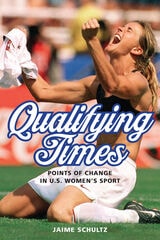
Qualifying Times
Points of Change in U.S. Women's SportJaime Schultz
University of Illinois Press, 2014
Beginning with the seemingly innocent ponytail, the subject of the Introduction, scholar Jaime Schultz challenges the reader to look at the historical and sociological significance of now-common items such as sports bras and tampons and ideas such as sex testing and competitive cheerleading. Tennis wear, tampons, and sports bras all facilitated women’s participation in physical culture, while physical educators, the aesthetic fitness movement, and Title IX encouraged women to challenge (or confront) policy, financial, and cultural obstacles.
While some of these points of change increased women's physical freedom and sporting participation, they also posed challenges. Tampons encouraged menstrual shame, sex testing (a tool never used with male athletes) perpetuated narrowly-defined cultural norms of femininity, and the late-twentieth-century aesthetic fitness movement fed into an unrealistic beauty ideal.
Ultimately, Schultz finds that U.S. women's sport has progressed significantly but ambivalently. Although participation in sports is no longer uncommon for girls and women, Schultz argues that these "points of change" have contributed to a complex matrix of gender differentiation that marks the female athletic body as different than--as less than--the male body, despite the advantages it may confer.
Quantifying Mentalities
The Use of Numbers by Ancient Greek HistoriansCatherine Rubincam
University of Michigan Press, 2021
As 21st-century citizens of developed countries, we are constantly bombarded by numbers in every aspect of our lives. Almost automatically, we learn to interpret how numbers are used in our language, what magnitude of numbers we expect to hear in particular contexts, how people in our community express degrees of confidence in the reliability of any particular number, etc. Context of this kind is lacking when we read a historical narrative composed in an ancient language, from a world vastly different from ours. In Quantifying Mentalities, Catherine Rubincam helps overcome this barrier to our accurate understanding of the numbers in the works of five major ancient Greek historians by providing a standard against which their credibility can be more accurately judged.
This systematic, quantified study is based on the compilation of statistics concerning a standard constellation of aspects of all the numbers in the historical works of the five earliest wholly or at least substantially surviving ancient Greek historians: Herodotus, Thucydides, Xenophon (Anabasis and Hellenica), Polybius, and Diodorus Siculus. Such a comprehensive study has not been attempted before. For scholars reading and writing about the history of ancient Greece the volume offers a tool for interpreting the numbers in these ancient texts with more sensitivity to the world in which they were written. Standard aspects of number use captured by the coding system are: the different types of number (cardinals, ordinals, compounds, and non-explicit but definite numbers); the subject category to which each number belongs (Time, Distance-Size, Military, Population, Money, and Miscellaneous); and the types of any qualifications attached to it (Approximating, Comparative, Alternative, and Emphatic). The statistics also facilitate comparisons of every aspect of number use between authors and texts, enabling the delineation of a numeric profile for each one. This allows us to read these texts with a greater sensitivity to how they might have sounded to the author and his original readers, thus providing a firmer foundation for reconstructing or interpreting ancient Greek history.

Quantum 2.0
The Weird Physics Driving a New Revolution in TechnologyPaul Davies
University of Chicago Press, 2025
Quantum computers, quantum cryptography, and even quantum AI—a century after the discovery of an unexpected physical world, researchers are putting this puzzling science to work in dazzling new ways.
In this exhilarating and mind-bending book, renowned scientist and author Paul Davies offers readers a glimpse of how quantum physics has led to a quantum technology revolution. Quantum 2.0 reveals how today’s brightest minds are harnessing exotic states of matter that have no counterpart in everyday life. Specifically, all eyes are on entanglement, called “spooky” by Einstein, which links the activities of separated particles even across vast distances.
By manipulating these weird properties of atoms, electrons, and photons, scientists are driving the burgeoning field of “quantum information science,” featuring new tools such as quantum computers, quantum cryptography, and the quantum internet. In turn, their efforts have attracted billions of dollars in investments and triggered a frantic quantum arms race between nations. At the same time, theorists are taking a closer look at quantum systems themselves, which possess properties that defy intuition and shred everyday notions of reality. Davies explains how researchers, including himself, are wrestling with quantum theory to make sense of this realm, where ghostly quantum particles produce tiny forces in nanotechnology, cause black holes to evaporate, and may even contribute to the universe’s accelerating expansion. A trusted guide, Davies takes readers from the basic concepts to today’s cutting edge, inviting us all to glimpse the wonderland of quantum physics and its stunning implications.

Quantum 2.0
The Weird Physics Driving a New Revolution in TechnologyPaul Davies
University of Chicago Press, 2025
In this exhilarating and mind-bending book, renowned scientist and author Paul Davies offers readers a glimpse of how quantum physics has led to a quantum technology revolution. Quantum 2.0 reveals how today’s brightest minds are harnessing exotic states of matter that have no counterpart in everyday life. Specifically, all eyes are on entanglement, called “spooky” by Einstein, which links the activities of separated particles even across vast distances.
By manipulating these weird properties of atoms, electrons, and photons, scientists are driving the burgeoning field of “quantum information science,” featuring new tools such as quantum computers, quantum cryptography, and the quantum internet. In turn, their efforts have attracted billions of dollars in investments and triggered a frantic quantum arms race between nations. At the same time, theorists are taking a closer look at quantum systems themselves, which possess properties that defy intuition and shred everyday notions of reality. Davies explains how researchers, including himself, are wrestling with quantum theory to make sense of this realm, where ghostly quantum particles produce tiny forces in nanotechnology, cause black holes to evaporate, and may even contribute to the universe’s accelerating expansion. A trusted guide, Davies takes readers from the basic concepts to today’s cutting edge, inviting us all to glimpse the wonderland of quantum physics and its stunning implications.

Quantum Art & Uncertainty
Paul Thomas
Intellect Books, 2018
In order to draw parallels between art, science, and culture, this publication will explore the ways that selected art works have contributed to a form of cultural pedagogy. It follows the integration of culture and science in artists’ expressions to create meaningful experiences that expose the probabilities and uncertainties equally present in the world of science.
Quantum Dialogue
The Making of a RevolutionMara Beller
University of Chicago Press, 1999
Beller draws her argument from her radical new reading of the history of the quantum revolution, especially the development of the Copenhagen interpretation. One of several competing approaches, this version succeeded largely due to the rhetorical skills of Niels Bohr and his colleagues. Using extensive archival research, Beller shows how Bohr and others marketed their views, misrepresenting and dismissing their opponents as "unreasonable" and championing their own not always coherent or well-supported position as "inevitable."
Quantum Dialogue, winner of the 1999 Morris D. Forkosch Prize of the Journal of the History of Ideas, will fascinate everyone interested in how stories of "scientific revolutions" are constructed and "scientific consensus" achieved.
"[A]n intellectually stimulating piece of work, energised by a distinct point of view."—Dipankar Home, Times Higher Education Supplement
"[R]emarkable and original. . . . [Beller's] arguments are thoroughly supported and her conclusions are meticulously argued. . . . This is an important book that all who are interested in the emergence of quantum mechanics will want to read."—William Evenson, History of Physics Newsletter

Quantum Legacies
Dispatches from an Uncertain WorldDavid Kaiser
University of Chicago Press, 2024
The ideas at the root of quantum theory remain stubbornly, famously bizarre: a solid world reduced to puffs of probability; particles that tunnel through walls; cats suspended in zombielike states, neither alive nor dead; and twinned particles that share entangled fates. For more than a century, physicists have grappled with these conceptual uncertainties while enmeshed in the larger uncertainties of the social and political worlds around them, a time pocked by the rise of fascism, cataclysmic world wars, and a new nuclear age.
In Quantum Legacies, David Kaiser introduces readers to iconic episodes in physicists’ still-unfolding quest to understand space, time, and matter at their most fundamental. In a series of vibrant essays, Kaiser takes us inside moments of discovery and debate among the great minds of the era—Albert Einstein, Erwin Schrödinger, Stephen Hawking, and many more who have indelibly shaped our understanding of nature—as they have tried to make sense of a messy world.
Ranging across space and time, the episodes span the heady 1920s, the dark days of the 1930s, the turbulence of the Cold War, and the peculiar political realities that followed. In those eras as in our own, researchers’ ambition has often been to transcend the vagaries of here and now, to contribute lasting insights into how the world works that might reach beyond a given researcher’s limited view. In Quantum Legacies, Kaiser unveils the difficult and unsteady work required to forge some shared understanding between individuals and across generations, and in doing so, he illuminates the deep ties between scientific exploration and the human condition.
Quantum Mechanics
Historical Contingency and the Copenhagen HegemonyJames T. Cushing
University of Chicago Press, 1994
Since the late 1920s, the theory formulated by Niels Bohr and his colleagues at Copenhagen has been the dominant interpretation of quantum mechanics. Yet an alternative interpretation, rooted in the work of Louis de Broglie in the early 1920s and reformulated and extended by David Bohm in the 1950s, equally well explains the observational data. Through a detailed historical and sociological study of the physicists who developed different theories of quantum mechanics, the debates within and between opposing camps, and the receptions given to each theory, Cushing shows that despite the preeminence of the Copenhagen view, the Bohm interpretation cannot be ignored. Cushing contends that the Copenhagen interpretation became widely accepted not because it is a better explanation of subatomic phenomena than is Bohm's, but because it happened to appear first.
Focusing on the philosophical, social, and cultural forces that shaped one of the most important developments in modern physics, this provocative book examines the role that timing can play in the establishment of theory and explanation.

Quarantine
John Smolens
Michigan State University Press, 2019

Quare Joyce
Joseph Valente, Editor
University of Michigan Press, 2000
Quebec During the American Invasion, 1775-1776
The Journal of Francois Baby, Gabriel Taschereau, and Jenkin WilliamsMichael P. Gabriel
Michigan State University Press, 2005
Available for the first time in English, the 1776 journal of François Baby, Gabriel Taschereau, and Jenkin Williams provides an insight into the failure to incite rebellion in Quebec by American revolutionaries. While other sources have shown how British soldiers and civilians and the French-Canadian gentry (the seigneurs) responded to the American invasion of 1775–1776, this journal focuses on French-Canadian peasants (les habitants) who made up the vast majority of the population; in other words, the journal helps explain why Quebec did not become the "fourteenth colony."
After American forces were expelled from Quebec in early 1776, the British governor, Sir Guy Carleton, sent three trusted envoys to discover who had collaborated with the rebels from the south. They traveled to fifty-six parishes and missions in the Quebec and Trois Rivières district, discharging disloyal militia officers and replacing them with faithful subjects. They prepared a report on each parish, revealing actions taken to support the Americans or the king. Baby and his colleagues documented a wide range of responses. Some habitants enlisted with the Americans; others supplied them with food, firewood, and transportation. Some habitants refused to cooperate with the king’s soldiers. In some parishes, women were the Americans’ most zealous supporters. Overall, the Baby Journal clearly reveals that the habitants played an important, but often overlooked, role in the American invasion.

Quebec and the Heritage of Franco-America
Edited by Iwan Morgan and Philip D. Davies
University of London Press, 2010

Queen Anne's War
The Second Contest for North America, 1702–1713Michael G. Laramie
Westholme Publishing, 2027
Told from the halls of power in North America and Europe, and through the eyes of the men and women who found themselves embroiled in this brutal realignment of colonial interests, Queen Anne’s War recreates the world of early North American expansion at the ground level, providing riveting accounts of the battles across settlements and wilderness as well as the motives, conditions, triumphs, and failures of the Europeans and their respective Native American allies. Based on extensive primary source research and command of English, French, and Spanish sources, the narrative not only describes the economic and geopolitical ramifications of the war that reshaped North America, but intriguingly reveals the sense of independence emerging in the colonies, from Puritan New England to plantation South Carolina, at the close of the war.

Queen Elizabeth's Book of Oxford
Edited by Louise Durning
Bodleian Library Publishing, 2006
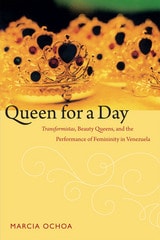
Queen for a Day
Transformistas, Beauty Queens, and the Performance of Femininity in VenezuelaMarcia Ochoa
Duke University Press, 2014
Beauty pageants play an outsized role in Venezuela. The country has won more international beauty contests than any other. The femininity performed by Venezuelan women in high-profile, widely viewed pageants defines a kind of national femininity. Ochoa argues that as transformistas and misses work to achieve the bodies, clothing and makeup styles, and postures and gestures of this national femininity, they come to embody Venezuelan modernity.
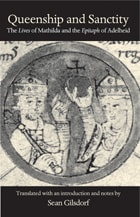
Queenship and Sanctity
The Lives of Mathilda and the Epitaph of Adelheid (Medieval Texts in Translation)Sean Gilsdorf
Catholic University of America Press, 2004

Queer Activism in India
A Story in the Anthropology of EthicsNaisargi Dave
Duke University Press, 2012
Dave argues that activism is an ethical practice comprised of critique, invention, and relational practice. Her analysis investigates the relationship between the ethics of activism and the existing social norms and conditions from which activism emerges. Through her study of different networks and institutions, Dave documents how activism oscillates between the potential for new social arrangements and the questions that arise once the activists' goals have been accomplished. Dave's book addresses a relevant and timely phenomenon and makes an important contribution to the anthropology of queer communities, social movements, affect, and ethics.
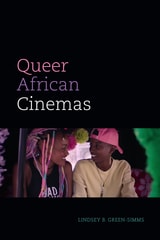
Queer African Cinemas
Lindsey B. Green-Simms
Duke University Press, 2022
Queer Bangkok
21st Century Markets, Media, and RightsEdited by Peter A. Jackson
Hong Kong University Press, 2011
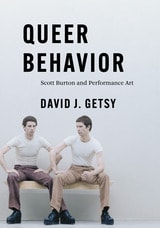
Queer Behavior
Scott Burton and Performance ArtDavid J. Getsy
University of Chicago Press, 2022
Scott Burton (1939–89) created performance art and sculpture that drew on queer experience and the sexual cultures that flourished in New York City in the 1970s. David J. Getsy argues that Burton looked to body language and queer behavior in public space—most importantly, street cruising—as foundations for rethinking the audiences and possibilities of art. This first book on the artist examines Burton’s underacknowledged contributions to performance art and how he made queer life central in them. Extending his performances about cruising, sexual signaling, and power dynamics throughout the decade, Burton also came to create functional sculptures that covertly signaled queerness by hiding in plain sight as furniture waiting to be used.
With research drawing from multiple archives and numerous interviews, Getsy charts Burton’s deep engagements with postminimalism, performance, feminism, behavioral psychology, design history, and queer culture. A restless and expansive artist, Burton transformed his commitment to gay liberation into a unique practice of performance, sculpture, and public art that aspired to be antielitist, embracing of differences, and open to all. Filled with stories of Burton’s life in New York’s art communities, Queer Behavior makes a case for Burton as one of the most significant out queer artists to emerge in the wake of the Stonewall uprising and offers rich accounts of queer art and performance art in the 1970s.
Queer Beirut
By Sofian Merabet
University of Texas Press, 2014
Gender and sexual identity formation is an ongoing anthropological conversation in both Middle Eastern studies and urban studies, but the story of gay and lesbian identity in the Middle East is only just beginning to be told. Queer Beirut is the first ethnographic study of queer lives in the Arab Middle East. Drawing on anthropology, urban studies, gender studies, queer studies, and sociocultural theory, Sofian Merabet’s compelling ethnography suggests a critical theory of gender and religious identity formations that will disrupt conventional anthropological premises about the contingent role that society and particular urban spaces have in facilitating the emergence of various subcultures within the city.
From 1995 to 2014, Merabet made a series of ethnographic journeys to Lebanon, during which he interviewed numerous gay men in Beirut. Through their life stories, Merabet crafts moving ethnographic narratives and explores how Lebanese gays inhabit and perform their gender as they formulate their sense of identity. He also examines the notion of “queer space” in Beirut and the role that this city, its class and sectarian structure, its colonial history, and religion have played in these people’s discovery and exploration of their sexualities. In using Beirut as a microcosm for the complexities of homosexual relationships in contemporary Lebanon, Queer Beirut provides a critical standpoint from which to deepen our understandings of gender rights and citizenship in the structuring of social inequality within the larger context of the Middle East.
Queer Between the Covers
Histories of Queer Publishing and Publishing Queer VoicesEdited by Leila Kassir and Richard Espley
University of London Press, 2021
Queer Between the Covers presents a history of radical queer publishing and literature from 1880 to the modern day. Chronicling the gay struggle for acceptance and liberation, the book demonstrates how the fight for representation was often waged between the covers of books in a world where spaces for queer expression were taboo. The chapters provide an array of voices and histories from the famous, Derek Jarman and Oscar Wilde, to the lesser known and underappreciated, such as John Wieners and Valerie Taylor. It includes firsthand accounts of seminal moments in queer history, including the birth of Hazard Press and the Defend Gay’s the Word Bookshop campaign in the 1980s.
Queer Between the Covers demonstrates the importance of the book and how the queer community could be brought together through shared literature. The works discussed show the imaginative and radical ways in which queer texts have fought against censorship and repression and could be used as a political tool for organization and production. This study follows key moments in queer literary history, from the powerful community wide demonstrations for Gay’s the Word during their battle with the British government, to the mapping of Chicago’s queer spaces within Valerie Taylor’s pulp novels, or the anonymous but likely shared authorship of the nineteenth century queer text Teleny. Queer publishing also often involved fascinating creative tactics for beating the censor, from the act of self-publishing to anonymous authorship as part of a so-called “cloaked resistance.” Collage and repurposing found images and texts were key practices for many queer publishers and authors, from Derek Jarman to the artworks created by the Hazard Press.
This is a fascinating and topical book on publishing history for those interested in how queer people throughout modernity have used literature as an important forum for self-expression and self-actualization when spaces and sites for queer expression were outlawed.
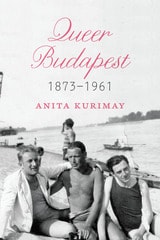
Queer Budapest, 1873–1961
Anita Kurimay
University of Chicago Press, 2020
Kurimay explores how and why a series of illiberal Hungarian regimes came to regulate but also tolerate and protect queer life. She also explains how the precarious coexistence between the illiberal state and queer community ended abruptly at the close of World War II. A stunning reappraisal of sexuality’s political implications, Queer Budapest recuperates queer communities as an integral part of Hungary’s—and Europe’s—modern incarnation.

Queer Chimerica
A Speculative Auto/Ethnography of the Cool ChildShana Ye
University of Michigan Press, 2024
Blending archival work, ethnography, and cultural analysis with memoir, graphic arts, and science fiction, Queer Chimerica unpacks the ways in which the transnational circulation of queer culture, politics, and institutions are structured through the antagonist interdependence of China and the United States. By examining the intersecting timelines of the rise of queer theory and the rise of China in the late Cold War era, Shana Ye explores the relationship between the discourse of queer fluidity and capital’s demands for labor flexibility.
Drawing on rare archival material and oral historical accounts of queer life from the 1950s to the late 2010s, the author shows how these accounts make sense of the variegated landscapes of desires, transformations, and conundrums in postsocialist China. The author illustrates party cadres in the Cultural Revolution, tongzhi activism mediated by the explosive politics of Tiananmen upheaval, HIV/AIDS community outreach workers, feminist artists and digital activists, leftist queer theorists, and fictional bio-engineers, layering these vivid depictions to reveal the poetic messiness of queer world-making. Queer Chimerica offers insight into the governmentality of LGBT rights, the rules of legibility and recognition, the geo- and bio-politics of identity, and the class-ridden appropriation of queer history and community. Thus understanding the production of queerness unveils the uneven distributions of capital, knowledge, affect, and opportunity that reproduce queer precarity and agency.
Queer Companions
Religion, Public Intimacy, and Saintly Affects in PakistanOmar Kasmani
Duke University Press, 2022
Queer Economic Dissonance and Victorian Literature
Meg Dobbins
The Ohio State University Press, 2022
Queer Encounters with Communist Power
Non-Heterosexual Lives and the State in Czechoslovakia, 1948-1989Vera Sokolová
Karolinum Press, 2019
Contrary to expectations, the book reveals that despite the Czechoslovak Communist regime’s brutality in many areas of life, the state did not carry out a hateful or seditious campaign against homosexual and non-heterosexual people. Rather, the official state sexology offices functioned from the late 1970s onward as essentially the first gay clubs in socialist Czechoslovakia. Interweaving the memories of non-heterosexual Czech women born between 1929 and 1952, Věra Sokolová’s study both enriches and challenges existing scholarship on lesbian and gay history during this era, promising to radically change the way we view gender, sexuality, and everyday life during East European socialism.
Queer Forster
Edited by Robert K. Martin and George Piggford
University of Chicago Press, 1997
Many previous critics of Forster downplayed his homosexuality or read Forster naively in terms of gay liberation. This collection situates Forster within the Bloomsbury Group and examines his relations to major figures such as Henry James, Edward Carpenter, and Virginia Woolf. Particular attention is paid to Forster's several accounts of India and their troubled relation to the British colonial enterprise. Analyzing a wide range of Forster's work, the authors examine material from Forster's undergraduate writings to stories written more than a half-century later.
A landmark book for the study of gender in literature, Queer Forster brings the terms "queer" and "gay" into conversation, opening up a dialogue on wider dimensions of theory and allowing a major revaluation of modernist inventions of sexual identity.
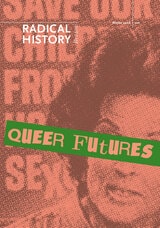
Queer Futures, Volume 2008
Kevin P. Murphy, Jason Ruiz, and David Serlin, eds.
Duke University Press, 0
Distinguished by its historical approach, “Queer Futures” examines homonormativity as a phenomenon that emerged in the United States after World War II and gained traction in the 1960s and 1970s. One essay compares Anita Bryant’s antigay campaigns in the late 1970s with those of current same-sex marriage proponents to show how both focus on the abstract figure of the “endangered child.” Another essay explores how the Gay and Lesbian Alliance Against Defamation’s organizational amnesia has shaped its often conservative agenda. Other essays include a Marxist reading of the transsexual body, an examination of reactionary politics at the core of the movement to repeal the U.S. military’s “don’t ask, don’t tell” policy, and a history of how “safe streets” patrols in the 1970s and 1980s became opportunities for urban gentrification and community exploitation.
Contributors. Anna M. Agathangelou, Daniel Bassichis, Aaron Belkin, Nan Alamilla Boyd, Maxime Cervulle, Vincent Doyle, Roderick A. Ferguson, Christina Hanhardt, Dan Irving, Regina Kunzel, Patrick McCreery, Kevin P. Murphy, Tavia Nyong’o, Jason Ruiz, David Serlin, Tamara L. Spira, Susan Stryker, Margot D. Weiss
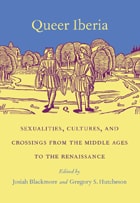
Queer Iberia
Sexualities, Cultures, and Crossings from the Middle Ages to the RenaissanceJosiah Blackmore and Gregory S. Hutcheson, eds.
Duke University Press, 1999
To show how sexual otherness is most evident at points of cultural conflict, the contributors use a variety of methodologies and perspectives and consider source materials that originated in Castilian, Latin, Arabic, Catalan, and Galician-Portuguese. Covering topics from the martydom of Pelagius to the exploits of the transgendered Catalina de Erauso, this volume is the first to provide a comprehensive historical examination of the relations among race, gender, sexuality, nation-building, colonialism, and imperial expansion in medieval and early modern Iberia. Some essays consider archival evidence of sexual otherness or evaluate the use of “deviance” as a marker for cultural and racial difference, while others explore both male and female homoeroticism as literary-aesthetic discourse or attempt to open up canonical texts to alternative readings.
Positing a queerness intrinsic to Iberia’s historical process and cultural identity, Queer Iberia will challenge the field of Iberian studies while appealing to scholars of medieval, cultural, Hispanic, gender, and gay and lesbian studies.
Contributors. Josiah Blackmore, Linde M. Brocato, Catherine Brown, Israel Burshatin, Daniel Eisenberg, E. Michael Gerli, Roberto J. González-Casanovas, Gregory S. Hutcheson, Mark D. Jordan, Sara Lipton, Benjamin Liu, Mary Elizabeth Perry, Michael Solomon, Louise O. Vasvári, Barbara Weissberger
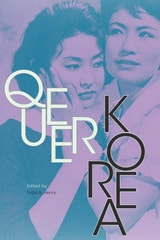
Queer Korea
Todd A. Henry, editor
Duke University Press, 2020
Contributors. Pei Jean Chen, John (Song Pae) Cho, Chung-kang Kim, Todd A. Henry, Merose Hwang, Ruin, Layoung Shin, Shin-ae Ha, John Whittier Treat
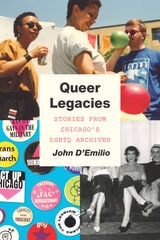
Queer Legacies
Stories from Chicago’s LGBTQ ArchivesJohn D'Emilio
University of Chicago Press, 2020
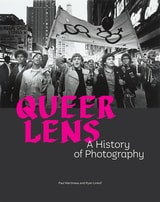
Queer Lens
A History of PhotographyPaul Martineau
J. Paul Getty Trust, The, 2025
Copiously illustrated, Queer Lens explores the transformative role of photography in LGBTQ+ communities from the nineteenth century to the present day.
Winner of the 2026 Lambda Literary Award for LGBTQ+ Anthology
“An outstanding addition to the growing body of scholarship around queer imagery.”
—Jim Van Buskirk, The Bay Area Reporter
“A tour de force. . . . A profound collective story of creativity, joy and resistance.”
—Emma Jacob, Aesthetica Magazine
“Potent and inspiring. . . . An empowering photography retrospective that reflects American queer communities.”
—Aleena Ortiz, Foreword Reviews
“A deeply significant and beautifully produced volume."
—All About Photo.com
“Eye-catching."
—Matthew Wexler, Queerty.com
Photography’s power to capture a subject—representing reality, or a close approximation—has inherently been linked with the construction and practice of identity. Since the camera’s invention in 1839, and despite periods of severe homophobia, the photographic art form has been used by and for individuals belonging to dynamic LGBTQ+ communities, helping shape and affirm queer culture and identity across its many intersections.
Queer Lens explores this transformative force of photography, which has played a pivotal role in increasing queer visibility. Lively essays by scholars and artists explore myriad manifestations of queer culture, both celebrating complex interpretations of people and relationships and resisting rigid definitions. Featuring a rich selection of images—including portraits of queer individuals, visual records of queer kinship, and documentary photographs of early queer groups and protests—this volume investigates the medium’s profound role in illuminating the vibrant tapestry of LGBTQ+ communities.
This volume is published to accompany an exhibition on view at the J. Paul Getty Museum at the Getty Center from June 17 to September 28, 2025.
Queer Livability
German Sexual Sciences and Life WritingIna Linge
University of Michigan Press, 2023
Finalist: Waterloo Centre for German Studies Book Prize | December 10, 2024
This book brings together an exciting new archive of queer and trans voices from the history of sexual sciences in the German-speaking world. A new language to express possibilities of gender and sexuality emerged at the turn of the twentieth century, from Sigmund Freud’s theories of homosexuality in Vienna to Magnus Hirschfeld’s “third sex” in Berlin. Together, they provided a language of sex and sexuality that is still recognizable today. Queer Livability: German Sexual Sciences and Life Writing shows that individual voices of trans and queer writers had a significant impact on the production of knowledge about gender and sexuality during this time and introduces lesser known texts to a new readership. It shows the remarkable power of queer life writing in imagining and creating the possibilities of a livable life in the face of restrictive legal, medical, and social frameworks.
Queer Livability: German Sexual Sciences and Life Writing will be of interest to anyone who wants to learn more about LGBTQ+ history and literature. It also provides a fascinating insight into the historical roots for our thinking about gender and sexuality today. The book will be of relevance to an academic readership of students and faculty in German studies, literary studies, European history, and the interdisciplinary fields of gender and sexuality studies, medical humanities, and the history of sexuality.
Queer London
Perils and Pleasures in the Sexual Metropolis, 1918-1957Matt Houlbrook
University of Chicago Press, 2005
Cyril's story is Matt Houlbrook's point of entry into the queer worlds of early twentieth-century London. Drawing on previously unknown sources, from police reports and newspaper exposés to personal letters, diaries, and the first queer guidebook ever written, Houlbrook here explores the relationship between queer sexualities and modern urban culture that we take for granted today. He revisits the diverse queer lives that took hold in London's parks and streets; its restaurants, pubs, and dancehalls; and its Turkish bathhouses and hotels—as well as attempts by municipal authorities to control and crack down on those worlds. He also describes how London shaped the culture and politics of queer life—and how London was in turn shaped by the lives of queer men. Ultimately, Houlbrook unveils the complex ways in which men made sense of their desires and who they were. In so doing, he mounts a sustained challenge to conventional understandings of the city as a place of sexual liberation and a unified queer culture.
A history remarkable in its complexity yet intimate in its portraiture, Queer London is a landmark work that redefines queer urban life in England and beyond.
Winner of History Today’s Book of the Year Award, 2006

Queer Marxism in Two Chinas
Petrus Liu
Duke University Press, 2015
Queer Migrations
Sexuality, U.S. Citizenship, and Border CrossingsEithne Luibheid
University of Minnesota Press, 2005
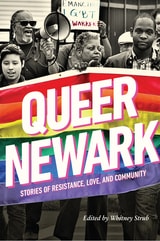
Queer Newark
Stories of Resistance, Love, and CommunityWhitney Strub
Rutgers University Press, 2024
Histories of gay and lesbian urban life typically focus on major metropolitan areas like San Francisco and New York, opportunity-filled destinations for LGBTQ migrants from across the country. Yet there are many other queer communities in economically depressed cities with majority Black and Hispanic populations that receive far less attention. Though just a few miles from New York, Newark is one of these cities, and its queer histories have been neglected—until now.
Queer Newark charts a history in which working-class people of color are the central actors and in which violence, poverty, and homophobia could never suppress joy, resistance, love, and desire. Drawing from rare archives that range from oral histories to vice squad reports, this collection’s authors uncover the sites and people of Newark’s queer past in bars, discos, ballrooms, and churches. Exploring the intersections of class, race, gender, and sexuality, they offer fresh perspectives on the HIV/AIDS epidemic, community relations with police, Latinx immigration, and gentrification, while considering how to best tell the rich and complex stories of queer urban life. Queer Newark reveals a new side of New Jersey’s largest city while rewriting the history of LGBTQ life in America.

Queer Ricans
Cultures and Sexualities in the DiasporaLawrence La Fountain-Stokes
University of Minnesota Press, 2009
Highlighting cultural and political resistance within Puerto Rico’s gay, lesbian, bisexual, and transgender subcultures, La Fountain-Stokes pays close attention to differences of gender, historical moment, and generation, arguing that Puerto Rican queer identity changes over time and is experienced in very different ways. He traces an arc from 1960s Puerto Rico and the writings of Luis Rafael Sánchez to New York City in the 1970s and 1980s (Manuel Ramos Otero), Philadelphia and New Jersey in the 1980s and 1990s (Luz María Umpierre and Frances Negrón-Muntaner), and Chicago (Rose Troche) and San Francisco (Erika López) in the 1990s, culminating with a discussion of Arthur Avilés and Elizabeth Marrero’s recent dance-theater work in the Bronx.
Proposing a radical new conceptualization of Puerto Rican migration, this work reveals how sexuality has shaped and defined the Puerto Rican experience in the United States.
Queer Throughlines
Spaces of Queer Activism in South Korea and the Korean DiasporaJu Hui Judy Han
University of Michigan Press, 2025
Queer Timing
The Emergence of Lesbian Sexuality in Early CinemaSusan Potter
University of Illinois Press, 2019
John Leo and Dana Heller Award for Best Single Work, Anthology, Multi-Authored or Edited Book in LGBTQ Studies, Popular Culture Association (PCA), 2020
In Queer Timing, Susan Potter offers a counter-history that reorients accepted views of lesbian representation and spectatorship in early cinema. Potter sees the emergence of lesbian figures as only the most visible but belated outcome of multiple sexuality effects. Early cinema reconfigured older erotic modalities, articulated new--though incoherent--sexual categories, and generated novel forms of queer feeling and affiliation.
Potter draws on queer theory, silent film historiography, feminist film analysis, and archival research to provide an original and innovative analysis. Taking a conceptually oriented approach, she articulates the processes of filmic representation and spectatorship that reshaped, marginalized, or suppressed women's same-sex desires and identities. As she pursues a sense of "timing," Potter stages scenes of the erotic and intellectual encounters shared by historical spectators, on-screen figures, and present-day scholars. The result is a daring revision of feminist and queer perspectives that foregrounds the centrality of women's same-sex desire to cinematic discourses of both homo- and heterosexuality.