Results by title
4743 books match the query 'Religion' and 17 start with q
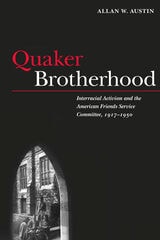
Quaker Brotherhood
Interracial Activism and the American Friends Service Committee, 1917-1950Allan W. Austin
University of Illinois Press, 2012
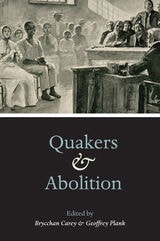
Quakers and Abolition
Edited by Brycchan Carey and Geoffrey Plank
University of Illinois Press, 2014
This collection of fifteen insightful essays examines the complexity and diversity of Quaker antislavery attitudes across three centuries, from 1658 to 1890. Contributors from a range of disciplines, nations, and faith backgrounds show Quaker's beliefs to be far from monolithic. They often disagreed with one another and the larger antislavery movement about the morality of slaveholding and the best approach to abolition.
Not surprisingly, contributors explain, this complicated and evolving antislavery sensibility left behind an equally complicated legacy. While Quaker antislavery was a powerful contemporary influence in both the United States and Europe, present-day scholars pay little substantive attention to the subject. This volume faithfully seeks to correct that oversight, offering accessible yet provocative new insights on a key chapter of religious, political, and cultural history.
Contributors include Dee E. Andrews, Kristen Block, Brycchan Carey, Christopher Densmore, Andrew Diemer, J. William Frost, Thomas D. Hamm, Nancy A. Hewitt, Maurice Jackson, Anna Vaughan Kett, Emma Jones Lapsansky-Werner, Gary B. Nash, Geoffrey Plank, Ellen M. Ross, Marie-Jeanne Rossignol, James Emmett Ryan, and James Walvin.

Quakers and Abolition
Brycchan Carey
University of Illinois Press, 2018

Quakers in the Colonial Northeast
Arthur J. Worrall
University Press of New England, 2002
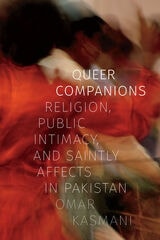
Queer Companions
Religion, Public Intimacy, and Saintly Affects in PakistanOmar Kasmani
Duke University Press, 2022
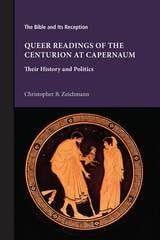
Queer Readings of the Centurion at Capernaum
Their History and PoliticsChristopher B. Zeichmann
SBL Press, 2022
The first-ever monograph on the history of queer biblical interpretation of a controversial biblical passage
Since the 1950s, homoerotic readings of the pericope in which Jesus heals a Roman centurion’s slave have been built upon three of the account’s features: the specific Greek word pais, which can refer to youth, slave, or the junior partner in a sexual relationship between two men; Luke’s characterization of the young man as “dear” (entimos) to the centurion; and commonplace homoeroticism in the Roman army. Rather than affirming or denying the historical reality of a sexual relationship between the centurion and the young man, Christopher B. Zeichmann instead traces the shifting patterns of queer readings of the text and the influences of the sexual, political, and theological discourses of late twentieth- and early twenty-first-century Europe, the United States, and Australia. Readers will see how distinct political contexts have led interpreters to find very different meanings about the sexual subtexts of this story.
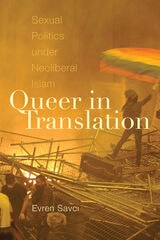
Queer in Translation
Sexual Politics under Neoliberal IslamEvren Savci
Duke University Press, 2021
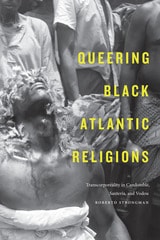
Queering Black Atlantic Religions
Transcorporeality in Candomblé, Santería, and VodouRoberto Strongman
Duke University Press, 2019

Quest for a Christian America, 1800–1865
A Social History of the Disciples of Christ, Volume 1David Edwin Harrell Jr.
University of Alabama Press, 2003
The definitive social history of the Disciples of Christ in the 19th century
Quest for a Christian America, 1800–1865: A Social History of the Disciples of Christ, Volume 1 by David Edwin Harrell Jr. is the definitive social history of the early Disciples of Christ and the broader Restoration Movement, one of the most influential religious reform movements in nineteenth-century America. Led by visionary figures such as Alexander Campbell and Barton W. Stone, the movement sought to restore the practices and principles of the early Christian church while promoting unity among believers in a rapidly changing nation.
Moving beyond traditional denominational history, Harrell examines the social, cultural, and political forces that shaped the movement's development between 1800 and the Civil War. He explores how Disciples responded to major issues of the era, including economic growth, reform movements, slavery, sectional conflict, patriotism, pacifism, and the challenges posed by an increasingly modern and diverse society. Through careful analysis, Harrell demonstrates how these concerns influenced both the movement's theology and its vision for a Christian nation.
Quest for a Christian America illuminates the origins of a movement whose descendants include the modern Christian Church (Disciples of Christ), Independent Christian Churches, and Churches of Christ. The book offers valuable insight into the relationship between religion, culture, and public life in nineteenth-century America.
Questions and Reform Jewish Answers - PDF Electronic Version
New American Reform ResponsaRabbi Walter Jacob
Central Conference of American Rabbis, 1992
Shall CPR be given to the frail elderly? Can genetic engineering be patented? Can there be a berit for Messianic Jews? May a tallit be worn at an interfaith service? May a criminal be a member of the congregation? Must a Jewish lawyer defend terrorists? These are just a few of the questions answered in this volume, which includes 246 Responsa. Originally published in 1992, many of these questions are still relevant for Jewish life today.
Questions on Aristotle's Categories
John Duns Scotus
Catholic University of America Press, 2014
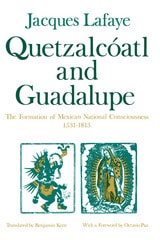
Quetzalcoatl and Guadalupe
The Formation of Mexican National Consciousness, 1531-1813Jacques Lafaye
University of Chicago Press, 1987
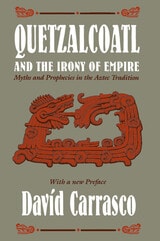
Quetzalcoatl and the Irony of Empire
Myths and Prophecies in the Aztec TraditionDavid Carrasco
University of Chicago Press, 1992
"This book, rich in ideas, constituting a novel approach . . . represents a stimulating and provocative contribution to Mesoamerican studies. . . . Recommended to all serious students of the New World's most advanced indigenous civilization."—H. B. Nicholson, Man
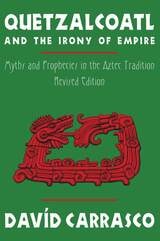
Quetzalcoatl and the Irony of Empire
Myths and Prophecies in the Aztec Tradition, Revised EditionDavíd Carrasco
University Press of Colorado, 2000
- American Anthropologist
"A must for both professional and serious non-professional students in Mesoamerica. Those who are interested in complex society and urbanism in general, as well as students of comparative religion, will find it stimulating. Most importantly, for anyone interested in the history of ideas, the book illuminates the tremendously powerful impact and role of a complex deity/mythico-historical figure in shaping one of the world's great pristine civilizations."
- Queen's Quarterly
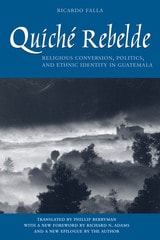
Quiché Rebelde
Religious Conversion, Politics, and Ethnic Identity in GuatemalaBy Ricardo Falla
University of Texas Press, 2001
Since the arrival of the Spanish in the sixteenth century, the Maya population of Guatemala has been forced to adapt to extraordinary challenges. Under colonial rule, the Indians had to adapt enough to satisfy the Spanish while resisting those changes not necessary for survival, applying their understanding of the world to the realities they confronted daily. Despite the major changes wrought in their way of life by centuries of submission, the Maya have managed to regenerate, and thus maintain, their self-identity.
Among the major challenges they have faced has been the imposition of outside religions. Quiché Rebelde examines what happened when Acción Católica came into the Guatemalan municipio of San Antonio Ilotenango, Quiché, to convert its inhabitants.
Ricardo Falla, a Guatemalan Jesuit priest and anthropologist, analyzes the movement's origins and why some people became part of it while others resisted. He shows how religion was used as another tool to readapt to the changing environment—natural, economic, political, and social. His work is the first major empirical study of how change occurred in a Maya community with no serious loss of Maya identity—and how the process of conversion is related to more general processes of cultural change that actually strengthen ethnic identity.
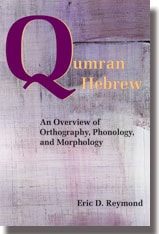
Qumran Hebrew
An Overview of Orthography, Phonology, and MorphologyEric D. Reymond
SBL Press, 2014
A unique study of the Hebrew of the Dead Sea Scrolls
In Qumran Hebrew, Reymond examines the orthography, phonology, and morphology of the Dead Sea Scrolls. Short sections treat specific linguistic phenomena and present a synopsis and critique of previous research. Reymond’s approach emphasizes problems posed by scribal errors and argues that guttural letters had not all “weakened” but instead were “weak” in specific linguistic environments, texts, or dialects. Reymond illustrates that certain phonetic shifts (such as the shift of yodh > aleph and the opposite shift of aleph > yodh) occur in discernible linguistic contexts that suggest this was a real phonetic phenomenon.
Features:
- Summary and critique of previous research
- Discussion of the most recently published scrolls
- Examination of scribal errors, guttural letters, and phonetic shifts
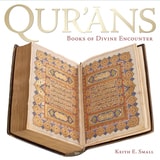
Qur'ans
Books of Divine EncounterKeith E. Small
Bodleian Library Publishing, 2015
A lavishly illustrated historical overview,Qur'ans: Books of Divine Encounter brings together in one volume a magnificent range of Qur'ans, bearing singular insight into these beautiful and significant sacred texts.