Results by title
235 books match the query 'Books and reading' and 26 start with r
RECIPROCAL INFLUENCES
Literary Production, Distribution, and Consumption in AmericaEdited by Steven Fink and Susan S. Williams
The Ohio State University Press, 1999

Read Me a Rhyme in Spanish and English
Rose Zertuche Treviño
American Library Association, 2009
Reading America
Citizenship, Democracy, and Cold War LiteratureKristin L. Matthews
University of Massachusetts Press, 2016
During the Cold War, the editor of Time magazine declared, “A good citizen is a good reader.” As postwar euphoria faded, a wide variety of Americans turned to reading to understand their place in the changing world. Yet, what did it mean to be a good reader? And how did reading make you a good citizen?
In Reading America, Kristin L. Matthews puts into conversation a range of political, educational, popular, and touchstone literary texts to demonstrate how Americans from across the political spectrum—including “great works” proponents, New Critics, civil rights leaders, postmodern theorists, neoconservatives, and multiculturalists—celebrated particular texts and advocated particular interpretive methods as they worked to make their vision of "America" a reality. She situates the fiction of J. D. Salinger, Ralph Ellison, Thomas Pynchon, John Barth, and Maxine Hong Kingston within these debates, illustrating how Cold War literature was not just an object of but also a vested participant in postwar efforts to define good reading and citizenship.
Reading National Geographic
Catherine A. Lutz and Jane L. Collins
University of Chicago Press, 1993
Lutz and Collins take us inside the National Geographic Society to investigate how its photographers, editors, and designers select images and text to produce representations of Third World cultures. Through interviews with the editors, they describe the process as one of negotiating standards of "balance" and "objectivity," informational content and visual beauty. Then, in a close reading of some six hundred photographs, they examine issues of race, gender, privilege, progress, and modernity through an analysis of the way such things as color, pose, framing, and vantage point are used in representations of non-Western peoples. Finally, through extensive interviews with readers, the authors assess how the cultural narratives of the magazine are received and interpreted, and identify a tension between the desire to know about other peoples and their ways and the wish to validate middle-class American values.
The result is a complex portrait of an institution and its role in promoting a kind of conservative humanism that acknowledges universal values and celebrates diversity while it allows readers to relegate non-Western peoples to an earlier stage of progress. We see the magazine and the Society as a key middlebrow arbiter of taste, wealth, and power in America, and we get a telling glimpse into middle-class American culture and all the wishes, assumptions, and fears it brings to bear on our armchair explorations of the world.

Reading Piers Plowman and the Pilgrim's Progress
Reception and the Protestant ReaderBarbara A. Johnson
Southern Illinois University Press, 1992
Centering her discussion on two historical "ways of reading"—which she calls the Protestant and the lettered—Barbara A. Johnson traces the development of a Protestant readership as it is reflected in the reception of Langland’s Piers Plowman and Bunyan’s Pilgrim’s Progress.
Informed by reader-response and reception theory and literacy and cultural studies, Johnson’s ambitious examination of these two ostensibly literary texts charts the cultural roles they played in the centuries following their composition, roles far more important than their modern critical reputations can explain.
Johnson argues that much more evidence exists about how earlier readers read than has hitherto been acknowledged. The reception of Piers Plowman, for example, can be inferred from references to the work, the apparatus its Renaissance printer inserted in his editions, the marginal comments readers inscribed both in printed editions and in manuscripts, and the apocryphal "plowman" texts that constitute interpretations of Langland’s poem. She demonstrates by example that what is culturally transmitted has not been just the work itself; it includes vestiges of past readers’ encounters with the text that are traceable both in the way a text is presented as well as in the way that presentation is received.
Conditioned more by religious, historical, and economic forces than by literary concerns, Langland’s poem became a part of the reformist tradition that culminated in Bunyan’s Pilgrim’s Progress. By understanding this tradition, Bunyan’s place in it, and the way the reception of The Pilgrim’s Progress illustrates the beginning of a new, more realistic fictional tradition, Johnson concludes, we can begin to delineate a more accurate history of the ways literature and society intersect, a history of readers reading.
Reading Places
Literacy, Democracy, and the Public Library in Cold War AmericaChristine Pawley
University of Massachusetts Press, 2010
Central to the experiment were well-stocked bookmobiles that brought books to rural districts and the one-room schools that dotted the region. Three years after the project began, state officials and local librarians judged it an overwhelming success. Library circulation figures soared to two-and-a-half times their previous level. Over 90 percent of grade-school children in the rural schools used the bookmobile service, and their reading scores improved beyond expectation.
Despite these successes, however, local communities displayed deeply divided reactions. Some welcomed the book-mobiles and new library services wholeheartedly, valuing print and reading as essential to the exercise of democracy, and keen to widen educational opportunities for children growing up on hardscrabble farms where books and magazines were rare. Others feared the intrusion of govern- ment into their homes and communities, resented the tax increases that library services entailed, and complained about the subversive or immoral nature of some books.
Analyzing the history of tensions between various community groups, Pawley delineates the long-standing antagonisms arising from class, gender, and ethnic differences which contributed to a suspicion of official projects to expand education. Relating a seemingly small story of library policy, she teases out the complex interaction of reading, locality, and cultural difference. In so doing, she illuminates broader questions regarding libraries, literacy, and citizenship, reaching back to the nineteenth century and forward to the present day.
Reading Practice
The Pursuit of Natural Knowledge from Manuscript to PrintMelissa Reynolds
University of Chicago Press, 2024
Reading Practice tells the story of how ordinary people grew comfortable learning from commonplace manuscripts and printed books, such as almanacs, medical recipe collections, and herbals. From the turn of the fifteenth century to the close of the sixteenth century, these were the books English people read when they wanted to attend to their health or understand their place in the universe. Before then, these works had largely been the purview of those who could read Latin. Around 1400, however, medical and scientific texts became available in Middle English while manuscripts became less expensive. These vernacular manuscripts invited their readers into a very old and learned conversation: Hippocrates and Galen weren’t distant authorities whose word was law, they were trusted guides, whose advice could be excerpted, rearranged, recombined, and even altered to suit a manuscript compiler’s needs. This conversation continued even after the printing press arrived in England in 1476. Printers mined manuscripts for medical and scientific texts that they would publish throughout the sixteenth century, though the pressures of a commercial printing market encouraged printers to package these old texts in new ways. Without the weight of authority conditioning their reactions and responses to very old knowledge, and with so many editions of practical books to choose from, English readers grew into confident critics and purveyors of natural knowledge in their own right.
Melissa Reynolds reconstructs shifting attitudes toward medicine and science over two centuries of seismic change within English culture, attending especially to the effects of the Reformation on attitudes toward nature and the human body. Her study shows how readers learned to be discerning and selective consumers of knowledge gradually, through everyday interactions with utilitarian books.

Reading Relations
How Authors Enter Our LivesDixon, Dan
University of Iowa Press, 2026
Drawing on the ordinary language philosophy of Toril Moi and Stanley Cavell, Dan Dixon argues that the act of reading shares emotional ground with our social lives. It prompts us to attend to the kinds of affective attachments that frequently resist description, as well as the attachments that encourage debate among scholars of literature.
Dixon posits that the interpretation of a text is significantly shaped by our impression of the writer. Through the lens of persona, this book examines the work of influential and iconic post-1945 American essayists, such as Joan Didion, Maggie Nelson, James Baldwin, Janet Malcolm, Teju Cole, David Foster Wallace, and Ben Lerner. The attachments we form might facilitate insight, consolation, distrust, or vanity. But whatever their effects, they can’t be ignored.
Reading Together
Katarzyna Bartoszynska
Prickly Paradigm Press, 2025
In this engaging and vivacious memoir, college professor Katarzyna Bartoszyńska thinks back on various book clubs she has been a part of. Through brief discussions of a variety of novels, memoirs, and nonfiction works such as Ottessa Moshfegh’s My Year of Rest and Relaxation, Marjane Satrapi’s Chicken with Plums, and Alma Guillermoprieto’s Dancing in Cuba, she considers how the things she has learned in book club discussions differ from what she tries to teach students in her literature classes. As she muses on the various benefits that we imagine reading offers, she describes the unique knowledge that book clubs can provide.
Reading Together, Reading Apart
Identity, Belonging, and South Asian American CommunityTamara Bhalla
University of Illinois Press, 2016
Tamara Bhalla blends a case study with literary and textual analysis to illuminate this phenomenon. Her fascinating investigation considers institutions from literary reviews to the marketplace to social media and other technologies, as well as traditional forms of literary discussion like book clubs and academic criticism. Throughout, Bhalla questions how her subjects' circumstances, desires, and shared race and class, limit the values they ascribe to reading. She also examines how ideology circulating around a body of literature or a self-selected, imagined community of readers shapes reading itself and influences South Asians' powerful, if contradictory, relationship with ideals of cultural authenticity.
Reading Up
Middle-Class Readers and the Culture of Success in the Early Twentieth-Century United StatesAmy Blair
Temple University Press, 2011
A person who reads a book for self-improvement rather than aesthetic pleasure is “reading up.” Reading Up is Amy Blair's engaging study of popular literary critics who promoted reading generally and specific books as vehicles for acquiring cultural competence and economic mobility. Combining methodologies from the history of the book and the history of reading, to mass-cultural studies, reader-response criticism, reception studies, and formalist literary analysis, Blair shows how such critics influenced the choices of striving readers and popularized some elite writers.
Framed by an analysis of Hamilton Wright Mabie's role promoting the concept of “reading up” during his ten-year stint as the cultivator of literary taste for the highly popular Ladies' Home Journal, Reading Up reveals how readers flocked to literary works that they would be expected to dislike. Blair shows that while readers could be led to certain books by a trusted adviser, they frequently followed their own path in interpreting them in unexpected ways.
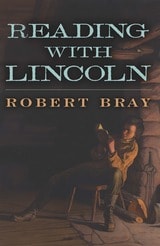
Reading With Lincoln
Robert Bray
Southern Illinois University Press, 2010
Through extensive reading and reflection, Abraham Lincoln fashioned a mind as powerfully intellectual and superlatively communicative as that of any other American political leader. Reading with Lincoln uncovers the how of Lincoln’s inspiring rise to greatness by connecting the content of his reading to the story of his life.
At the core of Lincoln’s success was his self-education, centered on his love of and appreciation for learning through books. From his early studies of grammar school handbooks and children’s classics to his interest in Shakespeare’s Macbeth and the Bible during his White House years, what Lincoln read helped to define who he was as a person and as a politician. This unique study delves into the books, pamphlets, poetry, plays, and essays that influenced Lincoln’s thoughts and actions.
Exploring in great depth and detail those readings that inspired the sixteenth president, author Robert Bray follows Lincoln’s progress closely, from the young teen composing letters for illiterate friends and neighbors to the politician who keenly employed what he read to advance his agenda. Bray analyzes Lincoln’s radical period in New Salem, during which he came under the influence of Anglo-American and French Enlightenment thinkers such as Thomas Paine, C. F. Volney, and Voltaire, and he investigates Lincoln’s appreciation of nineteenth-century lyric poetry, which he both read and wrote. Bray considers Lincoln’s fascination with science, mathematics, political economics, liberal social philosophy, theology, and the Bible, and devotes special attention to Lincoln’s enjoyment of American humor. While striving to arrive at an understanding of the role each subject played in the development of this remarkable leader, Bray also examines the connections and intertextual relations between what Lincoln read and how he wrote and spoke.
This comprehensive and long-awaited book provides fresh insight into the self-made man from the wilderness of Illinois. Bray offers a new way to approach the mind of the political artist who used his natural talent, honed by years of rhetorical study and practice, to abolish slavery and end the Civil War.
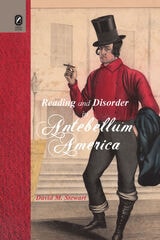
Reading and Disorder in Antebellum America
David M. Stewart
The Ohio State University Press, 2011
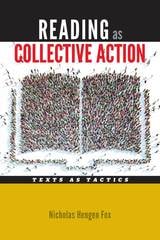
Reading as Collective Action
Text as TacticsNicholas Hengen Fox
University of Iowa Press, 2017
Reading as Collective Action shifts our focus outward, to another of literature’s powers: the power to reshape our world in very public, very active ways. In this book, you will encounter readers who criticized the Bush administration’s war on terror by republishing poems by writers ranging from Shakespeare to Amiri Baraka everywhere from lampposts to the New York Times. You will read about people in Michigan and Tennessee, who leveraged a community reading program on John Steinbeck’s The Grapes of Wrath to organize support for those in need during the Great Recession and to engage with their neighbors about immigration. You will meet a pair of students who took to public transit to talk with strangers about working-class literature and a trio who created a literary website that reclaimed the working-class history of the Pacific Northwest.
This book challenges dominant academic modes of reading. For adherents of the “civic turn,” it suggests how we can create more politically effective forms of service learning and community engagement grounded in a commitment to tactical, grassroots actions. Whether you’re a social worker or a student, a zine-maker, a librarian, a professor, or just a passionate reader with a desire to better your community, this book shows that when we read texts as tactics, “that book changed my life” can become “that book changed our lives.”
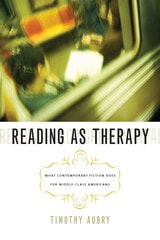
Reading as Therapy
What Contemporary Fiction Does for Middle-Class AmericansTimothy Aubry
University of Iowa Press, 2011
@font-face { font-family: "Myriad Pro";}p.MsoNormal, li.MsoNormal, div.MsoNormal { margin: 0in 0in 0.0001pt; font-size: 12pt; font-family: "Times New Roman"; }div.Section1 { page: Section1; }Why do Americans read contemporary fiction? This question seems simple, but is it? Do Americans read for the purpose of aesthetic appreciation? To satisfy their own insatiable intellectual curiosities? While other forms of media have come to monopolize consumers’ leisure time, in the past two decades book clubs have proliferated, Amazon has sponsored thriving online discussions, Oprah Winfrey has inspired millions of viewers to read both contemporary works and classics, and novels have retained their devoted following within middlebrow communities.
In Reading as Therapy, Timothy Aubry argues that contemporary fiction serves primarily as a therapeutic tool for lonely, dissatisfied middle-class American readers, one that validates their own private dysfunctions while supporting elusive communities of strangers unified by shared feelings. Aubry persuasively makes the case that contemporary literature’s persistent appeal depends upon its capacity to perform a therapeutic function.
Reading as Therapy traces the growth and proliferation of psychological concepts focused on the subjective interior within mainstream, middle-class society and the impact this has had on contemporary fiction. The prevailing tendency among academic critics has been to decry the personal emphasis of contemporary fiction as complicit with the rise of a narcissistic culture, the ascendency of liberal individualism, and the breakdown of public life. Reading as Therapy, by contrast, underscores the varied ideological effects that therapeutic culture can foster.
To uncover the many unpredictable ways in which contemporary literature answers the psychological needs of its readers, Aubry considers several different venues of reader-response—including Oprah’s Book Club and Amazon customer reviews—the promotional strategies of publishing houses, and a variety of contemporary texts, ranging from Khaled Hosseini’s The Kite Runner to Anita Shreve’s The Pilot’s Wife to David Foster Wallace’s Infinite Jest. He concludes that, in the face of an atomistic social landscape, contemporary fiction gives readers a therapeutic vocabulary that both reinforces the private sphere and creates surprising forms of sympathy and solidarity among strangers.
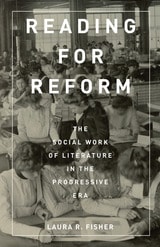
Reading for Reform
The Social Work of Literature in the Progressive EraLaura R. Fisher
University of Minnesota Press, 2019
An unprecedented examination of class-bridging reform and U.S. literary history at the turn of the twentieth century
Reading for Reform rewrites the literary history of late nineteenth and early twentieth century America by putting social reform institutions at the center of literary and cultural analysis. Examining the vibrant, often fractious literary cultures that developed as part of the Progressive mandate to uplift the socially disadvantaged, it shows that in these years reformers saw literature as a way to combat the myriad social problems that plagued modern U.S. society. As they developed distinctly literary methods for Americanizing immigrants, uplifting and refining wage-earning women, and educating black students, their institutions gave rise to a new social purpose for literature.
Class-bridging reform institutions—the urban settlement house, working girls’ club, and African American college—are rarely addressed in literary history. Yet, Laura R. Fisher argues, they engendered important experiments in the form and social utility of American literature, from minor texts of Yiddish drama and little-known periodical and reform writers to the fiction of Edith Wharton and Nella Larsen. Fisher delves into reform’s vast and largely unexplored institutional archives to show how dynamic sites of modern literary culture developed at the margins of social power.
Fisher reveals how reformist approaches to race, class, religion, and gender formation shaped American literature between the 1880s and the 1920s. In doing so, she tells a new story about the fate of literary practice, and the idea of literature’s practical value, during the very years that modernist authors were proclaiming art’s autonomy from concepts of social utility.
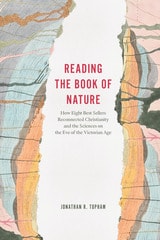
Reading the Book of Nature
How Eight Best Sellers Reconnected Christianity and the Sciences on the Eve of the Victorian AgeJonathan R. Topham
University of Chicago Press, 2022
When Charles Darwin returned to Britain from the Beagle voyage in 1836, the most talked-about scientific books of the day were the Bridgewater Treatises. This series of eight works was funded by a bequest of the last Earl of Bridgewater and written by leading men of science appointed by the president of the Royal Society to explore "the Power, Wisdom, and Goodness of God, as manifested in the Creation." Securing public attention beyond all expectations, the series offered Darwin’s generation a range of approaches to one of the great questions of the age: how to incorporate the newly emerging disciplinary sciences into Britain’s overwhelmingly Christian culture.
Drawing on a wealth of archival and published sources, including many unexplored by historians, Jonathan R. Topham examines how and to what extent the series contributed to a sense of congruence between Christianity and the sciences in the generation before the fabled Victorian conflict between science and religion. Building on the distinctive insights of book history and paying close attention to the production, circulation, and use of the books, Topham offers new perspectives on early Victorian science and the subject of science and religion as a whole.
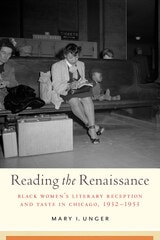
Reading the Renaissance
Black Women's Literary Reception and Taste in Chicago, 1932-1953Mary I. Unger
University of Massachusetts Press, 2025
From 1932 to 1953, during the Black Chicago Renaissance, numerous literary events were held within and for the city’s Black community. In book clubs, public forums, print reviews, little magazines, local programming, and other public venues, Black women in particular debated the role of literature in racial uplift efforts, set literary standards, and acted as community gatekeepers for cultural production during a time known as the Black Chicago Renaissance. Through these inspiring efforts, a mix of publishers, well-known authors, and everyday readers significantly fostered a robust literary culture in the Windy City.
Reading the Renaissance constructs a reception history of the Black women who read and reviewed, published and promoted, and collected and curated literature of the era. Mary Unger interprets how local figures such as Vivian G. Harsh, Ora Morrow, Gwendolyn Brooks, Alice Browning, Fern Gayden, and Margaret Walker cultivated particular literary tastes through collective acts of reading and reception. She does so by recovering a network of readers, book clubs, literary magazines, civic programs, and book businesses that Black women created, led, and transformed during the early 1930s through the early 1950s in Bronzeville, Chicago’s predominantly Black South Side neighborhood.
This illuminating work includes close readings of texts alongside letters, scrapbooks, meeting minutes, reviews, and other ephemera of local reading practices to show how Black women facilitated diverse strategies of reading while instructing community members how to engage a variety of print cultures at the time. Unger demonstrates how Black women readers influenced individual authors as well as the norms and expectations of African American literature more broadly, becoming important (yet too often overlooked) players in American literary history.
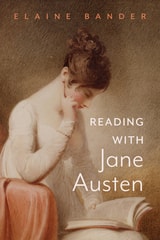
Reading with Jane Austen
Elaine Bander
Bucknell University Press, 2026
Jane Austen has more readers today than at any time in history. Many of Austen’s legions of fans, however, came to her novels after first seeing films or other adaptations made for twenty-first-century audiences. Austen herself conversely spent her literary career undermining romantic clichés and rethinking novel conventions. Confident that she and her contemporaries shared a common reading culture, Austen deliberately constructed her novels to set readerly expectations, only to disrupt or confound those expectations by challenging her readers’ assumptions and values. In Reading with Jane Austen, Elaine Bander carefully rereads the great author’s novels—beginning with her late work of juvenilia, “Catharine, or The Bower,” and ending with her final fragment, “Sanditon”—against the rich context of late Georgian literary and intellectual culture. In doing so, Bander invites us into the transformative experience that Austen intentionally designed for her earliest readers, adding new layers of appreciation for those who love her work.
Published by Bucknell University Press. Distributed worldwide by Rutgers University Press.
Elaine Bander speaking at the Atwater Library in Quebec (https://youtu.be/UeEjFOfp9cQ?si=Wv2hsLxkGK157WZI)
Rediscovering Nancy Drew
Carolyn Stewart Dyer
University of Iowa Press, 1995
Reid's Read-Alouds 2
Modern-Day Classics from C.S. Lewis to Lemony SnicketRob Reid
American Library Association, 2010
Reid's Read-Alouds
Selections for Children and TeensRob Reid
American Library Association, 2009
Reluctant Capitalists
Bookselling and the Culture of ConsumptionLaura J. Miller
University of Chicago Press, 2006
In Reluctant Capitalists, Miller looks at a century of book retailing, demonstrating that the independent/chain dynamic is not entirely new. It began one hundred years ago when department stores began selling books, continued through the 1960s with the emergence of national chain stores, and exploded with the formation of “superstores” in the 1990s. The advent of the Internet has further spurred tremendous changes in how booksellers approach their business. All of these changes have met resistance from book professionals and readers who believe that the book business should somehow be “above” market forces and instead embrace more noble priorities.
Miller uses interviews with bookstore customers and members of the book industry to explain why books evoke such distinct and heated reactions. She reveals why customers have such fierce loyalty to certain bookstores and why they identify so strongly with different types of books. In the process, she also teases out the meanings of retailing and consumption in American culture at large, underscoring her point that any type of consumer behavior is inevitably political, with consequences for communities as well as commercial institutions.
Revolutions at Home
The Origin of Modern Childhood and the German Middle ClassEmily C. Bruce
University of Massachusetts Press, 2021
Revolutions at Home analyzes a rich set of documents created for and by young Germans to show that children were central to reinventing their own education between 1770 and 1850. Through their reading and writing, they helped construct the modern child subject. The active child who emerged at this time was not simply a consequence of expanding literacy but, in fact, a key participant in defining modern life.
Risky Business
Taking and Managing Risks in Library Services for TeensLinda W. American Library Association
American Library Association, 2010
Romance and the Erotics of Property
Mass-Market Fiction for WomenJan Cohn
Duke University Press, 1988
Cohn argues that a full understanding of the contemporary romance requires an investigation of its literary and historical sources and analogues. Three principal sources are examined in the context of women's history in bourgeois society. Pride and Prejudice, Jane Erye, and Gone With the Wind demonstrate the development of romance fiction's themes, yet in all three the central love story is complicated by issues of property, the sign of male power. Jan Cohn further considers the development of the genre n the fictions of Harriet Lewis and May Agnes Fleming, prolific and popular American romance writers of the late nineteenth century who developed the role of the villain, thereby bringing into focus the sexual and economic struggles faced by the heroine.
Romance and the Erotics of Property sets romance fiction against a historic and literary background, arguing that contemporary romance disguises as tales of love the subversive fantasies of female appropriation and male property and power.