Results by title
718 books match the query 'Civil rights' and 46 start with r
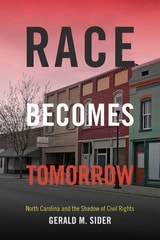
Race Becomes Tomorrow
North Carolina and the Shadow of Civil RightsGerald M. Sider
Duke University Press, 2015
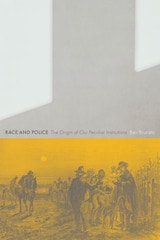
Race and Police
The Origin of Our Peculiar InstitutionsBen Brucato
Rutgers University Press, 2024
Race and Police corrects the Eurocentrism in the orthodox history of American police and in predominating critical theories of police. That orthodoxy rests on an origin story that begins with Sir Robert Peel and the London Metropolitan Police Service. Predating the Met by more than a century, America’s first police, often called slave patrols, did more than maintain order—it fabricated a racial order. Prior to their creation, all white citizens were conscripted to police all Blacks. Their participation in the coercive control of Blacks gave definition to their whiteness. Targeted as threats to the security of the economy and white society, being policed defined Blacks who, for the first time, were treated as a single racial group. The boundaries of whiteness were first established on the basis of who was required to regulate slaves, given a specific mandate to prevent Black insurrection, a mandate that remains core to the police role to this day.
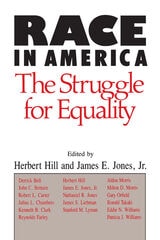
Race in America
The Struggle for EqualityHerbert Hill
University of Wisconsin Press, 1993
Race in America is a multidisciplinary analysis of race and injustice by some of the nation’s foremost scholar-activists who helped shape the course of the struggle for civil rights during the recent past. These essays provide a historical retrospective, an assessment of where we are now, and an outline of possibilities for the future.
The major controversial issues in race relations, in the past and in the present, such as affirmative action, educational segregation, racial practices of labor unions, legal strategies for protest movements, the persistence of racism in American institutions, and the sources of resistance to change are discussed at length by major authorities in their respective fields.
Many of the most important events in recent American history come alive in these pages as the strategies and programs, the victories and defeats of the civil rights movement are rigorously examined. A unique aspect of the book is that the human experience of active participants in this rich history is evoked through personal and often poignant accounts, such as those of Kenneth B. Clark, who in a memorable autobiographical essay describes a long life devoted to the pursuit of racial justice, and Patricia J. Williams, who relates the contemporary struggles of African American women to the historical context of slavery and its aftermath.
As no other book can, this collection provides the basis for the critical insights and historical perspectives that are essential for an understanding of the central issue still confronting American society: race and racism.
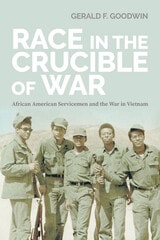
Race in the Crucible of War
African American Servicemen and the War in VietnamGerald F. Goodwin
University of Massachusetts Press, 2023
When African American servicemen went to fight in the Vietnam War, discrimination and prejudice followed them. Even in a faraway country, their military experiences were shaped by the racial environment of the home front. War is often viewed as a crucible that can transform society, but American race relations proved remarkably durable.
In Race in the Crucible of War, Gerald F. Goodwin examines how Black servicemen experienced and interpreted racial issues during their time in Vietnam. Drawing on more than fifty new oral interviews and significant archival research, as well as newspapers, periodicals, memoirs, and documentaries, Goodwin reveals that for many African Americans the front line and the home front were two sides of the same coin. Serving during the same period as the civil rights movement and the race riots in Chicago, Detroit, and dozens of other American cities, these men increasingly connected the racism that they encountered in the barracks and on the battlefields with the tensions and violence that were simmering back home.
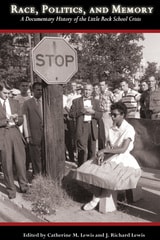
Race, Politics, and Memory
A Documentary History of the Little Rock School CrisisCatherine M. Lewis
University of Arkansas Press, 2007
Race, Religion, and Black Lives Matter
Essays on a Moment and a MovementChristopher Cameron
Vanderbilt University Press, 2021
This volume has a simple, but far-reaching argument: religion is an important thread in BLM. To advance this claim, Race, Religion, and Black Lives Matter examines religion’s place in the movement through the lenses of history, politics, and culture. While this collection is not exhaustive or comprehensive in its coverage of religion and BLM, it selectively anthologizes unique aspects of Black religious history, thought, and culture in relation to political struggle in the contemporary era. The chapters aim to document historical change in light of current trends and current events. The contributors analyze religion and BLM in a current historical moment fraught with aggressive, fascist, authoritarian tendencies and one shaped by profound ingenuity, creativity, and insightful perspectives on Black history and culture.
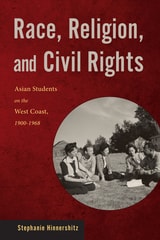
Race, Religion, and Civil Rights
Asian Students on the West Coast, 1900-1968Hinnershitz, Stephanie
Rutgers University Press, 2015
Stephanie Hinnershitz tells the story of the Asian American campus organizations that flourished on the West Coast from the 1900s through the 1960s. Using their faith to point out the hypocrisy of fellow American Protestants who supported segregation and discriminatory practices, the student activists in these groups also performed vital outreach to communities outside the university, from Californian farms to Alaskan canneries. Highlighting the unique multiethnic composition of these groups, Race, Religion, and Civil Rights explores how the students' interethnic activism weathered a variety of challenges, from the outbreak of war between Japan and China to the internment of Japanese Americans during World War II.
Drawing from a variety of archival sources to bring forth the authentic, passionate voices of the students, Race, Religion, and Civil Rights is a testament to the powerful ways they served to shape the social, political, and cultural direction of civil rights movements throughout the West Coast.
Race, Republicans, and the Return of the Party of Lincoln
Tasha S. Philpot
University of Michigan Press, 2007
Whether their slogan is “compassionate conservatism” or “hawkish liberalism,” political parties have always sought to expand their electoral coalitions by making minor adjustments to their public image. How do voters respond to these, often short-term, campaign appeals? Race, Republicans, and the Return of the Party of Lincoln is Tasha Philpot’s insightful study of how parties use racial images to shape and reshape the way citizens perceive them.
“Philpot has produced a timely, provocative, and nuanced analysis of political party image change, using the Republican Party’s attempts to recast itself as a party sensitive to issues of race with its 2000, and later 2004, national conventions as case examples. Using a mixture of experiments, focus groups, national surveys, and analyses of major national and black newspaper articles, Philpot finds that if race-related issues are important to individuals, such as blacks, the ability of the party to change its image without changing its political positions is far more difficult than it is among individuals who do not consider race-related issues important, e.g., whites. This book makes a major contribution
to our understanding of party image in general, and political parties’ use of race in particular. Bravo!”
—Paula D. McClain, Duke University
“This book does an excellent job of illuminating the linkages between racial images and partisan support. By highlighting Republican efforts to ‘play against type’ Philpot emphasizes the limits of successfully altering partisan images. That she accomplishes this in the controversial, yet salient, domain of race is no small feat. In short, by focusing on a topical issue, and by adopting a novel theoretical approach, Philpot is poised to make a significant contribution to the literatures on race and party images.”
—Vincent Hutchings, University of Michigan
Tasha S. Philpot is Assistant Professor of Government and African and African American Studies at the University of Texas at Austin.
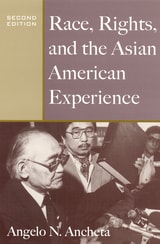
Race, Rights, and the Asian American Experience
Ancheta, Angelo N
Rutgers University Press, 2006
Ancheta examines legal and social theories of racial discrimination, ethnic differences in the Asian American population, nativism, citizenship, language, school desegregation, and affirmative action. In the revised edition of this influential book, Ancheta also covers post-9/11 anti-Asian sentiment and racial profiling. He analyzes recent legal cases involving political empowerment, language rights, human trafficking, immigrant rights, and affirmative action in higher education-many of which move the country farther away from the ideals of racial justice. On a more positive note, he reports on the progress Asian Americans have made in the corporate sector, politics, the military, entertainment, and academia.
A skillful mixture of legal theories, court cases, historical events, and personal insights, this revised edition brings fresh insights to U.S. civil rights from an Asian American perspective.

Race, Rights, and the Asian American Experience
Ancheta, Angelo N
Rutgers University Press, 1997
In Race, Rights, and the Asian American Experience, Angelo N. Ancheta demonstrates how United States civil rights laws have been framed by a black-white model of race that typically ignores the experiences of other groups, including Asian Americans. When racial discourse is limited to antagonisms between black and white, Asian Americans often find themselves in a racial limbo, marginalized or unrecognized as full participants.
Ancheta examines legal and social theories of racial discrimination, ethnic differences in the Asian American population, nativism, citizenship, language, school desegregation, and affirmative action. In the second edition of this influential book, Ancheta also covers post–9/11 anti-Asian sentiment and racial profiling. He analyzes recent legal cases involving political empowerment, language rights, human trafficking, immigrant rights, and affirmative action in higher education—many of which move the country farther away from the ideals of racial justice. On a more positive note, he reports on the progress Asian Americans have made in the corporate sector, politics, the military, entertainment, and academia.
A skillful mixture of legal theories, court cases, historical events, and personal insights, this second edition brings fresh insights to U.S. civil rights from an Asian American perspective.
Race/Class Conflict and Urban Financial Threat
Jennifer L. Hochschild
Russell Sage Foundation, 2024
Hochschild investigates the root causes of disputes in the arenas of policing, development, schooling, and budgeting. She finds that race and class are central to the Stop-Question-Frisk policing policy in New York City and the development of Atlanta’s Beltline. New York’s Stop-Question-Frisk policy was intended to fight crime and keep all New Yorkers safe. In practice, however, young Black and Latino men in low-income neighborhoods were disproportionately stopped by a predominantly White police force. The goal of the Atlanta Beltline, a redevelopment project that includes public parks, new housing, commercial development, and a robust public transit system, is to expand access around the city and keep working-class residents in the city by constructing affordable housing. Instead, the construction completed thus far has encouraged gentrification and displacement of poor, disproportionately Black residents, and has increased the wealth and power of both Black and White city elites.
However, Hochschild finds that race and class inequality are not central to all urban policy disputes. When investigating the issues of charter schools in Los Angeles and Chicago’s pension system she identifies a third driver: financial threat that feels existential to the policy and political actors. In Los Angeles, there is a battle between traditional public schools and independent charter schools. Increasingly, families with sufficient resources are moving out of L.A. to areas with better school districts. Traditional public schools and charter schools must fight for the remaining students and the funding that comes with them. There are not enough students to teach and not enough money to teach them. The school district risks school closures, layoffs, and pension deficits; in this context, race/class conflict fades into the background.
Chicago’s public sector pension debt is at least three times as large as the city’s annual budget and continues to grow. Policy actors agree that the pension system needs to be stably funded. Yet city leaders, fearful of upsetting constituents and jeopardizing their political careers, fail to implement policies that would do so. Meaningful policy change to rectify the pension deficit continues to get kicked down the line for future policy actors to address. In this context also, race/class conflict fades into the background.
Race/Class Conflict and Urban Financial Threat is a compelling examination of the role that race, class, and political and fiscal threat play in shaping urban policy.
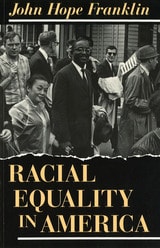
Racial Equality in America
John Hope Franklin
University of Missouri Press, 1976
This is distinguished historian John Hope Franklin's eloquent and forceful meditation on the persistent disparity between the goal of racial equality in America and the facts of discrimination.
In a searing critique of Thomas Jefferson, Franklin shows that this spokesman for democracy did not include African Americans among those "created equal." Franklin chronicles the events of the nineteenth century that solidified inequality in America and shows how emancipation dealt only with slavery, not with inequality.
In the twentieth century, America finally confronted the fact that equality is indivisible: it must not be divided so that it is extended to some at the expense of others. Once this indivisibility is accepted, Franklin charges, America faces the monumental task of overcoming its long heritage of inequality.
Racial Equality in America is a powerful reminder that our history is more than a record of idealized democratic traditions and institutions. It is a dramatic message to all Americans, calling them to know their history and themselves.
Racial Union
Law, Intimacy, and the White State in Alabama, 1865-1954Julie Novkov
University of Michigan Press, 2008
In November 2001, the state of Alabama opened a referendum on its long-standing constitutional prohibition against interracial marriage. A bill on the state ballot offered the opportunity to relegate the state's antimiscegenation law to the dustbin of history. The measure passed, but the margin was alarmingly slim: more than half a million voters, 40 percent of those who went to the polls, voted to retain a racist and constitutionally untenable law.
Julie Novkov's Racial Union explains how and why, nearly forty years after the height of the civil rights movement, Alabama struggled to repeal its prohibition against interracial marriage---the last state in the Union to do so. Novkov's compelling history of Alabama's battle over miscegenation shows how the fight shaped the meanings of race and state over ninety years. Novkov's work tells us much about the sometimes parallel, sometimes convergent evolution of our concepts of race and state in the nation as a whole.
"A remarkably nuanced account of interlocked struggles over race, gender, class and state power. Novkov's site is Alabama, but her insights are for all America."
---Rogers M. Smith, Christopher H. Browne Distinguished Professor of Political Science, University of Pennsylvania
"Hannah Arendt shocked Americans in the 1950s by suggesting that interracial intimacy was the true measure of a society's racial order. Julie Novkov's careful, illuminating, powerful book confirms Arendt's judgment. By ruling on who may be sexually linked with whom, Alabama's courts and legislators created a racial order and even a broad political order; Novkov shows us just how it worked in all of its painful, humiliating power."
---Jennifer L. Hochschild, Henry LaBarre Jayne Professor of Government, Professor of African and African American Studies, and Harvard College Professor
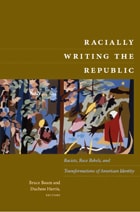
Racially Writing the Republic
Racists, Race Rebels, and Transformations of American IdentityBruce Baum and Duchess Harris, eds.
Duke University Press, 2009
The contributors analyze Thomas Jefferson’s legacy in light of his sexual relationship with his slave, Sally Hemings; the way that Samuel Gompers, the first president of the American Federation of Labor, rallied his organization against Chinese immigrant workers; and the eugenicist origins of the early-twentieth-century birth-control movement led by Margaret Sanger. They draw attention to the writing of Sarah Winnemucca, a Northern Piute and one of the first published Native American authors; the anti-lynching activist Ida B. Wells-Barnett; the Filipino American writer Carlos Bulosan; and the playwright Lorraine Hansberry, who linked civil rights struggles in the United States to anticolonial efforts abroad. Other figures considered include Alexis de Tocqueville and his traveling companion Gustave de Beaumont, Juan Nepomuceno Cortina (who fought against Anglo American expansion in what is now Texas), Abraham Lincoln, Theodore Roosevelt, and W. E. B. Du Bois. In the afterword, George Lipsitz reflects on U.S. racial politics since 1965.
Contributors. Bruce Baum, Cari M. Carpenter, Gary Gerstle, Duchess Harris, Catherine A. Holland, Allan Punzalan Isaac, Laura Janara, Ben Keppel, George Lipsitz, Gwendolyn Mink, Joel Olson, Dorothy Roberts, Patricia A. Schechter, John Kuo Wei Tchen, Jerry Thompson
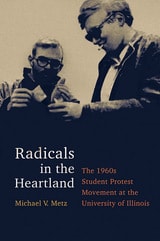
Radicals in the Heartland
The 1960s Student Protest Movement at the University of IllinoisMichael V. Metz
University of Illinois Press, 2019
Positioning the events in the context of their time, Michael V. Metz delves into the lives and actions of activists at the center of the drama. A participant himself, Metz draws on interviews, archives, and newspaper records to show a movement born in demands for free speech, inspired by a movement for civil rights, and driven to the edge by a seemingly never-ending war. If the sudden burst of irrational violence baffled parents, administrators, and legislators, it seemed inevitable to students after years of official intransigence and disregard. Metz portrays campus protesters not as angry, militant extremists but as youthful citizens deeply engaged with grave moral issues, embodying the idealism, naiveté, and courage of a minority of a generation.

Ralph J. Bunche
Selected Speeches and WritingsCharles P. Henry, Editor
University of Michigan Press, 1996
Bunche was a pioneer in every sense of the word. The first black American to hold a doctorate in political science, Bunche established the political science department at Howard University and co-founded the National Negro Congress. He served as the first African- American section head in the Office of Strategic Services and later moved to the State Department. He played a major part in the delegation that established the United Nations and, when he retired as Under Secretary General, was the highest- ranking black in that organization. In 1950, he was awarded the Nobel Peace Prize and thus became the first black Nobel laureate.
Bunche's thinking and writing was broad, ranging from the political left to the center. Early works flirt with socialist or even Bolshevist ideas, while later works maintained that a flawed American democracy was better than an impending threat of Nazi-influenced fascism. Bunche was one of the first African Americans to do academic work in Africa, forcing him to think through notions of colonialism and class that would influence his work at the United Nations. Although his passion for peace and civil rights never faltered, his relationship with American black movements vascillated from an early embrace of radicalism to a significant distancing during the mid-sixties to a final rapprochement during the last years of his life. A monumental contribution, Ralph J. Bunche: Selected Speeches and Writings reasserts the thinking of a great American whose views are entirely relevant to a generation still striving for the world Bunche envisioned.
Charles P. Henry is Associate Professor of African American Studies at the University of California, Berkeley.
From the book:
"I abhor racism as a dangerous virus, whether it is spread by white or black peoples. I seek total integration, which to me means the Negro taking his place in the very mainstream of American life . . . . My ancestors have contributed very much to the development of this country and therefore I have a vested interest in it that I intend to realize and protect."
"It seems painfully clear to me that there is no possibility in the affluent, highly industrialized and technological white-majority American society for anyone to be at once black, separate and equal."
"The colonial system in its modern version, implicitly arrogant and self-serving, was instituted and perpetuated chiefly by self-righteous and superior- minded Europeans. Its positive achievements notwithstanding, colonialism's evil legacies will bedevil the world for years to come."
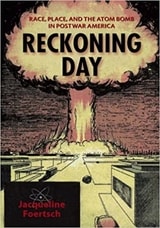
Reckoning Day
Race, Place, and the Atom Bomb in Postwar AmericaJacqueline Foertsch
Vanderbilt University Press, 2013
Foertsch also examines the location of African American characters in novels, science fiction, and survivalist nonfiction such as government-sponsored forecasts regarding post-nuclear survival. In these, black characters are often displaced or absented entirely: in doomsday narratives they are excluded from executive decision-making and the stories' often triumphant conclusions; in the nonfiction, they are rarely envisioned amongst the "typical American" survivors charged with rebuilding US society. Throughout Reckoning Day, issues of placement and positioning provide the conceptual framework: abandoned at "ground zero" (America's inner cities) during the height of the atomic threat, African Americans were figured in white-authored survival fiction as compliant servants aiding white victory over atomic adversity, while as historical figures they were often perceived as "elsewhere" (indifferent) to the atomic threat. In fact, African Americans' "position" on the bomb was rarely one of silence or indifference. Ranging from appreciation to disdain to vigorous opposition, atomic-era African Americans developed diverse and meaningful positions on the bomb and made essential contributions to a remarkably American dialogue.
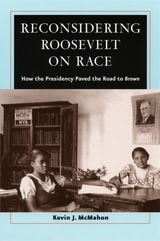
Reconsidering Roosevelt on Race
How the Presidency Paved the Road to BrownKevin J. McMahon
University of Chicago Press, 2003
McMahon shows how FDR's attempt to strengthen the presidency and undermine the power of conservative Southern Democrats dovetailed with his efforts to seek racial equality through the federal courts. By appointing a majority of rights-based liberals deferential to presidential power, Roosevelt ensured that the Supreme Court would be receptive to civil rights claims, especially when those claims had the support of the executive branch.
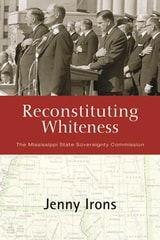
Reconstituting Whiteness
The Mississippi State Sovereignty CommissionJenny Irons
Vanderbilt University Press, 2010
Going far beyond a mere institutional history, however, Irons uses the commission as a tool to explore the intersection of state-organized defense of white supremacy and the dramatically shifting racial constructs of the civil rights era. Ultimately, the commission failed to protect segregation, but as a state entity, it adapted racism in new terms.
Reconstituting Whiteness is an insightful study of the methods Mississippi state government used to move the goal posts of what was considered "decent" and "acceptable" white supremacy and racism, as it raced against time to define whiteness while the boundaries of segregation fell all around it.
Reconstructing Reconstruction
The Supreme Court and the Production of Historical TruthPamela Brandwein
Duke University Press, 1999
Delving into the circumstances, assumptions, and rhetoric that shaped the “official” story of Reconstruction, Brandwein describes precisely how a dominant interpretation of events ultimately emerged and what its implications have been for twentieth-century judicial decisions, particularly for Supreme Court rulings on civil rights. While analyzing interpretive disputes about slavery, Brandwein offers a detailed rescoring of post–Civil War legislative and constitutional history, including analysis of the original understanding of the Fourteenth Amendment. She identifies the perspectives on Reconstruction that were endorsed or rejected by the Supreme Court. Explaining what it meant—theoretically and practically—to resolve Reconstruction debates with a particular definition of slavery, Brandwein recounts how the Northern Democratic definition of “ending” slavery was not the only definition, just the one that prevailed. Using a familiar historical moment to do new interpretive work, she outlines a sociology of constitutional law, showing how subjective narrative construction can solidify into opaque institutional memory.
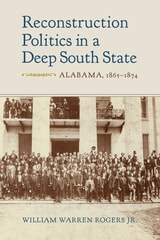
Reconstruction Politics in a Deep South State
Alabama, 1865–1874William Warren Rogers Jr.
University of Alabama Press, 2021
The battle for democracy in reconstruction-era Alabama.
Following the end of the Civil War, white Southerners were forced to concede equal rights to those who had been enslaved, ushering in a new and ruthless brand of politics. Suddenly, the status and place of some four million former slaves dominated the national and regional political dialogue. In Alabama, the Republican Party established itself quickly and powerfully with the participation of a newly freed constituency, firmly aligned against the Democratic Party that had long dictated the governance of the state. Well-heeled planters, merchants, and bankers, joined by yeoman farmers, staged a counterrevolution by gravitating strongly to the Democratic Party and its unabashedly white supremacist measures. The ensuing power struggle in the birthplace of the Confederacy is at the heart of Reconstruction Politics in a Deep South State: Alabama, 1865–1874.
What emerges in William Warren Rogers Jr.’s comprehensive study of the era is a detailed examination of Reconstruction politics, particularly in Alabama. This book explores an explosive and unpredictable political environment that a few years earlier would have been inconceivable. A vivid picture emerges of courthouse rallies and bitter infighting in legislative circles. Rogers’s narrative ventures into darker places as well: to the Tennessee Valley and the Black Belt regions of Alabama, where Klan nightriders used violence against an enemy and ideology they could not abide.
The attempt to capture and account for the unforgiving political landscape created by the extraordinary circumstances of Reconstruction constitutes this study’s most central contribution. Rogers often quotes black and white citizens, Democrats and Republicans. Drawn from newspapers, correspondence, and various federal investigations, these firsthand voices are passionate, unvarnished, and filled with conviction. They offer a startling immediacy and illustrate the temper—or distemper—of the times. Readers are treated to a panoramic unveiling of Reconstruction Alabama politics that provides a sense of what was truly at stake: the values by which a region and the nation as a whole would chart its future for the century to come.
Recovering Subversion
Feminist Politics beyond the LawNivedita Menon
University of Illinois Press, 2004
Is the language of rights enough to foster real social and political change? Nivedita Menon explores the relationship between law and feminist politics by examining the contemporary Indian women's movement with comparisons to France and the United States. She argues that the intersection of feminist politics, law, and the state often paradoxically and severely distorts important ethical and emancipatory impulses of feminism.
Menon reviews historical challenges to the liberal notion of rights from Marxist, feminist, postcolonial, and critical legal scholars, and analyzes current Indian debates on topics including abortion, sexual violence, and Parliamentary quotas for women. Far from being a call to withdraw from the arena of law, Recovering Subversion instead urges feminists everywhere to recognize the limits of "rights discourse" and pleads for a politics that goes beyond its boundaries.
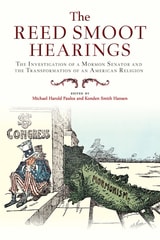
Reed Smoot Hearings
The Investigation of a Mormon Senator and the Transformation of an American ReligionMichael Harold Paulos
Utah State University Press, 2022
The work adds new insights into the role religion and the secular played in the shaping of US political institutions and national policies. Chapters also look at the history of anti-polygamy laws, the persistence of post-1890 plural marriage, the continuation of anti-Mormon sentiment, the intimacies and challenges of religious privatization, the dynamic of federal power on religious reform, and the more intimate role individuals played in effecting these institutional and national developments.
The Smoot hearings stand as an important case study that highlights the paradoxical history of religious liberty in America and the principles of exclusion and coercion that history is predicated on. Framed within a liberal Protestant sensibility, these principles of secular progress mapped out the relationship of religion and the nation-state for the new modern century. The Reed Smoot Hearings will be of significant interest to students and scholars of Mormon, western, American, and religious history.
Publication supported, in part, by Gonzaba Medical Group.
Contributors: Gary James Bergera, John Brumbaugh, Kenneth L. Cannon II, Byron W. Daynes, Kathryn M. Daynes, Kathryn Smoot Egan, D. Michael Quinn
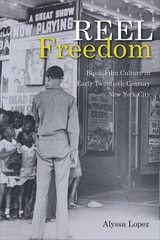
Reel Freedom
Black Film Culture in Early Twentieth-Century New York CityAlyssa Lopez
Temple University Press, 2025
Lopez investigates how ordinary people, labor activists, journalists, filmmakers, theater managers, and owners all shaped Black film culture. Black girls and women used moviegoing as a means of independence and control over their lives. Race filmmaker Oscar Micheaux fought with New York State’s censorship board to get his films screened with limited edits in local theaters. And Harlem’s Black projectionists battled for unionization and fair pay, while journalists linked cinema to Black New Yorkers’ lived experiences.
In Reel Freedom, Lopez chronicles the wide-ranging and remarkable pervasiveness of Black film culture in New York City, redefining a period and place most associated with the Harlem Renaissance. In doing so, she illustrates how Black New Yorkers leveraged cinema to make the city their own and to enjoy urban living to its fullest.
In the series Urban Life, Landscape, and Policy
Reel Inequality, Second Edition
Hollywood Actors and RacismNancy Wang Yuen
Rutgers University Press, 2027
Reel Inequality was the first book to systematically document how Hollywood's institutional racism shapes the lives and careers of actors of color. In this updated edition, Nancy Wang Yuen again translates academic research on structural racism into an engaging, accessible narrative for general readers. Connecting personal stories from actors of color, industry data and practices, and historical patterns, she reveals how racism operates both behind the scenes and on the screen. She also examines Hollywood’s retreat from diversity efforts amid the broader backlash against DEI.
Yuen draws on newly released industry data and recently published interviews with actors of color, showing how racism continues to shape who gets cast, who gets hired, and who gets to tell their own story. She looks closely at the pressures actors of color face, including typecasting, financial precarity, and racial burdens, even as many push back and forge their own paths. She also uses the lens of Hollywood to explore broader issues of race, inequality, and representation.
Reel Inequality
Hollywood Actors and RacismNancy Wang Yuen
Rutgers University Press, 2016
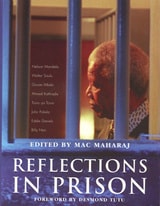
Reflections in Prison
Voices From the South African Liberation StruggleMac Maharaj
University of Massachusetts Press, 2002
Written by Mandela, Walter Sisulu, Ahmed Kathrada, Govan Mbeki, and four other leaders of the anti-apartheid movement, these essays provide a rare view of their thinking at a critical point in the liberation struggle, on the eve of the 1976 Soweto Uprising. The leaders describe their philosophies, strategies, and hopes. They debate such crucial issues as violent versus nonviolent forms of struggle, diversity and unity, the ideological challenge of the Black Consciousness movement, and how to accommodate different interpretations of African nationalism.
The book begins with a foreword by Desmond Tutu and a contextualizing introduction by Maharaj. Then come two essays by Mandela and one each by Sisulu, Kathrada, Mbeki, Billy Nair, John Pokela, Eddie Daniels and Andimba Toivo Ya Toivo. Each essay is preceded by a short biography of the author, a description of his life in prison, and a pencil sketch by a black South African artist.
Regulatory Rights
Supreme Court Activism, the Public Interest, and the Making of Constitutional LawLarry Yackle
University of Chicago Press, 2007
Traversing a wide range of Supreme Court decisions that established crucial precedents about racial discrimination, the death penalty, and sexual freedom, Yackle contends that the rights we enjoy are neither more nor less than what the justices choose to make of them. Regulatory Rights is a bracing read that will be heatedly debated by all those interested in constitutional law and the judiciary.
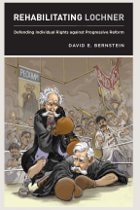
Rehabilitating Lochner
Defending Individual Rights against Progressive ReformDavid E. Bernstein
University of Chicago Press, 2011
In this timely reevaluation of an infamous Supreme Court decision, David E. Bernstein provides a compelling survey of the history and background of Lochner v. New York. This 1905 decision invalidated state laws limiting work hours and became the leading case contending that novel economic regulations were unconstitutional. Sure to be controversial, Rehabilitating Lochner argues that the decision was well grounded in precedent—and that modern constitutional jurisprudence owes at least as much to the limited-government ideas of Lochner proponents as to the more expansive vision of its Progressive opponents.
Tracing the influence of this decision through subsequent battles over segregation laws, sex discrimination, civil liberties, and more, Rehabilitating Lochner argues not only that the court acted reasonably in Lochner, but that Lochner and like-minded cases have been widely misunderstood and unfairly maligned ever since.
Religion and the Demise of Liberal Rationalism
The Foundational Crisis of the Separation of Church and StateJ. Judd Owen
University of Chicago Press, 2001
J. Judd Owen answers these questions with a remarkable critical analysis of four twentieth-century liberal and postliberal thinkers: John Dewey, John Rawls and, most extensively, Richard Rorty and Stanley Fish. His unique readings of these theorists and their approaches to religion lead him to conclusions that are meticulously constructed and surprising, arguing against the perception of liberalism as simple moral or religious neutrality, calling into question the prevailing justifications for separation of church and state, and challenging the way we think about the very basis of constitutional government.
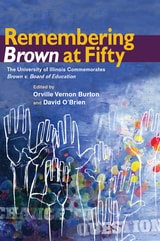
Remembering Brown at Fifty
The University of Illinois Commemorates Brown v. Board of EducationEdited by Orville Vernon Burton and David O'Brien
University of Illinois Press, 2009
Inspired by the University of Illinois's celebration of the Brown v. Board of Education decision's fiftieth anniversary, this collection addresses the significance of Brown in the contributors' lives or work in education and civil rights. Several authors describe their personal roles in the Brown case or similar cases, while others examine and illustrate events, performances, and exhibitions that were part of the anniversary commemoration. The book not only explores the repercussions of the Brown decision, but also stands as a historic document in its own right, preserving the reactions of many prominent intellectuals, artists, and activists fifty years after the decision.
Contributors are Kal Alston, Margaret L. Andersen, Kathryn H. Anthony, Nathaniel C. Banks, Bernice McNair Barnett, Christopher Benson, Ed Blankenheim, Julian Bond, Orville Vernon Burton, Jason Chambers, Constance Curry, Joseph A. De Laine Jr., Mary L. Dudziak, Joe R. Feagin, John Hope Franklin, Ophelia De Laine Gona, Lani Guinier, Darlene Clark Hine, Freeman A. Hrabowski III, John Jennings, Ralph Lemon, George Lipsitz, Jim Loewen, Laughlin McDonald, David O'Brien, James C. Onderdonk, Sekou Sundiata, Christopher Teal, Nicholas Watkins, Carrie Mae Weems, Juan Williams, and Joy Ann Williamson.
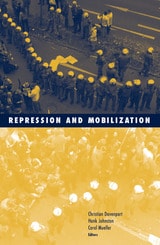
Repression And Mobilization
Christian Davenport
University of Minnesota Press, 2005
Brings together leading scholars from political science and sociology
Recent events—from the collapse of Leninist regimes in Eastern Europe to the democratization of South Asian and South American states—have profoundly changed our ways of understanding and studying contentious politics, particularly the relationship between state repression and political mobilization.
With case studies that range from Germany to the Philippines, the United States to Japan, Guatemala to China, the authors take up topics as varied as the dynamic interactions between protesters and policing agents, distinctions between “hard” and “soft” repression, the impact of media on our understanding of political contention, the timing and shape of protest and resistance cycles, and how measurements of social and geographic control influence states’s responses to insurgencies. Together these essays synthesize what we know about repression and mobilization and provide thoughtful insight for the future.
Contributors: Patrick Ball, Science and Human Rights Program of the American Association for the Advancement of Science; Vince Boudreau, City College of New York; Myra Marx Ferree, U of Wisconsin; Ronald A. Francisco, U of Kansas; Ruud Koopmans, Free U Amsterdam; Mark Lichbach, U of Maryland; John D. McCarthy, Pennsylvania State U; Clark McPhail, U of Illinois, Urbana-Champaign; Patricia Steinhoff, U of Hawaii; Charles Tilly, Columbia U; Gilda Zwerman, SUNY, Old Westbury.
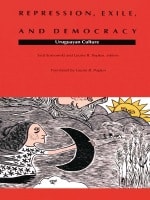
Repression, Exile, and Democracy
Uruguayan CultureSaul Sosnowski and Louise B. Popkin, eds.
Duke University Press, 1992
The first section provides a context for the volume, with its analyses of the historical, political, and social aspects of the Uruguayan experience. The following chapters explore various aspects of cultural production, including personal experiences of exile and imprisonment, popular music, censorship, literary criticism, return from exile, and the role that culture plays in redemocratization.
This book's appeal extends well beyond the study of Uruguay to scholars and students of the history and culture of other Latin American nations, as well as to fields of comparative literature and politics in general.
Contributors. Hugo Achugar, Alvarro Barros-Lémez, Lisa Block de Behar, Amanda Berenguer, Hiber Conteris, José Pedro Díaz, Eduardo Galeano, Edy Kaufman, Leo Masliah, Carina Perelli, Teresa Porzecanski, Juan Rial, Mauricio Rosencof, Jorge Ruffinelli, Saúl Sosonowski, Martin Weinstein, Ruben Yáñez

Resolving Racial Conflict
The Community Relations Service and Civil Rights, 1964-1989Bertram Levine
University of Missouri Press, 2005
Rethinking Rights
Historical, Political, and Philosophical PerspectivesEdited by Bruce P. Frohnen and Kenneth L. Grasso
University of Missouri Press, 2008
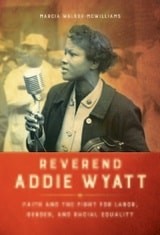
Reverend Addie Wyatt
Faith and the Fight for Labor, Gender, and Racial EqualityMarcia Walker-McWilliams
University of Illinois Press, 2016
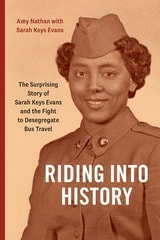
Riding into History
The Surprising Story of Sarah Keys Evans and the Fight to Desegregate Bus TravelAmy Nathan with Sarah Keys Evans
Duke University Press, 2026
Rights Enabled
The Disability Revolution, from the US, to Germany and Japan, to the United NationsKatharina Heyer
University of Michigan Press, 2015
Rights of Inclusion
Law and Identity in the Life Stories of Americans with DisabilitiesDavid M. Engel and Frank W. Munger
University of Chicago Press, 2003
Although all sixty interviewees had experienced discrimination, none had filed a formal protest or lawsuit. Nevertheless, civil rights played a crucial role in their lives. Rights improved their self-image, enhanced their career aspirations, and altered the perceptions and assumptions of their employers and coworkers-in effect producing more inclusive institutional arrangements. Focusing on these long-term life histories, Engel and Munger incisively show how rights and identity affect one another over time and how that interaction ultimately determines the success of laws such as the ADA.
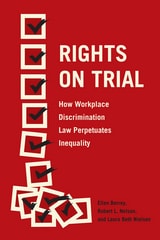
Rights on Trial
How Workplace Discrimination Law Perpetuates InequalityEllen Berrey, Robert L. Nelson, and Laura Beth Nielsen
University of Chicago Press, 2017
On the surface, America’s commitment to equal opportunity in the workplace has never been clearer. Virtually every company has antidiscrimination policies in place, and there are laws designed to protect these rights across a range of marginalized groups. But, as Ellen Berrey, Robert L. Nelson, and Laura Beth Nielsen compellingly show, this progressive vision of the law falls far short in practice. When aggrieved individuals turn to the law, the adversarial character of litigation imposes considerable personal and financial costs that make plaintiffs feel like they’ve lost regardless of the outcome of the case. Employer defendants also are dissatisfied with the system, often feeling “held up” by what they see as frivolous cases. And even when the case is resolved in the plaintiff’s favor, the conditions that gave rise to the lawsuit rarely change. In fact, the contemporary approach to workplace discrimination law perversely comes to reinforce the very hierarchies that antidiscrimination laws were created to redress.
Based on rich interviews with plaintiffs, attorneys, and representatives of defendants and an original national dataset on case outcomes, Rights on Trial reveals the fundamental flaws of workplace discrimination law and offers practical recommendations for how we might better respond to persistent patterns of discrimination.
Rigoberta Menchu Controversy
Arturo Arias
University of Minnesota Press, 2001
A balanced appraisal of the bitter debate surrounding the autobiography of Guatemala’s 1992 Nobel Peace Prize recipient.
Guatemalan indigenous rights activist Rigoberta Menchú first came to international prominence following the 1983 publication of her memoir, I, Rigoberta Menchú, which chronicled in compelling detail the violence and misery that she and her people suffered during her country’s brutal civil war. The book focused world attention on Guatemala and led to her being awarded the Nobel Peace Prize in 1992. In 1999, a book by David Stoll challenged the veracity of key details in Menchú’s account, generating a storm of controversy. Journalists and scholars squared off regarding whether Menchú had lied about her past and, if so, what that would mean about the larger truths revealed in her book.
In The Rigoberta Menchú Controversy, Arturo Arias has assembled a casebook that offers a balanced perspective. The first section of this volume collects the primary documents-newspaper articles, interviews, and official statements-in which the debate raged, many translated into English for the first time. In the second section, a distinguished group of international scholars assesses the political, historical, and cultural contexts of the debate and considers its implications for such issues as the “culture wars,” historical truth, and the politics of memory. Included is a new essay by David Stoll in which he responds to his critics.Contributors: Luis Aceituno; Juan Jesús Aznárez; John Beverley, U of Pittsburgh; Allen Carey-Webb, Western Michigan U; Margarita Carrera; Duncan Earle, U of Texas, El Paso; Carolina Escobar Sarti; Claudia Ferman, U of Richmond; Dina Fernández García; Eduardo Galeano; Dante Liano, U of Milan; W. George Lovell, Queen’s U, Canada; Christopher H. Lutz; Octavio Martí; Victor D. Montejo, UC Davis; Rosa Montero; Mario Roberto Morales, U of Northern Iowa; Jorge Palmieri; Daphne Patai, U of Massachusetts, Amherst; Mary Louise Pratt, Stanford U; Danilo Rodríguez; Ileana Rodríguez, Ohio State U; Larry Rohter; Jorge Skinner-Kleé; Elzbieta Sklodowska, Washington U; Carol A. Smith, UC Davis; Doris Sommer, Harvard U; David Stoll, Middlebury College; Manuel Vásquez Montalbán; and Kay B. Warren, Harvard U.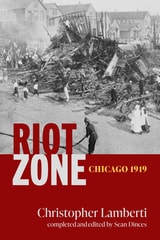
Riot Zone
Chicago 1919Christopher Lamberti, completed and edited by Sean Dinces
Temple University Press, 2027
Riot Zone presents a compelling forensic microhistory of the racial violence that exploded in Chicago starting on July 27, 1919, when a Black teenager named Eugene Williams drowned in Lake Michigan after white beachgoers attacked him as he swam with friends. In the days that followed, white gang members terrorized African Americans on the city’s South Side and Black Chicagoans armed and defended themselves in response. By the end of the first week of August, when the rioting finally ended, thirty-eight Chicagoans lay dead and hundreds nursed injuries as a result of what became known as America’s “Red Summer.”
The late Christopher Lamberti, with the help of editor Sean Dinces, recounts this sobering history using GIS software to map what occurred. The authors revisit and debunk ideas about the role race and ethnicity played in the riot and its aftermath, showing how the politics of housing and racial conflicts over residential space set the stage for the riots that ensued.
With insights that echo in today’s conflicts, Riot Zone proves that there is still plenty to learn about the history of America’s ongoing struggle with urban and racial violence.
Rising Up, Living On
Re-Existences, Sowings, and Decolonial CracksCatherine E. Walsh
Duke University Press, 2023
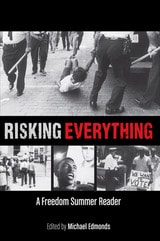
Risking Everything
A Freedom Summer ReaderMichael Edmonds
Wisconsin Historical Society Press, 2014
Risking Everything: A Freedom Summer Reader documents the 1964 Mississippi Freedom Summer Project, when SNCC and CORE workers and volunteers arrived in the Deep South to register voters and teach non-violence, and more than 60,000 black Mississippians risked everything to overturn a system that had brutally exploited them.
In the 44 original documents in this anthology, you’ll read their letters, eavesdrop on their meetings, shudder at their suffering, and admire their courage. You’ll witness the final hours of three workers murdered on the project’s first day, hear testimony by black residents who bravely stood up to police torture and Klan firebombs, and watch the liberal establishment betray them.
These vivid primary sources, collected by the Wisconsin Historical Society, provide both first-hand accounts of this astounding grassroots struggle as well as a broader understanding of the Civil Rights movement.
The selected documents are among the 25,000 pages about the Mississippi Freedom Summer Project in the archives of the Wisconsin Historical Society. The manuscripts were collected in the mid-1960s, at a time when few other institutions were interested in saving the stories of common people in McComb or Ruleville, Mississippi. Most have never been published before.
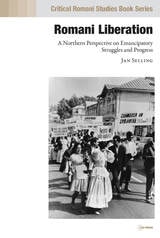
Romani Liberation
A Northern Perspective on Emancipatory Struggles and ProgressJan Selling
Central European University Press, 2022
Centered on the trajectory of the emancipation of Roma people in Scandinavia, Romani Liberation is a powerful challenge to the stereotype describing Romani as passive and incapable of responsibility and agency. The author also criticizes benevolent but paternalistic attitudes that center on Romani victimhood.
The first part of the book offers a comprehensive overview of the chronological phases of Romani emancipation in Sweden and other countries. Underscoring the significance of Roma activism in this process, Jan Selling profiles sixty Romani activists and protagonists, including numerous original photos. The narrative is followed by an analysis of the concepts of historical justice and of the process of decolonizing Romani Studies. Selling highlights the impact of the historical contexts that have enabled or impeded the success of the struggles against discrimination and for equal rights, emphasizing Romani activism as a precondition for liberation.
The particular Swedish framework is accentuated by a stimulating preface by the international activist Nicoleta Bitu, and afterwords by two prominent Romani advocates, the politician Soraya Post and the singer, author, and elder Hans Caldaras.
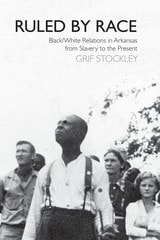
Ruled by Race
Black/White Relations in Arkansas From Slavery to the PresentGrif Stockley
University of Arkansas Press, 2008
Winner of the 2010 Booker Worthen Literary Prize, and the 2009 Ragsdale Award.
From the Civil War to Reconstruction, the Redeemer period, Jim Crow, and the modern civil rights era to the present, Ruled by Race describes the ways that race has been at the center of much of the state’s formation and image since its founding. Grif Stockley uses the work of published and unpublished historians and exhaustive primary source materials along with stories from authors as diverse as Maya Angelou and E. Lynn Harris to bring to life the voices of those who have both studied and lived the racial experience in Arkansas.
Topics range from the well-known Little Rock Central High Crisis of 1957 to lesser-known events such as the Elaine Race Massacres of 1919 and the shocking yet sadly commonplace attitudes found in newspaper reports and speeches. Through the words of the most powerful Arkansans such as racist Arkansas Govenor Jeff Davis (1901–1906) to the least powerful, including an unflinching look at the narratives of former slaves, readers will come away with increased awareness of the ways that race continues to affect where Arkansans live, send their children to school, work, travel, shop, spend leisure time, worship, and choose their friends and life partners.