Results by title
1049 books match the query 'English, Irish, Scottish, Welsh' and 48 start with r
READING LONDON
URBAN SPECULATION AND IMAGINATIVE GOVERNMENT EIGHTEENTH-CENTURY LITERATUREERIK BOND
The Ohio State University Press, 2007
REWRITING CHAUCER
CULTURE, AUTHORITY, AND THE IDEA OF THE AUTHENTIC TEXT, 1400–1602THOMAS A. PRENDERGAST
The Ohio State University Press, 1999
This collection of original essays examines how the idea of an authentic Chaucerian text was reimagined and reproduced by medieval and early modern scribes and editors to satisfy and shape the cultural expectations of their audiences. These “reproductions” of Chaucer’s works epitomize the tension between developing notions of what makes a text “authentic” and the cultural pressures that led scribes and editors to construct their own versions of Chaucer and his works.
The book begins by exploring medieval and early modern notions of origins and how they at once illuminate and problematize the recovery of Chaucerian texts. Essays in the second section examine how individual scribes and reading communities reshaped Chaucer’s texts. Finally, we see how the printing press—bringing with it a renewed concern about the idea of authenticity—led both to an increase in the number of works attributed to Chaucer and to increasing anxiety about their authenticity.
The focus on the ways in which Chaucer was rewritten in different cultural and aesthetic contexts will enable medieval and early modern critics to situate Chaucer more fully within his cultural milieu, while illuminating the ways in which his reputation as both a “laureate poet” and a “lewed compilator” affected rewritings of his works. Rewriting Chaucer, then, will appeal both to scholars interested in the critical juncture between manuscript and print culture and to those interested in how culture affects the reproduction of authoritative texts.
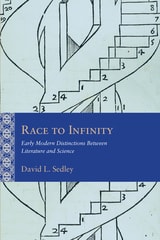
Race to Infinity
Early Modern Distinctions Between Literature and ScienceDavid L. Sedley
Northwestern University Press, 2027
Studying the early modern split between science and literature and the aftermath of their division
The conception of computers as thinking machines and literature as a social field stems from the early modern phenomenon of competing over the infinite as an object not just of contemplation but of appropriation in a race toward virtual control. The rediscovery of this origin undoes a collective forgetting of what technology and texts have in common, what they don’t, and what they can and ought to be in the future. David L. Sedley offers a new history of literature and science’s disciplinary divide—its origin and significance—tracing a series of points along the emerging frontier between these two fields. At each point there are two objects in play and two authors who push the objects in opposite directions: on the one hand, mechanical arts and the essay, probability theory and the novel, and geometry and epic; on the other, Montaigne and Bacon, Pascal and Lafayette, and Hobbes and Milton. Each of these authors, Sedley shows, tried to render an object either algorithmic or infinite to oppose the other’s efforts. Ultimately, Race to Infinity: Early Modern Distinctions Between Literature and Science illuminates the fortunes of the literary in the digital revolution and beyond.
Racine and English Classicism
By Katherine E. Wheatley
University of Texas Press, 1956
Literary historians and critics who have written on the influence of Racine in England during the neoclassical period apparently have assumed that the English translators and adapters of Racine’s plays in general succeeded in presenting the real Racine to the English public.
Katherine Wheatley here reveals the wide discrepancy between avowed intentions and actual results. Among the English plays she compares with their French originals are Otway’s Titus and Berenice, Congreve’s The Mourning Bride, and Philips’s The Distrest Mother. These comparisons, fully supported by quoted passages, reveal that those among the English public and contemporary critics who could not themselves read French had no chance whatever to know the real Racine: “The adapters and translators, so-called, had eliminated Racine from his tragedies before presenting them to the public.” Unacknowledged excisions and additions, shifts in plot, changes in dénouement, and frequent mistranslation turned Racine’s plays into “wretched travesties.” Two translations of Britannicus, intended for reading rather than for acting, are especially revealing in that they show which Racinian qualities eluded the British translators even when they were not trying to please an English theatergoing audience.
Why it is, asks the author, that no English dramatist could or would present Racine as he is to the English public of the neoclassical period? To answer this question she traces the development of Aristotelian formalism in England, showing the relation of the English theory of tragedy to French classical doctrine and the relation of the English adaptations of Racine to the English neoclassical theory of tragedy. She concludes that “deliberate alterations made by the English, far from violating classical tenets, bring Racine’s tragedies closer to the English neoclassical ideal than they were to begin with, and this despite the fact that some tenets of English doctrine came from parallel tenets widely accepted in France.” She finds that “in the last analysis, French classical doctrine was itself a barrier to the understanding of Racinian tragedy in England and an incentive to the sort of change English translators and adapters made in Racine.” This paradox she explains by the fact that Racine himself had broken with the classical tradition as represented by Corneille.
Radical Science
Plants, Agency, and Nineteenth-Century British NarrativeMary Bowden
The Ohio State University Press, 2026

Radical Tragedy
Religion, Ideology and Power in the Drama of Shakespeare and His ContemporariesJonathan Dollimore
Duke University Press, 2004

Raising the Dust
The Literary Housekeeping of Mary Ward, Sarah Grand, and Charlotte Perkins GilmanBeth Sutton-Ramspeck
Ohio University Press, 2004
To Mary Augusta Ward, Sarah Grand, and Charlotte Perkins Gilman, housekeeping represented public responsibilities: making the food supply safe, reforming politics, and improving the human race itself. Raising the Dust places their writing in the context of the late-Victorian era, in particular the eugenics movement, the proliferation of household conveniences, the home economics movement, and decreased reliance on servants. These changes affected relationships between the domestic sphere and the public sphere, and hence shaped the portrayal of domesticity in the era's fiction and nonfiction.
Moreover, Ward, Grand, and Gilman articulated a domestic aesthetic that swept away boundaries. Sutton-Ramspeck uncovers a new paradigm here: literature as engaging the public realm through the devices and perspectives of the domestic. Her innovative and ambitious book also connects fixations on cleaning with the discovery of germs (the first bacterium discovered was anthrax, and knowledge of its properties increased fears of dust); analyzes advertising cards for soap; and links the mental illness in Gilman's “The Yellow Wall-Paper” to fears during the period of arsenic poisoning from wallpaper.
Rape Of Clarissa
Writing, Sexuality, and Class Struggle in Samuel RichardsonTerry Eagleton
University of Minnesota Press, 1982
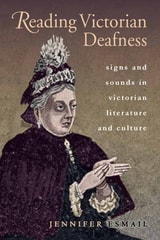
Reading Victorian Deafness
Signs and Sounds in Victorian Literature and CultureJennifer Esmail
Ohio University Press, 2013
Winner of the 2013 Sonya Rudikoff Award for best first book in Victorian Studies
Short-listed for the 2013 British Society for Literature and Science Book Prize.
Reading Victorian Deafness is the first book to address the crucial role that deaf people, and their unique language of signs, played in Victorian culture. Drawing on a range of works, from fiction by Charles Dickens and Wilkie Collins, to poetry by deaf poets and life writing by deaf memoirists Harriet Martineau and John Kitto, to scientific treatises by Alexander Graham Bell and Francis Galton, Reading Victorian Deafness argues that deaf people’s language use was a public, influential, and contentious issue in Victorian Britain.
The Victorians understood signed languages in multiple, and often contradictory, ways: they were objects of fascination and revulsion, were of scientific import and literary interest, and were considered both a unique mode of human communication and a vestige of a bestial heritage. Over the course of the nineteenth century, deaf people were increasingly stripped of their linguistic and cultural rights by a widespread pedagogical and cultural movement known as “oralism,” comprising mainly hearing educators, physicians, and parents.
Engaging with a group of human beings who used signs instead of speech challenged the Victorian understanding of humans as “the speaking animal” and the widespread understanding of “language” as a product of the voice. It is here that Reading Victorian Deafness offers substantial contributions to the fields of Victorian studies and disability studies. This book expands current scholarly conversations around orality, textuality, and sound while demonstrating how understandings of disability contributed to Victorian constructions of normalcy. Reading Victorian Deafness argues that deaf people were used as material test subjects for the Victorian process of understanding human language and, by extension, the definition of the human.
Reading for Health
Medical Narratives and the Nineteenth-Century NovelErika Wright
Ohio University Press, 2016
In Reading for Health: Medical Narratives and the Nineteenth-Century Novel, Erika Wright argues that the emphasis in Victorian Studies on disease as the primary source of narrative conflict that must be resolved has obscured the complex reading practices that emerge around the concept of health. By shifting attention to the ways that prevention of illness and the preservation of well-being operate in fiction, both thematically and structurally, Wright offers a new approach to reading character and voice, order and temporality, setting and metaphor. As Wright reveals, while canonical works by Austen, Brontë, Dickens, Martineau, and Gaskell register the pervasiveness of a conventional “therapeutic” form of action and mode of reading, they demonstrate as well an equally powerful investment in the achievement and maintenance of “health”—what Wright refers to as a “hygienic” narrative—both in personal and domestic conduct and in social interaction of the individual within the community.
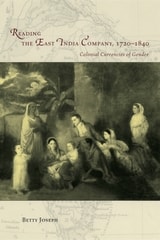
Reading the East India Company 1720-1840
Colonial Currencies of GenderBetty Joseph
University of Chicago Press, 2003
Drawing on the British East India Company's records as well as novels, memoirs, portraiture and guidebooks, Joseph shows how the company's economic and archival practices intersected to produce colonial "fictions" or "truth-effects" that strictly governed class and gender roles—in effect creating a "grammar of power" that kept the far-flung empire intact. And while women were often excluded from this archive, Joseph finds that we can still hear their voices at certain key historical junctures. Attending to these voices, Joseph illustrates how the writing of history belongs not only to the colonial project set forth by British men, but also to the agendas and mechanisms of agency—of colonized Indian, as well as European women. In the process, she makes a valuable and lasting contribution to gender studies, postcolonial theory, and the history of South Asia.
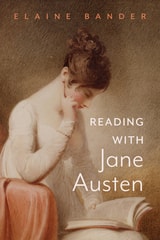
Reading with Jane Austen
Elaine Bander
Bucknell University Press, 2026
Jane Austen has more readers today than at any time in history. Many of Austen’s legions of fans, however, came to her novels after first seeing films or other adaptations made for twenty-first-century audiences. Austen herself conversely spent her literary career undermining romantic clichés and rethinking novel conventions. Confident that she and her contemporaries shared a common reading culture, Austen deliberately constructed her novels to set readerly expectations, only to disrupt or confound those expectations by challenging her readers’ assumptions and values. In Reading with Jane Austen, Elaine Bander carefully rereads the great author’s novels—beginning with her late work of juvenilia, “Catharine, or The Bower,” and ending with her final fragment, “Sanditon”—against the rich context of late Georgian literary and intellectual culture. In doing so, Bander invites us into the transformative experience that Austen intentionally designed for her earliest readers, adding new layers of appreciation for those who love her work.
Published by Bucknell University Press. Distributed worldwide by Rutgers University Press.
Elaine Bander speaking at the Atwater Library in Quebec (https://youtu.be/UeEjFOfp9cQ?si=Wv2hsLxkGK157WZI)
Readings
The Poetics of Blanchot, Joyce, Kakfa, Kleist, Lispector, and TsvetayevaHelene Cixous
University of Minnesota Press, 1991
Readings: The Poetics of Blanchot, Joyce, Kafka, Kleist, Lispector, and Tsvetayeva offers striking and novel textual studies of major literary figures and emergent authors. Selected from Cixous’s seminars taught between 1980 and 1986 at the Universite de Paris VII (Saint-Denis) and at the College International de Philosophie, the texts chronicle the French intellectual scene with its shifting tastes over the decade following May 1986.
In their simple and accessible language, the texts can be read as inspiration for Cixous’s fictional and critical practices. They not only introduce readers to emergent texts from Brazil and Russia, such as Clarice Lispector’s “Foreign Legion” and Marina Tsvetayeva’s “Mother and Music,” but also give new, incisive insights into Joyce’s Portrait of the Artist and Kafka’s “Before the Law.” Drawing from philosophy and psychoanalysis, Readings: The Poetics of Blanchot, Joyce, Kafka, Kleist, Lispector, and Tsvetayeva can be read side-by-side with Reading with Clarice Lispector, as an ongoing meditation on ethics and poetics.Also from MinnesotaReading with Clarice LispectorHelene CixousEdited, translated, and introduced by Verena Andermatt ConleyFor Cixous, Lispector’s work represents one of the finest examples of ecriture feminine in that she practices, in writing, what Cixous is searching for in her theoretical practice: the giving, spending, and inscribing of pleasure; an apprenticeship in the lessons of life.Theory and History of Literature, volume 73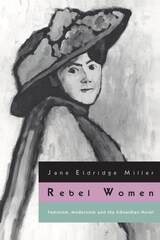
Rebel Women
Feminism, Modernism and the Edwardian NovelJane Eldridge Miller
University of Chicago Press, 1996
"Miller's is the best account we have, not only of Edwardian women novelists, but of early 20th-century women novelists; the measure of her achievement is that the distinction no longer seems workable." —David Trotter, The London Review of Books
Reconstruction Fiction
Housing and Realist Literature in Postwar BritainPaula Derdiger
The Ohio State University Press, 2020
Recovering Disability in Early Modern England
Edited by Allison P. Hobgood and David Houston Wood
The Ohio State University Press, 2013
Reflections on Beckett
A Centenary CelebrationAnna McMullan and S. E. Wilmer, Editors. Foreword by Dennis Kennedy
University of Michigan Press, 2009
Reforming Empire
Protestant Colonialism and Conscience in British LiteratureChristopher Hodgkins
University of Missouri Press, 2002
“The strength of Empire,” wrote Ben Jonson, “is in religion.” In Reforming Empire, Christopher Hodgkins takes Jonson’s dictum as his point of departure, showing how for more than four centuries the Protestant imagination gave the British Empire its main paradigms for dominion and also, ironically, its chief languages of anti-imperial dissent. From Edmund Spenser’s Faerie Queene to Rudyard Kipling’s “The Man Who Would Be King,” English literature about empire has turned with strange constancy to themes of worship and idolatry, atrocity and deliverance, slavery and service, conversion, prophecy, apostasy, and doom.
Focusing on the work of the Protestant imagination from the Renaissance origins of English overseas colonization through the modern end of England’s colonial enterprise, Hodgkins organizes his study around three kinds of religious binding—unification, subjugation, and self-restraint. He shows how early modern Protestants like Hakluyt and Spenser reformed the Arthurian chronicles and claimed to inherit Rome’s empire from the Caesars: how Ralegh and later Cromwell imagined a counterconquest of Spanish America, and how Milton’s Satan came to resemble Cortés; how Drake and the fictional Crusoe established their status as worthy colonial masters by refusing to be worshiped as gods; and how seventeenth-century preachers, poets, and colonists moved haltingly toward a racist metaphysics—as Virginia began by celebrating the mixed marriage of Pocahontas but soon imposed the draconian separation of the Color Line.
Yet Hodgkins reveals that Tudor-Stuart times also saw the revival of Augustinian anti-expansionism and the genesis of Protestant imperial guilt. From the start, British Protestant colonialism contained its own opposite: a religion of self-restraint. Though this conscience often was co-opted or conscripted to legitimize conquests and pacify the conquered, it frequently found memorable and even fierce literary expression in writers such as Shakespeare, Daniel, Herbert, Swift, Johnson, Burke, Blake, Austen, Browning, Tennyson, Conrad, Forster, and finally the anti-Protestant Waugh. Written in a lively and accessible style, Reforming Empire will be of interest to all scholars and students of English literature.
Regulating Confusion
Samuel Johnson and the CrowdThomas Reinert
Duke University Press, 1996
Ambivalent about the disruption, confusion, perplexity, and boundless variety apparent in the London of his day, Johnson was committed to the conventions of moral reflection but also troubled by the pressure to adopt the perspective of the crowd and the language of social theory. Regulating Confusion explores the consequences of his ambivalence and his attempt to order the chaos. It discusses his critique of moral generalizations, concept of moral reflection as a symbolic gesture, and account of what happens to the notion of character when individuals, having lost the support of moral convention, become faces in a crowd. Reflecting generally on the relationship between skepticism and political ideology, Reinert also discusses Johnson’s political skepticism and the forms of speculation and action it authorized.
Challenging prevalent psychologizing and humanistic interpretations, Regulating Confusion leaves behind the re-emergent view of Johnson as a reactionary ideologue and presents him in a theoretically sophisticated context. It offers his style of skepticism as a model of poise in the face of confusion about the nature of political truth and personal responsibility and demonstrates his value as a resource for students of culture struggling with contemporary debates about the relationship between literature and politics.
Religious Imaginaries
The Liturgical and Poetic Practices of Elizabeth Barrett Browning, Christina Rossetti, and Adelaide ProcterKaren Dieleman
Ohio University Press, 2012
Explores liturgical practice as formative for how three Victorian women poets imagined the world and their place in it and, consequently, for how they developed their creative and critical religious poetics.
This new study rethinks several assumptions in the field: that Victorian women’s faith commitments tended to limit creativity; that the contours of church experiences matter little for understanding religious poetry; and that gender is more significant than liturgy in shaping women’s religious poetry.
Exploring the import of bodily experience for spiritual, emotional, and cognitive forms of knowing, Karen Dieleman explains and clarifies the deep orientations of different strands of nineteenth-century Christianity, such as Congregationalism’s high regard for verbal proclamation, Anglicanism’s and Anglo-Catholicism’s valuation of manifestation, and revivalist Roman Catholicism’s recuperation of an affective aesthetic. Looking specifically at Elizabeth Barrett Browning, Christina Rossetti, and Adelaide Procter as astute participants in their chosen strands of Christianity, Dieleman reveals the subtle textures of these women’s religious poetry: the different voices, genres, and aesthetics they create in response to their worship experiences. Part recuperation, part reinterpretation, Dieleman’s readings highlight each poet’s innovative religious poetics.
Dieleman devotes two chapters to each of the three poets: the first chapter in each pair delineates the poet’s denominational practices and commitments; the second reads the corresponding poetry. Religious Imaginaries has appeal for scholars of Victorian literary criticism and scholars of Victorian religion, supporting its theoretical paradigm by digging deeply into primary sources associated with the actual churches in which the poets worshipped, detailing not only the liturgical practices but also the architectural environments that influenced the worshipper’s formation. By going far beyond descriptions of various doctrinal positions, this research significantly deepens our critical understanding of Victorian Christianity and the culture it influenced.

Remembering and Repeating
On Milton's Theology and PoeticsRegina M. Schwartz
University of Chicago Press, 1993
"A brilliant study that quietly but powerfully recharacterizes many of the contexts of discussion in Milton criticism. Particularly noteworthy is Schwartz's ability to introduce advanced theoretical perspectives without ever taking the focus of attention away from the dynamics and problematics of Milton's poem."—Stanley Fish
Renaissance Beasts
Of Animals, Humans, and Other Wonderful CreaturesEdited by Erica Fudge
University of Illinois Press, 2004
Taking as its starting point the popularity of speaking animals in sixteenth-century literature and ending with the decline of the imperial Ménagerie during the French Revolution, Renaissance Beasts uses the lens of human-animal relationships to view issues as diverse as human status and power, diet, civilization and the political life, religion and anthropocentrism, spectacle and entertainment, language, science and skepticism, and domestic and courtly cultures.
Within these pages scholars from a variety of disciplines discuss numerous kinds of texts--literary, dramatic, philosophical, religious, political--by writers including Calvin, Montaigne, Sidney, Shakespeare, Descartes, Boyle, and Locke. Through analysis of these and other writers, Renaissance Beasts uncovers new and arresting interpretations of Renaissance culture and the broader social assumptions glimpsed through views on matters such as pet ownership and meat consumption.
Renaissance Beasts is certainly about animals, but of the many species discussed, it is ultimately humankind that comes under the greatest scrutiny.
Renaissance Shakespeare/Shakespeare Renaissances
Proceedings of the Ninth World Shakespeare CongressMartin Procházka
University of Delaware Press, 2014
Published by University of Delaware Press. Distributed worldwide by Rutgers University Press.
Replotting Marriage in Nineteenth-Century British Literature
Edited by Jill Galvan and Elsie Michie
The Ohio State University Press, 2018
In Replotting Marriage in Nineteenth-Century British Literature, Jill Galvan and Elsie Michie bring together top Victorian scholars to scrutinize nineteenth-century marriage in incisive ways. The volume puts marriage in conversation with many aspects of culture, from education and anthropology to Darwinism and crime. It aims to widen the repertoire of critical questions we ask about how fiction represents conjugal coupling, employing, among other approaches, transimperial reading, queer theory, disability studies, and philosophies of the formation of human society. By paying close attention to elements of genre and narrative, moreover, the collection analyzes the story of marriage as formally and structurally diverse, rather than as a familiar plot line.
These essays point to nineteenth-century marriage studies as a new field of inquiry. With contributions by Ian Duncan, Elisha Cohn, Kathy Psomiades, Kelly Hager, Lauren Goodlad, Marlene Tromp, Sukanya Banerjee, Holly Furneaux, Talia Schaffer, and Helena Michie, and an afterword by Mary Jean Corbett, Replotting Marriage in Nineteenth-Century British Literature demonstrates how both established and developing fields can be brought to bear on a long-examined institution—ultimately prompting a rethinking of the nineteenth century itself.
Rereading Conrad
Daniel R.Schwarz
University of Missouri Press, 2001
Leading Conradian scholar Daniel R. Schwarz assembles his work from over the past two decades into one crucial volume, providing a significant reexamination of a seminal figure who continues to be a major focus in the twenty-first century. Schwarz touches on virtually all of Joseph Conrad's work including his masterworks and the later, relatively neglected fiction.
In his introduction and in the persuasive and insightful essays that follow, Schwarz explores how the study of Conrad has changed and why Conrad is such a focus of interest in terms of gender, postcolonial, and cultural studies. He also demonstrates how Conrad helps define the modernist cultural tradition.
Exploring such essential works as Heart of Darkness, Lord Jim, Nostromo, and "The Secret Sharer," Schwarz addresses issues raised by recent theory, discussing the ways in which contemporary readers, including, of course, himself, have come to read Conrad differently. He does so without abandoning crucial Conradian themes such as the disjunction between interior and articulated motives and the discrepancies between dimly acknowledged needs, obsessions, and compulsions and actual behavior.
Schwarz also touches on the extent to which Conrad's conservative desires for a few simple moral and political ideas were often at odds with his profound skepticism. A powerful close reader of Conrad's complex texts, Schwarz stresses how from their opening paragraphs Conrad's works establish a grammar of psychological, political, and moral cause and effect.
Rereading Conrad sheds new light on an author who has spoken to readers for over a century. Schwarz's essays take account of recent developments in theory and cultural studies, including postcolonial, feminist, gay, and ecological perspectives, and show how reading Conrad has changed in the face of the theoretical explosion that has occurred over the past two decades. Because for over three decades Schwarz has been an important figure in defining how we read Conrad and in studying modernism, including how we respond to the relationship between modern literature and modern art, scholars, teachers, and students will take great pleasure in this new collection of his work.
Resisting Texts
Authority and Submission in Constructions of MeaningPeter L. Shillingsburg
University of Michigan Press, 1998
Shillingsburg argues that as humans we are and always will be interested in the past, in what was meant, in what was revealed inadvertently by a text--and that is all to the good. But we learn more and can compare notes better when we understand the principles that govern the ways we read. Resisting Texts approaches crucial questions about the practice of textual editing and literary criticism by posing questions in the form "If we take such and such to be the goal of our reading, then what will follow from that assumption?"
With humor and a lively imagination, Shillingsburg takes the reader on a fresh theoretical investigation of communication, understanding and misunderstanding, and textual satisfactions, drawing examples from Thackeray, Wordsworth, Melville, and others.
Resisting Texts will appeal to all who enjoy the varieties of critical approaches to the written word.
Peter L. Shillingsburg is Professor of English, University of North Texas.
Restoration Reshaping
Shifting Forms, Genres and Conventions in Late 17th and Early 18th Century English TheatreEdited by Anna Hrdinová and Filip Krajník
Karolinum Press, 2026
An Interdisciplinary study of British theater between 1660 and 1737.
Restoration Reshaping explores English theater between the reopening of the playhouses in 1660 and the Licensing Act of 1737, examining both the dramatic works and the social, political, and cultural contexts in which they were produced. Drawing on papers from two international symposia, the volume investigates a wide range of genres—from comedies of manners and heroic plays to musical dramas, pantomimes, and ballad operas—while highlighting innovations in stagecraft, adaptation, and performance practices. Contributors consider the theatre’s connections to politics, gender, and society, its transnational influences, and its ongoing relevance for modern theatre, offering a rich, multi-perspective resource for scholars, students, and theatre practitioners.
Restoration Women’s Drama
Four Plays, 1662–1677Margaret Cavendish, Katherine Philips, Frances Boothby, and Aphra Behn
Iter Press, 2026
Restoration Women’s Drama collects four Restoration plays by women: the highly acclaimed Katherine Philips, the successful professional Aphra Behn, the confidently original Margaret Cavendish, and the obscure pioneer Frances Boothby. This anthology includes Behn’s only tragedy as well as the first printed edition of Boothby’s Marcelia, the first play by a woman to be professionally staged in London, demonstrating the range of early modern drama produced by women in this period. An excellent introduction, it is poised to stimulate new discussions of women’s authorship, theatrical knowledge, and literary affinities. Each play has been edited afresh, and each has been modernized and annotated to facilitate reading, teaching, and performance possibilities.
Retelling the Siege of Jerusalem in Early Modern England
Vanita Neelakanta
University of Delaware Press, 2019
Published by University of Delaware Press. Distributed worldwide by Rutgers University Press.
Revels in Madness
Insanity in Medicine and LiteratureAllen Thiher
University of Michigan Press, 2004
---Louis Sass, author of Madness and Modernism
"The scope of this book is daunting, ranging from madness in the ancient Greco-Roman world, to Christianized concepts of medieval folly, through the writings of early modern authors such as Shakespeare, Cervantes, and Descartes, and on to German Romantic philosophy, fin de siècle French poetry, and Freud . . . Artaud, Duras, and Plath."
---Isis
"This provocative and closely argued work will reward many readers."
---Choice
In Revels in Madness, Allen Thiher surveys a remarkable range of writers as he shows how conceptions of madness in literature have reflected the cultural assumptions of their era. Thiher underscores the transition from classical to modern theories of madness-a transition that began at the end of the Enlightenment and culminates in recent women's writing that challenges the postmodern understanding of madness as a fall from language or as a dysfunction of culture.
Revising the Clinic
Vision and Representation in Victorian Medical Narrative and the NovelMeegan Kennedy
The Ohio State University Press, 2010
Critics have examined how novelists borrow from other genres—newspapers, legal cases, autobiographies. Medical writing likewise enriches the novel’s uniquely flexible and wide-ranging presentation of Victorian culture. In turn, the novel shapes medical narrative even as clinical science idealizes methodological rigor. Revising the Clinic shows how the wealth of scientific material in mainstream Victorian periodicals creates a productive literary “commons” where novelists and physicians can encounter each others’ strategies for seeing and stating. Novelists adapt physicians’ techniques to nonmedical scenes, and physicians echo the sentimental or sensational novel to gain sympathy or rhetorical force when medical knowledge falters.
Kennedy traces the development of the Victorian novel and the case history from eighteenth-century curious observation and curious sights through nineteenth-century clinical observation, mechanical observation, and speculation, to Freud’s labyrinthine mapping and speculative insight. These make new sense, read within the literary tradition of the case history. The lens of Kennedy’s argument clarifies and illuminates the preoccupation with genre and visuality that is common to Victorian medicine and the novel.
Revisiting Richardson
Rebecca Anne Barr
Bucknell University Press, 2025
Published by Bucknell University Press. Distributed by Rutgers University Press.
Rewriting Crusoe
The Robinsonade across Languages, Cultures, and MediaJakub Lipski
Bucknell University Press, 2020
Published by Bucknell University Press. Distributed worldwide by Rutgers University Press.
Rhetoric and Resistance
The Literary Arts of Dissent in Nineteenth-Century BritainMaeve Adams
Ohio University Press, 2025
A fresh perspective on the enduring relationship between literature, democracy, and dissent
Rhetoric and Resistance explores the transformative role of nineteenth-century literature in shaping modern concepts and practices of democratic dissent. By examining the works of Romantic and Victorian novelists, poets, and journalists, Maeve Adams identifies origins of modern theories and practices of resistance in nineteenth-century literary forms. Offering a literary history of dissent, the book recovers the intertwined development of democracy and aesthetics, revealing how narrative form became a potent tool for challenging authority.
Tracing the lineage of dissent from the radical fiction and journalism of the 1800s to contemporary movements like #MeToo, Adams offers a genealogy that highlights how literary texts experimented with political power, granting new and consequential voices to working-class individuals, women, colonized peoples, and other marginalized groups.
Adams takes an interdisciplinary approach, weaving together close readings of works by Thomas De Quincey, Walter Scott, Elizabeth Gaskell, and H. G. Wells, as well as lesser-known journalists, with insights from modern moral and political philosophy. Drawing on theories of democratic ethics and justice from scholars such as Miranda Fricker, Sharon Krause, Martha Nussbaum, and Philip Pettit, the book bridges literary history and contemporary debates about political agency and expression.
Rhetoric, Science, and Magic in Seventeenth-century England
Ryan J. Stark
Catholic University of America Press, 2009
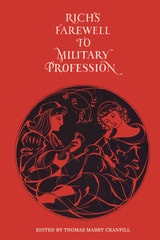
Rich’s Farewell to Military Profession, 1581
Edited by Thomas Mabry Cranfill
University of Texas Press, 1953
In a long and extraordinary career as captain, courier, privateer, real-estate agent, author, and informer, Barnaby Rich's principal achievement was the present volume—a collection of Elizabethan short stories despite its military title.
Unquestionably best sellers in Rich's own time, these tales continue to delight scholars, critics, and even casual readers today. One twentieth-century critic pronounces the Farewell "a landmark in Elizabethan short-story writing" and cites Rich's "romantic charm, gaiety and lightness of touch, good vivid dialogue, directness and ease." According to Henry Seidel Canby, Rich's "humor is of the gayest. . . . There is a suggestion of Chaucer about him, and not a little of the poet's merry humor." Yet the "stories themselves are diverse."
Certainly their charm and humor fetched Rich's contemporaries, who read out of existence all but one copy of the first edition and all but five of the subsequent three editions. Eight dramatists—including Shakespeare, Middleton, Shirley, and Marmion—immortalized several of the stories, however, by turning them into plays.
The present edition affords an opportunity to read Rich's tales in the form in which Elizabethans knew them. The text reproduced is that of the unique copy of the first edition, which appeared in 1581. The editor's scholarly, illuminating introduction and commentary display much of the liveliness, charm, and humor for which his subject was praised and in addition tell a great deal about the life and literature of that most fascinating of periods, the Age of Elizabeth I. Scholars will be especially interested in Cranfill's revelations of how an Elizabethan story maker operated, in the complex, checkered bibliographical history of the Farewell, and above all in the considerable use Shakespeare seems to have made of Rich's tales.
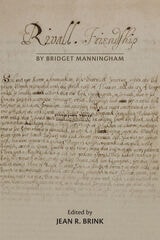
Rivall Friendship, by Bridget Manningham
Edited by Jean R. Brink
Arizona Center for Medieval and Renaissance Studies, 2021
The manuscript for Rivall Friendship was first acquired by the Newberry Library in 1937. At the time of the acquisition, the author of this seventeenth-century romance was anonymous. Scholar Jean R. Brink now suggests, based on dating of the manuscript and her analysis of its feminist themes, that the author was a woman. Specifically, Brink attributes the text to Bridget Manningham, who was the older sister of Thomas Manningham, a Jacobean and Caroline bishop, and the granddaughter of John Manningham, a diarist who recorded performances of Shakespeare’s plays.
Rivall Friendship is a post–English Civil War romance that examines proto-feminist issues, such as patriarchal dominance in the family and marriage. Manningham is scrupulous about maintaining verisimilitude, and unlike more fantastical romances of the period that feature monsters, giants, and magic, this text aspires to a level of probability in its historical and geographical details. The text of Rivall Friendship is accessible to most modern readers, particularly to students and scholars accustomed to working with seventeenth-century texts.
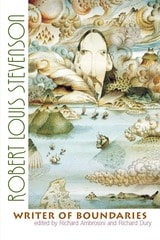
Robert Louis Stevenson
Writer of BoundariesEdited by Richard Ambrosini and Richard Dury
University of Wisconsin Press, 2006
Robert Louis Stevenson: Writer of Boundaries reinstates Stevenson at the center of critical debate and demonstrates the sophistication of his writings and the present relevance of his kaleidoscopic achievements. While most young readers know Robert Louis Stevenson (1850–1894) as the author of Treasure Island, few people outside of academia are aware of the breadth of his literary output. The contributors to Robert Louis Stevenson: Writer of Boundaries look, with varied critical approaches, at the whole range of his literary production and unite to confer scholarly legitimacy on this enormously influential writer who has been neglected by critics.
As the editors point out in their Introduction, Stevenson reinvented the “personal essay” and the “walking tour essay,” in texts of ironic stylistic brilliance that broke completely with Victorian moralism. His first full-length work of fiction, Treasure Island, provocatively combined a popular genre (subverting its imperialist ideology) with a self-conscious literary approach.
Stevenson, one of Scotland’s most prolific writers, was very effectively excluded from the canon by his twentieth-century successors and rejected by Anglo-American Modernist writers and critics for his play with popular genres and for his non-serious metaliterary brilliance. While Stevenson’s critical recognition has been slowly increasing, there have been far fewer published single-volume studies of his works than those of his contemporaries, Henry James and Joseph Conrad.
Robinson Crusoe after 300 Years
Andreas K. E. Mueller
Bucknell University Press, 2021
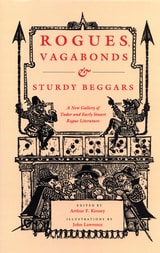
Rogues, Vagabonds, and Sturdy Beggars
A New Gallery of Tudor and Early Stuart Rogue Literature Exposing the Lives, Times, and Cozening Tricks of the Elizabethan UnderworldArthur F. Kinney
University of Massachusetts Press, 1990
In his introduction, Arthur F. Kinney discusses the significance of these works as protonovels and their influence on such writers as Shakespeare. He also explores the social, political, and economic conditions of a time that spawned a community of renegades who conned their way to fame, fortune, and, occasionally, the rope at Tyburn.
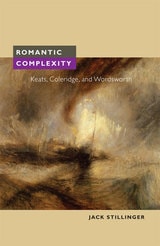
Romantic Complexity
Keats, Coleridge, and WordsworthJack Stillinger
University of Illinois Press, 2005
In Romantic Complexity, Jack Stillinger examines three of the most admired poets of English Romanticism--Keats, Coleridge, and Wordsworth--with a focus on the complexity that results from the multiple authorship, the multiple textual representation, and the multiple reading and interpretation of their best works.
Specific topics include the joint authorship of Wordsworth and Coleridge in the Lyrical Ballads, an experiment of 1798 that established the most essential characteristics of modern poetry; Coleridge's creation of eighteen or more different versions of The Ancient Mariner and how this textual multiplicity affects interpretation; the historical collaboration between Keats and his readers to produce fifty-nine separate but entirely legitimate readings of The Eve of St. Agnes; and a number of practical and theoretical matters bearing on the relationships among these writers and their influences on one another.
Stillinger shows his deep understanding of the poets' lives, works, and the history of their reception, in chapters rich with intriguing questions and answers sure to engage students and teachers of the world's greatest poetry.

Romantic Globalism
British Literature and Modern World Order, 1750–1830Evan Gottlieb
The Ohio State University Press, 2014
Although modern media tend to represent globalization as an essentially contemporary phenomenon, many scholars now agree that its fundamental dynamics—especially its characteristic annulment of spatial and temporal differences—have been present for several centuries. Moreover, the last decades of the eighteenth century and the first of the nineteenth century saw the convergence of a number of world-changing socio-political developments in the Western world. Romantic Globalism is significant because it is the first extended scholarly study that brings together these lines of inquiry. In so doing, Romantic Globalism not only charts a new course of study for British Romanticism but also suggests how the Romantics’ visions of globality might still be valuable to us today.
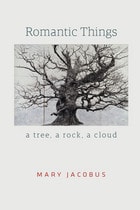
Romantic Things
A Tree, a Rock, a CloudMary Jacobus
University of Chicago Press, 2012
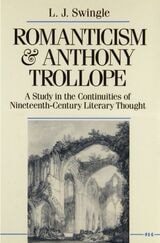
Romanticism and Anthony Trollope
A Study in the Continuities of Nineteenth-Century Literary ThoughtL. J. Swingle
University of Michigan Press, 1990
Romanticism and Transcendence
Wordsworth, Coleridge, and the Religious ImaginationJ. Robert Barth, S.J.
University of Missouri Press, 2003
Romanticism and the Question of the Stranger
David Simpson
University of Chicago Press, 2012
Romanticism, Nationalism, and the Revolt against Theory
David Simpson
University of Chicago Press, 1993
Simpson demonstrates the close association between "theory" and "method" and shows that by the mid-eighteenth century, "method" had acquired distinctly subversive associations in England. Attributed increasingly to the French and the Germans, "method" paradoxically evoked images both of inhuman rationality and unbridled sentimentality; in either incarnation, it was seen as a threat to what was claimed to be authentically British. Simpson develops these paradigms in relation to feminism, the gendering of Anglo-American culture, and the emergence of literature and literary criticism as antitheoretical discourses. He then looks at the Romantic poets' response to this confining ideology of the cultural role of literature. Finally, Simpson considers postmodern theory's claims for the radical energy of nonrational or antirationalist positions.
This is an essential book not only for students of the Romantic period and intellectual historians concerned with the idea of "method," but for anyone interested in the historical background of today's debates over the excesses and possibilities of "theory."
Romanticism’s Other Minds
Poetry, Cognition, and the Science of SociabilityJohn Savarese
The Ohio State University Press, 2020