Results by title
377 books match the query 'French' and 17 start with r
Race to Infinity
Early Modern Distinctions Between Literature and ScienceDavid L. Sedley
Northwestern University Press, 2027
Studying the early modern split between science and literature and the aftermath of their division
The conception of computers as thinking machines and literature as a social field stems from the early modern phenomenon of competing over the infinite as an object not just of contemplation but of appropriation in a race toward virtual control. The rediscovery of this origin undoes a collective forgetting of what technology and texts have in common, what they don’t, and what they can and ought to be in the future. David L. Sedley offers a new history of literature and science’s disciplinary divide—its origin and significance—tracing a series of points along the emerging frontier between these two fields. At each point there are two objects in play and two authors who push the objects in opposite directions: on the one hand, mechanical arts and the essay, probability theory and the novel, and geometry and epic; on the other, Montaigne and Bacon, Pascal and Lafayette, and Hobbes and Milton. Each of these authors, Sedley shows, tried to render an object either algorithmic or infinite to oppose the other’s efforts. Ultimately, Race to Infinity: Early Modern Distinctions Between Literature and Science illuminates the fortunes of the literary in the digital revolution and beyond.
Racine and English Classicism
By Katherine E. Wheatley
University of Texas Press, 1956
Literary historians and critics who have written on the influence of Racine in England during the neoclassical period apparently have assumed that the English translators and adapters of Racine’s plays in general succeeded in presenting the real Racine to the English public.
Katherine Wheatley here reveals the wide discrepancy between avowed intentions and actual results. Among the English plays she compares with their French originals are Otway’s Titus and Berenice, Congreve’s The Mourning Bride, and Philips’s The Distrest Mother. These comparisons, fully supported by quoted passages, reveal that those among the English public and contemporary critics who could not themselves read French had no chance whatever to know the real Racine: “The adapters and translators, so-called, had eliminated Racine from his tragedies before presenting them to the public.” Unacknowledged excisions and additions, shifts in plot, changes in dénouement, and frequent mistranslation turned Racine’s plays into “wretched travesties.” Two translations of Britannicus, intended for reading rather than for acting, are especially revealing in that they show which Racinian qualities eluded the British translators even when they were not trying to please an English theatergoing audience.
Why it is, asks the author, that no English dramatist could or would present Racine as he is to the English public of the neoclassical period? To answer this question she traces the development of Aristotelian formalism in England, showing the relation of the English theory of tragedy to French classical doctrine and the relation of the English adaptations of Racine to the English neoclassical theory of tragedy. She concludes that “deliberate alterations made by the English, far from violating classical tenets, bring Racine’s tragedies closer to the English neoclassical ideal than they were to begin with, and this despite the fact that some tenets of English doctrine came from parallel tenets widely accepted in France.” She finds that “in the last analysis, French classical doctrine was itself a barrier to the understanding of Racinian tragedy in England and an incentive to the sort of change English translators and adapters made in Racine.” This paradox she explains by the fact that Racine himself had broken with the classical tradition as represented by Corneille.
Reading Proust
In Search of Wolf-FishMaria Paganini
University of Minnesota Press, 1994
Reading at the Limits of Poetic Form
Dematerialization in Adorno, Blanchot, and CelanJacob McGuinn
Northwestern University Press, 2024
How does literary objecthood contend with the challenge of writing objects that emerge at an extreme limit of material presence? Jacob McGuinn delves into the ways literature writes this indeterminate presence in the context of pre- and post-’68 Paris, a vital moment in the history of criticism. The works of poet Paul Celan, philosopher Theodor Adorno, and writer Maurice Blanchot highlight how the complexities of reading such a dematerialized object are part of the indeterminacy of material itself. Indeterminate objects—glass, snow, walls, screens—are subjects Celan describes as existing in “meridian” space, while for Adorno and Blanchot, criticism not only responds to this indeterminacy but also takes it as its condition. Reading at the Limits of Poetic Form: Dematerialization in Adorno, Blanchot, and Celan shows how these readings simultaneously limit the object of criticism and outline alternative ways of thinking that lie between the models of critical formalism and historicism, ultimately revealing the possible materiality of literature in unrealized history, incomplete politics, and nondetermining thinking.
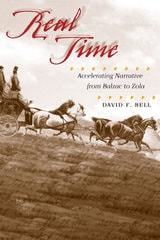
Real Time
Accelerating Narrative from Balzac to ZolaDavid F. Bell
University of Illinois Press, 2003
Nineteenth-century technological advances radically altered the infrastructure of France, changing the ways ordinary citizens–-and literary characters--viewed time, space, distance, and speed. The most influential of these advances included the improvement of the stagecoach, the growth of road and canal networks leading to the advent of the railway, and the increasing use of mail, and of the optical telegraph. Citing examples from a wide range of novels and stories, Bell demonstrates the numerous ways in which these trends of acceleration became not just literary devices and themes but also structuring principles of the novels themselves.
Beginning with both the provincial and the Parisian communications networks of Balzac, Bell proceeds to discuss the roles of horses and optical telegraphs in Stendhal and the importance of domination of communication channels to the characters of Dumas, whose Count of Monte-Cristo might be seen as the ultimate fictional master of this accelerated culture. Finally, Bell analyzes the cinematic vision created by the arrival of the railroad, as depicted by Zola in La Bète Humaine.
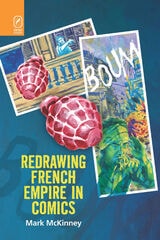
Redrawing French Empire in Comics
Mark McKinney
The Ohio State University Press, 2020

Reframing Reality
The Aesthetics of the Surrealist Object in French and Czech CinemaAlison Frank
Intellect Books, 2013
Remembering Paris in Text and Film
Echoes of Baudelaire in Text and on ScreenEdited by Alistair Rolls and Marguerite Johnson
Intellect Books, 2021
Experiencing urban space conjures visions of the past alongside contemplation of the present. This edited volume investigates this feeling of seeing double by investigating Paris—a city that has come to embody the tension of this sensation—through a dual lens of nostalgia and modernity.
Contributors survey Paris in film, poetry, and prose in the nineteenth and twentieth centuries, presenting the city as both a concrete reality and as a collection of the myths associated with it. Interdisciplinary and deeply researched, the essays distill complex concepts of the urban, the textual, and the modern for a wide readership.
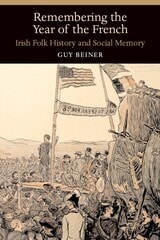
Remembering the Year of the French
Irish Folk History and Social MemoryGuy Beiner
University of Wisconsin Press, 2007
Beiner analyzes hundreds of hitherto unstudied historical, literary, and ethnographic sources. Though his focus is on 1798, his work is also a comprehensive study of Irish folk history and grass-roots social memory in Ireland. Investigating how communities in the West of Ireland remembered, well into the mid-twentieth century, an episode in the late eighteenth century, this is a “history from below” that gives serious attention to the perspectives of those who have been previously ignored or discounted. Beiner brilliantly captures the stories, ceremonies, and other popular traditions through which local communities narrated, remembered, and commemorated the past. Demonstrating the unique value of folklore as a historical source, Remembering the Year of the French offers a fresh perspective on collective memory and modern Irish history.
Winner, Wayland Hand Competition for outstanding publication in folklore and history, American Folklore Society
Finalist, award for the best book published about or growing out of public history, National Council on Public History
Winner, Michaelis-Jena Ratcliff Prize for the best study of folklore or folk life in Great Britain and Ireland
“An important and beautifully produced work. Guy Beiner here shows himself to be a historian of unusual talent.”—Marianne Elliott, Times Literary Supplement
“Thoroughly researched and scholarly. . . . Beiner’s work is full of empathy and sympathy for the human remains, memorials, and commemorations of past lives and the multiple ways in which they actually continue to live.”—Stiofán Ó Cadhla, Journal of British Studies
“A major contribution to Irish historiography.”—Maureen Murphy, Irish Literary Supplement
"A remarkable piece of scholarship . . . . Accessible, full of intriguing detail, and eminently teachable.”?—Ray Casman, New Hibernia Review
“The most important monograph on Irish history of the nineteenth and twentieth centuries to be published in recent years.”—Matthew Kelly, English Historical Review
“A strikingly ambitious work . . . . Elegantly constructed, lucidly written and inspired, and displaying an inexhaustible capacity for research”—Ciarán Brady, History IRELAND
“A closely argued, meticulously detailed and rich analysis . . . . providing such innovative treatment of a wide array of sources, his work will resonate with the concerns of many cultural and historical geographers working on social memory in quite different geographical settings and historical contexts.”—Yvonne Whelan, Journal of Historical Geography
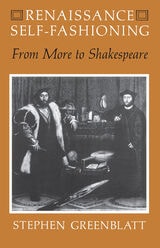
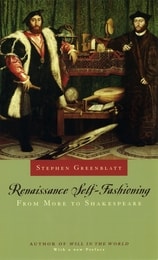
Renaissance Self-Fashioning
From More to ShakespeareStephen Greenblatt
University of Chicago Press, 1983
"No one who has read [Greenblatt's] accounts of More, Tyndale, Wyatt, and others can fail to be moved, as well as enlightened, by an interpretive mode which is as humane and sympathetic as it is analytical. These portraits are poignantly, subtly, and minutely rendered in a beautifully lucid prose alive in every sentence to the ambivalences and complexities of its subjects."—Harry Berger Jr., University of California, Santa Cruz
Renaissance Self-Fashioning
From More to ShakespeareStephen Greenblatt
University of Chicago Press, 2005
"No one who has read [Greenblatt's] accounts of More, Tyndale, Wyatt, and others can fail to be moved, as well as enlightened, by an interpretive mode which is as humane and sympathetic as it is analytical. These portraits are poignantly, subtly, and minutely rendered in a beautifully lucid prose alive in every sentence to the ambivalences and complexities of its subjects."—Harry Berger Jr., University of California, Santa Cruz
René Girard's Mimetic Theory
Wolfgang Palaver
Michigan State University Press, 2013
Reveries of Community
French Epic in the Age of Henri IV, 1572–1616Katherine S. Maynard
Northwestern University Press, 2018
Traditionally united by une foi, une loi, un roi (one faith, one law, one king), France under Henri IV was cleaved into warring factions of Catholics and Huguenots. The country suffered episodes of bloodshed such as the St. Bartholomew’s Day Massacre, even as attempts were made to attenuate the violence through frequent edicts, including those of St. Germain (1570) and Nantes (1598). Maynard examines the rich and often dismissed body work written during these bloody decades: Pierre de Ronsard’s Franciade, Guillaume Salluste Du Bartas’s La Judit and La Sepmaine, Sébastian Garnier’s La Henriade, Agrippa d’Aubigné’s Les Tragiques, and others. She traces how French poets, taking classics such as Virgil’s Aeneid and Homer’s Iliad as their models, reimagined possibilities for French reconciliation and unity.
Rimbaud
Complete Works, Selected Letters, a Bilingual EditionJean Nicholas Arthur Rimbaud
University of Chicago Press, 2005
The first translation of the poet's complete works when it was published in 1966, Rimbaud: Complete Works, Selected Letters introduced a new generation of Americans to the alienated genius—among them the Doors's lead singer Jim Morrison, who wrote to translator Wallace Fowlie to thank him for rendering the poems accessible to those who "don't read French that easily." Forty years later, the book remains the only side-by-side bilingual edition of Rimbaud's complete poetic works.
Thoroughly revising Fowlie's edition, Seth Whidden has made changes on virtually every page, correcting errors, reordering poems, adding previously omitted versions of poems and some letters, and updating the text to reflect current scholarship; left in place are Fowlie's literal and respectful translations of Rimbaud's complex and nontraditional verse. Whidden also provides a foreword that considers the heritage of Fowlie's edition and adds a bibliography that acknowledges relevant books that have appeared since the original publication. On its fortieth anniversary, Rimbaud remains the most authoritative—and now, completely up-to-date—edition of the young master's entire poetic ouvre.
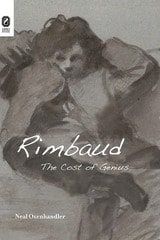
Rimbaud
The Cost of GeniusNeal Oxenhandler
The Ohio State University Press, 2009

Rousseau, Judge of Jean-Jacques
DialoguesJean-Jacques Rousseau
Dartmouth College Press, 2012
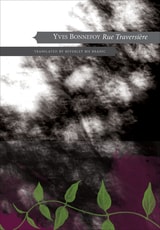
Rue Traversière
Yves Bonnefoy
Seagull Books, 1972
Praised by Paul Auster as “one of the rare poets in the history of literature to have sustained the highest level of artistic excellence throughout an entire lifetime,” Yves Bonnefoy is widely considered the foremost French poet of his generation. Proving that his prose is just as lyrical, Rue Traversière, written in 1977, is one of his most harmonious works. Each of the fifteen discrete or linked texts, whose lengths range from brief notations to long, intense, self-questioning pages, is a work of art in its own right: brief and richly suggestive as haiku, or long and intricately wrought in syntax and thought; and all are as rewarding in their sounds and rhythms, and their lightning flashes of insight, as any sonnet. “I can write all I like; I am also the person who looks at the map of the city of his childhood and doesn’t understand,” says the section that gives the book its title, as he revisits childhood cityscapes and explores the tricks memory plays on us.
A mixture of genres—the prose poem, the personal essay, quasi-philosophical reflections on time, memory, and art—this is a book of both epigrammatic concision and dreamlike narratives that meander with the poet’s thought as he struggles to understand and express some of the undercurrents of human life. The book’s layered texts echo and elaborate on one another, as well as on aspects of Bonnefoy’s own poetics and thought.