171 books match the query 'Labor unions' and 7 start with r
cover of Race against Liberalism: Black Workers and the UAW in Detroit

Race against Liberalism

Black Workers and the UAW in Detroit

David M. Lewis-Colman

University of Illinois Press, 2007

Race against Liberalism examines how black worker activism in Detroit shaped the racial politics of the labor movement and the white working class. David M. Lewis-Colman traces the substantive, long-standing disagreements between liberals and the black workers who embraced autonomous race-based action. As he shows, black autoworkers placed themselves at the center of Detroit's working-class politics and sought to forge a kind of working class unity that accommodated their interests as African Americans. The book covers the independent caucuses in the 1940s and the Trade Union Leadership Council in the 1950s; the black power movement and Revolutionary Union Movements of the mid-1960s; and the independent race-based activism of the 1970s that resulted in Coleman Young's 1973 election as the city's first black mayor.
[more]
cover of Race and Labor in Western Copper: The Fight for Equality, 1896-1918

Race and Labor in Western Copper

The Fight for Equality, 1896-1918

Philip J. Mellinger

University of Arizona Press, 1995

This is the story of immigrant copper workers and their attempts to organize at the turn of the century in Arizona, New Mexico, Nevada, Utah, and El Paso, Texas. These Mexican and European laborers of widely varying backgrounds and languages had little social, economic, or political power. Yet they achieved some surprising successes in their struggles—all in the face of a racist society and the unbridled power of the mine owners.

Mellinger's book is the first regional history of these ordinary working people—miners, muckers, millhands, and smelter workers—who labored in the thousands of mountain and desert mining camps across the western heartland early in this century. These men, largely uneducated, frequently moving from camp to camp, subjected to harsh and dangerous conditions, often poorly paid, nevertheless came together for a common purpose.

They came from Mexico, from the U.S. Hispanic Southwest, and from several European countries, especially from Greece, Italy, the former Yugoslavia, and Spain. They were far from a homogeneous group. Yet, in part because they set aside ethnic differences to pursue cooperative labor action, they were able to make demands, plan strikes, carry them out, and sometimes actually win. They also won the aid of the Western Federation of Miners and the more radical Industrial Workers of the World. After initial rejection, they were eventually accepted by mainstream unionists.

Mellinger discusses towns, mines, camps, companies, and labor unions, but this book is largely about people. In order to reconstruct their mining-community lives, he has used little-known union and company records, personal interviews with old-time workers and their families, and a variety of regional sources that together have enabled him to reveal a complex and significant pattern of social, economic, and political change in the American West.

[more]
cover of Race, Class, and Power in the Alabama Coalfields, 1908-21

Race, Class, and Power in the Alabama Coalfields, 1908-21

Brian Kelly

University of Illinois Press, 2001
Brian Kelly's acclaimed look at the fault lines in the society of an Alabama city challenges the notion that white workers led the resistance to racial equality in the Jim Crow South. Kelly focuses on the forces that brought the black and white miners of Birmingham, Alabama, together during the hard-fought strikes of 1908 and 1920. He examines the systematic efforts by the region's powerful industrialists to create racial divisions as a means of splitting the workforce, preventing unionization, and keeping wages the lowest in the United States. He also details the role played by Birmingham's small but influential black middle class, whose espousal of industrial accommodation outraged black miners and revealed significant tensions within the African American community.
[more]
cover of Race, Labor, and Violence in the Delta: Essays to Mark the Centennial of the Elaine Massacre

Race, Labor, and Violence in the Delta

Essays to Mark the Centennial of the Elaine Massacre

Michael Pierce

University of Arkansas Press, 2022
Race, Labor, and Violence in the Delta examines the history of labor relations and racial conflict in the Mississippi Valley from the Civil War into the late twentieth century. This essay collection grew out of a conference marking the hundredth anniversary of one of the nation’s deadliest labor conflicts—the 1919 Elaine Massacre, during which white mobs ruthlessly slaughtered over two hundred African Americans across Phillips County, Arkansas, in response to a meeting of unionized Black sharecroppers. The essays here demonstrate that the brutality that unfolded in Phillips County was characteristic of the culture of race- and labor-based violence that prevailed in the century after the Civil War. They detail how Delta landowners began seeking cheap labor as soon as the slave system ended—securing a workforce by inflicting racial terror, eroding the Reconstruction Amendments in the courts, and obstructing federal financial-relief efforts. The result was a system of peonage that continued to exploit Blacks and poor whites for their labor, sometimes fatally. In response, laborers devised their own methods for sustaining themselves and their communities: forming unions, calling strikes, relocating, and occasionally operating outside the law. By shedding light on the broader context of the Elaine Massacre, Race, Labor, and Violence in the Delta reveals that the fight against white supremacy in the Delta was necessarily a fight for better working conditions, fair labor practices, and economic justice.
[more]
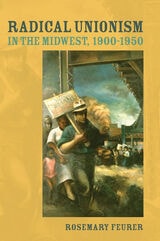
cover of Radical Unionism in the Midwest, 1900-1950

Radical Unionism in the Midwest, 1900-1950

Rosemary Feurer

University of Illinois Press, 2006

District 8 of the United Electrical, Radio, and Machine Workers (UE) developed a style of unionism designed to confront corporate power but also act as a force for social transformation in their community and nation.

Rosemary Feurer examines the fierce battles between these Midwestern electrical workers and the bitterly anti-union electrical and metal industry, Exploring the role of radicals in local movement formation, Feurer reveals a "civic" unionism that could connect community and union concerns to build solidarity and contest the political economy. District 8's spirited unionism included plant occupations in St. Louis and Iowa; campaigns to democratize economic planning; and strategies for national bargaining that elected officials inevitably branded as part of a communist conspiracy. Though destroyed by reactionaries and an anticommunist backlash, District 8 molded a story that tells another side of the labor movement's formation in the 1930s and 1940s, and can inform current struggles against corporate power in the modern global economy.

[more]
cover of Ramparts of Resistance: Why Workers Lost Their Power, and How to Get It Back

Ramparts of Resistance

Why Workers Lost Their Power, and How to Get It Back

Sheila Cohen

Pluto Press, 2006

Ramparts of Resistance examines the experience of British and U.S. workers during the last three decades to offer a broad analysis of the need for a new independent politics of trade unionism. Recent years have seen great changes in the trade union movement, from waves of strikes in the 1970s to a battery of employer and state onslaughts, culminating in the anti-union legislation of the 1980s and 1990s. Looking at grassroots labor struggles, Sheila Cohen explores issues of reformism, trade union democracy, and the political meaning of ordinary workplace resistance, and puts forward ideas for change. Ramparts of Resistance examines the failure of the union movement to rise to the neoliberal challenge and calls for a new politics of independent unionism and an explicitly class-based renewal of "workers' power." Coming at a time when union activity and membership involvement continues despite the odds, this book is an inspiring guide to the direction that unionism should take.
[more]
cover of Reassembling the UAW: Insurgency, Contention, and the Struggle for Unionism in the American South

Reassembling the UAW

Insurgency, Contention, and the Struggle for Unionism in the American South

Abe Walker

Temple University Press, 2026

When Volkswagen’s Chattanooga Assembly Plant opened in 2012, the United Auto Workers were excited by the golden opportunity to organize in the anti-union South, where their efforts had been routinely thwarted. However, it took ten years and several attempts before the UAW was successful in unionizing the plant. Reassembling the UAW explains why.

Abe Walker chronicles the organizing campaign from its origin in 2014 to the union’s breakthrough victory in 2024, illustrating what went wrong—and what went right—along the way. Walker provides a systematic analysis of the strategic challenges and tactical shifts, showing the patterns that persisted across three election cycles while highlighting their differences, from global-level alliances to local labor issues.

Reassembling the UAW also demonstrates how rebel rank-and-file workers ousted the old-guard leadership and transformed the UAW into a militant union to achieve results. Ultimately, Walker offers valuable lessons for organizational strategy, the power of collective action, and the future of the labor movement.
[more]