Results by title
328 books match the query 'Literature and society' and 27 start with r
READING LONDON
URBAN SPECULATION AND IMAGINATIVE GOVERNMENT EIGHTEENTH-CENTURY LITERATUREERIK BOND
The Ohio State University Press, 2007
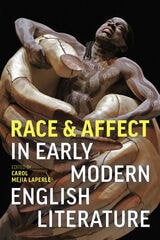
Race and Affect in Early Modern English Literature
Carole Mejia LaPerle
Arizona Center for Medieval and Renaissance Studies, 2021
Race and Affect in Early Modern English Literature puts the fields of critical race studies and affect theory into dialogue. Doing so opens a new set of questions: What are the emotional experiences of racial formation and racist ideologies? How do feelings—through the physical senses, emotional passions, or sexual encounters—come to signify race? What is the affective register of anti-blackness that pervades canonical literature? How can these visceral forms of racism be resisted in discourse and in practice? By investigating how race feels, this book offers new ways of reading and interpreting literary traditions, religious differences, gendered experiences, class hierarchies, sexuality, and social identities. So far scholars have shaped the discussion of race in the early modern period by focusing on topics such as genealogy, language, economics, religion, skin color, and ethnicity. This book, however, offers something new: it considers racializing processes as visceral, affective experiences.

Racial Feelings
Asian America in a Capitalist Culture of EmotionJeffrey Santa Ana
Temple University Press, 2015
Santa Ana explores various forms of Asian American cultural production, ranging from literature and graphic narratives to film and advertising, to illuminate the connections between global economic relations and the emotions that shape aspirations for the good life. He illustrates his argument with examples including the destitute Filipino immigrant William Paulinha, in Han Ong’s Fixer Chao, who targets his anger on the capitalist forces of objectification that racially exploit him, and Nan and Pingpin in Ha Jin’s A Free Life, who seek happiness and belonging in America.
Racial Feelings addresses how Asian Americans both resist and rely on stereotypes in their writing and art work. In addition, Santa Ana investigates how capitalism shapes and structures an emotional discourse that represents Asians as both economic exemplars and threats.
Rape Of Clarissa
Writing, Sexuality, and Class Struggle in Samuel RichardsonTerry Eagleton
University of Minnesota Press, 1982
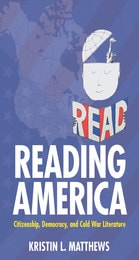
Reading America
Citizenship, Democracy, and Cold War LiteratureKristin L. Matthews
University of Massachusetts Press, 2016
During the Cold War, the editor of Time magazine declared, “A good citizen is a good reader.” As postwar euphoria faded, a wide variety of Americans turned to reading to understand their place in the changing world. Yet, what did it mean to be a good reader? And how did reading make you a good citizen?
In Reading America, Kristin L. Matthews puts into conversation a range of political, educational, popular, and touchstone literary texts to demonstrate how Americans from across the political spectrum—including “great works” proponents, New Critics, civil rights leaders, postmodern theorists, neoconservatives, and multiculturalists—celebrated particular texts and advocated particular interpretive methods as they worked to make their vision of "America" a reality. She situates the fiction of J. D. Salinger, Ralph Ellison, Thomas Pynchon, John Barth, and Maxine Hong Kingston within these debates, illustrating how Cold War literature was not just an object of but also a vested participant in postwar efforts to define good reading and citizenship.
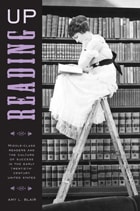
Reading Up
Middle-Class Readers and the Culture of Success in the Early Twentieth-Century United StatesAmy Blair
Temple University Press, 2011
A person who reads a book for self-improvement rather than aesthetic pleasure is “reading up.” Reading Up is Amy Blair's engaging study of popular literary critics who promoted reading generally and specific books as vehicles for acquiring cultural competence and economic mobility. Combining methodologies from the history of the book and the history of reading, to mass-cultural studies, reader-response criticism, reception studies, and formalist literary analysis, Blair shows how such critics influenced the choices of striving readers and popularized some elite writers.
Framed by an analysis of Hamilton Wright Mabie's role promoting the concept of “reading up” during his ten-year stint as the cultivator of literary taste for the highly popular Ladies' Home Journal, Reading Up reveals how readers flocked to literary works that they would be expected to dislike. Blair shows that while readers could be led to certain books by a trusted adviser, they frequently followed their own path in interpreting them in unexpected ways.
Reading and Writing the Ambiente
Queer Sexualities in Latino, Latin American, and Spanish CultureSusana Chávez-Silverman
University of Wisconsin Press, 2000
In this dynamic collection of essays, many leading literary scholars trace gay and lesbian themes in Latin American, Hispanic, and U.S. Latino literary and cultural texts. Reading and Writing the Ambiente is consciously ambitious and far-ranging, historically as well as geographically. It includes discussions of texts from as early as the seventeenth century to writings of the late twentieth century.
Reading and Writing the Ambiente also underscores the ways in which lesbian and gay self-representation in Hispanic texts differs from representations in Anglo-American texts. The contributors demonstrate that—unlike the emphasis on the individual in Anglo- American sexual identity—Latino, Spanish, and Latin American sexual identity is produced in the surrounding culture and community, in the ambiente. As one of the first collections of its kind, Reading and Writing the Ambiente is expressive of the next wave of gay Hispanic and Latin scholarship.
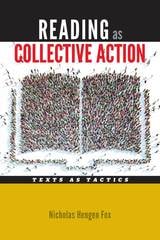
Reading as Collective Action
Text as TacticsNicholas Hengen Fox
University of Iowa Press, 2017
Reading as Collective Action shifts our focus outward, to another of literature’s powers: the power to reshape our world in very public, very active ways. In this book, you will encounter readers who criticized the Bush administration’s war on terror by republishing poems by writers ranging from Shakespeare to Amiri Baraka everywhere from lampposts to the New York Times. You will read about people in Michigan and Tennessee, who leveraged a community reading program on John Steinbeck’s The Grapes of Wrath to organize support for those in need during the Great Recession and to engage with their neighbors about immigration. You will meet a pair of students who took to public transit to talk with strangers about working-class literature and a trio who created a literary website that reclaimed the working-class history of the Pacific Northwest.
This book challenges dominant academic modes of reading. For adherents of the “civic turn,” it suggests how we can create more politically effective forms of service learning and community engagement grounded in a commitment to tactical, grassroots actions. Whether you’re a social worker or a student, a zine-maker, a librarian, a professor, or just a passionate reader with a desire to better your community, this book shows that when we read texts as tactics, “that book changed my life” can become “that book changed our lives.”
Reading as Therapy
What Contemporary Fiction Does for Middle-Class AmericansTimothy Aubry
University of Iowa Press, 2011
@font-face { font-family: "Myriad Pro";}p.MsoNormal, li.MsoNormal, div.MsoNormal { margin: 0in 0in 0.0001pt; font-size: 12pt; font-family: "Times New Roman"; }div.Section1 { page: Section1; }Why do Americans read contemporary fiction? This question seems simple, but is it? Do Americans read for the purpose of aesthetic appreciation? To satisfy their own insatiable intellectual curiosities? While other forms of media have come to monopolize consumers’ leisure time, in the past two decades book clubs have proliferated, Amazon has sponsored thriving online discussions, Oprah Winfrey has inspired millions of viewers to read both contemporary works and classics, and novels have retained their devoted following within middlebrow communities.
In Reading as Therapy, Timothy Aubry argues that contemporary fiction serves primarily as a therapeutic tool for lonely, dissatisfied middle-class American readers, one that validates their own private dysfunctions while supporting elusive communities of strangers unified by shared feelings. Aubry persuasively makes the case that contemporary literature’s persistent appeal depends upon its capacity to perform a therapeutic function.
Reading as Therapy traces the growth and proliferation of psychological concepts focused on the subjective interior within mainstream, middle-class society and the impact this has had on contemporary fiction. The prevailing tendency among academic critics has been to decry the personal emphasis of contemporary fiction as complicit with the rise of a narcissistic culture, the ascendency of liberal individualism, and the breakdown of public life. Reading as Therapy, by contrast, underscores the varied ideological effects that therapeutic culture can foster.
To uncover the many unpredictable ways in which contemporary literature answers the psychological needs of its readers, Aubry considers several different venues of reader-response—including Oprah’s Book Club and Amazon customer reviews—the promotional strategies of publishing houses, and a variety of contemporary texts, ranging from Khaled Hosseini’s The Kite Runner to Anita Shreve’s The Pilot’s Wife to David Foster Wallace’s Infinite Jest. He concludes that, in the face of an atomistic social landscape, contemporary fiction gives readers a therapeutic vocabulary that both reinforces the private sphere and creates surprising forms of sympathy and solidarity among strangers.
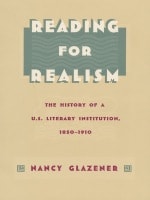
Reading for Realism
The History of a U.S. Literary Institution, 1850–1910Nancy Glazener
Duke University Press, 1997
Combining reception theory with a materialist analysis of the social formations in which realist reading practices circulated, Glazener’s study reveals the elitist underpinnings of literary realism. At the book’s center is the Atlantic group of magazines, whose influence was part of the cultural machinery of the Northeastern urban bourgeoisie and crucial to the development of literary realism in America. Glazener shows how the promotion of realism by this group of publications also meant a consolidation of privilege—primarily in terms of class, gender, race, and region—for the audience it served. Thus American realism, so often portrayed as a quintessentially populist form, actually served to enforce existing structures of class and power.
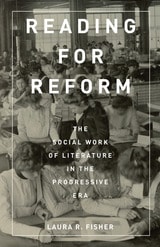
Reading for Reform
The Social Work of Literature in the Progressive EraLaura R. Fisher
University of Minnesota Press, 2019
An unprecedented examination of class-bridging reform and U.S. literary history at the turn of the twentieth century
Reading for Reform rewrites the literary history of late nineteenth and early twentieth century America by putting social reform institutions at the center of literary and cultural analysis. Examining the vibrant, often fractious literary cultures that developed as part of the Progressive mandate to uplift the socially disadvantaged, it shows that in these years reformers saw literature as a way to combat the myriad social problems that plagued modern U.S. society. As they developed distinctly literary methods for Americanizing immigrants, uplifting and refining wage-earning women, and educating black students, their institutions gave rise to a new social purpose for literature.
Class-bridging reform institutions—the urban settlement house, working girls’ club, and African American college—are rarely addressed in literary history. Yet, Laura R. Fisher argues, they engendered important experiments in the form and social utility of American literature, from minor texts of Yiddish drama and little-known periodical and reform writers to the fiction of Edith Wharton and Nella Larsen. Fisher delves into reform’s vast and largely unexplored institutional archives to show how dynamic sites of modern literary culture developed at the margins of social power.
Fisher reveals how reformist approaches to race, class, religion, and gender formation shaped American literature between the 1880s and the 1920s. In doing so, she tells a new story about the fate of literary practice, and the idea of literature’s practical value, during the very years that modernist authors were proclaiming art’s autonomy from concepts of social utility.
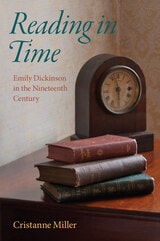
Reading in Time
Emily Dickinson in the Nineteenth CenturyCristanne Miller
University of Massachusetts Press, 2012
Before 1865, Dickinson at least ambivalently considered publication, circulated relatively few poems, and saved almost everything she wrote in organized booklets. After this date, she wrote far fewer poems, circulated many poems without retaining them, and took less interest in formally preserving her work. Yet, Miller argues, even when circulating relatively few poems, Dickinson was vitally engaged with the literary and political culture of her day and, in effect, wrote to her contemporaries. Unlike previous accounts placing Dickinson in her era, Reading in Time demonstrates the extent to which formal properties of her poems borrow from the short-lined verse she read in schoolbooks, periodicals, and single-authored volumes. Miller presents Dickinson's writing in relation to contemporary experiments with the lyric, the ballad, and free verse, explores her responses to American Orientalism, presents the dramatic lyric as one of her preferred modes for responding to the Civil War, and gives us new ways to understand the patterns of her composition and practice of poetry.
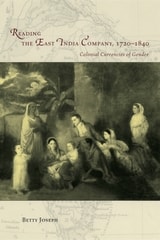
Reading the East India Company 1720-1840
Colonial Currencies of GenderBetty Joseph
University of Chicago Press, 2003
Drawing on the British East India Company's records as well as novels, memoirs, portraiture and guidebooks, Joseph shows how the company's economic and archival practices intersected to produce colonial "fictions" or "truth-effects" that strictly governed class and gender roles—in effect creating a "grammar of power" that kept the far-flung empire intact. And while women were often excluded from this archive, Joseph finds that we can still hear their voices at certain key historical junctures. Attending to these voices, Joseph illustrates how the writing of history belongs not only to the colonial project set forth by British men, but also to the agendas and mechanisms of agency—of colonized Indian, as well as European women. In the process, she makes a valuable and lasting contribution to gender studies, postcolonial theory, and the history of South Asia.
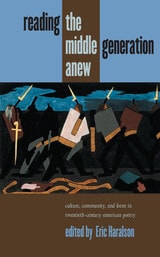
Reading the Middle Generation Anew
Culture, Community, and Form in Twentieth-Century American PoetryEric Haralson
University of Iowa Press, 2006
In addition to having worked during the broad middle of the last century, these poets constitute the center of twentieth-century American poetry in the larger sense, refuting invidious connotations of “middle” as coming after the great moderns and being superseded by a proliferating postmodern experimentation. This middle generation mediates the so-called American century and its prodigious body of poetry, even as it complicates historical and aesthetic categorizations.
Taking diverse formal and thematic angles on these poets—deconstructionist, biographical-historical, and more formalist accounts—this book re-examines their between-ness and ambivalence: their various positionings and repositionings in aesthetic, political, and personal matters. The essays study the interplay between these writers and such shifting formations as religious discourse, consumerism, militarism and war, the ideology of America as “nature’s nation,” and U.S. race relations and ethnic conflicts. Reading the Middle Generation Anew also shows the legacy of the middle generation, the ways in which their lives and writings continue to be a shaping force in American poetry. This fresh and invigorating collection will be of great interest to literary scholars and poets.

Rebecca Harding Davis
A Life Among WritersSharon M. Harris
West Virginia University Press, 2019
2018 Choice Outstanding Academic Title
This accessible treatment of Davis’s life, based on deep research in archival sources, provides new perspective on topics ranging from sectional tensions in the border South to the gendered world of nineteenth-century publishing. It promises to be the authoritative treatment of an important figure in the literary history of West Virginia and the wider world.
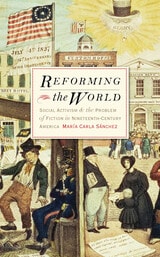
Reforming the World
Social Activism and the Problem of Fiction in Nineteenth-Century AmericaMaria Carla Sanchez
University of Iowa Press, 2009
In her informed and innovative work, Sánchez considers those authors both familiar (Lydia Maria Child, Harriet Jacobs, and Harriet Beecher Stowe) and those all but lost to history (Timothy Shay Arthur). Along the way, she refers to some of the most notable American writers in the period (Emerson, Thoreau, and Poe). Illuminating the intersection of reform and fiction, Reforming the World visits important questions about the very purpose of literature, telling the story of “a revolution that never quite took place," one that had no grandiose or even catchy name. But it did have numerous settings and participants: from the slums of New York, where prostitutes and the intemperate made their homes, to the offices of lawyers who charted the downward paths of broken men, to the tents for revival meetings, where land and souls alike were “burned over” by the grace of God.
Regulating Confusion
Samuel Johnson and the CrowdThomas Reinert
Duke University Press, 1996
Ambivalent about the disruption, confusion, perplexity, and boundless variety apparent in the London of his day, Johnson was committed to the conventions of moral reflection but also troubled by the pressure to adopt the perspective of the crowd and the language of social theory. Regulating Confusion explores the consequences of his ambivalence and his attempt to order the chaos. It discusses his critique of moral generalizations, concept of moral reflection as a symbolic gesture, and account of what happens to the notion of character when individuals, having lost the support of moral convention, become faces in a crowd. Reflecting generally on the relationship between skepticism and political ideology, Reinert also discusses Johnson’s political skepticism and the forms of speculation and action it authorized.
Challenging prevalent psychologizing and humanistic interpretations, Regulating Confusion leaves behind the re-emergent view of Johnson as a reactionary ideologue and presents him in a theoretically sophisticated context. It offers his style of skepticism as a model of poise in the face of confusion about the nature of political truth and personal responsibility and demonstrates his value as a resource for students of culture struggling with contemporary debates about the relationship between literature and politics.
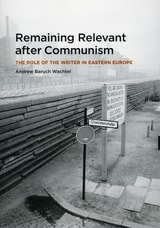
Remaining Relevant after Communism
The Role of the Writer in Eastern EuropeAndrew Baruch Wachtel
University of Chicago Press, 2005
According to Andrew Baruch Wachtel, the fall of the Berlin Wall and the creation of fledgling societies in Eastern Europe brought an end to the conditions that put the region's writers on a pedestal. In the euphoria that accompanied democracy and free markets, writers were liberated from the burden of grandiose political expectations. But no group is happy to lose its influence: despite recognizing that their exalted social position was related to their reputation for challenging political oppression, such writers have worked hard to retain their status, inventing a series of new strategies for this purpose. Remaining Relevant after Communism considers these strategies—from pulp fiction to public service—documenting what has happened on the East European scene since 1989.

Renaissance Revivals
City Comedy and Revenge Tragedy in the London Theater, 1576-1980Wendy Griswold
University of Chicago Press, 1986
Representing the Troubles in Irish Short Fiction
Michael L. Storey
Catholic University of America Press, 2004
Resisting Dialogue
Modern Fiction and the Future of DissentJuan Meneses
University of Minnesota Press, 2019
A bold new critique of dialogue as a method of eliminating dissent
Is dialogue always the productive political and communicative tool it is widely conceived to be? Resisting Dialogue reassesses our assumptions about dialogue and, in so doing, about what a politically healthy society should look like. Juan Meneses argues that, far from an unalloyed good, dialogue often serves as a subtle tool of domination, perpetuating the underlying inequalities it is intended to address.
Meneses investigates how “illusory dialogue” (a particular dialogic encounter designed to secure consensus) is employed as an instrument that forestalls—instead of fostering—articulations of dissent that lead to political change. He does so through close readings of novels from the English-speaking world written in the past hundred years—from E. M. Forster’s A Passage to India and Jeanette Winterson’s The Passion to Indra Sinha’s Animal’s People and more. Resisting Dialogue demonstrates how these novels are rhetorical exercises with real political clout capable of restoring the radical potential of dialogue in today’s globalized world. Expanding the boundaries of postpolitical theory, Meneses reveals how these works offer ways to practice disagreement against this regulatory use of dialogue and expose the pitfalls of certain other dialogic interventions in relation to some of the most prominent questions of modern history: cosmopolitanism at the end of empire, the dangers of rewriting the historical record, the affective dimension of neoliberalism, the racial and nationalist underpinnings of the “war on terror,” and the visibility of environmental violence in the Anthropocene.
Ultimately, Resisting Dialogue is a complex, provocative critique that, melding political and literary theory, reveals how fiction can help confront the deployment of dialogue to preempt the emergence of dissent and, thus, revitalize the practice of emancipatory politics.

Retelling the Siege of Jerusalem in Early Modern England
Vanita Neelakanta
University of Delaware Press, 2019
Published by University of Delaware Press. Distributed worldwide by Rutgers University Press.
Revisionary Interventions into the Americanist Canon
Donald E. Pease
Duke University Press, 1994
Originally published as a special issue of boundary 2, the essays gathered here discuss writers as diverse as Kate Chopin, Frederick Douglass, Emerson, Melville, W. D. Howells, Henry James, W. E. B. DuBois, and Mark Twain, plus the historical figure John Brown. Two major sections devoted to the theory of romance and to cultural-historical analyses emphasize the political perspective of "New Americanist" literary and cultural study.
Contributors. William E. Cain, Wai-chee Dimock, Howard Horwitz, Gregory S. Jay, Steven Mailloux, John McWilliams, Susan Mizruchi, Donald E. Pease, Ivy Schweitzer, Priscilla Wald, Michael Warner, Robert Weimann
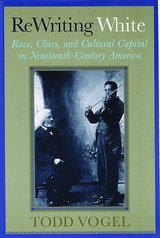
Rewriting White
Race, Class, and Cultural Capital in Nineteenth-Century AmericaTodd Vogel
Rutgers University Press, 2004
What did it mean for people of color in nineteenth-century America to speak or write "white"? More specifically, how many and what kinds of meaning could such "white" writing carry? In ReWriting White, Todd Vogel looks at how America has racialized language and aesthetic achievement. To make his point, he showcases the surprisingly complex interactions between four nineteenth-century writers of color and the "standard white English" they adapted for their own moral, political, and social ends. The African American, Native American, and Chinese American writers Vogel discusses delivered their messages in a manner that simultaneously demonstrated their command of the dominant discourse of their times-using styles and addressing forums considered above their station-and fashioned a subversive meaning in the very act of that demonstration.
The close readings and meticulous archival research in ReWriting White upend our conventional expectations, enrich our understanding of the dynamics of hegemony and cultural struggle, and contribute to the efforts of other cutting-edge contemporary scholars to chip away at the walls of racial segregation that have for too long defined and defaced the landscape of American literary and cultural studies.
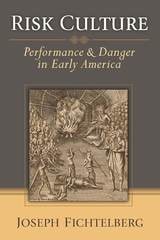
Risk Culture
Performance and Danger in Early AmericaJoseph Fichtelberg
University of Michigan Press, 2010
---David Shields, University of South Carolina
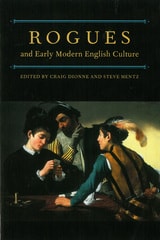
Rogues and Early Modern English Culture
Craig Dionne and Steve Mentz, Editors
University of Michigan Press, 2004
-Jonathan Dollimore, York University
"Rogues and Early Modern English Culture is an up-to-date and suggestive collection on a subject that all scholars of the early modern period have encountered but few have studied in the range and depth represented here."
-Lawrence Manley, Yale University
"A model of cross-disciplinary exchange, Rogues and Early Modern English Culture foregrounds the figure of the rogue in a nexus of early modern cultural inscriptions that reveals the provocation a seemingly marginal figure offers to authorities and various forms of authoritative understanding, then and now. The new and recent work gathered here is an exciting contribution to early modern studies, for both scholars and students."
-Alexandra W. Halasz, Dartmouth College
Rogues and Early Modern English Culture is a definitive collection of critical essays on the literary and cultural impact of the early modern rogue. Under various names-rogues, vagrants, molls, doxies, vagabonds, cony-catchers, masterless men, caterpillars of the commonwealth-this group of marginal figures, poor men and women with no clear social place or identity, exploded onto the scene in sixteenth-century English history and culture. Early modern representations of the rogue or moll in pamphlets, plays, poems, ballads, historical records, and the infamous Tudor Poor Laws treated these characters as harbingers of emerging social, economic, and cultural changes.
Images of the early modern rogue reflected historical developments but also created cultural icons for mobility, change, and social adaptation. The underclass rogue in many ways inverts the familiar image of the self-fashioned gentleman, traditionally seen as the literary focus and exemplar of the age, but the two characters have more in common than courtiers or humanists would have admitted. Both relied on linguistic prowess and social dexterity to manage their careers, whether exploiting the politics of privilege at court or surviving by their wits on urban streets.
Deftly edited by Craig Dionne and Steve Mentz, this anthology features essays from prominent and emerging critics in the field of Renaissance studies and promises to attract considerable attention from a broad range of readers and scholars in literary studies and social history.
Room for Maneuver
Reading (the) Oppositional (in) NarrativeRoss Chambers
University of Chicago Press, 1991