100 books match the query 'London' and 6 start with r

cover of READING LONDON: URBAN SPECULATION AND IMAGINATIVE GOVERNMENT EIGHTEENTH-CENTURY LITERATURE

READING LONDON

URBAN SPECULATION AND IMAGINATIVE GOVERNMENT EIGHTEENTH-CENTURY LITERATURE

ERIK BOND

The Ohio State University Press, 2007
While seventeenth-century London may immediately evoke images of Shakespeare and thatched roof-tops and nineteenth-century London may call forth images of Dickens and cobblestones, a popular conception of eighteenth-century London has been more difficult to imagine. In fact, the immense variety of textual traditions, metaphors, classical allusions, and contemporary contexts that eighteenth-century writers use to illustrate eighteenth-century London may make eighteenth-century London seem more strange and foreign to twenty-first-century readers than any of its other historical reincarnations. Indeed, “imagining” a familiar, unified London was precisely the task that occupied so many writers in London after the 1666 Fire decimated the City and the 1688 Glorious Revolution destabilized the English monarchy’s absolute power. In the authoritative void created by these two events, writers in London faced not only the problem of how to guide readers’ imaginations to a unified conception of London, but also the problem of how to govern readers whom they would never meet.
 
Erik Bond argues that Restoration London’s rapidly changing administrative geography as well as mid-eighteenth-century London’s proliferation of print helped writers generate several strategies to imagine that they could control not only other Londoners but also their interior selves. As a result, Reading London encourages readers to respect the historical alterity or “otherness” of eighteenth-century literature while recognizing that these historical alternatives prove that our present problems with urban societies do not have to be this way. In fact, the chapters illustrate how eighteenth-century writers gesture towards solutions to problems that urban citizens now face in terms of urban terror, crime, policing, and communal conduct.
[more]
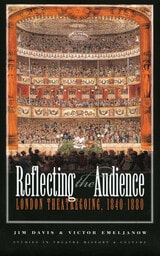
cover of Reflecting the Audience: London Theatregoing, 1840-1880

Reflecting the Audience

London Theatregoing, 1840-1880

Jim Davis

University of Iowa Press, 2001

This innovative work begins to fill a large gap in theatre studies: the lack of any comprehensive study of nineteenth-century British theatre audiences. In an attempt to bring some order to the enormous amount of available primary material, Jim Davis and Victor Emeljanow focus on London from 1840, immediately prior to the deregulation of that city's theatres, to 1880, when the Metropolitan Board of Works assumed responsibility for their licensing. In a further attempt to manage their material, they concentrate chapter by chapter on seven representative theatres from four areas: the Surrey Theatre and the Royal Victoria to the south, the Whitechapel Pavilion and the Britannia Theatre to the east, Sadler's Wells and the Queen's (later the Prince of Wales's) to the north, and Drury Lane to the west.

Davis and Emeljanow thoroughly examine the composition of these theatres' audiences, their behavior, and their attendance patterns by looking at topography, social demography, police reports, playbills, autobiographies and diaries, newspaper accounts, economic and social factors as seen in census returns, maps and transportation data, and the managerial policies of each theatre.

[more]
cover of Renaissance Revivals: City Comedy and Revenge Tragedy in the London Theater, 1576-1980

Renaissance Revivals

City Comedy and Revenge Tragedy in the London Theater, 1576-1980

Wendy Griswold

University of Chicago Press, 1986
Renaissance Revivals examines patterns in the London revivals of two English Renaissance theatre genres over the past four centuries. Griswold's focus on revenge tragedies and city comedies illuminates the ongoing interaction between society and its cultural products. No cultural object is ever created anew, she argues, but is instead constructed from existing cultural genres and conventions, the visions and professional needs of the artist, and the interests of an audience. Thus, every "new play" is in part a renaissance and every "revival" is in part an entirely new cultural object.
[more]
cover of Repertory of Shakespeare's Company, 1594–1613

Repertory of Shakespeare's Company, 1594–1613

Roslyn Lander Knutson

University of Arkansas Press, 1991

Knutson demystifies Shakespeare and his company by providing a clear vision of the dynamics of repertory management and play-going in Shakespeare's England.
[more]
cover of Ricin!: The Inside Story of the Terror Plot That Never Was

Ricin!

The Inside Story of the Terror Plot That Never Was

Lawrence Archer and Fiona Bawdon

Pluto Press, 2010

In January 2003, the British media splashed the news that anti-terror police had disrupted an Al-Qaeda cell, poised to unleash the deadly poison ricin on the capital. Police had reportedly found traces of ricin, as well as a panoply of bomb and poison-making equipment in the cell’s ‘factory of death’ – a shabby flat in north London. ‘This danger is present and real, and with us now’ announced prime minister Tony Blair.

But, when the ‘ricin plot’ came to trial at the Old Bailey, a very different story emerged: there was no ricin and no sophisticated plot. Rarely has a legal case been so shamelessly distorted by government, media and security forces to push their own ‘tough on terror’ agendas. In this meticulously researched and compellingly written book, Lawrence Archer, the jury foreman at the trial, and journalist Fiona Bawdon, give the definitive story of the ricin plot, the trial and its aftermath.
[more]
cover of Rogues, Vagabonds, and Sturdy Beggars: A New Gallery of Tudor and Early Stuart Rogue Literature Exposing the Lives, Times, and Cozening Tricks of the Elizabethan Underworld

Rogues, Vagabonds, and Sturdy Beggars

A New Gallery of Tudor and Early Stuart Rogue Literature Exposing the Lives, Times, and Cozening Tricks of the Elizabethan Underworld

Arthur F. Kinney

University of Massachusetts Press, 1990

The Elizabethan age was one of unbounded vitality and exuberance; nowhere is the color and action of life more vividly revealed than in the rogue books and cony-catching (confidence game) pamphlets of the sixteenth century. This book presents seven of the age's liveliest works: Walker's Manifest Detection of Dice Play; Awdeley's Fraternity of Vagabonds; Harman's Caveat for Common Cursitors Vulgarly Called Vagabonds; Greene's Notable Discovery of Cozenage and Black Book's Messenger; Dekker's Lantern and Candle-light; and Rid's Art of Juggling. From these pages spring the denizens of the Elizabethan underworld: cutpurses, hookers, palliards, jarkmen, doxies, counterfeit cranks, bawdy-baskets, walking morts, and priggers of prancers.

In his introduction, Arthur F. Kinney discusses the significance of these works as protonovels and their influence on such writers as Shakespeare. He also explores the social, political, and economic conditions of a time that spawned a community of renegades who conned their way to fame, fortune, and, occasionally, the rope at Tyburn.
[more]