Results by title
914 books match the query 'Medieval' and 28 start with r
Race and Ethnicity in the Middle Ages, Volume 31
Thomas Hahn, ed.
Duke University Press, 0
"The Difference the Middle Ages Makes: Color and Race before the Modern World" by Thomas Hahn
"Medieval and Modern Concepts of Race and Ethnicity" by Robert Bartlett
"Black Servant, Black Demon: Color Ideology in the Ashburnham Pentateuch" by Dorothy Hoogland Verkerk
"Pagans are wrong and Christians are right: Alterity, Gender, and Nation in the Chanson de Roland" by Sharon Kinoshita
"On Saracen Enjoyment: Some Fantasies of Race in Late Medieval France and England" by Jeffrey Jerome Cohen
"Medieval Travel Writing and the Question of Race" by Linda Lomperis
"Why ‘Race’?" by William Chester Jordan
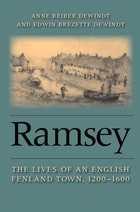
Ramsey
The Lives of an English Fenland Town, 1200–1600Anne Reiber DeWindt
Catholic University of America Press, 2006

Ravenna
its role in earlier medieval change and exchangeVolume editor Judith Herrin and Jinty Nelson
University of London Press, 2016
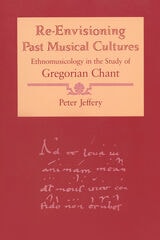
Re-Envisioning Past Musical Cultures
Ethnomusicology in the Study of Gregorian ChantPeter Jeffery
University of Chicago Press, 1992
Peter Jeffery offers an innovative new approach for understanding how these melodies were created, memorized, performed, and modified. Drawing on a variety of disciplines, including anthropology and ethnomusicology, he identifies characteristics of Gregorian chant that closely resemble other oral traditions in non-Western cultures and demonstrates ways music historians can take into account the social, cultural, and anthropological contexts of chant's development.
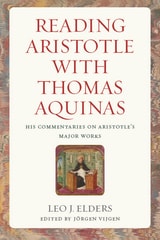
Reading Aristotle with Thomas Aquinas
His Commentaries on Aristotle's Major WorksLeo J. Elders
Catholic University of America Press, 2022
Reading Cusanus
Metaphor and Dialectic in a Conjectural UniverseClyde Lee Miller
Catholic University of America Press, 2019
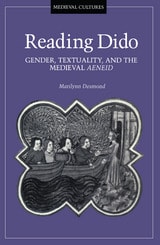
Reading Dido
Gender, Textuality, and the Medieval AeneidMarilynn Desmond
University of Minnesota Press, 1994
Describes the variations in the figure of Dido as she emerges from ancient literary texts.
If we view the Aeneid—the poem of empire, conquest, and male hierarchy-as the West's quintessential canonical text and Latin primer, then the history of Virgil readership should tell us much about the concept of education in the West. In this book, Marilynn Desmond reveals how a constructed and mediated tradition of reading Virgil has conditioned various interpretations among readers responding to medieval cultural and literary texts. In particular, she shows how the story of Dido has been marginalized within canonical readings of the Aeneid. Reaching back to the Middle Ages and vernacular poetic readings of Dido, Desmond recovers an alternative Virgil from historical tradition and provides another paradigm for reading the Aeneid.
Desmond follows the figure of Dido as she emerges from ancient historical and literary texts (from Timaeus and Justin to Virgil and Ovid) and circulates in medieval textual cultures. Her study ranges from the pedagogical discourses of Latin textual traditions (including Servius, Augustine, Bernard Silvestris, and John of Salisbury) to the French and English vernacular cultures inscribed in the Roman d'Eneas, the Histoire ancienne jusqu'à César, and the work of Dante, Chaucer, Gavin Douglas, Caxton, and Christine de Pizan. The positions of all these readers point to the cultural specificity and historical contingency of all traditions of reading; thus, this book demonstrates how medieval traditions of reading Dido offer the modern reader a series of countertraditions that support feminist, antihomophobic, and postcolonial interpretive gestures.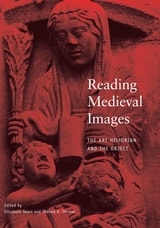
Reading Medieval Images
The Art Historian and the ObjectElizabeth Sears and Thelma K. Thomas, Editors
University of Michigan Press, 2002
What kind of language do they use to descibe what they see? How do they construct arguments using visual evidence? What sorts of arguments do they make? In this unusual anthology, eighteen prominent art historians specializing in the medieval field (European, Byzantine, and Islamic) provide answers to these fundamental questions, not directly but by way of example. Each author, responding to invitation, has chosen for study a single image or object and has submitted it to sustained analysis. The collection of essays, accompanied by statements on methodology by the editors, offers an accessible introduction to current art-historical practice.
Thelma K. Thomas is Associate Professor of the History of Art and Associate Curator of the Kelsey Museum, University of Michigan.
Reading Medieval Latin with the Legend of Barlaam and Josaphat
Donka D. Markus
University of Michigan Press, 2018
In Reading Medieval Latin with the Legend of Barlaam and Josaphat, Donka D. Markus offers comprehensive commentary on the 13th-century Dominican theologian Jacobus de Voragine’s retelling of the ancient story of the life of the Buddha that will resonate with contemporary students of Latin.
Jacobus’s version of the legend serves as a compelling, original Latin text. Vividly conveyed through parables, fables, and anecdotes, it naturally lends itself to a critical consideration of ethical principles and philosophical truths commonly shared across many cultures. With its rich stylistic devices and authentic classical Latin word order, it provides superb training for reading rhetorical prose before advancing to the works of more complex classical prose authors. At the same time, the text offers a unique opportunity for systematically learning the special features of Late and Medieval Latin. Included in this volume are two presentations of Jacobus’s text: one maintaining the original orthography reflecting Latin as it appears in medieval manuscripts, and one in which the orthography follows Classical Latin norms.
This textbook is designed for intermediate-level learners of Classical or Medieval Latin, whether in college, high school, or by self-directed study. The 5,000-word narrative text lends itself to a semester-long experience of reading one continuous work of prose. Each of the legend’s embedded stories can also be read as an independent selection with the help of the ample commentary, vocabulary, and grammar guidance. The extensive introduction provides the necessary background to contextualize the legend in its Latin iteration and sufficient historical information to make the reading meaningful for those without prior knowledge of Buddhism or medieval history. Additionally, this work makes Latin attractive to students of diverse backgrounds, as it highlights the language’s important role in disseminating the universally shared cultural legacy of humanity.
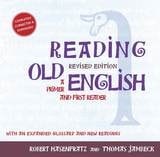
Reading Old English
A Primer and First Reader, Revised EditionROBERT HASENFRATZ
West Virginia University Press, 2010
With the immersion method dominating contemporary language learning, the knowledge of traditional grammar is at a low ebb, creating real barriers to any student wanting to learning dead or historical languages. This revised edition of Reading Old English aims to equip readers (advanced undergraduates, graduate students, and autodidacts) with the necessary tools to read the oldest recorded forms of the English language by explaining key language features clearly and methodically, without simplifying any of the core grammatical concepts. It includes a number of helpful exercises, a variety of interesting and unusual Old English texts to translate, as well as appendices covering the basics of traditional grammar and sound changes in Old English, along with an introduction to poetic structure.
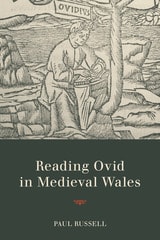
Reading Ovid in Medieval Wales
Paul Russell
The Ohio State University Press, 2017
Russell argues that this annotated version of the Ars amatoria arose out of the teaching traditions of the Carolingian world and that the annotation, as we have it, was the product of a cumulative process of glossing and commenting on the text. He then surveys other glossed Ovid manuscripts to demonstrate how that accumulation was built up. Russell also explores the fascinating issue of why Ovid’s love poetry should be used to teach Latin verse in monastic contexts. Finally, he discusses the connection between this manuscript and the numerous references to Ovid in later Welsh poetry, suggesting that the Ovidian references should perhaps be taken to refer to love poetry more generically.
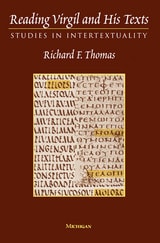
Reading Virgil and His Texts
Studies in IntertextualityRichard F. Thomas
University of Michigan Press, 2000
The articles and notes included in this volume have been selected for their diachronic aspect in addition to the synchronic status they had in their original context. Dealing with the intricate ways in which Virgil, and in the introductory chapter his predecessor Catullus, manipulated and appropriated their inherited Greek and Roman literary tradition, this book presents a coherent profile, through these detailed studies, of the mechanics of one of the most dynamic periods in the literary history of any culture.
Richard Thomas--one of the most important voices in Latin literary studies today--shows little anxiety about objections to authorial intentionality. Throughout there is a working assumption that intertextual connections can be established and, further, that functions and purposes, even intended ones, may be inferred from those connections.
This book will be of interest to scholars and students of Greek and Latin literature but will also be of great value to students of medieval, Renaissance, and early modern vernacular literatures, most of whose poets see themselves as closely connected to Virgil.
Richard F. Thomas is Professor of Greek and Latin, Harvard University.
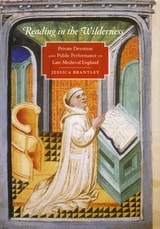
Reading in the Wilderness
Private Devotion and Public Performance in Late Medieval EnglandJessica Brantley
University of Chicago Press, 2007
Drawing on the work of W. J. T. Mitchell, Michael Camille, and others working at the image-text crossroads, Reading in the Wilderness addresses the manuscript’s texts and illustrations to examine connections between reading and performance within the solitary monk’s cell and also outside. Brantley reimagines the medieval codex as a site where the meanings of images and words are performed, both publicly and privately, in the act of reading.
Reading the World
Encyclopedic Writing in the Scholastic AgeMary Franklin-Brown
University of Chicago Press, 2012
Reason, Revelation, and Metaphysics
Montague Brown
Catholic University of America Press, 2021
Reclaiming Catherine of Siena
Literacy, Literature, and the Signs of OthersJane Tylus
University of Chicago Press, 2009
Jane Tylus charts here the contested struggles of scholars over the centuries to situate Catherine in the history of Italian culture in early modernity. But she mainly focuses on Catherine’s works, calling attention to the interplay between orality and textuality in the letters and demonstrating why it was so important for Catherine to envision herself as a writer. Tylus argues for a reevalution of Catherine as not just a medieval saint, but one of the major figures at the birth of the Italian literary canon.
Reinterpreting Galileo
William A. Wallace
Catholic University of America Press, 2018
Rereading the Black Legend
The Discourses of Religious and Racial Difference in the Renaissance EmpiresEdited by Margaret R. Greer, Walter D. Mignolo, and Maureen Quilligan
University of Chicago Press, 2008
A distinguished group of contributors here examine early modern imperialisms including the Ottomans in Eastern Europe, the Portuguese in East India, and the cases of Mughal India and China, to historicize the charge of unique Spanish brutality in encounters with indigenous peoples during the Age of Exploration. The geographic reach and linguistic breadth of this ambitious collection will make it a valuable resource for any discussion of race, national identity, and religious belief in the European Renaissance.
Rereading the Renaissance
Petrarch, Augustine, and the Language of HumanismCarol Everhart Quillen
University of Michigan Press, 1998
Carol Quillen argues that the essential role of Augustine's words and authority in the expression of Petrarch's humanism is best grasped through a study of the complex textual practices exemplified in the writings of both men. Petrarch's reliance on Augustine is most evident in his ways of reading and in his strategies of argument. Secondly, she maintains that Petrarch's appropriation of Augustine's words is only intelligible in light of his struggle to legitimate his cultural ideals in the face of compelling opposition. Finally, Quillen shows how Petrarch's uses of Augustine can simultaneously uphold his humanist ideals and challenge the legitimacy of the assumptions on which those ideals were founded.
Interdisciplinary in scope and method, this volume speaks to important debates that span the humanities. Scholars of literary and historical studies, as well as those in the fields of classical studies, patristics, and comparative literature, will find in Rereading the Renaissance a solid contribution to their interests.
Carol Everhart Quillen is Associate Professor of History, Rice University.
Restoring Nature
Essays Thomistic Philosophy & TheologyMichael M. Waddell
St. Augustine's Press, 2023
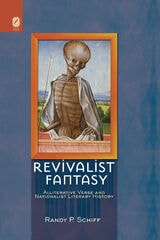
Revivalist Fantasy
Alliterative Verse and Nationalist Literary HistoryRandy P. Schiff
The Ohio State University Press, 2011
Schiff revises readings of alliterative poetry as Francophobic, exploring the transnational imperialist elitism in the translation William of Palerne. He contributes to the discussion of gender in Sir Gawain and the Green Knight by linking the poem’s powerful female players with anxieties about women’s control of wealth and property in militarized regions of England. The book also explores the emphatically pre-national, borderlands sensibilities informing the Awntyrs off Arthure and Golagros and Gawane, and it examines the exploitation of collaborative composition in the material legacy of the Piers Plowman tradition.
Revivalist Fantasy concludes that Revivalist nationalism obscures crucial continuities between late-medieval and post-national worlds and that critics’ interests should be channeled into the forging of connections between past and present rather than suspended in the scholarly pursuit of origins. The book will be of interest to scholars of editorial history and translation studies and to those interested in manuscript studies.
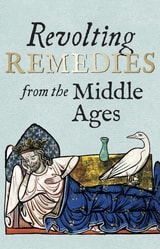
Revolting Remedies from the Middle Ages
Edited by Daniel Wakelin and compiled by students of the University of Oxford
Bodleian Library Publishing, 2017
In late medieval England, ordinary people, apothecaries, and physicians gathered up practical medical tips for everyday use. While some were sensible herbal cures, many were weird and wildly inventive, prescribing elixirs and regimens for problems like how to make a woman love you and how to stop dogs from barking at you. The would-be doctors seemed oblivious to pain, and would recommend any animal, vegetable, or mineral, let alone bodily fluid, be ground up, smeared on, or inserted for medical benefit. Full of embarrassing ailments, painful procedures, icky ingredients, and bizarre beliefs, this book selects some of the most revolting and remarkable remedies from medieval manuscripts in the Bodleian Library. Written in the down-to-earth speech of the time, these remedies offer humorous insight into the strange ideas, ingenuity, and bravery of men and women in the Middle Ages, and a glimpse of the often gruesome history of medicine through time.
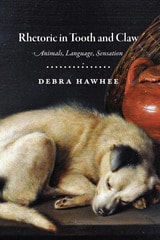
Rhetoric in Tooth and Claw
Animals, Language, SensationDebra Hawhee
University of Chicago Press, 2017
Yet when you look at ancient and early modern treatises on rhetoric, what you find is surprising: they’re crawling with animals. With Rhetoric in Tooth and Claw, Debra Hawhee explores this unexpected aspect of early thinking about rhetoric, going on from there to examine the enduring presence of nonhuman animals in rhetorical theory and education. In doing so, she not only offers a counter-history of rhetoric but also brings rhetorical studies into dialogue with animal studies, one of the most vibrant areas of interest in humanities today. By removing humanity and human reason from the center of our study of argument, Hawhee frees up space to study and emphasize other crucial components of communication, like energy, bodies, and sensation.
Drawing on thinkers from Aristotle to Erasmus, Rhetoric in Tooth and Claw tells a new story of the discipline’s history and development, one animated by the energy, force, liveliness, and diversity of our relationships with our “partners in feeling,” other animals.

Robert of Arbrissel
A Medieval Religious LifeBruce L. Venarde
Catholic University of America Press, 2003
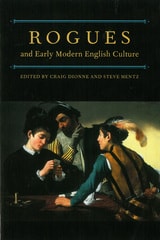
Rogues and Early Modern English Culture
Craig Dionne and Steve Mentz, Editors
University of Michigan Press, 2004
-Jonathan Dollimore, York University
"Rogues and Early Modern English Culture is an up-to-date and suggestive collection on a subject that all scholars of the early modern period have encountered but few have studied in the range and depth represented here."
-Lawrence Manley, Yale University
"A model of cross-disciplinary exchange, Rogues and Early Modern English Culture foregrounds the figure of the rogue in a nexus of early modern cultural inscriptions that reveals the provocation a seemingly marginal figure offers to authorities and various forms of authoritative understanding, then and now. The new and recent work gathered here is an exciting contribution to early modern studies, for both scholars and students."
-Alexandra W. Halasz, Dartmouth College
Rogues and Early Modern English Culture is a definitive collection of critical essays on the literary and cultural impact of the early modern rogue. Under various names-rogues, vagrants, molls, doxies, vagabonds, cony-catchers, masterless men, caterpillars of the commonwealth-this group of marginal figures, poor men and women with no clear social place or identity, exploded onto the scene in sixteenth-century English history and culture. Early modern representations of the rogue or moll in pamphlets, plays, poems, ballads, historical records, and the infamous Tudor Poor Laws treated these characters as harbingers of emerging social, economic, and cultural changes.
Images of the early modern rogue reflected historical developments but also created cultural icons for mobility, change, and social adaptation. The underclass rogue in many ways inverts the familiar image of the self-fashioned gentleman, traditionally seen as the literary focus and exemplar of the age, but the two characters have more in common than courtiers or humanists would have admitted. Both relied on linguistic prowess and social dexterity to manage their careers, whether exploiting the politics of privilege at court or surviving by their wits on urban streets.
Deftly edited by Craig Dionne and Steve Mentz, this anthology features essays from prominent and emerging critics in the field of Renaissance studies and promises to attract considerable attention from a broad range of readers and scholars in literary studies and social history.
Roman Propertius and the Reinvention of Elegy
Jeri Blair DeBrohun
University of Michigan Press, 2003
DeBrohun finds the most striking element of Book 4 to be the apparent polarity of the poems, whose themes are split between new, aetiological subjects of Roman national significance and amatory affairs that evoke the themes of Propertius' first three books. In her compelling reassessment of Propertius' aspirations in Book 4, DeBrohun identifies the conflict between his new ambitions to produce Roman aetiological elegy and his traditional, exclusive devotion to erotic concerns as the central dynamic of his collection. Roman Propertius and the Reinvention of Elegy reveals how the poet came to find in the subcodes of the elegiac genre a medium of interaction between the opposing values of the two themes.
Roman Propertius will interest not only scholars and students of Greek and Roman Poetry but also students of later traditions who are interested in the questions of genre and the relationship between poetry and wider cultural discourses.
Jeri Blair DeBrohun is Associate Professor of Classics, Brown University.
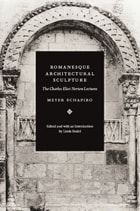
Romanesque Architectural Sculpture
The Charles Eliot Norton LecturesMeyer Schapiro
University of Chicago Press, 2006
Meyer Schapiro (1904-96), renowned for his critical essays on nineteenth- and twentieth-century painting, also played a decisive role as a young scholar in defining the style of art and architecture known as Romanesque. And, appropriately, when he was invited to deliver the prestigious Charles Eliot Norton Lectures at Harvard, he chose Romanesque architectural sculpture as his topic. These lectures, acclaimed for the verve and freshness with which Schapiro delivered them, languished unpublished for decades. But Linda Seidel, who knew Schapiro well and attended the 1967 lectures, has now expertly transcribed and edited them, presenting them for the first time to an audience beyond the halls of Harvard.
In editing the lectures, Seidel closely followed the recordings of the originals. Sentences are rendered as Schapiro spoke them, affording readers a unique opportunity to experience the legendary teacher as he rarely appears in print: forming his thoughts spontaneously, interrupting himself to develop related ideas, and responding to the audience’s interests by introducing humorous asides. Nonetheless, these lectures are carefully constructed, demonstrating Schapiro’s commitment to the originality and value of artistic production and affirming his lifelong belief in artists’ engagement with their cultures. Amply illustrated with many key works and augmented with Seidel’s indispensable introduction, this long-awaited volume will delight students and scholars of art history, as well as anyone interested in seeing a new side of a profoundly influential mind.
Romans in a New World
Classical Models in Sixteenth-Century Spanish AmericaDavid A. Lupher
University of Michigan Press, 2006
In the course of this debate, many Spaniards were inspired to think more deeply on their own ethnic ancestry and identity, as Spanish treatment of the New World natives awakened the slumbering memory of Roman treatment of the Iberian tribes whom modern Spaniards were now embracing as their truest ancestors. At the same time, growing awareness of the cultural practices--especially the religious rituals--of the American natives framed a new perspective on both the pre-Christian ancestors of modern Europeans and even on the survival of "pagan" customs among modern Europeans themselves. In this incisive study, David A. Lupher addresses the increasingly debated question of the impact the discovery of the New World had upon Europeans' perceptions of their identity and place in history.
Romans in a New World holds much to interest both classicists and students of the history and culture of early modern Europe--especially, though not exclusively, historians of Spain. David A. Lupher's concern with the ideology of imperialism and colonization and with cross-cultural negotiations will be useful to students of cultural studies, as well.
David A. Lupher is Professor of Classics, University of Puget Sound.