Results by title
405 books match the query 'Natural history' and 13 start with r
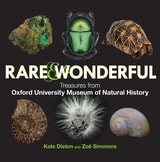
Rare and Wonderful
Treasures from the Oxford University Museum of Natural HistoryKate Diston and Zoë Simmons
Bodleian Library Publishing, 2018
This lavishly illustrated book features highlights from the collections, ranging from David Livingstone’s tsetse fly specimens to Mary Anning’s ichthyosaur, and from crabs collected by Darwin during his voyage on the Beagle to the iconic Dodo, the only soft tissue specimen of the species in existence. Also featured are the first described dinosaur bones, found in a small Oxfordshire village, the Red Lady of Paviland (who was in fact a man who lived 29,000 years ago), and a meteorite from the planet Mars.
Each item tells a unique story about natural history, the history of science, collecting, or the museum itself. Rare & Wonderful offers unique insight into the extraordinary wealth of information and fascinating tales that can be gleaned from these collections.
Reading The Trail
Exploring The Literature And Natural History Of The California CrestCorey Lee Lewis
University of Nevada Press, 2005
A provocative new way to read and interpret the classic works of John Muir, Mary Austin, and Gary Snyder, and to bring their ideas into the discussion of ecological values and the current environmental crisis. Lewis combines a perceptive discussion of their work and ideas with an engaging account of his own trail experiences as hiker/backpacker and volunteer trail builder, proposing that such a field-based, interdisciplinary approach to literary study and outdoors experience can enrich our appreciation for the work of nature writers.
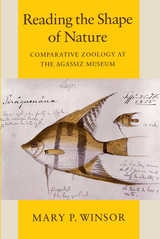
Reading the Shape of Nature
Comparative Zoology at the Agassiz MuseumMary P. Winsor
University of Chicago Press, 1991
In 1859, Louis Agassiz established the Museum of Comparative Zoology to house research on the ideal types that he believed were embodied in all living forms. Agassiz's vision arose from his insistence that the order inherent in the diversity of life reflected divine creation, not organic evolution. But the mortar of the new museum had scarcely dried when Darwin's Origin was published. By Louis Agassiz's death in 1873, even his former students, including his son Alexander, had defected to the evolutionist camp. Alexander, a self-made millionaire, succeeded his father as director and introduced a significantly different agenda for the museum.
To trace Louis and Alexander's arguments and the style of science they established at the museum, Winsor uses many fascinating examples that even zoologists may find unfamiliar. The locus of all this activity, the museum building itself, tells its own story through a wonderful series of archival photographs.
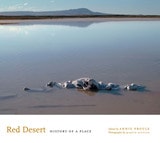
Red Desert
History of a PlaceEdited by Annie Proulx
University of Texas Press, 2008
Finalist, ForeWord Magazine Book of the Year Awards, Environment Category, 2008
A vast expanse of rock formations, sand dunes, and sagebrush in central and southwest Wyoming, the little-known Red Desert is one of the last undeveloped landscapes in the United States, as well as one of the most endangered. It is a last refuge for many species of wildlife. Sitting atop one of North America's largest untapped reservoirs of natural gas, the Red Desert is a magnet for energy producers who are damaging its complex and fragile ecosystem in a headlong race to open a new domestic source of energy and reap the profits.
To capture and preserve what makes the Red Desert both valuable and scientifically and historically interesting, writer Annie Proulx and photographer Martin Stupich enlisted a team of scientists and scholars to join them in exploring the Red Desert through many disciplines—geology, hydrology, paleontology, ornithology, zoology, entomology, botany, climatology, anthropology, archaeology, sociology, and history. Their essays reveal many fascinating, often previously unknown facts about the Red Desert—everything from the rich pocket habitats that support an amazing diversity of life to engrossing stories of the transcontinental migrations that began in prehistory and continue today on I-80, which bisects the Red Desert.
Complemented by Martin Stupich's photo-essay, which portrays both the beauty and the devastation that characterize the region today, Red Desert bears eloquent witness to a unique landscape in its final years as a wild place.

Reflections on the Neches
A Naturalist's Odyssey along the Big Thicket's Snow RiverGeraldine Ellis Watson
University of North Texas Press, 2003
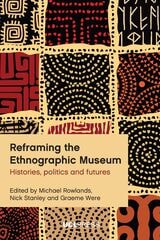
Reframing the Ethnographic Museum
Histories, Politics and FuturesEdited by Michael Rowlands, Nick Stanley, and Graeme Were
University College London, 2025
Ethnographic museums are at a crossroads; caught between colonial legacies, and the difficulties of captivating new audiences in a digital world. Reframing the Ethnographic Museum brings together leading scholars and curators to study the shifting role of these institutions in a rapidly changing cultural and political landscape. From Asia to Africa, the book explores how different museum strategies have grappled with decolonization and digital transformation, engaging in critical analysis and including case studies of innovative curatorial practices.
As museums confront calls for accountability and reconsider their collections, this volume provides a relevant exploration of the dilemmas and possibilities facing ethnographic display today. Reframing the Ethnographic Museum urges us to rethink how we engage with the past, and how museums can become spaces of dialogue and reflection.
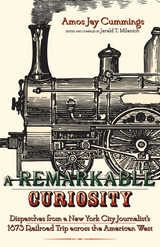
Remarkable Curiosity
Dispatches from a New York City Journalist's 1873 Railroad Trip across the American WestJerald T. Milanich
University Press of Colorado, 2008
Although today he is virtually unknown, during his lifetime Cummings was one of the most famous newspapermen in the United States, in part because of stories like these. Complete with a biographical sketch and historical introduction, A Remarkable Curiosity is an enjoyable read for anybody interested in the American West in the latter half of the nineteenth century.
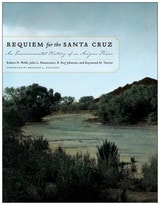
Requiem for the Santa Cruz
An Environmental History of an Arizona RiverRobert H. Webb, Julio L. Betancourt, R. Roy Johnson, and Raymond M. Turner; Foreword by Bernard L. Fontana
University of Arizona Press, 2014
Authored by an esteemed group of scientists, Requiem for the Santa Cruz thoroughly documents this river—the premier example of historic arroyo cutting during the late nineteenth and early twentieth centuries, when large floodflows cut down through unconsolidated valley fill to form deep channels in the major valleys of the American Southwest. Each chapter provides a unique opportunity to chronicle the arroyo legacy, evaluate its causes, and consider its aftermath. Using more than a collective century of observations and collections, the authors reconstruct the circumstances of the river’s entrenchment and the groundwater mining that ultimately killed the marshlands, a veritable mesquite forest, and a birdwatcher's paradise.
Today, communities everywhere face this conundrum: do we manage ephemeral rivers through urban areas for flood control, or do we attempt to restore them to some previous state of perennial naturalness? Requiem for the Santa Cruz carefully explores the legacies of channel change, groundwater depletion, flood control, and nascent attempts at river restoration to give a long-term perspective on management of rivers in arid lands. Tied together by authors who have committed their life’s work to the study of aridland rivers, this book offers a touching and scientifically grounded requiem for the Santa Cruz and every southwestern river.
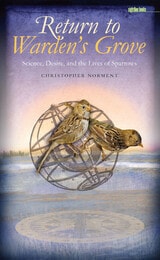
Return to Warden's Grove
Science, Desire, and the Lives of SparrowsChristopher Norment
University of Iowa Press, 2008
Based on three seasons of field research in the Canadian Arctic, Christopher Norment's exquisitely crafted meditation on science and nature, wildness and civilization, is marked by bottomless prose, reflection on timeless questions, and keen observations of the world and our place in it. In an era increasingly marked by cutting-edge research at the cellular and molecular level, what is the role for scientists of sympathetic observation? What can patient waiting tell us about ourselves and our place in the world?
His family at home in the American Midwest, Norment spends months on end living in isolation in the Northwest Territories, studying the ecology of the Harris's Sparrow. Although the fourteenth-century German mystic Meister Eckhardt wrote, "God is at home, we are in the far country," Norment argues that an intellectual, emotional, and spiritual "far country" can be found in the lives of animals and arctic wilderness. For Norment, "doing science" can lead to an enriched aesthetic and emotional connection to something beyond the self and a way to develop a sacred sense of place in a world that feels increasingly less welcoming, certain, and familiar.
Robert Frost and the Challenge of Darwin
Robert Faggen
University of Michigan Press, 2001
Combining both intellectual history and detailed analysis of Frost's poems, Robert Faggen shows how Frost's reading of Darwin reflected the significance of science in American culture from Emerson and Thoreau, through James and pragmatism. He provides fresh and provocative readings of many of Frost's shorter lyrics and longer pastoral narratives as they illustrate the impact of Darwinian thought on the concept of nature, with particular exploration of man's relationship to other creatures, the conditions of human equality and racial conflict, the impact of gender and sexual differences, and the survival of religion.
The book shows that Frost was neither a pessimist lamenting the uncertainties of the Darwinian worldview, nor a humanist opposing its power. Faggen draws on Frost's unpublished notebooks to reveal a complex thinker who willingly engaged with the difficult moral and epistemological implications of natural science, and showed their consonance with myths and traditions stretching back to Milton, Lucretius, and the Old Testament. Frost emerges as a thinker for whom poetry was not only artistic expression, but also a forum for the trial of ideas and their impact on humanity.
Robert Frost and the Challenge of Darwin provides a deeper understanding not only of Frost and modern poetry, but of the meaning of Darwin in the modern world, the complex interrelations of literature and science, and the history of American thought.
"A forceful, appealing study of the Frost-Darwin relation, which has gone little noted by previous scholars, and a fresh explanation of Frost's ambivalent relation to modernism, which he scorned but also influenced" --William Howarth, Princeton University
Robert Faggen is Associate Professor of Literature, Claremont McKenna College and Adjunct Associate Professor, Claremont Graduate School.
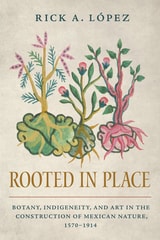
Rooted in Place
Botany, Indigeneity, and Art in the Construction of Mexican Nature, 1570–1914Rick A. López
University of Arizona Press, 2025
Prize for Best Book in Environmental Studies, Latin American Studies Association
Honorable mention for Best Book Prize in Visual Culture, Latin American Studies Association
Honorable mention for Best Book on Mexico, Latin American Studies Association
Since the first moment of conquest, colonizers and the colonized alike in Mexico confronted questions about what it meant to be from this place, what natural resources it offered, and who had the right to control those resources and on what basis.
Focusing on the ways people, environment, and policies have been affected by political boundaries, historian Rick A. López explores the historical connections between political identities and the natural world. López analyzes how scientific intellectuals laid claim to nature within Mexico, first on behalf of the Spanish Empire and then in the name of the republic, during three transformative moments: the Hernández expedition of the late sixteenth century; the Royal Botanical Expedition of the late eighteenth century; and the heyday of scientific societies such as the Sociedad Mexicana de Historia Natural of the late nineteenth century.
This work traces how scientific intellectuals studied and debated what it meant to know and claim the flora that sprang from Mexican soil—ranging from individual plants to forests and vegetated landscapes—and the importance they placed on indigeneity. It also points to the short- and long-term consequences of these efforts. López draws on archival and published sources produced from the sixteenth century through the start of the twentieth century and gives special attention to the use of visual images such as scientific illustrations and landscape art. López employs the term “visualization” in recognition of the degree to which officials, botanists, and draftsmen produced imagery and also how they and others viewed nature.
Rooted in Place reveals how scientific endeavors were not just about cataloging flora but were deeply intertwined with the construction of identity and the political landscape at three pivotal moments in Mexican history.
Rouge River Revived
How People Are Bringing Their River Back to LifeJohn H. Hartig and Jim Graham, Editors
University of Michigan Press, 2022
Rouge River Revived describes the river’s history from pre-European times into the 21st century. Chapters cover topics such as Native American life on the Rouge; indigenous flora and fauna over time; the river’s role in the founding of local cities; its key involvement in Detroit’s urban development and intensive industrialization; and the dramatic clean-up arising from citizen concern and activism. This book is not only a history of the environment of the Rouge River, but also of the complex and evolving relationship between humans and natural spaces.
Run, River, Run
A Naturalist's Journey Down One of the Great Rivers of the WestAnn Zwinger
University of Arizona Press, 1984