Results by title
4917 books match the query 'Philosophy' and 180 start with r
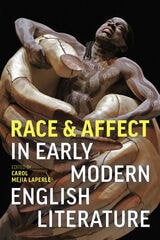
Race and Affect in Early Modern English Literature
Carole Mejia LaPerle
Arizona Center for Medieval and Renaissance Studies, 2021
Race and Affect in Early Modern English Literature puts the fields of critical race studies and affect theory into dialogue. Doing so opens a new set of questions: What are the emotional experiences of racial formation and racist ideologies? How do feelings—through the physical senses, emotional passions, or sexual encounters—come to signify race? What is the affective register of anti-blackness that pervades canonical literature? How can these visceral forms of racism be resisted in discourse and in practice? By investigating how race feels, this book offers new ways of reading and interpreting literary traditions, religious differences, gendered experiences, class hierarchies, sexuality, and social identities. So far scholars have shaped the discussion of race in the early modern period by focusing on topics such as genealogy, language, economics, religion, skin color, and ethnicity. This book, however, offers something new: it considers racializing processes as visceral, affective experiences.
Race and Mixed Race
Naomi Zack
Temple University Press, 1994
Race and State (CW2)
Eric Voegelin, Edited & Intro by Klaus Vondung, & Translated by Ruth Hein
University of Missouri Press, 0
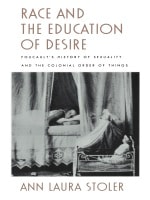
Race and the Education of Desire
Foucault's History of Sexuality and the Colonial Order of ThingsAnn Laura Stoler
Duke University Press, 1995
Drawing on Foucault’s little-known 1976 College de France lectures, Stoler addresses his treatment of the relationship between biopower, bourgeois sexuality, and what he identified as “racisms of the state.” In this critical and historically grounded analysis based on cultural theory and her own extensive research in Dutch and French colonial archives, Stoler suggests how Foucault’s insights have in the past constrained—and in the future may help shape—the ways we trace the genealogies of race.
Race and the Education of Desire will revise current notions of the connections between European and colonial historiography and between the European bourgeois order and the colonial treatment of sexuality. Arguing that a history of European nineteenth-century sexuality must also be a history of race, it will change the way we think about Foucault.
Race and the Rhetoric of Resistance
Jeffrey B. Ferguson
Rutgers University Press, 2021
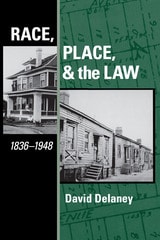
Race, Place, and the Law, 1836-1948
By David Delaney
University of Texas Press, 1998
Black and white Americans have occupied separate spaces since the days of "the big house" and "the quarters." But the segregation and racialization of American society was not a natural phenomenon that "just happened." The decisions, enacted into laws, that kept the races apart and restricted blacks to less desirable places sprang from legal reasoning which argued that segregated spaces were right, reasonable, and preferable to other arrangements.
In this book, David Delaney explores the historical intersections of race, place, and the law. Drawing on court cases spanning more than a century, he examines the moves and countermoves of attorneys and judges who participated in the geopolitics of slavery and emancipation; in the development of Jim Crow segregation, which effectively created apartheid laws in many cities; and in debates over the "doctrine of changed conditions," which challenged the legality of restrictive covenants and private contracts designed to exclude people of color from white neighborhoods. This historical investigation yields new insights into the patterns of segregation that persist in American society today.
Race, Rights, and Rifles
The Origins of the NRA and Contemporary Gun CultureAlexandra Filindra
University of Chicago Press, 2023
An eye-opening examination of the ties between American gun culture and white male supremacy from the American Revolution to today.
One-third of American adults—approximately 86 million people—own firearms. This is not just for protection or hunting. Although many associate gun-centric ideology with individualist and libertarian traditions in American political culture, Race, Rights, and Rifles shows that it rests on an equally old but different foundation. Instead, Alexandra Filindra shows that American gun culture can be traced back to the American Revolution when republican notions of civic duty were fused with a belief in white male supremacy and a commitment to maintaining racial and gender hierarchies.
Drawing on wide-ranging historical and contemporary evidence, Race, Rights, and Rifles traces how this ideology emerged during the Revolution and became embedded in America’s institutions, from state militias to the National Rifle Association (NRA). Utilizing original survey data, Filindra reveals how many White Americans —including those outside of the NRA’s direct orbit—embrace these beliefs, and as a result, they are more likely than other Americans to value gun rights over voting rights, embrace antidemocratic norms, and justify political violence.
Racism Postrace
Roopali Mukherjee, Sarah Banet-Weiser, and Herman Gray, editors
Duke University Press, 2019
Contributors. Inna Arzumanova, Sarah Banet-Weiser, Aymer Jean Christian, Kevin Fellezs, Roderick A. Ferguson, Herman Gray, Eva C. Hageman, Daniel Martinez HoSang, Victoria E. Johnson, Joseph Lowndes, Roopali Mukherjee, Safiya Umoja Noble, Radhika Parameswaran, Sarah T. Roberts, Catherine R. Squires, Brandi Thompson Summers, Karen Tongson, Cynthia A. Young

Radiation and Revolution
Sabu Kohso
Duke University Press, 2020
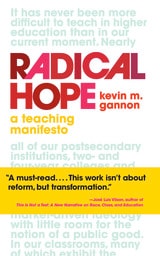
Radical Hope
A Teaching ManifestoKevin M. Gannon
West Virginia University Press, 2020
Higher education has seen better days. Harsh budget cuts, the precarious nature of employment in college teaching, and political hostility to the entire enterprise of education have made for an increasingly fraught landscape. Radical Hope is an ambitious response to this state of affairs, at once political and practical—the work of an activist, teacher, and public intellectual grappling with some of the most pressing topics at the intersection of higher education and social justice.
Kevin Gannon asks that the contemporary university’s manifold problems be approached as opportunities for critical engagement, arguing that, when done effectively, teaching is by definition emancipatory and hopeful. Considering individual pedagogical practice, the students who are the primary audience and beneficiaries of teaching, and the institutions and systems within which teaching occurs, Radical Hope surveys the field, tackling everything from impostor syndrome to cell phones in class to allegations of a campus “free speech crisis.” Throughout, Gannon translates ideals into tangible strategies and practices (including key takeaways at the conclusion of each chapter), with the goal of reclaiming teachers’ essential role in the discourse of higher education.

Radical Philosophy
Tradition, Counter-Tradition, PoliticsRoger Gottlieb
Temple University Press, 1993
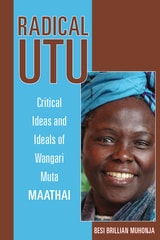
Radical Utu
Critical Ideas and Ideals of Wangari Muta MaathaiBesi Brillian Muhonja
Ohio University Press, 2020
Radicalization in Theory and Practice
Understanding Religious Violence in Western EuropeThierry Balzacq and Elyamine Settoul, Editors
University of Michigan Press, 2022
Radicalization is a major challenge of contemporary global security. It conjures up images of violent ideologies, “homegrown” terrorists and jihad in both the academic sphere and among security and defense experts. While the first instances of religious radicalization were initially limited to second-generation Muslim immigrants, significant changes are currently impacting this phenomenon. Technology is said to amplify the dissemination of radicalism, though there remains uncertainty as to the exact weight of technology on radical behaviors. Moreover, far from being restricted to young men of Muslim heritage suffering from a feeling of social relegation, radicalism concerns a significant number of converted Muslims, women and more heterogeneous profiles (social, academic and geographic), as well as individuals that give the appearance of being fully integrated in the host society. These new and striking dynamics require innovative conceptual lenses.
Radicalization in Theory and Practice identifies the mechanisms that explicitly link radical religious beliefs and radical actions. It describes its nature, singles out the mechanisms that enable radicalism to produce its effects, and develops a conceptual architecture to help scholars and policy-makers to address and evaluate radicalism—or what often passes as such. A variety of empirical chapters fed by first-hand data probe the relevance of theoretical perspectives that shape radicalization studies. By giving a prominent role to first-hand empirical investigations, the authors create a new framework of analysis from the ground up. This book enhances the quality of theorizing in this area, consolidates the quality of methodological enquiries, and articulates security studies insights with broader theoretical debates in different fields including sociology, social psychology, economics, and religious studies.

Radioactive Ghosts
Gabriele Schwab
University of Minnesota Press, 2020
A pioneering examination of nuclear trauma, the continuing and new nuclear peril, and the subjectivities they generate
Amid resurgent calls for widespread nuclear energy and “limited nuclear war,” the populations that must live with the consequences of these decisions are increasingly insecure. The nuclear peril combined with the looming threat of climate change means that we are seeing the formation of a new kind of subjectivity: humans who are in a position of perpetual ontological insecurity. In Radioactive Ghosts, Gabriele Schwab articulates a vision of these “nuclear subjectivities” that we all live with.
Focusing on the legacies of the Manhattan Project, Hiroshima, and nuclear energy politics, Radioactive Ghosts takes us on a tour of the little-seen sides of our nuclear world. Examining devastating uranium mining on Native lands, nuclear sacrifice zones, the catastrophic accidents at Chernobyl and Fukushima, and the formation of a new transspecies ethics, Schwab shows how individuals threatened with extinction are creating new adaptations, defenses, and communal spaces. Ranging from personal accounts of experiences with radiation to in-depth readings of literature, film, art, and scholarly works, Schwab gives us a complex, idiosyncratic, and personal analysis of one of the most overlooked issues of our time.
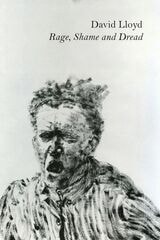
Rage, Shame and Dread
David Lloyd
Seagull Books, 2026
A radical rethinking of dark emotion as critical responses to capitalism, colonial violence, and authoritarian power.
Rage, Shame and Dread is a bold and unsettling exploration of three emotions that resist consolation, correction, or easy political use. In this triptych of essays, David Lloyd dwells with rage, shame, and dread not as states to be managed or redeemed, but as objectless, intransitive forces that interrupt social life and expose its underlying wrongness.
Reading rage as “sheer manifestation,” shame as a catastrophic rupture of self-relation, and dread as anticipation without an object, Lloyd traces how these unpromising emotions emerge from—and register—the violences of capitalism, colonialism, racialization, and authoritarian power. Drawing on Walter Benjamin, Sigmund Freud, Jacques Derrida, Frantz Fanon, Aimé Césaire, Joseph Conrad, Oscar Wilde, and Søren Kierkegaard, the book moves between philosophy, literature, and political theory to challenge therapeutic and liberal accounts that treat these feelings as errors to be corrected or tools for socialization.
Rather than pathologizing these states, Lloyd reads them as signals of damaged social relations and as thresholds to alternative forms of life-in-common. At once philosophically rigorous and politically urgent, Rage, Shame and Dread offers a radical rethinking of feeling as a site of critique, resistance, and collective possibility.
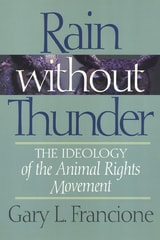
Rain Without Thunder
The Ideology of the Animal Rights MovementGary L. Francione
Temple University Press, 1996
Are "animal welfare" supporters indistinguishable from the animal exploiters they oppose? Do reformist measures reaffirm the underlying principles that make animal exploitation possible in the first place? In this provocative book, Gary L. Francione argues that the modern animal rights movement has become indistinguishable from a century-old concern with the welfare of animals that in no way prevents them from being exploited.
Francione maintains that advocating humane treatment of animals retains a sense of them as instrumental to human ends. When they are considered dispensable property, he says, they are left fundamentally without "rights." Until the seventies, Francione claims, this was the paradigm within which the Animal Rights Movement operated, as demonstrated by laws such as the Federal Humane Slaughter Act of 1958.
In this wide-ranging book, Francione takes the reader through the philosophical and intellectual debates surrounding animal welfare to make clear the difference between animal rights and animal welfare. Through case studies such as campaigns against animal shelters, animal laboratories, and the wearing of fur, Francione demonstrates the selectiveness and confusion inherent in reformist programs that target fur, for example, but leave wool and leather alone.
The solution to this dilemma, Francione argues, is not in a liberal position that espouses the humane treatment of animals, but in a more radical acceptance of the fundamental inalienability of animal rights.
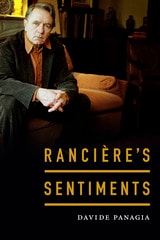
Rancière's Sentiments
Davide Panagia
Duke University Press, 2018
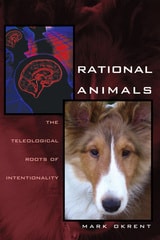
Rational Animals
The Teleological Roots of IntentionalityMark Okrent
Ohio University Press, 2007
Rational Animals: The Teleological Roots of Intentionality offers an original account of the intentionality of human mental states, such as beliefs and desires.
The account of intentionality in Rational Animals is broadly biological in its basis, emphasizing the continuity between human intentionality and the levels of intentionality that should be attributed to animal actions and states.
Establishing the goal-directed character of animal behavior, Mark Okrent argues that instrumentally rational action is a species of goal-directed behavior that is idiosyncratic to individual agents and is distinguished by its novelty and flexibility. He also argues that some nonlinguistic animals are capable of instrumental rationality and that in the first instance, the contents of beliefs and desires are individuated by the explanatory role of those states in rationxadally accounting for such instrumentally rational behavior.
The account of instrumental rationality offered in Rational Animals allows for understanding the practical rationality of linguistically competent human beings as a distinctive capacity of social animals capable of undertaking roles governed by socially sanctioned norms.
Rational Animals will be of interest to cognitive scientists, philosophers of mind, philosophers of biology, philosophers of action, ethologists, and those interested in the debates concerning animal intelligence.
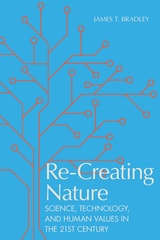
Re-Creating Nature
Science, Technology, and Human Values in the Twenty-First CenturyJames T. Bradley
University of Alabama Press, 2019
Many of the ethical issues raised by new technologies have not been widely examined, discussed, or indeed settled. For example, robotics technology challenges the notion of personhood. Should a robot, capable of making what humans would call ethical decisions, be held responsible for those decisions and the resultant actions? Should society reward and punish robots in the same way that it does humans? Likewise, issues of safety, environmental concerns, and distributive justice arise with the increasing acceptance of genetically modified organisms (GMOs) in food production nanotechnology in engineering and medicine, and human gene therapy and enhancement. The problem of dual-use—when a technology can be used both to benefit and to harm—exists with virtually all new technologies but is central in the context of emerging 21st century technologies ranging from artificial intelligence and robotics to human gene-editing and brain-computer interfacing.
In Re-Creating Nature: Science, Technology, and Human Values in the Twenty-First Century, James T. Bradley addresses emerging biotechnologies with prodigious potential to benefit humankind but that are also fraught with ethical consequences. Some actually possess the power to directly alter the evolution of life on earth including human. Specifically, these topics include stem cells, synthetic biology, GMOs in agriculture, nanotechnology, bioterrorism, CRISPR gene-editing technology, three-parent babies, robotics and roboethics, artificial intelligence, and human brain research and neurotechnologies.
Offering clear explanations of these various technologies, a pragmatic presentation of the conundrums involved, and questions that illuminate hypothetical situations, Bradley guides discussions of these and other thorny issues resulting from the development of new biotechnologies. He also highlights the responsibilities of scientists to conduct research in an ethical manner and the responsibilities of nonscientists to become “science literate” in the twenty-first century.
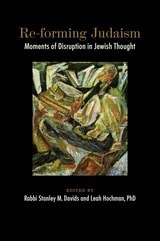
Re-forming Judaism
Moments of Disruption in Jewish ThoughtRabbi Stanley M. Davids and Leah Hochman, PhD
Central Conference of American Rabbis, 2023
Throughout Jewish history, revolutionary events and subversive ideas have burst forth, repeatedly transforming Jewish experience. Re-forming Judaism seeks to explore these ideas—and the individuals behind them—by delving into historical disruptions that led to lasting change in Jewish thought. A distinguished array of scholars take us on a journey from the disruptive prophets of ancient times, through rational, mystical, and extremist medievalists, to the impact of Haskalah and early Reform thought in modernity. Contemporary innovations such as changes in liturgy and music, feminism, and post-Holocaust theology are included, as are insights into Sephardic and North African experiences. By showing how Judaism forms—then re-forms, and re-forms again—the contributors demonstrate that tensions between continuity and change have always been part of Jewish life, helping us to both understand the past and contemplate the future.
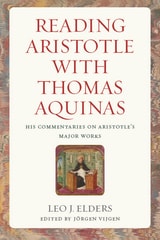
Reading Aristotle with Thomas Aquinas
His Commentaries on Aristotle's Major WorksLeo J. Elders
Catholic University of America Press, 2022
Reading Cusanus
Metaphor and Dialectic in a Conjectural UniverseClyde Lee Miller
Catholic University of America Press, 2019
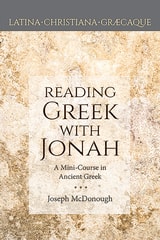
Reading Greek with Jonah
A Mini-Course in Ancient GreekJames McDonough
Catholic University of America Press, 2026
Reading Hegel
Irony, Recollection, CritiqueRobert Lucas Scott
University of Chicago Press, 2025
The relationship between Hegel and literary theory has for a long time been both contested and paradoxical. On the one hand, “theory” is often skeptical of all that Hegel ostensibly stood for: idealism, systematicity, and identity at the expense of difference. Yet, in spite of itself, literary theory is taken to owe a profound debt to Hegel’s philosophy. Robert Lucas Scott’s book complicates this account and argues that literary theory has made the mistake of abstracting Hegel’s thought from its more dynamic presentation in Hegel’s writings, reducing “Hegel” to a series of propositions or positions. Literary theory, Scott argues, misses what is perhaps the greatest innovation of Hegel’s philosophy: a presentation of experience that begins precisely by setting aside all preconceptions or prior assumptions. It is on this point that Hegel’s philosophy itself approaches literature: its content cannot be simply abstracted from the singular experience of reading it. Only through a mode of reading alive to speculative experience can literary theory become truly Hegelian. Scott’s exposition of Hegel offers a model of reading with relevance beyond philosophy: one that is critical without pretensions of mastery and detachment and that honors the singularity of the reading experience without succumbing to the subjectivism of the “postcritical.”
The book also includes engagements with the work of Luther, Kant, Marx, Gillian Rose, Fredric Jameson, Robert Brandom, Catherine Malabou, and more in its recovery of Hegel’s thought for a critical understanding of our time.
Reading Jean-Jacques Rousseau through the Prism of Chess
Florian Vauléon
University of Michigan Press, 2019
Over a period of forty years, Rousseau combined his devotion to writing with his enthusiasm for chess, and these two passions necessarily intertwined. Rousseau was able to transfer his power of concentration and the strict dialectics of his literary writings to his chess strategy. If Rousseau’s analytical skills influenced his attitude toward the game, then the game of chess inspired his logic and affected his discourse. Interpreted as a form of rationality, as a conceptual paradigm, the rules and strategies of chess accurately describe Rousseau’s ideas for social management, political power, and organization. Reading Jean-Jacques Rousseau through the Prism of Chess shows that Rousseau’s political theory, though allegedly inspired by Nature, found a perfect model in a game created by mankind; chess thus became a reference for his philosophical discourse and practice as well as a method to systematize Nature and organize society.
Reading Job with St. Thomas Aquinas
Matthew Levering
Catholic University of America Press, 2020
Reading Leo Strauss
Politics, Philosophy, JudaismSteven B. Smith
University of Chicago Press, 2006
Smith asserts that this philosophical skepticism defined Strauss’s thought. It was as a skeptic, Smith argues, that Strauss considered the seemingly irreconcilable conflict between reason and revelation—a conflict Strauss dubbed the “theologico-political problem.” Calling this problem “the theme of my investigations,” Strauss asked the same fundamental question throughout his life: what is the relation of the political order to revelation in general and Judaism in particular? Smith organizes his book with this question, first addressing Strauss’s views on religion and then examining his thought on philosophical and political issues.
In his investigation of these philosophical and political issues, Smith assesses Strauss’s attempt to direct the teaching of political science away from the examination of mass behavior and interest group politics and toward the study of the philosophical principles on which politics are based. With his provocative, lucid essays, Smith goes a long way toward establishing a distinctive form of Straussian liberalism.
Reading Marx
On Transcendental MaterialismReiner Schürmann
Diaphanes, 2020
Reading Nietzsche
Mazzino Montinari
University of Illinois Press, 1982
In Reading Nietzsche Montinari tackles such subjects as the relationship between Nietzsche and Wagner, early drafts of Thus Spoke Zarathustra, and the philosopher’s reputation among the Nazis and Marxists of the 1930s and 1940s. He also deals authoritatively with a number of figures who have had an unfortunate influence upon the way Nietzsche has been understood, from the chief Nazi interpreter of Nietzsche, Alfred Bäumler, to the chief Marxist interpreter, Georg Lukàcs, to Nietzsche’s sister, Elisabeth.

Reading North by South
On Latin American Literature, Culture, and PoliticsNeil Larsen
University of Minnesota Press, 1995
Reading North by South was first published in 1995. Minnesota Archive Editions uses digital technology to make long-unavailable books once again accessible, and are published unaltered from the original University of Minnesota Press editions.
Neil Larsen is concerned with misleading interpretations of literature and culture that dominate Latin American studies in North America. In Reading North by South he attempts to correct the distorted views that have prevailed by proposing the need for a freshly conceived historical materialist approach to Latin American texts and cultural practices.
Reading North by South opens with reflections on how North America has read Latin America since the advent of popular fiction from authors like Cortázar and García Márquez. Larsen argues that the North American academy tends to interpret Latin American texts through a postmodern lens of cultural politics that ignores historical realism, and he contends that more attention needs to be paid to historical and class issues. He provides insightful commentaries on political discourses, cultural events, films, and literary texts, and maintains that the canonization of the modernist aesthetic in the United States has resulted in a marginalization of writers and writing that reflect the historical realities of Latin American politics.
As it analyzes important points of debate within and outside of Latin American studies, Reading North by South draws upon a wide diversity of texts written in Portuguese, Spanish and English. Of particular interest is Larsen's discussion of writings from the Caribbean, an area that is not frequently included in Latin American studies. Reading North by South will lead readers to question the expectations and preconceptions that inform their readings of Latin American literature.
Neil Larsen is associate professor of Spanish and Latin American literature at Northeastern University. He is the author of Modernism and Hegemony: A Materialist Critique of Aesthetic Agencies (Minnesota, 1990), and editor of The Discourse of Power: Culture, Hegemony, and the Authoritarian State in Latin America (1983).
Reading Ronell
Edited by Diane Davis
University of Illinois Press, 2008
Avital Ronell has won worldwide acclaim for her work across literature and philosophy, psychoanalysis and popular culture, political theory and feminism, art and rhetoric, drugs and deconstruction. In works such as The Test Drive, Stupidity, Crack Wars, and The Telephone Book, she has perpetually raised new and powerful questions about how we think, what thinking does, and how we fool ourselves about the troubled space between thought and action.
In this collection, some of today's most distinguished and innovative thinkers turn their attention to Ronell's teaching, writing, and provocations, observing how Ronell reads and what comes from reading her. By reading Ronell, and reading Ronell reading, contributors examine the ethico-political implications of her radical dislocations and carefully explicate, extend, and explore the paraconcepts addressed in her works.
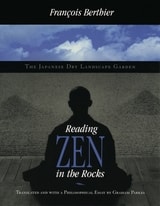
Reading Zen in the Rocks
The Japanese Dry Landscape GardenFrançois Berthier
University of Chicago Press, 2005
Berthier's guided tour of the famous garden of Ryoanji (Temple) in Kyoto leads him into an exposition of the genre, focusing on its Chinese antecedents and affiliations with Taoist ideas and Chinese landscape painting. He traces the roles of Shinto and Zen Buddhism in the evolution of the garden and also considers how manual laborers from the lowest classes in Japan had a hand in creating some of its highest examples. Parkes contributes an equally original and substantive essay which delves into the philosophical importance of rocks and their "language of stone," delineating the difference between Chinese and Japanese rock gardens and their relationship to Buddhism. Together, the two essays compose one of the most comprehensive and elegantly written studies of this haunting garden form.
Reading Zen in the Rocks is fully illustrated with photographs of all the major gardens discussed, making it a handsome addition to the library of anyone interested in gardening, Eastern philosophy, and the combination of the two that the karesansui so superbly represents.
Praise for the French edition:
"A small book of rare depth, remarkably illustrated, on one of the most celebrated and beautiful rock gardens of the monasteries of Kyoto."—L'Humanité
"Through Le Jardin de Ryoanji, Berthier teaches us to read the zen in the rocks, to discover the language offered by the garden at Ryoanji. Enigmatic, poetic, and disconcerting, an enriching journey through a work of art of surprising modernity, Le Jardin de Ryoanji is a work that will interest all the amateurs of Japanese art and Eastern philosophy."—Lien Horticole
Reading the Figural, or, Philosophy after the New Media
D. N. Rodowick
Duke University Press, 2001
To fully comprehend the emergence of the figural requires a genealogical critique of the aesthetic, Rodowick claims. Seeking allies in this effort to deconstruct the opposition of word and image and to create new concepts for comprehending the figural, he journeys through a range of philosophical writings: Thierry Kuntzel and Marie-Claire Ropars-Wuilleumier on film theory; Jacques Derrida on the deconstruction of the aesthetic; Siegfried Kracauer and Walter Benjamin on the historical image as a utopian force in photography and film; and Gilles Deleuze and Michel Foucault on the emergence of the figural as both a semiotic regime and a new stratagem of power coincident with the appearance of digital phenomena and of societies of control.
Scholars of philosophy, film theory, cultural criticism, new media, and art history will be interested in the original and sophisticated insights found in this book.
Reading with the Transcendentalists
Ten Works that Made a MovementPhilip F. Gura
University of Massachusetts Press, 2026
Exploring the books and reading practices behind the creation of Transcendentalist philosophy and community
Transcendentalism emerged in early 19th century New England as a uniquely American philosophical, spiritual, and literary movement. Its first generation of thinkers—including Ralph Waldo Emerson, Theodore Parker, and Margaret Fuller—created a worldview that stressed the inherent goodness of the “self-reliant” individual and the presence of the divine in nature. These intellectuals gathered in informal symposia devoted to what Emerson called “creative reading,” a practice that stresses the transformative potential of the written word that was central to the movement’s emergence, growth, and spread. But what were these thinkers reading and how did it influence the development of Transcendentalism?
In Reading with the Transcendentalists, renowned literary scholar Philip F. Gura focuses on 10 American, British, and European books that were essential to the movement’s thoughts, writings, and activities. Many of the authors of these books—James Marsh, Madame de Staël, Samson Reed, George Ripley, Thomas Carlyle, Albert Brisbane, and George Sand—stood outside of Transcendentalism yet profoundly influenced it. Others such as Emerson, Parker, and Fuller were the movement’s central architects, whose writings in turn inspired the next generation, including Henry David Thoreau and Caroline Healey Dall. Each of these books challenged prevailing religious, philosophical, and social conventions in ways that resonated deeply with burgeoning Transcendentalist ideals.
Blending intellectual biography with book history, Gura crafts a captivating cultural history that reconstructs the dynamic social networks of the early Transcendentalists, in which ideas from the written word circulated, evolved, and acquired new meanings. The result is an rich portrait of reading as a creative and communal act, and an exploration of how books ignite curiosity, sustain friendship, and catalyze intellectual transformation. Through a carefully developed narrative structure that is filled not only with books and reading but with headline-worthy scandals, disputes, and falling outs and realignments, Gura traces the historical arc of a transnational intellectual movement that helped lay the foundation for the idea of “America.”
Readings in Interpretation
Holderlin, Hegel, HeideggerAndrzej WarminskiIntroduction by Rodolphe Gasche
University of Minnesota Press, 1987
Readings in Interpretation was first published in 1987. Minnesota Archive Editions uses digital technology to make long-unavailable books once again accessible, and are published unaltered from the original University of Minnesota Press editions.
Readings in Interpretation — a volume primarily on the texts of Holderlin, Hegel, and their interpreter Heidegger—locates itself strategically between literature and philosophy. In keeping with this juxtaposition, it treats the question of self-consciousness and reflection on the levels of "theme" and "text." For both Hegel and Holderlin, selfconsciousness and its relation to knowing are explicit themes, but Waminski's readings show that a more disruptive reflection is operative on the level of text.
In an argument that centers on the textual aspects of Hegel's Phenomenology of the Spirit,Warminski demonstrates that the negative moment—which is often interpreted as a prelude to a unified self-consciousness—cannot be accounted for by interpretive models drawn from outside the text—by concepts like the self, consciousness, or the subject. Instead, a completely different practice and theory is necessary. The author's "Prefatory Postscript" at the beginning of the book therefore serves as an introduction to sketch the theoretical basis of the readings that follow and as a "postscript" that explains the difference between "reading" and "interpretation" which those readings make necessary.

Readings on Fascism and National Socialism
University of Colorado, Dept. of Philosophy
Ohio University Press, 1952
The catastrophe and holocaust brought about by the two powerful movements of fascism and national socialism will mark human life always. Now, as we feel our hatred for them, we find it difficult to understand how they could have been so powerful, how they could have appealed so strongly to millions of people of a modern age.
To understand our own times, it is necessary to understand these movements. And to understand them, we must read the basic philosophical and political documents which show the force of the ideas which moved a world to the brink of disaster.
This collection of readings has been selected to encourage students to clarify their thinking on social philosophy. They will accordingly need to determine whether the readings contain more or less coherent body of ideas which constitutes a social philosophy. They will also need to raise the more far-reaching question of whether the ideas are acceptable. To arrive at any satisfactory answer to this latter question, they will necessarily have to compare the ideas of fascism and their practical meanings with the alternatives, real and ideal, that are the substance of live philosophical issues.
Real American Ethics
Taking Responsibility for Our CountryAlbert Borgmann
University of Chicago Press, 2006
America is a wonderful and magnificent country that affords its citizens the broadest freedoms and the greatest prosperity in the world. But it also has its share of warts. It is embroiled in a war that many of its citizens consider unjust and even illegal. It continues to ravage the natural environment and ignore poverty both at home and abroad, and its culture is increasingly driven by materialism and consumerism. But America, for better or for worse, is still a nation that we have built. So why then, asks Albert Borgmann in this most timely and urgent work, are we failing to take responsibility for it?
In Real American Ethics, Borgmann asks us to reevaluate our role in the making of American values. Taking his cue from Winston Churchill—who once observed that we shape our buildings, and then our buildings shape us—Borgmann considers the power of our most enduring institutions and the condition of our present moral makeup to propose inspired new ways in which we, as ordinary citizens, can act to improve our country. This, he shows, includes everything from where we choose to live and what we spend our money on to daunting tasks like the reshaping of our cities—habits and actions that can guide us to more accomplished and virtuous lives. Using prose that is easy and direct throughout, Borgmann’s position is grounded neither by conservative nor liberal ideology, but in his understanding that he is a devoted citizen among many.
In an age in which the blame game is the only game in town, this patriotic book is an eloquent reminder of the political strength we all wield when we work together.
Real Presences
George Steiner
University of Chicago Press, 1989
In Real Presences, George Steiner, whom A. S. Byatt praised as "a late, late, late, late Renaissance man," addressed one of the most challenging and important questions about art and human understanding: Can there be major dimensions of a poem, a painting, a musical composition created in the absence of God? Or is God always a real presence in the arts? Drawing examples from across centuries and cultures, Steiner passionately argues that a transcendent reality grounds all genuine art and human communication.
Realism for the 21st Century
A John Deely ReaderJohn Deely
University of Scranton Press, 2009
Realism for the 21st Century is a collection of thirty essays from John Deely—a major figure in contemporary semiotics and an authority on scholastic realism and the works of Charles Sanders Peirce. The volume tracks Deely’s development as a pragmatic realist, featuring his early essays on our relation to the world after Darwinism; crucial articles on logic, semiotics, and objectivity; overviews of philosophy after modernity; and a new essay on “purely objective reality.”
Realism, Utopia, and the Mushroom Cloud
Four Activist Intellectuals and their Strategies for Peace, 1945-1989--Louise Weiss (France), Leo Szilard (USA), E. P. Thompson (England), Danilo Dolci (Italy)Michael Bess
University of Chicago Press, 1993
Nagasaki, and continued preparations for nuclear war illustrate the modern
world's propensity for mass destruction. . . . Yet there have been
important signs of resistance to this trend. These have included not only
the emergence of mass-based peace and disarmament movements but activist
intellectuals grappling with the growing problem posed by mass violence
among nation-states. . . . Bess examines the lives and ideas of four of
these intellectuals: Leo Szilard of Hungary and (later) the United States,
E. P. Thompson of England, Danilo Dolci of Italy, and Louise Weiss of
France. . . . Realism, Utopia, and the Mushroom Cloud is a powerful,
important scholarly work, casting new light upon some of the great issues
of modern times. Readers will learn much from it."—Lawrence S.
Wittner, Peace and Change
"Bess seeks to understand the way in which the creation of the atomic bomb
has changed the social and political situation of humankind. Are we to be
held hostage by military forces or can we transform our situation? He
describes the lives of four very different activists, each with different
views on what causes conflict and how best to address conflict. . . .
Overall, this book offers an interesting perspective on life after the
atomic bomb. . . . In asking ourselves what the possibilities of our future
are, we can turn to these lives for some guidance. . . . This book is
informative, provocative, and encourages one to consider carefully how s/he
chooses to live."—Erin McKenna, Utopian Studies
"These four lives, researched and skillfully presented by historian Michael
Bess, make fascinating stories in themselves. They also serve as useful
vehicles for examining major cross-currents of Cold War resistance. . . .
From Weiss the cynical pragmatist to Szilard the high-level fixer to
hompson the social reformer to Dolce the spiritual street organizer,
Michael Bess has woven an illuminating tapestry of human efforts to cope
with life under the mushroom cloud."—Samuel H. Day Jr., The
Progressive

Realist Magic
Objects, Ontology, CausalityTimothy Morton
Michigan Publishing Services, 2013
Reality Principles
From the Absurd to the VirtualHerbert Blau
University of Michigan Press, 2011
“Herbert Blau’s long sustained inquiry into theater’s most provocative questions—presence, liveness, and finitude—are, at their deepest level, queries into life. Reality Principles returns us to Blau’s inspiring provocations and extends them to new subjects—9/11 and Ground Zero, the nature of charisma, Pirandello and Strindberg.”
—Peggy Phelan, Stanford University
Reality Principles gathers recent essays by esteemed scholar and theater practitioner Herbert Blau covering a range of topics. The book’s provocative essays—including “The Emotional Memory of Directing,” “The Faith-Based Initiative of the Theater of the Absurd,” “Virtually Yours: Presence, Liveness, Lessness,” “The Human Nature of the Bot”—were given as keynotes and/or memorial lectures and are collected here for the first time. The essays take up a remarkable array of topics—from body art and the self-inflicted punishments of Stelarc, Orlan, and the Viennese Actionists, to Ground Zero and 9/11—and allow Blau to address critical questions of theater and theory, performance and relevance, the absurd and the virtual, history and illusion, community and memory. Reality Principles offers a panoramic view of Herbert Blau’s perspectives on life and the imitation of life on stage.
Reason Fulfilled by Revelation
The 1930s Christian Philosophy Debates in FranceGregory B. Sadler
Catholic University of America Press, 2011
Reason after Its Eclipse
On Late Critical TheoryMartin Jay
University of Wisconsin Press, 2017
After surveying Western ideas of reason from the ancient Greeks through Kant, Hegel, and Marx, Jay engages at length with the ways leading theorists of the Frankfurt School—Horkheimer, Marcuse, Adorno, and most extensively Habermas—sought to salvage a viable concept of reason after its apparent eclipse. They despaired, in particular, over the decay in the modern world of reason into mere instrumental rationality. When reason becomes a technical tool of calculation separated from the values and norms central to daily life, then choices become grounded not in careful thought but in emotion and will—a mode of thinking embraced by fascist movements in the twentieth century.
Is there a more robust idea of reason that can be defended as at once a philosophical concept, a ground of critique, and a norm for human emancipation? Jay explores at length the ommunicative rationality advocated by Habermas and considers the range of arguments, both pro and con, that have greeted his work.
Reason and Character
The Moral Foundations of Aristotelian Political PhilosophyLorraine Smith Pangle
University of Chicago Press, 2020
A close and selective commentary on Aristotle’s Nicomachean Ethics, offering a novel interpretation of Aristotle’s teachings on the relation between reason and moral virtue.
What does it mean to live a good life or a happy life, and what part does reason play in the quest for fulfillment? Lorraine Smith Pangle shows how Aristotle’s arguments for virtue as the core of happiness and for reason as the guide to virtue emerge in response to Socrates’s paradoxical claim that virtue is knowledge and vice is ignorance.
Against Socrates, Aristotle does justice to the effectual truth of moral responsibility—that our characters do indeed depend on our own voluntary actions. But he also incorporates Socratic insights into the close interconnection of passion and judgment and the way passions and bad habits work not to overcome knowledge that remains intact but to corrupt the knowledge one thinks one has. Reason and Character presents fresh interpretations of Aristotle’s teaching on the character of moral judgment and moral choice, on the way reason finds the mean—especially in justice—and on the relation between practical and theoretical wisdom.
Reason and Evidence in Husserl's Phenomenology
David Michael Kleinberg-Levin
Northwestern University Press, 1970
Reason and Morality
Alan Gewirth
University of Chicago Press, 1982
"This is a fascinating study of an apparently intractable problem. Gewirth has provided plenty of material for further discussion, and his theory deserves serious consideration. He is always aware of possible rejoinders and argues in a rigorous manner, showing a firm grasp of the current state of moral and political philosophy."—Mind
Reason, Revelation, and Metaphysics
Montague Brown
Catholic University of America Press, 2021
Reasoning with the Infinite
From the Closed World to the Mathematical UniverseMichel Blay
University of Chicago Press, 1998
"One of Michael Blay's many fine achievements in Reasoning with the Infinite is to make us realize how velocity, and later instantaneous velocity, came to play a vital part in the development of a rigorous mathematical science of motion."—Margaret Wertheim, New Scientist
Reasoning, Rationality and Probability
Edited by Maria Carla Galavotti, Roberto Scazzieri, and Patrick Suppes
CSLI, 2008