168 books match the query 'Poland' and 5 start with r
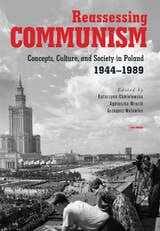
cover of Reassessing Communism: Concepts, Culture, and Society in Poland 1944–1989

Reassessing Communism

Concepts, Culture, and Society in Poland 1944–1989

Instytutem Badan Literackich PAN Chmielewska

Central European University Press, 2021

The thirteen authors of this collective work undertook to articulate matter-of-fact critiques of the dominant narrative about communism in Poland while offering new analyses of the concept, and also examining the manifestations of anticommunism. Approaching communist ideas and practices, programs and their implementations, as an inseparable whole, they examine the issues of emancipation, upward social mobility, and changes in the cultural canon.

The authors refuse to treat communism in Poland in simplistic categories of totalitarianism, absolute evil and Soviet colonization, and similarly refuse to equate communism and fascism. Nor do they adopt the neoliberal view of communism as a project doomed to failure. While wholly exempt from nostalgia, these essays show that beyond oppression and bad governance, communism was also a regime in which people pursued a variety of goals and sincerely attempted to build a better world for themselves.

The book is interdisciplinary and applies the tools of social history, intellectual history, political philosophy, anthropology, literature, cultural studies, and gender studies to provide a nuanced view of the communist regimes in east-central Europe.
[more]
cover of Rebellious Civil Society: Popular Protest and Democratic Consolidation in Poland, 1989-1993

Rebellious Civil Society

Popular Protest and Democratic Consolidation in Poland, 1989-1993

Grzegorz Ekiert and Jan Kubik

University of Michigan Press, 2001
Poland is the only country in which popular protest and mass opposition, epitomized by the Solidarity movement, played a significant role in bringing down the communist regime. This book, the first comprehensive study of the politics of protest in postcommunist Central Europe, shows that organized protests not only continued under the new regime but also had a powerful impact on Poland's democratic consolidation.
Following the collapse of communism in 1989, the countries of Eastern Europe embarked on the gargantuan project of restructuring their social, political, economic, and cultural institutions. The social cost of these transformations was high, and citizens expressed their discontent in various ways. Protest actions became common events, particularly in Poland. In order to explain why protest in Poland was so intense and so particularized, Grzegorz Ekiert and Jan Kubik place the situation within a broad political, economic, and social context and test it against major theories of protest politics. They conclude that in transitional polities where conventional political institutions such as parties or interest groups are underdeveloped, organized collective protest becomes a legitimate and moderately effective strategy for conducting state-society dialogue. The authors offer an original and rich description of protest movements in Poland after the fall of communism as a basis for developing and testing their ideas. They highlight the organized and moderate character of the protests and argue that the protests were not intended to reverse the change of 1989 but to protest specific policies of the government.
This book contributes to the literature on democratic consolidation, on the institutionalization of state-society relationship, and on protest and social movements. It will be of interest to political scientists, sociologists, historians, and policy advisors.
Grzegorz Ekiert is Professor of Government, Harvard University. Jan Kubik is Associate Professor of Political Science, Rutgers University.
[more]
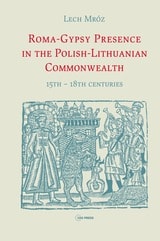
cover of Roma-Gypsy Presence in the Polish-Lithuanian Commonwealth: 15th – 18th centuries

Roma-Gypsy Presence in the Polish-Lithuanian Commonwealth

15th – 18th centuries

Lech Mróz

Central European University Press, 2017
This is an analysis of 166 original and previously unpublished documents dating from the very first mention of a Gypsy in 1401 up to the year 1 765. These documents range from royal decrees thru lawsuits to entries in municipal records. Some were written in Polish but many are in Latin, German or Ruthenian. They tell the story of not only the Gypsies living in Poland, but also of those who now live in Belarus, Lithuania, Latvia and Ukraine. Though Poland has not traditionally had a large Roma population, the author leads the reader through an eventful history of a people living on the margins of contemporary Europe. The historic documents illustrate a marked contrast to present stereotypes and popular media images and shows how the position of Roma/Gypsies shifted gradually from respected, wealthy and partly settled citizens of the early modern times, towards criminalized vagrants of the 18 th century. This is a careful interpretation and re-interpretation of documents pertaining to the Roma's past that will provide an enlightening historical perspective towards the re-evaluation and self-definition of the Romani people in contemporary Europe.
[more]
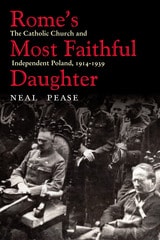
cover of Rome’s Most Faithful Daughter: The Catholic Church and Independent Poland, 1914–1939

Rome’s Most Faithful Daughter

The Catholic Church and Independent Poland, 1914–1939

Neal Pease

Ohio University Press, 2009

When an independent Poland reappeared on the map of Europe after World War I, it was widely regarded as the most Catholic country on the continent, as “Rome’s Most Faithful Daughter.” All the same, the relations of the Second Polish Republic with the Church—both its representatives inside the country and the Holy See itself—proved far more difficult than expected.

Based on original research in the libraries and depositories of four countries, including recently opened collections in the Vatican Secret Archives, Rome’s Most Faithful Daughter: The Catholic Church and Independent Poland, 1914–1939 presents the first scholarly history of the close but complex political relationship of Poland with the Catholic Church during the interwar period. Neal Pease addresses, for example, the centrality of Poland in the Vatican’s plans to convert the Soviet Union to Catholicism and the curious reluctance of each successive Polish government to play the role assigned to it. He also reveals the complicated story of the relations of Polish Catholicism with Jews, Freemasons, and other minorities within the country and what the response of Pope Pius XII to the Nazi German invasion of Poland in 1939 can tell us about his controversial policies during World War II.

Both authoritative and lively, Rome’s Most Faithful Daughter shows that the tensions generated by the interplay of church and state in Polish public life exerted great influence not only on the history of Poland but also on the wider Catholic world in the era between the wars.
[more]
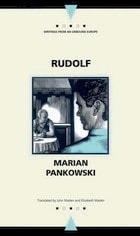
cover of Rudolf

Rudolf

Marian Pankowski

Northwestern University Press, 1996

This novel, set in the 1970s, tells the story of the "author," a middle-aged Polish professor who lives abroad but who earlier survived the Nazi concentration camps, and Rudolf, an old man. Told in stream of consciousness as well as through a triangular correspondence among Rudolf, the author, and the author's mother, the story emerges as a tale of subversion and liberation that echoes Gombrowicz in its exploration of transgressive desire. It will be of great interest to those interested in Polish literature and to readers of gay and lesbian literature.
[more]