Results by title
2018 books match the query 'Political aspects' and 103 start with r
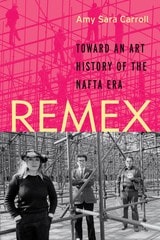
REMEX
Toward an Art History of the NAFTA EraBy Amy Sara Carroll
University of Texas Press, 2017
REMEX presents the first comprehensive examination of artistic responses and contributions to an era defined by the North American Free Trade Agreement (1994–2008). Marshaling over a decade’s worth of archival research, interviews, and participant observation in Mexico City and the Mexico–US borderlands, Amy Sara Carroll considers individual and collective art practices, recasting NAFTA as the most fantastical inter-American allegory of the turn of the millennium. Carroll organizes her interpretations of performance, installation, documentary film, built environment, and body, conceptual, and Internet art around three key coordinates—City, Woman, and Border. She links the rise of 1990s Mexico City art in the global market to the period’s consolidation of Mexico–US border art as a genre. She then interrupts this transnational art history with a sustained analysis of chilanga and Chicana artists’ remapping of the figure of Mexico as Woman.
A tour de force that depicts a feedback loop of art and public policy—what Carroll terms the “allegorical performative”—REMEX adds context to the long-term effects of the post-1968 intersection of D.F. performance and conceptualism, centralizes women artists’ embodied critiques of national and global master narratives, and tracks post-1984 border art’s “undocumentation” of racialized and sexualized reconfigurations of North American labor pools. The book’s featured artwork becomes the lens through which Carroll rereads a range of events and phenomenon from California’s Proposition 187 to Zapatismo, US immigration policy, 9/11 (1973/2001), femicide in Ciudad Juárez, and Mexico’s war on drugs.
Race And Reconciliation
Essays From The New South AfricaDaniel Herwitz
University of Minnesota Press, 2003
A meditation on the lessons to be learned from South Africa’s transformation in the wake of apartheid
Justice, truth, and identity; race, society, and law—all come into dramatic play as South Africa makes the tumultuous transition to a post-apartheid democracy. Seeking the timeless through the timely and trying to find the deeper meaning in the sweep of events, Daniel Herwitz brings the vast resources of the philosophical essay to bear on the new realities of post-apartheid South Africa—from racial identity to truth commissions, from architecture to film and television.
A public intellectual’s reflections on public life, Herwitz’s essays question how the new South Africa has constructed its concepts of reconciliation and return and how its historical emergence has meant a rethinking, reimagining, reexperiencing, relabeling, and repoliticizing of race. Herwitz’s purpose is to give a philosophical reading of society—a society already relying on implicitly philosophical concepts in its social and political agendas. Working through these concepts, testing their relevance for reading society, his book itself becomes a part of the politics of definition and description in the new South Africa.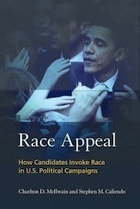
Race Appeal
How Candidates Invoke Race in U.S. Political CampaignsAuthored by Charlton D. McIlwain and Stephen M. Caliendo
Temple University Press, 2011
In our evolving American political culture, whites and blacks continue to respond very differently to race-based messages and the candidates who use them. Race Appeal examines the use and influence such appeals have on voters in elections for federal office in which one candidate is a member of a minority group.
Charlton McIlwain and Stephen Caliendo use various analysis methods to examine candidates who play the race card in political advertisements. They offer a compelling analysis of the construction of verbal and visual racial appeals and how the news media covers campaigns involving candidates of color.
Combining rigorous analyses with in-depth case studies-including an examination of race-based appeals in the historic 2008 presidential election—Race Appeal is a groundbreaking work that represents the most extensive and thorough treatment of race-based appeals in American political campaigns to date.
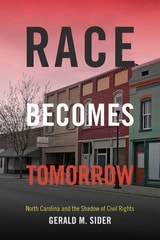
Race Becomes Tomorrow
North Carolina and the Shadow of Civil RightsGerald M. Sider
Duke University Press, 2015
Race and Performance after Repetition
Soyica Diggs Colbert, Douglas A. Jones Jr., and Shane Vogel, editors
Duke University Press, 2020
Contributors. Joshua Chambers-Letson, Soyica Diggs Colbert, Nicholas Fesette, Patricia Herrera, Jasmine Elizabeth Johnson, Douglas A. Jones Jr., Mario LaMothe, Daphne P. Lei, Jisha Menon, Tavia Nyong’o, Tina Post, Elizabeth W. Son, Shane Vogel, Catherine M. Young, Katherine Zien
Race in the College Classroom
TuSmith, Bonnie
Rutgers University Press, 2002
Winner of the 2003 American Educational Studies Association Critics' Choice Awards
Winner of the 2003 Gustavus Myers Outstanding Book Award
Did affirmative action programs solve the problem of race on American college campuses, as several recent books would have us believe? If so, why does talking about race in anything more than a superficial way make so many students uncomfortable? Written by college instructors from many disciplines, this volume of essays takes a bold first step toward a nationwide conversation. Each of the twenty-nine contributors addresses one central question: what are the challenges facing a college professor who believes that teaching responsibly requires an honest and searching examination of race?
Professors from the humanities, social sciences, sciences, and education consider topics such as how the classroom environment is structured by race; the temptation to retreat from challenging students when faced with possible reprisals in the form of complaints or negative evaluations; the implications of using standardized evaluations in faculty tenure and promotion when the course subject is intimately connected with race; and the varying ways in which white faculty and faculty of color are impacted by teaching about race.
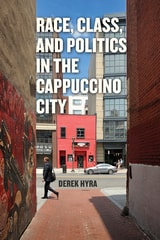
Race, Class, and Politics in the Cappuccino City
Derek S. Hyra
University of Chicago Press, 2017
Race, Class, and Politics in the Cappuccino City is an in-depth ethnography of this gilded ghetto. Derek S. Hyra captures here a quickly gentrifying space in which long-time black residents are joined, and variously displaced, by an influx of young, white, relatively wealthy, and/or gay professionals who, in part as a result of global economic forces and the recent development of central business districts, have returned to the cities earlier generations fled decades ago. As a result, America is witnessing the emergence of what Hyra calls “cappuccino cities.” A cappuccino has essentially the same ingredients as a cup of coffee with milk, but is considered upscale, and is double the price. In Hyra’s cappuccino city, the black inner-city neighborhood undergoes enormous transformations and becomes racially “lighter” and more expensive by the year.
Race, Ethnicity, and the Cold War
A Global PerspectivePhilip E. Muehlenbeck
Vanderbilt University Press, 2012
Table of Contents
Preface
Introduction: The Borders of Race and Nation
Nico Slate
Part I: Race and the International System
Token Diplomacy: The United States, Race, and the Cold War
Michael L. Krenn
A Wind of Change? White Redoubt and the Postcolonial Moment in South Africa, 1960-1963
Ryan M. Irwin
Part II: Race, Ethnicity, and Decolonization
Race, Labor, and Security in the Panama Canal Zone: The 1946 Greaves Rape Case, Local 713, and the Isthmian Cold War Crackdown
Michael Donoghue
Race, Identity, and Diplomacy in the Papua Decolonization Struggle, 1949-1962
David Webster
"For a Better Guinea": Winning Hearts and Minds in Portuguese Guinea
Luís Nuno Rodrigues
Part III: Race and the Interplay of Domestic and International Politics
Testing the Limits of Soviet Internationalism: African Students in the Soviet Union
Maxim Matusevich
Crimes against Humanity in the Congo: Nazi Legacies and the German Cold War in Africa
Katrina M. Hagen
Race and the Cuban Revolution: The Impact of Cuba's Intervention in Angola
Henley Adams
Part IV: Ethnicity and the Interplay of Domestic and International Politics
Ethnic Nationalism in the Cold War Context: The Cyprus Issue in the Greek and Greek American Public Debate, 1954-1989
Zinovia Lialiouti and Philip E. Muehlenbeck
God Bless Reagan and God Help Canada: The Polish Canadian Action Group and Solidarność in Toronto
Eric L. Payseur
Ethnic Nationalism and the Collapse of Soviet Communism
Mark R. Beissinger
Race, Nature, and the Politics of Difference
Donald S. Moore, Jake Kosek, and Anand Pandian, eds.
Duke University Press, 2003
Synthesizing a number of fields—anthropology, cultural studies, and critical race, feminist, and postcolonial theory—this collection analyzes diverse historical, cultural, and spatial locations. Contributors draw on thinkers such as Fanon, Foucault, and Gramsci to investigate themes ranging from exclusionary notions of whiteness and wilderness in North America to linguistic purity in Germany. Some essayists focus on the racialized violence of imperial rule and evolutionary science and the biopolitics of race and class in the Guatemalan civil war. Others examine how race and nature are fused in biogenetic discourse—in the emergence of “racial diseases” such as sickle cell anemia, in a case of mistaken in vitro fertilization in which a white couple gave birth to a black child, and even in the world of North American dog breeding. Several essays tackle the politics of representation surrounding environmental justice movements, transnational sex tourism, and indigenous struggles for land and resource rights in Indonesia and Brazil.
Contributors. Bruce Braun, Giovanna Di Chiro, Paul Gilroy, Steven Gregory, Donna Haraway, Jake Kosek, Tania Murray Li, Uli Linke, Zine Magubane, Donald S. Moore, Diane Nelson, Anand Pandian, Alcida Rita Ramos, Keith Wailoo, Robyn Wiegman
Race, Republicans, and the Return of the Party of Lincoln
Tasha S. Philpot
University of Michigan Press, 2007
Whether their slogan is “compassionate conservatism” or “hawkish liberalism,” political parties have always sought to expand their electoral coalitions by making minor adjustments to their public image. How do voters respond to these, often short-term, campaign appeals? Race, Republicans, and the Return of the Party of Lincoln is Tasha Philpot’s insightful study of how parties use racial images to shape and reshape the way citizens perceive them.
“Philpot has produced a timely, provocative, and nuanced analysis of political party image change, using the Republican Party’s attempts to recast itself as a party sensitive to issues of race with its 2000, and later 2004, national conventions as case examples. Using a mixture of experiments, focus groups, national surveys, and analyses of major national and black newspaper articles, Philpot finds that if race-related issues are important to individuals, such as blacks, the ability of the party to change its image without changing its political positions is far more difficult than it is among individuals who do not consider race-related issues important, e.g., whites. This book makes a major contribution
to our understanding of party image in general, and political parties’ use of race in particular. Bravo!”
—Paula D. McClain, Duke University
“This book does an excellent job of illuminating the linkages between racial images and partisan support. By highlighting Republican efforts to ‘play against type’ Philpot emphasizes the limits of successfully altering partisan images. That she accomplishes this in the controversial, yet salient, domain of race is no small feat. In short, by focusing on a topical issue, and by adopting a novel theoretical approach, Philpot is poised to make a significant contribution to the literatures on race and party images.”
—Vincent Hutchings, University of Michigan
Tasha S. Philpot is Assistant Professor of Government and African and African American Studies at the University of Texas at Austin.
Race/Class Conflict and Urban Financial Threat
Jennifer L. Hochschild
Russell Sage Foundation, 2024
Hochschild investigates the root causes of disputes in the arenas of policing, development, schooling, and budgeting. She finds that race and class are central to the Stop-Question-Frisk policing policy in New York City and the development of Atlanta’s Beltline. New York’s Stop-Question-Frisk policy was intended to fight crime and keep all New Yorkers safe. In practice, however, young Black and Latino men in low-income neighborhoods were disproportionately stopped by a predominantly White police force. The goal of the Atlanta Beltline, a redevelopment project that includes public parks, new housing, commercial development, and a robust public transit system, is to expand access around the city and keep working-class residents in the city by constructing affordable housing. Instead, the construction completed thus far has encouraged gentrification and displacement of poor, disproportionately Black residents, and has increased the wealth and power of both Black and White city elites.
However, Hochschild finds that race and class inequality are not central to all urban policy disputes. When investigating the issues of charter schools in Los Angeles and Chicago’s pension system she identifies a third driver: financial threat that feels existential to the policy and political actors. In Los Angeles, there is a battle between traditional public schools and independent charter schools. Increasingly, families with sufficient resources are moving out of L.A. to areas with better school districts. Traditional public schools and charter schools must fight for the remaining students and the funding that comes with them. There are not enough students to teach and not enough money to teach them. The school district risks school closures, layoffs, and pension deficits; in this context, race/class conflict fades into the background.
Chicago’s public sector pension debt is at least three times as large as the city’s annual budget and continues to grow. Policy actors agree that the pension system needs to be stably funded. Yet city leaders, fearful of upsetting constituents and jeopardizing their political careers, fail to implement policies that would do so. Meaningful policy change to rectify the pension deficit continues to get kicked down the line for future policy actors to address. In this context also, race/class conflict fades into the background.
Race/Class Conflict and Urban Financial Threat is a compelling examination of the role that race, class, and political and fiscal threat play in shaping urban policy.
Racial Blackness and the Discontinuity of Western Modernity
Edited by Justin A. Joyce, Dwight A. McBride, and John Carlos Rowe
University of Illinois Press, 2013
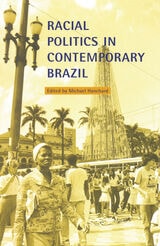
Racial Politics in Contemporary Brazil
Michael Hanchard, ed.
Duke University Press, 1999
The contributors to Racial Politics in Contemporary Brazil examine such topics as the legacy of slavery and its abolition, the historical impact of social movements, race-related violence, and the role of Afro-Brazilian activists in negotiating the cultural politics surrounding the issue of Brazilian national identity. These essays also provide comparisons of racial discrimination in the United States and Brazil, as well as an analysis of residential segregation in urban centers and its affect on the mobilization of blacks and browns. With a focus on racialized constructions of class and gender and
sexuality, Racial Politics in Contemporary Brazil reorients the direction of Brazilian studies, providing new insights into Brazilian culture, politics, and race relations.
This volume will be of importance to a wide cross section of scholars engaged with Brazil in particular, and Latin American studies in general. It will also appeal to those invested in the larger issues of political and social movements centered on the issue of race.
Contributors. Benedita da Silva, Nelson do Valle Silva, Ivanir dos Santos, Richard Graham, Michael Hanchard, Carlos Hasenbalg, Peggy A. Lovell, Michael Mitchell, Tereza Santos, Edward Telles, Howard Winant
Racialized Politics
The Debate about Racism in AmericaEdited by David O. Sears, James Sidanius, and Lawrence Bobo
University of Chicago Press, 1999
In Racialized Politics, political scientists, sociologists, and psychologists explore the current debate surrounding the sources of racism in America. Published here for the first time, the essays represent three major approaches to the topic. The social psychological approach maintains that prejudice socialized early in life feeds racial stereotypes, while the social structural viewpoint argues that behavior is shaped by whites' fear of losing their privileged status. The third perspective looks to non-racially inspired ideology, including attitudes about the size and role of government, as the reason for opposition to policies such as affirmative action. Timely and important, this collection provides a state-of-the-field assessment of the current issues and findings on the role of racism in mass politics and public opinion.
Contributors are Lawrence Bobo, Gretchen C. Crosby, Michael C. Dawson, Christopher Federico, P. J. Henry, John J. Hetts, Jennifer L. Hochschild, William G. Howell, Michael Hughes, Donald R. Kinder, Rick Kosterman, Tali Mendelberg, Thomas F. Pettigrew, Howard Schuman, David O. Sears, James Sidanius, Pam Singh, Paul M. Sniderman, Marylee C. Taylor, and Steven A. Tuch.

Radiation Sounds
Marshallese Music and Nuclear SilencesJessica A. Schwartz
Duke University Press, 2021

Radiation and Revolution
Sabu Kohso
Duke University Press, 2020
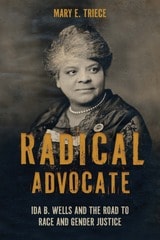
Radical Advocate
Ida B. Wells and the Road to Race and Gender JusticeMary E. Triece
University of Alabama Press, 2025
Pinpoints the persuasive strategies that typified Wells’s efforts to shape broader cultural conversations concerning the causes of racial, social, and gender inequity
Born into the brutal reality of slavery, Ida B. Wells rose to become an audacious journalist, teacher, and activist for racial and gender justice. In Radical Advocate, Mary E. Triece examines the rhetorical strategies employed by Wells to challenge deeply rooted systems of oppression, strategies that remain powerful and relevant today.
Triece introduces the concept of “radical embodied advocacy” to give an account of Wells’s unique position as a Black woman whose personal encounters with white violence were palpable, experienced physically and mentally. White men lynched Wells’s friends and threatened her own life, forcing her into exile after destroying the very press on which she wrote and edited. From this perspective, Wells understood lynching as linked to white economic and political control. Through a close analysis of Wells’s speeches, writings, and journalism, Triece reveals how Wells pioneered a form of “intersectional journalism” that centered the voices of those marginalized by race, gender, and class.
By examining Wells’s work through the lens of philosophy, rhetoric, and Black feminism, Triece underscores the epistemic challenges faced by marginalized advocates and the importance of their perspectives in shaping social change. Radical Advocate ultimately positions Wells as a prophetic figure whose insights into the systemic nature of racism remain profoundly relevant in today’s world.
Radical Enfranchisement in the Jury Room and Public Life
Sonali Chakravarti
University of Chicago Press, 2019
With Radical Enfranchisement in the Jury Room and Public Life, Sonali Chakravarti offers a full-throated defense of juries as a democratic institution. She argues that juries provide an important site for democratic action by citizens and that their use should be revived. The jury, Chakravarti argues, could be a forward-looking institution that nurtures the best democratic instincts of citizens, but this requires a change in civic education regarding the skills that should be cultivated in jurors before and through the process of a trial. Being a juror, perhaps counterintuitively, can guide citizens in how to be thoughtful rule-breakers by changing their relationship to their own perceptions and biases and by making options for collective action salient, but they must be better prepared and instructed along the way.
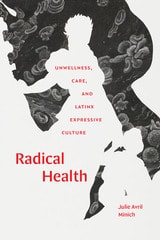
Radical Health
Unwellness, Care, and Latinx Expressive CultureJulie Avril Minich
Duke University Press, 2023
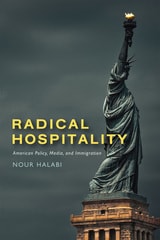
Radical Hospitality
American Policy, Media, and ImmigrationNour Halabi
Rutgers University Press, 2022

Radical Play
Revolutionizing Children’s Toys in 1960s and 1970s AmericaRob Goldberg
Duke University Press, 2023
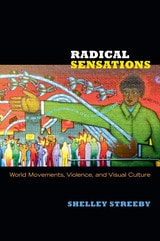
Radical Sensations
World Movements, Violence, and Visual CultureShelley Streeby
Duke University Press, 2013
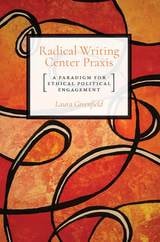
Radical Writing Center Praxis
A Paradigm for Ethical Political EngagementLaura Greenfield
Utah State University Press, 2019
Large, intersecting systems of oppression manifest in the everyday practices of institutions, classrooms, and writing centers. Local practices in turn influence the surrounding world. Radical Writing Center Praxis therefore challenges the writing center field to resist assumptions of political neutrality and instead to redefine itself in terms of more explicit ethical commitments. In this paradigm it is clear that to engage in anti-oppression work is not merely a special interest but rather a vital interest to all.
Introducing the concepts and vocabulary of radical politics, Radical Writing Center Praxis examines the tensions between the field’s professed beliefs and everyday practices and offers a process by which the writing center discipline as a whole might rebuild itself anew. It will be invaluable to writing center directors, tutors, scholars, and students as well as to administrators and compositionists.
Radio Utopia
Postwar Audio Documentary in the Public InterestMatthew Ehrlich
University of Illinois Press, 2017

Radioactive Ghosts
Gabriele Schwab
University of Minnesota Press, 2020
A pioneering examination of nuclear trauma, the continuing and new nuclear peril, and the subjectivities they generate
Amid resurgent calls for widespread nuclear energy and “limited nuclear war,” the populations that must live with the consequences of these decisions are increasingly insecure. The nuclear peril combined with the looming threat of climate change means that we are seeing the formation of a new kind of subjectivity: humans who are in a position of perpetual ontological insecurity. In Radioactive Ghosts, Gabriele Schwab articulates a vision of these “nuclear subjectivities” that we all live with.
Focusing on the legacies of the Manhattan Project, Hiroshima, and nuclear energy politics, Radioactive Ghosts takes us on a tour of the little-seen sides of our nuclear world. Examining devastating uranium mining on Native lands, nuclear sacrifice zones, the catastrophic accidents at Chernobyl and Fukushima, and the formation of a new transspecies ethics, Schwab shows how individuals threatened with extinction are creating new adaptations, defenses, and communal spaces. Ranging from personal accounts of experiences with radiation to in-depth readings of literature, film, art, and scholarly works, Schwab gives us a complex, idiosyncratic, and personal analysis of one of the most overlooked issues of our time.

Ranching, Endangered Species, and Urbanization in the Southwest
Species of CapitalNathan F. Sayre
University of Arizona Press, 2002
Nathan Sayre now takes a close look at how the ranching ideal has come into play in the conversion of a large tract of Arizona rangeland from private ranch to National Wildlife Refuge. He tells how the Buenos Aires Ranch, a working operation for a hundred years, became not only a rallying point for multiple agendas in the "rangeland conflict" after its conversion to a wildlife refuge but also an expression of the larger shift from agricultural to urban economies in the Southwest since World War II.
The U.S. Fish and Wildlife Service bought the Buenos Aires Ranch in 1985, removed all livestock, and attempted to restore the land to its "original" grassland in order to protect an endangered species, the masked bobwhite quail. Sayre examines the history of the ranch and the bobwhite together, exploring the interplay of social, economic, and ecological issues to show how ranchers and their cattle altered the land—for better or worse—during a century of ranching and how the masked bobwhite became a symbol for environmentalists who believe that the removal of cattle benefits rangelands and wildlife.
Sayre evaluates both sides of the Buenos Aires controversy—from ranching's impact on the environment to environmentalism's sometimes misguided efforts at restoration—to address the complex and contradictory roles of ranching, endangered species conservation, and urbanization in the social and environmental transformation of the West. He focuses on three dimensions of the Buenos Aires story: the land and its inhabitants, both human and animal; the role of government agencies in shaping range and wildlife management; and the various species of capital—economic, symbolic, and bureaucratic—that have structured the activities of ranchers, environmentalists, and government officials.
The creation of the Buenos Aires National Wildlife Refuge has been a symbolic victory for environmentalists, but it comes at the cost of implicitly legitimizing the ongoing fragmentation and suburbanization of Arizona's still-wild rangelands. Sayre reveals how the polarized politics of "the rangeland conflict" have bound the Fish and Wildlife Service to a narrow, ineffectual management strategy on the Buenos Aires, with greater attention paid to increasing tourism from birdwatchers than to the complex challenge of restoring the masked bobwhite and its habitat. His findings show that the urban boom of the late twentieth century echoed the cattle boom of a century before—capitalizing on land rather than grass, humans rather than cattle—in a book that will serve as a model for restoration efforts in any environment.
Rape at the Opera
Staging Sexual ViolenceMargaret Cormier
University of Michigan Press, 2024
Drawing on archival footage as well as attendance at live events, Cormier analyzes productions of canonic operas from German, Italian, and French traditions from the eighteenth to the early twentieth century, including Die Entführung aus dem Serail, Don Giovanni, La forza del destino, Un ballo in maschera, Salome, and Turandot. In doing so, Cormier highlights the dynamism of twenty-first-century opera performance practice with regard to sexual violence, establishes methods to evaluate representations of sexual violence on the opera stage, and reframes the primary responsibility of opera critics and creators as being not to opera composers and librettists but to the public.

Reactionary Mathematics
A Genealogy of PurityMassimo Mazzotti
University of Chicago Press, 2023
The nineteenth century opened with a major shift in European mathematics, and in the Kingdom of Naples, this occurred earlier than elsewhere. Between 1790 and 1830 its leading scientific institutions rejected as untrustworthy the “very modern mathematics” of French analysis and in its place consolidated, legitimated, and put to work a different mathematical culture. The Neapolitan mathematical resistance was a complete reorientation of mathematical practice. Over the unrestricted manipulation and application of algebraic algorithms, Neapolitan mathematicians called for a return to Greek-style geometry and the preeminence of pure mathematics.
For all their apparent backwardness, Massimo Mazzotti explains, they were arguing for what would become crucial features of modern mathematics: its voluntary restriction through a new kind of rigor and discipline, and the complete disconnection of mathematical truth from the empirical world—in other words, its purity. The Neapolitans, Mazzotti argues, were reacting to the widespread use of mathematical analysis in social and political arguments: theirs was a reactionary mathematics that aimed to technically refute the revolutionary mathematics of the Jacobins. During the Restoration, the expert groups in the service of the modern administrative state reaffirmed the role of pure mathematics as the foundation of a newly rigorous mathematics, which was now conceived as a neutral tool for modernization. What Mazzotti’s penetrating history shows us in vivid detail is that producing mathematical knowledge was equally about producing certain forms of social, political, and economic order.
Reading Embodied Citizenship
Disability, Narrative, and the Body PoliticRussell, Emily
Rutgers University Press, 2011
Liberal individualism, a foundational concept of American politics, assumes an essentially homogeneous population of independent citizens. When confronted with physical disability and the contradiction of seemingly unruly bodies, however, the public searches for a story that can make sense of the difference. The narrative that ensues makes "abnormality" an important part of the dialogue about what a genuine citizen is, though its role is concealed as an exception to the rule of individuality rather than a defining difference. Reading Embodied Citizenship brings disability to the forefront, illuminating its role in constituting what counts as U.S. citizenship.
Drawing from major figures in American literature, including Mark Twain, Flannery O'Connor, Carson McCullers, and David Foster Wallace, as well as introducing texts from the emerging canon of disability studies, Emily Russell demonstrates the place of disability at the core of American ideals. The narratives prompted by the encounter between physical difference and the body politic require a new understanding of embodiment as a necessary conjunction of physical, textual, and social bodies. Russell examines literature to explore and unsettle long-held assumptions about American citizenship.
Readying the Revolution
African American Theater and Performance from Post-World War II to the Black Arts MovementJonathan Shandell
University of Michigan Press, 2025
2026 American Theatre and Drama Society John W. Frick Book Award Winner
Starting in 1966, African American activist Stokely Carmichael and other political leaders adopted the phrase "Black Power!" The slogan captured a militant, revolutionary spirit that was already emerging in the work of playwrights, poets, musicians, and visual artists throughout the Black Arts movement of the mid-1960s. But the story of those theater artists and performers whose work helped bring about the Black Arts revolution has not fully been told. Readying the Revolution: African American Theater and Performance from Post-World War II to the Black Arts Movement explores the dynamic era of Black culture between the end of World War II and the start of the Black Arts Movement (1946-1964) by illuminating how artists and innovators such as Jackie Robinson, Lorraine Hansberry, Ossie Davis, Nina Simone, and others helped radicalize Black culture and Black political thought. In doing so, these artists defied white cultural hegemony in the United States, and built the foundation for the revolutionary movement in Black theater that followed in the mid 1960s. Through archival research, close textual reading, and an analysis of performance artifacts, Shandell demonstrates how these artists negotiated a space on the public stage for cultivating radical Black aesthetics and built the foundation for the revolutionary movement in Black theater that followed in the mid-1960s.
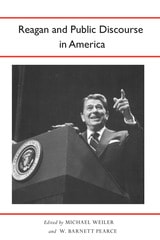
Reagan and Public Discourse in America
Michael Weiler
University of Alabama Press, 1992
The authors show that more than any president since John F. Kennedy, Reagan’s influence flowed from his rhetorical practices. And he is remembered as having reversed certain trends and cast the U.S. on a new course. The contributors to this insightful collection of essays show that Reagan’s rhetorical tactics were matters of primary concern to his administration’s chief political strategists.
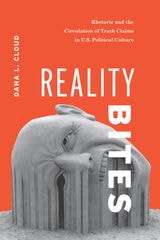
Reality Bites
Rhetoric and the Circulation of Truth Claims in U.S. Political CultureDana L. Cloud
The Ohio State University Press, 2018
Reason in Law, Tenth Edition
Lief H. Carter, Thomas F. Burke and Jessica Silbey
University of Chicago Press, 2026
An indispensable introduction to legal reasoning, updated for today’s political and legal environment.
Since it was first published nearly five decades ago, Reason in Law has become the starting point for understanding legal reasoning, a critical component of the rule of law. The editors show how judges can integrate all the elements of a case to persuasively explain their rulings—and, even more importantly, why they sometimes fail to do so. Drawing on cases old and new, Reason in Law enables readers to become sophisticated “judges of judging.”
Now in its tenth edition, Reason in Law includes a new chapter on the increasingly contentious and politically consequential field of administrative law and addresses recent developments in the American legal landscape, including growing conservatism in the federal judiciary and the flood of lawsuits brought against the second Trump administration. It also analyzes new cases on the First Amendment rights of high schoolers, transgender civil rights, the responsibilities universities have for student safety, Donald Trump’s sweeping claims of executive power, and historic Supreme Court decisions expanding the rights of gun owners and allowing states to criminalize abortion. As always, Reason in Law connects legal theory with empirical research on the American judicial system, showing how trustworthy legal reasoning helps preserve social peace and the rule of law.
Reason in Law
Ninth EditionLief H. Carter and Thomas F. Burke
University of Chicago Press, 2016
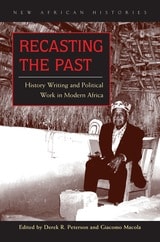
Recasting the Past
History Writing and Political Work in Modern AfricaDerek R. Peterson
Ohio University Press, 2009
The study of intellectual history in Africa is in its infancy. We know very little about what Africa’s thinkers made of their times. Recasting the Past brings one field of intellectual endeavor into view. The book takes its place alongside a small but growing literature that highlights how, in autobiographies, historical writing, fiction, and other literary genres, African writers intervened creatively in their political world.
The past has already been worked over by the African interpreters that the present volume brings into view. African brokers—pastors, journalists, kingmakers, religious dissidents, politicians, entrepreneurs all—have been doing research, conducting interviews, reading archives, and presenting their results to critical audiences. Their scholarly work makes it impossible to think of African history as an inert entity awaiting the attention of professional historians. Professionals take their place in a broader field of interpretation, where Africans are already reifying, editing, and representing the past.
The essays collected in Recasting the Past study the warp and weft of Africa’s homespun historical work. Contributors trace the strands of discourse from which historical entrepreneurs drew, highlighting the sources of inspiration and reference that enlivened their work. By illuminating the conventions of the past, Africa’s history writers set their contemporary constituents on a path toward a particular future. History writing was a means by which entrepreneurs conjured up constituencies, claimed legitimate authority, and mobilized people around a cause. By illuminating the spheres of debate in which Africa’s own scholars participated, Recasting the Past repositions the practice of modern history.
Reckless Legislation
How Legislators Ignore the ConsitutionBamberger, Michael A.
Rutgers University Press, 1999
Article 6 of the U.S. Constitution requires that every U.S. Senator and Representative, as well as all members of any state legislature, take an oath or affirmation to support the Constitution. Legislators, after all, must accept the basic principles embodied in the Constitution and Bill of Rights when interpreting questions of law. The only way to change these principles is through amendments to the Constitution. But in an increasing number of cases, contends Michael A, Bamberger, our legislators are knowingly abdicating their responsibility to uphold the Constitution. Instead of considering the constitutionality of legislation, they vote for what is politically expedient and popular, leaving it to the courts to determine the legality of their actions. Bamberger argues that legislators have a duty to consider constitutionality and not “pass the buck” to the judiciary regardless of political pressures or even well-meaning intentions to achieve desirable policy objectives.
Reckless Legislation examines legislative consideration and avoidance of issues of constitutionality through a number of examples: the regulation of the Internet by Congress and two state legislatures; the reliance by legislatures of Minneapolis, Indianapolis, and Tennessee on “experts” to justify passage of unconstitutional laws; the repeated passage of unconstitutional laws in New York and Missouri relating, respectively, to religion and abortion to wear down the courts and the opposition; and the efforts by Congress to reverse Supreme Court decisions believed by it to be incorrect or harmful.
Bamberger urges legislators to avoid the political motives that lead to “reckless legislation,” recommending that they “make full use of the full panoply of available support services . . . for a better and deeper knowledge of the issues raised.”
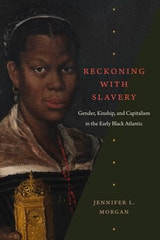
Reckoning with Slavery
Gender, Kinship, and Capitalism in the Early Black AtlanticJennifer L. Morgan
Duke University Press, 2021
Reclaiming Queer
Activist and Academic Rhetorics of ResistanceErin J. Rand
University of Alabama Press, 2014
An examination of the rhetorical linkage of queer theory in the academy with street-level queer activism in the 1980s and early 1990s
The late 1980s and early 1990s were a defining historical moment for both queer activism and queer theory in the United States. LGBTQ communities, confronted with the fatal indifference and homophobia of the AIDS crisis, often responded with angry, militant forms of activism designed not merely to promote acceptance or tolerance, but to forge identity and strength from victimization and assert loudly and forcefully their rights to safety and humanity. The activist reclamation of the word “queer” is one marker of this shift in ideology and practice, and it was mirrored in academic circles by the concurrent emergence of the new field of “queer theory.” That is, as queer activists were mobilizing in the streets, queer theorists were producing a similar foment in the halls and publications of academia, questioning regulatory categories of gender and sexuality, and attempting to illuminate the heteronormative foundations of Western thought. Notably, the narrative of queer theory’s development often describes it as arising from or being inspired by queer activism.
In Reclaiming Queer, Erin J. Rand examines both queer activist and academic practices during this period, taking as her primary object the rhetorical linkage of queer theory in the academy with street-level queer activism. Through this strategic conjuncture of activism and academia, Rand grapples with the specific conditions for and constraints on rhetorical agency in each context. She examines the early texts that inaugurated the field of queer theory, Queer Nation’s infamous “Queers Read This” manifesto, Larry Kramer’s polemic speeches and editorials, the Lesbian Avengers’ humorous and outrageous antics, the history of ACT UP, and the more recent appearance of Gay Shame activism. From these activist and academic discourses, Rand builds a theory of rhetorical agency that posits queerness as the very condition from which agency emerges.
Reclaiming Queer thus offers a critical look at the rhetoric of queer activism, engages the history of queer theory’s institutionalization and the politics of its proliferation, suggests a radically contextual understanding of rhetorical agency and form, and argues for the centrality of queerness to all rhetorical action.
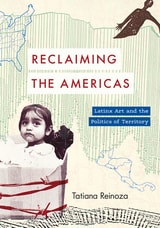
Reclaiming the Americas
Latinx Art and the Politics of TerritoryTatiana Reinoza
University of Texas Press, 2023
2023 Outstanding Book Award, National Association for Ethnic Studies
2024 Finalist, Charles Rufus Morey Book Award, College Art Association
2024 Best Arts Book, Empowering Latino Futures’ International Latino Book Awards
2025 Ewell L. Newman Book Award, American Historical Print Collectors Society
2025 Finalist, Charles C. Eldredge Prize, the Smithsonian American Art Museum
How Latinx artists around the US adopted the medium of printmaking to reclaim the lands of the Americas.
Printmakers have conspired, historically, to illustrate the maps created by European colonizers that were used to chart and claim their expanding territories. Over the last three decades, Latinx artists and print studios have reclaimed this printed art form for their own spatial discourse. This book examines the limited editions produced at four art studios around the US that span everything from sly critiques of Manifest Destiny to printed portraits of Dreamers in Texas.
Reclaiming the Americas is the visual history of Latinx printmaking in the US. Tatiana Reinoza employs a pan-ethnic comparative model for this interdisciplinary study of graphic art, drawing on art history, Latinx studies, and geography in her discussions. The book contests printmaking’s historical complicity in the logics of colonization and restores the art form and the lands it once illustrated to the Indigenous, migrant, mestiza/o, and Afro-descendant people of the Americas.
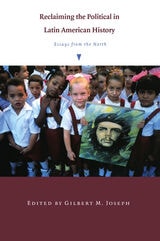
Reclaiming the Political in Latin American History
Essays from the NorthGilbert M. Joseph, ed.
Duke University Press, 2001
Taking careful stock of the state of historical writing on Latin America, the volume delineates current historiographical frontiers and suggests a series of new approaches that focus on several pivotal themes: the construction of historical narratives and memory; the articulation of class, race, gender, sexuality, and generation; and the historian’s involvement in the making of history. Although the book represents a view of the Latin American political that comes primarily from the North, the influence of Viotti da Costa powerfully marks the contributors’ engagement with Latin America’s past. Featuring a keynote essay by Viotti da Costa herself, the volume’s lively North-South encounter embodies incipient trends of hemispheric intellectual convergence.
Contributors. Jeffrey L. Gould, Greg Grandin, Daniel James, Gilbert M. Joseph, Thomas Miller Klubock, Mary Ann Mahony, Florencia E. Mallon, Diana Paton, Steve J. Stern, Heidi Tinsman, Emilia Viotti da Costa, Barbara Weinstein
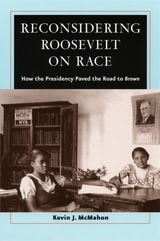
Reconsidering Roosevelt on Race
How the Presidency Paved the Road to BrownKevin J. McMahon
University of Chicago Press, 2003
McMahon shows how FDR's attempt to strengthen the presidency and undermine the power of conservative Southern Democrats dovetailed with his efforts to seek racial equality through the federal courts. By appointing a majority of rights-based liberals deferential to presidential power, Roosevelt ensured that the Supreme Court would be receptive to civil rights claims, especially when those claims had the support of the executive branch.
Reconstructing the National Bank Controversy
Politics and Law in the Early American RepublicEric Lomazoff
University of Chicago Press, 2018
With Reconstructing the National Bank Controversy, Eric Lomazoff offers a far more robust account of the constitutional politics of national banking between 1791 and 1832. During that time, three forces—changes within the Bank itself, growing tension over federal power within the Republican coalition, and the endurance of monetary turmoil beyond the War of 1812 —drove the development of our first major debate over the scope of federal power at least as much as the formal dimensions of the Constitution or the absence of a shared legal definition for the word “necessary.” These three forces—sometimes alone, sometimes in combination—repeatedly reshaped the terms on which the Bank’s constitutionality was contested. Lomazoff documents how these three dimensions of the polity changed over time and traces the manner in which they periodically led federal officials to adjust their claims about the Bank’s constitutionality. This includes the emergence of the Coinage Clause—which gives Congress power to “coin money, regulate the value thereof”—as a novel justification for the institution. He concludes the book by explaining why a more robust account of the national bank controversy can help us understand the constitutional basis for modern American monetary politics.

Recording Memories from Political Violence
A Film-maker's JourneyCahal McLaughlin
Intellect Books, 2010
Based on work the author has carried out with survivor groups in Northern Ireland and South Africa, Recording Memories from Political Violence draws on written and audiovisual texts to describe and analyze the use of documentary filmmaking in recording experiences of political conflict. A variety of issues relevant to the genre are addressed at length, including the importance of ethics in the collaboration between the filmmaker and the participant and the effect of location on the accounts of participants. Cahal McLaughlin draws on the diverse fields of film and cultural studies, as well as nearly twenty years of production experience, in this informed and instructive contribution to documentary filmmaking and post-conflict studies.
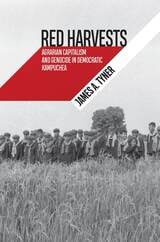
Red Harvests
Agrarian Capitalism and Genocide in Democratic KampucheaJames A. Tyner
West Virginia University Press, 2021
Reassessing the Cambodian genocide through the lens of global capitalist development.
James Tyner reinterprets the place of agriculture under the Khmer Rouge, positioning it in new ways relative to Marxism, capitalism, and genocide. The Cambodian revolutionaries’ agricultural management is widely viewed by critics as irrational and dangerous, and it is invoked as part of wider efforts to discredit leftist movements. Researching the specific functioning of Cambodia’s transition from farms to agriculture within the context of the global economy, Tyner comes to a different conclusion. He finds that analysis of “actually existing political economy”—as opposed to the Marxist identification the Khmer Rouge claimed—points to overlap between Cambodian practice and agrarian capitalism.
Tyner argues that dissolution of the traditional Khmer family farm under the aegis of state capitalism is central to any understanding of the mass violence unleashed by the Khmer Rouge. Seen less as a radical outlier than as part of a global shift in farming and food politics, the Cambodian tragedy imparts new lessons to our understanding of the political economy of genocide.

Red War on the Family
Sex, Gender, and Americanism in the First Red ScareErica J Ryan
Temple University Press, 2016
In her probing and engaging book, Red War on the Family, Erica Ryan traces the roots of sexual modernism and the history of antiradicalism and antifeminism. She illuminates how Americans responded to foreign and domestic threats and expressed nationalism by strengthening traditional gender and family roles-especially by imposing them on immigrant groups, workers, women, and young people.
Ryan argues that the environment of political conformity in the 1920s was maintained in part through the quest for cultural and social conformity, exemplified by white, middle-class family life. Red War on the Family charts the ways Americanism both reinforced and was reinforced by these sexual and gender norms in the decades after World War I.

Reel Power
Hollywood Cinema and American SupremacyMatthew Alford
Pluto Press, 2010
Hollywood is often characterised as a stronghold of left-liberal ideals. In Reel Power, Matthew Alford shows that it is in fact deeply complicit in serving the interests of the most regressive US corporate and political forces.
Films like Transformers, Terminator: Salvation and Black Hawk Down are constructed with Defence Department assistance as explicit cheerleaders for the US military, but Matthew Alford also emphasises how so-called 'radical' films like Three Kings, Hotel Rwanda and Avatar present watered-down alternative visions of American politics that serve a similar function.
Reel Power is the first book to examine the internal workings of contemporary Hollywood as a politicised industry as well as scores of films across all genres. No matter what the progressive impulses of some celebrities and artists, Alford shows how they are part of a system that is hard-wired to encourage American global supremacy and frequently the use of state violence.
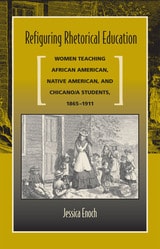
Refiguring Rhetorical Education
Women Teaching African American, Native American, and Chicano/a Students, 1865-1911Jessica Enoch
Southern Illinois University Press, 2008
Refiguring Rhetorical Education: Women Teaching African American, Native American, and Chicano/a Students, 1865-1911 examines the work of five female teachers who challenged gendered and cultural expectations to create teaching practices that met the civic and cultural needs of their students.
The volume analyzes Lydia Maria Child’s The Freedmen’s Book, a post–Civil War educational textbook for newly freed slaves; Zitkala Ša’s autobiographical essays published in the Atlantic Monthly in 1900 that questioned the work of off-reservation boarding schools for Native American students; and Jovita Idar, Marta Peña, and Leonor Villegas de Magnón’s contributions to the Spanish-language newspaper La Crónica in 1910 and 1911—contributions that offered language and cultural instruction their readers could not receive in Texas public schools.
Author Jessica Enoch explores the possibilities and limitations of rhetorical education by focusing on the challenges that Child, Zitkala Ša, Idar, Peña, and Villegas made to dominant educational practices. Each of these teachers transformed their seemingly apolitical occupation into a site of resistance, revising debilitating educational methods to advance culture-based and politicized teachings that empowered their students to rise above their subjugated positions.
Refiguring Rhetorical Education considers how race, culture, power, and language are both implicit and explicit in discussions of rhetorical education for marginalized students and includes six major tenets to guide present-day pedagogies for civic engagement.

Refiguring Spain
Cinema/Media/RepresentationMarsha Kinder, ed.
Duke University Press, 1997
These essays consider a diverse array of texts, ranging from recent films by Almodóvar, Saura, Erice, Miró, Bigas Luna, Gutiérrez Aragón, and Eloy de la Iglesia to media coverage of the 1993 elections. Francoist cinema and other popular media are examined in light of strategies used to redefine Spain’s cultural identity. The importance of the documentary, the appropriation of Hollywood film, and the significance of gender and sexuality in Spanish cinema are also discussed, as is the discourse of the Spanish media star—whether involving film celebrities like Rita Hayworth and Antonio Banderas or historical figures such as Cervantes. The volume concludes with an investigation of larger issues of government policy in relation to film and media, including a discussion of the financing of Spanish cinema and an exploration of the political dynamics of regional television and art museums. Drawing on a wide range of critical discourses, including feminist, postcolonial, and queer theory, political economy, cultural history, and museum studies, Refiguring Spain is the first comprehensive anthology on Spanish cinema in the English language.
Contributors. Peter Besas, Marvin D’Lugo, Selma Reuben Holo, Dona M. Kercher, Marsha Kinder, Jaume Martí-Olivella, Richard Maxwell, Hilary L. Neroni, Paul Julian Smith, Roland B. Tolentino, Stephen Tropiano, Kathleen M. Vernon, Iñaki Zabaleta
Refounding Democracy through Intersectional Activism
How Progressive Era Feminists Redefined Who We Are, and What It Means TodayWendy Sarvasy
Temple University Press, 2024
Sarvasy shows how these activists worked to incorporate women by combining political democracy with the creation of a welfare state. They embedded this nation-state project within a new humanitarian transnational level as they evolved their multileveled social citizenship.
Refounding Democracy through Intersectional Activism demonstrates how a theory-activist dynamic played out in experimental socializing spaces and democratic conversations. It offers an inspirational method for intersectional activists today.
Reframing Rhetorical History
Cases, Theories, and MethodologiesEdited by Kathleen J. Turner and Jason Edward Black
University of Alabama Press, 2022
A collection of essays providing insights into new directions in rhetorical history
Kathleen J. Turner’s 1998 multicontributor volume Doing Rhetorical History: Concepts and Cases quickly became a foundational text in the field, and the studies in the book have served as an important roadmap for scholars undertaking such scholarship. In the decades since its publication, developments in rhetorical-historical research, engaged scholarship, and academic interventionism have changed the practice of rhetorical history tremendously.
To address this shift, Turner and Jason Edward Black have edited a much-anticipated follow-up volume: Reframing Rhetorical History: Cases, Theories, and Methodologies, which reassesses both history as rhetoric and rhetorical history as practice. This new book attends to a number of topics that have become not just hot-button issues in rhetorical scholarship but have entrenched themselves as anchors within the field. These include digital rhetoric, public memory, race and ethnicity, gender dynamics and sexualities, health and well-being, transnationalism and globalization, social justice, archival methods and politics, and colonialism and decoloniality.
The sixteen essays are divided into four major parts: “Digital Humanities and Culture” introduces methods and cases using twenty-first century technologies; “Identities, Cultures, and Archives” addresses race and gender within the contexts of critical race theory, gendered health rhetoric, race-based public memory, and class/sectionalism; “Approaches to Nationalism and Transnationalism” explores ideologies related to US and international cultures; and “Metahistories and Pedagogies” explores creative ways to approach the frame of metarhetorical history given what the field has learned since the publication of Doing Rhetorical History.
CONTRIBUTORS
Andrew D. Barnes / Jason Edward Black / Bryan Crable / Adrienne E. Hacker Daniels / Matthew deTar / Margaret Franz / Joe Edward Hatfield / J. Michael Hogan / Andre E. Johnson / Madison A. Krall / Melody Lehn / Lisbeth A. Lipari / Chandra A. Maldonado / Roseann M. Mandziuk / Christina L. Moss / Christopher J. Oldenburg / Sean Patrick O’Rourke / Daniel P. Overton / Shawn J. Parry-Giles / Philip Perdue / Kathleen J. Turner