Results by title
598 books match the query 'Religious' and 21 start with r
Rabbi Esriel Hildesheimer and the Creation of a Modern Jewish Orthodoxy
David Ellenson
University of Alabama Press, 1990
Tradition, Modernity, and the Making of Modern Orthodoxy.
For many histories of Modern Orthodox Judaism, Rabbi Samson Raphael Hirsch stands as the primary architect of the movement's encounter with modernity. In Rabbi Esriel Hildesheimer and the Creation of a Modern Jewish Orthodoxy, distinguished scholar David Ellenson expands that narrative by recovering the life, thought, and enduring influence of one of Hirsch's most important contemporaries. Through a careful examination of Rabbi Esriel Hildesheimer's writings, leadership, educational initiatives, and responses to the social and intellectual challenges of nineteenth-century Europe, Ellenson demonstrates how Hildesheimer helped forge a model of Orthodoxy that remained firmly committed to Jewish tradition while engaging constructively with the modern world.
Set against a period of profound cultural, political, and religious transformation, this volume explores the tensions confronting European Jewry as modernization, secular education, religious pluralism, and changing political realities reshaped Jewish communal life. Ellenson shows how Hildesheimer addressed these challenges not through rigid isolation but through a pragmatic and intellectually sophisticated approach that balanced fidelity to halakhah with openness to selected aspects of modern culture and scholarship. His vision helped establish a framework for Modern Orthodoxy that continues to influence contemporary Jewish thought and practice.
Beyond its biographical focus, the study provides broader insights into the emergence of Modern Orthodoxy as a religious and intellectual movement. By illuminating Hildesheimer's efforts to integrate traditional scholarship with contemporary realities, Ellenson offers readers a deeper understanding of how Judaism has negotiated the relationship between heritage and change. The result is both a compelling portrait of an influential rabbinic figure and an important examination of the forces that shaped modern Jewish religious identity.
Rabbi Esriel Hildesheimer and the Creation of a Modern Jewish Orthodoxy is essential reading for scholars and students of Jewish studies, religious studies, theology, European history, intellectual history, and modern Judaism. It will also appeal to rabbis, educators, and general readers seeking to understand the historical roots of contemporary Orthodox Jewish life and the ongoing dialogue between tradition and modernity.
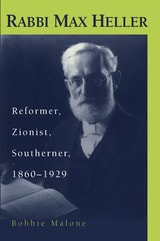
Rabbi Max Heller
Reformer, Zionist, Southerner, 1860-1929Barbara S. Malone
University of Alabama Press, 1997
Max Heller was a man of both passionate conviction and inner contradiction. He sought to be at the center of current affairs, not as a spokesperson of centrist opinion, but as an agitator or mediator, constantly struggling to find an acceptable path as he confronted the major issues of the day--racism and Jewish emancipation in eastern Europe, nationalism and nativism, immigration and assimilation. Heller's life experience provides a distinct vantage point from which to view the complexity of race relations in New Orleans and the South and the confluence of cultures that molded his development as a leader. A Bohemian immigrant and one of the first U.S.-trained rabbis, Max Heller served for 40 years as spiritual leader of a Reform Jewish congregation in New Orleans--at that time the largest city in the South. Far more than a congregational rabbi, Heller assumed an activist role in local affairs, Reform Judaism, and the Zionist movement, maintaining positions often unpopular with his neighbors, congregants, and colleagues. His deep concern for social justice led him to question two basic assumptions that characterized his larger social milieu--segregation and Jewish assimilation.
Heller, a consummate Progressive with clear vision and ideas substantially ahead of their time, led his congregation, his community, Reform Jewish colleagues, and Zionist sympathizers in a difficult era.
Rabbi Shneur Zalman of Liady
The Origins of Chabad HasidismImmanuel Etkes
Brandeis University Press, 2014
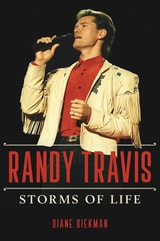
Randy Travis
Storms of LifeDiane Diekman
University of Illinois Press, 2025
Randy Travis’s 1986 breakthrough put him at the forefront of Nashville’s new traditionalist sound and, in the words of Garth Brooks, saved country music. The singer’s warm baritone and all-time classic songs like “Forever and Ever, Amen” landed him atop the charts sixteen times. His cross-genre appeal brought a level of multiplatinum success that no country artist before him had ever achieved.
Diane Diekman’s biography follows the life and career of one of country music’s most beloved figures. Steered from a troubled path as a teen, Travis served a long apprenticeship under manager and future wife Lib Hatcher before being rejected by the Nashville music industry as “too country.” The single “On the Other Hand” and his smash debut album did away with the doubters and began a dominant four-year run that stretched into ongoing success as a recording artist, trailblazing live performer, and actor in film and television. Diekman uses dozens of interviews and in-depth research to fill in the details of Travis’s pre-fame life and his enormous impact on country, popular, and gospel music. From there, she pivots to telling the story of the singer’s difficult divorce from Hatcher, subsequent problems with alcohol and run-ins with the law, and the challenges he overcame in the aftermath of a devastating 2013 stroke.
Informed by a wealth of new research and interviews, Randy Travis is the first in-depth biography of the country music legend.
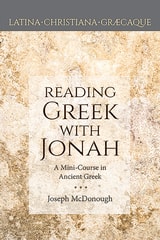
Reading Greek with Jonah
A Mini-Course in Ancient GreekJames McDonough
Catholic University of America Press, 2026
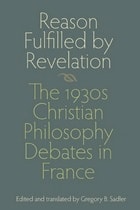
Reason Fulfilled by Revelation
The 1930s Christian Philosophy Debates in FranceGregory B. Sadler
Catholic University of America Press, 2011
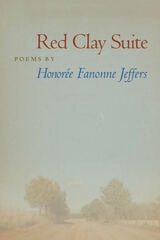
Red Clay Suite
Honoree Fanonne Jeffers
Southern Illinois University Press, 2007

Redescriptions
Toward a New Comparative ReligionRussell T. McCutcheon
Rutgers University Press, 2027
Although religion has long occupied the attention of scholars it has uniformly been assumed by them to be a special case, either to be nurtured and curated or explained away by developing theories specifically suited to it. This bracketing of our object of study has isolated the field and made it difficult for many to understand: Is religion a theological enterprise? Is it suited to the public university? Does it offend against some people’s sensibilities? Redescriptions: Toward a New Comparative Religion proposes a model for how to address this ambiguity by averring that the things scholars call religion are simply routine human doings that are therefore comparable to any other aspect of culture. The book offers a series of controlled experiments in which some novel conclusions about seemingly religious items—from myths of origins to memorials for the dead—are reached by placing them into some unexpected relationships of comparison.
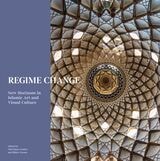
Regime Change
New Horizons in Islamic Art and Visual CultureEdited by Christiane Gruber and Bihter Esener
Gingko, 2024
The essays collected in this volume highlight some of the regimes of thought and changing trends that structure the field of Islamic art history. The authors present new research exploring the intentions of patrons, the agency of craftsmen, and their responses to previous artistic production, thereby allowing artifacts and monuments to be set within their historical, social, and artistic contexts.
In their contributions, Annabel Teh Gallop, Dmitry Bondarev, and Umberto Bongianino discuss significant changes to Qur’an production due to dynastic and political regime changes in Sumatra and the Malay Peninsula, as well as in Borno and Morocco in Africa. Corinne Mühlemann looks at changes in the role and status of designers and weavers making silk in Khurasan in the post-Mongol period. Lisa Golombek, Michael Chagnon, and Farshid Emami explore Safavid art and architecture, focusing on the material and sensorial qualities of a group of tiled arch panels tiles with narrative scenes, a delicately painted vase, and the clocks of the main square of seventeenth-century Isfahan. Regime change also comes about through technological shifts, and Ulrich Marzolph and Yasemin Gencer ask how the rise of photography and new printing techniques shaped the production, exchange, and transmission of images in Iran and Turkey.
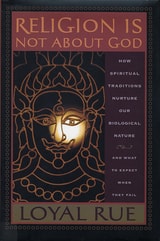
Religion is Not about God
How Spiritual Traditions Nurture our Biological Nature and What to Expect When They FailLoyal Rue
Rutgers University Press, 2006
Thousands of religious traditions have appeared over the course of human history but only a relative few have survived. Some speak of a myriad of gods, others of only one, and some recognize no gods at all. Volumes have been written attempting to prove the existence or nonexistence of supernatural being(s). So, if religion is not about God, then what is it about?
In this provocative book, Loyal Rue contends that religion, very basically, is about us. Successful religions are narrative (myth) traditions that influence human nature so that we might think, feel, and act in ways that are good for us, both individually and collectively. Through the use of images, symbols, and rituals, religion promotes reproductive fitness and survival through the facilitation of harmonious social relations. Drawing on examples from the major traditions—Judaism, Christianity, Islam, Hinduism, and Buddhism—Rue shows how each religion, in its own way, has guided human behavior to advance the twin goals of personal fulfillment and social coherence.
As all faiths are increasingly faced with a crisis of intellectual plausibility and moral relevance, this book presents a compelling and positive view of the centrality and meaning of religion.
Religion is Not about God
How Spiritual Traditions Nurture our Biological Nature and What to Expect When They FailLoyal Rue
Rutgers University Press, 2006
2006 Choice Outstanding Academic Title
Thousands of religious traditions have appeared over the course of human history but only a relative few have survived. Some speak of a myriad of gods, others of only one, and some recognize no gods at all. Volumes have been written attempting to prove the existence or nonexistence of supernatural being(s). So, if religion is not about God, then what is it about?
In this provocative book, Loyal Rue contends that religion, very basically, is about us. Successful religions are narrative (myth) traditions that influence human nature so that we might think, feel, and act in ways that are good for us, both individually and collectively. Through the use of images, symbols, and rituals, religion promotes reproductive fitness and survival through the facilitation of harmonious social relations. Drawing on examples from the major traditions—Judaism, Christianity, Islam, Hinduism, and Buddhism—Rue shows how each religion, in its own way, has guided human behavior to advance the twin goals of personal fulfillment and social coherence.
As all faiths are increasingly faced with a crisis of intellectual plausibility and moral relevance, this book presents a compelling and positive view of the centrality and meaning of religion.
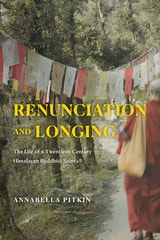
Renunciation and Longing
The Life of a Twentieth-Century Himalayan Buddhist SaintAnnabella Pitkin
University of Chicago Press, 2022
In the early twentieth century, Khunu Lama journeyed across Tibet and India, meeting Buddhist masters while sometimes living, so his students say, on cold porridge and water. Yet this elusive wandering renunciant became a revered teacher of the Fourteenth Dalai Lama. At Khunu Lama’s death in 1977, he was mourned by Himalayan nuns, Tibetan lamas, and American meditators alike. The many surviving stories about him reveal significant dimensions of Tibetan Buddhism, shedding new light on questions of religious affect and memory that reimagines cultural continuity beyond the binary of traditional and modern.
In Renunciation and Longing, Annabella Pitkin explores devotion, renunciation, and the teacher-student lineage relationship as resources for understanding Tibetan Buddhist approaches to modernity. By examining narrative accounts of the life of a remarkable twentieth-century Himalayan Buddhist and focusing on his remembered identity as a renunciant bodhisattva, Pitkin illuminates Tibetan and Himalayan practices of memory, affective connection, and mourning. Refuting long-standing caricatures of Tibetan Buddhist communities as unable to be modern because of their religious commitments, Pitkin shows instead how twentieth- and twenty-first-century Tibetan and Himalayan Buddhist narrators have used themes of renunciation, devotion, and lineage as touchstones for negotiating loss and vitalizing continuity.
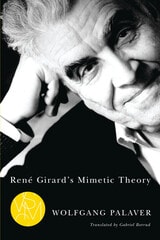
René Girard's Mimetic Theory
Wolfgang Palaver
Michigan State University Press, 2013
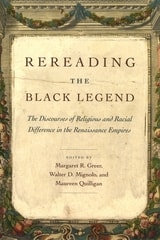
Rereading the Black Legend
The Discourses of Religious and Racial Difference in the Renaissance EmpiresEdited by Margaret R. Greer, Walter D. Mignolo, and Maureen Quilligan
University of Chicago Press, 2008
A distinguished group of contributors here examine early modern imperialisms including the Ottomans in Eastern Europe, the Portuguese in East India, and the cases of Mughal India and China, to historicize the charge of unique Spanish brutality in encounters with indigenous peoples during the Age of Exploration. The geographic reach and linguistic breadth of this ambitious collection will make it a valuable resource for any discussion of race, national identity, and religious belief in the European Renaissance.
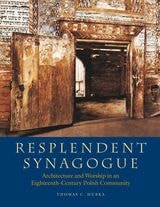
Resplendent Synagogue
Architecture and Worship in an Eighteenth-Century Polish CommunityThomas C. Hubka
Brandeis University Press, 2022
Thomas C. Hubka, an architectural historian, immersed himself in medieval and early modern Jewish history, religion, and culture to prepare for this remarkable study of the eighteenth-century Polish synagogue in the town of Gwozdziec, now in present-day Ukraine. Because the Gwozdziec Synagogue, like so many others, was destroyed by the Nazis, this book revives a spiritual community lost to history. Hubka selected the Gwozdziec Synagogue because of the completeness of its photographic and historical records. Graced with nearly two hundred historical photographs, architectural drawings, maps, diagrams, and color illustrations, Resplendent Synagogue vividly recreates the spiritual heart of a once-vibrant Jewish population. Hubka demonstrates that while the architectural exterior of the synagogue was largely the product of non-Jewish, regional influences, the interior design and elaborate wall-paintings signified a distinctly Jewish art form. The collaboration of Jewish and Gentile builders, craftsmen, and artists in the creation of this magnificent wooden structure attests to an eighteenth-century period of relative prosperity and communal well-being for the Jews of Gwozdziec. Part of a tradition that was later abandoned by Eastern European Jewish communities in the nineteenth and twentieth centuries, this truly resplendent synagogue exemplified a high point in Jewish architectural art and religious painting.
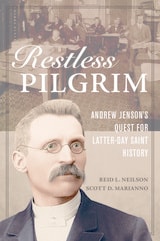
Restless Pilgrim
Andrew Jenson's Quest for Latter-day Saint HistoryReid L. Neilson and Scott D. Marianno
University of Illinois Press, 2022
Engaging and informed, Restless Pilgrim is a groundbreaking study of an important figure in Latter-day Saint intellectual life during a transformative era in Church history.

Revelation Occurs via Signs
God's Self-Communication to Humanity in Its Semiotic ConstitutionVincent Birch
Catholic University of America Press, 2027
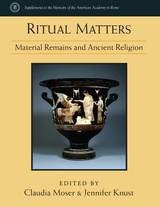
Ritual Matters
Material Remains and Ancient ReligionClaudia Moser and Jennifer Knust, editors
University of Michigan Press, 2017
Material remains of religious practices may reveal striking local continuity, but they also highlight points of change, as distinct moments of manufacture and use transformed both sites and objects. Yet not every religious practice leaves a trace: the embodied use of imperial statuary, the rationale for the design of particular sacred books or the ephemeral “magical” implements designed by local religious experts leave few traces, if any, and are therefore less amenable to material investigation. What does remain, however, challenges any neat association between representation and reality or literary claim and practical application.
This volume represents a significant contribution to the material approach of studying the ancient Mediterranean’s diverse religious practices. In addition to volume editors Claudia Moser and Jennifer Knust, contributors include Henri Duday, Gunnel Ekroth, David Frankfurter, Richard Gordon, Valérie Huet, William Van Andringa, and Zsuzsanna Várhelyi. Topics covered include funerary remains, sacrificial practices, “magic,” Roman altars, imperial reliefs and statuary, and the role of sacred books.

Roads to Rome
A Guide to Notable Converts from Britain and Ireland from the Reformation to theJohn Beaumont
St. Augustine's Press, 2010
To be a Christian is to be a convert. The word “convert” applies in a real sense both to cradle-born Catholics and to those, traditionally regarded as converts, who become Catholics as adults. The Catholic Church is the divinely established framework of the program of a conversion, which Christ presented as a thorough change of mind and heart (metanoia). While for a cradle-born Catholic the implementation of that program is usually a gradual process, for converts it contains a momentous act as they vote, so to speak, with their feet, on behalf of Truth, by joining the Church as the One True Fold, the Sole Ark of Salvation, to recall hallowed phrases dear to John Henry Newman, easily the greatest convert during the nineteenth century.
The aim of this book is to summarize the lives of notable converts from Britain and Ireland and explain (by reference to quotations from their writings) why they entered the Catholic Church. These reasons were many. Some looked chiefly at history and saw the apostolic Church in their day to be residing in the Catholic communion. Others, though appreciating the fact of the gift of faith, saw reason as the chief support of the step they were taking. To yet others it was the endurance of both the Church and that remarkable office of the papacy that proved the necessary stimulus. Many were inspired by the witness of some unsung saint in their neighbourhood. Some were eminent even before their “move to Rome,” others almost completely unknown. Some found fame on their conversion, others suffered greatly for their zeal for the one true fold of Christ. Some came into the Church relatively early in life, others entered at the final hour, even while on their death bed.
Taken altogether these accounts provide a profound and moving witness to the operation of divine grace in human souls.
Run in Such a Way
PoemsJustin Danzy
Northwestern University Press, 2027
A poet’s candid and probing exploration of faith, Blackness, and masculinity
With poems that closely examine familial bonds and heritage, biblical teachings, a shifting understanding of home, and the violence of toxic masculinity, Justin Danzy’s Run in Such a Way sits at the crossroads of religion, race, gender, and more. A collection about pursuit, tracking the narrative of its speaker’s journey toward a deeper understanding of himself and of his community as he moves from child to man, the book wrestles with the way an identity is constructed, deconstructed, and reconstructed again throughout one’s life. Playful and sincere in equal measure, Danzy’s command of the line carries us through as we travel with the speaker to the precipice of belief. Danzy’s lyrical voice and fealty to his people pays homage to the world that made him, and considers all that the speaker of this tremendous debut has—both wisely and foolishly—run toward and away from in the search for truth.
Russian Religious Thought
Edited by Judith Deutsch Kornblatt and Richard F. Gustafson
University of Wisconsin Press, 1996
As Russia entered the modern age in the nineteenth century, many Russian intellectuals combined the study of European philosophy with a return to their own traditions, culminating in the novels of Tolstoy and Dostoevsky and in the religious philosophy of their younger contemporary, Vladimir Soloviev. This book explores central issues of modern Russian religious thought by focusing on the work of Soloviev and three religious philosophers who further developed his ideas in the early twentieth century: P. A. Florensky, Sergei Bulgakov, and S. L. Frank. The essays place these thinkers in the contexts of both Western philosophy and Eastern Orthodoxy, presenting a substantially new perspective on Russian religious thought.
The work of these four philosophers, this volume demonstrates, influenced virtually all aspects of twentieth-century Russian culture, and indeed, many aspects of Soviet culture as well, but also represents a rich philosophical tradition devoted to issues of divinity, community, and humanity that transcend national boundaries and historical eras.
Included in Russian Religious Thought is an introduction, brief biographical information on Soloviev, Florensky, Bulgakov, and Frank, and an Afterword by scholar James Scanlan, who elaborates on the volume’s aim to provide a thoughtful corrective, both to unexamined assumptions of past scholarship and to nationalist readings currently popular in post-Soviet Russia.
"Russian religious philosophy, banned under the Soviets, has been marginalized in the Western academy as well. This interdisciplinary volume helps explain why this body of thought has remained for so long at the center of Russian culture."—Caryl Emerson, Princeton University