Results by title
140 books match the query 'Science Fiction & Fantasy' and 11 start with r

RE-FORMING THE PAST
HISTORY, THE FANTASTIC, & THE POSTMODERN SLAVE NARRATIVEA. Timothy Spaulding
The Ohio State University Press, 2005
In their rejection of mimetic representation and traditional historiography, Spaulding contextualizes postmodern slave narrative. By addressing both literary and popular African American texts, Re-Forming the Past expands discussions of both the African American literary tradition and postmodern culture.

Ray Bradbury
David Seed
University of Illinois Press, 2015
David Seed follows Bradbury's long career from the early short story masterpieces through his work in a wide variety of broadcast and film genres to the influential cultural commentary he spread via essays, speeches, and interviews. Mining Bradbury's classics and hard-to-find archival, literary, and cultural materials, Seed analyzes how the author's views on technology, authoritarianism, and censorship affected his art; how his Midwest of dream and dread brought his work to life; and the ways film and television influenced his creative process and visually-oriented prose style. The result is a passionate statement on Bradbury's status as an essential literary writer deserving of a place in the cultural history of his time.
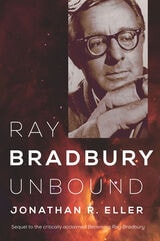
Ray Bradbury Unbound
Jonathan R. Eller
University of Illinois Press, 2020
At the height of his powers as a poetic prose stylist, Bradbury shifted his creative attention to film and television, where new successes gave him an enduring platform as a compelling cultural commentator. His passionate advocacy validated the U.S. space program's mission, extending his pivotal role as a chronicler of human values in an age of technological wonders.
Informed by many years of interviews with Bradbury as well as an unprecedented access to personal papers and private collections, Ray Bradbury Unbound provides the definitive portrait of how a legendary American author helped shape his times.
Re-Enchanted
The Rise of Children's Fantasy Literature in the Twentieth CenturyMaria Sachiko Cecire
University of Minnesota Press, 2019
Why are so many people drawn to fantasy set in medieval, British-looking lands? This question has immediate significance for millions around the world: from fans of Lord of the Rings, Narnia, Harry Potter, and Game of Thrones to those who avoid fantasy because of the racist, sexist, and escapist tendencies they have found there. Drawing on the history and power of children’s fantasy literature, Re-Enchanted argues that magic, medievalism, and childhood hold the paradoxical ability to re-enchant modern life.
Focusing on works by authors such as J. R. R. Tolkien, C. S. Lewis, Susan Cooper, Philip Pullman, J. K. Rowling, and Nnedi Okorafor, Re-Enchanted uncovers a new genealogy for medievalist fantasy—one that reveals the genre to be as important to the history of English studies and literary modernism as it is to shaping beliefs across geographies and generations. Maria Sachiko Cecire follows children’s fantasy as it transforms over the twentieth and twenty-first centuries—including the rise of diverse counternarratives and fantasy’s move into “high-brow” literary fiction. Grounded in a combination of archival scholarship and literary and cultural analysis, Re-Enchanted argues that medievalist fantasy has become a psychologized landscape for contemporary explorations of what it means to grow up, live well, and belong. The influential “Oxford School” of children’s fantasy connects to key issues throughout this book, from the legacies of empire and racial exclusion in children’s literature to what Christmas magic tells us about the roles of childhood and enchantment in Anglo-American culture.
Re-Enchanted engages with critical debates around what constitutes high and low culture during moments of crisis in the humanities, political and affective uses of childhood and the mythological past, the anxieties of modernity, and the social impact of racially charged origin stories.
Reading in the Postgenomic Age
Race, Discipline, and Bionarrativity in Contemporary North American LiteratureLesley Larkin
The Ohio State University Press, 2025

Red Planets
Marxism and Science FictionEdited by Mark Bould and China Mielville
Pluto Press, 2009
Covering a rich variety of examples from Weimar cinema to mainstream Hollywood films, and novelists from Jules Verne and H.G. Wells to Kim Stanley Robinson, Ken MacLeod and Charles Stross, this is an indespensible insight into how Marxism and science fiction go hand-in-hand.

Retrofitting Blade Runner
Issues in Ridley Scott's Blade Runner and Phillip K. Dick's Do Androids Dream of Electric Sheep?Judith B. Kerman
University of Wisconsin Press, 1997
Reverse Colonization
Science Fiction, Imperial Fantasy, and Alt-victimhoodDavid M. Higgins
University of Iowa Press, 2021
Higgins shows that this reverse colonization stance depends upon a science fictional logic that achieved dominance within imperial fantasy during the 1960s and has continued to gain momentum ever since. By identifying with fantastic forms of victimhood, subjects who already enjoy social hegemony are able to justify economic inequality, expansions of police and military power, climatological devastation, new articulations of racism, and countless other forms of violence—all purportedly in the name of security, self-defense, and self-protection.
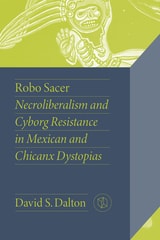
Robo Sacer
Necroliberalism and Cyborg Resistance in Mexican and Chicanx DystopiasDavid S. Dalton
Vanderbilt University Press, 2023
Harvey L. Johnson Publication Award, Southwest Council of Latin American Studies, 2026
Premio Alambique, Alambique: Revista Académica de Ciencia Ficción y Fantasía, 2025
Robo Sacer engages the digital humanities, critical race theory, border studies, biopolitical theory, and necropolitical theory to interrogate how technology has been used to oppress people of Mexican descent—both within Mexico and in the United States—since the advent of the North American Free Trade Agreement (NAFTA) in 1994. As the book argues, robo-sacer identity emerges as transnational flows of bodies, capital, and technology become an institutionalized state of exception that relegates people from marginalized communities to the periphery.
And yet the same technology can be utilized by the oppressed in the service of resistance. The texts studied here represent speculative stories about this technological empowerment. These texts theorize different means of techno-resistance to key realities that have emerged within Mexican and Chicano/a/x communities under the rise and reign of neoliberalism. The first three chapters deal with dehumanization, the trafficking of death, and unbalanced access to technology. The final two chapters deal with the major forms of violence—feminicide and drug-related violence—that have grown exponentially in Mexico with the rise of neoliberalism. These stories theorize the role of technology both in oppressing and in providing the subaltern with necessary tools for resistance.
Robo Sacer builds on the previous studies of Sayak Valencia, Irmgard Emmelhainz, Guy Emerson, Achille Mbembe, and of course Giorgio Agamben, but it differentiates itself from them through its theorization on how technology—and particularly cyborg subjectivity—can amend the reigning biopolitical and necropolitical structures of power in potentially liberatory ways. Robo Sacer shows how the cyborg can denaturalize constructs of zoē by providing an outlet through which the oppressed can tell their stories, thus imbuing the oppressed with the power to combat imperialist forces.
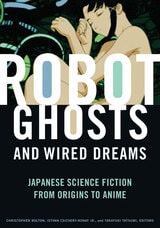
Robot Ghosts and Wired Dreams
Japanese Science Fiction from Origins to AnimeChristopher Bolton
University of Minnesota Press, 2007
Since the end of the Second World War—and particularly over the last decade—Japanese science fiction has strongly influenced global popular culture. Unlike American and British science fiction, its most popular examples have been visual—from Gojira (Godzilla) and Astro Boy in the 1950s and 1960s to the anime masterpieces Akira and Ghost in the Shell of the 1980s and 1990s—while little attention has been paid to a vibrant tradition of prose science fiction in Japan.
Robot Ghosts and Wired Dreams remedies this neglect with a rich exploration of the genre that connects prose science fiction to contemporary anime. Bringing together Western scholars and leading Japanese critics, this groundbreaking work traces the beginnings, evolution, and future direction of science fiction in Japan, its major schools and authors, cultural origins and relationship to its Western counterparts, the role of the genre in the formation of Japan’s national and political identity, and its unique fan culture.
Covering a remarkable range of texts—from the 1930s fantastic detective fiction of Yumeno Kyûsaku to the cross-culturally produced and marketed film and video game franchise Final Fantasy—this book firmly establishes Japanese science fiction as a vital and exciting genre.
Contributors: Hiroki Azuma; Hiroko Chiba, DePauw U; Naoki Chiba; William O. Gardner, Swarthmore College; Mari Kotani; Livia Monnet, U of Montreal; Miri Nakamura, Stanford U; Susan Napier, Tufts U; Sharalyn Orbaugh, U of British Columbia; Tamaki Saitô; Thomas Schnellbächer, Berlin Free U.
Christopher Bolton is assistant professor of Japanese at Williams College.
Istvan Csicsery-Ronay Jr. is professor of English at DePauw University.
Takayuki Tatsumi is professor of English at Keio University.
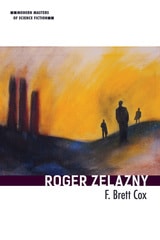
Roger Zelazny
F. Brett Cox
University of Illinois Press, 2021
Roger Zelazny combined poetic prose with fearless literary ambition to become one of the most influential science fiction writers of the 1960s. Yet many critics found his later novels underachieving and his turn to fantasy a disappointment. F. Brett Cox surveys the landscape of Zelazny's creative life and contradictions. Launched by the classic 1963 short story "A Rose for Ecclesiastes," Zelazny soon won the Hugo Award for Best Novel with …And Call Me Conrad and two years later won again for Lord of Light. Cox looks at the author's overnight success and follows Zelazny into a period of continued formal experimentation, the commercial triumph of the Amber sword and sorcery novels, and renewed acclaim for Hugo-winning novellas such as "Home Is the Hangman" and "24 Views of Mt. Fuji, by Hokusai." Throughout, Cox analyzes aspects of Zelazny's art, from his preference for poetically alienated protagonists to the ways his plots reflected his determined individualism.
Clear-eyed and detailed, Roger Zelazny provides an up-to-date reconsideration of an often-misunderstood SF maverick.