Results by title
262 books match the query 'Sex role' and 13 start with r

Race and Sex in Latin America
Peter Wade
Pluto Press, 2009
The intersection of race and sex in Latin America is a subject touched upon by many disciplines but this is the first book to deal solely with these issues.
Interracial sexual relations are often a key mythic basis for Latin American national identities, but the importance of this has been underexplored. Peter Wade provides a pioneering overview of the growing literature on race and sex in the region, covering historical aspects and contemporary debates. He includes both black and indigenous people in the frame, as well as mixed and white people, avoiding the implication that "race" means "black-white" relations.
Challenging but accessible, this book will appeal across the humanities and social sciences, particularly to students of anthropology, gender studies, history and Latin American studies.
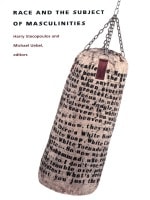
Race and the Subject of Masculinities
Harry Stecopoulos and Michael Uebel, eds.
Duke University Press, 1997
Discussing a wide range of subjects including the inherent homoeroticism of martial-arts cinema, the relationship between working-class ideologies and Elvis impersonators, the emergence of a gay, black masculine aesthetic in the works of James Van der Zee and Robert Mapplethorpe, and the comedy of Richard Pryor, Race and the Subject of Masculinities provides a variety of opportunities for thinking about how race, sexuality, and "manhood" are reinforced and reconstituted in today’s society. Editors Harry Stecopoulos and Michael Uebel have gathered together essays that make clear how the formation of masculine identity is never as obvious as it might seem to be. Examining personas as varied as Eddie Murphy, Bruce Lee, Tarzan, Malcolm X, and Andre Gidé, these essays draw on feminist critique and queer theory to demonstrate how cross-identification through performance and spectatorship among men of different races and cultural backgrounds has served to redefine masculinity in contemporary culture. By taking seriously the role of race in the making of men, Race and the Subject of Masculinities offers an important challenge to the new studies of masculinity.
Contributors. Herman Beavers, Jonathan Dollimore, Richard Dyer, Robin D. G. Kelly, Christopher Looby, Leerom Medovoi, Eric Lott, Deborah E. McDowell, José E. Muñoz, Harry Stecopoulos, Yvonne Tasker, Michael Uebel, Gayle Wald, Robyn Wiegman
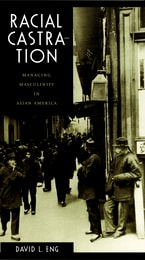
Racial Castration
Managing Masculinity in Asian AmericaDavid L. Eng
Duke University Press, 2001
Eng juxtaposes theortical discussions of Freud, Lacan, and Fanon with critical readings of works by Frank Chin, Maxine Hong Kingston, Lonny Kaneko, David Henry Hwang, Louie Chu, David Wong Louie, Ang Lee, and R. Zamora Linmark. While situating these literary and cultural productions in relation to both psychoanalytic theory and historical events of particular significance for Asian Americans, Eng presents a sustained analysis of dreamwork and photography, the mirror stage and the primal scene, and fetishism and hysteria. In the process, he offers startlingly new interpretations of Asian American masculinity in its connections to immigration exclusion, the building of the transcontinental railroad, the wartime internment of Japanese Americans, multiculturalism, and the model minority myth. After demonstrating the many ways in which Asian American males are haunted and constrained by enduring domestic norms of sexuality and race, Eng analyzes the relationship between Asian American male subjectivity and the larger transnational Asian diaspora. Challenging more conventional understandings of diaspora as organized by race, he instead reconceptualizes it in terms of sexuality and queerness.
Reading Biblical Texts Together
Pursuing Minoritized Biblical CriticismTat-Siong Benny Liew
SBL Press, 2022
A solid and suggestive foundation for the future of ethnic-racial minority biblical criticism
This volume, edited by Tat-siong Benny Liew and Fernando F. Segovia, expands the work begun in They Were All Together in One Place? Toward Minority Biblical Criticism (2009) by focusing on specific texts for scholarly engagement and exchange. Essays by scholars of racial/ethnic minoritized criticism of the Bible highlight the various factors and dynamics at play in the formation of power relations within and through four biblical texts: two from the Hebrew Bible (Genesis 21 and 1 Kings 12) and two from the New Testament (John 4 and Revelation 18). Contributors include Ahida Calderón Pilarski, Ronald Charles, Stephanie Buckhanon Crowder, Lynne St. Clair Darden, Steed Vernyl Davidson, Mary F. Foskett, Jione Havea, Tat-siong Benny Liew, Roberto Mata, Henry W. Morisada Rietz, Raj Nadella, Miranda N. Pillay, David Arthur Sánchez, Timothy J. Sandoval, Fernando F. Segovia, Mitzi J. Smith, Angeline M. G. Song, Linzie M. Treadway, Nasili Vaka’uta, Demetrius K. Williams, and Gale A. Yee. Each essay expands our understandings of minoritization from a global perspective.
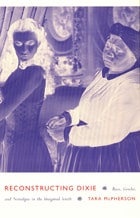
Reconstructing Dixie
Race, Gender, and Nostalgia in the Imagined SouthTara McPherson
Duke University Press, 2003
Illuminating crucial connections between understandings of race, gender, and place on the one hand and narrative and images on the other, McPherson reads a number of representations of the South produced from the 1930s to the present. These are drawn from fiction, film, television, southern studies scholarship, popular journalism, music, tourist sites, the internet, and autobiography. She examines modes of affect or ways of "feeling southern" to reveal how these feelings, along with the narratives and images she discusses, sanction particular racial logics. A wide-ranging cultural studies critique, Reconstructing Dixie calls for vibrant new ways of thinking about the South and for a revamped and reinvigorated southern studies.
Reconstructing Dixie will appeal to scholars in American, southern, and cultural studies, and to those in African American, media, and women’s studies.

Red Nails, Black Skates
Gender, Cash, and Pleasure on and off the IceErica Rand
Duke University Press, 2012

Red War on the Family
Sex, Gender, and Americanism in the First Red ScareErica J Ryan
Temple University Press, 2016
In her probing and engaging book, Red War on the Family, Erica Ryan traces the roots of sexual modernism and the history of antiradicalism and antifeminism. She illuminates how Americans responded to foreign and domestic threats and expressed nationalism by strengthening traditional gender and family roles-especially by imposing them on immigrant groups, workers, women, and young people.
Ryan argues that the environment of political conformity in the 1920s was maintained in part through the quest for cultural and social conformity, exemplified by white, middle-class family life. Red War on the Family charts the ways Americanism both reinforced and was reinforced by these sexual and gender norms in the decades after World War I.
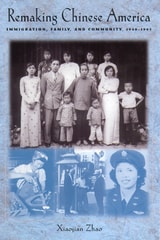
Remaking Chinese America
Immigration, Family, and Community, 1940-1965Zhao, Xiaojian
Rutgers University Press, 2001
In Remaking Chinese America, Xiaojian Zhao explores the myriad forces that changed and unified Chinese Americans during a key period in American history. Prior to 1940, this immigrant community was predominantly male, but between 1940 and 1965 it was transformed into a family-centered American ethnic community. Zhao pays special attention to forces both inside and outside of the country in order to explain these changing demographics. She scrutinizes the repealed exclusion laws and the immigration laws enacted after 1940. Careful attention is also paid to evolving gender roles, since women constituted the majority of newcomers, significantly changing the sex ratio of the Chinese American population.
As members of a minority sharing a common cultural heritage as well as pressures from the larger society, Chinese Americans networked and struggled to gain equal rights during the cold war period. In defining the political circumstances that brought the Chinese together as a cohesive political body, Zhao also delves into the complexities they faced when questioning their personal national allegiances. Remaking Chinese America uses a wealth of primary sources, including oral histories, newspapers, genealogical documents, and immigration files to illuminate what it was like to be Chinese living in the United States during a period that—until now—has been little studied.
Remaking the Godly Marriage
Gender Negotiation in Evangelical FamiliesBartkowski, John
Rutgers University Press, 2001
While religious leaders often have enormous influence over their members’ beliefs and how they translate their beliefs into action in everyday life, the individual family remains the place where religious values are practiced through and ultimately transferred to the next generation. As such, the family is an extremely important, though frequently overlooked, topic of study for sociologists of religion.
In Remaking the Godly Marriage, John Bartkowski studies evangelical Protestants and their views on marriage and gender relations and how they are lived within individual families. The author compares elite evangelical prescriptions for godly family living with the day-to-day practices in conservative Protestant households. He asks: How serious are the debates over gender and the family that are manifested within contemporary evangelicalism? What are the values that underlie this debate? Have these internecine disputes been altered by the emergence of new evangelical movements such as biblical feminism and the Promise Keepers? And given the fact that leading evangelicals advance competing visions of godly family life, how do conservative religious spouses make sense of their own family relationships and gender identities?
Through in-depth interviews with evangelical married couples and an exhaustive study of evangelical family advice manuals, Bartkowski explores the disputes and ambivalence concerning traditional gender roles and patriarchal models of family life, which derive from the tension between evangelical Protestantism as a religious subculture and the broader American secular culture in which it is embedded. Bartkowski reveals how evangelical men and women jointly negotiate gender roles within their families and selectively appropriate values of the larger culture even as they attempt to cope with the conflicting messages of their own faith.

Rethinking Pastoralism In Africa
Gender, Culture, and the Myth of the Patriarchal PastoralistDorothy L. Hodgson
Ohio University Press, 2001
The dominant trend in pastoralist studies has long assumed that pastoralism and pastoral gender relations are inherently patriarchal. The contributors to this collection, in contrast, use diverse analytic approaches to demonstrate that pastoralist gender relations are dynamic, relational, historical, and produced through complex local-translocal interactions. Combining theoretically sophisticated analysis with detailed case studies, this collection will appeal to those doing research and teaching in African studies, gender studies, anthropology, and history. Among the topics discussed are pastoralism, patriarchy, and history among Maasai in Tanganyika; women’s roles in peacemaking in Somali society; the fertility of houses and herds; gender, aging, and postchildbearing experience in a Tuareg community; and milk selling among Fulani women in Northern Burkina Faso.
Rewriting the Renaissance
The Discourses of Sexual Difference in Early Modern EuropeEdited by Margaret W. Ferguson, Maureen Quilligan, and Nancy Vickers
University of Chicago Press, 1986
Throughout, the essays focus on the structures of Renaissance patriarchy that organized power relations both in the state and in the family. They explore the major conequences of patriarchy for women—their marginalization and lack of identity and power—and the ways in which individual women or groups of women broke, or in some cases deliberately circumvented, the rules that defined them as a secondary sex. Topics covered include representations of women in literature and art, the actual work done by women both inside and outside of the home, and the writings of women themselves. In analyzing the rhetorical strategies that "marginalized" historical and fictional women, these essays counter scholarly and critical traditions that continue to exhibit patriarchal biases.

Rooms of Our Own
Susan Gubar
University of Illinois Press, 2006
With a little help from Virginia Woolf, Susan Gubar contemplates startling transformations produced by the women's movement in recent decades. What advances have women made and what still needs to be done? Taking Woolf's classic A Room of One's Own as her guide, Gubar engages these questions by recounting one year in the life of an English professor.
A meditation on the teaching of literature and on the state of the humanities today, her chapters also provide a crash course on the challenges and changes in feminist intellectual history over the past several decades: the influence of post-structuralism and of critical race, postcolonial, and cultural studies scholarship; the stakes of queer theory and the institutionalization of women's studies; and the effects of globalism and bioengineering on conversations about gender, sex, and sexuality. Yet Rooms of Our Own eschews a scholarly approach. Instead, through narrative criticism it enlists a thoroughly contemporary cast of characters who tell us as much about the comedies and tragedies of campus life today as they do about the sometimes contentious but invariably liberating feminisms of our future.
Russian Style
Performing Gender, Power, and PutinismJulie A. Cassiday
University of Wisconsin Press, 2023