Results by title
169 books match the query 'Shakespeare, William' and 10 start with r
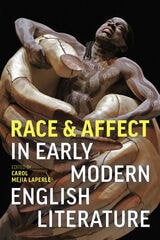
Race and Affect in Early Modern English Literature
Carole Mejia LaPerle
Arizona Center for Medieval and Renaissance Studies, 2021
Race and Affect in Early Modern English Literature puts the fields of critical race studies and affect theory into dialogue. Doing so opens a new set of questions: What are the emotional experiences of racial formation and racist ideologies? How do feelings—through the physical senses, emotional passions, or sexual encounters—come to signify race? What is the affective register of anti-blackness that pervades canonical literature? How can these visceral forms of racism be resisted in discourse and in practice? By investigating how race feels, this book offers new ways of reading and interpreting literary traditions, religious differences, gendered experiences, class hierarchies, sexuality, and social identities. So far scholars have shaped the discussion of race in the early modern period by focusing on topics such as genealogy, language, economics, religion, skin color, and ethnicity. This book, however, offers something new: it considers racializing processes as visceral, affective experiences.

Radical Tragedy
Religion, Ideology and Power in the Drama of Shakespeare and His ContemporariesJonathan Dollimore
Duke University Press, 2004
Renaissance Drama 38
William N. West
Northwestern University Press, 2010
Renaissance Drama, an annual interdisciplinary publication, is devoted to drama and performance as a central feature of Renaissance culture. The essays in each volume explore the traditional canon of drama, the significance of performance, broadly construed, to early modern culture, and the impact of new forms of interpretation on the study of Renaissance plays, theater, and performance.
Volume 38 includes essays that explore topics in early modern drama ranging from Shakespeare’s Jewish questions in The Merchant of Venice and the gender of rhetoric in Shakespeare’s sonnets and Jonson’s plays to improvisation in the commedia dell’arte and the rebirth of tragedy in 1940 Germany.
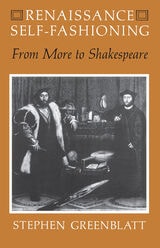
Renaissance Self-Fashioning
From More to ShakespeareStephen Greenblatt
University of Chicago Press, 1983
"No one who has read [Greenblatt's] accounts of More, Tyndale, Wyatt, and others can fail to be moved, as well as enlightened, by an interpretive mode which is as humane and sympathetic as it is analytical. These portraits are poignantly, subtly, and minutely rendered in a beautifully lucid prose alive in every sentence to the ambivalences and complexities of its subjects."—Harry Berger Jr., University of California, Santa Cruz
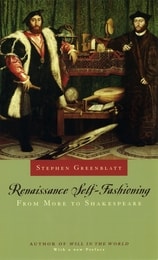
Renaissance Self-Fashioning
From More to ShakespeareStephen Greenblatt
University of Chicago Press, 2005
"No one who has read [Greenblatt's] accounts of More, Tyndale, Wyatt, and others can fail to be moved, as well as enlightened, by an interpretive mode which is as humane and sympathetic as it is analytical. These portraits are poignantly, subtly, and minutely rendered in a beautifully lucid prose alive in every sentence to the ambivalences and complexities of its subjects."—Harry Berger Jr., University of California, Santa Cruz
Repertory of Shakespeare's Company, 1594–1613
Roslyn Lander Knutson
University of Arkansas Press, 1991
Richard II
William Shakespeare
Arizona Center for Medieval and Renaissance Studies, 2021
Following the events of the final two years of his life, Richard II interrogates royal power and the forces that threaten it. After banishing his cousin Henry Bolingbroke, Richard begins to lose grip of his throne and strives to find meaning in the churn and chaos of the events unfolding around him. In her new translation, Naomi Iizuka ventures into the mystery of the work, scraping away the layers of received wisdom and cracking the play open for contemporary audiences.
This translation of Richard II was written as part of the Oregon Shakespeare Festival’s Play On! project, which commissioned new translations of thirty-nine Shakespeare plays. These translations present work from “The Bard” in language accessible to modern audiences while never losing the beauty of Shakespeare’s verse. Enlisting the talents of a diverse group of contemporary playwrights, screenwriters, and dramaturges from diverse backgrounds, this project reenvisions Shakespeare for the twenty-first century. These volumes make these works available for the first time in print—a new First Folio for a new era.
Richard III
William Shakespeare
Arizona Center for Medieval and Renaissance Studies, 2021
Nuyorican playwright Migdalia Cruz unpacks and repositions Shakespeare’s Richard III for a twenty-first-century audience. She presents a contemporary English verse translation, faithfully keeping the poetry, the puns, and the politics of the play intact, with a rigorous and in-depth examination of Richard III—the man, the king, the outsider—who is still the only English king to have died in battle. In the Wars of the Roses, his Catholic belief in his country led to his slaughter at Bosworth’s Field by his Protestant rivals. In reimagining this text, Cruz emphasizes Richard III’s outsider status—exacerbated by his severe scoliosis, which twisted his spine—by punctuating the text with punk music from 1970s London. Cruz’s Richard is no one’s fool or lackey. He is a new kind of monarch, whose dark sense of humor and deep sense of purpose leads his charge against the society which never fully accepted him because he looked different.
This translation was written as part of the Oregon Shakespeare Festival’s Play On! project, which commissioned new translations of thirty-nine Shakespeare plays. These translations present the work of "The Bard" in language accessible to modern audiences while never losing the beauty of Shakespeare’s verse. These volumes make these works available for the first time in print—a new First Folio for a new era.
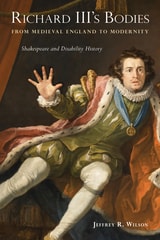
Richard III's Bodies from Medieval England to Modernity
Shakespeare and Disability HistoryJeffrey R. Wilson
Temple University Press, 2022
Richard III will always be central to English disability history as both man and myth—a disabled medieval king made into a monster by his nation’s most important artist.
In Richard III’s Bodies from Medieval England to Modernity, Jeffrey Wilson tracks disability over 500 years, from Richard’s own manuscripts, early Tudor propaganda, and x-rays of sixteenth-century paintings through Shakespeare’s soliloquies, into Samuel Johnson’s editorial notes, the first play produced by an African American Theater company, Freudian psychoanalysis, and the rise of disability theater. For Wilson, the changing meanings of disability created through shifting perspectives in Shakespeare’s plays prefigure a series of modern attempts to understand Richard’s body in different disciplinary contexts—from history and philosophy to sociology and medicine.
While theorizing a role for Shakespeare in the field of disability history, Wilson reveals how Richard III has become an index for some of modernity’s central concerns—the tension between appearance and reality, the conflict between individual will and external forces of nature and culture, the possibility of upward social mobility, and social interaction between self and other, including questions of discrimination, prejudice, hatred, oppression, power, and justice.
Romeo and Juliet
William Shakespeare
Arizona Center for Medieval and Renaissance Studies, 2022
“For never was a story of more woe / Than this of Juliet and her Romeo.” In this new version of Romeo and Juliet, written in accessible modern English, Hansol Jung breathes new life into Shakespeare’s famous tragedy. By closely examining the familiar language and focusing on the subtleties of the text, Jung illuminates a surprising and more nuanced world than many of us have come to expect from the well-known tale of star-crossed lovers.
This translation of Romeo and Juliet was written as part of the Oregon Shakespeare Festival’s Play On! project, which commissioned new translations of thirty-nine Shakespeare plays. These translations present work from “The Bard” in language accessible to modern audiences while never losing the beauty of Shakespeare’s verse. Enlisting the talents of a diverse group of contemporary playwrights, screenwriters, and dramaturges from diverse backgrounds, this project reenvisions Shakespeare for the twenty-first century. These volumes make these works available for the first time in print—a new First Folio for a new era.