Results by title
201 books match the query 'Social movements' and 18 start with r
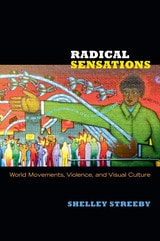
Radical Sensations
World Movements, Violence, and Visual CultureShelley Streeby
Duke University Press, 2013
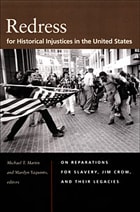
Redress for Historical Injustices in the United States
On Reparations for Slavery, Jim Crow, and Their LegaciesMichael T. Martin and Marilyn Yaquinto, eds.
Duke University Press, 2007
Written by activists and scholars of law, political science, African American studies, philosophy, economics, and history, the twenty-six essays include both previously published articles and pieces written specifically for this volume. Essays theorize the historical and legal bases of claims for redress; examine the history, strengths, and limitations of the reparations movement; and explore its relation to human rights and social justice movements in the United States and abroad. Other essays evaluate the movement’s primary strategies: legislation, litigation, and mobilization. While all of the contributors support the campaign for redress in one way or another, some of them engage with arguments against reparations.
Among the fifty-three primary documents included in the volume are federal, state, and municipal acts and resolutions; declarations and statements from organizations including the Black Panther Party and the NAACP; legal briefs and opinions; and findings and directives related to the provision of redress, from the Oklahoma Commission to Study the Tulsa Race Riot of 1921 to the mandate for the Greensboro Truth and Reconciliation Commission. Redress for Historical Injustices in the United States is a thorough assessment of the past, present, and future of the modern reparations movement.
Contributors. Richard F. America, Sam Anderson, Martha Biondi, Boris L. Bittker, James Bolner, Roy L. Brooks, Michael K. Brown, Robert S. Browne, Martin Carnoy, Chiquita Collins, J. Angelo Corlett, Elliott Currie, William A. Darity, Jr., Adrienne Davis, Michael C. Dawson, Troy Duster, Dania Frank, Robert Fullinwider, Charles P. Henry, Gerald C. Horne, Robert Johnson, Jr., Robin D. G. Kelley, Jeffrey R. Kerr-Ritchie, Theodore Kornweibel, Jr., David Lyons, Michael T. Martin, Douglas S. Massey , Muntu Matsimela , C. J. Munford, Yusuf Nuruddin, Charles J. Ogletree Jr., Melvin L. Oliver, David B. Oppenheimer, Rovana Popoff, Thomas M. Shapiro, Marjorie M. Shultz, Alan Singer, David Wellman, David R. Williams, Eric K. Yamamoto, Marilyn Yaquinto

Reformed American Dreams
Welfare Mothers, Higher Education, and ActivismSheila M. Katz
Rutgers University Press, 2019
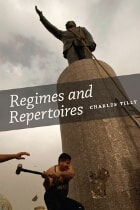
Regimes and Repertoires
Charles Tilly
University of Chicago Press, 2006
The means by which people protest—that is, their repertoires of contention—vary radically from one political regime to the next. Highly capable undemocratic regimes such as China's show no visible signs of popular social movements, yet produce many citizen protests against arbitrary, predatory government. Less effective and undemocratic governments like the Sudan’s, meanwhile, often experience regional insurgencies and even civil wars. In Regimes and Repertoires, Charles Tilly offers a fascinating and wide-ranging case-by-case study of various types of government and the equally various styles of protests they foster.
Using examples drawn from many areas—G8 summit and anti-globalization protests, Hindu activism in 1980s India, nineteenth-century English Chartists organizing on behalf of workers' rights, the revolutions of 1848, and civil wars in Angola, Chechnya, and Kosovo—Tilly masterfully shows that such episodes of contentious politics unfold like loosely scripted theater. Along the way, Tilly also brings forth powerful tools to sort out the reasons why certain political regimes vary and change, how the people living under them make claims on their government, and what connections can be drawn between regime change and the character of contentious politics.

Remembering the AIDS Quilt
Charles E. Morris III
Michigan State University Press, 2011
Replace the State
How to Change the World When Elections and Protests FailSasha Davis
University of Minnesota Press, 2025
A practical call to action against oppression
Across the globe, millions of people have participated in protests and marches, donated to political groups, or lobbied their representatives with the aim of creating lasting social change, overturning repressive laws, or limiting environmental destruction. Yet very little seems to improve for those affected by rapacious governments. Replace the State brings new hope for social justice movements by looking to progressive campaigns that have found success by unconventional, and more direct, means.
Sasha Davis, an activist and scholar of radical environmental advocacy, focuses on the strategies of movements, many of them Indigenous, that have occupied contested sites and demonstrated their effectiveness at managing or governing them. Including case studies of resistance to development on Indigenous lands in Hawai‘i, nuclear testing in the Nevada desert, and the U.S. military occupation of Okinawa, he offers insight and direction for activists, students, academics, and others dedicated to protecting and improving the well-being of their communities and beyond.
It would be easy to succumb to pessimism and political apathy in the face of governing institutions that are increasingly unresponsive to calls for change and repressive in response to protest, even as they violate human rights, ignore existential climate catastrophes, and concentrate power into fewer and fewer hands. Instead, Davis finds inspiration for genuine political change through social movements that are successfully “replacing the state” and taking over the day-to-day governance of threatened places. From contesting environmental abuse to reasserting Indigenous sovereignty, these social movements demonstrate how people can collectively wrest control over their communities from oppressive governments and manage them with a more egalitarian ethics of care.
Retail e-book files for this title are screen-reader friendly with images accompanied by short alt text and/or extended descriptions.

Resist the Punitive State
Grassroots Struggles Across Welfare, Housing, Education and PrisonsEmily Luise Hart
Pluto Press, 2019

Resist the Punitive State
Grassroots Struggles Across Welfare, Housing, Education and PrisonsEmily Luise Hart
Pluto Press, 2019
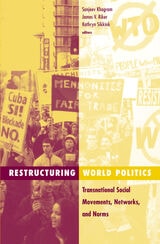
Restructuring World Politics
Transnational Social Movements, Networks, And NormsSanjeev Khagram
University of Minnesota Press, 2002
From the earliest campaign against Augusto Pinochet’s repressive practices to the recent massive demonstrations against the World Trade Organization, transnational collective action involving nongovernmental organizations has been restructuring politics and changing the world. Ranging from Santiago to Seattle and covering more than twenty-five years of transnational advocacy, the essays in Restructuring World Politics offer a clear, richly nuanced picture of this process and its far-reaching implications in an increasingly globalized political economy. The book brings together scholars, activists, and policy makers to show how such advocacy addresses—and reshapes—key issues in the areas of labor, human rights, gender justice, democratization, and sustainable development throughout the world.
A primary goal of transnational advocacy is to create, strengthen, implement, and monitor international norms. How transnational networks go about doing this, why and when they succeed, and what problems and complications they face are the main themes of this book. Looking at a wide range of cases where nongovernmental actors attempt to change norms and the practices of states, international organizations, and firms in the private sector—from debt restructuring to protecting human rights, from anti-dam projects in India to the prodemocracy movement in Indonesia—the authors compellingly depict international nongovernmental organizations and transnational social movements as considerable, emerging powers in international politics, initiating, facilitating, and directing the transformation of global norms and practices.
Contributors: Karen Brown Thompson, U of Minnesota; Charles T. Call, Brown U; Elizabeth A. Donnelly, Harvard U; Darren Hawkins, Brigham Young U; Thalia G. Kidder; Smitu Kothari; Paul J. Nelson, U of Pittsburgh; August Nimtz, U of Minnesota; Mark Ritchie, Institute for Agriculture and Trade Policy; Jackie Smith, SUNY Stony Brook; Daniel C. Thomas, U of Illinois, Chicago.

Revisiting Minjung
New Perspectives on the Cultural History of 1980s South KoreaSunyoung Park, Editor
University of Michigan Press, 2019
Revisiting Minjung brings new themes, new subjectivities, and new theoretical perspectives to the study of the rich ecosystem of 1980s Korean culture. Treated here is a wide array of topics, including the origins of minjung ideology, its critique by the right wing, minjung art and music, workers’ literary culture, women writers and the resurgence of feminism, erotic cinema, science fiction, transnational political travels, and the representations of race and queerness in 1980s popular culture. The book thus details the origins and development of some of the movements that shape cultural life in South Korea today, and it does so through analyses that engage some of the most pressing debates in current scholarship in Korea and abroad.

Rhyming Hope and History
Activists, Academics, and Social Movement ScholarshipDavid Croteau
University of Minnesota Press, 2005
Contributors: Kevin M. Carragee, Suffolk U; Catherine Corrigall-Brown, U of California, Irvine; Myra Marx Ferree, U of Wisconsin, Madison; Richard Flacks, U of California, Santa Barbara; Adria D. Goodson; Richard Healy and Sandra Hinson, Grassroots Policy Project; David Meyer, U of California, Irvine; Cynthia Peters, Worker Education Program of the Service Employees International Union, Local 2020; Barbara Risman, North Carolina State U; Robert J. S. Ross, Clark U; Leila J. Rupp, U of California, Santa Barbara; Cassie Schwerner, Schott Foundation; Valerie Sperling, Clark U; David A. Snow, U of California, Irvine; Verta Taylor, U of California, Santa Barbara.
David Croteau is formerly associate professor of sociology and anthropology at Virginia Commonwealth University. William Hoynes is professor of sociology and director of media studies at Vassar College. Charlotte Ryan is codirector of the Media Research and Action Project at Boston College. William A. Gamson is professor of sociology at Boston College.
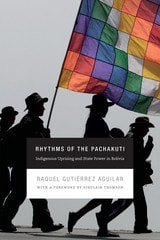
Rhythms of the Pachakuti
Indigenous Uprising and State Power in BoliviaRaquel Gutiérrez Aguilar
Duke University Press, 2014
"In Rhythms of the Pachakuti we can sense the reverberations of an extraordinary historical process that took place in Bolivia at the start of the twenty-first century. The book is the product of Raquel Gutiérrez Aguilar's political engagement in that historical process. . . . Though of Mexican nationality, [she] was intimately involved in Bolivian politics for many years and acquired a quasi-legendary status there as an intense, brilliant activist and radical intellectual. . . . [Her account is] . . . itself a revolutionary document. . . . Rhythms of the Pachakuti deserves to stand as a key text in the international literature of radicalism and emancipatory politics in the new century."—Sinclair Thomson, from the foreword
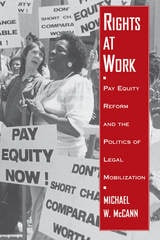
Rights at Work
Pay Equity Reform and the Politics of Legal MobilizationMichael W. McCann
University of Chicago Press, 1994
Rights at Work explores the political strategies in more than a dozen pay equity struggles since the late 1970s, including battles of state employees in Washington and Connecticut, as well as city employees in San Jose and Los Angeles. Relying on interviews with over 140 union and feminist activists, McCann shows that, even when the courts failed to correct wage discrimination, litigation and other forms of legal advocacy provided reformers with the legal discourse—the understanding of legal rights and their constraints—for defining and advancing their cause.
Rights at Work offers new insight into the relation between law and social change—the ways in which grass roots social movements work within legal rights traditions to promote progressive reform.
Rising Up, Living On
Re-Existences, Sowings, and Decolonial CracksCatherine E. Walsh
Duke University Press, 2023

Rivalry and Reform
Presidents, Social Movements, and the Transformation of American PoliticsSidney M. Milkis and Daniel J. Tichenor
University of Chicago Press, 2019
Rivalry and Reform explores the relationship between presidents and social movements throughout history and into the present day, revealing the patterns that emerge from the epic battles and uneasy partnerships that have profoundly shaped reform. Through a series of case studies, including Abraham Lincoln and abolitionism, Lyndon Johnson and the civil rights movement, and Ronald Reagan and the religious right, Sidney M. Milkis and Daniel J. Tichenor argue persuasively that major political change usually reflects neither a top-down nor bottom-up strategy but a crucial interplay between the two. Savvy leaders, the authors show, use social movements to support their policy goals. At the same time, the most successful social movements target the president as either a source of powerful support or the center of opposition. The book concludes with a consideration of Barack Obama’s approach to contemporary social movements such as Black Lives Matter, United We Dream, and Marriage Equality.

Riverine Citizenship
A Bosnian City in Love with the RiverAzra Hromadžic
Central European University Press, 2024
Water potential is a significant natural wealth of most parts of the Balkans, and it has given rise to a surge in hydropower investments unparalleled across Europe. As part of the process, a dam was planned to be built on the Una River, which runs through the Bosnian town of Bihać. This prospect alarmed the city’s residents, culminating in a protest in 2015. The book begins with this protest, and it explores how the threat of dam construction transformed the seemingly apolitical love of the river into a powerful political force around which thousands of people mobilized: riverine citizenship.
The book is based on interviews with participants, archival research, and over twenty years of ethnographic research. Azra Hromadžić focuses on the tension between ecological sustainability efforts in favor of renewable energy, on the one hand, and citizens’ historically shaped, deeply-felt, love for the river, on the other. She shows how the language and promises of green transition can mask the forces of capitalist accumulation that drive this change — whether in the form of building hydroelectric dams or promoting eco-tourism — and thus set in motion another cycle of environmental degradation, social dispossession, and economic exploitation.

Roots of Reform
Farmers, Workers, and the American State, 1877-1917Elizabeth Sanders
University of Chicago Press, 1999
Based on new evidence from legislative records and other sources, Sanders shows that this tenuous alliance of "producers versus plutocrats" shaped early regulatory legislation, remained powerful through the populist and progressive eras, and developed a characteristic method of democratic state expansion with continued relevance for subsequent reform movements.
Roots of Reform is essential reading for anyone interested in this crucial period of American political development.

Routing the Opposition
Social Movements, Public Policy, and DemocracyDavid S. Meyer
University of Minnesota Press, 2005