Results by title
661 books match the query 'South America' and 37 start with r
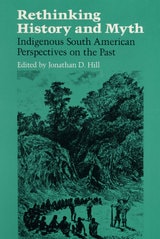
RETHINKING HISTORY
Indigenous South American Perspectives on the PastEdited by Jonathan D. Hill
University of Illinois Press, 2000
Examining specific cultural and linguistic traditions that shape the social consciousness of native South Americans, the authors show that historical and mythic consciousness work together in forming new symbolic strategies that allow indigenous peoples to understand their societies as at least partially autonomous groups within national and global power structures. This complex process is used to interpret the history of interethnic relations, allowing both individuals and groups to change themselves and alter their own circumstances.
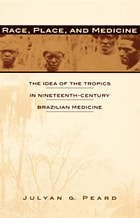
Race, Place, and Medicine
The Idea of the Tropics in Nineteenth-Century BrazilJulyan G. Peard
Duke University Press, 1999
Peard shows how the Tropicalistas adapted Western medicine and challenged the Brazilian medical status quo in order to find new answers to the old question of whether the diseases of warm climates were distinct from those of temperate Europe. They carried out innovative research on parasitology, herpetology, and tropical disorders, providing evidence that countered European assumptions about Brazilian racial and cultural inferiority. In the face of European fatalism about health care in the tropics, the Tropicalistas forged a distinctive medicine based on their beliefs that public health would improve only if large social issues—such as slavery and abolition—were addressed and that the delivery of health care should encompass groups hitherto outside the doctors’ sphere, especially women. But the Tropicalistas’ agenda, which included biting social critiques and broad demands for the extension of health measures to all of Brazil’s people, was not sustained. Race, Place, and Medicine shows how imported models of tropical medicine—constructed by colonial nations for their own needs—downplayed the connection between socioeconomic factors and tropical disorders.
This study of a neglected episode in Latin American history will interest Brazilianists, as well as scholars of Latin American, medical, and scientific history.
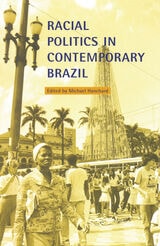
Racial Politics in Contemporary Brazil
Michael Hanchard, ed.
Duke University Press, 1999
The contributors to Racial Politics in Contemporary Brazil examine such topics as the legacy of slavery and its abolition, the historical impact of social movements, race-related violence, and the role of Afro-Brazilian activists in negotiating the cultural politics surrounding the issue of Brazilian national identity. These essays also provide comparisons of racial discrimination in the United States and Brazil, as well as an analysis of residential segregation in urban centers and its affect on the mobilization of blacks and browns. With a focus on racialized constructions of class and gender and
sexuality, Racial Politics in Contemporary Brazil reorients the direction of Brazilian studies, providing new insights into Brazilian culture, politics, and race relations.
This volume will be of importance to a wide cross section of scholars engaged with Brazil in particular, and Latin American studies in general. It will also appeal to those invested in the larger issues of political and social movements centered on the issue of race.
Contributors. Benedita da Silva, Nelson do Valle Silva, Ivanir dos Santos, Richard Graham, Michael Hanchard, Carlos Hasenbalg, Peggy A. Lovell, Michael Mitchell, Tereza Santos, Edward Telles, Howard Winant
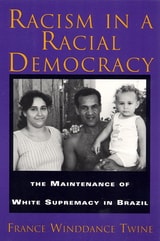
Racism in a Racial Democracy
The Maintenance of White Supremacy in BrazilTwine, Francine Winddance
Rutgers University Press, 1997
In Racism in a Racial Democracy, France Winddance Twine asks why Brazilians, particularly Afro-Brazilians, continue to have faith in Brazil's "racial democracy" in the face of pervasive racism in all spheres of Brazilian life. Through a detailed ethnography, Twine provides a cultural analysis of the everyday discursive and material practices that sustain and naturalize white supremacy.
This is the first ethnographic study of racism in southeastern Brazil to place the practices of upwardly mobile Afro-Brazilians at the center of analysis. Based on extensive field research and more than fifty life histories with Afro- and Euro-Brazilians, this book analyzes how Brazilians conceptualize and respond to racial disparities. Twine illuminates the obstacles Brazilian activists face when attempting to generate grassroots support for an antiracist movement among the majority of working class Brazilians. Anyone interested in racism and antiracism in Latin America will find this book compelling.
"Twine offers one of the most sophisticated analyses to date of the intransigence of Brazilian racism. Her nuanced account of the complex interplay of gender, race, and class is particularly exciting. This book will have a powerful impact not only on the field of Brazilian racial studies, but on the whole burgeoning literature on the African Diaspora." -- Howard Winant, author of Racial Conditions: Politics, Theory, Comparisons
"A revealing and sharply observed dissection of how racism works 'on the ground' in Brazil." -- George Reid Andrews, author of Blacks and Whites in Sao Paulo, Brazil, 1888-1988

Rain Forest Literatures
Amazonian Texts And Latin American CultureLucia Sa
University of Minnesota Press, 2004
Recaptures native literatures of the Amazonian rain forest
Native texts of the Amazonian rain forest have been viewed as myth or ethnographic matter—the raw material of literature—rather than as significant works in their own right. But in this unprecedented study, Lúcia Sá approaches indigenous texts as creative works rather than source material.
Disclosing the existence and nature of long-standing, rich, and complex Native American literary and intellectual traditions that have typically been neglected or demeaned by literary criticism, Rain Forest Literatures analyzes four indigenous cultural traditions: the Carib, Tupi-Guarani, Upper Rio Negro, and Western Arawak. In each case, Sá considers principal native texts and, where relevant, their publication history. She offers a historical overview of the impact of these texts on mainstream Spanish-American and Brazilian literatures, detailing comparisons with native sources and making close analyses of major instances, such as Mário de Andrade’s classic Macunaima (1928) and Mario Vargas Llosa’s The Storyteller (1986). A redrawing of the lineage of Brazilian and Spanish-American literatures, this book advocates an understanding of the relationships between cultures as a process of “transculturation” rather than “acculturation,” emphasizing the often-ignored impact of the peripheral culture on the one that assumes dominance.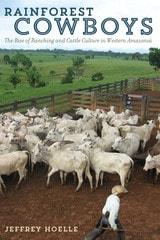
Rainforest Cowboys
The Rise of Ranching and Cattle Culture in Western AmazoniaBy Jeffrey Hoelle
University of Texas Press, 2015
This ambitious interdisciplinary study is the first to examine the interlinked economic uses and cultural practices and beliefs surrounding cattle in Western Amazonia, where cattle raising is at the center of debates about economic development and environ
Winner, Brazil Section Book Award, Latin American Studies Association, 2016
The opening of the Amazon to colonization in the 1970s brought cattle, land conflict, and widespread deforestation. In the remote state of Acre, Brazil, rubber tappers fought against migrant ranchers to preserve the forest they relied on, and in the process, these “forest guardians” showed the world that it was possible to unite forest livelihoods and environmental preservation. Nowadays, many rubber tappers and their children are turning away from the forest-based lifestyle they once sought to protect and are becoming cattle-raisers or even caubois (cowboys). Rainforest Cowboys is the first book to examine the social and cultural forces driving the expansion of Amazonian cattle raising in all of their complexity.
Drawing on eighteen months of fieldwork, Jeffrey Hoelle shows how cattle raising is about much more than beef production or deforestation in Acre, even among “carnivorous” environmentalists, vilified ranchers, and urbanites with no land or cattle. He contextualizes the rise of ranching in relation to political economic structures and broader meanings to understand the spread of “cattle culture.” This cattle-centered vision of rural life builds on local experiences and influences from across the Americas and even resembles East African cultural practices. Written in a broadly accessible and interdisciplinary style, Rainforest Cowboys is essential reading for a global audience interested in understanding the economic and cultural features of cattle raising, deforestation, and the continuing tensions between conservation and development in the Amazon.
Reading Inca History
Catherine Julien
University of Iowa Press, 2002
At the heart of this book is the controversy over whether Inca history can and should be read as history. Did the Incas narrate a true reflection of their past, and did the Spaniards capture these narratives in a way that can be meaningfully reconstructed? In Reading Inca History,Catherine Julien finds that the Incas did indeed create detectable life histories.
The two historical genres that contributed most to sixteenth- and seventeenth-century Spanish narratives about the Incas were an official account of Inca dynastic genealogy and a series of life histories of Inca rulers. Rather than take for granted that there was an Inca historical consciousness, Julien begins by establishing an Inca purpose for keeping this dynastic genealogy. She then compares Spanish narratives of the Inca past to identify the structure of underlying Inca genres and establish the dependency on oral sources. Once the genealogical genre can be identified, the life histories can also be detected.
By carefully studying the composition of Spanish narratives and their underlying sources, Julien provides an informed and convincing reading of these complex texts. By disentangling the sources of their meaning, she reaches across time, language, and cultural barriers to achieve a rewarding understanding of the dynamics of Inca and colonial political history.
Reading the Illegible
Indigenous Writing and the Limits of Colonial Hegemony in the AndesLaura Leon Llerena
University of Arizona Press, 2023
The concept of legibility allows us to reconsider this unique manuscript within the intertwined histories of literacy, knowledge, and colonialism. Reading the Illegible shows that the anonymous author(s) of the Huarochirí Manuscript, along with two contemporaneous Andean-authored texts by Joan de Santa Cruz Pachacuti and Felipe Guaman Poma de Ayala, rewrote the history of writing and the notion of Christianity by deploying the colonizers’ technology of alphabetic writing.
Reading the Illegible weaves together the story of the peoples, places, objects, and media that surrounded the creation of the anonymous Huarochirí Manuscript to demonstrate how Andean people endowed the European technology of writing with a new social role in the context of a multimedia society.
Rebellion in the Backlands
Euclides da Cunha
University of Chicago Press, 1957
Euclides da Cunha's classic account of the brutal campaigns against religious mystic Antonio Conselheiro has been praised by readers around the world as perhaps the greatest book ever written about Brazil. An epic of nonfiction that reads like a novel, it has been hailed by the likes of Stefan Zweig and Elizabeth Hardwick for its prose and its insights into the character of Brazil as the nation was being formed. Da Cunha tells the story of a guerrilla rebellion in the remote village of Canudos that fought the central government from 1893 to 1897, of the challenging conditions that led the people to revolt, and of the violent repression that resulted. A national epic like no other, Rebellion in the Backlands is a lasting classic, a book that has been handed from reader to reader for decades.
Reckoning with Pinochet
The Memory Question in Democratic Chile, 1989–2006Steve J. Stern
Duke University Press, 2010
Stern’s analysis integrates policymaking by elites, grassroots efforts by human rights victims and activists, and inside accounts of the truth commissions and courts where top-down and bottom-up initiatives met. Interpreting solemn presidential speeches, raucous street protests, interviews, journalism, humor, cinema, and other sources, he describes the slow, imperfect, but surprisingly forceful advance of efforts to revive democratic values through public memory struggles, despite the power still wielded by the military and a conservative social base including the investor class. Over time, resourceful civil-society activists and select state actors won hard-fought, if limited, gains. As a result, Chileans were able to face the unwelcome past more honestly, launch the world’s first truth commission to examine torture, ensnare high-level perpetrators in the web of criminal justice, and build a public culture of human rights. Stern provides an important conceptualization of collective memory in the wake of national trauma in this magisterial work of history.
Reckoning
The Ends of War in GuatemalaDiane M. Nelson
Duke University Press, 2009
Nelson brings together stories of human rights activism, Mayan identity struggles, coerced participation in massacres, and popular entertainment—including traditional dances, horror films, and carnivals—with analyses of mass-grave exhumations, official apologies, and reparations. She discusses the stereotype of the Two-Faced Indian as colonial discourse revivified by anti-guerrilla counterinsurgency and by the claims of duplicity leveled against the Nobel laureate Rigoberta Menchú, and she explores how duplicity may in turn function as a survival strategy for some. Nelson examines suspicions that state power is also two-faced, from the left’s fears of a clandestine para-state behind the democratic façade, to the right’s conviction that NGOs threaten Guatemalan sovereignty. Her comparison of antimalaria and antisubversive campaigns suggests biopolitical ways that the state is two-faced, simultaneously giving and taking life. Reckoning is a view from the ground up of how Guatemalans are finding creative ways forward, turning ledger books, technoscience, and even gory horror movies into tools for making sense of violence, loss, and the future.
Reclaiming the Discarded
Life and Labor on Rio's Garbage DumpKathleen M. Millar
Duke University Press, 2018
Reclaiming the Political in Latin American History
Essays from the NorthGilbert M. Joseph, ed.
Duke University Press, 2001
Taking careful stock of the state of historical writing on Latin America, the volume delineates current historiographical frontiers and suggests a series of new approaches that focus on several pivotal themes: the construction of historical narratives and memory; the articulation of class, race, gender, sexuality, and generation; and the historian’s involvement in the making of history. Although the book represents a view of the Latin American political that comes primarily from the North, the influence of Viotti da Costa powerfully marks the contributors’ engagement with Latin America’s past. Featuring a keynote essay by Viotti da Costa herself, the volume’s lively North-South encounter embodies incipient trends of hemispheric intellectual convergence.
Contributors. Jeffrey L. Gould, Greg Grandin, Daniel James, Gilbert M. Joseph, Thomas Miller Klubock, Mary Ann Mahony, Florencia E. Mallon, Diana Paton, Steve J. Stern, Heidi Tinsman, Emilia Viotti da Costa, Barbara Weinstein
Red Against Blue
The Liberal Party in Colombian Politics, 1863 - 1899Helen Delpar
University of Alabama Press, 1981
A landmark study of Liberalism, political conflict, and nation-building in Colombia.
Red Against Blue: The Liberal Party in Colombian Politics, 1863–1899 is a seminal study of the political forces that shaped modern Colombia during the nineteenth century. In this carefully researched work, historian Helen Delpar traces the rise, dominance, decline, and transformation of the Colombian Liberal Party, offering readers a deeper understanding of one of Latin America's most influential political movements. Through extensive use of political writings, personal papers, electoral records, and contemporary sources, Delpar reconstructs the complex world of Colombian politics during an era marked by ideological conflict, regional division, constitutional experimentation, and recurring civil unrest.
The book examines the period from the adoption of the federal Constitution of 1863 through the end of the nineteenth century, when Liberal leaders sought to shape Colombia's political future while confronting growing opposition from Conservative rivals. Delpar explores the origins of Colombian Liberalism, the development of party ideology, the regional bases of political support, and the personalities who guided the party through both triumph and defeat. Her analysis reveals a political movement that was far more diverse and dynamic than conventional interpretations have suggested.
As Liberal influence declined in the 1880s and Conservatives consolidated power under the Regeneration movement, political tensions intensified. Delpar shows how these struggles helped lay the groundwork for the devastating War of the Thousand Days at the century's close, one of the most significant conflicts in Colombian history.
Combining narrative history with insightful political analysis, Red Against Blue remains an indispensable resource for students and scholars of Latin American history, political development, democracy, and nation-building. It offers a compelling portrait of a society grappling with questions of power, ideology, regional identity, and the meaning of political participation in a rapidly changing world.
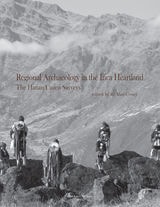
Regional Archaeology in the Inca Heartland
The Hanan Cuzco SurveysEdited by R. Alan Covey
University of Michigan Press, 2014
The Cuzco region of highland Peru was the heartland of the Inca empire, the largest native state to develop in the Americas. Archaeologists have studied Inca monumental architecture for more than a century, but it is only in recent decades that regional survey work has systematically sought to reconstruct patterns of settlement, subsistence, and social organization in the region. This monograph presents the results of regional surveys conducted (from 2000 to 2008) to the north and west of the city of Cuzco, a region of approximately 1200 square kilometers that was investigated using the same field methodology as other systematic surveys in the Cuzco region. The study region, referred to as Hanan Cuzco in this volume, encompasses considerable environmental variations, ranging from warm valley-bottom lands to snow-capped mountains. The chapters in this volume present settlement pattern data from all periods of pre-Columbian occupation—from the arrival of the first hunter-gatherers to the transformation of valley-bottom fields by the last Inca emperors. A chapter on the colonial period discusses how Spanish colonial practices transformed an imperial landscape into a peripheral one. Together, the chapters in this volume contribute to the archaeological understanding of several central issues in Andean prehistory.
Regional Archaeology in the Valle de la Plata, Colombia/Arqueología Regional en el Valle de la Plata, Colombia
Edited by Robert D. Drennan
University of Michigan Press, 1985
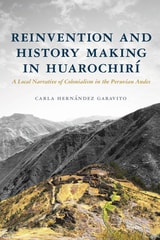
Reinvention and History Making in Huarochirí
A Local Narrative of Colonialism in the Peruvian AndesCarla Hernández Garavito
University of Arizona Press, 2026
Using archaeological and historical datasets and spatial modeling, this book centers on local memory and experience throughout colonized landscapes as the thread that connects the long history of Indigenous engagement with expanding colonial empires and the emergent Peruvian nation. The author builds on Andean epistemological frameworks to argue that in the face of drastic sociopolitical changes, the people of Huarochirí turned to their own history. They created analogies and shared spaces between local and Inka landscapes and materiality and incorporated written representations and ideas of settled lives to validate their claims.
This exciting new work moves the field of Andean archaeology into conversations with decolonial and decolonizing methodologies and shows how Indigenous communities captured and made sense of their long history, reframing colonialism as a local experience.
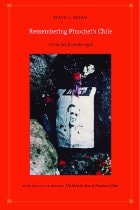
Remembering Pinochet's Chile
On the Eve of London 1998Steve J. Stern
Duke University Press, 2004
“A thoughtful, nuanced study of how Chileans remember the traumatic 1973 coup by Augusto Pinochet against Salvador Allende and the nearly two decades of military government that followed. . . . In light of the recent revelations of American human rights abuses of Iraqi prisoners, [Stern’s] insights into the legacies of torture and abuse in the Chilean prisons of the 1970s certainly have contemporary significance for any society that undergoes a national trauma.”—Publishers Weekly
“This outstanding work of scholarship sets a benchmark in the history of state terror, trauma, and memory in Latin America.”—Thomas Miller Klubock, American Historical Review
“This is a book of uncommon depth and introspection. . . . Steve J. Stern has not only advanced the memory of the horrors of the military dictatorship; he has assured the place of Pinochet’s legacy of atrocity in our collective conscience.”—Peter Kornbluh, author of The Pinochet File: A Declassified Dossier on Atrocity and Accountability
“Steve J. Stern’s book elegantly recounts the conflicted recent history of Chile. He has found a deft solution to the knotty problem of evenhandedness in representing points of view so divergent they defy even the most careful attempts to portray the facts of the Pinochet period. He weaves a tapestry of memory in which narratives of horror and rupture commingle with the sincere perceptions of Chileans who remember Pinochet’s rule as salvation. The facts are there, but more important is the understanding we gain by knowing how ordinary Chileans—Pinochet’s supporters and his victims—work through their unresolved past.”—John Dinges, author of The Condor Years: How Pinochet and His Allies Brought Terrorism to Three Continents
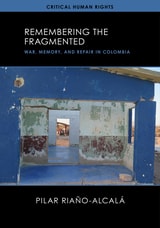
Remembering the Fragmented
War, Memory, and Repair in ColombiaPilar Riaño-Alcalá
University of Wisconsin Press, 2027
The South American nation of Colombia has experienced decades of violence involving state, guerrilla, and paramilitary actors, resulting in profound and enduring consequences. Scholars have examined both the violent events and the subsequent truth and reconciliation initiatives addressing this complex history. Pilar Riaño-Alcalá introduces a novel perspective by integrating Black, Indigenous, and memory studies in her analysis of two significant sites of mass violence: Bahia Portete, a Wayuu Indigenous territory in Upper Guajira, and Bojayá, a Black and Embera Indigenous territory in Chocó. By recognizing nonhuman and nonliving community members as actants and foregrounding Indigenous and Black ontologies in collective remembrance, Riaño-Alcalá reveals the processes through which these communities engage in social repair. She demonstrates how they interpret, restore, sustain, and reimagine their identities amid ongoing challenges posed by war and racial capitalism. This work advances scholarship in human rights studies, memory studies, Indigenous studies, Latin American studies, and the anthropology of social repair, offering significant new insights into a well-examined historical context.
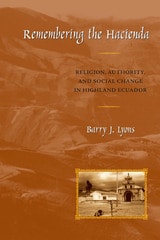
Remembering the Hacienda
Religion, Authority, and Social Change in Highland EcuadorBy Barry J. Lyons
University of Texas Press, 2006
From the colonial period through the mid-twentieth century, haciendas dominated the Latin American countryside. In the Ecuadorian Andes, Runa—Quichua-speaking indigenous people—worked on these large agrarian estates as virtual serfs. In Remembering the Hacienda: Religion, Authority, and Social Change in Highland Ecuador, Barry Lyons probes the workings of power on haciendas and explores the hacienda's contemporary legacy.
Lyons lived for three years in a Runa village and conducted in-depth interviews with elderly former hacienda laborers. He combines their wrenching accounts with archival evidence to paint an astonishing portrait of daily life on haciendas. Lyons also develops an innovative analysis of hacienda discipline and authority relations. Remembering the Hacienda explains the role of religion as well as the reshaping of Runa culture and identity under the impact of land reform and liberation theology.
This beautifully written book is a major contribution to the understanding of social control and domination. It will be valuable reading for a broad audience in anthropology, history, Latin American studies, and religious studies.
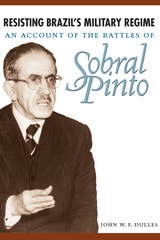
Resisting Brazil's Military Regime
An Account of the Battles of Sobral PintoBy John W. F. Dulles
University of Texas Press, 2007
Praised by his many admirers as a "courageous and fearless" defender of human rights, Heráclito Fontoura Sobral Pinto (1893-1991) was the most consistently forceful opponent of the regime of Brazilian dictator Getúlio Vargas. John W. F. Dulles chronicled Sobral's battles with the Vargas government in Sobral Pinto, "The Conscience of Brazil": Leading the Attack against Vargas (1930-1945), which History: Reviews of New Books called "a must-read for anyone wanting to understand twentieth-century Brazil."
In this second and final volume of his biography of Sobral Pinto, Professor Dulles completes the story of the fiery crusader's fight for democracy, morality, and justice, particularly for the downtrodden. Drawing on Sobral's vast correspondence, Dulles offers an extensive account of Sobral's opposition to the military regime that ruled Brazil from 1964 to 1985. He describes how Sobral Pinto defended those who had been politically influential before April, 1964, as well as other victims of the regime, including Communists, once-powerful labor leaders, priests, militant journalists, and students. Because Sobral Pinto participated in so many of the struggles against the military regime, his experiences provide vivid new insights into this important period in recent Brazilian history. They also shed light on developments in the Catholic Church (Sobral, a devout Catholic, vigorously opposed liberation theology), as well as on Sobral's key role in preserving Brazil's commission for defending human rights.
Resource Radicals
From Petro-Nationalism to Post-Extractivism in EcuadorThea Riofrancos
Duke University Press, 2020
Rethinking the Inka
Community, Landscape, and Empire in the Southern AndesEdited by Frances M. Hayashida, Andrés Troncoso, and Diego Salazar
University of Texas Press, 2022
2023 Book Award, Society for American Archaeology
A dramatic reappraisal of the Inka Empire through the lens of Qullasuyu.
The Inka conquered an immense area extending across five modern nations, yet most English-language publications on the Inka focus on governance in the area of modern Peru. This volume expands the range of scholarship available in English by collecting new and notable research on Qullasuyu, the largest of the four quarters of the empire, which extended south from Cuzco into contemporary Bolivia, Argentina, and Chile.
From the study of Qullasuyu arise fresh theoretical perspectives that both complement and challenge what we think we know about the Inka. While existing scholarship emphasizes the political and economic rationales underlying state action, Rethinking the Inka turns to the conquered themselves and reassesses imperial motivations. The book’s chapters, incorporating more than two hundred photographs, explore relations between powerful local lords and their Inka rulers; the roles of nonhumans in the social and political life of the empire; local landscapes remade under Inka rule; and the appropriation and reinterpretation by locals of Inka objects, infrastructure, practices, and symbols. Written by some of South America’s leading archaeologists, Rethinking the Inka is poised to be a landmark book in the field.
Revolt of the Saints
Memory and Redemption in the Twilight of Brazilian Racial DemocracyJohn F. Collins
Duke University Press, 2015
Revolution in the Andes
The Age of Túpac AmaruSergio Serulnikov
Duke University Press, 2013
Revolution on the Pampas
A Social History of Argentine Wheat, 1860–1910By James R. Scobie
University of Texas Press, 1964
On the Argentine pampas, between the years 1860 and 1910, a dramatic social and agricultural revolution took place. The haunts of wild cattle, native peoples, and gauchos were transformed into cultivated fields and rich pastures. A land that had produced only scrawny sheep and cattle became one of the world’s leading exporters of wheat, corn, beef, mutton, and wool. A country that had had only a sparse and scattered Spanish and mestizo population now boasted a metropolis of one and a half million, and a national population of eight million people, nearly a third of whom were born in Europe. These were significant changes, and wheat growing played a major role in all of them. This study traces the development of the Argentine wheat zone, focusing on the part wheat played in forming the Argentina of today.
James R. Scobie begins his account with the first settlers who colonized Santa Fe in the 1850s and shows how they and thousands of other European immigrants converted this vast grassland into a world breadbasket. He explains why these small farmer-owners soon gave way to tenant farmers, and how crop farming developed primarily as servant to the predominant sheep and cattle interests. He expands on several factors responsible for this evolvement: the elimination of indigenous threat, the coming of the railroad, the agricultural policy—or lack of policy—of the Argentine government, and the urban orientation of the Argentine people.
The railroads, by suppressing the building of other roads through the pampas, had the effect of isolating the wheatgrowers. By making the products of the pampas available to world markets, the railroads opened up new trade, which helped the growth of cities tremendously; but this very prosperity pushed the cost of land far beyond the wheatgrower’s ability to buy it. The result was a pampas without settlers, a frontier filled with migrant sharecroppers and tenant farmers, a land exploited but not possessed. Transiency as well as isolation became the common denominators of these families, who were forced to move every few years to make way for more valued tenants—sheep and cattle. They left behind them no schools, no churches, no roads, no villages. Immigrants came to labor but not to sink their roots in the pampas.
Without sentimentality but with understanding and compassion, Scobie explores every facet of the lives of these laborers who created Argentina’s agricultural greatness. His examination of Argentina’s broad policies toward land, immigration, and tariffs shows that the national government had little lasting or effective interest in the country’s agricultural development. In a social sense, the thousands of immigrants who toiled the pampas were looked upon as the wild cattle or fertile soil—blessings which neither needed nor warranted official attention. Scobie’s conclusion is that Argentina got better than it deserved.
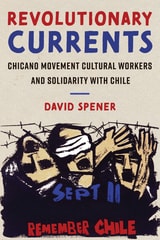
Revolutionary Currents
Chicano Movement Cultural Workers and Solidarity with ChileDavid Spener
University of Arizona Press, 2027
On September 11, 1973, General Augusto Pinochet led a bloody military coup in Chile that overthrew Salvador Allende’s democratically elected socialist government. The coup ushered in a cruelly repressive dictatorship that would govern the country for the next seventeen years, constituting a watershed moment in Cold War history.
This book recounts the untold story of how Chicano Movement poets, artists, musicians, and theater groups in the United States used their work to express solidarity with the international campaign to restore democracy in Chile. Such expressions of solidarity were especially prominent in the San Francisco Bay Area, where hundreds of Chilean exiles settled following the coup. Upon arrival, they joined a diverse Latinx population that was home to a Chicanx arts community whose members’ political orientations primed them to lend their talents to anti-imperialist causes. These Chicanxs were also drawn to the campaign against the dictatorship through friendship and acquaintance with members of the Chilean exile community.
David Spener shows how the Bay Area’s unique cosmopolitan social context offered Chicanxs and Chileans meaningful opportunities for dialogue and collaboration with each other as well as with Latinxs of other national origins. Chicanxs often adopted a pan-ethnic raza identity that they could share with Chilean, Nicaraguan, Puerto Rican, Salvadoran, and other Latinx activists. This did not mean, however, that they abandoned the political identities that they had gained from the Chicano Movement. Instead, many came to see themselves as uniting with other Latinxs, first Chileans and then Nicaraguans and Salvadorans, in a struggle against U.S. imperialism throughout the Americas.
Revolutionizing Repertoires
The Rise of Populist Mobilization in PeruRobert S. Jansen
University of Chicago Press, 2017
Drawing on pragmatist theories of social action, Revolutionizing Repertoires sets out to examine what happens when the repertoire of practices available to political actors is dramatically reconfigured. Taking as his case study the development of a distinctively Latin American style of populist mobilization, Robert S. Jansen analyzes the Peruvian presidential election of 1931. He finds that, ultimately, populist mobilization emerged in the country at this time because newly empowered outsiders recognized the limitations of routine political practice and understood how to modify, transpose, invent, and recombine practices in a whole new way. Suggesting striking parallels to the recent populist turn in global politics, Revolutionizing Repertoires offers new insights not only to historians of Peru but also to scholars of historical sociology and comparative politics, and to anyone interested in the social and political origins of populism.
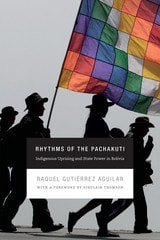
Rhythms of the Pachakuti
Indigenous Uprising and State Power in BoliviaRaquel Gutiérrez Aguilar
Duke University Press, 2014
"In Rhythms of the Pachakuti we can sense the reverberations of an extraordinary historical process that took place in Bolivia at the start of the twenty-first century. The book is the product of Raquel Gutiérrez Aguilar's political engagement in that historical process. . . . Though of Mexican nationality, [she] was intimately involved in Bolivian politics for many years and acquired a quasi-legendary status there as an intense, brilliant activist and radical intellectual. . . . [Her account is] . . . itself a revolutionary document. . . . Rhythms of the Pachakuti deserves to stand as a key text in the international literature of radicalism and emancipatory politics in the new century."—Sinclair Thomson, from the foreword
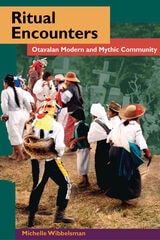
Ritual Encounters
Otavalan Modern and Mythic CommunityMichelle Wibbelsman
University of Illinois Press, 2008
This book examines ritual practices and public festivals in the Otavalo and Cotacachi areas of northern Andean Ecuador's Imbabura province. Otavaleños are a unique group in that they maintain their traditional identity but also cultivate a cosmopolitanism through frequent international travel. Ritual Encountersexplores the moral, mythic, and modern crossroads at which Otavaleños stand, and how, at this junction, they come to define themselves as millennial people.
Michelle Wibbelsman shows that Otavaleños are deeply engaged in transnational mobility and in the cultural transformations that have resulted from Otavalan participation in global markets, international consumer trends, and technological developments. Rituals have persisted among this ethnic community as important processes for symbolically capturing and critically assessing cultural changes in the face of modern influences. As religious expression, political commentary, transcendental communication, moral judgment, and transformative experience, Otavalan rituals constitute enduring practices that affirm ethnic identities, challenge dominant narratives, and take issue with power inequalities behind hegemony. Ritual Encounters thus offers an appreciation of the modern and mythic community as a single and emergent condition.
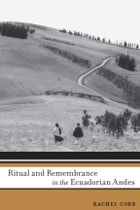
Ritual and Remembrance in the Ecuadorian Andes
Rachel Corr
University of Arizona Press, 2010
In this book Rachel Corr provides a knowledgeable account of the Salasacan religion and rituals and their respective histories. Based on eighteen years of fieldwork in Salasaca, as well as extensive research in Church archives—including never-before-published documents—Corr’s book illuminates how Salasacan culture adapted to Catholic traditions and recentered, reinterpreted, and even reshaped them to serve similarly motivated Salasacan practices, demonstrating the link between formal and folk Catholicism and pre-Columbian beliefs and practices. Corr also explores the intense connection between the local Salasacan rituals and the mountain landscapes around them, from peak to valley.
Ritual and Remembrance in the Ecuadorian Andes is, in its portrayal of Salasacan religious culture, both thorough and all-encompassing. Sections of the book cover everything from the performance of death rituals to stories about Amazonia as Salasacans interacted with outsiders—conquistadors and camera-toting tourists alike. Corr also investigates the role of shamanism in modern Salasacan culture, including shamanic powers and mountain spirits, and the use of reshaped, Andeanized Catholicism to sustain collective memory. Through its unique insider’s perspective of Salasacan spirituality, Ritual and Remembrance in the Ecuadorian Andes is a valuable anthropological work that honestly represents this people’s great ability to adapt.
Routine Crisis
An Ethnography of DisillusionSarah Muir
University of Chicago Press, 2021
Anthropologist Sarah Muir offers a cogent meditation on the limits of critique at this historical moment, drawing on deep experience in Argentina but reflecting on a truly global condition. If we feel things are being upended in a manner that is ongoing, tumultuous, and harmful, what would we need to do—and what would we need to give up—to usher in a revitalized critique for today's world? Routine Crisis is an original provocation and a challenge to think beyond the limits of exhaustion and reimagine a form of criticism for the twenty-first century.
Royal Commentaries of the Incas and General History of Peru, Part One
By Garcilaso de la Vega; translated by Harold V. Livermore
University of Texas Press, 1966
Garcilaso de la Vega, the first native of the New World to attain importance as a writer in the Old, was born in Cuzco in 1539, the illegitimate son of a Spanish cavalier and an Inca princess. Although he was educated as a gentleman of Spain and won an important place in Spanish letters, Garcilaso was fiercely proud of his Indian ancestry and wrote under the name EI Inca.
Royal Commentaries of the Incas is the account of the origin, growth, and destruction of the Inca empire, from its legendary birth until the death in 1572 of its last independent ruler. For the material in Part One of Royal Commentaries—the history of the Inca civilization prior to the arrival of the Spaniards—Garcilaso drew upon "what I often heard as a child from the lips of my mother and her brothers and uncles and other elders . . . [of] the origin of the Inca kings, their greatness, the grandeur of their empire, their deeds and conquests, their government in peace and war, and the laws they ordained so greatly to the advantage of their vassals."
The conventionalized and formal history of an oral tradition, Royal Commentaries describes the gradual imposition of order and civilization upon a primitive and barbaric world. To this Garcilaso adds facts about the geography and the flora and fauna of the land; the folk practices, religion, and superstitions; the agricultural and the architectural and engineering achievements of the people; and a variety of other information drawn from his rich store of traditional knowledge, personal observation, or speculative philosophy.
Important though it is as history, Garcilaso's classic is much more: it is also a work of art. Its gracious and graceful style, skillfully translated by Harold V. Livermore, succeeds in bringing to life for the reader a genuine work of literature.
Part One covers the history of the Incas up to the arrival of the Spanish.
Royal Commentaries of the Incas and General History of Peru, Part Two
By Garcilaso de la Vega; translated by Harold V. Livermore
University of Texas Press, 1966
Garcilaso de la Vega, the first native of the New World to attain importance as a writer in the Old, was born in Cuzco in 1539, the illegitimate son of a Spanish cavalier and an Inca princess. Although he was educated as a gentleman of Spain and won an important place in Spanish letters, Garcilaso was fiercely proud of his Indian ancestry and wrote under the name El Inca.
Royal Commentaries of the Incas is the account of the origin, growth, and destruction of the Inca empire, from its legendary birth until the death in 1572 of its last independent ruler. For the material in Part One of Royal Commentaries—the history of the Inca civilization prior to the arrival of the Spaniards—Garcilaso drew upon "what I often heard as a child from the lips of my mother and her brothers and uncles and other elders . . . [of] the origin of the Inca kings, their greatness, the grandeur of their empire, their deeds and conquests, their government in peace and war, and the laws they ordained so greatly to the advantage of their vassals."
The conventionalized and formal history of an oral tradition, Royal Commentaries describes the gradual imposition of order and civilization upon a primitive and barbaric world. To this Garcilaso adds facts about the geography and the flora and fauna of the land; the folk practices, religion, and superstitions; the agricultural and the architectural and engineering achievements of the people; and a variety of other information drawn from his rich store of traditional knowledge, personal observation, or speculative philosophy.
Important though it is as history, Garcilaso's classic is much more: it is also a work of art. Its gracious and graceful style, skillfully translated by Harold V. Livermore, succeeds in bringing to life for the reader a genuine work of literature.
Part Two covers the Spanish conquest of the Incas.
Royal Commentaries of the Incas and General History of Peru, Parts One and Two
Harold V. Garcilaso de la Vega
University of Texas Press, 2014
Garcilaso de la Vega, the first native of the New World to attain importance as a writer in the Old, was born in Cuzco in 1539, the illegitimate son of a Spanish cavalier and an Inca princess. Although he was educated as a gentleman of Spain and won an important place in Spanish letters, Garcilaso was fiercely proud of his Indian ancestry and wrote under the name El Inca.
Royal Commentaries of the Incas is the account of the origin, growth, and destruction of the Inca empire, from its legendary birth until the death in 1572 of its last independent ruler. For the material in Part One of Royal Commentaries—the history of the Inca civilization prior to the arrival of the Spaniards—Garcilaso drew upon "what I often heard as a child from the lips of my mother and her brothers and uncles and other elders . . . [of] the origin of the Inca kings, their greatness, the grandeur of their empire, their deeds and conquests, their government in peace and war, and the laws they ordained so greatly to the advantage of their vassals."
The conventionalized and formal history of an oral tradition, Royal Commentaries describes the gradual imposition of order and civilization upon a primitive and barbaric world. To this Garcilaso adds facts about the geography and the flora and fauna of the land; the folk practices, religion, and superstitions; the agricultural and the architectural and engineering achievements of the people; and a variety of other information drawn from his rich store of traditional knowledge, personal observation, or speculative philosophy.
Important though it is as history, Garcilaso's classic is much more: it is also a work of art. Its gracious and graceful style, skillfully translated by Harold V. Livermore, succeeds in bringing to life for the reader a genuine work of literature.
Rubble
The Afterlife of DestructionGastón R. Gordillo
Duke University Press, 2014
Running After Paradise
Hope, Survival, and Activism in Brazil's Atlantic ForestColleen M. Scanlan Lyons
University of Arizona Press, 2022
The pressures on this tropical forest are palpable. So are people’s responses to these pressures. What was once the state’s economic mainstay, cacao production, is only now beginning to make a comeback after a disease decimated the crops of large and small farmers alike. Tourism, another economic hope, is susceptible to economic crises and pandemics. And the threat of a massive state-led infrastructure project involving mining, a railroad, and an international port has loomed over the region for well over a decade.
Southern Bahia is at a crossroads: develop a sustainable, forest-based economy or run the risk of losing the identity and soul of this place forevermore. Through the lives of environmentalists, farmers, quilombolas, and nativos—people who are in and of this place—this book brings alive the people who are grappling with this dilemma.
Anthropologist Colleen M. Scanlan Lyons brings the eye of a storyteller to present this complex struggle, weaving in her own challenges of balancing family and fieldwork alongside the stories of the people who live in this dynamic region. Intertwined tales, friendships, and hope emerge as people both struggle to sustain their lives in a biodiversity hotspot and strive to create their paradise.