1927 books match the query 'Technology & Engineering' and 87 start with r

cover of R. F. D.: Charles Allen Smart

R. F. D.

Charles Allen Smart

Charles Allen Smart

Ohio University Press, 1998

“This book,” the author tells us in his preface, “is intended to be a picture of life on a farm in Southern Ohio in the 1930s.” It is a faithful portrait of farm life as thousands of men and women experienced it from one end of the country to the other and from pioneering times to the present century.

Originally published in 1938 to enthusiastic reviews and commercial success, RFD is the story of one couple’s trials with leaving the comforts of city life for a chance to get back to the land.

From his farm near Chillicothe, Ohio, Charles Allen Smart gives a realistic rendering of what it meant to farm in the 1930s. It is part of the book’s intrinsic honesty that it could not be as good as Walden. Thoreau had worked out a philosophy that suited him and that he was ready to recommend to others. Mr. Smart had no prescription for the general ailments, beyond a belief that creating things is important and that owning, buying, and selling things are unimportant.

What he tells us throughout this unusual book is that for him life on this particular farm, in this particular house, with this particular set-up of friends, neighbors, dogs, sheep, hens, cattle, trees, corn, vegetables, grass, and weather, costs less in human values than life in New York City—or in Chillicothe.

Ohio University Press is especially pleased to reissue this midwestern classic with a new foreword by noted farm writer Gene Logsdon.

[more]
cover of RF Power Amplifiers

RF Power Amplifiers

Mihai Albulet

The Institution of Engineering and Technology, 2001
In this thorough overview, Mihai Albulet presents a full account of RF amplifiers and shows that understanding large-signal RF signals is simply a matter of understanding basic principles and their applications. In addition to discussing the basic concepts used in the analysis and design of RF power amplifiers, detailed mathematical derivations indicate the assumptions and limitations of the presented results, allowing the reader to calculate their usefulness in practical designs. Covered are amplification classes, circuit topologies, bias circuits, and matching networks.
[more]
cover of RF and Microwave Modeling and Measurement Techniques for Field Effect Transistors

RF and Microwave Modeling and Measurement Techniques for Field Effect Transistors

Jianjun Gao

The Institution of Engineering and Technology, 2010
This book is an introduction to microwave and RF signal modeling and measurement techniques for field effect transistors. It assumes only a basic course in electronic circuits and prerequisite knowledge for readers to apply the techniques and improve the performance of integrated circuits, reduce design cycles and increase their chance at first time success. The first chapters offer a general overview and discussion of microwave signal and noise matrices, and microwave measurement techniques. The following chapters address modeling techniques for field effect transistors and cover models such as: small signal, large signal, noise, and the artificial neural network based.
[more]
cover of RF and Microwave Module Level Design and Integration

RF and Microwave Module Level Design and Integration

Mohammad Almalkawi

The Institution of Engineering and Technology, 2019
RF and Microwave Module Level Design and Integration presents a thorough introduction to the basic elements of radio frequency (RF) and microwave modules, followed by a discussion of system-level concepts and measures that can be applied to real-world designs. With a strong emphasis on design and integration, the book offers practical solutions to today's commonly encountered challenges in RF and microwave modules, including system integration, network loss reduction techniques, electromagnetic compatibility, crosstalk reduction techniques, computer-aided design tools, system-level modeling methodologies, and system-level performance evaluation via common RF measurements. Several design examples are presented across the book chapters.
[more]
cover of RFIC and MMIC Design and Technology

RFIC and MMIC Design and Technology

I.D. Robertson

The Institution of Engineering and Technology, 2001
RFIC and MMIC technology provides the core components for many microwave and millimetre-wave communications, radar and sensing systems. Recent years have seen exciting developments, such as circuits operating to over 200 GHz, millimetre-wave micromachined antenna arrays and microelectromechanical systems (MEMS). At the same time, the rapid growth of wireless communications in the 1 to 6 GHz range has seen a dramatic shift towards advanced silicon technology. It is timely, therefore, to introduce this fully up-to-date second edition of a world-renowned standard text.
[more]
cover of RFID Protocol Design, Optimization, and Security for the Internet of Things

RFID Protocol Design, Optimization, and Security for the Internet of Things

Alex X. Liu

The Institution of Engineering and Technology, 2018
Radio-frequency identification (RFID) uses electromagnetic fields to automatically identify and track tags attached to objects. The tags contain electronically stored information. RFIDs have been widely used in countless applications such as object tracking, 3D positioning, indoor localization, supply chain management, automotive, inventory control, anti-theft, anti-counterfeit, and access control. The Internet of Things (IoT) promises a huge growth in RFID technology and usage.
[more]
cover of Radar Array Design using Optimization Theory

Radar Array Design using Optimization Theory

Guolong Cui

The Institution of Engineering and Technology, 2024
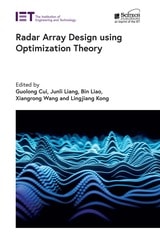
Radar array design aims at shaping a specific transmit/receive beampattern through optimizing array geometry, transmit waveform, and transmit/receive weight vectors. It is a hot topic among the scientific and industrial communities due to the advent of modern digital arrays with multiple digital transmit and receive channels, arbitrary digital waveform generators, and solid-state transmitters. The radar array beampattern is a critical performance metric, and there has been a proliferation of techniques for radar array design exploiting the mathematical results drawn from optimisation theory.
[more]
cover of Radar Automatic Target Recognition (ATR) and Non-Cooperative Target Recognition (NCTR)

Radar Automatic Target Recognition (ATR) and Non-Cooperative Target Recognition (NCTR)

David Blacknell

The Institution of Engineering and Technology, 2013
The ability to detect and locate targets by day or night, over wide areas, regardless of weather conditions has long made radar a key sensor in many military and civil applications. However, the ability to automatically and reliably distinguish different targets represents a difficult challenge. Radar Automatic Target Recognition (ATR) and Non-Cooperative Target Recognition (NCTR) captures material presented in the NATO SET-172 lecture series to provide an overview of the state-of-the-art and continuing challenges of radar target recognition.
[more]
cover of Radar Countermeasures for Unmanned Aerial Vehicles

Radar Countermeasures for Unmanned Aerial Vehicles

Carmine Clemente

The Institution of Engineering and Technology, 2021
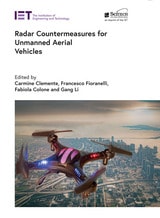
Over the last ten years, the numbers of unmanned air vehicles (UAVs) or “drones” have changed from being just a few specialist systems, used for scientific data gathering and military purposes, to them proliferating in huge numbers. They are used across a broad range of different leisure, commercial and military activities. UAVs can be used for: movement of items in factories for manufacturing, passenger and freight transportation, can take various roles in the agriculture and forestry industries (dispensing seeds, watering and monitoring crops), remote sensing for the oil and gas industries, traffic flow monitoring, support of emergency services, hobbies, security, military and many other applications.
[more]
cover of Radar Cross Section

Radar Cross Section

Eugene F. Knott

The Institution of Engineering and Technology, 2004
Radar cross section (RCS) is a comparison of two radar signal strengths. One is the strength of the radar beam sweeping over a target, the other is the strength of the reflected echo sensed by the receiver. This book shows how the RCS gauge can be predicted for theoretical objects and how it can be measured for real targets. Predicting RCS is not easy, even for simple objects like spheres or cylinders, but this book explains the two exact forms of theory so well that even a novice will understand enough to make close predictions. Weapons systems developers are keenly interested in reducing the RCS of their platforms. The two most practical ways to reduce RCS are shaping and absorption. This book explains both in great detail, especially in the design, evaluation, and selection of radar absorbers. There is also great detail on the design and employment of indoor and outdoor test ranges for scale models or for full-scale targets (such as aircraft). In essence, this book covers everything you need to know about RCS, from what it is, how to predict and measure, and how to test targets (indoors and out), and how to beat it.
[more]
cover of Radar Detection

Radar Detection

Julius V. DiFranco

The Institution of Engineering and Technology, 2004
This book presents a comprehensive tutorial exposition of radar detection using the methods and techniques of mathematical statistics. The material presented is as current and useful to today's engineers as when the book was first published by Prentice-Hall in 1968 and then republished by Artech House in 1980. The book is divided into six parts. Part I is introductory and describes the nature of the radar detection problem. Part II reviews the mathematical tools necessary for a study of detection theory. Part III contains tutorial expositions in a radar context of the classical signal-to-noise and a posteriori theories, both of which have played important roles in the evolution of modern radar. The unifying theme of the book is provided by statistical decision theory, introduced in the last chapter of Part III, which provides the framework for the chapters that follow. The first three chapters of Part IV contain a unified tutorial exposition of single and multiple hit detection theory. The last two chapters are respectively devoted to the use of the radar equation and a discussion of cumulative detection probability. The latter includes a procedure for minimizing the power-aperture product of a search radar. The performance of near-optimum multiple hit detection strategies are considered in Part V. These include binary and pulse train detection strategies. The first chapter in Part VI applies sequential detection theory to the radar detection problem. It includes the Marcus and Swerling test strategy and a two-step approximation to sequential detection. The second chapter contains the development of Bayes decision rules and Bayes receivers for optimizing the detection of multiple targets with unknown parameters, such as range, velocity, angle, etc.
[more]
cover of Radar Essentials: A concise handbook for radar design and performance analysis

Radar Essentials

A concise handbook for radar design and performance analysis

G. Richard Curry

The Institution of Engineering and Technology, 2012
When you need vital data fast, turn to Radar Essentials. This compact yet comprehensive reference has compiled the most used principles, data, tables, and equations that are used by radar and aerospace system designers on a daily basis. Experts and non-experts alike will find this to be their go-to source for recalling and understanding the fundamentals and employing them in design and performance analysis.
[more]
cover of Radar Essentials: A concise handbook for radar design and performance analysis

Radar Essentials

A concise handbook for radar design and performance analysis

G. Richard Curry

The Institution of Engineering and Technology, 2025
To meet the need for a compendium of radar information essential for design and performance analysis, a book should combine elements of both a radar text and a handbook. Radar Essentials, 2nd Edition: A concise handbook for radar design and performance analysis delivers on this requirement: it contains the radar principles, data, and equations most useful for practicing radar engineers and also material to help those who are not radar experts understand and use the information. The book is comprehensive, and serves as a complete radar reference, yet compact enough to fit on an engineer's desk or travel with them.
[more]
cover of Radar Foundations for Imaging and Advanced Concepts

Radar Foundations for Imaging and Advanced Concepts

Roger J. Sullivan

The Institution of Engineering and Technology, 2004
Through courses taught internally at the Institute for Defense Analysis, Dr. Roger Sullivan has devised a book that brings readers fully up to speed on the most essential quantitative aspects of general radar in order to introduce study of the most exciting and relevant applications to radar imaging and advanced concepts: Synthetic Aperture Radar (4 chapters), Space-time Adaptive Processing, moving target indication (MTI), bistatic radar, low probability of intercept (LPI) radar, weather radar, and ground-penetrating radar. Whether you are a radar novice or experienced professional, this is an essential reference that features the theory and practical application of formulas you use in radar design every day. With this book, you are taken step-by-step through the development of modern airborne microwave radar, up to the cutting edge of emergent technologies including new results on theoretical 2D and 3D SAR point-spread functions (PSF) and current discussions concerning dechirp/deskew processing, layover in SAR images, vibrating targets, foliage penetration, image quality parameters, and more. Plus, for students of electrical engineering, physics, and radar, this book provides the best source of basic airborne radar understanding, as well as a broad introduction to the field of radar imaging.
[more]
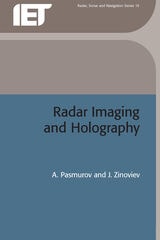
cover of Radar Imaging and Holography

Radar Imaging and Holography

A. Pasmurov

The Institution of Engineering and Technology, 2005
Increasing information content is an important scientific problem in modern observation systems development. Radar, or microwave, imaging, a technique which combines radar techniques with digital or optical information processing, can be used for this purpose. Drawing on their own research, the authors provide an overview of the field and explain why a unified approach based on wave field processing techniques, including holographic and tomographic approaches, is necessary in high resolution radar design. Such techniques use the complex field incident on an observation surface to produce a hologram, which can be used to reconstruct an image of the object or to restore some of its physical parameters. This makes it possible to extract the size, coordinates and radar cross-section of individual scattering centres.
[more]
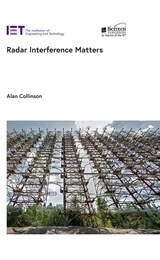
cover of Radar Interference Matters

Radar Interference Matters

Alan Collinson

The Institution of Engineering and Technology, 2026
Radar Interference Matters is rooted in 25 years of real-world radar interference experience. The author began work on a radar interference investigation in 2000, expecting it to last six months - yet aspects are still ongoing. Many interference and coexistence cases followed over the years, and these have shaped a wider understanding of spectrum coexistence, safeguarding, and interference management. Professionals often had to "feel their way through" these problems due to a lack of structured guidance. That gap in practical, experience-based knowledge provided the inspiration for the book.
[more]
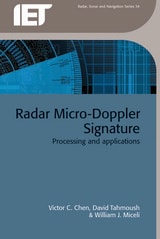
cover of Radar Micro-Doppler Signatures: Processing and applications

Radar Micro-Doppler Signatures

Processing and applications

Victor C. Chen

The Institution of Engineering and Technology, 2014
The micro-Doppler effect appears as Doppler frequency modulations in coherent laser or microwave radar systems induced by mechanical vibrations or rotations of a target or any part on the target. These Doppler modulations become a distinctive signature of a target that incorporates vibrating or rotating structures, and provides evidence of the identity of the target with movement.
[more]
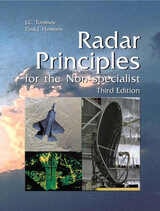
cover of Radar Principles for the Non-Specialist

Radar Principles for the Non-Specialist

J.C. Toomay

The Institution of Engineering and Technology, 2004
Radar Principles for the Non-specialist, 3rd Edition continues its popular tradition: to distil the very complex technology of radar into its fundamentals, tying them to the laws of nature on one end and to the most modern and complex systems on the other. It starts with electromagnetic propagation, describes a radar of the utmost simplicity, and derives the radar range equation from that simple radar. Once the radar range equation is available, the book attacks the meaning of each term in it, moving through antennas, detection and tracking, radar cross-sections, waveforms and signal processing, and systems applications. At the finish, the reader should be able to do an acceptable, first order radar design and to critique the design of others. Students, engineers, scientists and managers will benefit from this book. The more noticeable enhancements to the third edition are the additions of equation numbers, more numerical examples, tables and figures showing many of the concepts numerically, and exercises for almost all of the concepts. These enhancements make the book easier to learn from and easier to teach out of.
[more]
cover of Radar Sea Clutter: Modelling and target detection

Radar Sea Clutter

Modelling and target detection

Luke Rosenberg

The Institution of Engineering and Technology, 2022
The first maritime surveillance radars in World War II quickly discovered that returns from the sea, soon to be known as sea clutter, were often the limiting factor when attempting to detect small targets while controlling false alarms. This remains true for modern radars, where the detection of small, slow moving targets on a rough sea surface remains one of the main drivers for maritime radar design, particularly in the development of detection processing.
[more]
cover of Radar Techniques Using Array Antennas

Radar Techniques Using Array Antennas

Wulf-Dieter Wirth

The Institution of Engineering and Technology, 2001
This book presents a unique and comprehensive introduction to modern radar techniques using array antennas. The author focuses upon the principles, system concepts and techniques using electronic steerable and active array antennas for future high standard multifunction radar systems in both military and civil applications. Signal processing and array antennas are discussed from an engineering perspective, as a basis for system design. The key areas covered include array signal processing, adaptive digital beamforming, adaptive monopulse, superresolution, sequential detection, SAR with an active array for moving target detection, target imaging, adaptive clutter suppression, pulse compression with low range sidelobes and high range resolution, target detection with long pulse series, energy management and system parameter relations. Several new and effective radar techniques using array antennas are also discussed based on the pioneering work conducted by the authors team at FGAN, complete with experimental simulation results. The book will prove useful for engineers and scientists who work on research, development and systems design in the radar field as well as those who are responsible for radar decision making and planning within the government or industry.
[more]
cover of Radar Techniques Using Array Antennas

Radar Techniques Using Array Antennas

Wulf-Dieter Wirth

The Institution of Engineering and Technology, 2013
Radar Techniques Using Array Antennas is a thorough introduction to the possibilities of radar technology based on electronic steerable and active array antennas.
[more]
cover of Radar Waveform Design based on Optimization Theory

Radar Waveform Design based on Optimization Theory

Guolong Cui

The Institution of Engineering and Technology, 2020
This book provides an overview of radar waveform synthesis obtained as the result of computational optimization processes and covers the most challenging application fields. The book balances a practical point of view with a rigorous mathematical approach corroborated with a wealth of numerical study cases and some real experiments. Additionally, the book has a cross-disciplinary approach because it exploits cross-fertilization with the recent research and discoveries in optimization theory. The material of the book is organized into ten chapters, each one completed with a comprehensive list of references.
[more]
cover of Radar and Communication Spectrum Sharing

Radar and Communication Spectrum Sharing

Shannon D. Blunt

The Institution of Engineering and Technology, 2019
Radar and Communication Spectrum Sharing addresses the growing conflict over use of the radio-frequency spectrum by different systems, such as civil and security applications of radar and consumer use for wireless communications. The increasing demand for this finite resource is driving innovation into new ways in which these diverse systems can cohabit the spectrum. The book provides a broad survey of recent and ongoing work on the topic of spectrum sharing, with an emphasis on identifying the technology gaps for practical realization and the regulatory and measurement compliance aspects of this problem space. The introductory section sets the scene, making the case for spectrum access and reviewing spectrum use, congestion, lessons learned, ways forward and research areas. The book then covers system engineering perspectives, the issues involved with addressing interference, and radar/communication co-design strategies. With contributions from an international panel of experts, this book is essential reading for researchers, engineers and advanced students in radar, communications, navigation, and electronic warfare whose work is impacted by spectrum engineering requirements.
[more]
cover of Radar and Electronic Warfare Principles for the Non-Specialist

Radar and Electronic Warfare Principles for the Non-Specialist

Paul Hannen

The Institution of Engineering and Technology, 2014

This book presents a comprehensive set of radar and electronic warfare principles including many of the latest applications in a clear and consistent manner.
[more]
cover of Radio Direction Finding and Superresolution

Radio Direction Finding and Superresolution

P.J.D. Gething

The Institution of Engineering and Technology, 1991
This is an enlarged and revised second edition of a book first published in 1978 and reprinted twice since then. The new edition includes updates to all the original chapters, plus two new chapters on developments in superresolution techniques and their application to direction-finding arrays.
[more]
cover of Radio Frequency Interference (RFI) Pocket Guide

Radio Frequency Interference (RFI) Pocket Guide

Kenneth Wyatt

The Institution of Engineering and Technology, 2015
This handy pocket guide to essential radio frequency interference (RFI) is a valuable, pocket-sized reference for radio amateurs and others in the radio communication fields.
[more]
cover of Radio Frequency and Microwave Power Amplifiers: Efficiency and Linearity Enhancement Techniques, Volume 2

Radio Frequency and Microwave Power Amplifiers

Efficiency and Linearity Enhancement Techniques, Volume 2

Andrei Grebennikov

The Institution of Engineering and Technology, 2019
Radio Frequency and Microwave Power Amplifiers are finding an increasingly broad range of applications, particularly in communications and broadcasting, but also in the industrial, medical, automotive, aviation, military, and sensing fields. Each application has its own design specifications, for example, high linearity in modern communication systems or high efficiency in broadcasting, and, depending on process technology, capability to operate efficiently at very high frequencies, such as 77 GHz and higher for automotive radars. Advances in design methodologies have practical applications in improving gain, power output, bandwidth, power efficiency, linearity, input and output impedance matching, and heat dissipation.
[more]
cover of Radio Frequency and Microwave Power Amplifiers: Principles, Device Modeling and Matching Networks, Volume 1

Radio Frequency and Microwave Power Amplifiers

Principles, Device Modeling and Matching Networks, Volume 1

Andrei Grebennikov

The Institution of Engineering and Technology, 2019

Radio Frequency and Microwave Power Amplifiers are finding an increasingly broad range of applications, particularly in communications and broadcasting, but also in the industrial, medical, automotive, aviation, military, and sensing fields. Each application has its own design specifications, for example, high linearity in modern communication systems or high efficiency in broadcasting, and, depending on process technology, capability to operate efficiently at very high frequencies, such as 77 GHz and higher for automotive radars. Advances in design methodologies have practical applications in improving gain, power output, bandwidth, power efficiency, linearity, input and output impedance matching, and heat dissipation.
[more]
cover of Radio Frequency and Microwave Power Amplifiers: Theory, design and applications

Radio Frequency and Microwave Power Amplifiers

Theory, design and applications

Andrei Grebennikov

The Institution of Engineering and Technology, 2019

Radio Frequency and Microwave Power Amplifiers are finding an increasingly broad range of applications, particularly in communications and broadcasting, but also in the industrial, medical, automotive, aviation, military, and sensing fields. Each application has its own design specifications, for example, high linearity in modern communication systems or high efficiency in broadcasting, and, depending on process technology, capability to operate efficiently at very high frequencies, such as 77 GHz and higher for automotive radars. Advances in design methodologies have practical applications in improving gain, power output, bandwidth, power efficiency, linearity, input and output impedance matching, and heat dissipation.
[more]
cover of Radio Frequency and Microwave Power Measurement

Radio Frequency and Microwave Power Measurement

Alan E. Fantom

The Institution of Engineering and Technology, 1990
The need to measure electrical power is common to many branches of science and engineering. This book presents a wide-ranging survey of the many types of radio-frequency and microwave power meter and the techniques which are used for calibrating and intercomparing them. The frequency range is 1 MHz to 200 GHz.
[more]
cover of Radio Man: The remarkable rise and fall of C.O. Stanley

Radio Man

The remarkable rise and fall of C.O. Stanley

Mark Frankland

The Institution of Engineering and Technology, 2002

Radio Man tells the story of C.O. Stanley, the unconventional Irishman who acquired Pye Radio at the beginning of the broadcasting age. Although he started with little experience and even less money, he was to make Pye a major player in the British electronics industry - only to crash it spectacularly forty years later. From the romance of early radio to the birth of the mobile, Stanley and Pye were players in some of the key moments of twentieth century Britain. His obsession with the infant medium of television allowed Pye to provide the equipment that put radar into planes in time for the Battle of Britain. His energy also drove Pye's pioneering work on the proximity fuse - work that would revolutionise antiaircraft warfare - and the company's manufacture of the war's most successful army radios.
[more]
cover of Radio Spectrum Management: Management of the spectrum and regulation of radio services

Radio Spectrum Management

Management of the spectrum and regulation of radio services

David Withers

The Institution of Engineering and Technology, 1999
Vast numbers of radio systems are now in use, and with new users and new uses constantly emerging, these systems have the potential to interfere with each other.
[more]
cover of Radio Utopia: Postwar Audio Documentary in the Public Interest

Radio Utopia

Postwar Audio Documentary in the Public Interest

Matthew Ehrlich

University of Illinois Press, 2017
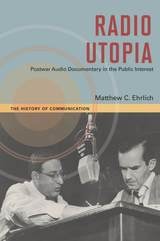
As World War II drew to a close and radio news was popularized through overseas broadcasting, journalists and dramatists began to build upon the unprecedented success of war reporting on the radio by creating audio documentaries. Focusing particularly on the work of radio luminaries such as Edward R. Murrow, Fred Friendly, Norman Corwin, and Erik Barnouw, Radio Utopia: Postwar Audio Documentary in the Public Interest traces this crucial phase in American radio history, significant not only for its timing immediately before television, but also because it bridges the gap between the end of the World Wars and the beginning of the Cold War.
 
Matthew C. Ehrlich closely examines the production of audio documentaries disseminated by major American commercial broadcast networks CBS, NBC, and ABC from 1945 to 1951. Audio documentary programs educated Americans about juvenile delinquency, slums, race relations, venereal disease, atomic energy, arms control, and other issues of public interest, but they typically stopped short of calling for radical change. Drawing on rare recordings and scripts, Ehrlich traces a crucial phase in the evolution of news documentary, as docudramas featuring actors were supplanted by reality-based programs that took advantage of new recording technology. Paralleling that shift from drama to realism was a shift in liberal thought from dreams of world peace to uneasy adjustments to a cold war mentality.
 
Influenced by corporate competition and government regulations, radio programming reflected shifts in a range of political thought that included pacifism, liberalism, and McCarthyism. In showing how programming highlighted contradictions within journalism and documentary, Radio Utopia reveals radio's response to the political, economic, and cultural upheaval of the post-war era.
[more]
cover of Radio Wave Propagation in Vehicular Environments

Radio Wave Propagation in Vehicular Environments

Leyre Azpilicueta

The Institution of Engineering and Technology, 2021
Providing a unified treatment of radio wave propagation in vehicular environments, this book offers a thorough discussion of their theoretical background and fundamental limits, and paves the way to a better understanding of more advanced topics. Further, the book introduces the newest challenges and problems posed by the ever growing need to communicate in mobile networks whilst in a vehicle.
[more]
cover of Radio's America: The Great Depression and the Rise of Modern Mass Culture

Radio's America

The Great Depression and the Rise of Modern Mass Culture

Bruce Lenthall

University of Chicago Press, 2007

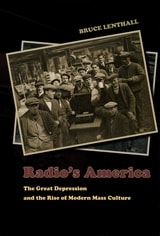
Orson Welles’s greatest breakthrough into the popular consciousness occurred in 1938, three years before Citizen Kane, when his War of the Worlds radio broadcast succeeded so spectacularly that terrified listeners believed they were hearing a genuine report of an alien invasion—a landmark in the history of radio’s powerful relationship with its audience. In Radio’s America, Bruce Lenthall documents the enormous impact radio had on the lives of Depression-era Americans and charts the formative years of our modern mass culture.

Many Americans became alienated from their government and economy in the twentieth century, and Lenthall explains that radio’s appeal came from its capability to personalize an increasingly impersonal public arena. His depictions of such figures as proto-Fascist Charles Coughlin and medical quack John Brinkley offer penetrating insight into radio’s use as a persuasive tool, and Lenthall’s book is unique in its exploration of how ordinary Americans made radio a part of their lives. Television inherited radio’s cultural role, and as the voting tallies for American Idol attest, broadcasting continues to occupy a powerfully intimate place in American life. Radio’s America reveals how the connections between power and mass media began.

[more]
cover of Radium and the Secret of Life

Radium and the Secret of Life

Luis A. Campos

University of Chicago Press, 2015

Before the hydrogen bomb indelibly associated radioactivity with death, many chemists, physicians, botanists, and geneticists believed that radium might hold the secret to life. Physicists and chemists early on described the wondrous new element in lifelike terms such as “decay” and “half-life,” and made frequent references to the “natural selection” and “evolution” of the elements. Meanwhile, biologists of the period used radium in experiments aimed at elucidating some of the most basic phenomena of life, including metabolism and mutation.

From the creation of half-living microbes in the test tube to charting the earliest histories of genetic engineering, Radium and the Secret of Life highlights previously unknown interconnections between the history of the early radioactive sciences and the sciences of heredity. Equating the transmutation of radium with the biological transmutation of living species, biologists saw in metabolism and mutation properties that reminded them of the new element. These initially provocative metaphoric links between radium and life proved remarkably productive and ultimately led to key biological insights into the origin of life, the nature of heredity, and the structure of the gene. Radium and the Secret of Life recovers a forgotten history of the connections between radioactivity and the life sciences that existed long before the dawn of molecular biology.

[more]
cover of Reading Sounds: Closed-Captioned Media and Popular Culture

Reading Sounds

Closed-Captioned Media and Popular Culture

Sean Zdenek

University of Chicago Press, 2015

Imagine a common movie scene: a hero confronts a villain. Captioning such a moment would at first glance seem as basic as transcribing the dialogue. But consider the choices involved: How do you convey the sarcasm in a comeback? Do you include a henchman’s muttering in the background? Does the villain emit a scream, a grunt, or a howl as he goes down? And how do you note a gunshot without spoiling the scene?

These are the choices closed captioners face every day. Captioners must decide whether and how to describe background noises, accents, laughter, musical cues, and even silences. When captioners describe a sound—or choose to ignore it—they are applying their own subjective interpretations to otherwise objective noises, creating meaning that does not necessarily exist in the soundtrack or the script.

Reading Sounds looks at closed-captioning as a potent source of meaning in rhetorical analysis. Through nine engrossing chapters, Sean Zdenek demonstrates how the choices captioners make affect the way deaf and hard of hearing viewers experience media. He draws on hundreds of real-life examples, as well as interviews with both professional captioners and regular viewers of closed captioning. Zdenek’s analysis is an engrossing look at how we make the audible visible, one that proves that better standards for closed captioning create a better entertainment experience for all viewers.
[more]
cover of Reading in a Digital Age

Reading in a Digital Age

David M. Durant

Against the Grain, LLC, 2017

Charleston Briefings: Trending Topics for Information Professionals is a thought-provoking series of brief books concerning innovation in the sphere of libraries, publishing, and technology in scholarly communication. The briefings, growing out of the vital conversations characteristic of the Charleston Conference and Against the Grain, will offer valuable insights into the trends shaping our professional lives and the institutions in which we work.
 
The Charleston Briefings are written by authorities who provide an effective, readable overview of their topics—not an academic monograph. The intended audience is busy nonspecialist readers who want to be informed concerning important issues in our industry in an accessible and timely manner.

​How is reading changing in the digital environment? How will it continue to change? Are we headed for an all- digital future? Or does print still have a place in the reading environment? Does format matter? What do readers tell us they want? This brief monograph offers librarians, publishers, vendors, and others an overview of these key issues as well as advice on how their institutions should approach the print versus digital controversy.

[more]
cover of Reagan and Public Discourse in America

Reagan and Public Discourse in America

Michael Weiler

University of Alabama Press, 1992

A critical assessment of the impact of the administration of President Ronald Reagan on public discourse in the United States

The authors show that more than any president since John F. Kennedy, Reagan’s influence flowed from his rhetorical practices. And he is remembered as having reversed certain trends and cast the U.S. on a new course. The contributors to this insightful collection of essays show that Reagan’s rhetorical tactics were matters of primary concern to his administration’s chief political strategists.

[more]
cover of Real American Ethics: Taking Responsibility for Our Country

Real American Ethics

Taking Responsibility for Our Country

Albert Borgmann

University of Chicago Press, 2006

America is a wonderful and magnificent country that affords its citizens the broadest freedoms and the greatest prosperity in the world. But it also has its share of warts. It is embroiled in a war that many of its citizens consider unjust and even illegal. It continues to ravage the natural environment and ignore poverty both at home and abroad, and its culture is increasingly driven by materialism and consumerism. But America, for better or for worse, is still a nation that we have built. So why then, asks Albert Borgmann in this most timely and urgent work, are we failing to take responsibility for it? 

In Real American Ethics, Borgmann asks us to reevaluate our role in the making of American values. Taking his cue from Winston Churchill—who once observed that we shape our buildings, and then our buildings shape us—Borgmann considers the power of our most enduring institutions and the condition of our present moral makeup to propose inspired new ways in which we, as ordinary citizens, can act to improve our country. This, he shows, includes everything from where we choose to live and what we spend our money on to daunting tasks like the reshaping of our cities—habits and actions that can guide us to more accomplished and virtuous lives. Using prose that is easy and direct throughout, Borgmann’s position is grounded neither by conservative nor liberal ideology, but in his understanding that he is a devoted citizen among many. 

In an age in which the blame game is the only game in town, this patriotic book is an eloquent reminder of the political strength we all wield when we work together.

[more]
cover of Real Time Convex Optimisation for 5G Networks and Beyond

Real Time Convex Optimisation for 5G Networks and Beyond

Long D. Nguyen

The Institution of Engineering and Technology, 2022

There is no doubt that we are facing a wireless data explosion. Modern wireless networks need to satisfy increasing demand, but are faced with challenges such as limited spectrum, expensive resources, green communication requirements and security issues. In the age of internet of things (IoT) with massive data transfers and huge numbers of connected devices, including high-demand QoS (4G, 5G networks and beyond), signal processing is producing data sets at the gigabyte and terabyte scales.
[more]
cover of Recasting the Machine Age: Henry Ford's Village Industries

Recasting the Machine Age

Henry Ford's Village Industries

Howard P. Segal

University of Massachusetts Press, 2005

Recasting the Machine Age recounts the history of Henry Ford's efforts to shift the production of Ford cars and trucks from the large-scale factories he had pioneered in the Detroit area to nineteen decentralized, small-scale plants within sixty miles of Ford headquarters in Dearborn. The visionary who had become famous in the early twentieth century for his huge and technologically advanced Highland Park and River Rouge complexes gradually changed his focus beginning in the teens and continuing until his death in 1947. 

Ford may well have been motivated to spend great sums on the village industries in part to prevent the unionization of his company. But these industrial experiments represented much more than “union busting.” They were significant examples of profound social, cultural, and ideological shifts in America between the World Wars as reflected in the thought and practice of one notable industrialist. 

Howard P. Segal recounts the development of the plants, their fate after Ford's death, their recent revival as part of Michigan's renewed appreciation of its industrial heritage, and their connections to contemporary efforts to decentralize high-tech working and living arrangements.

[more]
cover of Recent Advances in High-Power Electromagnetics

Recent Advances in High-Power Electromagnetics

Felix Vega

The Institution of Engineering and Technology, 2024
We live in a modern world powered by large, complex systems, including financial markets, communication networks, transportation networks, and security infrastructure. Sensitive electronics are omnipresent, making them increasingly vulnerable to high-power electromagnetic (HPEM) threats - an emerging risk capable of disrupting critical networks and the infrastructure they support. This book explores recent advances in HPEM sources, electromagnetic compatibility (EMC), strategies for protecting against intentional electromagnetic interference (IEMI) and detection and mitigation of these threats.
[more]
cover of Recent Trends in Sliding Mode Control

Recent Trends in Sliding Mode Control

Leonid Fridman

The Institution of Engineering and Technology, 2016
In control theory, sliding mode control, or SMC, is a nonlinear control method that alters the dynamics of a nonlinear system by application of a discontinuous control signal that forces the system to 'slide' along a cross-section of the system's normal behaviour. This book describes recent advances in the theory, properties, methods and applications of SMC.
[more]
cover of Reckoning with Matter: Calculating Machines, Innovation, and Thinking about Thinking from Pascal to Babbage

Reckoning with Matter

Calculating Machines, Innovation, and Thinking about Thinking from Pascal to Babbage

Matthew L. Jones

University of Chicago Press, 2016

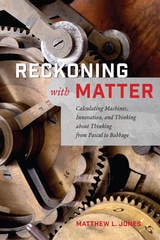
From Blaise Pascal in the 1600s to Charles Babbage in the first half of the nineteenth century, inventors struggled to create the first calculating machines. All failed—but that does not mean we cannot learn from the trail of ideas, correspondence, machines, and arguments they left behind.
 
In Reckoning with Matter, Matthew L. Jones draws on the remarkably extensive and well-preserved records of the quest to explore the concrete processes involved in imagining, elaborating, testing, and building calculating machines. He explores the writings of philosophers, engineers, and craftspeople, showing how they thought about technical novelty, their distinctive areas of expertise, and ways they could coordinate their efforts. In doing so, Jones argues that the conceptions of creativity and making they exhibited are often more incisive—and more honest—than those that dominate our current legal, political, and aesthetic culture.
 
[more]
cover of Recommendations for Energy-efficient Exterior Lighting Systems

Recommendations for Energy-efficient Exterior Lighting Systems

The Institution of Engineering and Technology

The Institution of Engineering and Technology, 2015
This good practice Guide supports informed customers and users of exterior lighting systems, providing a basis for evaluation of technical issues and decision-making on technology adoption, in order to achieve functional, budgetary and compliance requirements. It provides recommendations for decision making and appropriate approaches to the specification and procurement of energy efficient exterior lighting systems.
[more]
cover of Reconstructors: Land, Work, and Engineering After the Civil War

Reconstructors

Land, Work, and Engineering After the Civil War

John Dean Davis

University of Chicago Press, 2026

Explores the institutional and environmental transformations that occurred during the Reconstruction Era. 

While the Reconstruction Era in America saw a paradigmatic realignment of the country’s core institutions and values, there was a physical quality to Reconstruction as well: the country was not only rebuilding the South after the Civil War, but flat-out building as it expanded westward. 

In Reconstructors, John Dean Davis details how the Army Corps of Engineers and its subcontractors designed and redesigned the infrastructural landscape to support the republic’s rebirth. The Corps’ projects not only transformed the landscape; they created markets, fostered a distinctive expansionist culture, and—for a time—enacted a less discriminatory economic and social agenda across the South and West. Davis aims to bring federal power, environmentalism, and capitalism into a frame that reveals the landscape's power to further ideology. 
[more]
cover of Red Metal: The Calumet and Hecla Story

Red Metal

The Calumet and Hecla Story

C. Harry Benedict

University of Michigan Press, 1952

Red Metal is a different kind of book on American industrial history. It’s a dramatic story linked to the present by the energies and fortunes of the men who move in colorful realism through its pages; it’s a story of fortunes and misfortunes, of foresight and mistakes, of successes and failures of American enterprise relating to the largest of the copper mines of the Upper Peninsula of Michigan. The story traces the development of one of the oldest and richest copper companies in America. From the pathless wilds in which the great Calumet conglomerate ore body was first discovered came the achievement of many years of world leadership in the copper industry and the present aspects of a company with manufacturing plants that fabricate products of copper, copper-base alloys, aluminum, and steel.
[more]
cover of Red Revolution, Green Revolution: Scientific Farming in Socialist China

Red Revolution, Green Revolution

Scientific Farming in Socialist China

Sigrid Schmalzer

University of Chicago Press, 2016

In 1968, the director of USAID coined the term “green revolution” to celebrate the new technological solutions that promised to ease hunger around the world—and forestall the spread of more “red,” or socialist, revolutions. Yet in China, where modernization and scientific progress could not be divorced from politics, green and red revolutions proceeded side by side.
           
In Red Revolution, Green Revolution, Sigrid Schmalzer explores the intersection of politics and agriculture in socialist China through the diverse experiences of scientists, peasants, state agents, and “educated youth.” The environmental costs of chemical-intensive agriculture and the human costs of emphasizing increasing production over equitable distribution of food and labor have been felt as strongly in China as anywhere—and yet, as Schmalzer shows, Mao-era challenges to technocracy laid important groundwork for today’s sustainability and food justice movements. This history of “scientific farming” in China offers us a unique opportunity not only to explore the consequences of modern agricultural technologies but also to engage in a necessary rethinking of fundamental assumptions about science and society.
[more]