Results by title
967 books match the query 'Theater' and 48 start with r
Race and Performance after Repetition
Soyica Diggs Colbert, Douglas A. Jones Jr., and Shane Vogel, editors
Duke University Press, 2020
Contributors. Joshua Chambers-Letson, Soyica Diggs Colbert, Nicholas Fesette, Patricia Herrera, Jasmine Elizabeth Johnson, Douglas A. Jones Jr., Mario LaMothe, Daphne P. Lei, Jisha Menon, Tavia Nyong’o, Tina Post, Elizabeth W. Son, Shane Vogel, Catherine M. Young, Katherine Zien
Race and Role
The Mixed-Race Asian Experience in American DramaRena M. Heinrich
Rutgers University Press, 2023
Race and Role: The Mixed-Race Experience in American Drama traces the shifting identities of multiracial Asian figures in theater from the late-nineteenth century to the present day and explores the ways that mixed-race Asian identity transforms our understanding of race. Mixed-Asian playwrights harness theater’s generative power to enact performances of “double liminality” and expose the absurd tenacity with which society clings to a tenuous racial scaffolding.
Race and the Forms of Knowledge
Technique, Identity, and Place in Artistic ResearchBen Spatz
Northwestern University Press, 2024
Enacts a radically interdisciplinary intersectionality to position performance-based research in solidarity with decoloniality
This boldly innovative work interrogates the form and meaning of artistic research (also called practice research, performance as research, and research-creation), examining its development within the context of predominately white institutions that have enabled and depoliticized it while highlighting its radical potential when reframed as a lineage of critical whiteness practice.
Ben Spatz crafts a fluid yet critical new framework, explored via a series of case studies that includes Spatz’s own practice-as-research, to productively confront hegemonic modes of white writing and white institutionality. Ultimately taking jewishness as a paradigmatically “molecular” identity—variously configured as racial, ethnic, religious, or national—they offer a series of concrete methodological and formal proposals for working at the intersections of embodied identities, artistic techniques, and alternative forms of knowledge.
Race and the Forms of Knowledge: Technique, Identity, and Place in Artistic Research takes inspiration from recent critical studies of blackness and indigeneity to show how artistic research is always involved in the production and transformation of identity. Spatz offers a toolkit of practical methods and concepts—from molecular identities to audiovisual ethnotechnics and earthing the laboratory—for reimagining the university and other contemporary institutions.

Racial Care
On Asian American Suffering and SurvivalJames McMaster
Duke University Press, 2025
Racing the Great White Way
Black Performance, Eugene O’Neill, and the Transformation of BroadwayKatie N. Johnson
University of Michigan Press, 2023
Finalist: 2023 Theatre Library Association George Freedley Memorial Award
The early drama of Eugene O’Neill, with its emphasis on racial themes and conflicts, opened up extraordinary opportunities for Black performers to challenge racist structures in modern theater and cinema. By adapting O’Neill’s dramatic writing—changing scripts to omit offensive epithets, inserting African American music and dance, or including citations of Black internationalism--theater artists of color have used O’Neill’s texts to raze barriers in American and transatlantic theater.
Challenging the widely accepted idea that Broadway was the white-hot creative engine of U.S. theater during the early 20th century, author Katie N. Johnson reveals a far more complex system of exchanges between the Broadway establishment and a vibrant Black theater scene in New York and beyond to chart a new history of American and transnational theater. In spite of their dichotomous (and at times problematic) representation of Blackness, O’Neill’s plays such as The Emperor Jones and All God’s Chillun Got Wings make ideal case studies because of the way these works stimulated traffic between Broadway and Harlem—and between white and Black America. These investigations of O’Neill and Broadway productions are enriched by the vibrant transnational exchange found in early to mid-20th century artistic production. Anchored in archival research, Racing the Great White Way recovers not only vital lost performance histories, but also the layered contexts for performing bodies across the Black Atlantic and the Circum-Atlantic.

Radical Initiatives in Interventionist & Community Drama
Edited by Peter Billingham
Intellect Books, 1995
The list of contributors is impressive and quite consciously eclectic, ranging from established scholars such as Dr. Lionel Pilkington (University of Galway) through to the latest talent emerging in the field of theatre research such as Bill McDonnell (University of Sheffield) and Maureen Barry (Bretton Hall College, University of Leeds.) There is also a significant international dimension to Volume I with contributions from Carole Christensen (Copenhagen) and - (South Africa), with Velda Harris (Central School of Speech and Drama) offering a critical evaluation of her work with nomadic tribes people in Azerbaijan.
As with the series as a whole, the focus for this first collection is a fusion of high-quality scholarly research with dynamic and perceptive accounts from practitioners in their field of work. Similarly this collection represents an eclectic mix of material that is absolutely contemporary and previously unpublished, offering a unique insight into some of the ideological, methodological and aesthetic issues surrounding the generic area of Interventionist and Community Theatre.
Reactivations
Essays on Performance and Its DocumentationPhilip Auslander
University of Michigan Press, 2018
performance from its documentation? What is the value of performance documentation?
The book treats performance documentation as a specific discursive use of media that arose in the middle of the 20th century alongside such forms of performance as the Happening and that is different, both discursively and as a practice, from traditional theater and dance photography. Philip Auslander explores the phenomenal relationship between the spectator who experiences the performance from the document and the document itself. The document is not merely a secondary iteration of the original event but a vehicle that gives us meaningful access to the performance itself as an artistic work.
Readying the Revolution
African American Theater and Performance from Post-World War II to the Black Arts MovementJonathan Shandell
University of Michigan Press, 2025
2026 American Theatre and Drama Society John W. Frick Book Award Winner
Starting in 1966, African American activist Stokely Carmichael and other political leaders adopted the phrase "Black Power!" The slogan captured a militant, revolutionary spirit that was already emerging in the work of playwrights, poets, musicians, and visual artists throughout the Black Arts movement of the mid-1960s. But the story of those theater artists and performers whose work helped bring about the Black Arts revolution has not fully been told. Readying the Revolution: African American Theater and Performance from Post-World War II to the Black Arts Movement explores the dynamic era of Black culture between the end of World War II and the start of the Black Arts Movement (1946-1964) by illuminating how artists and innovators such as Jackie Robinson, Lorraine Hansberry, Ossie Davis, Nina Simone, and others helped radicalize Black culture and Black political thought. In doing so, these artists defied white cultural hegemony in the United States, and built the foundation for the revolutionary movement in Black theater that followed in the mid 1960s. Through archival research, close textual reading, and an analysis of performance artifacts, Shandell demonstrates how these artists negotiated a space on the public stage for cultivating radical Black aesthetics and built the foundation for the revolutionary movement in Black theater that followed in the mid-1960s.
Realism and the American Dramatic Tradition
William W. Demastes
University of Alabama Press, 1996
This book reconsiders realism on the American stage by addressing the great variety and richness of the plays that form the American theatre canon.
Any review of 20th-century American theatre invariably leads to the term realism. Yet despite the strong tradition of theatrical realism on the American stage, the term is frequently misidentified, and the practices to which it refers are often attacked as monolithically tyrannical, restricting the potential of the American national theatre.This book reconsiders realism on the American stage by addressing the great variety and richness of the plays that form the American theatre canon. By reconsidering the form and revisiting many of the plays that contributed to the realist tradition, the authors provide the opportunity to apprise strengths often overlooked by previous critics. The volume traces the development of American dramatic realism from James A. Herne, the "American Ibsen," to currently active contemporaries such as Sam Shepard, David Mamet, and Marsha Norman. This frank assessment, in sixteen original essays, reopens a critical dialog too long closed.
Essays include:
American Dramatic Realisms, Viable Frames of Thought
The Struggle for the Real--Interpretive Conflict, Dramatic Method, and the Paradox of Realism
The Legacy of James A. Herne: American Realities and Realisms
Whose Realism? Rachel Crothers's Power Struggle in the American Theatre
The Provincetown Players' Experiments with Realism
Servant of Three Masters: Realism, Idealism, and "Hokum" in American High Comedy
Realisms in East Asian Performance
Jessica Nakamura and Katherine Saltzman-Li, Editors
University of Michigan Press, 2023
Existing scholarly discussions of theatrical realism have been predominantly limited to 19th-century European and Russian theater, with little attention paid to wider explorations and alternative definitions of the practice. Examining theater forms and artists from China, Japan, and Korea, Realisms in East Asian Performance brings together a group of theater historians to reconsider realism through the performing arts of East Asia.
The book’s contributors emphasize trans-regional conversations and activate inter-Asian dialogues on theatrical production. Tracing historical trajectories, starting from premodern periods through today, the book seeks to understand realisms’ multiple origins, forms, and cultural significances, and examines their continuities, disruptions, and divergences. In its diversity of topics, geographic locations, and time periods, Realisms in East Asian Performance aims to globalize and de-center the dominant narratives surrounding realism in theater, and revise assumptions about the spectacular and theatrical forms of Asian performance. Understanding realism as a powerful representational style, chapters collectively reevaluate acts of representation on stage not just for East Asia, but for theater and performance studies more broadly.
Reality Principles
From the Absurd to the VirtualHerbert Blau
University of Michigan Press, 2011
“Herbert Blau’s long sustained inquiry into theater’s most provocative questions—presence, liveness, and finitude—are, at their deepest level, queries into life. Reality Principles returns us to Blau’s inspiring provocations and extends them to new subjects—9/11 and Ground Zero, the nature of charisma, Pirandello and Strindberg.”
—Peggy Phelan, Stanford University
Reality Principles gathers recent essays by esteemed scholar and theater practitioner Herbert Blau covering a range of topics. The book’s provocative essays—including “The Emotional Memory of Directing,” “The Faith-Based Initiative of the Theater of the Absurd,” “Virtually Yours: Presence, Liveness, Lessness,” “The Human Nature of the Bot”—were given as keynotes and/or memorial lectures and are collected here for the first time. The essays take up a remarkable array of topics—from body art and the self-inflicted punishments of Stelarc, Orlan, and the Viennese Actionists, to Ground Zero and 9/11—and allow Blau to address critical questions of theater and theory, performance and relevance, the absurd and the virtual, history and illusion, community and memory. Reality Principles offers a panoramic view of Herbert Blau’s perspectives on life and the imitation of life on stage.
Reckoning with Spirit in the Paradigm of Performance
Donnalee Dox
University of Michigan Press, 2016
Reclaiming Time
Race, Temporality, and Black Expressive CultureIsaiah Matthew Wooden
Northwestern University Press, 2025
Showing how twenty-first-century Black theater and media arts challenge dominant conceptualizations of time
Reclaiming Time: Race, Temporality, and Black Expressive Culture examines works by contemporary Black artists in multiple media—drama, film, performance art, and photography—that trouble dominant conceptualizations and normative configurations of time in relation to race in the twenty-first century. Isaiah Matthew Wooden explores the ways in which an intentional and sometimes ludic engagement with time and temporality has enabled these artists to probe urgent questions and themes concerning the conditions of contemporary Black life.
Wooden surveys a diverse array of performance-based and visual texts to explore the rich practices of contemporary Black expressive culture: dramatic works by playwrights Eisa Davis, Tarell Alvin McCraney, and Robert O’Hara; performance art and photography by visual artists Jefferson Pinder and LaToya Ruby Frazier; and feature-length cinema by director-producer Tanya Hamilton. These works expose normative time as specious and evidence the transformative potential in honing practices of Black temporal experimentation and intervention. By putting this cross-disciplinary set of texts in conversation with each other, Wooden sheds new light on the shrewd ways that they each reflect an investment in unbinding time from the exigencies of normativity and teleology, as well as on their shared commitments to reclaiming time to reimagine and represent Blackness in all its multiplicities.
Red Sun and Merlin Unchained
David Rudkin
Intellect Books, 2011
Red Sun and Merlin Unchained are the most recent original stage works by one of the most accomplished yet neglected dramatists of our time. Red Sun is a two-hander, tightly tethered within the classical unities of theme and space and the span of a single day. Merlin Unchained is an explosive, multitudinous epic, crossing continents and centuries and passing between worlds. Yet though technically so different, both works speak with the same distinctive voice, offering an exhilarating—and sometimes disturbing— challenge to the cultural and political perceptions of the contemporary audience, and exploring alien worlds that, alarmingly, begin to become recognizable as our own.
Redefining Theatre Communities
International Perspectives on Community-Conscious Theatre-MakingEdited by Marco Galea and Szabolcs Musca
Intellect Books, 2023
Redefining Theatre Communities explores the interplay between contemporary theatre and communities. It considers the aesthetic, social, and cultural aspects of community-conscious theatre-making. While doing so, the volume reflects on recent transformations in structural, textual, and theatrical conventions and traditions, and explores the changing modes of production and spectatorship in relation to theatre communities. The essays in this collection present an array of emerging perspectives on the politics, ethics, and practices of community representation in the contemporary international theatre landscape. An international, interdisciplinary collection featuring work by theatre scholars, theatre-makers, and artistic directors from across Europe and beyond, Redefining Theatre Communities will appeal to those interested in the diverse forms of socially engaged theatre and performance.
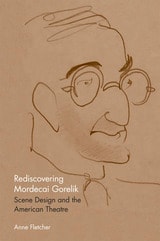
Rediscovering Mordecai Gorelik
Scene Design and the American TheatreAnne Fletcher
Southern Illinois University Press, 2009
Rediscovering Mordecai Gorelik explores the life and work of the pioneering scene designer whose career spanned decades in American theatre. Anne Fletcher’s insightful volume draws intriguing parallels and contrasts between Gorelik’s productions and the theatrical movements of the twentieth century, exposing the indelible mark he left on the stage. Through in-depth analysis of his letters, diaries, designs, and theoretical works, Fletcher examines the ways in which Gorelik’s productions can be used as a mirror to reflect the shifting dramatic landscapes of his times.
Fletcher places Gorelik against the colorful historical backdrops that surrounded him—including the avant-garde movement of the 1920s, World War II, the Cold War, and absurdism—using the designer’s career as a window into the theatre during these eras. Within these cultural contexts, Gorelik sought to blaze his own unconventional path through the realms of theatre and theory. Fletcher traces Gorelik’s tenures with such companies as the Provincetown Players, the Theatre Guild, and the Theatre Union, as well as his relationships with icons such as Bertolt Brecht, revealing how his interactions with others influenced his progressive designs and thus set the stage for major dramatic innovations. In particular, Fletcher explores Gorelik’s use of scenic metaphor: the employment of stage design techniques to subtly enhance the tone or mood of a production. Fletcher also details the designer’s written contributions to criticism and theory, including the influential volume New Theatres for Old, as well as other articles and publications.
In addition to thorough examinations of several of Gorelik’s most famous projects, Rediscovering Mordecai Gorelik contains explications of productions by such legends as John Howard Lawson, Clifford Odets, and Arthur Miller. Also included are numerous full-color and black-and-white illustrations of Gorelik’s work, most of which have never been available to the public until now. More than simply a portrait of one man, this indispensable volume is a cultural history of American theatre as seen through the career of a visionary designer and theoretician.
Redreaming the Renaissance
Essays on History and Literature in Honor of Guido RuggieroMary Lindemann
University of Delaware Press, 2024
Reflecting the Audience
London Theatregoing, 1840-1880Jim Davis
University of Iowa Press, 2001
Davis and Emeljanow thoroughly examine the composition of these theatres' audiences, their behavior, and their attendance patterns by looking at topography, social demography, police reports, playbills, autobiographies and diaries, newspaper accounts, economic and social factors as seen in census returns, maps and transportation data, and the managerial policies of each theatre.
Reflections on Beckett
A Centenary CelebrationAnna McMullan and S. E. Wilmer, Editors. Foreword by Dennis Kennedy
University of Michigan Press, 2009
Refrains for Moving Bodies
Experience and Experiment in Affective SpacesDerek P. McCormack
Duke University Press, 2013
Refugee Performance
Practical EncountersEdited by Michael Balfour
Intellect Books, 2013
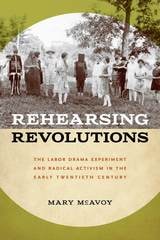
Rehearsing Revolutions
The Labor Drama Experiment and Radical Activism in the Early Twentieth CenturyMary McAvoy
University of Iowa Press, 2019
Choice Outstanding Academic Title, 2019
George Freedley Memorial Award Finalist, 2020
Between the world wars, several labor colleges sprouted up across the U.S. These schools, funded by unions, sought to provide members with adult education while also indoctrinating them into the cause. As Mary McAvoy reveals, a big part of that learning experience centered on the schools’ drama programs. For the first time, Rehearsing Revolutions shows how these left-leaning drama programs prepared American workers for the “on-the-ground” activism emerging across the country. In fact, McAvoy argues, these amateur stages served as training grounds for radical social activism in early twentieth-century America.Using a wealth of previously unpublished material such as director’s reports, course materials, playscripts, and reviews, McAvoy traces the programs’ evolution from experimental teaching tool to radically politicized training that inspired overt—even militant—labor activism by the late 1930s. All the while, she keeps an eye on larger trends in public life, connecting interwar labor drama to post-war arts-based activism in response to McCarthyism, the Cold War, and the Civil Rights movement. Ultimately, McAvoy asks: What did labor drama do for the workers’ colleges and why did they pursue it? She finds her answer through several different case studies in places like the Portland Labor College and the Highlander Folk School in Tennessee.
Renaissance Drama 38
William N. West
Northwestern University Press, 2010
Renaissance Drama, an annual interdisciplinary publication, is devoted to drama and performance as a central feature of Renaissance culture. The essays in each volume explore the traditional canon of drama, the significance of performance, broadly construed, to early modern culture, and the impact of new forms of interpretation on the study of Renaissance plays, theater, and performance.
Volume 38 includes essays that explore topics in early modern drama ranging from Shakespeare’s Jewish questions in The Merchant of Venice and the gender of rhetoric in Shakespeare’s sonnets and Jonson’s plays to improvisation in the commedia dell’arte and the rebirth of tragedy in 1940 Germany.
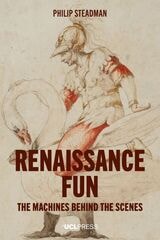
Renaissance Fun
The Machines behind the ScenesPhilip Steadman
University College London, 2021
Renaissance Fun is about the technology of entertainment in the forms of stage machinery, theatrical special effects, gardens, fountains, automata, and self-playing musical instruments from the Renaissance. How did the machines behind these shows work? How exactly were chariots filled with singers let down onto the stage? How were flaming dragons made to fly across the sky? How were seas created on stage? How did mechanical birds imitate real birdsong? What was “artificial music,” three centuries before Edison and the phonograph? How could pipe organs be driven and made to play themselves by waterpower alone? And who were the architects, engineers, and craftsmen who created these wonders? While this book is offered as entertainment in itself, it also offers a more serious scholarly argument centered on the enormous influence of Vitruvius and Hero, two ancient writers who composed on the subject.

Renaissance Revivals
City Comedy and Revenge Tragedy in the London Theater, 1576-1980Wendy Griswold
University of Chicago Press, 1986
Renaissance Shakespeare/Shakespeare Renaissances
Proceedings of the Ninth World Shakespeare CongressMartin Procházka
University of Delaware Press, 2014
Published by University of Delaware Press. Distributed worldwide by Rutgers University Press.
Representing the Past
Essays in Performance HistoriographyCharlotte M. Canning
University of Iowa Press, 2010
How do historians represent the past? How do theatre historians represent performance events? The fifteen challenging essays in Representing the Past: Essays in Performance Historiography focus on the fundamental epistemological conditions and procedures that serve as the foundational ideas that guide all historians in their endeavors. Unified by their investigations into how best to understand and then represent the past, this diverse group of scholars in the field of theatre history and performance studies offers insights into the abiding issues that all historians face in the task of representing human events and actions.
Five primary ideas provide the topics as well as the intellectual parameters for this book: archive, time, space, identity, and narrative. Taking these as the conceptual framework for historical research and analysis, the essayists cover an expansive range of case studies and problems in the historical study of performance from the Americas to Africa and from Europe to India and China. Considering not only how historians think about these concepts in their research and writing but more pointedly—and historiographically—how they think with them, the essayists demonstrate the power and centrality of each of these five ideas in historical scholarship from initial research to the writing of essays and books.
Performance history has a diversity of identities, locations, sources, and narratives. This compelling engagement with the concepts essential to historical understanding is a valuable contribution to the historiography of performance—for students, teachers, and the future of the discipline itself. Expanding upon its classic predecessor, Interpreting the Theatrical Past: Essays in the Historiography of Performance, this exciting new collection illustrates the contemporary richness of historical thinking and writing in the field of performance history.
Resetting the Stage
Public Theatre between the Market and DemocracyDragan Klaic
Intellect Books, 2012
Resistance on the National Stage
Theater and Politics in Late New Order IndonesiaMichael H. Bodden
Ohio University Press, 2010
Resistance on the National Stage analyzes the ways in which, between 1985 and 1998, modern theater pracxadtitioners in Indonesia contributed to a rising movement of social protest against the long-governing New Order regime of President Suharto. It examines the work of an array of theater groups and networks from Jakarta, Bandung, and Yogyakarta that pioneered new forms of theater-making and new themes that were often presented more directly and critically than previous groups had dared to do.
Michael H. Bodden looks at a wide range of case studies to show how theater contributed to and helped build the opposition. He also looks at how specific combinations of social groups created tensions and gave modern theater a special role in bridging social gaps and creating social networks that expanded the reach of the prodemocracy movement. Theater workers constructed new social networks by involving peasants, Muslim youth, industrial workers, and lower-middle-class slum dwellers in theater productions about their own lives. Such networking and resistance established theater as one significant arena in which the groundwork for the ouster of Suharto in May 1998, and the succeeding Reform era, was laid.
Resistance on the National Stage will have broad appeal, not only for scholars of contemporary Indonesian culture and theater, but also for those interested in Indonesian history and politics, as well as scholars of postcolonial theater and culture.
Resisting Spirits
Drama Reform and Cultural Transformation in the People's Republic of ChinaMaggie Greene
University of Michigan Press, 2019
Restaging the Future
Neoliberalization, Theater, and Performance in BritainLouise Owen
Northwestern University Press, 2023
Post-Thatcher, British cultural politics were shaped by the government’s use of the arts in service of its own social and economic agenda. Restaging the Future: Neoliberalization, Theater, and Performance in Britain interrogates how arts practices and cultural institutions were enmeshed with the particular processes of neoliberalization mobilized at the end of the twentieth century and into the twenty-first.
Louise Owen traces the uneasy entanglement of performance with neoliberalism's marketization of social life. Focusing on this political moment, Owen guides readers through a wide range of performance works crossing multiple forms, genres, and spaces—from European dance tours, to Brazilian favelas, to the streets of Liverpool—attending to their distinct implications for the reenvisioned future in whose wake we now live.
Analyzing this array of participatory dance, film, music, public art, and theater projects, Owen uncovers unexpected affinities between community-based, experimental, and avant-garde movements. Restaging the Future provides key historical context for these performances, their negotiations of their political moment, and their themes of insecurity, identity, and inequality, created in a period of profound ideological and socioeconomic change.
Restaging the Sixties
Radical Theaters and Their LegaciesEdited by James M. Harding and Cindy Rosenthal
University of Michigan Press, 2006
The volume explores how creations such as the Living Theatre's Paradise Now and the Performance Group’s Dionysus in 69 overlapped with political interests that, in the late 1960s, highlighted the notion of social collectives as a radical alternative to mainstream society. Situating theatrical practice within this socio-political context, the book considers how radical theaters sought to redefine the relationship between theater and political activism, and how, as a result, they challenged the foundations of theater itself.
James M. Harding is Associate Professor of English at Mary Washington University. His other books include Not the Other Avant-Garde: The Transnational Foundations of Avant-Garde Performance.
Cindy Rosenthal is Associate Professor of Theatre Studies, Hofstra University.
“A useful introduction to an eclectic period of experimental theater, providing portraits of the major political theaters and engaging with new vigor many of the era’s familiar aesthetic and ideological concerns. The writers offer a provocative history of theater’s attraction to (and occasional anxiety over) activism.”
--Marc Robinson, Yale University
Resurrecting the First Great American Play
Imperial Politics and Colonial Ambitions in Frontier DetroitSämi Ludwig
University of Wisconsin Press, 2020
Sämi Ludwig contends that Ponteach's literary and artistic merits are worthy of further exploration. He investigates questions of authorship and analyzes the play's content, embracing its many contradictions as enriching windows into the era. In this way, he suggests using Ponteach as a tool to better understand British imperialism in North America and the emerging theatrical forms of the Young Republic.
Rethinking Chinese Socialist Theaters of Reform
Performance Practice and Debate in the Mao EraXiaomei Chen, Tarryn Li-Min Chun, and Siyuan Liu, Editors
University of Michigan Press, 2021
Reverberations across Small-Scale British Theatre
Politics, Aesthetics and FormsEdited by Patrick Duggan and Victor Ukaegbu
Intellect Books, 2013
Revolutionary Stagecraft
Theater, Technology, and Politics in Modern ChinaTarryn Li-Min Chun
University of Michigan Press, 2024
2026 NYU Joe Callaway Prize Winner
- 2025 Association for Theatre in Higher Education Outstanding Book Award in Innovative Achievement Winner
- 2024 Theatre Library Association George Freedley Memorial Award Co-Winner
- American Society for Theatre Research Barnard Hewitt Award for Outstanding Research in Theatre History Finalist
Revolutionary Stagecraft draws on a rich corpus of literary, historical, and technical materials to reveal a deep entanglement among technological modernization, political agendas, and the performing arts in modern China. This unique approach to Chinese theater history combines a close look at plays themselves, performance practices, technical theater details, and behind-the-scenes debates over “how to” make theater amid the political upheavals of China’s 20th century. The book begins at a pivotal moment in the 1920s—when Chinese theater artists began to import, use, and write about modern stage equipment—and ends in the 1980s when China's scientific and technological boom began. By examining iconic plays and performances from the perspective of the stage technologies involved, Tarryn Li-Min Chun provides a fresh perspective on their composition and staging. The chapters include stories on the challenges of creating imitation neon, rigging up a makeshift revolving stage, and representing a nuclear bomb detonating onstage.
In thinking about theater through technicity, the author mines well-studied materials such as dramatic texts and performance reviews for hidden technical details and brings to light a number of previously untapped sources such as technical journals and manuals; set design renderings, lighting plots, and prop schematics; and stage technology how-to guides for amateur thespians. This approach focuses on material stage technologies, situating these objects equally in relation to their technical potential, their human use, and the social, political, economic, and cultural forces that influence them. In each of its case studies, Revolutionary Stagecraft reveals the complex and at times surprising ways in which Chinese theater artists and technicians of the 20th century envisioned and enacted their own revolutions through the materiality of the theater apparatus.
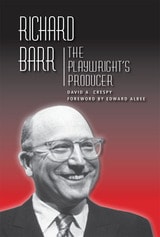
Richard Barr
The Playwright's ProducerDavid A. Crespy
Southern Illinois University Press, 2013
In Richard Barr: The Playwright’s Producer, author David A. Crespy investigates the career of one of the theatre’s most vivid luminaries, from his work on the film and radio productions of Orson Welles to his triumphant—and final—production of Stephen Sondheim’s Sweeney Todd: The Demon Barber of Fleet Street. Explored in detail along the way are the producer’s relationship with playwright Edward Albee, whose major plays such as A Zoo Story and Who’s Afraid of Virginia Woolf Barr was the first to produce, and his innovative productions of controversial works by playwrights like Samuel Beckett, Terrence McNally, and Sam Shepard. Crespy draws on Barr’s own writings on the theatre, his personal papers, and more than sixty interviews with theatre professionals to offer insight into a man whose legacy to producers and playwrights resounds in the theatre world. Also included in the volume are a foreword and an afterword by Edward Albee, a three-time Pulitzer Prize–winning playwright and one of Barr’s closest associates.
Riot and Great Anger
Stage Censorship in Twentieth-Century IrelandJoan Fitzpatrick Dean
University of Wisconsin Press, 2010
Joan FitzPatrick Dean’s Riot and Great Anger suggests that while there was no state censorship in early-twentieth-century Ireland, the theater often evoked heated responses from theatergoers, sometimes resulting in riots and the public denunciation of playwrights and artists. Dean examines the plays that provoked these controversies, the degree to which they were "censored" by the audience or actors, and the range of responses from both the press and the courts. She addresses familiar pieces such as those of William Butler Yeats, John Millington Synge, and Sean O’Casey, as well as the works of less known playwrights such as George Birmingham. Dean’s original research meticulously analyzes Ireland’s great theatrical tradition, both on the stage and off, concluding that the public responses to these controversial productions reveal a country that, at century’s end as at its beginning, was pluralistic, heterogeneous, and complex.
Risk Culture
Performance and Danger in Early AmericaJoseph Fichtelberg
University of Michigan Press, 2010
---David Shields, University of South Carolina
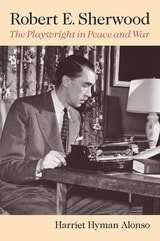
Robert E. Sherwood
The Playwright in Peace and WarHarriet Hyman Alonso
University of Massachusetts Press, 2007
One of the nation's first film critics, an acclaimed speechwriter on his own and for President Franklin D. Roosevelt, a propagandist during World War II, and a leading producer on Broadway, Robert E. Sherwood scripted some of the most popular plays and films of his day, including Waterloo Bridge, The Best Years of Our Lives, Idiot's Delight, Abe Lincoln in Illinois, and Rebecca. His work brought him four Pulitzer Prizes and an Oscar. In his personal life, however, he was driven by a deep conviction that war was a societal evil that must be eradicated and human rights a moral responsibility that all governments should protect. At times, his belief in pacifism and his commitment to defending freedom and justice came into conflict with each other, causing frustration and emotional trauma which found their way into his writings and actions.
In this book, Harriet Hyman Alonso unravels Sherwood's inner struggle and portrays his political journey. Relying largely on his letters, diaries, plays, films, essays, and biography of Roosevelt and Harry Hopkins, she traces Sherwood's obsession with the world of politics and its effects on his life and art, from his experience as a soldier in World War I to the Cold War. She also describes his participation in the Algonquin Round Table, his friendships and working relationships with such notables as Alfred Lunt, Lynn Fontanne, Edna Ferber, Spencer Tracy, Harry Hopkins, and Franklin D. Roosevelt, his two marriages and uneasy relationship with his daughter, and his leadership role in the Broadway community.
Alonso brings together history, theater and film studies, and peace studies in this interdisciplinary political biography. In the process, she illuminates major currents in U.S. foreign policy, society, and culture from 1896 to 1955—the years of the remarkable life of Robert E. Sherwood.
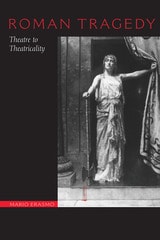
Roman Tragedy
Theatre to TheatricalityBy Mario Erasmo
University of Texas Press, 2004
Roman tragedies were written for over three hundred years, but only fragments remain of plays that predate the works of Seneca in the mid-first century C.E., making it difficult to define the role of tragedy in ancient Roman culture. Nevertheless, in this pioneering book, Mario Erasmo draws on all the available evidence to trace the evolution of Roman tragedy from the earliest tragedians to the dramatist Seneca and to explore the role played by Roman culture in shaping the perception of theatricality on and off the stage.
Performing a philological analysis of texts informed by semiotic theory and audience reception, Erasmo pursues two main questions in this study: how does Roman tragedy become metatragedy, and how did off-stage theatricality come to compete with the theatre? Working chronologically, he looks at how plays began to incorporate a rhetoricized reality on stage, thus pointing to their own theatricality. And he shows how this theatricality, in turn, came to permeate society, so that real events such as the assassination of Julius Caesar took on theatrical overtones, while Pompey's theatre opening and the lavish spectacles of the emperor Nero deliberately blurred the lines between reality and theatre. Tragedy eventually declined as a force in Roman culture, Erasmo suggests, because off-stage reality became so theatrical that on-stage tragedy could no longer compete.
Rough Magic
Making Theatre at the Royal Shakespeare CompanySteven Adler. Foreword by Chris Parry
Southern Illinois University Press, 2001
Steven Adler examines the dynamic life and workings of the theatre company responsible for some of the world’s most compelling performances and influential productions of the last forty years, including Marat/Sade, A Midsummer Night’s Dream, Les Misérables, Les Liaisons Dangereuses, and Nicholas Nickleby.
Rough Magic provides a thorough analysis of the many strands of theatrical activity on both sides of the footlights that coalesce in the artistic vigor of the Royal Shakespeare Company. Adler traces the company’s evolution from its origins in 1879 as a week-long festival presented by Stratford-upon-Avon as a birthday homage to its native son, to its current incarnation as one of the world’s most distinguished institutional theatres. He probes the aspirations and achievements of the RSC’s four successive artistic directors: Peter Hall, Trevor Nunn, Terry Hands, and Adrian Noble. He offers a comprehensive view of the design and aesthetics of the RSC’s five theatres in Stratford and London, and explores the intricate process of crafting a repertoire at home and on tour that responds to the needs of the artists as well as the demands of the box office.
Vivid illustrations, personal observation, research, and dozens of interviews with current and former members of the Royal Shakespeare Company unite to produce Rough Magic.
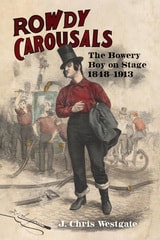
Rowdy Carousals
The Bowery Boy on Stage, 1848-1913J. Chris Westgate
University of Iowa Press, 2024
The book’s examination of working-class whiteness on stage, in the theatre, and in print culture invites theatre historians and critics to check the impulse to downplay or ignore questions about race and ethnicity in discussion of the Bowery Boy. J. Chris Westgate further explores links between the Bowery Boy’s rowdyism in the nineteenth century and the resurgence of white supremacy in the early twenty-first century.
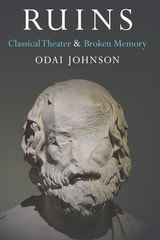
Ruins
Classical Theater and Broken MemoryOdai Johnson
University of Michigan Press, 2018
Much of the theater of antiquity is marked by erasures: missing origins, broken genres, fragments of plays, ruins of architecture, absented gods, remains of older practices imperfectly buried and ghosting through the civic productions that replaced them. Ruins: Classical Theater and Broken Memory traces the remains, the remembering, and the forgetting of performance traditions of classical theater. The book argues that it is only when we look back over the accumulation of small evidence over a thousand-year sweep of classical theater that the remarkable and unequaled endurance of the tradition emerges. In the absence of more evidence, Odai Johnson turns instead to the absence itself, pressing its most legible gaps into a narrative about scars, vanishings, erasures, and silence: all the breakages that constitute the ruins of antiquity.
In ten wide-ranging case studies, theater history and performance theory are brought together to examine the texts, artifacts, and icons left behind, reading them in fresh ways to offer an elegantly written, extended meditation on “how the aesthetic of ruins offered a model for an ideal that dislodged and ultimately stood in for the historic.”
Russia, Freaks and Foreigners
Three Performance TextsJames MacDonald
Intellect Books, 2008
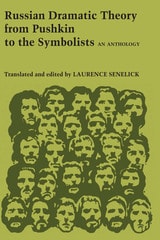
Russian Dramatic Theory from Pushkin to the Symbolists
An AnthologyTranslated and edited by Laurence P. Senelick
University of Texas Press, 1981
Although younger than most European theatrical traditions, the Russian professional theater has generated an exciting body of criticism and theory which until recently has remained unknown or nearly inaccessible in the West. This anthology presents a selection of important Russian writing on the aesthetics of drama and the theater from 1828 to 1914.
The focus of these essays, most published here for the first time in English, is on the so-called Crisis in the Theater of 1904 to 1914, a lively debate between the symbolists and the naturalists that evoked brilliant polemic writing from Meyerhold, Bely, Bryusov, and others. Along with Chekhov's amusing critique of Sarah Bernhardt ("monstrously facile!") and Ivanov's abstruse analysis of the essence of tragedy, the essays form a running commentary on the development of the Russian theater: Pushkin on his predecessors, Gogol on his own work, Belinsky on Gogol, Sleptsov on Ostrovsky and Leskov, Bely on Chekhov's The Cherry Orchard ("enervated people, trying to forget the terror of life"), the symbolists on one another.
Each selection is printed in its entirety, with extensive notes, and a lengthy introduction places all the pieces within their historical and cultural contexts to comprise a brief history of Russian dramatic theory before the revolution. This volume is essential reading for all who wish to extend their knowledge of the Russian contribution to theatrical history, theory, and criticism.

Russian Theater
The Twenty-first Century, Volume 36Tom Sellar and Yana Ross, eds.
Duke University Press, 0
In the first English-language collection to examine twenty-first-century Russian theater, this special issue of Theater also includes the complete texts of two new Russian plays, published for the first time in English. Ivan Vyrypaev’s Oxygen is a poetic panorama of new Russian identity set to techno music, and Danila Privalov’s 5-25 explores traditional Dostoyevskian existential themes in the language of a new generation. One contributor chronicles the sweeping cultural and institutional changes in the Russian theater since 2000, while another provides an overview of the regional theater system in the world’s most geographically vast country. Another essay explores the development of the new playwriting movement, identifying its key writers and producers. This special issue also includes interviews with the movement’s directors and producers. Additionally, it contains letters, previously unpublished in English, from the Moscow Art Theater’s Olga Bokshanskaya to the Russian theatrical titan Vladimir Nemirovich-Danchenko, reporting on the Moscow Art Theater’s legendary U.S. tour in 1920–22, which was recorded in theater history as a turning point for American acting.
Contributors. AKHE, Dmitri Chernikov, Nina Chusova, Marina Dmitrievskaya, Sasha Dugdale, John Freedman, Elena Gremina, Nina Karpova, Mindaugus Korbauskis, Ryan McKittrick, Arkady Ostrovsky, Danila Privalov, Victor Rizhakov, Yana Ross, Tom Sellar, Kirill Serebrennikov, Anatoly Smeliansky, Julia Smeliansky, Ivan Vyrypaev
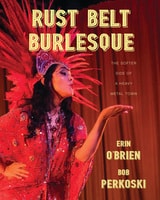
Rust Belt Burlesque
The Softer Side of a Heavy Metal TownErin O’Brien
Ohio University Press, 2019
The performance art of burlesque, once a faded form, has made a comeback in the twenty-first century, and it has shimmied back to life with a vengeance in Cleveland. Thanks to fans and entrepreneurs, neo-burlesque has taken the stage—and it’s more inclusive, less seedy, and emphatically fun.
Rust Belt Burlesque traces the history of burlesque in Cleveland from the mid-1800s to the present day, while also telling the story of Bella Sin, a Mexican immigrant who largely drove Northeast Ohio’s neo-burlesque comeback. The historical center of Cleveland burlesque was the iconic Roxy Theater on East Ninth Street. Here, in its twentieth-century heyday, famed dancers like Blaze Starr and comics like Red Skelton and Abbott and Costello entertained both regulars and celebrity guests.
Erin O’Brien’s lively storytelling and Bob Perkoski’s color photos give readers a peek into the raucous Ohio Burlesque Festival that packs the house at the Beachland Ballroom every year. Today’s burlies come in all shapes, ethnicities, and orientations, drawing a legion of adoring fans. This is a show you won’t want to miss.