Results by title
28164 books match the query 'History' and 1206 start with r
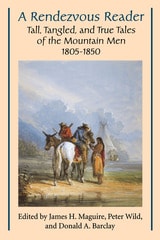
Rendezvous Reader
James H. Maguire
University of Utah Press, 1997
The early plans for Mount Rushmore called for blasting heroic likenesses of mountain men--Kit Carson, Jim Bridger, and John Colter-—into the solid mountain granite of South Dakota. Readers of this colorful volume will see the heroics and the brutally rugged individualism that made these fur trappers candidates for legend and infamy.
The accounts of the mountain men are spun from the experiences of a nation moving westward: a trapper returns from the dead; hunters feast on buffalo intestines served on a dirty blanket; a missionary woman is astounded by the violence and vulgarity of the trappers’ rendezvous. These are just a few of the narratives, tall tales, and just plain lies that make up A Rendezvous Reader.
The writers represented in this book include a dyed-in-the wool trappers, adventuring European nobles, upward-gazing eastern missionaries, and just plain hacks who never unsheathed a Green River knife or traveled farther west that the Ohio River. What these writers have in common is that all of them, whether they dealt mostly in fact of entirely in fantasy, helped to create a uniquely American icon: the mountain man.
Though A Rendezvous Reader will certainly be of interest to the historian and the historically curious, the true purpose of this anthology is to bring together in one volume the liveliest most readable accounts by and about the mountain men. Whether you sample or devour this anthology of mountain horrors and delights, it is a book guaranteed to entertain as well as inform.
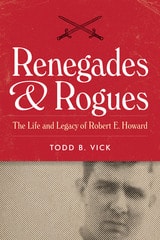
Renegades and Rogues
The Life and Legacy of Robert E. HowardBy Todd B. Vick
University of Texas Press, 2021
2022 Atlantean Award, Robert E. Howard Foundation
You may not know the name Robert E. Howard, but you probably know his work. His most famous creation, Conan the Barbarian, is an icon of popular culture. In hundreds of tales detailing the exploits of Conan, King Kull, and others, Howard helped to invent the sword and sorcery genre.
Todd B. Vick delves into newly available archives and probes Howard’s relationships, particularly with schoolteacher Novalyne Price, to bring a fresh, objective perspective to Howard's life. Like his many characters, Howard was an enigma and an outsider. He spent his formative years visiting the four corners of Texas, experiences that left a mark on his stories. He was intensely devoted to his mother, whom he nursed in her final days, and whose impending death contributed to his suicide in 1936 when he was just thirty years old.
Renegades and Rogues is an unequivocal journalistic account that situates Howard within the broader context of pulp literature. More than a realistic fantasist, he wrote westerns and horror stories as well, and engaged in avid correspondence with H. P. Lovecraft and other pulp writers of his day. Vick investigates Howard’s twelve-year writing career, analyzes the influences that underlay his celebrated characters, and assesses the afterlife of Conan, the figure in whom Howard's fervent imagination achieved its most durable expression.
Renewal
Liberal Protestants and the American City after World War IIMark Wild
University of Chicago Press, 2019
Renewal explores the rise and fall of this movement, which began as an effort to restore the church’s standing but wound up as nothing less than an openhearted crusade to remake our nation’s cities. These campaigns reached beyond church walls to build or lend a hand to scores of organizations fighting for welfare, social justice, and community empowerment among the increasingly nonwhite urban working class. Church leaders extended their efforts far beyond traditional evangelicalism, often dovetailing with many of the contemporaneous social currents coursing through the nation, including black freedom movements and the War on Poverty.
Renewal illuminates the overlooked story of how religious institutions both shaped and were shaped by postwar urban America.
Renewal
Liberal Protestants and the American City after World War IIMark Wild
University of Chicago Press, 2019
In the decades following World War II, a movement of clergy and laity sought to restore liberal Protestantism to the center of American urban life. Chastened by their failure to avert war and the Holocaust, and troubled by missionaries’ complicity with colonial regimes, they redirected their energies back home.
Renewal explores the rise and fall of this movement, which began as an effort to restore the church’s standing but wound up as nothing less than an openhearted crusade to remake our nation’s cities. These campaigns reached beyond church walls to build or lend a hand to scores of organizations fighting for welfare, social justice, and community empowerment among the increasingly nonwhite urban working class. Church leaders extended their efforts far beyond traditional evangelicalism, often dovetailing with many of the contemporaneous social currents coursing through the nation, including black freedom movements and the War on Poverty.
Renewal illuminates the overlooked story of how religious institutions both shaped and were shaped by postwar urban America.
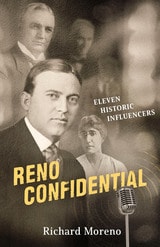
Reno Confidential
Eleven Historic InfluencersRichard Moreno
University of Nevada Press, 2027
In Reno Confidential, veteran Nevada historian Richard Moreno pulls back the curtain on the Biggest Little City to reveal eleven men and women who shaped its destiny—some celebrated, others nearly forgotten. Heavyweights like George Wingfield and William Harrah loom large, but Moreno digs deeper, spotlighting bold reformers, civil rights leaders, architects, club owners, and even underworld figures who steered Reno’s image in lasting ways.
From free-thinking mayor Edwin E. Roberts to trailblazing attorney Felice Cohn, from visionary designer Frederic DeLongchamps to colorful dealmakers working behind the scenes, these were the original influencers—long before social media—who used newspapers, politics, business, and sheer force of personality to leave their mark.
Lively, accessible, and rich with story, Reno Confidential brings the city’s past into sharp focus through eleven unforgettable characters whose ambitions, rivalries, and vision helped make Reno what it is today.
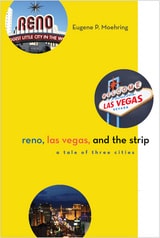
Reno, Las Vegas, and the Strip
A Tale of Three CitiesEugene P. Moehring
University of Nevada Press, 2024
Moehring brings the story of the three cities to the present day, examining lessons learned from the Great Recession and the efforts under way in all three metropolises to diversify their economies. Moehring makes an important contribution with the only current study of Nevada’s cities, focusing on urban development issues rather than social history or the gaming industry. As the service economy continues to grow, not only in Nevada but throughout the United States, Moehring’s work has many implications for urban studies and particularly the study of urban development in other metropolitan areas.
Rent Strikes
A History of Collective Tenant Actions Across the WorldEdited by Lucas Poy and Hannes Rolf
University College London, 2025
Since the late nineteenth century, tenants across various historical and geographic contexts have engaged in collective action, including rent strikes, to improve their standard of living. Rent Strikes brings together an international cohort of researchers to identify common patterns and global trajectories in this rich history, spanning from the early twentieth century to the COVID-19 pandemic. Encompassing various continents and periods, it explores tenants’ struggles on both the local and national levels in North and Latin America, Northern and Southern Europe, and Oceania. Not only does this volume expand the scope of previous studies to consider the role of ethnicity, nationality, and gender in tenant mobilization, but it also aims to engage a wider audience beyond academia, including activists, policymakers, and the general public interested in housing.
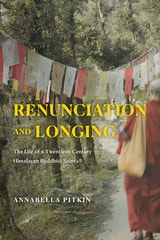
Renunciation and Longing
The Life of a Twentieth-Century Himalayan Buddhist SaintAnnabella Pitkin
University of Chicago Press, 2022
In the early twentieth century, Khunu Lama journeyed across Tibet and India, meeting Buddhist masters while sometimes living, so his students say, on cold porridge and water. Yet this elusive wandering renunciant became a revered teacher of the Fourteenth Dalai Lama. At Khunu Lama’s death in 1977, he was mourned by Himalayan nuns, Tibetan lamas, and American meditators alike. The many surviving stories about him reveal significant dimensions of Tibetan Buddhism, shedding new light on questions of religious affect and memory that reimagines cultural continuity beyond the binary of traditional and modern.
In Renunciation and Longing, Annabella Pitkin explores devotion, renunciation, and the teacher-student lineage relationship as resources for understanding Tibetan Buddhist approaches to modernity. By examining narrative accounts of the life of a remarkable twentieth-century Himalayan Buddhist and focusing on his remembered identity as a renunciant bodhisattva, Pitkin illuminates Tibetan and Himalayan practices of memory, affective connection, and mourning. Refuting long-standing caricatures of Tibetan Buddhist communities as unable to be modern because of their religious commitments, Pitkin shows instead how twentieth- and twenty-first-century Tibetan and Himalayan Buddhist narrators have used themes of renunciation, devotion, and lineage as touchstones for negotiating loss and vitalizing continuity.
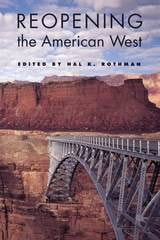
Reopening the American West
Edited by Hal K. Rothman
University of Arizona Press, 1998
In this book Mike Davis, Stephen Pyne, William deBuys, Donald Worster, Dan Flores, and others re-examine the relationship between people and the environment in the American West over five hundred years, from the legacy of Coronado's search for the Cities of Gold to the social costs of tourism and gaming inflicted by modern adventurers. By exploring places in the West, aspects of the region's past, and ways of understanding some of its pressing issues, the authors foster a better understanding of how people interact and perceive land.
Reopening the American West takes a fresh approach to the history of the region, examining the premises of earlier scholars as well as those who have redefined the study of the West over the past two decades. It combines provocative essays with insightful analyses to address issues that are representative of the West in the twentieth century—multiculturalism, water issues, resource exploitation—and to reopen the West for all readers interested in new ways of looking at its wide-open spaces.
Contents:
Places
Dreams of Earth, William deBuys
Environmentalism and Multiculturalism, Dan L. Flores
Pyre on the Mountain, Stephen J. Pyne
Las Vegas Versus Nature, Mike Davis
Pasts
The Legacy of John Wesley Powell, Donald Worster
Pokey’s Paradox: Tourism and Transformation on the Western Navajo Reservation, Hal K. Rothman
Negotiating National Identity: Western Tourism and "See American First," Marguerite Schaffer
Understanding
Place Humanists at the Headgates, Helen Ingram
Tapping the Rockies: Resource Exploitation and Conservation in the Intermountain West, Char Miller
The Meaning of Place: Reimagining Community in a Changing West, Robert Gottlieb
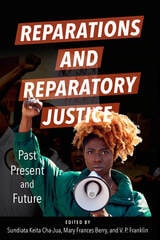
Reparations and Reparatory Justice
Past, Present, and FutureEdited by Sundiata Keita Cha-Jua, Mary Frances Berry, and V. P. Franklin
University of Illinois Press, 2024
Sharing a focus on reparations as an issue of justice, the contributors provide a historical primer of the movement; introduce the philosophical, political, economic, legal and ethical issues surrounding reparations; explain why government, corporations, universities, and other institutions must take steps to rehabilitate, compensate, and commemorate African Americans; call for the restoration of Black people’s human and civil rights and material and psychological well-being; lay out specific ideas about how reparations can and should be paid; and advance cutting-edge interpretations of the complex long-lasting effects that enslavement, police and vigilante actions, economic discrimination, and other behaviors have had on people of African descent.
Groundbreaking and innovative, Reparations and Reparatory Justice offers a multifaceted resource to anyone wishing to explore a defining moral issue of our time.
Contributors: Dedrick Asante-Muhammad, Hilary McDonald Beckles, Mary Frances Berry, Sundiata Keita Cha-Jua, Chuck Collins, Ron Daniels, V. P. Franklin, Danny Glover, Adom Gretachew, Charles Henry, Kamm Howard, Earl Ofari Hutchinson, Jesse Jackson, Sr., Brian Jones, Sheila Jackson Lee, James B. Stewart, the Movement 4 Black Lives, the National African American Reparations Commission, the National Coalition of Blacks for Reparations in America, the New Afrikan Peoples Organization/Malcolm X Grassroots Movement

Repealed
Ireland’s Unfinished Fight for Reproductive RightsCamilla Fitzsimons
Pluto Press, 2021
*Winner of the James S. Donnelly, Sr. Prize 2022*
In Ireland, 2018, a constitutional ban that equated the life of a woman to the life of a fertilized embryo was overturned and abortion was finally legalized. This victory for the Irish feminist movement set the country alight with euphoria. But the celebrations were short-lived - the new legislation turned out to be one of the most conservative in Europe. This book tells the story of the ‘Repeal’ campaign through the lens of the activists.
The authors trace the shocking history of the origins of the eighth amendment, which was drawn up in fear of a tide of liberal reforms across Europe. They draw out the lessons learned through the decades and from the groundbreaking campaign in 2018, which was an inspiring example of modern grassroots activism. They also recount the tensions between a medicalized approach and reproductive justice approach to abortion, as well as the harsh effect of the campaign on the health of activists.
Grounded in a radical feminist politics, this book is an honest and inspirational account of a movement that is only just beginning.
Repeat Performances
Ovidian Repetition and the <i>Metamorphoses<i/>Edited by Laurel Fulkerson and Tim Stover
University of Wisconsin Press, 2016
A shared vision of the possibilities of Latin epic poetry unites the essays, as does a series of attempts to realize those opportunities. Some of the pieces represent a traditional vein of allusion and intertextuality; others are more innovative in their approaches. Each, in a sense, stands as a placeholder for a methodology of theorizing the repetitive practices of poetry, of epic, and of Ovid in particular.
Contributors: Antony Augoustakis, Neil W. Bernstein, Barbara Weiden Boyd, Andrew Feldherr, Peter Heslin, Stephen Hinds, Sharon L. James, Alison Keith, Peter E. Knox, Darcy Krasne
Repertory of Shakespeare's Company, 1594–1613
Roslyn Lander Knutson
University of Arkansas Press, 1991
Replaceable You
Engineering the Body in Postwar AmericaDavid Serlin
University of Chicago Press, 2004
Replaying Communism
Trauma and Nostalgia in European Cultural ProductionLucy Jeffery
Central European University Press, 2026
The volume adopts an interdisciplinary approach to extend debates on the lasting impact of the communist era across Central and Eastern Europe with chapters thematically threaded through concepts including curation, immersion, interaction, humor and authenticity. A ‘trauma/nostalgia paradigm’ emerges as the tissue connecting the plurality of post-communist efforts employed to address the region’s contested pasts. Twelve original essays by contributors from both ‘inside’ and ‘outside’ the region detail how twenty-first-century cultural productions reengage the communist past. The impact of this past is seen as fundamental to understanding and shaping Central and Eastern European identities.

Replays, Rivalries, and Rumbles
The Most Iconic Moments in American SportsSteven Gietschier
University of Illinois Press, 2017
Report On Brunei In 1904
Mis Sea#74M.S.H. Mcarthur
Ohio University Press, 1987
Report on a Journey to the Western States of North America
and a Stay of Several Years Along the Missouri (During the Years 1824-1827)Gottfried Duden; James W. Goodrich, General Editor; George H. Kellner, Elsa Nagel, Adolf E. Schroeder, and W. M. Senner, Editors and Translators
University of Missouri Press, 1980
The mass migrations to the United States from Europe that began in the 1830s were strongly influenced by what is known today as emigration literature--travelers' writings about their experiences in the New World. Such accounts were particularly popular with German readers; over 150 examples of the genre were published in Germany between 1827 and 1856. Gottfried Duden's Report on a Journey to the Western States of North America, published in 1829, was one of the most influential of these books. The timing, format, coverage, and literary qualities of the Report, and its idyllic descriptions of pioneer farming in Missouri, combined to make it an instant success. It attracted thousands of Germans to the Midwest, and particularly to Missouri, the focus of Duden's account. This edited and annotated translation is the first complete version to be published in English. It provides for the general public and the professional historian a significant contribution to U.S. immigration history and a unique and delightful fragment of Missouri's rich German heritage.
Duden presented his account in the form of personal letters, a style that helped make the book believable. The Mississippi- Missouri valley reminded him of his native Rhineland where the rivers facilitated trade and transportation, and fertile river bottomland offers the perfect environment for agriculture. Duden farmed the land he bought during his sojourn in Missouri, and his book includes meticulous descriptions of clearing, fencing, and harvesting. His pro-emigration bias, colored by the fact that he himself had been able to hire help on his Missouri farm, made his view of the farmer's life, it turned out, more idyllic than practical. Many would-be gentlemen farmers, inspired by his book to come to Missouri, found pioneer farming more strenuous than they had expected.

Report on the Island and Diocese of Puerto Rico (1647)
Don Diego Torres y Vargas, Translated by Jaime R. Vidal
University of Scranton Press, 2010
Composed at the request of the Royal Spanish Chronicler of the Indies, Don Diego Torres y Vargas’s Report on the Island & Diocese of Puerto Rico was the first history of Puerto Rico written by a native of the Spanish island colony. Torres y Vargas, a fourth generation Puerto Rican and descendant of Ponce de Leon, records here the history of the Catholic Church in Puerto Rico as well as the political, social, military, economic, and natural history of the island.
This translation—the first ever into English—includes three historical essays by eminent Puerto Rican and Latino Studies scholar Anthony Stevens-Arroyo and extensive translator notes to guide the reader through the realities of seventeenth-century Puerto Rican culture and society.
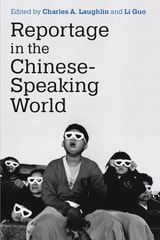
Reportage in the Chinese-Speaking World
Edited by Charles A. Laughlin and Li Guo
University of Michigan Press, 2026
Reportage in the Chinese-Speaking World examines reportage as an important aesthetic form of cultural production in the Sinophone world. Originating as a proletarian nonfiction form in interwar Europe, reportage spread around the world, coming into its own in the Sinophone world from the 1930s to today. Going beyond fact-based journalism, reportage is pursued through a variety of artistic forms and media, from nonfiction writing to photography to documentary film. Reportage’s plurimedial representations facilitate and amplify intersectional struggles against multiple forms of social and political oppression. Engaging its audiences in affective ethico-political exchanges with (human or nonhuman) subjects, reportage promotes audiences’ empathetic responses to the democratic appeals of marginalized groups whose status, identity, or situation manifest emergent ethical challenges in the society of their time.
This work offers new understandings of reportage’s dialectical relationship with its readership by evoking sympathetic identifications with personal contemplations of place, hearth, and senses of belonging. Covering a breadth of media across mainland China, Taiwan, and the Sinophone diaspora in the United States and Japan, this book examines how intermediality cultivates distinctive expressions in reportage, cross-cultural empathy, and ethico-political relationships between the reporter, photographer, filmmaker, and their surroundings.

Reporting the Chinese Revolution
The Letters of Rayna ProhmeGregor Benton and Arthur J. Knodel
Pluto Press, 2007
The book consists of letters Prohme wrote to her closest friend and her husband in the period immediately before, during and after the Wuhan interlude. Her reporting brought her into contact with many major political figures including Madam Sun Yat-sen (a prominent figure in the opposition to Chiang Kai-shek) and Mikhail Borodin (a chief Soviet advisor in China).
This book provides an unusual and often moving insight into a fascinating period in modern Chinese history.
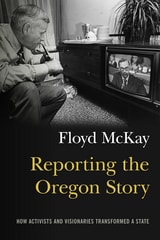
Reporting the Oregon Story
How Activists and Visionaries Transformed a StateFloyd J. McKay
Oregon State University Press, 2016
As a political reporter for The Oregon Statesman in Salem, and then as news analyst for KGW-TV in Portland, McKay was known for asking tough questions and pulling no punches. His reporting and commentaries ranged from analysis of the “Tom and Bob” rivalry, to the Vietnam War’s impact on Senators Wayne Morse and Mark Hatfield and the emergence of a new generation of Portland activists in the 1970s.
McKay and his colleagues were on the beaches as Oregon crafted its landmark Beach Bill, ensuring the protection of beaches for public use. They watched as activists turned back efforts to build a highway on the sand at Pacific City. Pitched battles over Oregon’s Bottle Bill, and the panic-inducing excitement of “Vortex”—the nation’s only state-sponsored rock festival—characterized the period. Covering the period from 1964-1986, McKay remembers the action, the players and the consequences, in this compelling and personal account.
As major actors fade from the scene and new leaders emerge, McKay casts a backwards glance at enduring Oregon legends. Half a century later, amid today’s cynicism and disillusionment with media, politics, and politicians, Reporting the Oregon Story serves as a timely reminder that charged politics and bitter rivalries can also come hand-in-hand with lasting social progress.
Reporting the Oregon Story will be relished by those who lived the history, and it will serve as a worthy introduction to Oregonians young and old who want a first-hand account of Oregon’s mid- twentieth-century political history and legislative legacy.
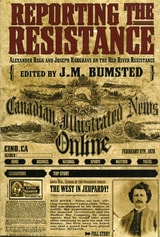
Reporting the Resistance
Alexander Begg and Joseph Hargrave on the Red River ResistanceAlexander Begg
University of Manitoba Press, 2003

Reporting the Wars
Joseph J. Mathews
University of Minnesota Press, 1957
Reporting the Wars was first published in 1957. Minnesota Archive Editions uses digital technology to make long-unavailable books once again accessible, and are published unaltered from the original University of Minnesota Press editions.
News of the wars has always intrigued the public, from the time of the Napoleonic wars up to the present. In this period of the last century and a half, however, the character both of the public and of the news has changed. Mr. Mathews traces the history of war news coverage from John Bell, who, in 1794, was probably the first war correspondent, to Ernie Pyle of World War II fame. The account is colorful, since war correspondents are notably adventurous individuals, and it is significant for a basic understanding of history, since the reporting of war news has represented a constant struggle against the forces of censorship and propaganda. The book is illustrated with newspaper cartoons.
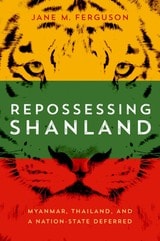
Repossessing Shanland
Myanmar, Thailand, and a Nation-State DeferredJane M. Ferguson
University of Wisconsin Press, 2022
Based on close readings of Shan-language media and years of ethnographic research in a community of soldiers and their families, Jane M. Ferguson details the origins of these movements and tells the story of the Shan in their own voices. She shows how the Shan have forged a homeland and identity during great upheaval by using state building as an ongoing project of resistance, resilience, and accommodation within both countries. In avoiding a good/bad moral binary and illuminating cultural complexities, Repossessing Shanland offers a fresh perspective on identity formation, transformation, and how people understand and experience borderlands today.
Represent and Destroy
Rationalizing Violence in the New Racial CapitalismJodi Melamed
University of Minnesota Press, 2011
In the global convulsions in the aftermath of World War II, one dominant world racial order broke apart and a new one emerged. This is the story Jodi Melamed tells in Represent and Destroy, portraying the postwar racial break as a transition from white supremacist modernity to a formally antiracist liberal capitalist modernity in which racial violence works normatively by policing representations of difference.
Following the institutionalization of literature as a privileged domain for Americans to get to know difference—to describe, teach, and situate themselves with respect to race—Melamed focuses on literary studies as a cultural technology for transmitting liberal racial orders. She examines official antiracism in the United States and finds that these were key to ratifying the country’s global ascendancy. She shows how racial liberalism, liberal multiculturalism, and neoliberal multiculturalism made racism appear to be disappearing, even as they incorporated the assumptions of global capitalism into accepted notions of racial equality.
Yet Represent and Destroy also recovers an anticapitalist “race radical” tradition that provides a materialist opposition to official antiracisms in the postwar United States—a literature that sounds out the violence of liberal racial orders, relinks racial inequality to material conditions, and compels desire for something better than U.S. multiculturalism.
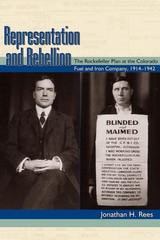
Representation and Rebellion
The Rockefeller Plan at the Colorado Fuel and Iron Company, 1914-1942Jonathan H. Rees
University Press of Colorado, 2010

Representations on the Margins of Europe
Politics and Identities in the Baltic and South Caucasian StatesEdited by Tsypylma Darieva and Wolfgang Kaschuba
Campus Verlag, 2007
Representing Electrons
A Biographical Approach to Theoretical EntitiesTheodore Arabatzis
University of Chicago Press, 2005
Using the electron—or rather its representation—as a historical actor, Theodore Arabatzis illustrates the emergence and gradual consolidation of its representation in physics, its career throughout old quantum theory, and its appropriation and reinterpretation by chemists. As Arabatzis develops this novel biographical approach, he portrays scientific representations as partly autonomous agents with lives of their own. Furthermore, he argues that the considerable variance in the representation of the electron does not undermine its stable identity or existence.
Raising philosophical issues of contentious debate in the history and philosophy of science—namely, scientific realism and meaning change—Arabatzis addresses the history of the electron across disciplines, integrating historical narrative with philosophical analysis in a book that will be a touchstone for historians and philosophers of science and scientists alike.
Representing Talent
Hollywood Agents and the Making of MoviesViolaine Roussel
University of Chicago Press, 2017
The book takes readers behind the scenes to observe the day-to-day activities of agents, revealing their influence on artistic careers and the prospects of Hollywood’s forthcoming projects. Agents are crucial to understanding how creative and economic power are intertwined in Hollywood today. They play a key role in the process by which artistic worth and economic value are evaluated and attributed to people and projects. Roussel’s fieldwork examines what “having relationships” really means for agents, and how they perform the relationship work that’s at the heart of their professional existence and success. Representing Talent helps us to understand the players behind the definition of entertainment itself, as well as behind its current transformations.

Representing the French Revolution
Literature, Historiography, and ArtEdited by James A. W. Heffernan
Brandeis University Press, 1992
Representing the Troubles in Irish Short Fiction
Michael L. Storey
Catholic University of America Press, 2004
Repression, Exile, and Democracy
Uruguayan CultureSaul Sosnowski and Louise B. Popkin, eds.
Duke University Press, 1992
The first section provides a context for the volume, with its analyses of the historical, political, and social aspects of the Uruguayan experience. The following chapters explore various aspects of cultural production, including personal experiences of exile and imprisonment, popular music, censorship, literary criticism, return from exile, and the role that culture plays in redemocratization.
This book's appeal extends well beyond the study of Uruguay to scholars and students of the history and culture of other Latin American nations, as well as to fields of comparative literature and politics in general.
Contributors. Hugo Achugar, Alvarro Barros-Lémez, Lisa Block de Behar, Amanda Berenguer, Hiber Conteris, José Pedro Díaz, Eduardo Galeano, Edy Kaufman, Leo Masliah, Carina Perelli, Teresa Porzecanski, Juan Rial, Mauricio Rosencof, Jorge Ruffinelli, Saúl Sosonowski, Martin Weinstein, Ruben Yáñez
Reproducing the French Race
Immigration, Intimacy, and Embodiment in the Early Twentieth CenturyElisa Camiscioli
Duke University Press, 2009
By focusing on telling aspects of the immigration debate, Camiscioli reveals how racial hierarchies were constructed, how gender figured in their creation, and how only white Europeans were cast as assimilable. Delving into pronatalist politics, she describes how potential immigrants were ranked according to their imagined capacity to adapt to the workplace and family life in France. She traces the links between racialized categories and concerns about industrial skills and output, and she examines medico-hygienic texts on interracial sex, connecting those to the crusade against prostitution and the related campaign to abolish “white slavery,” the alleged entrapment of (white) women for sale into prostitution abroad. Camiscioli also explores the debate surrounding the 1927 law that first made it possible for French women who married foreigners to keep their French nationality. She concludes by linking the Third Republic’s impulse to create racial hierarchies to the emergence of the Vichy regime.
Reproduction by Design
Sex, Robots, Trees, and Test-Tube Babies in Interwar BritainAngus McLaren
University of Chicago Press, 2012
Reproductions of Banality
Fascism, Literature, and French Intellectual LifeAlice Yaeger KaplanForeword by Russell Berman
University of Minnesota Press, 1986
Reproductions of Banality was first published in 1986. Minnesota Archive Editions uses digital technology to make long-unavailable books once again accessible, and are published unaltered from the original University of Minnesota Press editions.
An established fascist state has never existed in France, and after World War II there was a tendency to blame the Nazi Occupation for the presence of fascists within the country. Yet the memory of fascism within their ranks still haunts French intellectuals, and questions about a French version of fascist ideology have returned to the political forefront again and again in the years since the war. In Reproductions of Banality, Alice Yaegar Kaplan investigates the development of fascist ideology as it was manifested in the culture of prewar and Occupied France. Precisely because it existed only in a "gathering" or formative stage, and never achieved the power that brings with it a bureaucratic state apparatus, French fascism never lost its utopian, communal elements, or its consequent aesthetic appeal. Kaplan weighs this fascist aesthetic and its puzzling power of attraction by looking closely at its material remains: the narratives, slogans, newspapers, and film criticism produced by a group of writers who worked in Paris in the 1930s and early 1940s — their "most real moment."
These writers include Pierre Drieu la Rochelle, Louis-Ferdinand Celine, Lucien Rebatat, Robert Brasillach, and Maurice Bardeche, as well as two precursors of French fascism, Georges Sorel and the Italian futurist F.T. Marinetti, who made of the airplane an industrial carrier of sexual fantasies and a prime mover in the transit from futurism to fascism. Kaplan's work is grounded in the major Marxist and psychoanalytic theories of fascism and in concepts of banality and mechanical reproduction that draw upon Walter Benjamin. Emphasizing the role played by the new technologies of sight and sound, she is able to suggest the nature of the long-repressed cultural and political climate that produced French fascism, and to show—by implication — that the mass marketing of ideology in democratic states bears a family resemblance to the fascist mode of an earlier time.
Reproductive Restraints
Birth Control in India, 1877-1947Sanjam Ahluwalia
University of Illinois Press, 2007
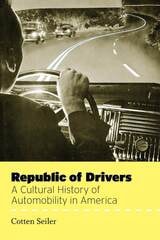
Republic of Drivers
A Cultural History of Automobility in AmericaCotten Seiler
University of Chicago Press, 2008
Cotten Seiler combs through a vast number of historical, social scientific, philosophical, and literary sources to illustrate the importance of driving to modern American conceptions of the self and the social and political order. He finds that as the figure of the driver blurred into the figure of the citizen, automobility became a powerful resource for women, African Americans, and others seeking entry into the public sphere. And yet, he argues, the individualistic but anonymous act of driving has also monopolized our thinking about freedom and democracy, discouraging the crafting of a more sustainable way of life. As our fantasies of the open road turn into fears of a looming energy crisis, Seiler shows us just how we ended up a republic of drivers—and where we might be headed.
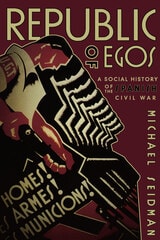
Republic of Egos
A Social History of the Spanish Civil WarMichael Seidman
University of Wisconsin Press, 2002
Most histories of the Spanish Civil War (1936–1939) have examined major leaders or well-established political and social groups to explore class, gender, and ideological struggles. The war in Spain was marked by momentous conflicts between democracy and dictatorship, Communism and fascism, anarchism and authoritarianism, and Catholicism and anticlericalism that still provoke our fascination.
In Republic of Egos, Michael Seidman focuses instead on the personal and individual experiences of the common men and women who were actors in a struggle that defined a generation and helped to shape our world. By examining the roles of anonymous individuals, families, and small groups who fought for their own interests and survival—and not necessarily for an abstract or revolutionary cause—Seidman reveals a powerful but rarely considered pressure on the outcome of history. He shows how price controls and inflation in the Republican zone encouraged peasant hoarding, black marketing, and unrest among urban workers. Soldiers of the Republican Army responded to material shortages by looting, deserting, and fraternizing with the enemy. Seidman’s focus on average, seemingly nonpolitical individuals provides a new vision of both the experience and outcome of the war.
Republic of the Dispossessed
The Exceptional Old-European Consensus in AmericaRowland Berthoff
University of Missouri Press, 1997
Do Americans, in all their cultural diversity, share any fundamental consensus? Does such a consensus, or anything else, make America exceptional in the modern world?
Since 1960 most historians have answered no--except perhaps for the current nostalgia for the Eisenhower years (the "Ozzie and Harriet" years of popular recollection) of middle-class American prosperity.
In Republic of the Dispossessed social historian Rowland Berthoff maintains not only that there was--and still is--a middle-class consensus and that America is exceptional in it but that it goes back some five hundred years. The consensus stems from all those European peasants and artisans who, from 1600 to 1950, fled dispossession in the Old World. They brought with them basic social values that acted as a template for middle-class American values. To consider modern American society as exceptional--that is, as distinctive and different from any contemporary European pattern of thought--is therefore, in Berthoff's theory, not at all the "illogical absurdity" that current conventional wisdom makes it.
The Berthoff thesis, as he develops it in these ten essays from throughout the course of his career, is well worth a second look by those within and beyond the field of social history. It suggests that the ideal--both peasant and classical republican-- of maintaining a balance between personal liberty and communal equality has long inspired American reaction to the drastic modern changes of industrialization, urbanization, and immigration.
Observing that most Americans still see themselves as independent, basically equal, middle-class citizens, Berthoff explains the current apprehension among Americans that at the end of the twentieth century they are once again being dispossessed-- thus, the current emphasis on "traditional values." Because that problem is the same that worried their European ancestors as much as five hundred years ago, Berthoff argues, the time has come to face the question head-on.
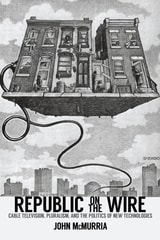
Republic on the Wire
Cable Television, Pluralism, and the Politics of New Technologies, 1948-1984McMurria, John
Rutgers University Press, 2017
Republican Portugal
A Political History, 1910–1926Douglas L. Wheeler
University of Wisconsin Press, 1998
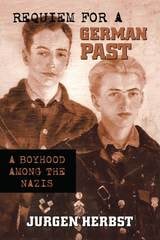
Requiem for a German Past
A Boyhood among the NazisJurgen Herbst
University of Wisconsin Press, 2002
Jurgen Herbst’s account of growing up in Nazi Germany from 1928 to 1948 is a boy’s experience of anti-Semitism and militarism from the inside. Herbst was a middle-class boy in a Lutheran family that saw value in Prussian military ideals and a mythic German past. His memoir is a compelling, understated tale of moral awakening.
Requiem, Rwanda
Laura Apol
Michigan State University Press, 2015
Rereading the Black Legend
The Discourses of Religious and Racial Difference in the Renaissance EmpiresEdited by Margaret R. Greer, Walter D. Mignolo, and Maureen Quilligan
University of Chicago Press, 2008
A distinguished group of contributors here examine early modern imperialisms including the Ottomans in Eastern Europe, the Portuguese in East India, and the cases of Mughal India and China, to historicize the charge of unique Spanish brutality in encounters with indigenous peoples during the Age of Exploration. The geographic reach and linguistic breadth of this ambitious collection will make it a valuable resource for any discussion of race, national identity, and religious belief in the European Renaissance.

Rereading the Fossil Record
The Growth of Paleobiology as an Evolutionary DisciplineDavid Sepkoski
University of Chicago Press, 2012
Rereading the Fossil Record presents the first-ever historical account of the origin, rise, and importance of paleobiology, from the mid-nineteenth century to the late 1980s. Drawing on a wealth of archival material, David Sepkoski shows how the movement was conceived and promoted by a small but influential group of paleontologists and examines the intellectual, disciplinary, and political dynamics involved in the ascendency of paleobiology. By tracing the role of computer technology, large databases, and quantitative analytical methods in the emergence of paleobiology, this book also offers insight into the growing prominence and centrality of data-driven approaches in recent science.
Rereading the Renaissance
Petrarch, Augustine, and the Language of HumanismCarol Everhart Quillen
University of Michigan Press, 1998
Carol Quillen argues that the essential role of Augustine's words and authority in the expression of Petrarch's humanism is best grasped through a study of the complex textual practices exemplified in the writings of both men. Petrarch's reliance on Augustine is most evident in his ways of reading and in his strategies of argument. Secondly, she maintains that Petrarch's appropriation of Augustine's words is only intelligible in light of his struggle to legitimate his cultural ideals in the face of compelling opposition. Finally, Quillen shows how Petrarch's uses of Augustine can simultaneously uphold his humanist ideals and challenge the legitimacy of the assumptions on which those ideals were founded.
Interdisciplinary in scope and method, this volume speaks to important debates that span the humanities. Scholars of literary and historical studies, as well as those in the fields of classical studies, patristics, and comparative literature, will find in Rereading the Renaissance a solid contribution to their interests.
Carol Everhart Quillen is Associate Professor of History, Rice University.

Rereading the Revolution
The Turn-of-the-Century American Revolutionary War NovelAnita Lawson
University of Wisconsin Press, 2000
Approximately fifty historical novels dealing with the American Revolution were published in the United States from 1896 to 1906. Benjamin S. Lawson critically examines the narrative strategies employed in these works and the ways in which fiction is made to serve the purpose of vivifying national history.
Writing within the conventions of the historical romance, these authors created plots that reflect the enveloping concerns of the War for Independence, such as the young American woman who often must choose between suitors on opposite sides in the wider conflict.
Lawson concludes that these works reassured readers of the worth of an Anglo-American heritage. They were escapist fantasies to the degree that they failed to confront contemporary realities of crisis and change: the New Immigration, urbanization and industrialization, labor strife, the plight of the poor, and agitation on behalf of women and ethnic minorities.
Rescue and Remembrance
Imagining the German Collective after NazismKobi Kabalek
University of Wisconsin Press, 2025
Kabalek argues that such simplistic depictions of the majority versus minority obscure the complex motivations and situations that led people in Nazi Germany to help persecuted Jews. Against the view that the rescuers were “forgotten” after the war, he shows that portrayals and interpretations of helping Jews appeared in various media and social discourses in East, West, and unified Germany and were used to actively debate questions of collective morality. Rescue and Remembrance analyzes the varied and changing depictions of rescue in the distinct German politics from the Nazi period, examining how the very notions of “majority” and “collective” were articulated and reformulated.
Rescued from Oblivion
Historical Cultures in the Early United StatesAlea Henle
University of Massachusetts Press, 2020
With in-depth research and an expansive scope, Rescued from Oblivion offers a vital account of the formation of historical culture and consciousness in the early United States, re-centering in the record groups long marginalized from the national memory. As Alea Henle demonstrates, these societies laid the groundwork for professional practices that are still embraced today: collection policies, distinctions between preservation of textual and nontextual artifacts, publication programs, historical rituals and commemorations, reconciliation of scholarly and popular approaches, and more. At the same time, officers of these early societies faced challenges to their historical authority from communities interested in preserving a broader range of materials and documenting more inclusive histories, including fellow members, popular historians, white women, and peoples of color.