Results by title
1441 books match the query 'Great Britain' and 70 start with r
Richard II
William Shakespeare
Arizona Center for Medieval and Renaissance Studies, 2021
Following the events of the final two years of his life, Richard II interrogates royal power and the forces that threaten it. After banishing his cousin Henry Bolingbroke, Richard begins to lose grip of his throne and strives to find meaning in the churn and chaos of the events unfolding around him. In her new translation, Naomi Iizuka ventures into the mystery of the work, scraping away the layers of received wisdom and cracking the play open for contemporary audiences.
This translation of Richard II was written as part of the Oregon Shakespeare Festival’s Play On! project, which commissioned new translations of thirty-nine Shakespeare plays. These translations present work from “The Bard” in language accessible to modern audiences while never losing the beauty of Shakespeare’s verse. Enlisting the talents of a diverse group of contemporary playwrights, screenwriters, and dramaturges from diverse backgrounds, this project reenvisions Shakespeare for the twenty-first century. These volumes make these works available for the first time in print—a new First Folio for a new era.
Richard III
William Shakespeare
Arizona Center for Medieval and Renaissance Studies, 2021
Nuyorican playwright Migdalia Cruz unpacks and repositions Shakespeare’s Richard III for a twenty-first-century audience. She presents a contemporary English verse translation, faithfully keeping the poetry, the puns, and the politics of the play intact, with a rigorous and in-depth examination of Richard III—the man, the king, the outsider—who is still the only English king to have died in battle. In the Wars of the Roses, his Catholic belief in his country led to his slaughter at Bosworth’s Field by his Protestant rivals. In reimagining this text, Cruz emphasizes Richard III’s outsider status—exacerbated by his severe scoliosis, which twisted his spine—by punctuating the text with punk music from 1970s London. Cruz’s Richard is no one’s fool or lackey. He is a new kind of monarch, whose dark sense of humor and deep sense of purpose leads his charge against the society which never fully accepted him because he looked different.
This translation was written as part of the Oregon Shakespeare Festival’s Play On! project, which commissioned new translations of thirty-nine Shakespeare plays. These translations present the work of "The Bard" in language accessible to modern audiences while never losing the beauty of Shakespeare’s verse. These volumes make these works available for the first time in print—a new First Folio for a new era.
Richard Owen
Biology without DarwinNicolaas A. Rupke
University of Chicago Press, 2009
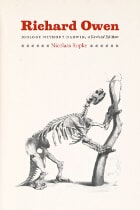
In the mid-1850s, no scientist in the British Empire was more visible than Richard Owen. Mentioned in the same breath as Isaac Newton and championed as Britain’s answer to France’s Georges Cuvier and Germany’s Alexander von Humboldt, Owen was, as the Times declared in 1856, the most “distinguished man of science in the country.” But, a century and a half later, Owen remains largely obscured by the shadow of the most famous Victorian naturalist of all, Charles Darwin. Publicly marginalized by his contemporaries for his critique of natural selection, Owen suffered personal attacks that undermined his credibility long after his name faded from history.
With this innovative biography, Nicolaas A. Rupke resuscitates Owen’s reputation. Arguing that Owen should no longer be judged by the evolution dispute that figured in only a minor part of his work, Rupke stresses context, emphasizing the importance of places and practices in the production and reception of scientific knowledge. Dovetailing with the recent resurgence of interest in Owen’s life and work, Rupke’s book brings the forgotten naturalist back into the canon of the history of science and demonstrates how much biology existed with, and without, Darwin
Riddle, Mystery, and Enigma
Two Hundred Years of British–Russian RelationsDavid Owen
Haus Publishing, 2022
With Riddle, Mystery, and Enigma, statesman and author David Owen tells the story of Britain’s relationship with Russia, which has been surprisingly underexplored. Through his characteristic insight and expertise, he depicts a relationship governed by principle as often as by suspicion, expediency, and necessity.
When the two nations formed a pragmatic alliance and fought together at the Battle of Navarino in Greece in 1827, it was overwhelmingly the work of the British prime minister, George Canning. His death brought about a drastic shift that would see the countries fighting on opposite sides in the Crimean War and jostling for power during the Great Game. It was not until the Russian Revolution of 1917 that another statesman had a defining impact on relations between Britain and Russia: Winston Churchill, who opposed Bolshevism yet never stopped advocating for diplomatic and military engagement with Russia. In the Second World War, he recognized early on the necessity of allying with the Soviets against the menace of Nazi Germany. Bringing us into the twenty-first century, Owen chronicles how both countries have responded to their geopolitical decline. Drawing on both imperial and Soviet history, he explains the unique nature of Putin’s autocracy and addresses Britain’s return to “blue water” diplomacy. Newly revised, this paperback edition features extended chapters on Putin’s Russia and the future of British–Russian relations after the Russo-Ukrainian War.
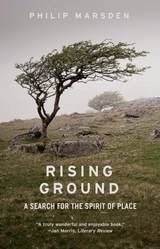
Rising Ground
A Search for the Spirit of PlacePhilip Marsden
University of Chicago Press, 2016
Rising Ground is a record of that journey, but it is also so much more: a beautifully written meditation on place, nature, and human life that encompasses history, archaeology, geography, and the love of place that suffuses us when we finally find home. Firmly in a storied tradition of English nature writing that stretches from Gilbert White to Helen MacDonald, Rising Ground reveals the ways that places and peoples have interacted over time, from standing stones to footpaths, ancient habitations to modern highways. What does it mean to truly live in a place, and what does it take to understand, and honor, those who lived and died there long before we arrived?
Like the best travel and nature writing, Rising Ground is written with the pace of a contemplative walk, and is rich with insight and a powerful sense of the long skein of years that links us to our ancestors. Marsden’s close, loving look at the small patch of earth around him is sure to help you see your own place—and your own home—anew.

Roads to Rome
A Guide to Notable Converts from Britain and Ireland from the Reformation to theJohn Beaumont
St. Augustine's Press, 2010
To be a Christian is to be a convert. The word “convert” applies in a real sense both to cradle-born Catholics and to those, traditionally regarded as converts, who become Catholics as adults. The Catholic Church is the divinely established framework of the program of a conversion, which Christ presented as a thorough change of mind and heart (metanoia). While for a cradle-born Catholic the implementation of that program is usually a gradual process, for converts it contains a momentous act as they vote, so to speak, with their feet, on behalf of Truth, by joining the Church as the One True Fold, the Sole Ark of Salvation, to recall hallowed phrases dear to John Henry Newman, easily the greatest convert during the nineteenth century.
The aim of this book is to summarize the lives of notable converts from Britain and Ireland and explain (by reference to quotations from their writings) why they entered the Catholic Church. These reasons were many. Some looked chiefly at history and saw the apostolic Church in their day to be residing in the Catholic communion. Others, though appreciating the fact of the gift of faith, saw reason as the chief support of the step they were taking. To yet others it was the endurance of both the Church and that remarkable office of the papacy that proved the necessary stimulus. Many were inspired by the witness of some unsung saint in their neighbourhood. Some were eminent even before their “move to Rome,” others almost completely unknown. Some found fame on their conversion, others suffered greatly for their zeal for the one true fold of Christ. Some came into the Church relatively early in life, others entered at the final hour, even while on their death bed.
Taken altogether these accounts provide a profound and moving witness to the operation of divine grace in human souls.
Robert Paul and the Origins of British Cinema
Ian Christie
University of Chicago Press, 2019
From improving upon Edison’s Kinetoscope to cocreating the first movie camera in Britain to building England’s first film studio and launching the country’s motion-picture industry, Paul played a key part in the history of cinema worldwide. It’s not only Paul’s story, however, that historian Ian Christie tells here. Robert Paul and the Origins of British Cinema also details the race among inventors to develop lucrative technologies and the jumbled culture of patent-snatching, showmanship, and music halls that prevailed in the last decade of the nineteenth century. Both an in-depth biography and a magnificent look at early cinema and fin-de-siècle Britain, Robert Paul and the Origins of British Cinema is a first-rate cultural history of a fascinating era of global invention, and the revelation of one of its undervalued contributors.
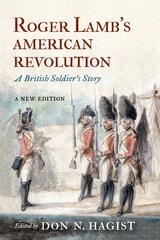
Roger Lamb's American Revolution
A British Soldier's StoryDon N. Hagist
Westholme Publishing, 2022
Of all the British soldiers who served in North America during the American Revolution, none wrote more about his experiences than Roger Lamb. He certainly had a lot to say: his service in two of the most important campaigns—the 1777 Saratoga campaign and the 1781 campaign through the Carolinas to Virginia—put him in the thick of some of the war’s most famous battles. Moreover, he was twice captured and twice escaped, making his way through hostile territory to rejoin the British army. Later in his life he wrote two books chronicling these experiences in great detail. Hundreds of British soldiers went through similar ordeals, sharing in the campaigns, the battles, the captivities, the escapes, but none recounted any aspect of these activities in the level of detail that Lamb did.
The first edition of this book, published in 2004, combined all of Roger Lamb’s first-hand recollections from his two books, An Original and Authentic Journal of Occurrences during the late American War, from its Commencement to the Year 1783 (Dublin, 1809) and Memoir of his Own Life (Dublin, 1811). Since that publication, two more important documents written by Lamb have come to light—an intelligence report written in 1782 recounting details of one of his escapes, and a “commonplace book” kept later in his life to record a vast range of memories, thoughts, and observations. Roger Lamb’s American Revolution: A British Soldier’s Story combines all of the material from these four sources pertaining to Lamb’s career as a soldier, from the time he joined the army to his departure from it, plus his recollections of childhood and post-military life. The result is the most comprehensive first-hand account by a British soldier in the American Revolution, an essential record for understanding the war in its totality.
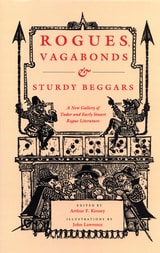
Rogues, Vagabonds, and Sturdy Beggars
A New Gallery of Tudor and Early Stuart Rogue Literature Exposing the Lives, Times, and Cozening Tricks of the Elizabethan UnderworldArthur F. Kinney
University of Massachusetts Press, 1990
In his introduction, Arthur F. Kinney discusses the significance of these works as protonovels and their influence on such writers as Shakespeare. He also explores the social, political, and economic conditions of a time that spawned a community of renegades who conned their way to fame, fortune, and, occasionally, the rope at Tyburn.
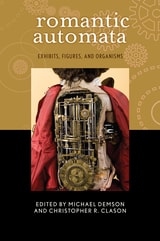
Romantic Automata
Exhibitions, Figures, OrganismsMichael Demson
Bucknell University Press, 2020
Recent scholarship in post-humanism, post-colonialism, disability studies, post-modern feminism, eco-criticism, and radical Orientalism has significantly affected the critical discourse on this topic. In engaging with the work and thought of Coleridge, Poe, Hoffmann, Mary Shelley, and other Romantic luminaries, the contributors to this collection open new methodological approaches to understanding human interaction with technology that strives to simulate, supplement, or supplant organic life.
Published by Bucknell University Press. Distributed worldwide by Rutgers University Press.
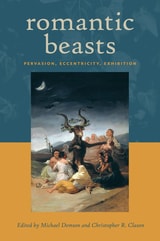
Romantic Beasts
Pervasion, Eccentricity, ExhibitionMichael Demson
Bucknell University Press, 2025
Published by Bucknell University Press. Distributed worldwide by Rutgers University Press.
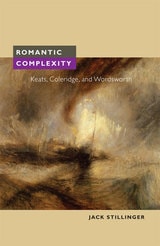
Romantic Complexity
Keats, Coleridge, and WordsworthJack Stillinger
University of Illinois Press, 2005
In Romantic Complexity, Jack Stillinger examines three of the most admired poets of English Romanticism--Keats, Coleridge, and Wordsworth--with a focus on the complexity that results from the multiple authorship, the multiple textual representation, and the multiple reading and interpretation of their best works.
Specific topics include the joint authorship of Wordsworth and Coleridge in the Lyrical Ballads, an experiment of 1798 that established the most essential characteristics of modern poetry; Coleridge's creation of eighteen or more different versions of The Ancient Mariner and how this textual multiplicity affects interpretation; the historical collaboration between Keats and his readers to produce fifty-nine separate but entirely legitimate readings of The Eve of St. Agnes; and a number of practical and theoretical matters bearing on the relationships among these writers and their influences on one another.
Stillinger shows his deep understanding of the poets' lives, works, and the history of their reception, in chapters rich with intriguing questions and answers sure to engage students and teachers of the world's greatest poetry.

Romantic Globalism
British Literature and Modern World Order, 1750–1830Evan Gottlieb
The Ohio State University Press, 2014
Although modern media tend to represent globalization as an essentially contemporary phenomenon, many scholars now agree that its fundamental dynamics—especially its characteristic annulment of spatial and temporal differences—have been present for several centuries. Moreover, the last decades of the eighteenth century and the first of the nineteenth century saw the convergence of a number of world-changing socio-political developments in the Western world. Romantic Globalism is significant because it is the first extended scholarly study that brings together these lines of inquiry. In so doing, Romantic Globalism not only charts a new course of study for British Romanticism but also suggests how the Romantics’ visions of globality might still be valuable to us today.
Romantic Poetry
Recent Revisionary CriticismKroeber, Karl
Rutgers University Press, 1993
Romantic Women Writers
Voices and CountervoicesPaula R. Feldman and Theresa M. Kelley
Brandeis University Press, 1995
Romanticism, Nationalism, and the Revolt against Theory
David Simpson
University of Chicago Press, 1993
Simpson demonstrates the close association between "theory" and "method" and shows that by the mid-eighteenth century, "method" had acquired distinctly subversive associations in England. Attributed increasingly to the French and the Germans, "method" paradoxically evoked images both of inhuman rationality and unbridled sentimentality; in either incarnation, it was seen as a threat to what was claimed to be authentically British. Simpson develops these paradigms in relation to feminism, the gendering of Anglo-American culture, and the emergence of literature and literary criticism as antitheoretical discourses. He then looks at the Romantic poets' response to this confining ideology of the cultural role of literature. Finally, Simpson considers postmodern theory's claims for the radical energy of nonrational or antirationalist positions.
This is an essential book not only for students of the Romantic period and intellectual historians concerned with the idea of "method," but for anyone interested in the historical background of today's debates over the excesses and possibilities of "theory."
Romanticism’s Other Minds
Poetry, Cognition, and the Science of SociabilityJohn Savarese
The Ohio State University Press, 2020
Roots of the Revival
American and British Folk Music in the 1950sRonald D. Cohen and Rachel Clare Donaldson
University of Illinois Press, 2014
After setting the stage with the work of music collectors in the nineteenth century, the authors explore the so-called recovery of folk music practices and performers by Alan Lomax and others, including journeys to and within the British Isles that allowed artists and folk music advocates to absorb native forms and facilitate the music's transatlantic exchange. Cohen and Donaldson place the musical and cultural connections of the twin revivals within the decade's social and musical milieu and grapple with the performers' leftist political agendas and artistic challenges, including the fierce debates over "authenticity" in practice and repertoire that erupted when artists like Harry Belafonte and the Kingston Trio carried folk into the popular music mainstream.
From work songs to skiffle, from the Weavers in Greenwich Village to Burl Ives on the BBC, Roots of the Revival offers a frank and wide-ranging consideration of a time, a movement, and a transformative period in American and British pop culture.

Roy Pascal and Georg Lukács
Towards a Re-Evaluation of the History of Marxist Literary Criticism in Britain?Helmut Peitsch
University of London Press, 2018
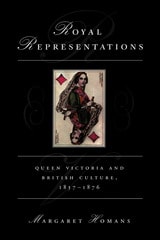
Royal Representations
Queen Victoria and British Culture, 1837-1876Margaret Homans
University of Chicago Press, 1998
Arguing that being, seeming, and appearing were crucial to Victoria's "rule," Homans explores the variability of Victoria's agency and of its representations using a wide array of literary, historical, and visual sources. Along the way she shows how Victoria provided a deeply equivocal model for women's powers in and out of marriage, how Victoria's dramatic public withdrawal after Albert's death helped to ease the monarchy's transition to an entirely symbolic role, and how Victoria's literary self-representations influenced debates over political self-representation.
Homans considers versions of Victoria in the work of Elizabeth Barrett Browning, George Eliot, John Ruskin, Margaret Oliphant, Lewis Carroll, Alfred Lord Tennyson, and Julia Margaret Cameron.