Results by title
4030 books match the query 'Language Arts & Disciplines' and 235 start with r
Reasons and Feelings
Writing for the Humanities NowSarah Mesle
University of Chicago Press, 2025
Humanities experts today are embattled. In a world of crises undermining higher education at every turn, what can still motivate humanists to write? Galvanizing, imaginative, and unrepentantly nerdy, Sarah Mesle’s Reasons and Feeling offers practical writing and publishing advice alongside a forcefully affirmative account of why humanities writing matters.
Mesle proposes that writing can help envision sustainable community, but only when we recognize that humanist authority comes from both our reasons and our feelings. Alongside everyday compositional advice—including strategies for addressing different audiences, pitching publications, and managing writing anxiety—readers will find an account of how such craft practices connect to both their intellectual commitments and their historical conditions. Mesle shows how university-trained writers at all levels benefit from embracing a broader range of styles and affects. Doing so helps them harness their writing’s community-building potential and makes them better able to value their own expertise, whether they write for the classroom, in public venues, or for the specialized scholarly communities that share their niche, weird, or beloved, objects of study.
Reasons and Feelings draws on Mesle’s expertise as a professor of writing and her work as an editor helping academics shift between writing for scholarly venues and journalistic ones. In a voice that’s honest, warm, accessible, and bracingly funny, Reasons and Feelings gives humanists a path toward bolder fantasies of the worlds their writing can make.

Rebels and Outliers
Real Stories of the American WestJohn M Glionna
University of Nevada Press, 2025
This vibrant collection invites readers to journey through the rugged landscapes and tight-knit communities that define the American West. Along the way, you’ll meet individuals whose grit, resilience, and pioneering spirit embody the heart of this region’s legacy.
A captivating follow-up to Glionna’s 2022 book, Outback Nevada: Real Stories of the Silver State, Rebels and Outliers is a testament to the untamed, enduring character of the people who call the West home.
Rebuilding the News
Metropolitan Journalism in the Digital AgeC. W. Anderson
Temple University Press, 2013
Breaking down the walls of the traditional newsroom, Rebuilding the News traces the evolution of news reporting as it moves from print to online. As the business models of newspapers have collapsed, author C. W. Anderson chronicles how bloggers, citizen journalists, and social networks are implicated in the massive changes confronting journalism.
Through a combination of local newsroom fieldwork, social-network analysis, and online archival research, Rebuilding the News places the current shifts in news production in socio-historical context. Focusing on the Philadelphia Inquirer, the Philadelphia Daily News, Anderson presents a gripping case study of how these papers have struggled to adapt to emerging economic, social, and technological realities.
As he explores the organizational, networked culture of journalism, Anderson lays bare questions about the future of news-oriented media and its evolving relationship with “the public” in the digital age.
Reckoning with the Past
National Geographic and the Limits of Social Justice RhetoricLeland G. Spencer
Michigan State University Press, 2026
For over a century, National Geographic has shaped American visual culture, captivating audiences with stunning photography and compelling storytelling. Yet behind its iconic yellow border lies a fraught legacy of gender bias, racial misrepresentation, and colonialist narratives.In this incisive study, Leland G. Spencer examines the brand's recent attempts to reckon with that legacy across its magazine and television platforms. From special issues spotlighting transgender lives, to a public acknowledgment of past racism, to a magazine edition created entirely by women, these efforts signal a move toward inclusivity. But as Spencer reveals through rigorous rhetorical analysis, these gestures often fall short. The texts themselves frequently echo the same systemic inequalities they seek to redress. National Geographic's progressive rebranding, he argues, remains tangled in the very histories it aims to transcend.
Reclaiming Accountability
Improving Writing Programs through Accreditation and Large-Scale AssessmentsWendy Sharer
Utah State University Press, 2016
Reclaiming Accountability brings together a series of critical case studies of writing programs that have planned, implemented, and/or assessed the impact of large-scale accreditation-supported initiatives. The book reimagines accreditation as a way to leverage institutional or programmatic change.
Contributions to the volume are divided into three parts. Part 1 considers how specialists in composition and rhetoric can work most productively with accrediting bodies to design assessments and initiatives that meet requirements while also helping those agencies to better understand how writing develops and how it can most effectively be assessed. Parts 2 and 3 present case studies of how institutions have used ongoing accreditation and assessment imperatives to meet student learning needs through programmatic changes and faculty development. They provide concrete examples of productive curricular (part 2) and instructional (part 3) changes that can follow from accreditation mandates while providing guidance for navigating challenges and pitfalls that WPAs may encounter within shifting and often volatile local, regional, and national contexts.
In addition to providing examples of how others in the profession might approach such work, Reclaiming Accountability addresses assessment requirements beyond those in the writing program itself. It will be of interest to department heads, administrators, writing program directors, and those involved with writing teacher education, among others.
Contributors: Linda Adler-Kassner, William P. Banks, Remica Bingham-Risher, Melanie Burdick, Polina Chemishanova, Malkiel Choseed, Kyle Christiansen, Angela Crow, Maggie Debelius, Michelle F. Eble, Jonathan Elmore, Lorna Gonzalez, Angela Green, Jim Henry, Ryan Hoover, Rebecca Ingalls, Cynthia Miecznikowski, Susan Miller-Cochran, Cindy Moore, Tracy Ann Morse, Joyce Magnotto Neff, Karen Nulton, Peggy O’Neill, Jessica Parker, Mary Rist, Rochelle Rodrigo, Tulora Roeckers, Shirley K. Rose, Iris M. Saltiel, Wendy Sharer, Terri Van Sickle, Jane Chapman Vigil, David M. Weed
Reclaiming Fair Use
How to Put Balance Back in Copyright, Second EditionPatricia Aufderheide and Peter Jaszi
University of Chicago Press, 2018
Originally published in 2011, Reclaiming Fair Use challenged the widely held notion that copyright law is obsolete in an age of digital technologies. Beginning with a survey of the contemporary landscape of copyright law, Aufderheide and Jaszi drew on their years of experience advising documentary filmmakers, English teachers, performing arts scholars, and other creative professionals to lay out in detail how the principles of fair-use can be employed to avoid copyright violation. Taking stock of the vibrant remix culture that has only burgeoned since the book’s original publication, this new edition addresses the expanded reach of fair use—tracking the Twitter hashtag #WTFU (where’s the fair use?), the maturing of the transformativeness measure in legal disputes, the ongoing fight against automatic detection software, and the progress and delays of digitization initiatives around the country.
Full of no-nonsense advice and practical examples, Reclaiming Fair Use remains essential reading for anyone interested in law, creativity, and the ever-broadening realm of new media.
Reclaiming Queer
Activist and Academic Rhetorics of ResistanceErin J. Rand
University of Alabama Press, 2014
An examination of the rhetorical linkage of queer theory in the academy with street-level queer activism in the 1980s and early 1990s
The late 1980s and early 1990s were a defining historical moment for both queer activism and queer theory in the United States. LGBTQ communities, confronted with the fatal indifference and homophobia of the AIDS crisis, often responded with angry, militant forms of activism designed not merely to promote acceptance or tolerance, but to forge identity and strength from victimization and assert loudly and forcefully their rights to safety and humanity. The activist reclamation of the word “queer” is one marker of this shift in ideology and practice, and it was mirrored in academic circles by the concurrent emergence of the new field of “queer theory.” That is, as queer activists were mobilizing in the streets, queer theorists were producing a similar foment in the halls and publications of academia, questioning regulatory categories of gender and sexuality, and attempting to illuminate the heteronormative foundations of Western thought. Notably, the narrative of queer theory’s development often describes it as arising from or being inspired by queer activism.
In Reclaiming Queer, Erin J. Rand examines both queer activist and academic practices during this period, taking as her primary object the rhetorical linkage of queer theory in the academy with street-level queer activism. Through this strategic conjuncture of activism and academia, Rand grapples with the specific conditions for and constraints on rhetorical agency in each context. She examines the early texts that inaugurated the field of queer theory, Queer Nation’s infamous “Queers Read This” manifesto, Larry Kramer’s polemic speeches and editorials, the Lesbian Avengers’ humorous and outrageous antics, the history of ACT UP, and the more recent appearance of Gay Shame activism. From these activist and academic discourses, Rand builds a theory of rhetorical agency that posits queerness as the very condition from which agency emerges.
Reclaiming Queer thus offers a critical look at the rhetoric of queer activism, engages the history of queer theory’s institutionalization and the politics of its proliferation, suggests a radically contextual understanding of rhetorical agency and form, and argues for the centrality of queerness to all rhetorical action.

Reclaiming the Media
Communication Rights and Democratic Media RolesEdited by Bart Cammaerts and Nico Carpentier
Intellect Books, 1995
In the twentieth century, the media gave whistleblowers a voice, spearheaded the downfall of powerful politicians, and exposed widespread corporate corruption. How will the twenty-first-century media cope with its storied legacy as the watchdog of democratic society? Reclaiming the Media examines the sometimes tenuous, often fraught relationship between media organizations and civil rights in Europe. In sections devoted to citizenship, participation, contemporary journalism, and activist communication strategies, a panel of European media experts makes the case for deepening the media’s role in democracy.
Reclaiming the Rural
Essays on Literacy, Rhetoric, and PedagogyEdited by Kim Donehower, Charlotte Hogg, and Eileen E. Schell
Southern Illinois University Press, 2012
In Reclaiming the Rural: Essays on Literacy, Rhetoric, and Pedagogy, editors Kim Donehower, Charlotte Hogg, and Eileen E. Schell bring together a diverse collection of essays that consider literacy, rhetoric, and pedagogy in the United States, Canada, and Mexico. The essays move beyond the typical arguments for preserving, abandoning, or modernizing by analyzing how rural communities sustain themselves through literate action. The contributors explore the rhetorics of water disputes in the western United States, the histories and influences of religious rhetorics in Mexico, agricultural and rural literacy curricula, the literacies of organizations such as 4-H and Academia de la Nueva Raza, and neoliberal rhetorics. Central to these examinations are the rural populations themselves, which include indigenous peoples in the rural United States, Canada, and Mexico, as well as those of European or other backgrounds.
The strength of the anthology lies in its multiple perspectives, various research sites, and the range of methodologies employed, including rhetorical analyses of economies and environments, media, and public spaces; classroom-based research; historical analysis and archival work; and qualitative research. The researchers engage the duality between the practices of everyday life in rural communities and the practices of reflecting on and making meaning.
Reclaiming the Rural reflects the continually changing, nuanced, context-dependent realities of rural life while acknowledging the complex histories, power struggles, and governmental actions that have affected and continue to affect the lives of rural citizens. This thought-provoking collection demonstrates the value in reclaiming the rural for scholarly and pedagogical analysis.
Reconceptualizing Response
Using Instructor Feedback to Promote Linguistic JusticeKelly Blewett
Utah State University Press, 2026
Reconceptualizing Response reframes instructor feedback, one of the most consequential practices in rhetoric and writing studies, as a site of linguistic justice. Instructor response is not merely technical commentary; it is contested terrain where students’ identities, experiences, and language varieties must be named, supported, and celebrated.
Contributors represent a wide range of institutional contexts—including two-year colleges, four-year universities, HBCUs, HSIs, SLACs, and PWIs—and write from diverse positionalities, amplifying current debates and productive tensions in the field. Organized around four key moves—looking back, looking within, looking up, and looking around—the book invites readers to critically examine the ideologies underlying feedback practices; recognize how instructors' positionality, values, and beliefs are communicated through feedback; align feedback with students’ needs; and reconsider the broader classroom ecology required for justice. Bridging linguistic justice and feedback studies, this collection provides concrete tools and frameworks, as well as sample rubrics, course policies, and fresh approaches to assessment.
Ideal for graduate students, writing program administrators, faculty teaching future writing instructors, and anyone seeking to transform classroom practice, Reconceptualizing Response offers guiding questions for reflection and practical strategies for change. This volume reimagines instructor response as a catalyst for equity, consciousness-raising, and transformation, calling instructors not only to comment on writing but also to use feedback to dismantle oppressive logics and foster linguistic justice.
Reconstructing Argumentative Discourse
Frans Van Eemeren
University of Alabama Press, 1993
Reconstructing Argumentative Discourse analyzes argumentation in ordinary disputes. The analysis begins with an ideal model: a theoretical structure of discourse that might be used to resolve a dispute about the merits of two opposing cases. The ideal model does not describe actual argumentative practice. Argumentative discourse does not always seek genuine resolution and, when it does, the participants may not perform as ideal arguers.
Reconstructing Response to Student Writing
A National Study from across the CurriculumDan Melzer
Utah State University Press, 2023
Presenting the results of a national study of teacher and peer response and student self-assessment at institutions of higher education across the United States, Melzer analyzes teacher and peer response to over 1,000 pieces of student writing as well as 128 student portfolio reflection essays. He draws on his analysis and on a comprehensive review of the literature on response to introduce a constructivist heuristic for response aimed at both composition instructors and instructors across disciplines. Melzer argues that teachers and researchers should focus less on teacher response to individual pieces of student writing and more on engaging in dialogue with student self-assessment and peer response, focusing on growth and transfer rather than products and grades.
Reconstructing Response to Student Writing, especially when taken together with Melzer’s previous book Assignments across the Curriculum, provides a comprehensive and large-scale view of college writing and responding across the curriculum in the United States.
Records and Information Management
Patricia C. Franks
American Library Association, 2018
As Information Management put it, "On the strength of its currency and coverage alone, Franks' book is poised to take over as the recommended go-to reference for both students and RIM professionals for many years to come.” The new second edition cements this work’s status as an up-to-date classic, its content updated and expanded to address emerging technologies, most notably blockchain, and evolving standards and practices. Inside, Franks presents complete coverage of the records and information lifecycle model, encompassing paper, electronic (databases, office suites, email), and new media records (blogs, chat messages, and software as a service). Informed by an advisory board of experts in the field and with contributions by noted authorities, the text addresses such key topics as
- the origins and development of records and information;
- the discipline of information governance and developing a strategic records management plan;
- creation/capture and classification;
- retention strategies, inactive records management, archives, and long-term preservation;
- access, storage, and retrieval;
- electronic records and electronic records management systems;
- the latest on rapidly evolving technologies such as web records, social media, and mobile devices;
- vital records, disaster preparedness and recovery, and business continuity;
- monitoring, auditing, and risk management; and
- education and training.
This book’s authoritative blend of theory and practice makes it a matchless resource for everyone in the archives and records management field. Instructor/trainer extras include a set of ready-to-go, customizable PowerPoint slides to accompany the text.

Records and Information Management
Patricia C. Franks
American Library Association, 2013
Records and Information Management
Third EditionPatricia C. Franks
American Library Association, 2025
Widely acknowledged as the benchmark text for both students and RIM professionals ("extremely comprehensive and accessible," raves Archival Issues) the new third edition updates its authoritative blend of theory and practice to reflect the field’s dynamically evolving environment, including the rapid rise of applications powered by AI/ML. Franks presents complete coverage of the records and information lifecycle model, encompassing paper, electronic (databases, office suites such as Microsoft 365, and email), and new media records (blogs, chat messages, and software as a service), while acknowledging the influence of emerging and developing technologies and encouraging new ways of meeting the resulting challenges. In this book, enhanced with supplemental contributions from a wide range of thought leaders and practitioners, readers will explore such keys topics as
- the latest advances in disruptive technologies, including blockchain, Web3, the metaverse, and evolving digital communication tools such as enterprise social media;
- an overview of the origins and development of records and information management;
- the discipline of information governance and the steps to develop a strategic records and information management plan;
- a completely new chapter that demystifies data governance, automation, and AI;
- strategies for the creation/capture and classification of records and information;
- approaches to retention strategies, inactive records management, archives, and long-term digital preservation;
- methods for access, storage, and retrieval of records and information;
- insight into electronic records and electronic records management systems;
- practices for safeguarding essential records, including disaster preparedness, recovery, and business continuity;
- approaches to monitoring, auditing, privacy, security, and risk management;
- fresh discussion of the leadership and management skills required of RIM professionals; and
- expert guidance on trendspotting, education, and training.
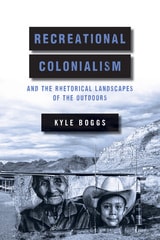
Recreational Colonialism and the Rhetorical Landscapes of the Outdoors
Kyle Boggs
The Ohio State University Press, 2025
In Recreational Colonialism and the Rhetorical Landscapes of the Outdoors, Kyle Boggs chronicles the struggle between Indigenous peoples who have rooted religious and cultural ties to outdoor sites across the US and elsewhere and the settlers who claim the right to freely recreate in those same places. Synthesizing theories of rhetoric, environmental studies, and settler colonialism, Boggs confronts the ways that settler colonial experiences and expectations have been narrated through rhetorical practices on these so-called public lands. Fusing journalism and personal narrative with scholarly research, Boggs’s argument comes to bear on his central case study of a northern Arizona ski development on a mountain held sacred by at least thirteen Indigenous tribes. In illuminating the striking ways that settler imaginaries are accommodated, performed, and sustained in the everyday, Boggs offers a powerful reminder that even during leisure activities (in this case, sports such as ultrarunning, rock climbing, and skiing), complex webs of power control who can access resources and land and who has the right to protect histories and cultures.
Redefining Roles
The Professional, Faculty, and Graduate Consultant’s Guide to Writing CentersMegan Swihart Jewell
Utah State University Press, 2021
Thirty-two authors, consultants, and administrators from diverse centers—from large public four-year institutions to a private, online for-profit university—provide both theoretical frameworks and practical applications in eighteen chapters. Ten chapters focus on graduate consultants and address issues of authority, training, professional development, and mentoring, and eight focus on professional and faculty consultant training as well as specific issues of identity and authority. By sharing these voices, Redefining Roles broadens the very idea of writing centers while opening the door to more dialogue on the important role these practitioners play.
Redefining Roles is designed for writing center practitioners, scholars, and staff. It is also a necessary addition to help campus administrators in the ongoing struggle to validate the intellectually complex work that such staff performs.
Contributors: Fallon N. Allison, Vicki Behrens, Cassie J. Brownell, Matt Burchanoski, Megan Boeshart Burelle, Danielle Clapham, Steffani Dambruch, Elise Dixon, Elizabeth Festa, Will Fitzsimmons, Alex Frissell, Alex Funt, Genie Giaimo, Amanda Gomez, Lisa Lamson, Miriam E. Laufer, Kristin Messuri, Rebecca Nowacek, Kimberly Fahle Peck, Mark Pedretti, Irina Ruppo, Arundhati Sanyal, Anna Scanlon, Matthew Sharkey-Smith, Kelly A. Shea, Anne Shiell, Anna Sicari, Catherine Siemann, Meagan Thompson, Lisa Nicole Tyson, Marcus Weakley, Alex Wulff
Reengineering the Library
Issues in Electronic Resources ManagementGeorge Stachokas
American Library Association, 2022
Reference Books Bulletin 2006-2007
A Compilation of Evaluations September 2006 through August 2007American Library Association, 2009
Reference Renaissance
Current and Future TrendsAmerican Library Association, 2010
Reference Sources and Services for Youth
Meghan Harper
American Library Association, 2011
Reference Sources for Small and Medium-Sized Libraries
Jack O'Gorman
American Library Association, 2014
Reference and Information Services
An IntroductionKay Ann Cassell
American Library Association, 2018
Reference and Information Services
An IntroductionKay Ann Cassell
American Library Association, 2012
Reference and Information Services
An Introduction, Fifth EditionKay Ann Cassell and Uma Hiremath
American Library Association, 2022
- a basic template for the skills required and expectations demanded of the reference librarian;
- the pandemic’s effect on reference services and how the ingenuity employed by libraries in providing remote and virtual reference is here to stay;
- a new chapter dedicated to health information, with a special focus on health equity and information sources;
- selecting and evaluating reference materials, with strategies for keeping up to date;
- a heightened emphasis on techniques for evaluating sources for misinformation and ways to give library users the tools to discern facts vs. “fake facts”;
- reference as programming, readers’ advisory services, developmentally appropriate material for children and young adults, and information literacy;
- evidence-based guidance on handling microaggressions in reference interactions, featuring discussions of cultural humility and competence alongside recommended resources on implicit bias;
- managing, assessing, and improving reference services; and
- the future of information and reference services, encapsulating existing models, materials, and services to project possible evolutions in the dynamic world of reference
Reference and Reflexivity
2nd EditionJohn Perry
CSLI, 2012
Referencialismo critico
le teoria reflexivo-referencial del significadoJohn Perry
CSLI, 2006
Referential Practice
Language and Lived Space among the MayaWilliam F. Hanks
University of Chicago Press, 1990
As his central case, Hanks undertakes a comprehensive analysis of deixis—linguistic forms that fix reference in context, such as English I, you, this, that, here, and there. He shows that Maya deixis is a basic cultural construct linking language with body space, domestic space, agricultural and ritual practices, and other fields of social activity. Using this as a guide to ethnographic description, he discovers striking regularities in person reference and modes of participation, the role of perception in reference, and varieties of spatial orientation, including locative deixis. Traditionally considered a marginal area in linguistics and virtually untouched in the ethnographic literature, the study of referential deixis becomes in Hanks's treatment an innovative and revealing methodology.
Referential Practice is the first full-length study of actual deictic use in a non-Western language, the first in-depth study of speech practice in Yucatec Maya culture, and the first detailed account of the relation between routine conversation, embodiment, and ritual discourse.
Refiguring Mass Communication
A HistoryPeter Simonson
University of Illinois Press, 2010
This unique inquiry into the history and ongoing moral significance of mass communication also represents a defense, extension, and overhaul of the idea and social form of the discipline. Organized around narrative accounts of individuals and their communicative worlds, Refiguring Mass Communication illuminates significant but overlooked rhetorical episodes in history to enable modern-day readers to rehabilitate and reinvigorate their own engagements with mass communication.
Coined in the 1920s as a way to describe radio, motion pictures, wide-circulation magazines, and the press, the term "mass communication" frequently is misused in the era of cable TV, niche marketing, and the Internet. In Refiguring Mass Communication, Peter Simonson compares his own vision of mass communication with distinct views articulated throughout history by Paul of Tarsus, Walt Whitman, Charles Horton Cooley, David Sarnoff, and Robert K. Merton, utilizing a collection of texts and tenets from a variety of time periods and perspectives. Drawing on textual and archival research as well as access to Merton's personal papers, Simonson broadly reconceives a sense of communication theory and what social processes might be considered species of mass communication. Simonson reveals the geographical and social contexts from which these visions have emerged and the religious and moral horizons against which they have taken shape. In a unique perspective, he considers the American county fair as an example of a live gathering and crucial site that is overlooked in contemporary forms of mass communication, urging a reconsideration of how individuals participate in and shape similar forms.
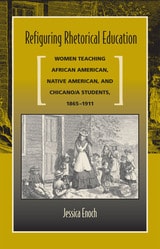
Refiguring Rhetorical Education
Women Teaching African American, Native American, and Chicano/a Students, 1865-1911Jessica Enoch
Southern Illinois University Press, 2008
Refiguring Rhetorical Education: Women Teaching African American, Native American, and Chicano/a Students, 1865-1911 examines the work of five female teachers who challenged gendered and cultural expectations to create teaching practices that met the civic and cultural needs of their students.
The volume analyzes Lydia Maria Child’s The Freedmen’s Book, a post–Civil War educational textbook for newly freed slaves; Zitkala Ša’s autobiographical essays published in the Atlantic Monthly in 1900 that questioned the work of off-reservation boarding schools for Native American students; and Jovita Idar, Marta Peña, and Leonor Villegas de Magnón’s contributions to the Spanish-language newspaper La Crónica in 1910 and 1911—contributions that offered language and cultural instruction their readers could not receive in Texas public schools.
Author Jessica Enoch explores the possibilities and limitations of rhetorical education by focusing on the challenges that Child, Zitkala Ša, Idar, Peña, and Villegas made to dominant educational practices. Each of these teachers transformed their seemingly apolitical occupation into a site of resistance, revising debilitating educational methods to advance culture-based and politicized teachings that empowered their students to rise above their subjugated positions.
Refiguring Rhetorical Education considers how race, culture, power, and language are both implicit and explicit in discussions of rhetorical education for marginalized students and includes six major tenets to guide present-day pedagogies for civic engagement.
Reflecting on the Future of Academic and Public Libraries
Peter Hernon
American Library Association, 2013
Reflection In The Writing Classroom
Kathleen Blake Yancey
Utah State University Press, 1998
Yancey explores reflection as a promising body of practice and inquiry in the writing classroom. Yancey develops a line of research based on concepts of philosopher Donald Schon and others involving the role of deliberative reflection in classroom contexts. Developing the concepts of reflection-in-action, constructive reflection, and reflection-in-presentation, she offers a structure for discussing how reflection operates as students compose individual pieces of writing, as they progress through successive writings, and as they deliberately review a compiled body of their work-a portfolio, for example. Throughout the book, she explores how reflection can enhance student learning along with teacher response to and evaluation of student writing.
Reflection in the Writing Classroom will be a valuable addition to the personal library of faculty currently teaching in or administering a writing program; it is also a natural for graduate students who teach writing courses, for the TA training program, or for the English Education program.
Reflection-in-Motion
Reimagining Reflection in the Writing ClassroomJaclyn Fiscus-Cannaday
Utah State University Press, 2024
underrepresented viewpoints about how reflection works in the writing classroom. Jaclyn Fiscus-Cannaday examines how its availability is subject to teacher/student power dynamics, the literacies welcomed (or not) in the class, the past and present pedagogies that students are engaging with and attending to, and the interactions among humans, materials, and emotions within the rhetorical context. She adopts an intersectional feminist perspective for an inclusive view of how practitioners name, identify, and practice reflection in the everyday moments of writing classrooms.
Fiscus-Cannaday invokes a Black feminist qualitative research method that Venus Evans-Winters calls a “mosaic.” When researchers collect both traditional and nontraditional texts to create a full view of students’ and teachers’ interviews at three institutions (a Hispanic Serving Institution, a Historically Black College and University, and an Asian American Native American Pacific Islander Serving Institution), she finds that practitioners often build definitions from past experiences with reflection—and then use those definitions as terministic screens to decide if an activity can be named, identified, and practiced as reflection. These definitions hold different rhetorical effects: reflection-for-introspection, reflection-for-learning, reflection-for-mindfulness, and reflection-for-awareness.
Reflection is used for these different rhetorical effects, but because classrooms so often focus on the Westernized view and its emphasis on growth, reflection has the underused and undertheorized potential rhetorical effect of helping students investigate their identities and positionalities, acknowledge deep-rooted ideologies, and consider new perspectives so they can better work across difference. Reflection-in-Motion will inspire teachers and writing program administrators to listen to how students define and practice reflection and why—thus making room for more capacious definitions of reflection and student-centered practices of what reflection can do and be.
Reflections On Practitioner Research
A Practical GuideLee Ann Fullington
American Library Association, 2020
Reflections
Conversations with Politicians Volume IIPeter Hennessy and Robert Shepherd
Haus Publishing, 2019
Reflective Teaching, Effective Learning
Instructional Literacy for Library EducatorsChar Booth
American Library Association, 2011
Reflective Teaching, Effective Learning
Instructional Literacy for Library EducatorsChar Booth
American Library Association, 2022
Reflexive Translation Studies
Translation as Critical ReflectionSilvia Kadiu
University College London, 2019
In exploring the interaction between form and content, Reflexive Translation Studies promotes the need for an experimental, multisensory, and intuitive practice, which invites students, scholars, and practitioners alike to engage with theory productively and creatively through translation.
Reformers, Teachers, Writers
Curricular and Pedagogical InquiriesNeal Lerner
Utah State University Press, 2019
Lerner’s mixed-methods approach—quantitative, qualitative, textual, historical, narrative, and theoretical—reflects the importance and effects of curriculum in a wide variety of settings, whether in writing centers, writing classrooms, or students’ out-of-school lives, as well as the many methodological approaches available to understand curriculum in writing studies. The richness of this approach allows for multiple considerations of the distinction and relationship between pedagogy and curriculum. Chapters are grouped into three parts: disciplinary inquiries, experiential inquiries, and empirical inquiries, exploring the presence and effect of curriculum and its relationship to pedagogy in multiple sites, both historical and contemporary, and for multiple stakeholders.
Reformers, Teachers, Writers calls out writing studies’ inattention to curriculum, which hampers efforts to enact meaningful reform and to have an impact on larger conversations about education and writing. The book will be invaluable to scholars, teachers, and administrators interested in rhetoric and composition, writing studies, and education.
Reframing Rhetorical History
Cases, Theories, and MethodologiesEdited by Kathleen J. Turner and Jason Edward Black
University of Alabama Press, 2022
A collection of essays providing insights into new directions in rhetorical history
Kathleen J. Turner’s 1998 multicontributor volume Doing Rhetorical History: Concepts and Cases quickly became a foundational text in the field, and the studies in the book have served as an important roadmap for scholars undertaking such scholarship. In the decades since its publication, developments in rhetorical-historical research, engaged scholarship, and academic interventionism have changed the practice of rhetorical history tremendously.
To address this shift, Turner and Jason Edward Black have edited a much-anticipated follow-up volume: Reframing Rhetorical History: Cases, Theories, and Methodologies, which reassesses both history as rhetoric and rhetorical history as practice. This new book attends to a number of topics that have become not just hot-button issues in rhetorical scholarship but have entrenched themselves as anchors within the field. These include digital rhetoric, public memory, race and ethnicity, gender dynamics and sexualities, health and well-being, transnationalism and globalization, social justice, archival methods and politics, and colonialism and decoloniality.
The sixteen essays are divided into four major parts: “Digital Humanities and Culture” introduces methods and cases using twenty-first century technologies; “Identities, Cultures, and Archives” addresses race and gender within the contexts of critical race theory, gendered health rhetoric, race-based public memory, and class/sectionalism; “Approaches to Nationalism and Transnationalism” explores ideologies related to US and international cultures; and “Metahistories and Pedagogies” explores creative ways to approach the frame of metarhetorical history given what the field has learned since the publication of Doing Rhetorical History.
CONTRIBUTORS
Andrew D. Barnes / Jason Edward Black / Bryan Crable / Adrienne E. Hacker Daniels / Matthew deTar / Margaret Franz / Joe Edward Hatfield / J. Michael Hogan / Andre E. Johnson / Madison A. Krall / Melody Lehn / Lisbeth A. Lipari / Chandra A. Maldonado / Roseann M. Mandziuk / Christina L. Moss / Christopher J. Oldenburg / Sean Patrick O’Rourke / Daniel P. Overton / Shawn J. Parry-Giles / Philip Perdue / Kathleen J. Turner
Reframing Writing Assessment to Improve Teaching and Learning
Linda Adler-Kassner
Utah State University Press, 2010
Adler-Kassner and O'Neill show writing faculty and administrators how to frame discussions of writing assessment so that they accurately represent research-based practices, and promote assessments that are valid, reliable, and discipline-appropriate.
Public discourse about writing instruction is currently driven by ideas of what instructors and programs “need to do,” “should do,” or “are not doing,” and is based on poorly informed concepts of correctness and unfounded claims about a broad decline in educational quality. This discussion needs to be reframed, say Adler-Kassner and O'Neill, to help policymakers understand that the purpose of writing instruction is to help students develop critical thinking, reading, and writing strategies that will form the foundation for their future educations, professional careers, and civic engagement.
Reframing Writing Assessment to Improve Teaching and Learning is grounded in the best of writing assessment research, and focuses on how to communicate it effectively to publics beyond academe.
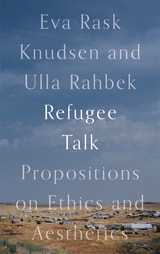
Refugee Talk
Propositions on Ethics and AestheticsEva
Pluto Press, 2022
An innovative approach to the refugee crisis through a focus on language use, discourse and representation
'A wide-ranging, erudite and multi-faceted analyses of the fundamental problem of who gets to be counted as human' - Kate Evans
What does it mean to be a refugee? What political questions do they raise? Through what political rhetoric is their experiences parsed? The ongoing refugee crisis has sparked all these questions and more.
Refugee Talk uses conversation as a research method and ethical practice to approach the representation of and the discourse about and by the refugee. Though refugees who cross borders are routinely registered, filed, and detained, the individual stories they carry are just as routinely overlooked or ignored. When language itself becomes another border that excludes refugees, the need for a new vocabulary that decriminalizes and re-humanizes the refugee experience asserts itself.
The authors engage theoretically with thinkers from Hannah Arendt to Paolo Freire and Kwame A. Appiah and structure the book around conversations with academics, activists, journalists, and refugee artists and writers. The result is a comprehensive humanities approach that places ethics and aesthetics at its core.
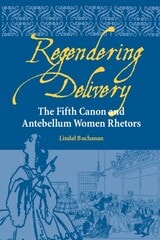
Regendering Delivery
The Fifth Canon and Antebellum Women RhetorsLindal Buchanan
Southern Illinois University Press, 2005
Lindal Buchanan thoroughly analyzes how antebellum women infiltrated the male-dominated realm of public speaking by adapting elocutionary instruction to subversive ends, developing distinctive delivery styles, and reconciling conflicting public and private roles. By detailing the education and oratorical practices of pioneering female public speakers, Regendering Delivery: The Fifth Canon and Antebellum Women Rhetors theorizes how gender impacted the fifth rhetorical canon of delivery and how cultural constructions of the feminine have shaped public performance.
Buchanan argues that restrictive gender norms encouraged antebellum women rhetors to develop unique styles and methods of rhetorical production and performance. She examines how schoolgirls devised ways to learn and practice elocution in academic settings and how women developed inventive delivery strategies to maintain the appearance of femininity even as they participated in conventionally masculine discursive activities from general public speaking to political lobbying. She also identifies collaborative methods that enabled antebellum women to negotiate conflicts between their domestic and rhetorical commitments and thus reach public platforms
Assessing the calculable impact of gender on rhetorical performance, Buchanan maintains that delivery holds particular sexual and textual connotations for women rhetors. Regendering Delivery notably contributes to ongoing feminist efforts to incorporate women into the rhetorical tradition by probing such gendered—and largely overlooked—aspects of oratorical delivery as cultural context, gender norms, elocutionary education, sexuality, maternity, feminine ethos, and collaboration.
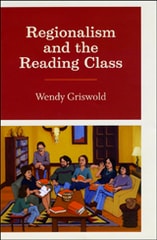
Regionalism and the Reading Class
Wendy Griswold
University of Chicago Press, 2008
Wendy Griswold draws on cases from Italy, Norway, and the United States to show that fans of books form their own reading class, with a distinctive demographic profile separate from the general public. This reading class is modest in size but intense in its literary practices. Paradoxically these educated and mobile elites work hard to put down local roots by, among other strategies, exploring regional writing. Ultimately, due to the technological, economic, and political advantages they wield, cosmopolitan readers are able to celebrate, perpetuate, and reinvigorate local culture.
Griswold’s study will appeal to students of cultural sociology and the history of the book—and her findings will be welcome news to anyone worried about the future of reading or the eclipse of place.
Rehearsing New Roles
How College Students Develop as WritersLee Ann Carroll
Southern Illinois University Press, 2002
In Rehearsing New Roles: How College Students Develop as Writers, Lee Ann Carroll argues for a developmental perspective to counter the fantasy held by many college faculty that students should, or could, be taught to write once so that ever after, they can write effectively on any topic, any place, any time. Carroll demonstrates in this volume why a one- or two-semester, first-year course in writing cannot meet all the needs of even more experienced writers. She then shows how students’ complex literacy skills develop slowly, often idiosyncratically, over the course of their college years, as they choose or are coerced to take on new roles as writers.
As evidence, Carroll offers a longitudinal study of a group of students and the literacy environment they experienced in a midsize, independent university. Her study follows the experiences that altered their conception of writing in college and fostered their growing capacities as writers.
Carroll’s analysis of the data collected supports a limited but still useful role for first-year composition, demonstrates how students do learn to write differently across the curriculum in ways that may or may not be recognized by faculty, and evaluates the teaching and learning practices that promote or constrain students’ development.
Reid's Read-Alouds 2
Modern-Day Classics from C.S. Lewis to Lemony SnicketRob Reid
American Library Association, 2010
Reid's Read-Alouds
Selections for Children and TeensRob Reid
American Library Association, 2009
Reimagining Popular Notions of American Intellectualism
Literacy, Education, and ClassKelly Susan Bradbury
Southern Illinois University Press, 2016
Bradbury begins by tracing the origins and evolution of the narrow views of intellectualism that are common in the United States today. Then, applying a more inclusive and egalitarian definition of intellectualism, she examines the literacy and learning practices of three nonelite sites of adult public education in the United States: the nineteenth-century lyceum, a twentieth-century labor college, and a twenty-first-century GED writing workshop. Bradbury argues that together these three case studies teach us much about literacy, learning, and intellectualism in the United States over time and place. She concludes the book with a reflection on her own efforts to aid students in recognizing and resisting the rhetoric of anti-intellectualism that surrounds them and that influences their attitudes and actions.
Drawing on case studies as well as Bradbury’s own experiences with students, Reimagining Popular Notions of American Intellectualism demonstrates that Americans have engaged and do engage in the process and exercise of intellectual inquiry, contrary to what many people believe. Addressing a topic often overlooked by rhetoric, composition, and literacy studies scholars, it offers methods for helping students reimagine what it means to be intellectual in the twenty-first century.
Reimagining Process
Online Writing Archives and the Future of Writing StudiesKyle Jensen
Southern Illinois University Press, 2015
For more than four decades, the dominant model for pedagogy and research in the field of composition has been a how-centered process approach to writing instruction, which involves studying the writing that students produce to expose the various stages of their writing process. By looking at notes, outlines, and multiple drafts, often presented by students together in the form of a portfolio, instructors can identify unproductive habits that students may have and provide techniques that help them improve their writing. In this groundbreaking volume, Kyle Jensen critiques traditional how-centered process instruction and presents a sound, practical methodology by which portfolios and online writing archives—digital interfaces that expose the marks of revision writers make during composition—might be employed to develop theories about what writing is: how it occurs, functions, circulates, creates meaning, and forms its subjects. Offering online writing archives as a way to envision a transdisciplinary approach to writing studies, Reimagining Process does not abandon the prevailing concepts of process pedagogy but rather casts them in wider contexts to conceive new ways of teaching and studying writing.
Reinventing (with) Theory in Rhetoric and Writing Studies
Essays in Honor of Sharon CrowleyAndrea Alden
Utah State University Press, 2019
For Crowley, theory is a basic building block of rhetoric “produced by and within specific times and locations as a means of opening other ways of believing or acting.” Doing theory, in this sense, is the practice of surveying the common sense of the community (doxa) and discovering the available means of persuasion (invention). The ultimate goal of doing theory is not to prescribe certain actions but to ascertain what options exist for rhetors to see the world differently, to discover new possibilities for thought and action, and thereby to effect change in the world.
The scholarship collected in Reinventing (with) Theory in Rhetoric and Writing Studies takes Crowley’s notion of theory as an invitation to develop new avenues for believing and acting. By reinventing the understanding of theory and its role in the field, this collection makes an important contribution to scholarship in rhetorical studies and writing studies. It will be valuable to scholars, teachers, and students interested in diverse theoretical directions in rhetoric and writing studies as well as in race, gender, and disability theories, religious rhetorics, digital rhetoric, and the history of rhetoric.
Publication supported in part by the Texas Tech University Humanities Center.
Contributors: Jason Barrett-Fox, Geoffrey Clegg, Kirsti Cole, Joshua Daniel-Wariya, Diane Davis, Rebecca Disrud, Bre Garrett, Catherine C. Gouge, Debra Hawhee, Matthew Heard, Joshua C. Hilst, David G. Holmes, Bruce Horner, William B. Lalicker, Jennifer Lin LeMesurier, James C. McDonald, Timothy Oleksiak, Dawn Penich-Thacker, J. Blake Scott, Victor J. Vitanza, Susan Wyche