Results by title
4743 books match the query 'Religion' and 288 start with r
Reading the Book of Revelation
A Resource for StudentsDavid L. Barr
SBL Press, 2003
Reading the Dead Sea Scrolls
Essays in MethodGeorge J. Brooke
SBL Press, 2013
Reading the Epistle of James
A Resource for StudentsEric F. Mason
SBL Press, 2019
Foundational essays for students of New Testament epistles
This accessible introduction to contemporary scholarship on the Epistle of James begins with chapters that consider possible sources and backgrounds used by the author of James, the genre and literary structure of the book, and its major theological themes. Building on this foundation, subsequent chapters examine James through social-scientific readings, perspectives of Latin American immigrants and the marginalized, and major recent developments in textual criticism. The final chapters in the volume address the relationship between the epistle and the historical James, reception of the epistle in the early church, and major Catholic and Protestant interpretations of the book in the Reformation era. The contributions in this volume distill a range of important issues for readers undertaking a serious study of this letter for the first time.
Features
- An introduction to contemporary scholarship on this important but often-overlooked text
- Clear explanations of all technical terms and themes
- In-depth discussions of the importance of Jewish Scripture and interpretative traditions, Greco-Roman philosophy and Jewish wisdom motifs, and biblical perspectives on justice, wealth, and poverty
Reading the Epistle to the Hebrews
Eric F. Mason
SBL Press, 2011
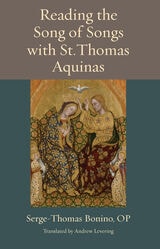
Reading the Song of Songs with St. Thomas Aquinas
Serge-Thomas Bonino
Catholic University of America Press, 2022
Reading the Underthought
Jewish Hermeneutics and the Christian Poetry of Hopkins and EliotKinereth Meyer
Catholic University of America Press, 2010
Reading with Feeling
Affect Theory and the BibleFiona C. Black
SBL Press, 2019
Essays with a methodological and metacritical focus
The psychological approach known as affect theory focuses on bodily feelings—depression, happiness, disgust, love—and can illuminate both texts and their interpretations. In this collection of essays scholars break new ground in biblical interpretation by deploying a range of affect-theoretical approaches in their interpretations of texts. Contributors direct their attention to the political, social, and cultural formation of emotion and other precognitive forces as a corrective to more traditional historical-critical methods and postmodern approaches. The inclusion of response essays results in a rich transdisciplinary dialog, with, for example, history, classics, and philosophy. Fiona C. Black, Amy C. Cottrill, Rhiannon Graybill, Jennifer L. Koosed, Joseph Marchal, Robert Seesengood, Ken Stone, and Jay Twomey engage a range of texts from biblical, to prayers, to graphic novels. Erin Runions and Stephen D. Moore’s responses push the conversation in new fruitful directions.
Features
Realized Religion
Research on the Relationship between Religion and HealthTheodore J. Chamberlain
Templeton Press, 2001
Realized Religion includes research that investigates the impact of spirituality in health and healing, faith healing, religion and mental health, religion and life satisfaction, religion and mental disorders, religion and martial satisfaction, the effect of religion on suicide, and the effect of religion on alcohol use and abuse. This book documents over 300 scientific studies published by reputable scientific journals demonstrating that religion has an ameliorating effect on the survival rate of surgical patients, on depression and anxiety, on suicide rates, and on promotion of a healthy lifestyle.
Realized Religion presents useful and helpful information to researchers and scholars who seek to understand the subtle connection between healing and spirituality. It will be an invaluable resource for libraries and others interested in the emerging field of spirituality and healing.
Realm of the Saint
Power and Authority in Moroccan SufismBy Vincent J. Cornell
University of Texas Press, 1998
In premodern Moroccan Sufism, sainthood involved not only a closeness to the Divine presence (walaya) but also the exercise of worldly authority (wilaya). The Moroccan Jazuliyya Sufi order used the doctrine that the saint was a "substitute of the prophets" and personification of a universal "Muhammadan Reality" to justify nearly one hundred years of Sufi involvement in Moroccan political life, which led to the creation of the sharifian state.
This book presents a systematic history of Moroccan Sufism through the fifteenth and sixteenth centuries C.E. and a comprehensive study of Moroccan Sufi doctrine, focusing on the concept of sainthood. Vincent J. Cornell engages in a sociohistorical analysis of Sufi institutions, a critical examination of hagiography as a source for history, a study of the Sufi model of sainthood in relation to social and political life, and a sociological analysis of more than three hundred biographies of saints. He concludes by identifying eight indigenous ideal types of saint that are linked to specific forms of authority. Taken together, they define sainthood as a socioreligious institution in Morocco.
Rearranging the Landscape of the Gods
The Politics of a Pilgrimage Site in Japan, 1573-1912Sarah Thal
University of Chicago Press, 2005
Using miracle tales, votive plaques, diaries, and newspapers, Sarah Thal traces such changes at one of the most popular Japanese pilgrimage sites of the nineteenth and twentieth centuries: the shrine of Konpira on the island of Shikoku. This rich and fascinating history explores how people from all walks of life gave shape to the gods, shrines, and rituals so often attributed to ancient, indigenous Japan. Thal shows how worshippers and priests, rulers and entrepreneurs, repeatedly rebuilt and reinterpreted Konpira to reflect their needs and aspirations in a changing world—and how, in doing so, they helped shape the structures of the modern state, economy, and society in turn.
Rearranging the Landscape of the Gods will be welcomed by all scholars of Japanese history and by students of religion interested in the construction of modernity.
Reason and Wonder
Why Science and Faith Need Each OtherEric Priest
Templeton Press, 2016
This is exactly what Reason and Wonder does. Eric Priest has brought together twelve of the leading thinkers in science and theology to discuss everything from the origins of the universe to evolution and evil. At the heart of each essay is an understanding that the best science—and the best theology— are both undergirded by an appeal to reason as well as a deep sense of wonder.
Each of these great scientific and theological thinkers offers a chapter on their area of expertise, and the book closes with a stimulating set of questions for group discussion or personal reflection.
- Contributors and their topics include:
- Eric Priest: Towards an integration of science and religion
- Keith Ward: God, science and the New Atheism
- Eleonore Stump: Natural law, reductionism and the Creator
- David Wilkinson: The origin and end of the universe: A challenge for Christianity
- Jennifer Wiseman: Universe of wonder, universe of life
- Kenneth R. Miller: Evolution, faith and science
- Michael J. Murray and Jeff Schloss: Evolution and evil
- Pauline Rudd: Is there more to life than genes?
- David G. Myers: Psychological science meets Christian faith
- John Wyatt: Being a person: Towards an integration of neuroscientific and Christian perspectives
- John Swinton: From projection to connection: Conversations between science, spirituality and health
- Mark Harris: Do the miracles of Jesus contradict science?
- N. T. Wright: Can a scientist trust the New Testament?
Reason, Revelation, and Metaphysics
Montague Brown
Catholic University of America Press, 2021
Reassessing Reform
Christopher M. Bellitto
Catholic University of America Press, 2012
Rebuilding Jewish Life in Germany
Jay Howard Geller
Rutgers University Press, 2020
Rebuilding Trust
Clergy Morale in the Wake of the Abuse CrisisBrandon Vaidyanathan
Catholic University of America Press, 2025
Receiving the Bible in faith
historical and theological exegesisDavid M. Williams
Catholic University of America Press, 2004
Receiving the Gifts of Every Member
A Practical Ecclesiological Case Study on Inclusion and the ChurchKoos Tamminga
Central European University Press, 2026
Recent Reform Responsa - PDF Electronic Version
Rabbi Solomon B. Freehof
Central Conference of American Rabbis, 1963
Can women serve as pall-bearers? Is it appropriate to refer to God as YHVE? May a bar mitzvah take place on Shabbat Shuvah? What are acceptable medical uses of a fetus? What names are to be avoided? Can a convicted accountant serve as a congregational officer? Must a sperm donor be Jewish in order for the fetus to be Jewish? These are some of the questions dealt with in this collection. Originally published in 1963, many of these questions are still relevant today.
Recharging Judaism
How Civic Engagement Is Good for Synagogues, Jews, and AmericaRabbi Judith Schindler and Judy Seldin-Cohen
Central Conference of American Rabbis, 2018
Recharging Judaism is the essential and timely guide for every synagogue and community seeking to strengthen the bonds of Jewish communal life through advocating for social justice. This volume delves into the enriching civic engagement and acts of righteousness already undertaken by Jews and Jewish communities across the country, and further explores the positive differences we can all affect upon the future of America. There are a myriad of ways in which advocating for social justice and participating in civic engagement can create lasting change. Those inspired to affect such change will find new meaning in the texts and history of our tradition. Using real examples from both small and large congregations across the country, Recharging Judaism offers a framework to guide us through our journey of civic responsibility and social duty and into a brighter future for our country.
Reckoning with Spirit in the Paradigm of Performance
Donnalee Dox
University of Michigan Press, 2016
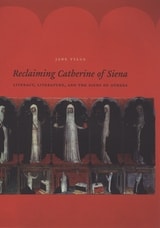
Reclaiming Catherine of Siena
Literacy, Literature, and the Signs of OthersJane Tylus
University of Chicago Press, 2009
Jane Tylus charts here the contested struggles of scholars over the centuries to situate Catherine in the history of Italian culture in early modernity. But she mainly focuses on Catherine’s works, calling attention to the interplay between orality and textuality in the letters and demonstrating why it was so important for Catherine to envision herself as a writer. Tylus argues for a reevalution of Catherine as not just a medieval saint, but one of the major figures at the birth of the Italian literary canon.
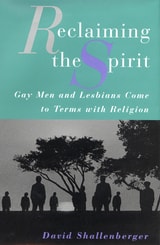
Reclaiming the Spirit
Gay Men and Lesbians Come to Terms with Their ReligionShallenberger, David
Rutgers University Press, 1998
In a world in which religion and homosexuality are often by definition incompatible, it is crucial to hear from gay men and women about how they perceive themselves to be religious or spiritual people. Eliciting powerful, frank, and sometimes troubling responses, David Shallenberger interviewed gay men and women who grew up in families that belonged to traditional religions-Jewish, Roman Catholic, and Protestant-that rejected homosexuality as an unacceptable life-style. When these children grew into adulthood and "came out," many rejected the religion of their childhood as they sought out a more accepting gay community. But once they became comfortable with their new gay identity, they began to experience a spiritual hunger and a desire to be part of a religious community. Some sought to return to the traditions from which they came; others desired membership in new religious communities.
The quest for an integration of homosexuality and spirituality is the focus of Reclaiming the Spirit. Shallenberger asks how individuals can balance both a gay and a religious identity, whether coming out is a spiritual experience, and how coming out affects an individual's relationship to a traditional religious community. Divided into chapters that correspond to the common stages of spiritual integration, Reclaiming the Spirit is immensely readable and introduces an important group of voices into the hotly contested debates surrounding religion and gay participation.
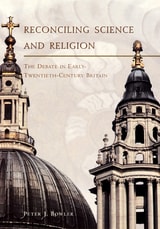
Reconciling Science and Religion
The Debate in Early-Twentieth-Century BritainPeter J. Bowler
University of Chicago Press, 2001
Peter J. Bowler argues that unlike the United States, where a strong fundamentalist opposition to evolutionism developed in the 1920s (most famously expressed in the Scopes "monkey trial" of 1925), in Britain there was a concerted effort to reconcile science and religion. Intellectually conservative scientists championed the reconciliation and were supported by liberal theologians in the Free Churches and the Church of England, especially the Anglican "Modernists." Popular writers such as Julian Huxley and George Bernard Shaw sought to create a non-Christian religion similar in some respects to the Modernist position. Younger scientists and secularists—including Rationalists such as H. G. Wells and the Marxists—tended to oppose these efforts, as did conservative Christians, who saw the liberal position as a betrayal of the true spirit of their religion. With the increased social tensions of the 1930s, as the churches moved toward a neo-orthodoxy unfriendly to natural theology and biologists adopted the "Modern Synthesis" of genetics and evolutionary theory, the proposed reconciliation fell apart.
Because the tensions between science and religion—and efforts at reconciling the two—are still very much with us today, Bowler's book will be important for everyone interested in these issues.
Reconsidering No Man Knows My History
edited by Newell G. Bringhurst
Utah State University Press, 1996
Recovering Nineteenth-Century Women Interpreters of the Bible
Christiana de Groot
SBL Press, 2007
Women have been thoughtful readers and interpreters of scripture throughout the ages, yet the usual history of biblical interpretation includes few women’s voices. To introduce readers to this untapped source for the history of biblical interpretation, this volume presents forgotten works from the nineteenth century written by women—including Grace Aguilar, Florence Nightingale, and Harriet Beecher Stowe, among others—from various faith backgrounds, countries, and social classes engaging contemporary biblical scholarship. Due to their exclusion from the academy, women’s interpretive writings addressed primarily a nonscholarly audience and were written in a variety of genres: novels and poetry, catechisms, manuals for Bible study, and commentaries on the books of the Bible. To recover these nineteenth-century women interpreters of the Bible, each essay in this volume locates a female author in her historical, ecclesiastical, and interpretive context, focusing on particular biblical passages to clarify an author’s contributions as well as to explore how her reading of the text was shaped by her experience as a woman.
Recovering Origins
A Unique Healing Program for Adult Children of DivorceMargaret Harper McCarthy
Catholic University of America Press, 2021
Recovering Self-Evident Truths
Catholic Perspectives on American LawMichael A. Scaperlanda
Catholic University of America Press, 2007
Recovering the Eucharistic Ecclesiology of the Early Church
An Introduction to Nicolas AfanasievAnastacia Wooden
Catholic University of America Press, 2025
Recovering the Margins of American Religious History
The Legacy of David Edwin Harrell Jr.B. Dwain Waldrep
University of Alabama Press, 2012
Recruiting Young Love
How Christians Talk about HomosexualityMark D. Jordan
University of Chicago Press, 2011
In the view of many Christians, the teenage years are simultaneously the most dangerous and the most promising. At the very moment when teens are trying to establish a sense of identity and belonging, they are beset by temptation on all sides—from the pressure of their peers to the nihilism and materialism of popular culture. Add the specter of homosexuality to the mix, and you’ve got a situation ripe for worry, sermonizing, and exploitation.
In Recruiting Young Love, Mark D. Jordan explores more than a half century of American church debate about homosexuality to show that even as the main lesson—homosexuality is bad, teens are vulnerable—has remained constant, the arguments and assumptions have changed remarkably. At the time of the first Kinsey Report, in 1948, homosexuality was simultaneously condemned and little discussed—a teen struggling with same-sex desire would have found little specific guidance. Sixty years later, church rhetoric has undergone a radical shift, as silence has given way to frequent, public, detailed discussion of homosexuality and its perceived dangers. Along the way, churches have quietly adopted much of the language and ideas of modern sexology, psychiatry, and social reformers—deploying it, for example, to buttress the credentials of anti-gay “deprogramming” centers and traditional gender roles.
Jordan tells this story through a wide variety of sources, including oral histories, interviews, memoirs, and even pulp novels; the result is a fascinating window onto the never-ending battle for the teenage soul.
Red Man's Religion
Beliefs and Practices of the Indians North of MexicoRuth Murray Underhill
University of Chicago Press, 1965
"The distinctive contribution of [Red Man's Religion] is the treatment of topics, the insight and the perspective of the author, and her ability to transmit these to the reader. . . . Trais and aspects of religion are not treated as abstract entitites, to be enumerated and summated, assigned a geographic distribution, and then abandoned. No page is a dry recital; each is an illumination. Insight and wisdom are framed in poetic prose. An offering of information in such a medium merits gratitude."—American Anthropologist
Redeeming Culture
American Religion in an Age of ScienceJames Gilbert
University of Chicago Press, 1997
"Anyone seriously interested in the history of current controversies involving religion and science will find Gilbert's book invaluable."—Peter J. Causton, Boston Book Review
"Redeeming Culture provides some fascinating background for understanding the interactions of science and religion in the United States. . . . Intriguing pictures of some of the highlights in this cultural exchange."—George Marsden, Nature
"A solid and entertaining account of the obstacles to mutual understanding that science and religion are now warily overcoming."—Catholic News Service
"[An] always fascinating look at the conversation between religion and science in America."—Publishers Weekly
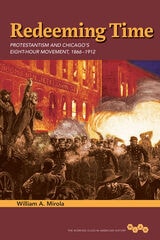
Redeeming Time
Protestantism and Chicago's Eight-Hour Movement, 1866-1912William A. Mirola
University of Illinois Press, 2015
William A. Mirola explores how the city's eight-hour movement intersected with a Protestant religious culture that supported long hours to keep workers from idleness, intemperance, and secular leisure activities. Analyzing how both workers and clergy rewove working-class religious cultures and ideologies into strategic and rhetorical frames, Mirola shows how every faith-based appeal contested whose religious meanings would define labor conditions and conflicts. As he notes, the ongoing worker-employer tension transformed both how clergy spoke about the eight-hour movement and what they were willing to do, until intensified worker protest and employer intransigence spurred Protestant clergy to support the eight-hour movement even as political and economic arguments eclipsed religious framing.
A revealing study of an era and a movement, Redeeming Time illustrates the potential--and the limitations--of religious culture and religious leaders as forces in industrial reform.
Redeeming Work
A Guide to Discovering God's Calling for Your CareerBryan J. Dik
Templeton Press, 2020
The author, Bryan Dik, PhD, is one of the leading psychologists in the world who specializes in vocation. A professor, entrepreneur, and follower of Christ, Dik wrote this book as a labor of love after devoting his career to research and development of practical strategies for helping others find purposeful work. His message: there are abundant opportunities for Christians to forge careers that answer God’s calling for their lives. In Redeeming Work, he shares the tools you need to find these opportunities and pursue them successfully.
Your purchase of Redeeming Work comes with a special bonus: free access to an evidence-based online career assessment system called PathwayU. By taking this assessment, you’ll learn about what makes you unique, including what you enjoy (interests), what matters to you (values), your general tendencies (personality), and what you most need from an organization (workplace preferences). Then, you’ll be able to explore career paths (and current job openings) that fit the pattern of gifts God has given you.
Redefining Heresy and Tolerance
Governance of Muslims and Christians in the Qing Empire before 1864Tak Wai Hung
Hong Kong University Press, 2024
Redefining Heresy and Tolerance demonstrates how the political philosophies of toleration developed in the context of late Imperial China were different from the theories that emerged in the West during their time. Focusing on religious policy in the Qing Empire, Hung attempts to clarify the Qing toleration policies and the reasoning behind them. He also demonstrates how the Qing government prevented Confucian bureaucrats from interfering in the religious life of Christians and Muslims, and how the Confucians’ understanding of “religion” was reshaped in the period.
Redescribing the Gospel of Mark
Barry S. Crawford
SBL Press, 2017
A collaborative project with a variety of critical essays
This final volume of studies by members of the Society of Biblical Literature’s consultation, and later seminar, on Ancient Myths and Modern Theories of Christian Origins focuses on Mark. As with previous volumes, the provocative proposals on Christian origins offered by Burton L. Mack are tested by applying Jonathan Z. Smith's distinctive social theorizing and comparative method. Essays examine Mark as an author’s writing in a book culture, a writing that responded to situations arising out of the first Roman-Judean war after the destruction of the Jerusalem temple in 70 CE. Contributors William E. Arnal, Barry S. Crawford, Burton L. Mack, Christopher R. Matthews, Merrill P. Miller, Jonathan Z. Smith, and Robyn Faith Walsh explore the southern Levant as a plausible provenance of the Gospel of Mark and provide a detailed analysis of the construction of Mark as a narrative composed without access to prior narrative sources about Jesus. A concluding retrospective follows the work of the seminar, its developing discourse and debates, and the continuing work of successor groups in the field.Features
- A thorough examination of the relation between structure and event in social and anthropological theory that provides conceptual tools for representing the project of the author of Mark
- An exploration of the southern Levant as a plausible provenance of the Gospel, a permanent site of successive imperial regimes and culturally related peoples
- A detailed analysis of the construction of Mark as a narrative composed without access to prior narrative sources about Jesus

Redescriptions
Toward a New Comparative ReligionRussell T. McCutcheon
Rutgers University Press, 2027
Although religion has long occupied the attention of scholars it has uniformly been assumed by them to be a special case, either to be nurtured and curated or explained away by developing theories specifically suited to it. This bracketing of our object of study has isolated the field and made it difficult for many to understand: Is religion a theological enterprise? Is it suited to the public university? Does it offend against some people’s sensibilities? Redescriptions: Toward a New Comparative Religion proposes a model for how to address this ambiguity by averring that the things scholars call religion are simply routine human doings that are therefore comparable to any other aspect of culture. The book offers a series of controlled experiments in which some novel conclusions about seemingly religious items—from myths of origins to memorials for the dead—are reached by placing them into some unexpected relationships of comparison.
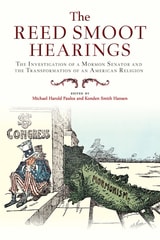
Reed Smoot Hearings
The Investigation of a Mormon Senator and the Transformation of an American ReligionMichael Harold Paulos
Utah State University Press, 2022
The work adds new insights into the role religion and the secular played in the shaping of US political institutions and national policies. Chapters also look at the history of anti-polygamy laws, the persistence of post-1890 plural marriage, the continuation of anti-Mormon sentiment, the intimacies and challenges of religious privatization, the dynamic of federal power on religious reform, and the more intimate role individuals played in effecting these institutional and national developments.
The Smoot hearings stand as an important case study that highlights the paradoxical history of religious liberty in America and the principles of exclusion and coercion that history is predicated on. Framed within a liberal Protestant sensibility, these principles of secular progress mapped out the relationship of religion and the nation-state for the new modern century. The Reed Smoot Hearings will be of significant interest to students and scholars of Mormon, western, American, and religious history.
Publication supported, in part, by Gonzaba Medical Group.
Contributors: Gary James Bergera, John Brumbaugh, Kenneth L. Cannon II, Byron W. Daynes, Kathryn M. Daynes, Kathryn Smoot Egan, D. Michael Quinn
Reel Kabbalah
Jewish Mysticism and Neo-Hasidism in Contemporary CinemaBrian Ogren
Rutgers University Press, 2024
Reform Responsa - PDF Electronic Version
Rabbi Solomon B. Freehof
Central Conference of American Rabbis, 1960
This volume of Responsa, originally published in 1960, answers such questions as: May a memorial service be held on Shabbat? What is the role of a stepfather at a bar mitzvah? Can a congregational gift shop be open on Shabbat? Must an Ark be centered on the bima? Is it acceptable to marry an apostate daughter of a Jewish mother? Should a dying patient be informed of his condition? What to do when a body is lost at sea? These questions and more shed light on the issues of concern to the Jewish community when this book was first published, and still provide insight today.
Reform Responsa for Our Time - PDF Electronic Version
Rabbi Solomon B. Freehof
Central Conference of American Rabbis, 1977
Originally published in 1977, this back-in-print classic offers a historic look at the concerns of an earlier generation. The questions and answers in this book deal with issues of Jewish ritual observance, holidays, life cycle events, synagogue life, birth, death, medical ethics, abortion, and much more. Though some issues are dated, this volume offers timeless wisdom and unique insights into Jewish thought.
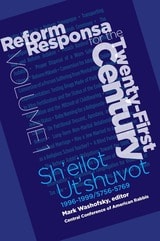
Reform Responsa for the Twenty-First Century, Volume 1
Sh'eilot Ut'shuvotRabbi Mark Washofsky, PhD
Central Conference of American Rabbis, 2010
Reform Responsa for the Twenty-First Century: Sh'eilot Ut'shuvot is the latest in an ongoing series of Reform Responsa. Drawing from the breadth of traditional and modern Jewish texts, law, and ideology, this two volumes set addresses over seventy contemporary topics, including conversion of adopted children, fertility treatments, patrilineal descent, issues of synagogue management, social justice activism, interfaith marriage, and rituals of death and mourning.
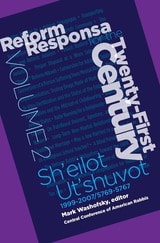
Reform Responsa for the Twenty-First Century, Volume 2
Sh'eilot Ut'shuvotRabbi Mark Washofsky, PhD
Central Conference of American Rabbis, 2010
Reform Responsa for the Twenty-First Century: Sh'eilot Ut'shuvot is part of an ongoing series of Reform Responsa. Drawing from the breadth of traditional and modern Jewish texts, law, and ideology, this two volumes set addresses over seventy contemporary topics, including conversion of adopted children, fertility treatments, patrilineal descent, issues of synagogue management, social justice activism, interfaith marriage, and rituals of death and mourning.
Reformation Movements in the Sixteenth and Seventeenth Centuries
Charlotte Methuen
SBL Press, 2025
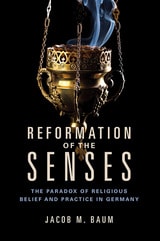
Reformation of the Senses
The Paradox of Religious Belief and Practice in GermanyJacob M. Baum
University of Illinois Press, 2018
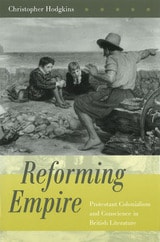
Reforming Empire
Protestant Colonialism and Conscience in British LiteratureChristopher Hodgkins
University of Missouri Press, 2002
“The strength of Empire,” wrote Ben Jonson, “is in religion.” In Reforming Empire, Christopher Hodgkins takes Jonson’s dictum as his point of departure, showing how for more than four centuries the Protestant imagination gave the British Empire its main paradigms for dominion and also, ironically, its chief languages of anti-imperial dissent. From Edmund Spenser’s Faerie Queene to Rudyard Kipling’s “The Man Who Would Be King,” English literature about empire has turned with strange constancy to themes of worship and idolatry, atrocity and deliverance, slavery and service, conversion, prophecy, apostasy, and doom.
Focusing on the work of the Protestant imagination from the Renaissance origins of English overseas colonization through the modern end of England’s colonial enterprise, Hodgkins organizes his study around three kinds of religious binding—unification, subjugation, and self-restraint. He shows how early modern Protestants like Hakluyt and Spenser reformed the Arthurian chronicles and claimed to inherit Rome’s empire from the Caesars: how Ralegh and later Cromwell imagined a counterconquest of Spanish America, and how Milton’s Satan came to resemble Cortés; how Drake and the fictional Crusoe established their status as worthy colonial masters by refusing to be worshiped as gods; and how seventeenth-century preachers, poets, and colonists moved haltingly toward a racist metaphysics—as Virginia began by celebrating the mixed marriage of Pocahontas but soon imposed the draconian separation of the Color Line.
Yet Hodgkins reveals that Tudor-Stuart times also saw the revival of Augustinian anti-expansionism and the genesis of Protestant imperial guilt. From the start, British Protestant colonialism contained its own opposite: a religion of self-restraint. Though this conscience often was co-opted or conscripted to legitimize conquests and pacify the conquered, it frequently found memorable and even fierce literary expression in writers such as Shakespeare, Daniel, Herbert, Swift, Johnson, Burke, Blake, Austen, Browning, Tennyson, Conrad, Forster, and finally the anti-Protestant Waugh. Written in a lively and accessible style, Reforming Empire will be of interest to all scholars and students of English literature.

Reforming Scriptures
Theories, Transformations, and Experiences Across American ReligionsEdited by Matthew Bowman, Heather Marie Burrow, Rebekah Call, and James W. Yuile
University of Illinois Press, 2027
The contributors draw on pioneering theorists like Vincent Wimbush and William Graham to grapple with how we might understand what we call scripture. The first section asks what makes a text scripture; the second looks at how scripture might change from medium to medium or context to context; and the third delves into how people use scripture. Two key themes emerge: that it is communities that produce and confer authority on scripture; and that fully grasping what a piece of scripture means must account for the medium that transmits it.
Diverse and interdisciplinary. Reforming Scriptures rethinks what “scripture” really means.
Contributors: Samantha Baskind, Jon Bialecki, James Bielo, Kelly D. Dagley, Megan Sanborn Jones, Joseph McDonald, Tom Mould, Eugene C. Staples II, Peter J. Thuesen, Jordan T. Watkins, Rosalynde Frandsen Welch, Lydia Willsky-Ciollo
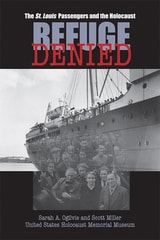
Refuge Denied
The St. Louis Passengers and the HolocaustSarah A. Ogilvie and Scott Miller
University of Wisconsin Press, 2006
Although the episode of the St. Louis is well known, the actual fates of the passengers, once they disembarked, slipped into historical obscurity. Prompted by a former passenger’s curiosity, Sarah Ogilvie and Scott Miller of the United States Holocaust Memorial Museum set out in 1996 to discover what happened to each of the 937 passengers. Their investigation, spanning nine years and half the globe, took them to unexpected places and produced surprising results. Refuge Denied chronicles the unraveling of the mystery, from Los Angeles to Havana and from New York to Jerusalem.
Some of the most memorable stories include the fate of a young toolmaker who survived initial selection at Auschwitz because his glasses had gone flying moments before and a Jewish child whose apprenticeship with a baker in wartime France later translated into the establishment of a successful business in the United States. Unfolding like a compelling detective thriller, Refuge Denied is a must-read for anyone interested in the Holocaust and its impact on the lives of ordinary people.
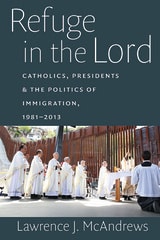
Refuge in the Lord
Lawrence J. McAndrews
Catholic University of America Press, 2015
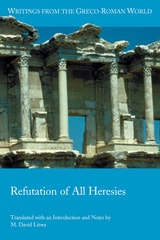
Refutation of All Heresies
M. David Litwa
SBL Press, 2016
A reliable, readable translation for scholars and students
The Refutation of All Heresies (ca. 225 CE) is a treasure-trove of ancient philosophy, astrology, medicine, magic, Gnostic thought, numerology, heresiography, ecclesial politics, and early Christian studies in general. Offered here for the first time in almost a century is a full English translation, along with a newly-edited Greek text, extensive notes, and a thorough introduction.
Features:
- A full English translation with extensive notes
- Newly edited Greek text that avoids the pitfalls of the most recent edition
- A thorough-going introduction that addresses the questions of authorship, date, and audience, as well as the purpose of the book, its organization, method, and importance for Gnostic studies