Results by title
1882 books match the query 'Criticism and interpretation' and 105 start with r
Rowing in Eden
Rereading Emily DickinsonBy Martha Nell Smith
University of Texas Press, 1992
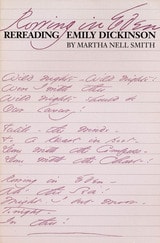
Emily Dickinson wrote a "letter to the world" and left it lying in her drawer more than a century ago. This widely admired epistle was her poems, which were never conventionally published in book form during her lifetime. Since the posthumous discovery of her work, general readers and literary scholars alike have puzzled over this paradox of wanting to communicate widely and yet apparently refusing to publish. In this pathbreaking study, Martha Nell Smith unravels the paradox by boldly recasting two of the oldest and still most frequently asked questions about Emily Dickinson: Why didn't she publish more poems while she was alive? and Who was her most important contemporary audience?
Regarding the question of publication, Smith urges a reconception of the act of publication itself. She argues that Dickinson did publish her work in letters and in forty manuscript books that circulated among a cultured network of correspondents, most important of whom was her sister-in-law, Susan Huntington Gilbert Dickinson. Rather than considering this material unpublished because unprinted, Smith views its alternative publication as a conscious strategy on the poet's part, a daring poetic experiment that also included Dickinson's unusual punctuation, line breaks, stanza divisions, calligraphic orthography, and bookmaking—all the characteristics that later editors tried to standardize or eliminate in preparing the poems for printing.
Dickinson's relationship with her most important reader, Sue Dickinson, has also been lost or distorted by multiple levels of censorship, Smith finds. Emphasizing the poet-sustaining aspects of the passionate bonds between the two women, Smith shows that their relationship was both textual and sexual. Based on study of the actual holograph poems, Smith reveals the extent of Sue Dickinson's collaboration in the production of poems, most notably "Safe in Their Alabaster Chambers." This finding will surely challenge the popular conception of the isolated, withdrawn Emily Dickinson.
Well-versed in poststructuralist, feminist, and new textual criticism, Rowing in Eden uncovers the process by which the conventional portrait of Emily Dickinson was drawn and offers readers a chance to go back to original letters and poems and look at the poet and her work through new eyes. It will be of great interest to a wide audience in literary and feminist studies.
Roy Orbison
Invention Of An Alternative Rock MasculinityPeter Lehman
Temple University Press, 2003
Rubén Darío and the Romantic Search for Unity
The Modernist Recourse to Esoteric TraditionBy Cathy Login Jrade
University of Texas Press, 1983
Modernism was the major Spanish American literary movement of the late nineteenth and early twentieth centuries. Leader of that influential movement was Rubén Darío, the Nicaraguan now recognized as one of the most important Hispanic poets of all time.
Like the Romantics in England and the Symbolists on the Continent, Darío and other Modernists were strongly influenced by occultist thought. But, as the poet Octavio Paz has written, "academic criticism has ... preferred to close its eyes to the stream of occultism that runs throughout Darío's work. This silence damages our comprehension of his poetry."
Cathy Login Jrade's groundbreaking study corrects this critical oversight. Her work clearly demonstrates that esoteric tradition is central to Modernism and that an understanding of this centrality clarifies both the nature of the movement and its relationship to earlier European literature.
After placing Modernism in a broad historical and literary perspective, Jrade examines the impact of esoteric beliefs upon Darío's view of the world and the role of poetry in it. Through detailed and insightful analyses of key poems, she explores the poet's quest for solutions to the nineteenth-century crisis of belief.
The movement that Ruben Darío headed brought Hispanic poetry into the mainstream of the "modern tradition," with its sense of fragmentation and alienation and its hope for integration and reconciliation with nature. Rubén Darío and the Romantic Search for Unity enriches our understanding of that movement and the work of its leading poet.

Russia’s Capitalist Realism
Tolstoy, Dostoevsky, and ChekhovVadim Shneyder
Northwestern University Press, 2021
Russia’s Capitalist Realism examines how the literary tradition that produced the great works of Leo Tolstoy, Fyodor Dostoevsky, and Anton Chekhov responded to the dangers and possibilities posed by Russia’s industrial revolution. During Russia’s first tumultuous transition to capitalism, social problems became issues of literary form for writers trying to make sense of economic change. The new environments created by industry, such as giant factories and mills, demanded some kind of response from writers but defied all existing forms of language.
This book recovers the rich and lively public discourse of this volatile historical period, which Tolstoy, Dostoevsky, and Chekhov transformed into some of the world’s greatest works of literature. Russia’s Capitalist Realism will appeal to readers interested in nineteenth‑century Russian literature and history, the relationship between capitalism and literary form, and theories of the novel.
Ruthless Hedonism
The American Reception of MatisseJohn O'Brian
University of Chicago Press, 1999
In this ambitious study, John O'Brian argues that Matisse's sober presentations of himself were calculated to fit with the social constraints and ideological demands of the times. Matisse's strategy included cooperating with museums, cultivating private collectors, playing off dealers one against another, and reassuring the media that, whatever his reputation as an avant-gardist, the conduct of his life was solidly bourgeois.
Moving from the late 1920s, when Matisse's output was shedding its outlaw reputation, to the early 1950s, when his work was canonized, O'Brian shows how the way Matisse's work was viewed changed as attention shifted away from the seductiveness of his subject matter to the seductiveness of his paint. The art's resolute rejection of political concerns, its deployment of decorative design for visual satisfaction, and its representations of pleasure encouraged American audiences, who in the 1930s deemed the art disreputable, to celebrate its gratifications by the early years of the Cold War.
This intriguing, wide-ranging investigation of Matisse's self-promotion, America's uneasy embrace of modernism, and America's consumer culture and politics provides a rich context to Clement Greenberg's words published in the Nation in 1947: "Matisse's cold hedonism and ruthless exclusion of everything but the concrete, immediate sensation will in the future, once we are away from the present Zeitgeist, be better understood as the most profound mood of the first half of the twentieth century."