Results by title
4030 books match the query 'Language Arts & Disciplines' and 235 start with r

Reinventing Reference
How Public, Academic, and School Libraries Deliver Value in the Age of GoogleVibiana Bowman Cvetkovic
American Library Association, 2014
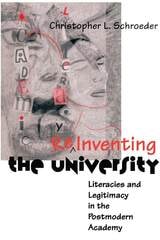
Reinventing The University
Literacies and Legitimacy in the Postmodern AcademyChristopher L. Schroeder
Utah State University Press, 2001
Christopher Schroeder spends almost no time disputing David Bartholomae's famous essay, but throughout ReInventing the University, he elaborates an approach to teaching composition that is at odds with the tradition that essay has come to represent.
On the other hand, his approach is also at odds with elements of the pedagogies of such theorists as Berlin, Bizzell, and Shor. Schroeder argues that, for students, postmodern instability in literacy and meaning has become a question of the legitimacy of current discourse of education. Schroeder is committed, then, to constructing literacies jointly with students and by so doing to bringing students to engage more deeply with education and society.
Reinventing the Library for Online Education
Frederick Stielow
American Library Association, 2013
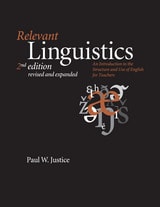
Relevant Linguistics, Second Edition, Revised and Expanded
An Introduction to the Structure and Use of English for TeachersPaul W. Justice
CSLI, 2004
Each chapter of Relevant Linguistics leads students through descriptive analysis, helps them grasp linguistic concepts, and provides them with the reference materials necessary for their own teaching. This second edition contains more exercises as well as expanded and clarified explanations of the issues discussed in the first edition. Also included are more references to areas such as the history of English and semantics.
Relevant Linguistics
An Introduction to the Structure and Use of English for TeachersPaul W. Justice
CSLI, 2001
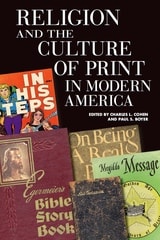
Religion and the Culture of Print in Modern America
Edited by Charles L. Cohen and Paul S. Boyer
University of Wisconsin Press, 2008
Religious Expression and the American Constitution
Franklyn S. Haiman
Michigan State University Press, 2003
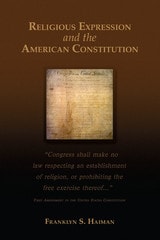
First Amendment rights have been among the most fiercely debated topics in the aftermath of 9/11. In the current environment and fervor for “homeland security,” personal freedoms in exchange for security are coming under more scrutiny. Among these guaranteed freedoms are the protection of religious expression given by the U.S. Constitution and the constitutional prohibitions against behaviors that violate the separation of church and state. The mandate that the government “shall make no law respecting an establishment of religion, or prohibiting the free exercise thereof” is a general principle that has guided American courts in interpreting the original intent of the First Amendment. In Religious Expression and the American Constitution, Haiman focuses on the current state of American law with respect to a broad range of controversial issues affecting religious expression, both verbal and nonverbal, along with a review of the recent history of each issue to provide a full understanding.
Relocating Authority
Japanese Americans Writing to Redress Mass IncarcerationMira Shimabukuro
University Press of Colorado, 2015
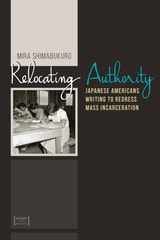
Relocating Authority examines the ways Japanese Americans have continually used writing to respond to the circumstances of their community’s mass imprisonment during World War II. Using both Nikkei cultural frameworks and community-specific history for methodological inspiration and guidance, Mira Shimabukuro shows how writing was used privately and publicly to individually survive and collectively resist the conditions of incarceration.
Examining a wide range of diverse texts and literacy practices such as diary entries, note-taking, manifestos, and multiple drafts of single documents, Relocating Authority draws upon community archives, visual histories, and Asian American history and theory to reveal the ways writing has served as a critical tool for incarcerees and their descendants. Incarcerees not only used writing to redress the “internment” in the moment but also created pieces of text that enabled and inspired further redress long after the camps had closed.
Relocating Authority highlights literacy’s enduring potential to participate in social change and assist an imprisoned people in relocating authority away from their captors and back to their community and themselves. It will be of great interest to students and scholars of ethnic and Asian American rhetorics, American studies, and anyone interested in the relationship between literacy and social justice.

Remake, Remodel
Women's Magazines in the Digital AgeBrooke Erin Duffy
University of Illinois Press, 2013
Remembering the AIDS Quilt
Charles E. Morris III
Michigan State University Press, 2011
Remixing Composition
A History of Multimodal Writing PedagogyJason Palmeri
Southern Illinois University Press, 2012
Using the concept of the remix, Palmeri outlines practical pedagogical suggestions for how writing teachers can build upon this heritage with digital activities, assignments, and curricula that meet the needs of contemporary students. He details a pluralist vision of composition pedagogy that explains the ways that writing teachers can synthesize expressivist, cognitive, and social-epistemic approaches.
Palmeri reveals an expansive history of now forgotten multimodal approaches to composing moving images and sounds and demonstrates how current compositionists can productively remix these past pedagogies to address the challenges and possibilities of the contemporary digital era. A strikingly original take on the recent history of composition, Remixing Composition is an important work for the future of writing instruction in a digital age.
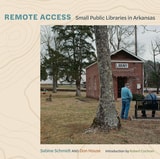
Remote Access
Small Public Libraries in ArkansasSabine Schmidt
University of Arkansas Press, 2021
Winner, 2024 Arkansiana Book Award, Arkansas Library Association
With their cameras and notebooks in hand, photographers Sabine Schmidt and Don House embarked on an ambitious project to document the libraries committed to serving Arkansas’s smallest communities. Remote Access is the culmination of this fascinating three-year effort, which took the artists to every region of their home state.
Schmidt’s carefully constructed color images of libraries and the communities they serve and House’s rich black-and-white portraits of library patrons and staff shine alongside the authors’ personal essays about their experiences. The pages here come alive with a deep connection to Arkansas’s history and culture as we accompany the authors on visits to a section of the Trail of Tears near Parkin, to the site of the tragic 1959 fire at the Arkansas Negro Boys Industrial School in Wrightsville, and to Maya Angelou’s childhood home in Stamps, among many other significant destinations.
Through this testament to the essential role of libraries in the twenty-first century, Schmidt and House have created a clear-eyed portrait of contemporary rural life, delving into issues of race, politics, gender, and isolation as they document the remarkable hard work and generosity put forth in community efforts to sustain local libraries.
Renew Yourself
A Six-Step Plan for More Meaningful WorkCatherine Hakala-Ausperk
American Library Association, 2017
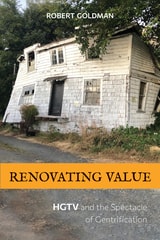
Renovating Value
HGTV and the Spectacle of GentrificationRobert Goldman
Temple University Press, 2021
HGTV has perfected stories about creating and capturing value in the housing market. But according to Robert Goldman, this lifestyle network’s beloved flagship programs, Flip or Flop, Property Brothers, and Fixer Upper—where people revitalize modern spaces and reinvent property values—offer “fairy tales” in the wake of the 2008 economic crisis. The cable channel’s seductive, bingeable programs may show how to find and extract value from properties, but, in fact, they insidiously ignore the realities of the real estate and mortgage markets, housing inequality, gentrification, economic insecurity, and even homelessness. In effect, HGTV has turned house flipping into a master narrative about getting ahead in America during an era of otherwise uneasy economic prospects.
HGTV pictures its insular moral economy as an alternative to a crisis-ridden neoliberal finance system that shaped landscapes of foreclosure and financial uncertainty for millions of households. Renovating Value explores the circuitry of consumer credit and debt, and a rent-gap model of gentrification that charts a path to the rehabilitation of Value. Goldman shrewdly critiques the aspirational myth of adding value to a home simply by using imagination, elbow grease, and aesthetic know-how.

Report on the State of UK-Based Research on Latin America and the Caribbean 2014
Edited by Antoni Kapcia and Linda A. Newson
University of London Press, 2015
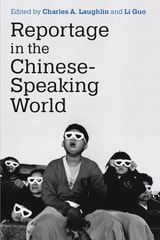
Reportage in the Chinese-Speaking World
Edited by Charles A. Laughlin and Li Guo
University of Michigan Press, 2026
Reportage in the Chinese-Speaking World examines reportage as an important aesthetic form of cultural production in the Sinophone world. Originating as a proletarian nonfiction form in interwar Europe, reportage spread around the world, coming into its own in the Sinophone world from the 1930s to today. Going beyond fact-based journalism, reportage is pursued through a variety of artistic forms and media, from nonfiction writing to photography to documentary film. Reportage’s plurimedial representations facilitate and amplify intersectional struggles against multiple forms of social and political oppression. Engaging its audiences in affective ethico-political exchanges with (human or nonhuman) subjects, reportage promotes audiences’ empathetic responses to the democratic appeals of marginalized groups whose status, identity, or situation manifest emergent ethical challenges in the society of their time.
This work offers new understandings of reportage’s dialectical relationship with its readership by evoking sympathetic identifications with personal contemplations of place, hearth, and senses of belonging. Covering a breadth of media across mainland China, Taiwan, and the Sinophone diaspora in the United States and Japan, this book examines how intermediality cultivates distinctive expressions in reportage, cross-cultural empathy, and ethico-political relationships between the reporter, photographer, filmmaker, and their surroundings.
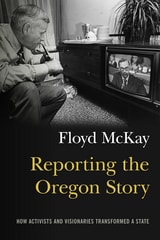
Reporting the Oregon Story
How Activists and Visionaries Transformed a StateFloyd J. McKay
Oregon State University Press, 2016
As a political reporter for The Oregon Statesman in Salem, and then as news analyst for KGW-TV in Portland, McKay was known for asking tough questions and pulling no punches. His reporting and commentaries ranged from analysis of the “Tom and Bob” rivalry, to the Vietnam War’s impact on Senators Wayne Morse and Mark Hatfield and the emergence of a new generation of Portland activists in the 1970s.
McKay and his colleagues were on the beaches as Oregon crafted its landmark Beach Bill, ensuring the protection of beaches for public use. They watched as activists turned back efforts to build a highway on the sand at Pacific City. Pitched battles over Oregon’s Bottle Bill, and the panic-inducing excitement of “Vortex”—the nation’s only state-sponsored rock festival—characterized the period. Covering the period from 1964-1986, McKay remembers the action, the players and the consequences, in this compelling and personal account.
As major actors fade from the scene and new leaders emerge, McKay casts a backwards glance at enduring Oregon legends. Half a century later, amid today’s cynicism and disillusionment with media, politics, and politicians, Reporting the Oregon Story serves as a timely reminder that charged politics and bitter rivalries can also come hand-in-hand with lasting social progress.
Reporting the Oregon Story will be relished by those who lived the history, and it will serve as a worthy introduction to Oregonians young and old who want a first-hand account of Oregon’s mid- twentieth-century political history and legislative legacy.
Representation and Inference for Natural Language
A First Course in Computational SemanticsPatrick Blackburn and Johan Bos
CSLI, 2005
Representations
Doing Asian American RhetoricLuMing Mao and Morris Young
Utah State University Press, 2008
Mao, Young, and their contributors propose that Asian American discourse should be seen as a spacious form, one that deliberately and selectively incorporates Asian “foreign-ness” into the English of Asian Americans. These authors offer the concept of a dynamic “togetherness-in-difference” as a way to theorize the contact and mutual influence. Chapters here explore a rich diversity of histories, theories, literary texts, and rhetorical practices. Collectively, they move the scholarly discussion toward a more nuanced, better balanced, critically informed representation of the forms of Asian American rhetorics and the cultural work that they do.
Reprogrammable Rhetoric
Critical Making Theories and Methods in Rhetoric and CompositionMichael J. Faris
Utah State University Press, 2022
This collection offers nuanced theoretical perspectives on material and cultural rhetorics alongside practical tutorials for students, researchers, and teachers to explore critical making across traditional areas such as wearable sensors, Arduinos, Twitter bots, multimodal pedagogy, Raspberry Pis, and paper circuitry, as well as underexplored areas like play, gaming, text mining, bots, and electronic monuments.
Designed to be taught in upper division undergraduate and graduate classrooms, these tutorials will benefit non-expert and expert critical makers alike. All contributed codes and scripts are also available on Utah State University Press’s companion website to encourage downloading, cloning, and repurposing.
Contributors: Aaron Beveridge, Kendall Gerdes, Kellie Gray, Matthew Halm, Steven Hammer, Cana Uluak Itchuaqiyaq, John Jones, M.Bawar Khan, Bree McGregor, Sean Morey, Ryan Omizo, Andrew Pilsch, David Rieder, David Sheridan, Wendi Sierra, Nicholas Van Horn

Repurposing Composition
Feminist Interventions for a Neoliberal AgeShari J. Stenberg
Utah State University Press, 2015
In Repurposing Composition, Shari J. Stenberg responds to the increasing neoliberal discourse of academe through the feminist practice of repurposing. In doing so, she demonstrates how tactics informed by feminist praxis can repurpose current writing pedagogy, assessment, public engagement, and other dimensions of writing education.
Stenberg disrupts entrenched neoliberalism by looking to feminism’s long history of repurposing “neutral” practices and approaches to the rhetorical tradition, the composing process, and pedagogy. She illuminates practices of repurposing in classroom moments, student writing, and assessment work, and she offers examples of institutions, programs, and individuals that demonstrate a responsibility approach to teaching and learning as an alternative to top-down accountability logic.
Repurposing Composition is a call for purposes of work in composition and rhetoric that challenge neoliberal aims to emphasize instead a public-good model that values difference, inclusion, and collaboration.
Rereading Aristotle's Rhetoric
Edited by Alan G. Gross and Arthur E. Walzer
Southern Illinois University Press, 2000
In this collection edited by Alan G. Gross and Arthur E. Walzer, scholars in communication, rhetoric and composition, and philosophy seek to “reread” Aristotle’s Rhetoric from a purely rhetorical perspective. So important do these contributors find the Rhetoric, in fact, that a core tenet in this book is that “all subsequent rhetorical theory is but a series of responses to issues raised by the central work.”
The essays reflect on questions basic to rhetoric as a humanistic discipline. Some explore the ways in which the Rhetoric explicates the nature of the art of rhetoric, noting that on this issue, the tensions within the Rhetoric often provide a direct passageway into our own conflicts.
Rereading Moliere
Mise en Scène from Antoine to VitezJim Carmody
University of Michigan Press, 1993

Rereading the Sophists
Classical Rhetoric RefiguredSusan C. Jarratt
Southern Illinois University Press, 1998
This book is a critically informed challenge to the traditional histories of rhetoric and to the current emphasis on Aristotle and Plato as the most significant classical voices in rhetoric. In it, Susan C. Jarratt argues that the first sophists—a diverse group of traveling intellectuals in the fifth century B.C.—should be given a more prominent place in the study of rhetoric and composition. Rereading the ancient sophists, she creates a new lens through which to see contemporary social issues, including the orality/literacy debate, feminist writing, deconstruction, and writing pedagogy.
The sophists’ pleasure in the play of language, their focus on historical contin-gency, and the centrality of their teaching for democratic practice were sufficiently threatening to their successors Plato and Aristotle that both sought to bury the sophists under philosophical theories of language. The censure of Plato and Aris-totle set a pattern for historical views of the sophists for centuries. Following Hegel and Nietzsche, Jarratt breaks the pattern, finding in the sophists a more progressive charter for teachers and scholars of reading and writing, as well as for those in the adjacent disciplines of literary criticism and theory, education, speech communication, and ancient history.
In tracing the historical interpretations of sophistic rhetoric, Jarratt suggests that the sophists themselves provide the outlines of an alternative to history-writing as the discovery and recounting of a set of stable facts. She sees sophistic use of narrative in argument as a challenge to a simple division between orality and literacy, current discussions of which virtually ignore the sophists. Outlining similarities between écriture féminine and sophistic style, Jarratt shows that contemporary feminisms have more in common with sophists than just a style; they share a rhetorical basis for deployment of theory in political action. In her final chapter, Jarratt takes issue with accounts of sophistic pedagogy focusing on technique and the development of the individual. She argues that, despite its employment by powerful demagogues, sophistic pedagogy offers a resource for today’s teachers interested in encouraging minority voices of resistance through language study as the practice of democracy.
Rescuing the Subject, 2nd Edition
A Critical Introduction to Rhetoric and the WriterSusan Miller. Foreword by Thomas P. Miller
Southern Illinois University Press, 2004
When it was first published in 1989, Susan Miller’s Rescuing the Subject: A Critical Introduction to Rhetoric and the Writer established a landmark pedagogical approach to composition based on the importance of the writer and the act of writing in the history of rhetoric. Widely used as an introduction to rhetoric and composition theory for graduate students, the volume was the first winner of the W. Ross Winterowd Award from JAC and is still one of the most frequently cited books in the field.
This first paperback edition includes a new introductory chapter in which Miller addresses changes in the field since the first edition, outlines new research, and surveys positions she no longer supports. A new foreword by Thomas P. Miller assesses the proven impact of Rescuing the Subject on the field of rhetoric and composition.
Situating modern composition theory in the historical context of rhetoric, Miller notes that throughout the eighteenth century, rhetoric referred to oral, not written, discourse. By contrast, her history of rhetoric contends oral and written discourse were related from the beginning. Taking a thematic rather than chronological approach, she shows how actual acts of writing comment on both rhetoric and composition.
Miller also asserts that contemporary composition study is the necessary cultural outcome of changing conditions for producing discourse, describing the history of rhetoric as the gradual and unstable relocation of discourse in conventions that only written language can create. She maintains teachers and historians of rhetoric must recognize that the contemporary writing they analyze and teach demands their attention to a “textual rhetoric” that allows theorizing the writer as always symbolically a student of situated meanings.
Research-Based Readers' Advisory
Jessica E. Moyer
American Library Association, 2008
Researching Writing
An Introduction to Research MethodsJoyce Kinkead
Utah State University Press, 2016
Author Joyce Kinkead lays out the research process, including finding and defining questions, planning, and starting the research. Expository content introduces the language and methods of writing research, and specific methods are demonstrated in published examples, illustrating student work using student work and showing that it is possible for students to join the scholarly conversation in writing studies. Other features include student activities, instructor resources, student resources, and links to external content on journal websites, digital publications, YouTube, and similar work.
The first-ever textbook for research methods in writing studies for undergraduates, Researching Writing takes a hands-on approach that excites and engages students in the depth and complexities of research and will influence the creation of courses in new writing majors as the field continues to grow.
Resilience
Rebekkah Smith Aldrich
American Library Association, 2018
Resistance in the Era of Nationalisms
Performing Identities in Taiwan and Hong KongHsin-I Cheng
Michigan State University Press, 2023
Resource Sharing in Libraries
Marshall Breeding
American Library Association, 2010
Resowing the Seeds of War
Presidential Peace Rhetoric since 1945Stephen J. Heidt
Michigan State University Press, 2021
Responding to Rapid Change in Libraries
A User Experience ApproachLauren Stara and Callan Bignoli
American Library Association, 2020
In the face of rapid change and an ever-widening constellation of challenges, it’s crucial for library leaders to pull back to the question of “why?” Plotting a sustainable way forward depends upon recommitting ourselves to our underlying values, such as customer service and community-building, while fostering the improvements that change makes possible. With passion, patience, and fortitude, libraries can stride confidently into the future. In this book, noted speakers and consultants Bignoli and Stara speak directly to library directors, managers, administrators, and technology staff, offering concrete guidance on setting or resetting strategic priorities. Taking an interconnected and specific approach to planning for and strengthening the library environment as a whole, their book
- discusses why libraries should embrace change as a fundamental part of library life;
- explores how to harness rapid change to provide more responsive, user-centered library service;
- addresses the ways in which libraries straddle the physical and the digital, in areas such as service provision and collections, illuminating how they overlap and can be improved using similar philosophies;
- presents both a comprehensive overview of library technologies as well as related team and change management advice, all grounded in user experience principles;
- shows how the concepts of sustainability and flexibility apply to physical space planning and design, from furniture selection and arrangement to infrastructure; and
- provides sound guidance on project management, problem solving, preparing for future challenges, personal reflection and self-care, and other leadership topics.
Response to Reform
Composition and the Professionalization of TeachingMargaret J. Marshall
Southern Illinois University Press, 2003
Response to Reform: Composition and the Professionalization of Teaching critiques the politics of labor and gender biases inherent in the composition workplace that prevent literacy teachers from attaining professional status and respect. Scrutinizing the relationship between scholarship and teaching, Margaret J. Marshall calls for a reconceptualization of what it means to prepare for and enter the field of composition instruction.
Interrogating the approach the education system takes to certify teachers without actually “professionalizing” their careers, Marshall contends that these programs rely on outdated rhetorics of labor that only widen the gap between teaching and other professional jobs. Such attempts to re-educate literacy teachers exploit and marginalize their work, and thus prevent them from claiming the status of academic professionals. In providing an overview of the history of and language used to literacy instruction, she also points out that while women are overrepresented in composition instruction, they are underrepresented in tenure track and administrative positions.
To correct and combat these inequities, Marshall advocates an alternate alignment of power structures and rhetorical choices. In a wide-ranging survey that sheds new light on the composition workplace as well as higher education at large, Response to Reform: Composition and the Professionalization of Teaching boldly asks us to do away with the reductive language we inherit from the past that characterize teaching and professionalization, as well as our customary responses to public criticism of education. The result is a new articulation of composition as a meritorious profession.
Responsive Web Design for Libraries
A LITA GuideAmerican Library Association, 2014
Retention and Resistance
Writing Instruction and Students Who LeavePegeen Reichert Powell
Utah State University Press, 2014
Retention is a vital issue for institutions, but as these students’ stories show, leaving college is often the result of complex and idiosyncratic individual situations that make institutional efforts difficult and ultimately ineffective. An adjustment of institutional and pedagogical objectives is needed to refocus on educating as many students as possible, including those who might leave before graduation.
Much of the pedagogy, curricula, and methodologies of composition studies assume students are preparing for further academic study. Retention and Resistance argues for a new kairotic pedagogy that moves toward an emphasis on the present classroom experience and takes students’ varied experiences into account. Infusing the discourse of retention with three individual student voices, Powell explores the obligation of faculty to participate in designing an institution that educates all students, no matter where they are in their educational journey or how far that journey will go.
Retention, Persistence, and Writing Programs
Todd Ruecker
Utah State University Press, 2017
From scholars working in a variety of institutional and geographic contexts and with a wide range of student populations, Retention, Persistence, and Writing Programs offers perspectives on how writing programs can support or hinder students’ transitions to college. The contributors present individual and program case studies, student surveys, a wealth of institutional retention data, and critical policy analysis.
Rates of student retention in higher education are a widely acknowledged problem: although approximately 66 percent of high school graduates begin college, of those who attend public four-year institutions, only about 80 percent return the following year, with 58 percent graduating within six years. At public two-year institutions, only 60 percent of students return, and fewer than a third graduate within three years. Less commonly known is the crucial effect of writing courses on these statistics.
First-year writing is a course that virtually all students have to take; thus, writing programs are well-positioned to contribute to larger institutional conversations regarding retention and persistence and should offer themselves as much-needed sites for advocacy, research, and curricular innovation. Retention, Persistence, and Writing Programs is a timely resource for writing program administrators as well as for new writing teachers, advisors, administrators, and state boards of education.
Contributors: Matthew Bridgewater, Cristine Busser, Beth Buyserie, Polina Chemishanova, Michael Day, Bruce Feinstein, Patricia Freitag Ericsson, Nathan Garrett, Joanne Baird Giordano, Tawanda Gipson, Sarah E. Harris, Mark Hartlaub, Holly Hassel, Jennifer Heinert, Ashley J. Holmes, Rita Malenczyk, Christopher P. Parker, Cassandra Phillips, Anna Plemons, Pegeen Reichert Powell, Marc Scott, Robin Snead, Sarah Elizabeth Snyder, Sara Webb-Sunderhaus, Susan Wolff Murphy
Rethinking Ethos
A Feminist Ecological Approach to RhetoricEdited by Kathleen J. Ryan, Nancy Myers, and Rebecca Jones
Southern Illinois University Press, 2016
Editors Kathleen J. Ryan, Nancy Myers, and Rebecca Jones identify three rhetorical maneuvers that characterize ethos in the feminist ecological imaginary: ethe as interruption/interrupting, ethe as advocacy/advocating, and ethe as relation/relating. Each section of the book explores one of these rhetorical maneuvers. An afterword gathers contributors’ thoughts on the collection’s potential impact and influence, possibilities for future scholarship, and the future of feminist rhetorical studies.
With its rich mix of historical examples and contemporary case studies, Rethinking Ethos offers a range of new perspectives, including queer theory, transnational approaches, radical feminism, Chicana feminism, and indigenous points of view, from which to consider a feminist approach to ethos.
Rethinking Library Linking
Breathing New Life Into Open URLCindi American Library Association
American Library Association, 2010
Rethinking Peer Review
Critical Reflections on a Pedagogical PracticePhoebe Jackson
University Press of Colorado, 2024
Rethinking Racism
Emotion, Persuasion, and Literacy Education in an All-White High SchoolJennifer Seibel Trainor
Southern Illinois University Press, 2008
In Rethinking Racism: Emotion, Persuasion, and Literacy Education in an All-White High School, Jennifer Seibel Trainor proposes a new understanding of the roots of racism, one that is based on attention to the role of emotion and the dynamics of persuasion. This one-year ethnographic study argues against previous assumptions about racism, demonstrating instead how rhetoric and emotion, as well as the processes and culture of schools, are involved in the formation of racist beliefs.
Telling the story of a year spent in an all-white high school, Trainor suggests that contrary to prevailing opinion, racism often does not stem from ignorance, a lack of exposure to other cultures, or the desire to protect white privilege. Rather, the causes of racism are frequently found in the realms of emotion and language, as opposed to rational calculations of privilege or political ideologies. Trainor maintains that racist assertions often originate not from prejudiced attitudes or beliefs but from metaphorical connections between racist ideas and nonracist values. These values are reinforced, even promoted by schooling via "emotioned rules" in place in classrooms: in tacit, unexamined lessons, rituals, and practices that exert a powerful—though largely unacknowledged—persuasive force on student feelings and beliefs about race.
Through in-depth analysis of established anti-racist pedagogies, student behavior, and racial discourses, Trainor illustrates the manner in which racist ideas are subtly upheld through social and literacy education in the classroom—and are thus embedded in the infrastructures of schools themselves. It is the emotional and rhetorical framework of the classroom that lends racism its compelling power in the minds of students, even as teachers endeavor to address the issue of cultural discrimination. This effort is continually hindered by an incomplete understanding of the function of emotions in relation to antiracist persuasion and cannot be remedied until the root of the problem is addressed.
Rethinking Racism calls for a fresh approach to understanding racism and its causes, offering crucial insight into the formative role of schooling in the perpetuation of discriminatory beliefs. In addition, this highly readable narrative draws from white students' own stories about the meanings of race in their learning and their lives. It thus provides new ways of thinking about how researchers and teachers rep- resent whiteness. Blending narrative with more traditional forms of ethnographic analysis, Rethinking Racism uncovers the ways in which constructions of racism originate in literacy research and in our classrooms—and how these constructions themselves can limit the rhetorical positions students enact.
Rethinking Reference and Instruction with Tablets
Rebecca K. Miller
American Library Association, 0
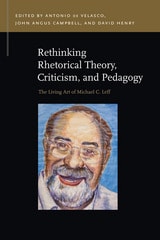
Rethinking Rhetorical Theory, Criticism, and Pedagogy
The Living Art of Michael C. LeffAntonio de Velasco
Michigan State University Press, 2016
Rethinking Rhetorical Theory, Criticism, and Pedagogy: The Living Art of Michael C. Leff offers answers to these questions by introducing the central insights of one of the most innovative and prolific rhetoricians of the twentieth century, Michael C. Leff. This volume charts Leff ’s decades-long development as a scholar, revealing both the variety of topics and the approach that marked his oeuvre, as well as his long-standing critique of the disciplinary assumptions of classical, Hellenistic, renaissance, modern, and postmodern rhetoric.
Rethinking Rhetorical Theory, Criticism, and Pedagogy includes a synoptic introduction to the evolution of Leff ’s thought from his time as a graduate student in the late 1960s to his death in 2010, as well as specific commentary on twenty-four of his most illuminating essays and lectures.
Rethinking Your Writing
Rhetoric for Reflective WritersE. Shelley Reid
University Press of Colorado, 2025
Created from the start as an online book, Rethinking also helps support instructors as they engage students with many kinds of writing tasks, from typical first-year assignments like narratives and research-based arguments to writing that happens in response to more complex rhetorical situations, such as community-based writing, writing in multiple genres, and writing across disciplines:
- The modular, cross-linked design helps faculty assign and students locate information needed for any writing situation.
- In-depth, student-friendly sections guide students’ thinking on vital but less visible elements of writing, such as threshold concepts, rhetorical analysis, reflective practice, peer review, writers’ dispositions, critical reading, research processes, and questions of equity.
- A book-wide focus on how writers choose their approaches based on their goals, resources, and constraints supports learners who are exploring new genres and audiences, and lays the groundwork for discussion of how writers use tools like Generative AI.
- More than 70 innovative writing exercises help writers explore and practice relevant strategies.
In Rethinking Your Writing, E. Shelley Reid provides a versatile guide that can be tailored to the needs of almost any course or classroom. Whether you select a single module to supplement your current resources or use the text throughout your course, this book is designed to help you engage your students and deepen their understanding of how writers learn and succeed in school, their careers, and beyond.
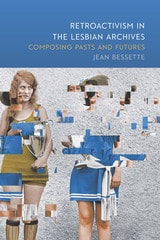
Retroactivism in the Lesbian Archives
Composing Pasts and FuturesJean Bessette
Southern Illinois University Press, 2018
Grassroots historiography has been essential in shaping American sexual identities in the twentieth century. Retroactivism in the Lesbian Archives examines how lesbian collectives have employed “retroactivist” rhetorics to propel change in present identification and politics. By appropriating and composing versions of the past, these collectives question, challenge, deconstruct, and reinvent historical discourse itself to negotiate and contest lesbian identity.
Bessette considers a diverse array of primary sources, including grassroots newsletters, place-based archives, experimental documentary films, and digital video collections, to investigate how retroactivists have revised and replaced dominant accounts of lesbian deviance. Her analysis reveals inventive rhetorical strategies leveraged by these rhetors to belie the alienating, dispersing effects of discourses that painted women with same-sex desire as diseased and criminal. Focusing on the Daughters of Bilitis, the Lesbian Herstory Archives, and the June L. Mazer Archives, and on historiographic filmmakers such as Barbara Hammer and Cheryl Dunye, Bessette argues that these retroactivists composed versions of a queer past that challenged then-present oppressions, joined together provisional communities, and disrupted static definitions and associations of lesbian identity.
Retroactivism in the Lesbian Archives issues a challenge to feminist and queer scholars to acknowledge how historiographic rhetoric functions in defining and contesting identities and the historical forces that shape them.
Revealing Structure
Edited by Eugene Buckley, Thera Crane, and Jeff Good
CSLI, 2018

Reviewing The Academic Library
A Guide To Self-Study And ExEleanor Mitchell
Assoc of College & Research Libraries, 2015
Reviewing the Academic Library
A Guide to Self-Study and External ReviewEleanor Mitchell
Assoc of College & Research Libraries, 2015
Revised Standards and Guidelines of Service for the Library of Congress Network of Libraries for the Blind and Physically Handicapped
American Library Association, 2017
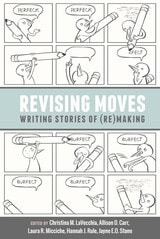
Revising Moves
Writing Stories of (Re)MakingChristina LaVecchia
Utah State University Press, 2024
In these narrative-driven essays written by a wide range of writing professionals, Revising Moves describes revision as a messy, generative, and often collaborative act. These meditations reveal how revision is both a micro practice tracked by textual change and a macro phenomenon rooted in family life, institutional culture, identity commitments, and political and social upheaval. Contributors depict revision as a holistic undertaking and a radically contextualized, distributed practice that showcases its relationality to everything else. Authors share their revision processes when creating scholarly works, institutional and self-promoting documents, and creative projects. Through narrative the volume opens a window to what is often unseen in a finished text: months or years of work, life events that disrupt or alter writing plans, multiple draft changes, questions about writerly identity and positionality, layers of (sometimes contradictory) feedback, and much more.
Revisionary Rhetoric, Feminist Pedagogy, and Multigenre Texts
Julie Jung
Southern Illinois University Press, 2005
In this precise and provocative treatise, Julie Jung augments the understanding and teaching of revision by arguing that the process should entail changing attitudes rather than simply changing texts. Revisionary Rhetoric, Feminist Pedagogy, and Multigenre Texts proposes and demonstrates alternative ways of reading, writing, and teaching that hear silences in such a way as to generate personal, pedagogical, and professional revisions. As both a challenge to prevailing revision pedagogies and an elaboration of contemporary feminist rhetorics, the volume encourages students and instructors to examine their identities as scholars of rhetoric and composition and to question how and why revision is taught.
Jung analyzes feminist texts to identify a revisionary rhetoric that is, at its core, most concerned with creating a space in which to engage productively with issues of difference. This synthesis of feminist theory and revision studies yields a pedagogically useful definition of feminist rhetoric, through which Jung examines the insights afforded by multigenre texts in various related contexts: the academic essay, the discipline of rhetoric and composition studies, feminist composition, and the subfields of English studies including rhetoric and composition, literature, and creative writing. Jung illustrates how multigenre texts demand innovative methods of inquiry because they do not fit the conventions of any single genre. Because genre is inextricably tied to the construction of social identity, she explains, multigenre texts also offer a means for understanding and revising disciplinary identity.
Boldly making a case for the revisionary power of multigenre texts, Jung retheorizes revision as a process of disrupting textual clarity so that differences can be identified, contended with, and perhaps understood. Revisionary Rhetoric, Feminist Pedagogy, and Multigenre Texts makes great strides towards defining feminist rhetoric and ascertaining how revision can be theorized, not just practiced. Jung also provides a multigenre epilogue that explores the usefulness of reconceiving revision as a progression towards wholeness rather than perfection.