Results by title
8113 books match the query 'Literary Criticism' and 415 start with r

Reading Relations
How Authors Enter Our LivesDixon, Dan
University of Iowa Press, 2026
Drawing on the ordinary language philosophy of Toril Moi and Stanley Cavell, Dan Dixon argues that the act of reading shares emotional ground with our social lives. It prompts us to attend to the kinds of affective attachments that frequently resist description, as well as the attachments that encourage debate among scholars of literature.
Dixon posits that the interpretation of a text is significantly shaped by our impression of the writer. Through the lens of persona, this book examines the work of influential and iconic post-1945 American essayists, such as Joan Didion, Maggie Nelson, James Baldwin, Janet Malcolm, Teju Cole, David Foster Wallace, and Ben Lerner. The attachments we form might facilitate insight, consolation, distrust, or vanity. But whatever their effects, they can’t be ignored.
Reading Robert Walser
Criticism, Creativity, CorrespondenceSimon Wortham
University College London, 2025
Robert Walser’s letters to Frieda Mermet, the laundry manager at a Swiss psychiatric hospital, offer an intimate and enigmatic glimpse into the mind of a writer whose literary fortunes waned even as his influence grew in the decades following his death. Covering nearly thirty years, from 1913 to 1942, these letters chart Walser’s transition from a celebrated modernist to a man institutionalized, yet still deeply engaged with language and identity.
In Reading Robert Walser, Simon Wortham studies Walser’s letters within the broader context of modernist literature and deconstruction, and also imaginatively reconstructs Mermet’s possible lost responses, blurring the lines between criticism and creativity. The result is an innovative exploration of authorship and the act of reading itself—one that deepens our understanding of Walser’s life and work while questioning the very nature of literary correspondence.
Reading Sedgwick
Lauren Berlant, editor
Duke University Press, 2019
Contributors. Lauren Berlant, Kathryn Bond Stockton, Judith Butler, Lee Edelman, Jason Edwards, Ramzi Fawaz, Denis Flannery, Jane Gallop, Jonathan Goldberg, Meridith Kruse, Michael Moon, José Esteban Muñoz, Chris Nealon, Andrew Parker, H. A. Sedgwick, Karin Sellberg, Michael D. Snediker, Melissa Solomon, Robyn Wiegman
Reading The Social Body
Catherine B. Burroughs
University of Iowa Press, 1993
The overarching argument of Reading the Social Body is that the body is cultural rather than “natural.” Some of the essays treat the social construction of bodies that have actually existed in human history; others discuss the representation of bodies in artistic contexts; all recognize that everything visible to the human body—from posture and costume to the width of an eyebrow or a smile—is determined by and shaped in response to a particular culture.
Reading The Trail
Exploring The Literature And Natural History Of The California CrestCorey Lee Lewis
University of Nevada Press, 2005
A provocative new way to read and interpret the classic works of John Muir, Mary Austin, and Gary Snyder, and to bring their ideas into the discussion of ecological values and the current environmental crisis. Lewis combines a perceptive discussion of their work and ideas with an engaging account of his own trail experiences as hiker/backpacker and volunteer trail builder, proposing that such a field-based, interdisciplinary approach to literary study and outdoors experience can enrich our appreciation for the work of nature writers.
Reading Together
Katarzyna Bartoszynska
Prickly Paradigm Press, 2025
In this engaging and vivacious memoir, college professor Katarzyna Bartoszyńska thinks back on various book clubs she has been a part of. Through brief discussions of a variety of novels, memoirs, and nonfiction works such as Ottessa Moshfegh’s My Year of Rest and Relaxation, Marjane Satrapi’s Chicken with Plums, and Alma Guillermoprieto’s Dancing in Cuba, she considers how the things she has learned in book club discussions differ from what she tries to teach students in her literature classes. As she muses on the various benefits that we imagine reading offers, she describes the unique knowledge that book clubs can provide.
Reading Together, Reading Apart
Identity, Belonging, and South Asian American CommunityTamara Bhalla
University of Illinois Press, 2016
Tamara Bhalla blends a case study with literary and textual analysis to illuminate this phenomenon. Her fascinating investigation considers institutions from literary reviews to the marketplace to social media and other technologies, as well as traditional forms of literary discussion like book clubs and academic criticism. Throughout, Bhalla questions how her subjects' circumstances, desires, and shared race and class, limit the values they ascribe to reading. She also examines how ideology circulating around a body of literature or a self-selected, imagined community of readers shapes reading itself and influences South Asians' powerful, if contradictory, relationship with ideals of cultural authenticity.
Reading Up
Middle-Class Readers and the Culture of Success in the Early Twentieth-Century United StatesAmy Blair
Temple University Press, 2011
A person who reads a book for self-improvement rather than aesthetic pleasure is “reading up.” Reading Up is Amy Blair's engaging study of popular literary critics who promoted reading generally and specific books as vehicles for acquiring cultural competence and economic mobility. Combining methodologies from the history of the book and the history of reading, to mass-cultural studies, reader-response criticism, reception studies, and formalist literary analysis, Blair shows how such critics influenced the choices of striving readers and popularized some elite writers.
Framed by an analysis of Hamilton Wright Mabie's role promoting the concept of “reading up” during his ten-year stint as the cultivator of literary taste for the highly popular Ladies' Home Journal, Reading Up reveals how readers flocked to literary works that they would be expected to dislike. Blair shows that while readers could be led to certain books by a trusted adviser, they frequently followed their own path in interpreting them in unexpected ways.
Reading Victorian Deafness
Signs and Sounds in Victorian Literature and CultureJennifer Esmail
Ohio University Press, 2013
Winner of the 2013 Sonya Rudikoff Award for best first book in Victorian Studies
Short-listed for the 2013 British Society for Literature and Science Book Prize.
Reading Victorian Deafness is the first book to address the crucial role that deaf people, and their unique language of signs, played in Victorian culture. Drawing on a range of works, from fiction by Charles Dickens and Wilkie Collins, to poetry by deaf poets and life writing by deaf memoirists Harriet Martineau and John Kitto, to scientific treatises by Alexander Graham Bell and Francis Galton, Reading Victorian Deafness argues that deaf people’s language use was a public, influential, and contentious issue in Victorian Britain.
The Victorians understood signed languages in multiple, and often contradictory, ways: they were objects of fascination and revulsion, were of scientific import and literary interest, and were considered both a unique mode of human communication and a vestige of a bestial heritage. Over the course of the nineteenth century, deaf people were increasingly stripped of their linguistic and cultural rights by a widespread pedagogical and cultural movement known as “oralism,” comprising mainly hearing educators, physicians, and parents.
Engaging with a group of human beings who used signs instead of speech challenged the Victorian understanding of humans as “the speaking animal” and the widespread understanding of “language” as a product of the voice. It is here that Reading Victorian Deafness offers substantial contributions to the fields of Victorian studies and disability studies. This book expands current scholarly conversations around orality, textuality, and sound while demonstrating how understandings of disability contributed to Victorian constructions of normalcy. Reading Victorian Deafness argues that deaf people were used as material test subjects for the Victorian process of understanding human language and, by extension, the definition of the human.
Reading With Clarice Lispector
Helene Cixous
University of Minnesota Press, 1990
Reading With Lincoln
Robert Bray
Southern Illinois University Press, 2010
Through extensive reading and reflection, Abraham Lincoln fashioned a mind as powerfully intellectual and superlatively communicative as that of any other American political leader. Reading with Lincoln uncovers the how of Lincoln’s inspiring rise to greatness by connecting the content of his reading to the story of his life.
At the core of Lincoln’s success was his self-education, centered on his love of and appreciation for learning through books. From his early studies of grammar school handbooks and children’s classics to his interest in Shakespeare’s Macbeth and the Bible during his White House years, what Lincoln read helped to define who he was as a person and as a politician. This unique study delves into the books, pamphlets, poetry, plays, and essays that influenced Lincoln’s thoughts and actions.
Exploring in great depth and detail those readings that inspired the sixteenth president, author Robert Bray follows Lincoln’s progress closely, from the young teen composing letters for illiterate friends and neighbors to the politician who keenly employed what he read to advance his agenda. Bray analyzes Lincoln’s radical period in New Salem, during which he came under the influence of Anglo-American and French Enlightenment thinkers such as Thomas Paine, C. F. Volney, and Voltaire, and he investigates Lincoln’s appreciation of nineteenth-century lyric poetry, which he both read and wrote. Bray considers Lincoln’s fascination with science, mathematics, political economics, liberal social philosophy, theology, and the Bible, and devotes special attention to Lincoln’s enjoyment of American humor. While striving to arrive at an understanding of the role each subject played in the development of this remarkable leader, Bray also examines the connections and intertextual relations between what Lincoln read and how he wrote and spoke.
This comprehensive and long-awaited book provides fresh insight into the self-made man from the wilderness of Illinois. Bray offers a new way to approach the mind of the political artist who used his natural talent, honed by years of rhetorical study and practice, to abolish slavery and end the Civil War.
Reading World Literature
Theory, History, PracticeEdited by Sarah Lawall
University of Texas Press, 1994
As teachers and readers expand the canon of world literature to include writers whose voices traditionally have been silenced by the dominant culture, fundamental questions arise. What do we mean by "world"? What constitutes "literature"? Who should decide?
Reading World Literature is a cumulative study of the concept and evolving practices of "world literature." Sarah Lawall opens the book with a substantial introduction to the overall topic. Twelve original essays by distinguished specialists run the gamut from close readings of specific texts to problems of translation theory and reader response. The sequence of essays develops from re-examinations of traditional canonical pieces through explorations of less familiar works to discussions of reading itself as a "literacy" dependent on worldview.
Reading World Literature will open challenging new vistas for a wide audience in the humanities, from traditionalists to avant-garde specialists in literary theory, cultural studies, and area studies.
Reading across Borders
Afghans, Iranians, and Literary NationalismAria Fani
University of Texas Press, 2024
2025 René Wellek Prize, Monograph, American Comparative Literature Association
The dynamic and interconnected ways Afghans and Iranians invented their modern selves through literature.
Contrary to the presumption that literary nationalism in the Global South emerged through contact with Europe alone, Reading across Borders demonstrates how the cultural forms of Iran and Afghanistan as nation-states arose from their shared Persian heritage and cross-cultural exchange in the twentieth century. In this book, Aria Fani charts the individuals, institutions, and conversations that made this exchange possible, detailing the dynamic and interconnected ways Afghans and Iranians invented their modern selves through new ideas about literature.
Fani illustrates how voluntary and state-funded associations of readers helped formulate and propagate "literature" as a recognizable notion, adapting and changing Persian concepts to fit this modern idea. Focusing on early twentieth-century periodicals with readers in Afghan and Iranian cities and their diaspora, Fani exposes how nationalism intensified—rather than severed—cultural contact among two Persian-speaking societies amidst the diverging and competing demands of their respective nation-states. This interconnected history was ultimately forgotten, shaping many of the cultural disputes between Iran and Afghanistan today.
Reading after Actium
Vergil's Georgics, Octavian, and RomeChristopher Nappa
University of Michigan Press, 2005
Reading after Actium is a study of Vergil's Georgics, a didactic poem ostensibly about farming but in fact a brilliant exercise challenging readers to develop a broader perspective on the basic problems and the dangers of human life. Octavian is treated as one of the poet's students and given the opportunity to learn lessons in handling power, in controlling Rome's vast resources, and in preventing the bloody cycle of civil war from beginning again. Most of all the Georgics asks Octavian to consider what is involved in assuming godlike power over his fellow citizens.
Reading after Actium provides an introduction to the history of scholarship surrounding the Georgics and the political questions surrounding Octavian and his career. Nappa gives a book by book analysis of the entire poem, and a conclusion that draws together the themes of the whole. Reading after Actium will appeal to students and critics of Vergil and other Augustan Literature as well as those of didactic poetry and its traditions. Students of Roman history and politics should read this as well.
Christopher Nappa is Assistant Professor of Classics at the University of Minnesota.
Reading and Disorder in Antebellum America
David M. Stewart
The Ohio State University Press, 2011
Reading and Writing Instruction in the Twenty-First Century
Recovering and Transforming the Pedagogy of Robert ScholesEllen C. Carillo
Utah State University Press, 2021
In this volume, Scholes’s scholarship is included alongside original essays, providing a resource for those considering everything from the place of the English major in the twenty-first century to best practices for helping students navigate misinformation and disinformation. Reading and Writing Instruction in the Twenty-First Century not only keeps Scholes’s legacy alive but carries it on through a commitment, in Scholes’s (1998) own words, to “offer our students . . . the cultural equipment they are going to need when they leave us.”
Contributors:
Angela Christie, Paul T. Corrigan, Lynée Lewis Gaillet, Doug Hesse, Alice S. Horning, Emily J. Isaacs, Christopher La Casse, Robert Lestón, Kelsey McNiff, Thomas P. Miller, Jessica Rivera-Mueller, Christian Smith, Kenny Smith
Reading as Collective Action
Text as TacticsNicholas Hengen Fox
University of Iowa Press, 2017
Reading as Collective Action shifts our focus outward, to another of literature’s powers: the power to reshape our world in very public, very active ways. In this book, you will encounter readers who criticized the Bush administration’s war on terror by republishing poems by writers ranging from Shakespeare to Amiri Baraka everywhere from lampposts to the New York Times. You will read about people in Michigan and Tennessee, who leveraged a community reading program on John Steinbeck’s The Grapes of Wrath to organize support for those in need during the Great Recession and to engage with their neighbors about immigration. You will meet a pair of students who took to public transit to talk with strangers about working-class literature and a trio who created a literary website that reclaimed the working-class history of the Pacific Northwest.
This book challenges dominant academic modes of reading. For adherents of the “civic turn,” it suggests how we can create more politically effective forms of service learning and community engagement grounded in a commitment to tactical, grassroots actions. Whether you’re a social worker or a student, a zine-maker, a librarian, a professor, or just a passionate reader with a desire to better your community, this book shows that when we read texts as tactics, “that book changed my life” can become “that book changed our lives.”
Reading as Therapy
What Contemporary Fiction Does for Middle-Class AmericansTimothy Aubry
University of Iowa Press, 2011
@font-face { font-family: "Myriad Pro";}p.MsoNormal, li.MsoNormal, div.MsoNormal { margin: 0in 0in 0.0001pt; font-size: 12pt; font-family: "Times New Roman"; }div.Section1 { page: Section1; }Why do Americans read contemporary fiction? This question seems simple, but is it? Do Americans read for the purpose of aesthetic appreciation? To satisfy their own insatiable intellectual curiosities? While other forms of media have come to monopolize consumers’ leisure time, in the past two decades book clubs have proliferated, Amazon has sponsored thriving online discussions, Oprah Winfrey has inspired millions of viewers to read both contemporary works and classics, and novels have retained their devoted following within middlebrow communities.
In Reading as Therapy, Timothy Aubry argues that contemporary fiction serves primarily as a therapeutic tool for lonely, dissatisfied middle-class American readers, one that validates their own private dysfunctions while supporting elusive communities of strangers unified by shared feelings. Aubry persuasively makes the case that contemporary literature’s persistent appeal depends upon its capacity to perform a therapeutic function.
Reading as Therapy traces the growth and proliferation of psychological concepts focused on the subjective interior within mainstream, middle-class society and the impact this has had on contemporary fiction. The prevailing tendency among academic critics has been to decry the personal emphasis of contemporary fiction as complicit with the rise of a narcissistic culture, the ascendency of liberal individualism, and the breakdown of public life. Reading as Therapy, by contrast, underscores the varied ideological effects that therapeutic culture can foster.
To uncover the many unpredictable ways in which contemporary literature answers the psychological needs of its readers, Aubry considers several different venues of reader-response—including Oprah’s Book Club and Amazon customer reviews—the promotional strategies of publishing houses, and a variety of contemporary texts, ranging from Khaled Hosseini’s The Kite Runner to Anita Shreve’s The Pilot’s Wife to David Foster Wallace’s Infinite Jest. He concludes that, in the face of an atomistic social landscape, contemporary fiction gives readers a therapeutic vocabulary that both reinforces the private sphere and creates surprising forms of sympathy and solidarity among strangers.
Reading at the Limits of Poetic Form
Dematerialization in Adorno, Blanchot, and CelanJacob McGuinn
Northwestern University Press, 2024
How does literary objecthood contend with the challenge of writing objects that emerge at an extreme limit of material presence? Jacob McGuinn delves into the ways literature writes this indeterminate presence in the context of pre- and post-’68 Paris, a vital moment in the history of criticism. The works of poet Paul Celan, philosopher Theodor Adorno, and writer Maurice Blanchot highlight how the complexities of reading such a dematerialized object are part of the indeterminacy of material itself. Indeterminate objects—glass, snow, walls, screens—are subjects Celan describes as existing in “meridian” space, while for Adorno and Blanchot, criticism not only responds to this indeterminacy but also takes it as its condition. Reading at the Limits of Poetic Form: Dematerialization in Adorno, Blanchot, and Celan shows how these readings simultaneously limit the object of criticism and outline alternative ways of thinking that lie between the models of critical formalism and historicism, ultimately revealing the possible materiality of literature in unrealized history, incomplete politics, and nondetermining thinking.

Reading for Form, Volume 61
Susan Wolfson and Marshall Brown
Duke University Press, 0
It includes Heather Dubrow, answering New Historicist accounts of country house ideology, J. Paul Hunter reclaiming attention to eighteenth-century couplet structures, and Garrett Stewart arguing for the comprehensive import of the local syntactic forms in syllepsis in Dickens. Ronald Levao recovers the ethical urgency behind stylistic individuation in Milton; Frances Ferguson reveals the ideology of character within Austen’s free indirect discourse; Franco Moretti traces the history of the clue as formal device in detective fiction; and Robert Kaufman shows how formal dynamics derived from Kant and Adorno animate some of the most disruptive contemporary poetry. The history of formalism is the topic of Catherine Gallagher’s meditation on the dialogue of form and time since Percy Shelley and of Virgil Nemoianu’s account of the political vicissitudes of form in the twentieth century. These wide-ranging critical interventions are introduced by Susan Wolfson’s reflections on form today and by Ellen Rooney’s polemical appeal to cultural theorists not to defeat their purposes by neglecting form.
Contributors. Heather Dubrow, Frances Ferguson, Catherine Gallagher, J. Paul Hunter, Robert Kaufman, Ronald Levao, Franco Moretti, Virgil Nemoianu, Ellen Rooney, Garrett Stewart
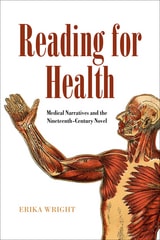
Reading for Health
Medical Narratives and the Nineteenth-Century NovelErika Wright
Ohio University Press, 2016
In Reading for Health: Medical Narratives and the Nineteenth-Century Novel, Erika Wright argues that the emphasis in Victorian Studies on disease as the primary source of narrative conflict that must be resolved has obscured the complex reading practices that emerge around the concept of health. By shifting attention to the ways that prevention of illness and the preservation of well-being operate in fiction, both thematically and structurally, Wright offers a new approach to reading character and voice, order and temporality, setting and metaphor. As Wright reveals, while canonical works by Austen, Brontë, Dickens, Martineau, and Gaskell register the pervasiveness of a conventional “therapeutic” form of action and mode of reading, they demonstrate as well an equally powerful investment in the achievement and maintenance of “health”—what Wright refers to as a “hygienic” narrative—both in personal and domestic conduct and in social interaction of the individual within the community.
Reading for Realism
The History of a U.S. Literary Institution, 1850–1910Nancy Glazener
Duke University Press, 1997
Combining reception theory with a materialist analysis of the social formations in which realist reading practices circulated, Glazener’s study reveals the elitist underpinnings of literary realism. At the book’s center is the Atlantic group of magazines, whose influence was part of the cultural machinery of the Northeastern urban bourgeoisie and crucial to the development of literary realism in America. Glazener shows how the promotion of realism by this group of publications also meant a consolidation of privilege—primarily in terms of class, gender, race, and region—for the audience it served. Thus American realism, so often portrayed as a quintessentially populist form, actually served to enforce existing structures of class and power.
Reading for Reform
The Social Work of Literature in the Progressive EraLaura R. Fisher
University of Minnesota Press, 2019
An unprecedented examination of class-bridging reform and U.S. literary history at the turn of the twentieth century
Reading for Reform rewrites the literary history of late nineteenth and early twentieth century America by putting social reform institutions at the center of literary and cultural analysis. Examining the vibrant, often fractious literary cultures that developed as part of the Progressive mandate to uplift the socially disadvantaged, it shows that in these years reformers saw literature as a way to combat the myriad social problems that plagued modern U.S. society. As they developed distinctly literary methods for Americanizing immigrants, uplifting and refining wage-earning women, and educating black students, their institutions gave rise to a new social purpose for literature.
Class-bridging reform institutions—the urban settlement house, working girls’ club, and African American college—are rarely addressed in literary history. Yet, Laura R. Fisher argues, they engendered important experiments in the form and social utility of American literature, from minor texts of Yiddish drama and little-known periodical and reform writers to the fiction of Edith Wharton and Nella Larsen. Fisher delves into reform’s vast and largely unexplored institutional archives to show how dynamic sites of modern literary culture developed at the margins of social power.
Fisher reveals how reformist approaches to race, class, religion, and gender formation shaped American literature between the 1880s and the 1920s. In doing so, she tells a new story about the fate of literary practice, and the idea of literature’s practical value, during the very years that modernist authors were proclaiming art’s autonomy from concepts of social utility.
Reading for the Planet
Toward a GeomethodologyChristian Moraru
University of Michigan Press, 2015
Reading in Time
Emily Dickinson in the Nineteenth CenturyCristanne Miller
University of Massachusetts Press, 2012
Before 1865, Dickinson at least ambivalently considered publication, circulated relatively few poems, and saved almost everything she wrote in organized booklets. After this date, she wrote far fewer poems, circulated many poems without retaining them, and took less interest in formally preserving her work. Yet, Miller argues, even when circulating relatively few poems, Dickinson was vitally engaged with the literary and political culture of her day and, in effect, wrote to her contemporaries. Unlike previous accounts placing Dickinson in her era, Reading in Time demonstrates the extent to which formal properties of her poems borrow from the short-lined verse she read in schoolbooks, periodicals, and single-authored volumes. Miller presents Dickinson's writing in relation to contemporary experiments with the lyric, the ballad, and free verse, explores her responses to American Orientalism, presents the dramatic lyric as one of her preferred modes for responding to the Civil War, and gives us new ways to understand the patterns of her composition and practice of poetry.
Reading in the Postgenomic Age
Race, Discipline, and Bionarrativity in Contemporary North American LiteratureLesley Larkin
The Ohio State University Press, 2025
Reading on the Middle Border
The Culture of Print in Late-Nineteenth-Century Osage, IowaChristine Pawley
University of Massachusetts Press, 2009
Christine Pawley investigates the use of print by "ordinary" Americans in the small, rural community of Osage, Iowa—the town that shaped Hamlin Garland—analyzing primary source material on education, religious life, a reading club, and business affairs. A major section of her study focuses on the public library, an institution that provides a valuable window into the reading practices of men and women of various ages, classes, ethnicities, and religions. An extensive database of library circulation and accessions information, combined with federal and state census data, sheds light on the elusive issue of "Who read what?"
Pawley explores the ways print confirmed or challenged people's economic, social, and religious world, and asks what values print expressed or confronted. She also raises questions relating to modes and contexts of reading, distinguishing between groups and individuals. The picture of print in Osage is complex and defies reduction, but by placing print in a community context and viewing printed materials as an expression of activities, not mere artifacts, Pawley enhances our understanding of the role of reading in American culture.
Reading the Difficulties
Dialogues with Contemporary American Innovative PoetryThomas Fink
University of Alabama Press, 2013
New Strategies for Reading the Most Innovative Poetry of Our Time.
Definitions of what constitutes innovative poetry are innumerable and are offered from every quarter. Some critics and poets argue that innovative poetry concerns free association (John Ashbery), others that experimental poetry is a “re-staging” of language (Bruce Andrews) or a syntactic and cognitive break with the past (Ron Silliman and Lyn Hejinian). The tenets of new poetry abound.
But what of the new reading that such poetry demands? Essays in Reading the Difficulties ask what kinds of stances allow readers to interact with verse that deliberately removes many of the comfortable cues to comprehension—poetry that is frequently nonnarrative, nonrepresentational, and indeterminate in subject, theme, or message.
Some essays in Thomas Fink and Judith Halden-Sullivan’s collection address issues of reader reception and the way specific stances toward reading support or complement the aesthetic of each poet. Others suggest how we can be open readers, how innovative poetic texts change the very nature of reader and reading, and how critical language can capture this metamorphosis. Some contributors consider how the reader changes innovative poetry, what language reveals about this interaction, which new reading strategies unfold for the audiences of innovative verse, and what questions readers should ask of innovative verse and of events and experiences that we might bring to reading it.
Reading the East India Company 1720-1840
Colonial Currencies of GenderBetty Joseph
University of Chicago Press, 2003
Drawing on the British East India Company's records as well as novels, memoirs, portraiture and guidebooks, Joseph shows how the company's economic and archival practices intersected to produce colonial "fictions" or "truth-effects" that strictly governed class and gender roles—in effect creating a "grammar of power" that kept the far-flung empire intact. And while women were often excluded from this archive, Joseph finds that we can still hear their voices at certain key historical junctures. Attending to these voices, Joseph illustrates how the writing of history belongs not only to the colonial project set forth by British men, but also to the agendas and mechanisms of agency—of colonized Indian, as well as European women. In the process, she makes a valuable and lasting contribution to gender studies, postcolonial theory, and the history of South Asia.
Reading the Fascicles of Emily Dickinson
Dwelling in PossibilitiesEleanor Elson Heginbotham
The Ohio State University Press, 2020
We cannot know why Dickinson compiled the books or what she thought of them, but we can observe what she left in them. What she left is visible only by noting the way the poem answers in a dialogue across the pages, the way lines spilling onto a second page introduce the next poem, the way openings suggest image clusters so that each book has its own network of concerns and language—not a story or philosophical preachment but an aesthetic wholeness.
This book is the first to demonstrate that Dickinson’s poetic and philosophical creativity is most startling when the reader observes the individual lyric in the poet’s own, and only, context for them. For teacher, student, scholar, and poetry lover, Heginbotham creates an important new framework for understanding one of the most complex, clever, and profound U.S. poets.
Reading the Illegible
Rainer Rumold
Northwestern University Press, 2003
In his scrutiny of selected works, and with reference to a rich variety of textual materials--from popular and scientific texts to visual art, political and cultural theories, and experimental films--Dworkin proposes a new way of apprehending the radical formalism of so-called unreadable texts. Dworkin unveils what he describes as "the politics of the poem"--what is signified by its form, enacted by its structures, and implicit in the philosophy of language; how it positions its reader; and other questions relating to the poem as material object. In doing so, he exposes the mechanics and function of truly radical formalism as a practice that move beyond aesthetic considerations into the realms of politics and ideology. Reading the Illegible asks us to reconsider poetry as a physical act, and helps us to see how the range of a text's linguistic and political maneuvers depends to a great extent on the material conditions of reading and writing as well as the mechanics of reproduction.
Reading the Literatures of Asian America
Shirley Geok-lin Lim
Temple University Press, 1992
Reading the Middle Generation Anew
Culture, Community, and Form in Twentieth-Century American PoetryEric Haralson
University of Iowa Press, 2006
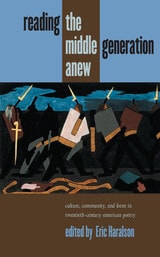
In addition to having worked during the broad middle of the last century, these poets constitute the center of twentieth-century American poetry in the larger sense, refuting invidious connotations of “middle” as coming after the great moderns and being superseded by a proliferating postmodern experimentation. This middle generation mediates the so-called American century and its prodigious body of poetry, even as it complicates historical and aesthetic categorizations.
Taking diverse formal and thematic angles on these poets—deconstructionist, biographical-historical, and more formalist accounts—this book re-examines their between-ness and ambivalence: their various positionings and repositionings in aesthetic, political, and personal matters. The essays study the interplay between these writers and such shifting formations as religious discourse, consumerism, militarism and war, the ideology of America as “nature’s nation,” and U.S. race relations and ethnic conflicts. Reading the Middle Generation Anew also shows the legacy of the middle generation, the ways in which their lives and writings continue to be a shaping force in American poetry. This fresh and invigorating collection will be of great interest to literary scholars and poets.
Reading the Renaissance
Black Women's Literary Reception and Taste in Chicago, 1932-1953Mary I. Unger
University of Massachusetts Press, 2025
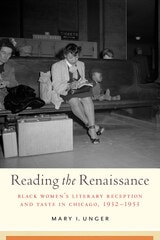
From 1932 to 1953, during the Black Chicago Renaissance, numerous literary events were held within and for the city’s Black community. In book clubs, public forums, print reviews, little magazines, local programming, and other public venues, Black women in particular debated the role of literature in racial uplift efforts, set literary standards, and acted as community gatekeepers for cultural production during a time known as the Black Chicago Renaissance. Through these inspiring efforts, a mix of publishers, well-known authors, and everyday readers significantly fostered a robust literary culture in the Windy City.
Reading the Renaissance constructs a reception history of the Black women who read and reviewed, published and promoted, and collected and curated literature of the era. Mary Unger interprets how local figures such as Vivian G. Harsh, Ora Morrow, Gwendolyn Brooks, Alice Browning, Fern Gayden, and Margaret Walker cultivated particular literary tastes through collective acts of reading and reception. She does so by recovering a network of readers, book clubs, literary magazines, civic programs, and book businesses that Black women created, led, and transformed during the early 1930s through the early 1950s in Bronzeville, Chicago’s predominantly Black South Side neighborhood.
This illuminating work includes close readings of texts alongside letters, scrapbooks, meeting minutes, reviews, and other ephemera of local reading practices to show how Black women facilitated diverse strategies of reading while instructing community members how to engage a variety of print cultures at the time. Unger demonstrates how Black women readers influenced individual authors as well as the norms and expectations of African American literature more broadly, becoming important (yet too often overlooked) players in American literary history.

Reading the Room
A Bookseller's TalePaul Yamazaki
Prickly Paradigm Press, 2024
Over twenty-four hours, Paul Yamazaki leads us through the stacks of storied City Lights Booksellers in San Francisco; the care and prowess of his approach to book buying; his upbringing in a Japanese American family in Southern California and moving to San Francisco at the height of revolutionary foment; working with legendary figures in the book publishing industry like Lawrence Ferlinghetti, Sonny Mehta, and others; and his vision for the future of bookselling. Navigating building trust with readers and nurturing relationships across the literary industry, Yamazaki testifies to the value of generosity, sharing knowledge, and dialogue in a life devoted to books.
Reading the Underthought
Jewish Hermeneutics and the Christian Poetry of Hopkins and EliotKinereth Meyer
Catholic University of America Press, 2010
Reading the Wind
The Literature of the Vietnam WarTimothy J. Lomperis
Duke University Press, 1987
Reading the World
Encyclopedic Writing in the Scholastic AgeMary Franklin-Brown
University of Chicago Press, 2012
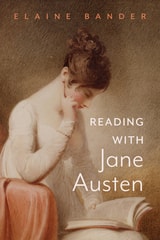
Reading with Jane Austen
Elaine Bander
Bucknell University Press, 2026
Jane Austen has more readers today than at any time in history. Many of Austen’s legions of fans, however, came to her novels after first seeing films or other adaptations made for twenty-first-century audiences. Austen herself conversely spent her literary career undermining romantic clichés and rethinking novel conventions. Confident that she and her contemporaries shared a common reading culture, Austen deliberately constructed her novels to set readerly expectations, only to disrupt or confound those expectations by challenging her readers’ assumptions and values. In Reading with Jane Austen, Elaine Bander carefully rereads the great author’s novels—beginning with her late work of juvenilia, “Catharine, or The Bower,” and ending with her final fragment, “Sanditon”—against the rich context of late Georgian literary and intellectual culture. In doing so, Bander invites us into the transformative experience that Austen intentionally designed for her earliest readers, adding new layers of appreciation for those who love her work.
Published by Bucknell University Press. Distributed worldwide by Rutgers University Press.
Elaine Bander speaking at the Atwater Library in Quebec (https://youtu.be/UeEjFOfp9cQ?si=Wv2hsLxkGK157WZI)
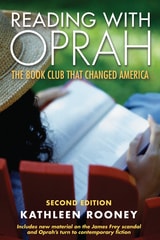
Reading with Oprah
The Book Club that Changed AmericaKathleen Rooney
University of Arkansas Press, 2008
Adored by its fans, deplored by its critics, Oprah’s Book Club has been at the center of arguments about cultural authority and literary taste since it began in 1996. Reading with Oprah explores the club’s revolutionary fusion of books, television, and commerce and tells the engaging and in-depth story of the OBC phenomenon.
Kathleen Rooney combines extensive research with a dynamic voice to reveal the club’s far-reaching cultural impact and its role as crucible for the clash between “high” and “low” literary taste. Comprehensive and up-to-date, the book covers the club from its inception in 1996, through the Jonathan Franzen contretemps, the surprising suspension in 2002, and, after the club’s return in 2003, the progression from “great books” to memoir. New material includes an extensive look at the James Frey scandal and Oprah’s turn to contemporary fiction, including The Road and Middlesex.
Through close examination of Winfrey’s picks and personal interviews with book club authors and readers, Rooney demonstrates how the club that Barbara Kingsolver calls “one of the best possible uses of a television set” has, according to Wally Lamb, “gotten people of all ages to read, to read more, and to read widely.”
First edition published in 2005.
Reading with the Transcendentalists
Ten Works that Made a MovementPhilip F. Gura
University of Massachusetts Press, 2026
Exploring the books and reading practices behind the creation of Transcendentalist philosophy and community
Transcendentalism emerged in early 19th century New England as a uniquely American philosophical, spiritual, and literary movement. Its first generation of thinkers—including Ralph Waldo Emerson, Theodore Parker, and Margaret Fuller—created a worldview that stressed the inherent goodness of the “self-reliant” individual and the presence of the divine in nature. These intellectuals gathered in informal symposia devoted to what Emerson called “creative reading,” a practice that stresses the transformative potential of the written word that was central to the movement’s emergence, growth, and spread. But what were these thinkers reading and how did it influence the development of Transcendentalism?
In Reading with the Transcendentalists, renowned literary scholar Philip F. Gura focuses on 10 American, British, and European books that were essential to the movement’s thoughts, writings, and activities. Many of the authors of these books—James Marsh, Madame de Staël, Samson Reed, George Ripley, Thomas Carlyle, Albert Brisbane, and George Sand—stood outside of Transcendentalism yet profoundly influenced it. Others such as Emerson, Parker, and Fuller were the movement’s central architects, whose writings in turn inspired the next generation, including Henry David Thoreau and Caroline Healey Dall. Each of these books challenged prevailing religious, philosophical, and social conventions in ways that resonated deeply with burgeoning Transcendentalist ideals.
Blending intellectual biography with book history, Gura crafts a captivating cultural history that reconstructs the dynamic social networks of the early Transcendentalists, in which ideas from the written word circulated, evolved, and acquired new meanings. The result is an rich portrait of reading as a creative and communal act, and an exploration of how books ignite curiosity, sustain friendship, and catalyze intellectual transformation. Through a carefully developed narrative structure that is filled not only with books and reading but with headline-worthy scandals, disputes, and falling outs and realignments, Gura traces the historical arc of a transnational intellectual movement that helped lay the foundation for the idea of “America.”

Reading, Gender and Identity in Seventeenth-Century England
Hannah Jeans
University of London Press, 2025
This ambitious and interdisciplinary book redraws the history of early modern Englishwomen’s reading, exploring the connections between gender, reading habits, and genre throughout the seventeenth century. Reading, Gender and Identity in Seventeenth-Century England challenges accepted historiographical narratives about reading that have privileged male experience and the impact of the Civil War; the book highlights the multiplicity and complexity of women’s reading practices, focusing on how women used reading in constructing their gender identity. Reading was a gendered act in the early modern period; across genres, women were depicted negotiating a range of gendered behavioral norms. From religious texts, romances, and cookbooks, to news, household records, and scientific and medical treatises, Jeans draws on archival sources across a wide range of writing types to offer a more complete picture of women’s reading experiences, ultimately questioning the accepted notion of the woman reader itself.
Readings
Gayatri Chakravorty Spivak
Seagull Books, 2014
In Readings, Spivak elaborates a utopian vision for the kind of deep and investigative reading that can develop a will for peaceful social justice in coming generations. Through her own analysis of specific works, Spivak demonstrates modes in which such a vision might be achieved. In the examples here, she pays close attention to signposts of character, action, and place in J. M. Coetzee’s Summertime and Elizabeth Gaskell’s North and South. She also offers rereads of two of her own essays, addressing changes in her own thinking and practice over the course of her career. Now in her fifth decade of teaching, Spivak passes on her lessons through anecdote, interpretation, warning, and instruction to students and teachers of literature. She writes, “I urge students of English to understand that utopia does not happen, and yet to understand, also, their importance to the nation and the world. Indeed, I know how hard it is to sustain such a spirit in the midst of a hostile polity, but I urge the students to consider the challenge.”

Readings at the Edge of Literature
Myra Jehlen
University of Chicago Press, 2002
Throughout these essays Jehlen demonstrates the crucial role that the process of writing itself plays in unfolding these paradoxes, whether in the form of novels by Harriet Beecher Stowe and Virginia Woolf; the histories of Captain John Smith; or even a work of architecture, such as the Guggenheim museum in Bilbao.

Readings in Interpretation
Holderlin, Hegel, HeideggerAndrzej WarminskiIntroduction by Rodolphe Gasche
University of Minnesota Press, 1987
Readings in Interpretation was first published in 1987. Minnesota Archive Editions uses digital technology to make long-unavailable books once again accessible, and are published unaltered from the original University of Minnesota Press editions.
Readings in Interpretation — a volume primarily on the texts of Holderlin, Hegel, and their interpreter Heidegger—locates itself strategically between literature and philosophy. In keeping with this juxtaposition, it treats the question of self-consciousness and reflection on the levels of "theme" and "text." For both Hegel and Holderlin, selfconsciousness and its relation to knowing are explicit themes, but Waminski's readings show that a more disruptive reflection is operative on the level of text.
In an argument that centers on the textual aspects of Hegel's Phenomenology of the Spirit,Warminski demonstrates that the negative moment—which is often interpreted as a prelude to a unified self-consciousness—cannot be accounted for by interpretive models drawn from outside the text—by concepts like the self, consciousness, or the subject. Instead, a completely different practice and theory is necessary. The author's "Prefatory Postscript" at the beginning of the book therefore serves as an introduction to sketch the theoretical basis of the readings that follow and as a "postscript" that explains the difference between "reading" and "interpretation" which those readings make necessary.
Readings
The Poetics of Blanchot, Joyce, Kakfa, Kleist, Lispector, and TsvetayevaHelene Cixous
University of Minnesota Press, 1991
Readings: The Poetics of Blanchot, Joyce, Kafka, Kleist, Lispector, and Tsvetayeva offers striking and novel textual studies of major literary figures and emergent authors. Selected from Cixous’s seminars taught between 1980 and 1986 at the Universite de Paris VII (Saint-Denis) and at the College International de Philosophie, the texts chronicle the French intellectual scene with its shifting tastes over the decade following May 1986.
In their simple and accessible language, the texts can be read as inspiration for Cixous’s fictional and critical practices. They not only introduce readers to emergent texts from Brazil and Russia, such as Clarice Lispector’s “Foreign Legion” and Marina Tsvetayeva’s “Mother and Music,” but also give new, incisive insights into Joyce’s Portrait of the Artist and Kafka’s “Before the Law.” Drawing from philosophy and psychoanalysis, Readings: The Poetics of Blanchot, Joyce, Kafka, Kleist, Lispector, and Tsvetayeva can be read side-by-side with Reading with Clarice Lispector, as an ongoing meditation on ethics and poetics.Also from MinnesotaReading with Clarice LispectorHelene CixousEdited, translated, and introduced by Verena Andermatt ConleyFor Cixous, Lispector’s work represents one of the finest examples of ecriture feminine in that she practices, in writing, what Cixous is searching for in her theoretical practice: the giving, spending, and inscribing of pleasure; an apprenticeship in the lessons of life.Theory and History of Literature, volume 73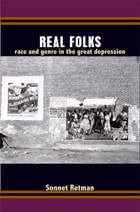
Real Folks
Race and Genre in the Great DepressionSonnet H. Retman
Duke University Press, 2011
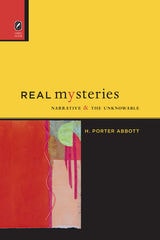
Real Mysteries
Narrative and the UnknowableH. Porter Abbott
The Ohio State University Press, 2013
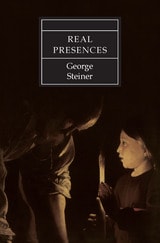
Real Presences
George Steiner
University of Chicago Press, 1989
In Real Presences, George Steiner, whom A. S. Byatt praised as "a late, late, late, late Renaissance man," addressed one of the most challenging and important questions about art and human understanding: Can there be major dimensions of a poem, a painting, a musical composition created in the absence of God? Or is God always a real presence in the arts? Drawing examples from across centuries and cultures, Steiner passionately argues that a transcendent reality grounds all genuine art and human communication.
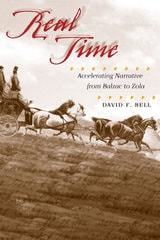
Real Time
Accelerating Narrative from Balzac to ZolaDavid F. Bell
University of Illinois Press, 2003
Nineteenth-century technological advances radically altered the infrastructure of France, changing the ways ordinary citizens–-and literary characters--viewed time, space, distance, and speed. The most influential of these advances included the improvement of the stagecoach, the growth of road and canal networks leading to the advent of the railway, and the increasing use of mail, and of the optical telegraph. Citing examples from a wide range of novels and stories, Bell demonstrates the numerous ways in which these trends of acceleration became not just literary devices and themes but also structuring principles of the novels themselves.
Beginning with both the provincial and the Parisian communications networks of Balzac, Bell proceeds to discuss the roles of horses and optical telegraphs in Stendhal and the importance of domination of communication channels to the characters of Dumas, whose Count of Monte-Cristo might be seen as the ultimate fictional master of this accelerated culture. Finally, Bell analyzes the cinematic vision created by the arrival of the railroad, as depicted by Zola in La Bète Humaine.