Results by title
4743 books match the query 'Religion' and 288 start with r
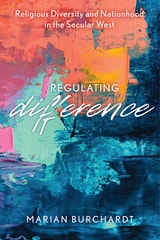
Regulating Difference
Religious Diversity and Nationhood in the Secular WestMarian Burchardt
Rutgers University Press, 2020
Transnational migration has contributed to the rise of religious diversity and has led to profound changes in the religious make-up of society across the Western world. As a result, societies and nation-states have faced the challenge of crafting ways to bring new religious communities into existing institutions and the legal frameworks. Regulating Difference explores how the state regulates religious diversity and examines the processes whereby religious diversity and expression becomes part of administrative landscapes of nation-states and people’s everyday lives. Arguing that concepts of nationhood are key to understanding the governance of religious diversity, Regulating Difference employs a transatlantic comparison of the Spanish region of Catalonia and the Canadian province of Quebec to show how processes of nation-building, religious heritage-making and the mobilization of divergent interpretations of secularism are co-implicated in shaping religious diversity. It argues that religious diversity has become central for governing national and urban spaces.
This book is also freely available online as an open access digital edition.
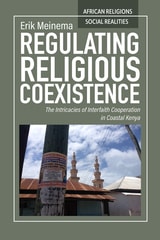
Regulating Religious Coexistence
The Intricacies of Interfaith Cooperation in Coastal KenyaErik Meinema
Ohio University Press, 0
Regulating Religious Coexistence offers a compelling ethnographic analysis of how Muslims, Christians, and practitioners of indigenous African religions negotiate coexistence in Kenya’s coastal region. The book conceptualizes religious diversity as a dynamic field shaped by multiple partly intersecting and partly conflicting models of interaction. These include the political secularism promoted by the Kenyan state and civil society organizations focused on interfaith harmony, forms of competition between religious groups, and pluralistic practices in which individuals draw on multiple traditions to meet spiritual needs.
Through a close examination of civil society initiatives funded by Western donors to foster peacebuilding and to counter violent extremism, the book investigates how these models for coexistence are negotiated and contested and how they intersect with historical and contemporary patterns. It demonstrates that modes of religious coexistence in coastal Kenya have been shaped by colonial and postcolonial governance, transregional connections, and interactions between Christians, Muslims, and Traditionalists across time.
As one of the few monographs on political secularism in an African context, Regulating Religious Coexistence makes a significant contribution to scholarship on religious diversity and coexistence. It situates Christianity, Islam, and indigenous African traditions within a single conceptual framework, broadening earlier studies that mostly treated them in isolation. This book is essential reading for scholars of religion, anthropology, African studies, and political theory, offering fresh insights into the complex realities of religious diversity in Africa and beyond.
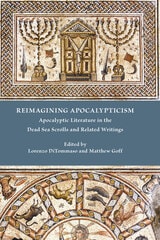
Reimagining Apocalypticism
Apocalyptic Literature in the Dead Sea Scrolls and Related WritingsLorenzo DiTommaso
SBL Press, 2023
Reimagining Indian Secularism
Rajeev Bhargava
Seagull Books, 2023
What is unique about Indian secularism? In this book, Rajeev Bhargava argues that secularism in India, as opposed to in the West, did not arise in a society that had already been religiously homogenized, where the need of the hour was to break the political nexus between church and state. In India, secularism does not demand that the state is against or indifferent to religion, but rather that it combat institutionalized religious domination, both between and within religions. Apathy or antipathy to religion, Bhargava points out, would foment inter-religious rivalries that intensify anti-reformist tendencies, fueling further division.
As secularism receives daily ridicule in India, Bhargava provides an account of how this “principled distance” from religion has been a victim of misunderstandings by its proponents, abuse by its practitioners, and deliberate distortion by its opponents. Reimagining Indian Secularism offers a proposal of how we might one day be able to rehabilitate secularism.

Reincarnation in Philo of Alexandria
Sami Yli-Karjanmaa
SBL Press, 2015
The best current research on Philo's allegorical exegesis of Scripture
The strong element of Greek philosophy in Philo's thought has been recognized since antiquity, but his relation to the Pythagorean-Platonic tenet of reincarnation has been a neglected, even avoided, topic in research. This book confirms the view common in the seventeenth to nineteenth centuries that Philo accepted the doctrine of reincarnation even though he preferred not to speak openly about it. The book shows how allegorization enabled Philo to give a reincarnational interpretation to very different scriptural passages.
Features:
- Highlights the importance of reading Philonic parallel passages together for fuller understanding of Philo s message
- Discusses the difference between protological and universal allegory in Philo's exegesis of the first chapters of Genesis
- Introduces new concepts to Philonic research such as the corporealization of the mind (the result of transgression and a driving force for reincarnation) and monadization (the human soul's transformation into pure mind upon salvation)

Reject Aeneas, Accept Pius
Selected Letters of Aeneas Sylvius Piccolomini (Pope Pius II)Thomas M. Pius II
Catholic University of America Press, 2006
Relating Religion
Essays in the Study of ReligionJonathan Z. Smith
University of Chicago Press, 2004
Smith first explains how he was drawn to the study of religion, outlines his own theoretical commitments, and draws the connections between his thinking and his concerns for general education. He then engages several figures and traditions that serve to define his interests within the larger setting of the discipline. The essays that follow consider the role of taxonomy and classification in the study of religion, the construction of difference, and the procedures of generalization and redescription that Smith takes to be key to the comparative enterprise. The final essays deploy features of Smith's most recent work, especially the notion of translation.
Heady, original, and provocative, Relating Religion is certain to be hailed as a landmark in the academic study and critical theory of religion.
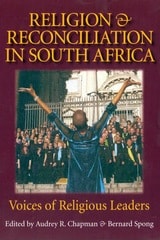
Religion & Reconciliation in South Africa
Voices of Religious LeadersBernard Spong
Templeton Press, 2003
Postapartheid South Africa's efforts to come to terms with its past, particularly its Truth and Reconciliation Commission's emphasis on forgiveness and reconciliation, is of special interest to many in the world community. The Truth and Reconciliation Commission (TRC), led by Archbishop Desmond Tutu, was mandated to go beyond truth-finding and to "promote national unity and reconciliation in a spirit of understanding which transcends the conflict and divisions of the past." In contrast with other truth commissions, the TRC was led by clerics rather than lawyers and judge, and the TRC's approach to reconciliation was shaped by and imbued with religious content. The TRC submitted its final report to the Mandela administration in October 1998.
Over the next two years, the Rev. Bernard Spong, former communications director of the South African Council of Churches, conducted a series of in-depth interviews about the TRC with thirty-three key religious figures. In this volume, they discuss and evaluate the following issues:
•How should we understand the concept of national or political reconciliation and its requirements?•What are the differences and similarities between religious and political approaches to reconciliation?
•Does national or political reconciliation require forgiveness between former victims and perpetrators?
•What is the appropriate role of religious representatives in a truth commission process? And is it recommended that other countries emulate the South African model?
•How do religious leaders assess the contributions and limitations of the TRC?
•What kind of initiatives are contemporary religious communities taking to promote reconciliation among their members and in the wider society?
The conversations presented in this volume, and the essays interpreting them, seek to illuminate issues and questions raised by the TRC model, including how to conceptualize reconciliation and the differences between political and religious approaches.
Religion After the Gods
Edwin H. Wilson and the American Humanist AssociationJohn S. Haller Jr.
University of Illinois Press, 2026
Sometimes called America’s fourth religion, religious humanism emerged in the Midwest as a product of Enlightenment rationality, the Social Gospel, and the philosophy of pragmatism. John S. Haller Jr. examines religious humanism’s first fifty years alongside Edwin H. Wilson’s pivotal role in the American Humanist Association (AHA).
Started by a group of Unitarian faculty and students, religious humanism applied the rituals of the theocentric universe of Judeo-Christianity to the non-theistic, anthropocentric universe of agnostics, altruists, humanitarians, and meliorists. Their beliefs found expression in the AHA, founded in 1941 with Wilson as the secretary and editor of its magazine. Wilson’s actions in these and other roles weighed heavily on the organization’s reputation, influence, successes, and failures. At the same time, his multifaceted work reflected the relationship between power and the possibilities inherent in the pluralistic and democratic heritage he pursued.
Rigorous and astute, Religion After the Gods reveals how the tensions between individual aspirations and bureaucratic constraints culminated in hopeful humanist practices.
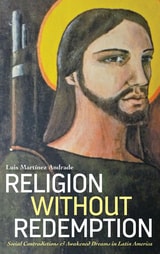
Religion Without Redemption
Social Contradictions and Awakened Dreams in Latin AmericaLuis Martinez Andrade
Pluto Press, 2015
Martínez Andrade focuses on the central role of religion in the region and how it influences people’s interaction with changes in modern economics. Capitalism in Latin America, Martínez Andrade argues, has taken on religious characteristics, with places of worship—shopping malls and department stores—as well as its own prophets. This form of cultural religion is often contradictory in surprising ways: not only does it legitimate oppression, it can also be a powerful source of rebellion, unveiling a subversive side to the status quo. Religion Without Redemption advances the ideas of liberation theory, and challenges the provincialism to which many Latin American thinkers are usually consigned.
Religion and Adaptation
William Adams
CSLI, 2004
The volume uses a wide variety of ethnographic and historical sources to support its analysis, beginning with two detailed case studies of the religions practiced by Navajo Indians and Arab villagers. An intriguing comparison of these two systems of faith reveals the difficulty of finding one definition of religion. William Adams explores this problem of definition, suggesting that religion and science actually share the role of providing logical explanations in human society. In subsequent chapters, he considers the development of religious systems, the growth of religious consciousness in the individual, and the dynamics of religious change. The book ultimately aims to be a purely empirical study that probes the reasons for the existence of religion and its role as a moral and stabilizing force in human societies.
Religion and Culture
Christopher Dawson
Catholic University of America Press, 2013
Religion and Economic Justice
edited by Michael Zweig
Temple University Press, 1992
As Eastern European economies move to capitalism, many people there hope for a better life. But capitalism is no guarantee of prosperity. Economic deprivation, war, social marginalization, and powerlessness mark the lives of millions and spark social movements for economic justice aimed at correcting these conditions. Often these movements are based in religious communities, their activists motivated by religious commitment to human dignity and the need for personal empowerment. Although the new theology contains an economic critique, little dialogue has taken place between the religious and economic communities on matters of economic analysis. Religion and Economic Justice seeks to develop this exchange.
This book contains original essays by distinguished contributors from economics, religious ethics, and biblical studies. The authors provide a powerful critique of the individualism which underlies mainstream economic analysis and which fragments our communities, a critique that extends to the values implicit in the market system. The authors also show how social marginalization and economic deprivation are the consequences of economic organization, not simply the failings of individuals.
Religion and Its Other
Secular and Sacral Concepts and Practices in InteractionEdited by Heike Bock, Jörg Feuchter, and Michi Knecht
Campus Verlag, 2008
Religion and Jewish Identity in the Soviet Union, 1941–1964
Mordechai Altshuler
Brandeis University Press, 2012

Religion and Nationalism in Soviet and East European Politics
Pedro Ramet, ed.
Duke University Press, 1988
Religion and Peace
Global Perspectives and PossibilitiesNukhet A. Sandal
Ohio University Press, 2022
Religion and Political Tolerance in America
Advances in the State of the ArtPaul Djupe
Temple University Press, 2015
The essays in Religion and Political Tolerance in America seek to understand how these elements interrelate. The editor and contributors to this important volume present new and innovative research that wrestles with the fundamental question of the place of religion in democratic society. They address topics ranging from religious contributions to social identity to the political tolerance that religious elites (clergy) hold and advocate to others, and how religion shapes responses to intolerance.
The conclusion, by Ted Jelen, emphasizes that religion’s take on political tolerance is nuanced and that they are not incompatible; religion can sometimes enhance the tolerance of ordinary citizens.

Religion and Politics in East Africa
The Period since IndependenceHölger Bernt Hansen
Ohio University Press, 1994
Religious activities have been of continuing importance in the rise of protest against postcolonial governments in Eastern Africa. Governments have attempted to “manage“ religious affairs in both Muslim and Christian areas. Religious denominations have acted as advocates of human rights and in opposition to one-party-state regimes. Islamic fundamentalism changed with the ending of the Cold War.
The book is divided into four parts: The Challenge of Islam; Christianity, Sectarianism, and Politics in Uganda; Christians and Muslim in Kenyan Politics; and Cross-cultural Complications. An introductory essay by Michael Twaddle provides and overview of the changing character of politico-religious conflict in Eastern Africa. Holger Bernt Hansen summarizes the presentation with a discussion of dilemmas and challenges in the study of religion and politics.
Religion and Poverty
Pan-African PerspectivesPeter J. Paris, ed.
Duke University Press, 2009
Contributors from Africa and North America explore poverty’s roots and effects, the ways that experiences and understandings of deprivation are shaped by religion, and the capacity and limitations of religion as a means of alleviating poverty. As part of a collaborative project, the contributors visited Ghana, Kenya, and South Africa, as well as Jamaica and the United States. In each location, they met with clergy, scholars, government representatives, and NGO workers, and they examined how religious groups and community organizations address poverty. Their essays complement one another. Some focus on poverty, some on religion, others on their intersection, and still others on social change. A Jamaican scholar of gender studies decries the feminization of poverty, while a Nigerian ethicist and lawyer argues that the protection of human rights must factor into efforts to overcome poverty. A church historian from Togo examines the idea of poverty as a moral virtue and its repercussions in Africa, and a Tanzanian theologian and priest analyzes ujamaa, an African philosophy of community and social change. Taken together, the volume’s essays create a discourse of mutual understanding across linguistic, religious, ethnic, and national boundaries.
Contributors. Elizabeth Amoah, Kossi A. Ayedze, Barbara Bailey, Katie G. Cannon, Noel Erskine, Dwight N. Hopkins, Simeon O. Ilesanmi, Laurenti Magesa, Madipoane Masenya, Takatso A. Mofokeng, Esther M. Mombo, Nyambura J. Njoroge, Jacob Olupona, Peter J. Paris, Anthony B. Pinn, Linda E. Thomas, Lewin L. Williams
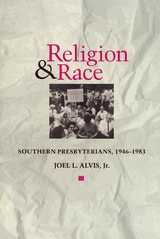
Religion and Race
Southern Presbyterians, 1946 to 1983Joel L. Alvis Jr
University of Alabama Press, 1994
Joel Alvis focuses on the relationships and tensions in the Presbyterian Church, U.S., whose ecclesiastical boundaries never expanded significantly beyond its original territory in the Confederacy and border South. By the time of the civil rights movement, the church was actively involved in ecumenical activities despite its regional isolation, and that involvement created unease in some quarters of the denomination. This concise institutional history traces how the church shaped and was shaped by its regional culture and explores the denomination's own cultural struggle to determine what role race issues would play in the definition of being Presbyterian.
Religion and Radical Politics
An Alternative Christian Tradition in the United StatesRobert Craig
Temple University Press, 1995
Religion and Sexuality
The Shakers, the Mormons, and the Oneida CommunityLawrence Foster
University of Illinois Press, 2009
Winner of the Best Book Award, Mormon History Association
Religion and Social Justice For Immigrants
Hondagneu-Sotelo, Pierrette
Rutgers University Press, 2006
Religion has jumped into the sphere of global and domestic politics in ways that few would have imagined a century ago. Some expected that religion would die as modernity flourished. Instead, it now stares at us almost daily from the front pages of newspapers and television broadcasts. Although it is usually stories about the Christian Right or conservative Islam that grab headlines, there are many religious activists of other political persuasions that are working quietly for social justice. This book examines how religious immigrants and religious activists are working for equitable treatment for immigrants in the United States.
The essays in this book analyze the different ways in which organized religion provides immigrants with an arena for mobilization, civic participation, and solidarity. Contributors explore topics including how non-Western religious groups such as the Vietnamese Caodai are striving for community recognition and addressing problems such as racism, economic issues, and the politics of diaspora; how interfaith groups organize religious people into immigrant civil rights activists at the U.S.–Mexican border; and how Catholic groups advocate governmental legislation and policies on behalf of refugees.

Religion and Spanish Film
Luis Buñuel, the Franco Era, and Contemporary DirectorsElizabeth Scarlett
University of Michigan Press, 2014
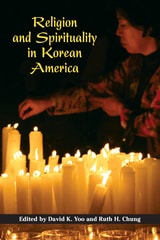
Religion and Spirituality in Korean America
Edited by David K. Yoo and Ruth H. Chung
University of Illinois Press, 2007
Contributors: Ruth H. Chung, Jae Ran Kim, Jung Ha Kim, Rebecca Kim, Sharon Kim, Okyun Kwon, Sang Hyun Lee, Anselm Kyongsuk Min, Sharon A. Suh, Sung Hyun Um, and David K. Yoo
Religion and State Formation in Postrevolutionary Mexico
Ben Fallaw
Duke University Press, 2012
Ben Fallaw argues that previous scholarship has not appreciated the pervasive influence of Catholics and Catholicism on postrevolutionary state formation. By delving into the history of four understudied Mexican states, he is able to show that religion swayed regional politics not just in states such as Guanajuato, in Mexico's central-west "Rosary Belt," but even in those considered much less observant, including Campeche, Guerrero, and Hidalgo. Religion and State Formation in Postrevolutionary Mexico reshapes our understanding of agrarian reform, federal schooling, revolutionary anticlericalism, elections, the Segunda (a second Cristero War in the 1930s), and indigenism, the Revolution's valorization of the Mesoamerican past as the font of national identity.
Religion and the Authority of the Past
Tobin Siebers, Editor
University of Michigan Press, 1993
Religion and the Authority of the Past looks at how the past has influenced religious authority, and demonstrates that authority has been, and continues to be, prevalent in all religions and cultures. This book shows, in a fascinating variety of ways, how religious doctrine, interpretation, behavior, and expression are affected by those in power.
The contributors—distinguished scholars from the fields of history, religion, classics, art, and Asian studies—find authority not only in places where one might expect it—in Islamic doctrine, Hindu religious texts, and the dogma of the Roman Catholic church, for example—but also in unimagined and intriguing locations: in the first U.S. archaeological expedition to the ancient Near East; in representations of heroic action in the Homeric epics and early Chinese classics; in the transmission of religious stereotypes from the Old World to the New; in the poetry of Paul Celan and Dan Pagis; and in a sculptor's attempts to create art for houses of worship, where architects, bishops, priests, and the laity assert a variety of forms of religious authority of their own.
Religion and the Cold War
A Global PerspectivePhilip E. Muehlenbeck
Vanderbilt University Press, 2012
Students and scholars will find in this volume a level of comprehensiveness rarely achieved in Cold War studies. Each chapter reveals that the power and influence of ideas are just as important as military might in the struggles between superpowersand that few ideas, then as now, carry as much force as religious ideology. As Muehlenbeck and his contributors demonstrate, no area of the world, and no religious tenet, was safe from the manipulations of a powerful set of players focused solely on their own sphere of influence.
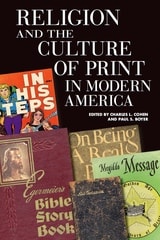
Religion and the Culture of Print in Modern America
Edited by Charles L. Cohen and Paul S. Boyer
University of Wisconsin Press, 2008
Religion and the Demise of Liberal Rationalism
The Foundational Crisis of the Separation of Church and StateJ. Judd Owen
University of Chicago Press, 2001
J. Judd Owen answers these questions with a remarkable critical analysis of four twentieth-century liberal and postliberal thinkers: John Dewey, John Rawls and, most extensively, Richard Rorty and Stanley Fish. His unique readings of these theorists and their approaches to religion lead him to conclusions that are meticulously constructed and surprising, arguing against the perception of liberalism as simple moral or religious neutrality, calling into question the prevailing justifications for separation of church and state, and challenging the way we think about the very basis of constitutional government.
Religion and the Making of Nigeria
Olufemi Vaughan
Duke University Press, 2016
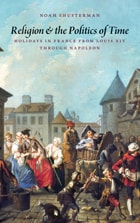
Religion and the Politics of Time
Noah Shusterman
Catholic University of America Press, 2010
Religion and the Social Sciences
Basic and Applied Research PerspectivesJeff Levin
Templeton Press, 2018
To give this research the attention it deserves, editor Jeff Levin assembled a panel of preeminent social scientists and gave them a single directive: write the ultimate statement on religion from within their respective social science discipline or field. The result is this single volume, “state-of-the-science” compendium—a first of its kind for the study of religion.
Composed of ten essays, this book details the study of religion within nine basic and applied areas of social science. Along with a critical introduction to this subject, these essays include the expert contributions of:
- Kenneth I. Pargament & Julie J. Exline on psychology
- Anthony Gill on political science
- Charles M. North on economics
- Barry Hankins on history
- Annette Mahoney on family studies
- Byron R. Johnson on criminology
- Linda K. George on gerontology
- William H. Jeynes on education
- Jeff Levin on epidemiology
- An introduction to the history of the discipline’s or field’s religious research, as well as its most important people and published works.
- A comprehensive overview of key research findings and theories.
- A detailed research agenda to guide future scholars.
- An annotated bibliography of seminal works for the reader’s further consideration.
Religion as a Chain of Memory
Daniele Hervieu-Leger
Rutgers University Press, 2000
For most of the last twenty years, sociologists have studied the “decline” of religion in the modern world—a decline they saw as a defining feature of modernity, which promotes materialism over spirituality. The revival and political strength of varying religious traditions around the world, however, has forced sociologists to reconsider.
This paradox has led Hervieu-Léger to undertake a sociological redefinition and reexamination of religion. For religion to endure in the modern world, she finds, it must have deep roots in traditions and times in which it was not defined as irrelevant. This reasoning leads her to develop the concept of a “chain of memory”—a process by which individual believers become members of a community that links past, present, and future members. Thus, like cultural tradition, religion may be understood as a shared understanding with a collective memory that enables it to draw upon the deep well of its past for nourishment in the increasingly secular present.
Hervieu-Legér also argues that the modern secular societies of the West have not, as is commonly assumed, outgrown or found secular substitutes for religious traditions; nor are they more “rational” than past societies. Rather, modern societies have become “amnesiacs,” no longer able to maintain the chain of memory that binds them to their religious pasts. Ironically, however, even as the modern world is destroying and losing touch with its traditional religious bases, it is also creating the need for a spiritual life and is thus opening up a space that only religion can fill.
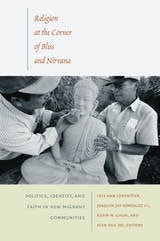
Religion at the Corner of Bliss and Nirvana
Politics, Identity, and Faith in New Migrant CommunitiesLois Ann Lorentzen, Joaquin Jay Gonzalez III, Kevin M. Chun and Hien Duc Do, eds.
Duke University Press, 2009
As they conducted research, the contributors not only visited churches and temples but also single-room-occupancy hotels, brothels, tattoo-removal clinics, and the streets of San Francisco, El Salvador, Mexico, and Vietnam. Their essays include an exploration of how faith-based organizations can help LGBT migrants surmount legal and social complexities, an examination of transgendered sex workers’ relationship with the unofficial saint Santisima Muerte, a comparison of how a Presbyterian mission and a Buddhist temple in San Francisco help Chinese immigrants to acculturate, and an analysis of the transformation of baptismal rites performed by Mayan migrants. The voices of gang members, Chinese and Vietnamese Buddhist nuns, members of Pentecostal churches, and many others animate this collection. In the process of giving voice to these communities, the contributors interrogate theories about acculturation, class, political and social capital, gender and sexuality, the sociology of religion, transnationalism, and globalization. The collection includes twenty-one photographs by Jerry Berndt.
Contributors. Luis Enrique Bazan, Kevin M. Chun, Hien Duc Do, Patricia Fortuny Loret de Mola, Joaquin Jay Gonzalez III, Sarah Horton, Cymene Howe, Mimi Khúc, Jonathan H. X. Lee, Lois Ann Lorentzen, Andrea Maison, Dennis Marzan, Rosalina Mira, Claudine del Rosario, Susanna Zaraysky
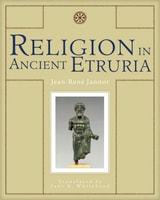
Religion in Ancient Etruria
Jean-René Jannot, Translated by Jane K. Whitehead
University of Wisconsin Press, 2005
Provocative insights and thoughtful discussions contribute to an understanding of the prophetic nature of Etruscan culture. Jannot investigates the elaborate systems of defining space and time that so distinctly characterize this ancient society. Religion in Ancient Etruria offers a unique perspective that illuminates the origins of some of our own "modern" religious beliefs.
This updated edition includes more than 100 illustrations that demonstrate early temples, statues, mirrors, tablets, and sculptures.
1998 French edition, Picard
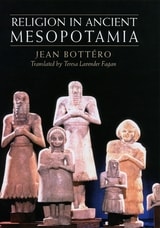
Religion in Ancient Mesopotamia
Jean Bottéro
University of Chicago Press, 2001

Religion in China and Its Modern Fate
Paul R. Katz
Brandeis University Press, 2014
Religion in Ohio
Profiles of Faith CommunitiesTarunjit Singh Butalia
Ohio University Press, 2004
Religion in Ohio tells the story of Ohio’s religious and spiritual heritage going back to the state’s ancient and historic native populations, and including the westward migration of settlers to this region, the development of a wide variety of faith traditions in the years preceding the mid-twentieth century, and the arrival of newer immigrants in the last fifty years, each group bringing with it cherished traditions.
Documenting religious pluralism in Ohio and the impact faith communities have had on the state, Religion in Ohio encompasses the historical experiences of many groups. Each chapter is the story of one of those communities written by a member of that faith or denomination.
Operating under the auspices of the Ohio Bicentennial Commission and the Interfaith Association of Central Ohio, the editors of Religion in Ohio have created a unique collection of the experiences of faith groups during the two hundred years of Ohio’s statehood and the years leading up to it. The largely untold stories of religious experience in Ohio are gathered here in one volume so they may be appreciated in all their breadth and diversity.
The Religious Experience Advisory Council of the Ohio Bicentennial Commission is one among twenty-two advisory councils established by the commission to commemorate Ohio’s bicentennial celebration. The council consists of more than twenty volunteers representing various faith traditions that have chosen Ohio to be their home.
Tarunjit Singh Butalia and Dianne P. Small present the profiles of faith communities in a highly readable and accessible format. Religion in Ohio will be a lasting legacy of the Ohio Bicentennial and a valuable tool for understanding and appreciating the breadth of the religious pluralism in the state for years to come.
Religion in Plain View
Public Aesthetics of American DisplaySally M. Promey
University of Chicago Press, 2024
In Religion in Plain View, Sally M. Promey analyzes religion’s visible saturation of American public space and the histories that shaped this exhibitionary aesthetics. In street art, vehicle décor, signs, monuments, architecture, zoning policy, and more, Promey exposes American display’s merger of evangelicalism, capitalism, and imperialism. From this convergence, display materializes a distinctly American drive to advertise, claim territory, invalidate competitors, and fabricate a tractable national heritage. Charting this aesthetics’ strategic work as a Protestant technology of White nation formation, Religion in Plain View offers a dynamic critique of the ways public display perpetuates deeply ingrained assumptions about the proper shape of life and land in the United States.
Religion in the Modern American West
Ferenc Morton Szasz
University of Arizona Press, 2000
When Americans migrated west, they carried with them not only their hopes for better lives but their religious traditions as well. Yet the importance of religion in the forging of a western identity has seldom been examined.
In this first historical overview of religion in the modern American West, Ferenc Szasz shows the important role that organized religion played in the shaping of the region from the late-nineteenth to late-twentieth century. He traces the major faiths over that time span, analyzes the distinctive response of western religious institutions to national events, and shows how western cities became homes to a variety of organized faiths that cast only faint shadows back east.
While many historians have minimized the importance of religion for the region, Szasz maintains that it lies at the very heart of the western experience. From the 1890s to the 1920s, churches and synagogues created institutions such as schools and hospitals that shaped their local communities; during the Great Depression, the Latter-day Saints introduced their innovative social welfare system; and in later years, Pentecostal groups carried their traditions to the Pacific coast and Southern Baptists (among others) set out in earnest to evangelize the Far West. Beginning in the 1960s, the arrival of Asian faiths, the revitalization of evangelical Protestantism, the ferment of post-Vatican II Catholicism, the rediscovery of Native American spirituality, and the emergence of New Age sects combined to make western cities such as Los Angeles and San Francisco among the most religiously pluralistic in the world.
Examining the careers of key figures in western religion, from Rabbi William Friedman to Reverend Robert H. Schuller, Szasz balances specific and general trends to weave the story of religion into a wider social and cultural context. Religion in the Modern American West calls attention to an often-overlooked facet of regional history and broadens our understanding of the American experience.
Religion in the New Europe
Krzysztof Michalski
Central European University Press, 2006
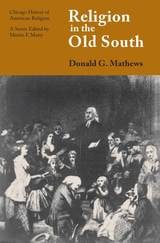
Religion in the Old South
Donald G. Mathews
University of Chicago Press, 1979
"A major achievement—a magnificently provocative contribution to the understanding of the history of religion in America."—William G. McLoughlin, Book Reviews
"A meticulous and well-documented study . . . In the changing connotations of the word 'liberty' lie most of the dilemmas of Southern (and American) history, dilemmas Dr. Mathews analyses with considerable penetration."—Times Literary Supplement
"The most compact and yet comprehensive view of the Old South in its religious dimension that is presently available. This is a pioneering work by one who is widely read in the sources and is creative enough to synthesize and introduce fresh themes. . . . He makes a unique contribution to southern historiography which will act as a corrective upon earlier works. . . . Boldly stated, every library that consults Choice should purchase this volume."—Choice
"Mathews presents us with the findest and grandest history of old southern religion that one could imagine finding in so short a book on so large a topic. . . . Here stands in its own right a masterpiece of regional historiography of religion in America."—William A. Clebsch, Reviews in American History
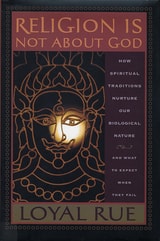
Religion is Not about God
How Spiritual Traditions Nurture our Biological Nature and What to Expect When They FailLoyal Rue
Rutgers University Press, 2006
Thousands of religious traditions have appeared over the course of human history but only a relative few have survived. Some speak of a myriad of gods, others of only one, and some recognize no gods at all. Volumes have been written attempting to prove the existence or nonexistence of supernatural being(s). So, if religion is not about God, then what is it about?
In this provocative book, Loyal Rue contends that religion, very basically, is about us. Successful religions are narrative (myth) traditions that influence human nature so that we might think, feel, and act in ways that are good for us, both individually and collectively. Through the use of images, symbols, and rituals, religion promotes reproductive fitness and survival through the facilitation of harmonious social relations. Drawing on examples from the major traditions—Judaism, Christianity, Islam, Hinduism, and Buddhism—Rue shows how each religion, in its own way, has guided human behavior to advance the twin goals of personal fulfillment and social coherence.
As all faiths are increasingly faced with a crisis of intellectual plausibility and moral relevance, this book presents a compelling and positive view of the centrality and meaning of religion.

Religion is Not about God
How Spiritual Traditions Nurture our Biological Nature and What to Expect When They FailLoyal Rue
Rutgers University Press, 2006
2006 Choice Outstanding Academic Title
Thousands of religious traditions have appeared over the course of human history but only a relative few have survived. Some speak of a myriad of gods, others of only one, and some recognize no gods at all. Volumes have been written attempting to prove the existence or nonexistence of supernatural being(s). So, if religion is not about God, then what is it about?
In this provocative book, Loyal Rue contends that religion, very basically, is about us. Successful religions are narrative (myth) traditions that influence human nature so that we might think, feel, and act in ways that are good for us, both individually and collectively. Through the use of images, symbols, and rituals, religion promotes reproductive fitness and survival through the facilitation of harmonious social relations. Drawing on examples from the major traditions—Judaism, Christianity, Islam, Hinduism, and Buddhism—Rue shows how each religion, in its own way, has guided human behavior to advance the twin goals of personal fulfillment and social coherence.
As all faiths are increasingly faced with a crisis of intellectual plausibility and moral relevance, this book presents a compelling and positive view of the centrality and meaning of religion.
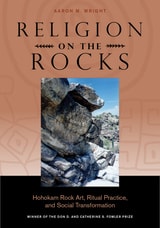
Religion on the Rocks
Hohokam Rock Art, Ritual Practice, and Social TransformationAaron M. Wright
University of Utah Press, 2014
We are nearly all intrigued by the petroglyphs and pictographs of the American Southwest, and we commonly ask what they “mean”. Religion on the Rocks redirects our attention to the equally important matter of what compelled ancient peoples to craft rock art in the first place. To examine this question, Aaron Wright presents a case study from Arizona's South Mountains, an area once flanked by several densely populated Hohokam villages. Synthesizing results from recent archaeological surveys, he explores how the mountains' petroglyphs were woven into the broader cultural landscape and argues that the petroglyphs are relics of a bygone ritual system in which people vied for prestige and power by controlling religious knowledge. The features and strategic placement of the rock art suggest this dimension of Hohokam ritual was participatory and prominent in village life. Around AD 1100, however, petroglyph creation and other ritual practices began to wane, denoting a broad transformation of the Hohokam social world. Wright’s examination of the South Mountains petroglyphs offers a novel narrative of how Hohokam villagers negotiated a concentration of politico-religious authority around platform mounds. Readers will come away with a better understanding of the Hohokam legacy and a greater appreciation for rock art's value to anthropology.
Religion or Ethnicity?
Jewish Identities in EvolutionGitelman, Zvi
Rutgers University Press, 2009
In Religion or Ethnicity? fifteen leading scholars trace the evolution of Jewish identity. The book examines Judaism from the Greco-Roman age, through medieval times, modern western and eastern Europe, to today. Jewish identity has been defined as an ethnicity, a nation, a culture, and even a race. Religion or Ethnicity? questions what it means to be Jewish. The contributors show how the Jewish people have evolved over time in different ethnic, religious, and political movements. In his closing essay, Gitelman questions the viability of secular Jewishness outside Israel but suggests that the continued interest in exploring the relationship between Judaism's secular and religious forms will keep the heritage alive for generations to come.
Religion, Conflict, and Peacemaking
An Interdisciplinary ConversationMuriel Schmid
University of Utah Press, 2017
Contributors from varied backgrounds share perspectives and insights gleaned from history, theory, practice, and case studies. While the authors acknowledge the role of religion in generating conflict, they emphasize the part religion can play in conflict resolution. Addressing the centrality of conflict to the human condition, they recognize the consequent difficulty in teasing out the exact role of religion. Overall, the authors assert the necessity of frank, knowledgeable dialogue to understanding sources of, finding grounds for resolving, and managing conflict. Many of the essayists offer creative solutions for building peace. Employing examples and viewpoints drawn from diverse faith traditions, academic traditions, and cultural backgrounds, contributors seek to foster respectful dialogue and debate by exploring the complex dynamic that interconnects religion, violence, and peace.
Religion, Education and the American Experience
Reflections on Religion and the American Public LifeEdith L. Blumhofer
University of Alabama Press, 2002
This collection of provocative and timely essays addresses the ways in which religious and educational institutions have come to define one another and American culture and identity.
Education in America-public and private, from the elementary to the university level-is the subject of urgent, ongoing debates. School vouchers, home schooling, prayer in the classrooms, sex education in the schools, and evolution versus creationism are just a few of the touchstones and flashpoints that have ignited a national dialogue concerning the role of religion in U.S. educational institutions.
The ten major essays assembled here emerged from a series of conferences conducted by the Public Religion Project at the University of Chicago Divinity School, funded by a grant from The Pew Charitable Trust. Written by recognized leaders in the fields of education and religion, the essays address such issues as the role of religious studies programs in tax-supported public universities; the evolving role of the university chaplain; the impact of religious doctrine on literary scholarship and the natural sciences; the college president as a spiritual leader; the secularization of private colleges whose foundations rest in the spiritual mission of a specific church or denomination and, conversely, the obligations, if any, of colleges that have maintained distinct denominational identities toward pluralistic outreach and openness; and an examination of the home schooling movement.
A true "dialogue" designed to inspire readers to rethink, argue, act, and continually converse on the subject, Religion, Education, and the American Experience will appeal to educators, college and university administrators, and boards of trustees, as well as academic libraries and scholars of education and religious studies.