Results by title
28167 books match the query 'History' and 1206 start with r
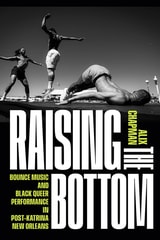
Raising the Bottom
Bounce Music and Black Queer Performance in Post-Katrina New OrleansAlix Chapman
Duke University Press, 2026
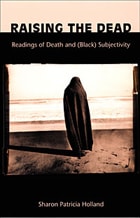
Raising the Dead
Readings of Death and (Black) SubjectivitySharon Patricia Holland
Duke University Press, 2000
Holland argues that the presence of blacks, Native Americans, women, queers, and other “minorities” in society is, like death, “almost unspeakable.” She gives voice to—or raises—the dead through her examination of works such as the movie Menace II Society, Toni Morrison’s novel Beloved, Leslie Marmon Silko’s Almanac of the Dead, Randall Kenan’s A Visitation of Spirits, and the work of the all-white, male, feminist hip-hop band Consolidated. In challenging established methods of literary investigation by putting often-disparate voices in dialogue with each other, Holland forges connections among African-American literature and culture, queer and feminist theory.
Raising the Dead will be of interest to students and scholars of American culture, African-American literature, literary theory, gender studies, queer theory, and cultural studies.

Raising the Dust
The Literary Housekeeping of Mary Ward, Sarah Grand, and Charlotte Perkins GilmanBeth Sutton-Ramspeck
Ohio University Press, 2004
To Mary Augusta Ward, Sarah Grand, and Charlotte Perkins Gilman, housekeeping represented public responsibilities: making the food supply safe, reforming politics, and improving the human race itself. Raising the Dust places their writing in the context of the late-Victorian era, in particular the eugenics movement, the proliferation of household conveniences, the home economics movement, and decreased reliance on servants. These changes affected relationships between the domestic sphere and the public sphere, and hence shaped the portrayal of domesticity in the era's fiction and nonfiction.
Moreover, Ward, Grand, and Gilman articulated a domestic aesthetic that swept away boundaries. Sutton-Ramspeck uncovers a new paradigm here: literature as engaging the public realm through the devices and perspectives of the domestic. Her innovative and ambitious book also connects fixations on cleaning with the discovery of germs (the first bacterium discovered was anthrax, and knowledge of its properties increased fears of dust); analyzes advertising cards for soap; and links the mental illness in Gilman's “The Yellow Wall-Paper” to fears during the period of arsenic poisoning from wallpaper.
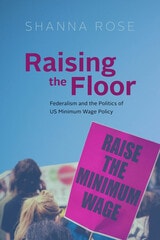
Raising the Floor
Federalism and the Politics of US Minimum Wage PolicyShanna Rose
University of Chicago Press, 2026
A rich history of the development of American minimum wage policy with lessons for today.
Despite broad popular support for robust minimum wage policy, the federal minimum wage is now worth less—in real, inflation-adjusted terms—than at any time since 1949. While some state and local governments have stepped in to fill this void, others have declined to set any minimum wage standard at all. Traversing more than 100 years of history, Raising the Floor examines how interest groups have navigated the highly decentralized American political system to shape the development of federal, state, and local minimum wage laws.
In her analysis, Shanna Rose highlights the importance of American federalism. She argues that because federalism creates multiple arenas for policy change, interest groups have sought out the sites most conducive to their goals, shifting their lobbying efforts as new obstacles and opportunities emerge. Federalism has facilitated minimum wage policymaking by fostering policy experimentation, learning, and diffusion across states and by allowing state and local governments to overcome gridlock and status-quo biases at the national level. Yet, federalism has also been an instrument for containment, enabling those opposed to minimum wage increases to litigate and preempt local-level laws.
With rich historical chapters that illuminate different phases in the development of today’s patchwork of wage standards, Raising the Floor is a deep examination of the past, present, and future of American minimum wage law.
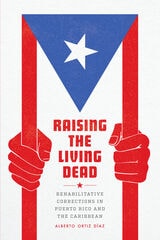
Raising the Living Dead
Rehabilitative Corrections in Puerto Rico and the CaribbeanAlberto Ortiz Díaz
University of Chicago Press, 2023
Raising the Living Dead is a history of Puerto Rico’s carceral rehabilitation system that brings to life the interactions of incarcerated people, their wider social networks, and health care professionals. Alberto Ortiz Díaz describes the ways that multiple communities of care came together both inside and outside of prisons to imagine and enact solution-oriented cultures of rehabilitation from the 1930s to the 1960s. Scientific and humanistic approaches to well-being were deliberately fused to raise the “living dead,” an expression that reemerged in the modern Caribbean to refer to prisoners. These reform groups sought to raise incarcerated people physically, mentally, socially, spiritually, and civically.
The book is based on deep, original archival research into the Oso Blanco (White Bear) penitentiary in Puerto Rico, yet it situates its study within Puerto Rico’s broader carceral archipelago and other Caribbean prisons. The agents of this history include not only physical health professionals, but also psychologists and psychiatrists, social workers, spiritual and religious practitioners, and, of course, the prisoners and their families. By following all these groups and emphasizing the interpersonal exercise of power, Ortiz Díaz tells a story that goes beyond debates about structural and social control.
The book addresses key issues in the history of prisons and the histories of medicine and belief, including how prisoners’ different racial, class, and cultural identities shaped their incarceration and how professionals living in a colonial society dealt with the challenge of rehabilitating prisoners for citizenship.
Raising the Living Dead is not just about convicts, their immediate interlocutors, and their contexts, however, but about how together these open a window into the history of social uplift projects within the (neo)colonial societies of the Caribbean. There is no book like this in Caribbean historiography; few examine these themes in the larger literature on the history of prisons.
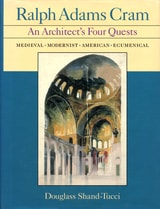
Ralph Adams Cram
An Architect's Four QuestsDouglass Shand-Tucci
University of Massachusetts Press, 2005
With his partner Bertram Goodhue, Cram won a number of important commissions, beginning with the West Point competition in 1903. Although an increasingly bitter rivalry with Goodhue would lead to the dissolution of their partnership in 1912, Cram had already begun to strike out on his own. Supervising architect at Princeton, consulting architect at Wellesley, and head of the MIT School of Architecture, he would also design most of New York's Cathedral of St. John the Divine and the campus of Rice University, as well as important church and collegiate structures throughout the country. By the 1920s Cram had become a household name, even appearing on the cover of Time magazine.
A complex man, Cram was a leading figure in what Shand-Tucci calls "a full-fledged homosexual monastery" in England, while at the same time married to Elizabeth Read. Their relationship was a complicated one, the effect of which on his children and his career is explored fully in this book. So too is his work as a religious leader and social theorist.
Shand-Tucci traces the influence on Cram of such disparate figures as Franklin Delano Roosevelt, Phillips Brooks, Henry Adams, and Ayn Rand. He divides Cram's career into four lifelong "quests": medieval, modernist, American, and ecumenical. Some quests may have failed, but in each he left a considerable legacy, ultimately transforming the visual image of American Christianity in the twentieth century.
Handsomely illustrated with over 130 photographs and drawings and eight pages of color plates, Ralph Adams Cram can be read on its own or in conjunction with Boston Bohemia, 1881–1900. Together, the two volumes complete what the Christian Century has described as a "superbly researched and captivating biography."

Ralph Ayres' Cookery Book
Edited by Jane Jakeman
Bodleian Library Publishing, 2006
If you've ever wondered what a London Wigg was or why plum cake does not actually contain plums, Ralph Ayres' Cookery Book will prove to be a most rewarding collection. Here the details of sumptuous British meals are meticulously presented, as is their larger context in the history of cooking. Recipes for such famous dishes as Quaking Pudding, Oxford Sausages, Damson Preserve, and other savory English delights fill the pages. Some, such as the famous New College Pudding, are still used today. The volume is beautifully produced, featuring a wealth of full-color botanical illustrations and elegant script reproduced from the original text, and also includes an informative foreword by Bodleian emeritus librarian David Vaisey.
A captivating glimpse into the world of eighteenth-century food and the culture of academia's apex, Ralph Ayres' Cookery Book is a valuable and engaging historical chronicle of British cuisine. It will appeal to social and culinary historians, as well as to the many lovers of griskin and collops.
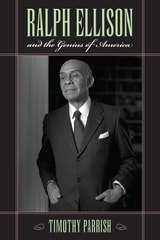
Ralph Ellison and the Genius of America
Timothy Parrish
University of Massachusetts Press, 2012
Ralph Ellison has long been admired as the author of one of the most important American novels of the twentieth century, Invisible Man. Yet he has also been dismissed by some critics as a writer who only published one major work of fiction and a black intellectual out of touch with his times. In this book, Timothy Parrish offers a fundamentally different assessment of Ellison's legacy, describing him as the most important American writer since William Faulkner and someone whose political and cultural achievements have not been fully recognized.
Embracing jazz artist Wynton Marsalis's characterization of Ellison as the unacknowledged “political theorist” of the civil rights movement, Parrish argues that the defining event of Ellison's career was not Invisible Man but the 1954 Supreme Court decision that set his country on the road to racial integration. In Parrish's view, no other American intellectual, black or white, better grasped the cultural implications of the new era than Ellison did; no other major American writer has been so misunderstood.
Drawing on Ellison's recently published “unfinished” novel, newly released archival materials, and unpublished correspondence, Parrish provides a sustained reconsideration of the writer's crucial friendships with Richard Wright, Robert Penn Warren, and C. Vann Woodward to show how his life was dedicated to creating an American society in which all could participate equally. By resituating Ellison's career in the historical context of its making, Parrish challenges the premises that distorted the writer's reception in his own lifetime to make the case for Ellison as the essential visionary of post–Civil War America.

Ralph J. Bunche
Selected Speeches and WritingsCharles P. Henry, Editor
University of Michigan Press, 1996
Bunche was a pioneer in every sense of the word. The first black American to hold a doctorate in political science, Bunche established the political science department at Howard University and co-founded the National Negro Congress. He served as the first African- American section head in the Office of Strategic Services and later moved to the State Department. He played a major part in the delegation that established the United Nations and, when he retired as Under Secretary General, was the highest- ranking black in that organization. In 1950, he was awarded the Nobel Peace Prize and thus became the first black Nobel laureate.
Bunche's thinking and writing was broad, ranging from the political left to the center. Early works flirt with socialist or even Bolshevist ideas, while later works maintained that a flawed American democracy was better than an impending threat of Nazi-influenced fascism. Bunche was one of the first African Americans to do academic work in Africa, forcing him to think through notions of colonialism and class that would influence his work at the United Nations. Although his passion for peace and civil rights never faltered, his relationship with American black movements vascillated from an early embrace of radicalism to a significant distancing during the mid-sixties to a final rapprochement during the last years of his life. A monumental contribution, Ralph J. Bunche: Selected Speeches and Writings reasserts the thinking of a great American whose views are entirely relevant to a generation still striving for the world Bunche envisioned.
Charles P. Henry is Associate Professor of African American Studies at the University of California, Berkeley.
From the book:
"I abhor racism as a dangerous virus, whether it is spread by white or black peoples. I seek total integration, which to me means the Negro taking his place in the very mainstream of American life . . . . My ancestors have contributed very much to the development of this country and therefore I have a vested interest in it that I intend to realize and protect."
"It seems painfully clear to me that there is no possibility in the affluent, highly industrialized and technological white-majority American society for anyone to be at once black, separate and equal."
"The colonial system in its modern version, implicitly arrogant and self-serving, was instituted and perpetuated chiefly by self-righteous and superior- minded Europeans. Its positive achievements notwithstanding, colonialism's evil legacies will bedevil the world for years to come."
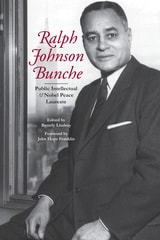
Ralph Johnson Bunche
Public Intellectual and Nobel Peace LaureateEdited by Beverly Lindsay; Foreword by John Hope Franklin
University of Illinois Press, 2007
Nobel Peace Prize winner Ralph Johnson Bunche (1904-71) was one of the twentieth century’s foremost diplomats and intellectuals. In the wake of centennial celebrations of his birth, leading scholars and diplomats assess Bunche’s historical importance and enduring impact on higher education, public policy, and international politics. Their essays reveal not only the breadth of Bunche’s influence, such as his United Nations work to broker peace during times of civil war in Africa, the Middle East, and Asia, but also the depth of his intellectual perspectives on race, civil rights, higher education, and international law. Probing his publications, speeches, and public policy initiatives, the volume offers telling insights into the critical roles of universities, public intellectuals, and diplomats in working together to find solutions to domestic and international problems through public and scholarly engagement. In this way, the volume highlights the very connections that Bunche exhibited as an academic, intellectual, and diplomat.
Contributors include Lorenzo DuBois Baber, John Hope Franklin, Jonathan Scott Holloway, Charles P. Henry, Ben Keppel, Beverly Lindsay, Princeton Lyman, Edwin Smith, and Hanes Walton Jr.
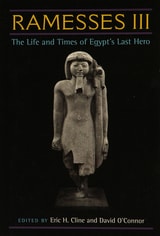
Ramesses III
The Life and Times of Egypt's Last HeroEdited by Eric H. Cline and David O'Connor
University of Michigan Press, 2012

Ramona Memories
Tourism and the Shaping of Southern CaliforniaDydia DeLyser
University of Minnesota Press, 2005
Ramsey
The Lives of an English Fenland Town, 1200–1600Anne Reiber DeWindt
Catholic University of America Press, 2006
Ramus, Method, and the Decay of Dialogue
From the Art of Discourse to the Art of ReasonWalter J. Ong, S.J.
University of Chicago Press, 2004
Considered the most important work of Walter Ong's career, Ramus, Method, and the Decay of Dialogue is an elegant review of the history of Ramist scholarship and Ramus's quarrels with Aristotle. A key influence on Marshall McLuhan, with whom Ong enjoys the status of honorary guru among technophiles, this challenging study remains the most detailed account of Ramus's method ever published. Out of print for more than a decade, this book—with a new foreword by Adrian Johns—is a canonical text for enthusiasts of media, Renaissance literature, and intellectual history.
Ranchero Revolt
The Mexican Revolution in GuerreroBy Ian Jacobs
University of Texas Press, 1982
The Mexican Revolution has most often been characterized as the revolt of the oppressed rural masses against the conservative regime of Porfirio Díaz. In Ranchero Revolt Ian Jacobs challenges this populist interpretation of the Revolution by exploring the crucial role played by the rural middle class—rancheros—in the organization and final victory of the Revolution.
Jacobs focuses on the Revolution as it developed in Guerrero, the rebellious Mexican state still frequently at odds with central authority. His is the first account in English of the genesis and development of the Revolution in this important Mexican state and the first detailed history in any language of Guerrero in the period 1876 to 1940.
Stressing as it does the conservative tendencies of the Revolution in Mexico, Ranchero Revolt is a major contribution to revisionist history. It is a striking example of the trend toward local and regional studies of Mexican history that are transforming much of the conventional wisdom about modern Mexico.
Among these studies, however, Ranchero Revolt is unusual in its chronological scope, embracing not only the origins and military struggle of the Revolution but also the emergence of a new revolutionary state in the 1920s and 1930s. Especially valuable are Jacobs' descriptions of the agrarian developments that preceded and followed the Revolution; the vagaries of local factions; and the process of political centralization that took place first under Díaz and later under the revolutionary regimes.
Ranching, Endangered Species, and Urbanization in the Southwest
Species of CapitalNathan F. Sayre
University of Arizona Press, 2002
Nathan Sayre now takes a close look at how the ranching ideal has come into play in the conversion of a large tract of Arizona rangeland from private ranch to National Wildlife Refuge. He tells how the Buenos Aires Ranch, a working operation for a hundred years, became not only a rallying point for multiple agendas in the "rangeland conflict" after its conversion to a wildlife refuge but also an expression of the larger shift from agricultural to urban economies in the Southwest since World War II.
The U.S. Fish and Wildlife Service bought the Buenos Aires Ranch in 1985, removed all livestock, and attempted to restore the land to its "original" grassland in order to protect an endangered species, the masked bobwhite quail. Sayre examines the history of the ranch and the bobwhite together, exploring the interplay of social, economic, and ecological issues to show how ranchers and their cattle altered the land—for better or worse—during a century of ranching and how the masked bobwhite became a symbol for environmentalists who believe that the removal of cattle benefits rangelands and wildlife.
Sayre evaluates both sides of the Buenos Aires controversy—from ranching's impact on the environment to environmentalism's sometimes misguided efforts at restoration—to address the complex and contradictory roles of ranching, endangered species conservation, and urbanization in the social and environmental transformation of the West. He focuses on three dimensions of the Buenos Aires story: the land and its inhabitants, both human and animal; the role of government agencies in shaping range and wildlife management; and the various species of capital—economic, symbolic, and bureaucratic—that have structured the activities of ranchers, environmentalists, and government officials.
The creation of the Buenos Aires National Wildlife Refuge has been a symbolic victory for environmentalists, but it comes at the cost of implicitly legitimizing the ongoing fragmentation and suburbanization of Arizona's still-wild rangelands. Sayre reveals how the polarized politics of "the rangeland conflict" have bound the Fish and Wildlife Service to a narrow, ineffectual management strategy on the Buenos Aires, with greater attention paid to increasing tourism from birdwatchers than to the complex challenge of restoring the masked bobwhite and its habitat. His findings show that the urban boom of the late twentieth century echoed the cattle boom of a century before—capitalizing on land rather than grass, humans rather than cattle—in a book that will serve as a model for restoration efforts in any environment.
Rank-and-File Rebels
Theories of Power and Change in the 2018 Education StrikesErin Dyke
University Press of Colorado, 2024
Rape Of Clarissa
Writing, Sexuality, and Class Struggle in Samuel RichardsonTerry Eagleton
University of Minnesota Press, 1982

Rape and Writing in the Heptameron of Marguerite de Navarre
Patricia Francis Cholakian
Southern Illinois University Press, 1991
Marguerite de Navarre (1492–1549), the sister of the French king François I, composed the Heptaméron as a complex collection of seventy-two novellas, creating one of the first examples of realistic, psychological fiction in French literature. These novellas, framed by debates among ten storytellers, all noble lords and ladies, reveal the author’s desire to depart from the purely masculine voice of the age.
Cholakian contends that this Renaissance text is characterized by feminine writing. She reads the text as the product of the author’s personal experience. Beginning her study with the rape narrative in the autobiographical novella 4, she examines how the Heptaméron interacts with male literary traditions and narrative conventions about gender relations. She analyzes such words as rape, and honor, noting how they are defined differently by men and women and how these differences in perception affect the development of both plot and character.
Rape at the Opera
Staging Sexual ViolenceMargaret Cormier
University of Michigan Press, 2024
Drawing on archival footage as well as attendance at live events, Cormier analyzes productions of canonic operas from German, Italian, and French traditions from the eighteenth to the early twentieth century, including Die Entführung aus dem Serail, Don Giovanni, La forza del destino, Un ballo in maschera, Salome, and Turandot. In doing so, Cormier highlights the dynamism of twenty-first-century opera performance practice with regard to sexual violence, establishes methods to evaluate representations of sexual violence on the opera stage, and reframes the primary responsibility of opera critics and creators as being not to opera composers and librettists but to the public.
Rape in Chicago
Race, Myth, and the CourtsDawn Rae Flood
University of Illinois Press, 2018
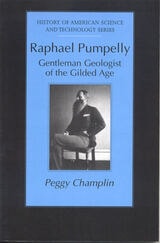
Raphael Pumpelly
Gentleman Geologist of the Gilded AgePeggy Champlin
University of Alabama Press, 1994
A definitive biography illuminating the scientific, industrial, and exploratory contributions of America’s pioneering economic geologist.
Raphael Pumpelly: Gentleman Geologist of the Gilded Age provides an excellent opportunity to look at the development of the profession of geology during the years spanned by his career, from 1860 to the early twentieth century. In this period, the practical applications of geology to resource development were of major importance, but geologists were also investigating new subjects, such as petrology, geomorphology, glaciology, and structural geology. These investigations resulted in an explosion of knowledge in these areas and in the growth of subdisciplines. Pumpelly did research in these fields but like others of his generation did not limit himself to any one of them; he remained a generalist in a time of increasing specialization, a transitional figure in a period of rapid change.
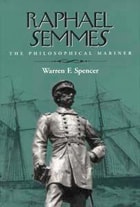
Raphael Semmes
The Philosophical MarinerWarren F. Spencer
University of Alabama Press, 1997
Naval hero for all the South, Raphael Semmes (1809-1877) sailed two famous Confederate raiders. He outfitted CSS Sumter in 1861 and captured 18 Union merchant ships in six months before the raider was blockaded at Gibraltar. Next he took command of CSS Alabama, an English-built raider, and terrorized U.S. merchant vessels on the high seas from August 1862 until the raider was sunk in battle off Cherbourg in June 1864. During that two-year period, he captured more enemy merchant ships than any other cruiser captain in maritime history. He is considered one of the greatest ship's commanders that America has produced.
In this first, full-scale biography that relies on Semmes's private papers, unpublished diaries, and correspondence, Spencer has produced a well-balanced and comprehensive account of the man, as well as the naval officer. The biographer paints a vivid portrait of Semmes—the intellectual, the family man, lawyer, romanticist, nationalist—providing a greater understanding of the man behind the heroic deeds.
Semmes was born in Maryland to a slave-holding family and entered the United States Navy in 1826. In 1849, he moved his family to Mobile, Alabama, to be near the navy base at Pensacola, Florida, and to practice law during leaves. Semmes was an astute student, not only of international and maritime law but also of weather patterns; astronomy; flora and fauna; naval, social, and cultural history; and the classics. His study of constitutional law led him to side with his adopted state in 1861, a move that set the stage for his place in history.
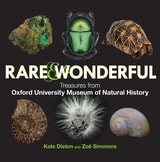
Rare and Wonderful
Treasures from the Oxford University Museum of Natural HistoryKate Diston and Zoë Simmons
Bodleian Library Publishing, 2018
This lavishly illustrated book features highlights from the collections, ranging from David Livingstone’s tsetse fly specimens to Mary Anning’s ichthyosaur, and from crabs collected by Darwin during his voyage on the Beagle to the iconic Dodo, the only soft tissue specimen of the species in existence. Also featured are the first described dinosaur bones, found in a small Oxfordshire village, the Red Lady of Paviland (who was in fact a man who lived 29,000 years ago), and a meteorite from the planet Mars.
Each item tells a unique story about natural history, the history of science, collecting, or the museum itself. Rare & Wonderful offers unique insight into the extraordinary wealth of information and fascinating tales that can be gleaned from these collections.
Raritan on War
An AnthologyJackson Lears
Rutgers University Press, 2025
Raritan on War collects some of the finest writing on that troubling subject published in Raritan Quarterly between 2003 and 2022. The editors, Jackson Lears and Karen Parker Lears, have selected work that typifies Raritan's wide-ranging sensibility, focusing on a topic that is aesthetically rich, intellectually challenging, and morally disturbing. Ultimately, Raritan on War reveals the power of art and reflection to sustain humane ways of being in the world, even amid constant global violence.
Contributors: C. Felix Amerasinghe; Andrew J. Bacevich; Victoria De Grazia; Tamas Dobozy; David Ferry; M. Fortuna; Cai Guo-Qiang; Emma Dodge Hanson; Jochen Hellbeck; Karl Kirchwey; Ray Klimek; Peter LaBier; Patrick Lawrence; d. mark levitt; Michael Miller; Lyle Jeremy Rubin; Elizabeth D. Samet; Sherod Santos; Robert Westbrook
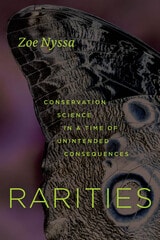
Rarities
Conservation Science in a Time of Unintended ConsequencesZoe Nyssa
University of Chicago Press, 2026
A sweeping study that reveals how conservation science does more than simply protect by inadvertently making nature valuable in new ways.
Climate change and other environmental transformations are causing species to go extinct at accelerating rates. What, then, should a science of saving nature look like? In Rarities, Zoe Nyssa traces how conservation emerged as a distinct scientific endeavor in the United States over the twentieth century and how this history has shaped environmental research practices and policy today. Drawing on archival and ethnographic research with leading conservation labs and programs, Nyssa explores how conservation science appears to generate contradictory, even counterintuitive, results as scientists, policymakers, and the public all take up, respond to, and repurpose scientists’ ideas about rarity, vulnerability, and endangerment. The designation of new nature reserves can lead to increased poaching and habitat destruction. The listing of a species as endangered fuels their black-market consumption as pets, food, or luxury items. Protection of natural resources can push resource extraction into unprotected areas. Other effects are less simple to calculate; persuading the public to care about one species might siphon support for another, and paying for one kind of conservation behavior can discourage other forms of conservation activity.
The science of saving nature spans a century of work by ecologists and others to develop a scientific basis for conservation. Yet Nyssa shows how their efforts to understand the natural world in terms of endangerment and extinction unleashed new ways for nonscientists to experience and understand nature as well. The scientific values that emerge, she argues, can transform the complex interconnections between human and nonhuman life. Rarities offers a framework for understanding these surprising socio-ecological dynamics and why they matter, both for contemporary science and for the planet.
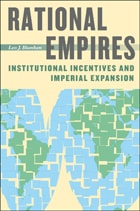
Rational Empires
Institutional Incentives and Imperial ExpansionLeo J. Blanken
University of Chicago Press, 2012
The nineteenth century marked the high point of imperialism, when tsarist Russia expanded to the Pacific and the sun was said never to set on the British Empire. Imperialism remains a perennial issue in international relations today, and nowhere is this more evident than in the intensifying competition for global resources.
Leo J. Blanken explains imperialism through an analysis of the institutions of both the expanding state and its targets of conquest. While democratic states favoring free trade generally resort to imperialism only to preempt aggressive rivals—or when they have reason to believe another state’s political institutions will not hold up when making bargains—authoritarian states tend toward imperialism because they don’t stand to benefit from free trade. The result is three distinct strategies toward imperialism: actors fighting over territory, actors peaceably dividing territory among themselves, and actors refraining from seizing territory altogether. Blanken examines these dynamics through three case studies: the scramble for Africa, the unequal treaties imposed on Qing Dynasty China, and the evolution of Britain’s imperial policy in India. By separating out the different types of imperialism, Blanken provides insight into its sources, as well as the potential implications of increased competition in the current international arena.
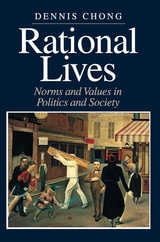
Rational Lives
Norms and Values in Politics and SocietyDennis Chong
University of Chicago Press, 2000
Chong's book yields insights about the circumstances under which preferences, beliefs, values, norms and group identifications are formed. It offers a provocative explanation of how ingrained social norms and values can change over time despite the forces maintaining the status quo.
"Going beyond the tired polemics on both sides, [Chong] constructs a new interpretation of human behavior in which culture and individual rationality both matter. The synthesis is a more comprehensive and powerful explanatory framework than either side could have produced, and Chong's creativity should influence subsequent interpretations of our social life in fundamental ways."—Christopher H. Achen, University of Michigan
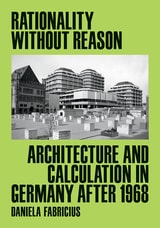
Rationality Without Reason
Architecture and Calculation in Germany After 1968Daniela Fabricius
University of Minnesota Press, 2027
A critical examination of the rational turn in postwar West German architecture
Postwar West German architecture experienced a “rational turn” characterized by a dramatic push toward ideals of optimization, economy, and accuracy based in calculation. Analyzing how architects reckoned with the political and cultural legacy of fascism and were driven by the desire to quantify and manage unpredictability in the human environment, Rationality Without Reason shows how they translated their design and production methods into numbers through protodigital technology and computational processes.
Daniela Fabricius examines architectural practices within the wider context of the shifting intellectual and cultural landscape as rationalism devolved between the student movements of 1968 and the reign of postmodernism in the 1980s. Showing how rationalism’s limitations and contradictions became increasingly apparent, she demonstrates how the intensity of these approaches ultimately led to a form of rationalism devoid of reason. Fabricius explores how the development of increasingly autonomous systems and formalist methods strayed from important economic, social, and ethical concerns and impeded the potential for developing more liberatory forms of architecture.
Using case studies involving the Ulm School for Design and the research-based work of Frei Otto and Oswald Mathias Ungers, Rationality Without Reason traces how debates around scientific thinking evolved throughout the Cold War era and offers a critical look at the utopian promises associated with supposedly rational systems of knowledge. Through an interdisciplinary approach steeped in archival research, Fabricius highlights how the logic of quantification is bound to be unsustainable without serious ethical considerations.
Retail e-book files for this title are screen-reader friendly with images accompanied by short alt text and/or extended descriptions.
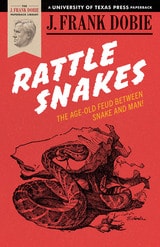
Rattlesnakes
By J. Frank Dobie
University of Texas Press, 1982
Here are observations and speculations, legends and yarns, even gossip about the habits and dispositions of these extraordinary creatures—rattlesnakes—their reported size, deadliness, and power to charm their natural enemies. Here are descriptions of actual fights to the death between rattlesnakes and other animals and accounts of the strange experiences human beings have had with them, as well as tips on where to find them and how to act when you see one.
Dobie began systematically collecting lore about the rattlesnake world many years ago, using some of it in such regional publications as Southwest Review and incorporating much of it into essays—with the intention of eventually putting together a book about rattlesnakes. Now, in this collection of twenty-two articles, his wish is posthumously fulfilled.
Only Frank Dobie could tell of this fascinating and frightening creature with such wisdom and humor, thereby tempering "the age-old feud between the snake and man." And the rattlesnake—who once aroused fear among even the boldest men in the Old West—can at last be regarded with tolerance, respect, and even affection.
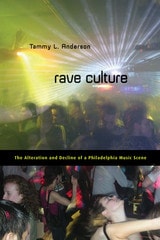
Rave Culture
The Alteration and Decline of a Philadelphia Music SceneTammy L. Anderson
Temple University Press, 2009
It used to be that raves were grassroots organized, anti-establishment, unlicensed all-night drug-fueled dance parties held in abandoned warehouses or an open field. These days, you pay $40 for a branded party at popular riverfront nightclubs where age and status, rather than DJ expertise and dancing, shape your experience.
In Rave Culture, sociologist Tammy Anderson explores the dance music, drug use and social deviance that are part of the pulsing dynamics of this collective. Her ethnographic study compares the Philadelphia rave scene with other rave scenes in London and Ibiza. She chronicles how generational change, commercialization, law enforcement, hedonism, and genre fragmentation fundamentally altered electronic dance music parties. Her analysis calls attention to issues of personal and collective identity in helping to explain such social change and what the decline of the rave scene means for the future of youth culture and electronic dance music.

Ravenna
its role in earlier medieval change and exchangeVolume editor Judith Herrin and Jinty Nelson
University of London Press, 2016
Raw Material
Producing Pathology in Victorian CultureErin O'Connor
Duke University Press, 2000
O’Connor focuses on how four particularly troubling physical conditions were represented in a variety of literature. She begins by exploring how Asiatic cholera, which reached epidemic proportions on four separate occasions between 1832 and 1865, was thought to represent the dangers of cultural contamination and dissolution. The next two chapters concentrate on the problems breast cancer and amputation posed for understanding gender. After discussing how breast cancer was believed to be caused by the female body’s intolerance to urban life, O'Connor turns to men’s bodies, examining how new prosthetic technology allowed dismembered soldiers and industrial workers to reconstruct themselves as productive members of society. The final chapter explores how freak shows displayed gross deformity as the stuff of a new and improved individuality. Complicating an understanding of the Victorian body as both a stable and stabilizing structure, she elaborates how Victorians used disease as a messy, often strategically unintelligible way of articulating the uncertainties of chaotic change. Over the course of the century, O’Connor shows, the disfiguring process of disease became a way of symbolically transfiguring the self. While cholera, cancer, limb loss, and deformity incapacitated and even killed people, their dramatic symptoms provided opportunities for imaginatively adapting to a world where it was increasingly difficult to determine not only what it meant to be human but also what it meant to be alive.
Raw Material will interest an audience of students and scholars of Victorian literature, cultural history, and the history of medicine.

Rawhide Ranger, Ira Aten
Enforcing Law on the Texas FrontierBob Alexander
University of North Texas Press, 2011
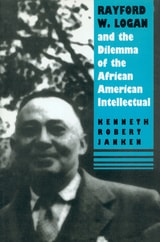
Rayford W. Logan and the Dilemma of the African American Intellectual
Kenneth Robert Janken
University of Massachusetts Press, 1993
This biography of the African-American activist and scholar, Rayford W. Logan, draws from his own work, letters, diaries and autobiography to create a portrait of a lesser-known member of the Black scholarly elite in the mid-20th century.
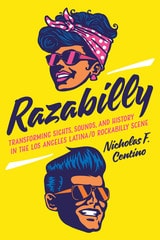
Razabilly
Transforming Sights, Sounds, and History in the Los Angeles Latina/o Rockabilly SceneBy Nicholas F. Centino
University of Texas Press, 2021
Vocals tinged with pain and desperation. The deep thuds of an upright bass. Women with short bangs and men in cuffed jeans. These elements and others are the unmistakable signatures of rockabilly, a musical genre normally associated with white male musicians of the 1950s. But in Los Angeles today, rockabilly's primary producers and consumers are Latinos and Latinas. Why are these "Razabillies" partaking in a visibly "un-Latino" subculture that's thought of as a white person's fixation everywhere else?
As a Los Angeles Rockabilly insider, Nicholas F. Centino is the right person to answer this question. Pairing a decade of participant observation with interviews and historical research, Centino explores the reasons behind a Rockabilly renaissance in 1990s Los Angeles and demonstrates how, as a form of working-class leisure, this scene provides Razabillies with spaces of respite and conviviality within the alienating landscape of the urban metropolis. A nuanced account revealing how and why Los Angeles Latinas/os have turned to and transformed the music and aesthetic style of 1950s rockabilly, Razabilly offers rare insight into this musical subculture, its place in rock and roll history, and its passionate practitioners.
Re-Envisioning Past Musical Cultures
Ethnomusicology in the Study of Gregorian ChantPeter Jeffery
University of Chicago Press, 1992
Peter Jeffery offers an innovative new approach for understanding how these melodies were created, memorized, performed, and modified. Drawing on a variety of disciplines, including anthropology and ethnomusicology, he identifies characteristics of Gregorian chant that closely resemble other oral traditions in non-Western cultures and demonstrates ways music historians can take into account the social, cultural, and anthropological contexts of chant's development.
Re-Framing the Transnational Turn in American Studies
Edited by Winfried Fluck, Donald E. Pease, and John Carlos Rowe
Dartmouth College Press, 2011
Re-Mapping Centre and Periphery
Asymmetrical Encounters in European and Global ContextsEdited by Tessa Hauswedell, Axel Körner, and Ulrich Tiedau
University College London, 2019
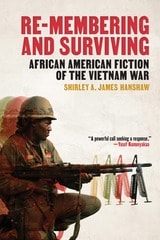
Re-Membering and Surviving
African American Fiction of the Vietnam WarShirley A. James Hanshaw
Michigan State University Press, 2020
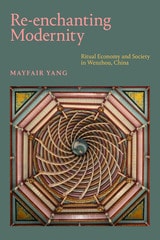
Re-enchanting Modernity
Ritual Economy and Society in Wenzhou, ChinaMayfair Yang
Duke University Press, 2020
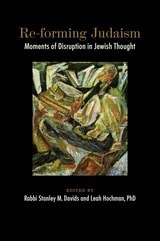
Re-forming Judaism
Moments of Disruption in Jewish ThoughtRabbi Stanley M. Davids and Leah Hochman, PhD
Central Conference of American Rabbis, 2023
Throughout Jewish history, revolutionary events and subversive ideas have burst forth, repeatedly transforming Jewish experience. Re-forming Judaism seeks to explore these ideas—and the individuals behind them—by delving into historical disruptions that led to lasting change in Jewish thought. A distinguished array of scholars take us on a journey from the disruptive prophets of ancient times, through rational, mystical, and extremist medievalists, to the impact of Haskalah and early Reform thought in modernity. Contemporary innovations such as changes in liturgy and music, feminism, and post-Holocaust theology are included, as are insights into Sephardic and North African experiences. By showing how Judaism forms—then re-forms, and re-forms again—the contributors demonstrate that tensions between continuity and change have always been part of Jewish life, helping us to both understand the past and contemplate the future.
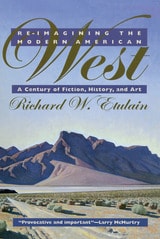
Re-imagining the Modern American West
A Century of Fiction, History, and ArtRichard W. Etulain
University of Arizona Press, 1996
He discusses novelists from Jack London to John Steinbeck and on to Joan Didion. He covers historians from Frederick Jackson Turner to Earl Pomeroy and Patricia Nelson Limerick, and artists from Frederic Remington and Charles Russell to Georgia O’Keeffe and R. C. Gorman. The author places emphasis on women painters and authors such as Mary Hallock Foote, Mary Austin, Willa Cather, and Judith Baca. He also stresses important works of ethnic writers including Leslie Marmon Silko, Rudolfo Anaya, and Amy Tan. An intriguing survey of tendencies and trends and a well-defined profile of influences and outgrowths, this book will be valuable to students and scholars of western culture and history, American studies, and related disciplines. General readers will appreciate the book’s balanced structure and spirited writing style. All readers, whatever their level of interest, will discover the major cultural inventions of the American West over the past one hundred years.
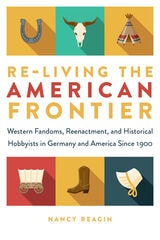
Re-living the American Frontier
Western Fandoms, Reenactment, and Historical Hobbyists in Germany and America Since 1900Nancy Reagin
University of Iowa Press, 2021
But the Old West (like all visions of the past) proved to be shifting cultural terrain. In both Germany and the U. S., Western narratives of white settlement were once seen as “apolitical” and were widely accepted by white people. But during the Nazi period in Germany and in East Germany after 1945, the American West was reevaluated and politically repurposed. Then, during the late twentieth century, understandings of the West changed in the U. S. as well, while the violence of white settler colonialism and the displacement of Indigenous peoples became a flashpoint in the culture wars between right and left. Reagin shows that the past that fans seek to recreate is shaped by the changing present, as each new generation adapts and relives their own West.
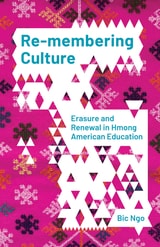
Re-membering Culture
Erasure and Renewal in Hmong American EducationBic Ngo
University of Minnesota Press, 2024
The untold stories of resilience in Hmong American education
Re-membering Culture is a deep exploration of the intricate dynamics of cultural memory and education, centering the experiences of Hmong American students and educators. Arguing that the school, as a product of coloniality, perpetuates the marginalization and erasure of non-Western epistemologies, author Bic Ngo sheds light on the subtle yet impactful process of structured forgetting within the American education system. This politics of forgetting, in turn, contributes to the fragmentation of Hmong cultural heritage, identity, and community.
Based on a high school in an urban center with a considerable Hmong immigrant community, Ngo’s work draws on extensive ethnographic research with Hmong American community leaders, school administrators, parents, teachers, staff, and high school students to understand how they navigate the terrain of Western pedagogy while attempting to retain and preserve Hmong knowledge systems. Exploring a range of school experiences, Ngo traverses students’ challenges in balancing school with family life and the everyday cultural racism encountered in the classroom as well as grassroots efforts to preserve culture, including the establishment of a Hmong Cultural Club.
Highlighting these experiences and voices, Ngo provides a nuanced understanding of the challenges Hmong Americans face within an assimilationist society while contesting the dominant anti-immigrant narratives of refugee suffering and poverty. Through these practices of (re)storytelling, resurgence, and refusal, she underscores the agency of the Hmong American community, illuminating how the critical consciousness fostered by re-membering serves as a powerful tool in confronting white hegemonic ideologies in education.
Retail e-book files for this title are screen-reader friendly.
Re/imaginations of Disability in State Socialism
Visions, Promises, FrustrationsEdited by Katerina Kolárová and Martina Winkler
Campus Verlag, 2021
In Re/imaginations of Disability in State Socialism, an interdisciplinary group of scholars examines how disability has been conceptualized and treated in socialist states throughout global history. Drawing on intersectional theories that set disability in conversation with other identity categories such as race, age, gender, and sexuality, this book offers a unique approach to this crucial issue.
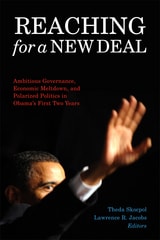
Reaching for a New Deal
Ambitious Governance, Economic Meltdown, and Polarized Politics in Obama's First Two YearsTheda Skocpol
Russell Sage Foundation, 2011
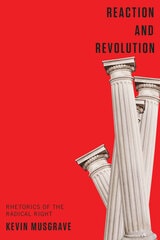
Reaction and Revolution
Rhetorics of the Radical RightKevin Musgrave
Michigan State University Press, 2027
Reaction and Revolution situates the resurgence of far-right movements and thinkers within a longer intellectual history that emerged primarily in interwar Germany—a philosophical conversation centered on political theology. Arguing that the more radically democratic modes of political theology offer better ways to understand and to counter the far right’s rhetorical appeal, this book offers a rhetorical-intellectual critique of three key thinkers and their allied movements: Paul Gottfried and the American paleoconservatives, Guillaume Faye and the French Identitarians, and Nick Land and the Dark Enlightenment. Kevin Musgrave argues that a radical political theology of race offers meaningful ways of challenging the right’s efforts to build a global imperium of whiteness and of reclaiming the promise of human dignity.
Reaction to World News Events and the Influence of Mass Media in an Indian Village
Thomas Poffenberger and Shirley B. Poffenberger
University of Michigan Press, 1971
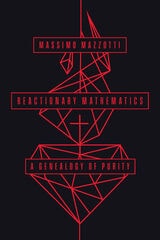
Reactionary Mathematics
A Genealogy of PurityMassimo Mazzotti
University of Chicago Press, 2023
The nineteenth century opened with a major shift in European mathematics, and in the Kingdom of Naples, this occurred earlier than elsewhere. Between 1790 and 1830 its leading scientific institutions rejected as untrustworthy the “very modern mathematics” of French analysis and in its place consolidated, legitimated, and put to work a different mathematical culture. The Neapolitan mathematical resistance was a complete reorientation of mathematical practice. Over the unrestricted manipulation and application of algebraic algorithms, Neapolitan mathematicians called for a return to Greek-style geometry and the preeminence of pure mathematics.
For all their apparent backwardness, Massimo Mazzotti explains, they were arguing for what would become crucial features of modern mathematics: its voluntary restriction through a new kind of rigor and discipline, and the complete disconnection of mathematical truth from the empirical world—in other words, its purity. The Neapolitans, Mazzotti argues, were reacting to the widespread use of mathematical analysis in social and political arguments: theirs was a reactionary mathematics that aimed to technically refute the revolutionary mathematics of the Jacobins. During the Restoration, the expert groups in the service of the modern administrative state reaffirmed the role of pure mathematics as the foundation of a newly rigorous mathematics, which was now conceived as a neutral tool for modernization. What Mazzotti’s penetrating history shows us in vivid detail is that producing mathematical knowledge was equally about producing certain forms of social, political, and economic order.