Results by title
4531 books match the query 'Cultural & Ethnic Studies' and 272 start with r
Resurgency
Outlasting the War on Terror in IraqKali Rubaii
Duke University Press, 2026
In Resurgency, Kali Rubaii offers detailed ethnographic insight into how decades of war have affected everyday life in Iraq. Drawing on fieldwork in Anbar province and Iraqi Kurdistan in 2014–15 and 2021–24, Rubaii foregrounds the practices of displaced people who stubbornly outlast their occupiers, returning to homes that feel estranging, repairing war-damaged land, and surviving into futures to which they have been disinvited. Following Anbari farmers in their struggle to counter the social and environmental fallout from toxic military waste, depleted ecosystems, and transformed political economies, Resurgency expands the temporal and descriptive categories of what war is—and what resistance looks like. By asking what actions and dispositions make sense when conditions of survival are diminished, and when today may be better than tomorrow, Rubaii offers new methods and insights to those concerned about the possibilities of life amid environmental devastation, mass displacement, and the slow violence of the forever wars.
Resurgent Voices in Latin America
Indigenous Peoples, Political Mobilization, and Religious ChangeCleary, Edward L.
Rutgers University Press, 2004
After more than 500 years of marginalization, Latin America’s forty million Indians have recently made major strides in gaining political recognition and civil rights. In this book, social scientists explore the important role of religion in indigenous activism, showing the ways that religion has strengthened indigenous identity and contributed to the struggle for indigenous rights in the region.
Drawing on case studies from Bolivia, Peru, Guatemala, Ecuador, Paraguay, and Mexico, the contributors explore four key questions. How have traditional religions interacted with Christianity to produce new practices and beliefs? What resources, motivations, and ideological legitimacies do religious institutions provide for indigenous social movements? How effective are these movements in achieving their goals? Finally, as new religious groups continue to compete for adherents in the region, how will individuals’ religious choices affect political outcomes?
Resurgent Voices in Latin America offers new insight into the dynamics of indigenous social movements and into the complex and changing world of Latin American religions. The essays show that religious beliefs, practices, and institutions have both affected and been affected by political activism.
Rethinking America's Past
Voices from the Kinsey African American Art and History CollectionEdited by Tim Gruenewald
University of Minnesota Press, 2019
Among the first scholarly books dedicated to a private African American collection, Rethinking America’s Past: Voices from the Kinsey African American Art and History Collection both chronicles the reach of this important cultural collection and contributes to its project by sharing selected objects and stories with a broader audience. Essays range in subject from iconic African American artists, such as Loïs Mailou Jones and Beauford Delaney, to important historical figures such as Frederick Douglas and Martin Luther King, to individuals whose experiences might be lost to history but for the found objects that preserve their stories. Rethinking America’s Past demonstrates how the African American story, from slavery through the present, is represented and can be actively remembered through the act of collecting.
Rethinking America’s Past will appeal to audiences interested in African American history as well as art history, but its real power is in linking the two, showing how important collections are in constructing and repairing historical narratives, and how in the words of editor Tim Gruenewald, “Collecting overlooked aspects of our past and sharing such collections enables a deeper understanding of the present moment, and facilitates a more inclusive and just future.”
Rethinking Chinese Socialist Theaters of Reform
Performance Practice and Debate in the Mao EraXiaomei Chen, Tarryn Li-Min Chun, and Siyuan Liu, Editors
University of Michigan Press, 2021
Rethinking Community in Myanmar
Practices of We-Formation among Muslims and Hindus in Urban YangonJudith Beyer
National University of Singapore Press, 2023

Rethinking Japanese History
Amino Yoshihiko; Translated and with an Introduction by Alan S. Christy; Preface and Afterword by Hitomi Tonomura
University of Michigan Press, 2012

Rethinking Protestantism in Latin America
David Stoll
Temple University Press, 1993
Rethinking the Greek Campaign to Repatriate the Parthenon Marbles
Problems and Complexities with Contested Cultural HeritageJames Beresford
Central European University Press, 2026
Return Engagements
Contemporary Art's Traumas of Modernity and History in Sài Gòn and Phnom PenhViet Lê
Duke University Press, 2021
Return Of Guatemala'S Refugees
Clark Taylor
Temple University Press, 1998
Twelve years later, utilizing terms of refugee agreements reached in 1982, villagers from Santa Maria who had fled to Mexico returned to their homes and lands to re-create their community with those who had stayed in Guatemala. Return of Guatemala's Refugees tells the story of that process. In this moving and provocative book, Clark Taylor describes the experiences of the survivors -- both those who stayed behind in conditions of savage repression and those who fled to Mexico where they learned to organize and defend their rights. Their struggle to rebuild is set in the wider drama of efforts by grassroots groups to pressure the government, economic elites, and army to fulfill peace accords signed in December of 1996.
Focusing on the village of Santa Maria Tzeja, Taylor defines the challenges that faced returning refugees and their community. How did the opposing subcultures of fear (generated among those who stayed in Guatemala) and of education and human rights (experienced by those who took refuge in Mexico) coexist? Would the flood of international money sent to settle the refugees and fulfill the peace accords serve to promote participatory development or new forms of social control? How did survivors expand the space for democracy firmly grounded in human rights? How did they get beyond the grief and trauma that remained from the terror of the early eighties? Finally, the ultimate challenge, how did they work within conditions of extreme poverty to create a grassroots democracy in a militarized society?
Return from the World
Economic Growth and Reverse Migration in BrazilGregory Duff Morton
University of Chicago Press, 2024
In Return from the World, anthropologist Gregory Duff Morton traces the migrations of Brazilian workers who leave a thriving labor market and return to their home villages to become peasant farmers. Morton seeks to understand what it means to turn one’s back deliberately on the promise of economic growth.
Giving up their positions in factories, at construction sites, and as domestic workers, these migrants travel thousands of miles back to villages without running water or dependable power. There, many take up subsistence farming. Some become activists with the MST, Brazil’s militant movement of landless peasants. Bringing their stories vividly to life, Morton dives into the dreams and disputes at play in finding freedom in the shared rejection of growth.

Return to Centro Histórico
A Mexican Jew Looks for His RootsStavans, Ilan
Rutgers University Press, 2012
After a stirring e-mail exchange with his father, awardwinning essayist and cultural commentator Ilan Stavans decided to do something bizarre: revisit his hometown, Mexico City, accompanied by a tourist guide. But rather than seeking his roots in the neighborhood where he grew up, he headed to the Centro Histórico, the downtown area at the heart of the world’s largest metropolis. It was there that conversos, the hidden Jews escaping the might of the Holy Office of the Inquisition, were burned at the stake. And, centuries later, it was the same section where Jewish immigrants, both Yiddish-speaking Ashkenazim and Sephardim from the Ottoman Empire, made their homes as peddlers. In a sense, Centro Histórico is to Mexico what the Lower East Side is to the United States: a platform for reinventing one’s self in the New World.
With the same linguistic verve and insight that has made him one of the most distinguished voices in American literature today, Ilan Stavans invites readers along for a personal journey that is not only his own, but that of an entire culture. In Return to Centro Histórico he makes it possible to understand the intimate role that Jews have played in the development of Hispanic civilization.
Returning the Gaze
A Genealogy of Black Film Criticism, 1909–1949Anna Everett
Duke University Press, 2001
Culling black newspapers, magazines, scholarly and political journals, and monographs, Everett has produced an unparalleled investigation of black critical writing on the early cinema during the era of racial segregation in America. Correcting the notion that black critical interest in the cinema began and ended with the well-documented press campaign against D. W. Griffith’s Birth of a Nation, she discovers that as early as 1909 black newspapers produced celebratory discourses about the cinema as a much-needed corrective to the predominance of theatrical blackface minstrelsy. She shows how, even before the Birth of a Nation controversy, the black press succeeded in drawing attention to both the callous commercial exploitation of lynching footage and the varied work of black film entrepreneurs. The book also reveals a feast of film commentaries that were produced during the “roaring twenties” and the jazz age by such writers as W.E.B. DuBois, Langston Hughes, and Zora Neale Hurston, as well as additional pieces that were written throughout the Depression and the pre– and post–war periods. Situating this wide-ranging and ideologically complex material in its myriad social, political, economic, and cultural contexts, Everett aims to resuscitate a historical tradition for contemporary black film literature and criticism.
Returning the Gaze will appeal to scholars and students of film, black and ethnic studies, American studies, cultural studies, literature, and journalism.
Reunited
Family Separation and Central American Youth MigrationErnesto Castañeda
Russell Sage Foundation, 2024
In interviews with Central American youth, their sponsors, and social services practitioners in and around Washington, D.C., Castañeda and Jenks find that Central American minors migrate on their own mainly for three reasons: gang violence, lack of educational and economic opportunity, and a longing for family reunification. The authors note that youth who feel comfortable leaving and have feelings of belonging upon arrival integrate quickly and easily while those who experience trauma in their home countries and on their way to the United States face more challenges.
Castañeda and Jenks recount these young migrants’ journey from Central America to the U.S. border, detailing the youths’ difficulties passing through Mexico, proving to U.S. Customs and Border Protection officials that they have a legitimate fear of returning or are victims of trafficking, and staying in shelters while their sponsorship, placement, and departure are arranged. The authors also describe the tensions the youth face when they reunite with family members they may view as strangers. Despite their biological, emotional, and financial bonds to these relatives, the youth must learn how to relate to new authority figures and decide whether or how to follow their rules.
The experience of migrating can have a lasting effect on the mental health of young migrants, Castañeda and Jenks note. Although the authors find that Central American youths’ mental health improves after migrating to the United States, the young migrants remain at risk of further problems. They are likely to have lived through traumatizing experiences that inhibit their integration. Difficulty integrating, in turn, creates new stressors that exacerbate PTSD, depression, and anxiety. Consequently, schools and social service organizations are critical, the authors argue, for enhancing youth migrants’ sense of belonging and their integration into their new communities. Bilingual programs, Spanish-speaking PTA groups, message boards, mentoring of immigrant children, and after-school programs for members of reunited families are all integral in supporting immigrant youth as they learn English, finish high school, apply to college, and find jobs.
Offering a complex exploration of youth migration and family reunification, Reunited provides a moving account of how young Central American migrants make the journey north and ultimately reintegrate with their families in the United States.

Revealed Identity
The Noh Plays of Komparu ZenchikuPaul S. Atkins
University of Michigan Press, 2006

Reverberations of Racial Violence
Critical Reflections on the History of the BorderEdited by Sonia Hernández and John Morán González
University of Texas Press, 2021
Between 1910 and 1920, thousands of Mexican Americans and Mexican nationals were killed along the Texas border. The killers included strangers and neighbors, vigilantes and law enforcement officers—in particular, Texas Rangers. Despite a 1919 investigation of the state-sanctioned violence, no one in authority was ever held responsible.
Reverberations of Racial Violence gathers fourteen essays on this dark chapter in American history. Contributors explore the impact of civil rights advocates, such as José Tomás Canales, the sole Mexican-American representative in the Texas State Legislature between 1905 and 1921. The investigation he spearheaded emerges as a historical touchstone, one in which witnesses testified in detail to the extrajudicial killings carried out by state agents. Other chapters situate anti-Mexican racism in the context of the era's rampant and more fully documented violence against African Americans. Contributors also address the roles of women in responding to the violence, as well as the many ways in which the killings have continued to weigh on communities of color in Texas. Taken together, the essays provide an opportunity to move beyond the more standard Black-white paradigm in reflecting on the broad history of American nation-making, the nation’s rampant racial violence, and civil rights activism.
Reverend Addie Wyatt
Faith and the Fight for Labor, Gender, and Racial EqualityMarcia Walker-McWilliams
University of Illinois Press, 2016
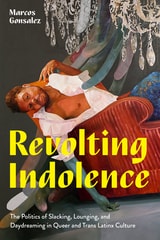
Revolting Indolence
The Politics of Slacking, Lounging, and Daydreaming in Queer and Trans Latinx CultureMarcos Gonsalez
University of Texas Press, 2024
2026 Bronze Medal for the Best LGBTQ+ Themed Book, Conference on Latin American History (CLAH)
2025 Honorable Mention, John Leo & Dana Heller Award for Best Single Work, Anthology, Multi-Authored, or Edited Book in LGBTQ Studies, Popular Culture Association (PCA)
2025 Honorable Mention, Alan Bray Memorial Book Prize, GL/Q Caucus of the Modern Language Association and the Q/T Caucus of the American Studies Association
How indolent practices in Latinx LGBTQ culture challenge capitalist imperatives to be productive.
Revolting Indolence makes a case for laziness as an aesthetic-political strategy for countering the oppressive logics of cisheteronormative racial capitalism. Focusing on ways in which queer and trans Latinx people demonstrate the unwillingness of their participation in “productivist” ethics and allied respectability politics, Marcos Gonsalez argues that slacking off, lounging, daydreaming, and partying are liberatory practices—revolts that in turn are treated as revolting.
Gonsalez explores how queer and trans Latinx artists refute discourses in which work is a moral good. In Paris Is Burning, RuPaul's Drag Race, documentary photography of queer and trans Latinx life in Los Angeles, and other sources, Gonsalez identifies two lazy styles: first, flagrant refusals of work that critique capitalist reason; and second, the invention of alternative aesthetic worlds beyond racial capitalism and violence targeting queer and trans people, whose rejection of the cisgender nuclear family paradigm is rightly seen as threatening the stability of a functioning capitalist system. Reclaiming laziness as a resource for radical imagining, Revolting Indolence asks us to do that which we want most and which capitalist exploitation can least tolerate: to slow down.
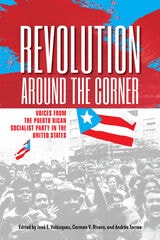
Revolution Around the Corner
Voices from the Puerto Rican Socialist Party in the U.S.Edited by José E. Velázquez, Carmen V. Rivera, and Andrés Torres
Temple University Press, 2021
Active from the late 1960s until the mid-1990s, the U.S. branch of the Puerto Rican Socialist Party (PSP) worked simultaneously to build support for Puerto Rican independence and to engage in radical social change within the United States.
Revolution Around the Corner chronicles this unique social movement, describing various mass campaigns and the inner workings of the organization. The editors and contributors—all former members, leaders, and supporters of the PSP—offer a range of views and interpretations of their experience.
Combining historical accounts, personal stories, interviews, and retrospective analysis, Revolution Around the Corner examines specific actions such as the National Day of Solidarity (El Acto Nacional), the Bicentennial without Colonies, the Save Hostos struggle, and the Vieques campaign. Testimonies recount the pros and cons of membership diversity, as well as issues of loyalty and compañerismo. In addition, essays describe the PSP’s participation in coalitions and alliances with Left and progressive movements. The book concludes with the editors’ reflections on the PSP’s achievements, mistakes, and contributions.
Revolution Squared
Tahrir, Political Possibilities, and Counterrevolution in EgyptAtef Shahat Said
Duke University Press, 2024
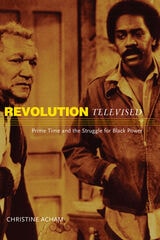
Revolution Televised
Prime Time and the Struggle for Black PowerChristine Acham
University of Minnesota Press, 2005
In Revolution Televised, Christine Acham offers a more complex reading of this period in African American television history, finding within these programs opposition to dominant white constructions of African American identity. She explores the intersection of popular television and race as witnessed from the documentary coverage of the civil rights and Black Power movements, the personal politics of Flip Wilson and Soul Train’s Don Cornelius, and the ways in which notorious X-rated comic Redd Foxx reinvented himself for prime time.
Reflecting on both the potential of television to effect social change as well as its limitations, Acham concludes with analyses of Richard Pryor’s politically charged and short-lived sketch comedy show and the success of outspoken comic Chris Rock. Revolution Televised deftly illustrates how black television artists operated within the constraints of the television industry to resist and ultimately shape the mass media’s portrayal of African American life.
Christine Acham is assistant professor in African American and African studies at the University of California, Davis.
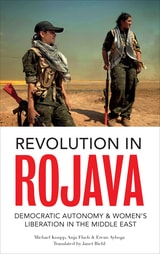
Revolution in Rojava
Democratic Autonomy and Women's Liberation in the Syrian KurdistanMichael Knapp, Ercan Ayboga, and Anja Flach
Pluto Press, 2016
Revolution in Rojava tells the story of Rojava's groundbreaking experiment in what they call democratic confederalism, a communally organized democracy that is fiercely anti-capitalist and committed to female equality, while rejecting reactionary nationalist ideologies.
Rooted in the ideas of imprisoned Kurdish leader Abdullah Ocalan, the system is built on effective gender quotas, bottom-up democratic structures, far-sighted ecological policies, and a powerful militancy that has allowed the region to keep ISIS at bay.
Given the widespread violence and suffering in Syria, it's not unreasonable that outsiders look at the situation as unrelentingly awful. And while the reality of the devastation is undeniable, there is reason for hope in at least one small pocket of the nation: the cantons of Rojava in Syrian Kurdistan, where in the wake of war people are quietly building one of the most progressive societies in the world today. Chapters here include:
*Rojava's Diverse Cultures
*Democratic Confederalism
*The Liberation
*A Women's Revolution
*Democratic Autonomy in Rojava
*Civil Society Associations
*The Theory of the Rose: Defense
*The New Justice System
*Democratization of Education
*Health Care
*The Social Economy
*Ecological Challenges
This first full-length study of democratic developments in Rojava tells an extraordinary and powerfully hopeful story of a little-known battle for true freedom in dark times. With excellent first-hand background information about this important, but little understood struggle, Revolution in Rojava will educate and inspire the reader to learn more about Rojava, Syria, and the fight for change in one of the world’s most dangerous regions.
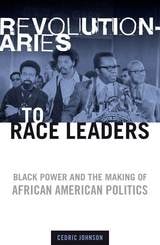
Revolutionaries to Race Leaders
Black Power and the Making of African American PoliticsCedric Johnson
University of Minnesota Press, 2007
The Black Power movement represented a key turning point in American politics. Disenchanted by the hollow progress of federal desegregation during the 1960s, many black citizens and leaders across the United States demanded meaningful self-determination. The popular movement they created was marked by a vigorous artistic renaissance, militant political action, and fierce ideological debate.
Exploring the major political and intellectual currents from the Black Power era to the present, Cedric Johnson reveals how black political life gradually conformed to liberal democratic capitalism and how the movement’s most radical aims—the rejection of white aesthetic standards, redefinition of black identity, solidarity with the Third World, and anticapitalist revolution—were gradually eclipsed by more moderate aspirations. Although Black Power activists transformed the face of American government, Johnson contends that the evolution of the movement as a form of ethnic politics restricted the struggle for social justice to the world of formal politics.
Johnson offers a compelling and theoretically sophisticated critique of the rhetoric and strategies that emerged in this period. Drawing on extensive archival research, he reinterprets the place of key intellectual figures, such as Harold Cruse and Amiri Baraka, and influential organizations, including the African Liberation Support Committee, the National Black Political Assembly, and the National Black Independent Political Party in postsegregation black politics, while at the same time identifying the contradictions of Black Power radicalism itself.
Documenting the historical retreat from radical, democratic struggle, Revolutionaries to Race Leaders ultimately calls for the renewal of popular struggle and class-conscious politics.
Cedric Johnson is assistant professor of political science at Hobart and William Smith Colleges.
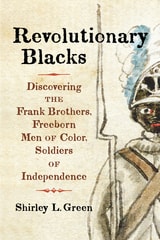
Revolutionary Blacks
Discovering the Frank Brothers, Freeborn Men of Color, Soldiers of IndependenceShirley L. Green
Westholme Publishing, 2026
In Revolutionary Blacks: Discovering the Frank Brothers, Freeborn Men of Color, Soldiers of Independence historian Shirley L. Green takes the reader on a journey based on her family’s history, rooted in its oral tradition. Putting together the pieces of this puzzle through archival research, interviews, and DNA evidence, the author authenticates and expands the family’s oral history. In addition to providing context and substance to the Black experience during the war years, the author underscores the significant distinction between free Blacks in military service and those who had been enslaved, and how they responded in different ways to the harsh realities of racism. An original and important contribution to American history, Revolutionary Blacks presents a complex account of Black life during the Revolutionary Era and demonstrates that free men of color shared with white soldiers the desire to improve their condition in life and to maintain their families safely in postcolonial North America.
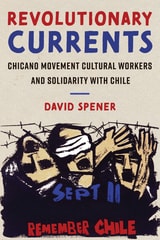
Revolutionary Currents
Chicano Movement Cultural Workers and Solidarity with ChileDavid Spener
University of Arizona Press, 2027
On September 11, 1973, General Augusto Pinochet led a bloody military coup in Chile that overthrew Salvador Allende’s democratically elected socialist government. The coup ushered in a cruelly repressive dictatorship that would govern the country for the next seventeen years, constituting a watershed moment in Cold War history.
This book recounts the untold story of how Chicano Movement poets, artists, musicians, and theater groups in the United States used their work to express solidarity with the international campaign to restore democracy in Chile. Such expressions of solidarity were especially prominent in the San Francisco Bay Area, where hundreds of Chilean exiles settled following the coup. Upon arrival, they joined a diverse Latinx population that was home to a Chicanx arts community whose members’ political orientations primed them to lend their talents to anti-imperialist causes. These Chicanxs were also drawn to the campaign against the dictatorship through friendship and acquaintance with members of the Chilean exile community.
David Spener shows how the Bay Area’s unique cosmopolitan social context offered Chicanxs and Chileans meaningful opportunities for dialogue and collaboration with each other as well as with Latinxs of other national origins. Chicanxs often adopted a pan-ethnic raza identity that they could share with Chilean, Nicaraguan, Puerto Rican, Salvadoran, and other Latinx activists. This did not mean, however, that they abandoned the political identities that they had gained from the Chicano Movement. Instead, many came to see themselves as uniting with other Latinxs, first Chileans and then Nicaraguans and Salvadorans, in a struggle against U.S. imperialism throughout the Americas.
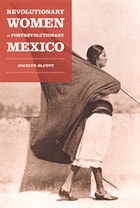
Revolutionary Women in Postrevolutionary Mexico
Jocelyn Olcott
Duke University Press, 2005
Olcott demonstrates an extraordinary grasp of the complexity of postrevolutionary Mexican politics, exploring the goals and outcomes of women’s organizing in Mexico City and the port city of Acapulco as well as in three rural locations: the southeastern state of Yucatán, the central state of Michoacán, and the northern region of the Comarca Lagunera. Combining the strengths of national and regional approaches, this comparative perspective sets in relief the specificities of citizenship as a lived experience.
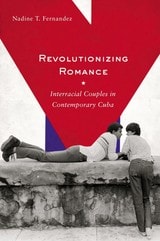
Revolutionizing Romance
Interracial Couples in Contemporary CubaFernandez, Nadine T
Rutgers University Press, 2010
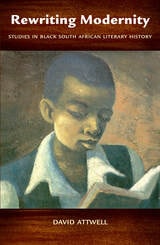
Rewriting Modernity
Studies in Black South African Literary HistoryDavid Attwell
Ohio University Press, 2006
Rewriting Modernity: Studies in Black South African Literary History connects the black literary archive in South Africa—from the nineteenth-century writing of Tiyo Soga to Zakes Mda in the twenty-first century—to international postcolonial studies via the theory of transculturation, a position adapted from the Cuban anthropologist Fernando Ortiz.
David Attwell provides a welcome complication of the linear black literary history—literature as a reflection of the process of political emancipation—that is so often presented. He focuses on cultural transactions in a series of key moments and argues that black writers in South Africa have used print culture to map themselves onto modernity as contemporary subjects, to negotiate, counteract, reinvent, and recast their positioning within colonialism, apartheid, and the context of democracy.
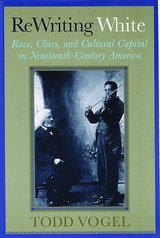
Rewriting White
Race, Class, and Cultural Capital in Nineteenth-Century AmericaTodd Vogel
Rutgers University Press, 2004
What did it mean for people of color in nineteenth-century America to speak or write "white"? More specifically, how many and what kinds of meaning could such "white" writing carry? In ReWriting White, Todd Vogel looks at how America has racialized language and aesthetic achievement. To make his point, he showcases the surprisingly complex interactions between four nineteenth-century writers of color and the "standard white English" they adapted for their own moral, political, and social ends. The African American, Native American, and Chinese American writers Vogel discusses delivered their messages in a manner that simultaneously demonstrated their command of the dominant discourse of their times-using styles and addressing forums considered above their station-and fashioned a subversive meaning in the very act of that demonstration.
The close readings and meticulous archival research in ReWriting White upend our conventional expectations, enrich our understanding of the dynamics of hegemony and cultural struggle, and contribute to the efforts of other cutting-edge contemporary scholars to chip away at the walls of racial segregation that have for too long defined and defaced the landscape of American literary and cultural studies.
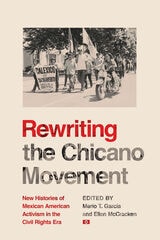
Rewriting the Chicano Movement
New Histories of Mexican American Activism in the Civil Rights EraMario T. García
University of Arizona Press, 2021
The essays in this volume broaden traditional views of the Chicano Movement that are too narrow and monolithic. Instead, the contributors to this book highlight the role of women in the movement, the regional and ideological diversification of the movement, and the various cultural fronts in which the movement was active. Rewriting the Chicano Movement stresses that there was no single Chicano Movement but instead a composite of movements committed to the same goal of Chicano self-determination. Scholars, students, and community activists interested in the history of the Chicano Movement can best start by reading this book.
Contributors: Holly Barnet-Sanchez, Tim Drescher, Jesús Jesse Esparza, Patrick Fontes, Mario T. García, Tiffany Jasmín González, Ellen McCracken, Juan Pablo Mercado, Andrea Muñoz, Michael Anthony Turcios, Omar Valerio-Jiménez
Rhetorics of Refusal
Medical Dissent and the US-Somali DiasporaKari Campeau
The Ohio State University Press, 2025
Rhetorics of Refusal focuses on a recent public health crisis—Minnesota’s 2017 measles outbreak—to recast vaccine refusals less as products of poor health literacy or disinformation and more as strategic and generative acts of noncompliance. The outbreak, which primarily affected unvaccinated Somali children, occurred at the nexus of declining vaccination rates, spiking autism concerns, antivaccination predation, and a fraying public health infrastructure. However, during a year-long ethnographic study at a Somali health center, Kari Campeau found that personal stories from parents offered a much different picture of vaccine refusal than the one painted by news media. Tracking refusals across four sites, Campeau argues for the importance of approaching refusals as rhetorical and participatory strategies that hold institutions accountable, press for change, and practice care within emergent biosocial communities. Moreover, she views refusal as necessary and potentially transformative in situations where refusers have little access to power or platform. By contextualizing refusals in longer cultural and political histories, Campeau unsettles traditional narratives of medical dissent while offering new entry points into discussions on racialized biopolitics, care, disability, and public health.

Rhymin' and Stealin'
Musical Borrowing in Hip-HopJustin A. Williams
University of Michigan Press, 2014
Rhymin’ and Stealin’begins with a crucial premise: the fundamental element of hip-hop culture and aesthetics is the overt use of preexisting material to new ends. Whether it is taking an old dance move for a breakdancing battle, using spray paint to create street art, quoting from a famous speech, or sampling a rapper or 1970s funk song, hip-hop aesthetics involve borrowing from the past. By appropriating and reappropriating these elements, they become transformed into something new, something different, something hip-hop. Rhymin’ and Stealin’ is the first book-length study of musical borrowing in hip-hop music, which not only includes digital sampling but also demonstrates a wider web of references and quotations within the hip-hop world. Examples from Nas, Jay-Z, A Tribe Called Quest, Eminem, and many others show that the transformation of preexisting material is the fundamental element of hip-hop aesthetics. Although all music genres use and adapt preexisting material in different ways, hip-hop music celebrates and flaunts its “open source” culture through highly varied means. It is this interest in the web of references, borrowed material, and digitally sampled sounds that forms the basis of this book—sampling and other types of borrowing becomes a framework with which to analyze hip-hop music and wider cultural trends.
Rhythm Is Our Business
Jimmie Lunceford and the Harlem ExpressEddy Determeyer
University of Michigan Press, 2010
"The first detailed study of one of the swing era's most important bands and the first biography of its leader, Jimmie Lunceford. This is a most welcome and significant contribution to the literature of jazz, to our understanding of a vital period in jazz history, and to the music of an outstanding and unique ensemble that was emblematic of the swing era."
---Dan Morgenstern, Director, Institute of Jazz Studies, Rutgers University, and author of Living with Jazz
"We were more popular than Benny Goodman! We were the first black band that played the Paramount Theater, downtown New York. Not Duke Ellington, not Count Basie. Six weeks in a row, four or five shows daily, and it was packed every day, people lining up around the corner constantly! We could outdraw any band in the country."
---Gerald Wilson
"Jimmie Lunceford was a key swing-era figure, and no book covers his biography and music like this one does. Grounded in years of research and inspired by the writer's love of his subject, the book fills a critical gap in the jazz literature and will be essential reading for all swing aficionados."
---Jeffrey Magee, Associate Professor of Musicology, University of Illinois, Urbana-Champaign, and author of The Uncrowned King of Swing: Fletcher Henderson and Big Band Jazz
"It was Jimmie Lunceford and his orchestra that inspired me to become a musician. I was eleven years old at the time. When I heard that band play I said to myself, 'That's for me. I want to become a musician.' I still get inspired when I listen to some of their recordings. The Jimmie Lunceford Orchestra is one of the great jazz orchestras of all time."
---Horace Silver
"Jimmie Lunceford has the best of all bands. Duke is great, Basie is remarkable, but Lunceford tops them both."
---Glenn Miller
In the 1930s, swing music reigned, and the Jimmie Lunceford Orchestra was the hottest and hippest attraction on the black dance circuits. Known for its impeccable appearance and infectious rhythms, Lunceford's group was able to out-swing and outdraw any band. For ten consecutive years, they were the best-loved attraction at Harlem's famed Apollo Theater. The group's hit recordings sold in the hundreds of thousands, and Jimmie Lunceford's band rivaled Ellington's for popularity in the African American community.
Jimmie Lunceford was also an innovator, elevating big-band showmanship to an art and introducing such novel instruments as the electric guitar and bass. The band's arrangements, written by Sy Oliver, Edwin Wilcox, Gerald Wilson, Billy Moore, Jr., and Tadd Dameron, were daring and forward looking, influencing generations of big-band writers.
Rhythm Is Our Business traces the development of the Jimmie Lunceford Orchestra from its infant days as a high school band in Memphis to its record-breaking tours across the United States, Canada, and Europe. The book also unveils Lunceford's romantic yet ill-fated involvement with Yolande Du Bois, daughter of famous writer and opinion leader W.E.B. Du Bois. And by reconstructing Lunceford's last day, the book offers a glimpse into the mysteries surrounding the leader's untimely death. This is essential reading for anyone interested in the history and legacy of swing.
Eddy Determeyer has been a freelance music journalist for more than three decades. In 1984 Determeyer wrote a seven-part series on Jimmie Lunceford for the Dutch magazine Jazz Nu. Determeyer has written thousands of articles on music for a variety of Dutch publications and is the author of several books. He currently produces the Holiday for Hipsters radio show for Dutch station Concertzender.
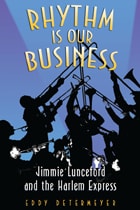
Cover image: Lunceford brass section, ca. late 1936. Left to right: Paul Webster, Eddie Durham, Sy Oliver, Elmer Crumbley, Eddie Tompkins, Russell Bowles. (Bertil Lyttkens Collection)
Rhythm and Noise
An Aesthetics of RockTheodore Gracyk
Duke University Press, 1996
What’s in a name? “Rock” or “Rock ’n’ Roll?” Grayck argues that rock and roll is actually a performance style, one in a number of musical styles comprising rock. What distinguishes rock, Gracyk tells us, is how it is mediated by technology: The art is in the recording. The lesson is a heady one, entailing a tour through the history of rock music from Elvis Presley’s first recordings in 1954 to Kurt Cobain’s suicide in 1994. Gracyk takes us through key recordings, lets us hear what rock musicians and their critics have to say, shows us how other kinds of music compare, and gives us the philosophical background to make more than passing sense of the medium. His work takes up the common myths and stereotypes about rock, popular and academic, and focuses on the features of the music that electrify fans and consistently generate controversy. When Elvis came to town, did southern sheriffs say that rock was barbaric and addictive? Well so did Theodor Adorno, in his way, and Allan Bloom, in his, and Gracyk takes aim at this charge as it echoes through the era of recorded music. He looks at what rock has to do with romanticism and, even more, with commercialism. And he questions the orthodoxy of making grand distinctions between “serious” and “popular” art.
Keenly attuned to the nuances of music and of all the ways that we can think about it, this exhilarating book tunes us in, as no other has, to the complex role of rock in American culture.

Richard Wright
The Life and TimesHazel Rowley
University of Chicago Press, 2008
Drawing on journals, letters, and eyewitness accounts, Richard Wright probes the author’s relationships with Langston Hughes and Ralph Ellison, his attraction to Communism, and his so-called exile in France. Skillfully interweaving quotes from Wright’s own writings, Rowley deftly portrays a passionate, courageous, and flawed man who would become one of our most enduring literary figures.
“Splendid. . . . Richard Wright is well written, prodigiously researched, and nicely paced, a compelling evocation of the man, his craft, and the different worlds through which he moved.”—Michael J. Ybarra, Wall Street Journal
“A welcome and illuminating work . . . [Rowley] does an outstanding job. . . . Rich and revealing.”—Megan Harlan, San Francisco Chronicle
“A magnificent biography, subtle and insightful. . . . Rowley writes with style and grace, and her research on Wright is prodigious.”—Howard Zinn, The Week

Riding
Pardis Mahdavi
Duke University Press, 2025
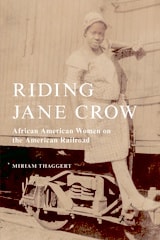
Riding Jane Crow
African American Women on the American RailroadMiriam Thaggert
University of Illinois Press, 2022

Riding into History
The Surprising Story of Sarah Keys Evans and the Fight to Desegregate Bus TravelAmy Nathan with Sarah Keys Evans
Duke University Press, 2026
Right Here, Right Now
Life Stories from America's Death RowLynden Harris, editor
Duke University Press, 2021
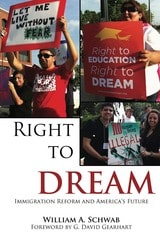
Right to DREAM
Immigration Reform and America’s FutureWilliam A. Schwab
University of Arkansas Press, 2013
Righteous Revolutionaries
Morality, Mobilization, and Violence in the Making of the Chinese StateJeffrey A. Javed
University of Michigan Press, 2022
Righteous Revolutionaries argues that the Chinese Party-state simultaneously removed perceived threats to its authority at the grassroots and bolstered its legitimacy through a process called moral mobilization. This mobilization process created a moral boundary that designated a virtuous ingroup of “the masses” and a demonized outgroup of “class enemies,” mobilized the masses to participate in violence against this broadly defined outgroup, and strengthened this symbolic boundary by making the masses complicit in state violence. Righteous Revolutionaries shows how we can find traces of moral mobilization in China today under Xi Jinping’s rule. In an era where states and politicians regularly weaponize moral emotions to foment intergroup conflict and violence, understanding the dynamics of violent mobilization and state authority are more relevant than ever before.
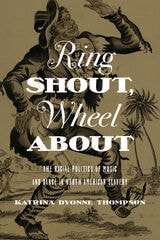
Ring Shout, Wheel About
The Racial Politics of Music and Dance in North American SlaveryKatrina D. Thompson
University of Illinois Press, 2014
In this ambitious project, historian Katrina Thompson examines the conceptualization and staging of race through the performance, sometimes coerced, of black dance from the slave ship to the minstrel stage. Drawing on a rich variety of sources, Thompson explicates how black musical performance was used by white Europeans and Americans to justify enslavement, perpetuate the existing racial hierarchy, and mask the brutality of the domestic slave trade. Whether on slave ships, at the auction block, or on plantations, whites often used coerced performances to oppress and demean the enslaved.
As Thompson shows, however, blacks' "backstage" use of musical performance often served quite a different purpose. Through creolization and other means, enslaved people preserved some native musical and dance traditions and invented or adopted new traditions that built community and even aided rebellion.
Thompson shows how these traditions evolved into nineteenth-century minstrelsy and, ultimately, raises the question of whether today's mass media performances and depictions of African Americans are so very far removed from their troublesome roots.
Rings of Dissent
Boxing and Performances of RebellionEdited by Rudy Mondragón, Gaye Theresa Johnson, and David J. Leonard
University of Illinois Press, 2025
Rio as Method
Collective Resistance for a New GenerationPaul Amar, editor
Duke University Press, 2024
Contributors. Rosiane Rodrigues de Almeida, José Claudio Souza Alves, Tamires Maria Alves, Paul Amar, Marcelo Caetano Andreoli, Beatriz Bissio, Thaddeus Gregory Blanchette, Fernando Brancoli, Thayane Brêtas, Victoria Broadus, Fatima Cecchetto, Leonard Cortana, Marcos Coutinho, Monica Cunha, Luiz Henrique Eloy Amado, Marielle Franco, Cristiane Gomes Julião, Benjamin Lessing, Roberto Kant de Lima, Amanda De Lisio, Bryan McCann, Flávia Medeiros, Ana Paula Mendes de Miranda, Sean T. Mitchell, Rodrigo Monteiro, Vitória Moreira, Jacqueline de Oliveira Muniz, Laura Rebecca Murray, Cesar Pinheiro Teixeira, Osmundo Pinho, Paulo Pinto, María Victoria Pita, João Gabriel Rabello Sodré, Luciane Rocha, Marcos Alexandre dos Santos Albuquerque, Ana Paula da Silva, Denise Ferreira da Silva, Soraya Simões, Indianare Siqueira, Antonio Carlos de Souza Lima, Leonardo Vieira Silva
Rise and Fall of the Cosmic Race
The Cult of Mestizaje in Latin AmericaBy Marilyn Grace Miller
University of Texas Press, 2004
Latin America is characterized by a uniquely rich history of cultural and racial mixtures known collectively as mestizaje. These mixtures reflect the influences of indigenous peoples from Latin America, Europeans, and Africans, and spawn a fascinating and often volatile blend of cultural practices and products. Yet no scholarly study to date has provided an articulate context for fully appreciating and exploring the profound effects of distinct local invocations of syncretism and hybridity. Rise and Fall of the Cosmic Race fills this void by charting the history of Latin America's experience of mestizaje through the prisms of literature, the visual and performing arts, social commentary, and music.
In accessible, jargon-free prose, Marilyn Grace Miller brings to life the varied perspectives of a vast region in a tour that stretches from Mexico and the Caribbean to Brazil, Ecuador and Argentina. She explores the repercussions of mestizo identity in the United States and reveals the key moments in the story of Latin America's cult of synthesis. Rise and Fall of the Cosmic Race examines the inextricable links between aesthetics and politics, and unravels the threads of colonialism woven throughout national narratives in which mestizos serve as primary protagonists.
Illuminating the ways in which regional engagements with mestizaje represent contentious sites of nation building and racial politics, Miller uncovers a rich and multivalent self-portrait of Latin America's diverse populations.
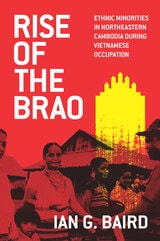
Rise of the Brao
Ethnic Minorities in Northeastern Cambodia during Vietnamese OccupationIan G. Baird
University of Wisconsin Press, 2022
Based on detailed research and interviews, Ian G. Baird documents this golden age of the Brao, including the voices of those who are too frequently omitted from official records. Rise of the Brao challenges scholars to look beyond the prevailing historical narratives to consider the nuanced perspectives of peripheral or marginal regions.

Rising Anthills
African and African American Writing on Female Genital Excision, 1960–2000Elisabeth Bekers
University of Wisconsin Press, 2010
Rising Anthills (the title refers to a Dogon myth) analyzes works in English, French, and Arabic by African and African American writers, both women and men, from different parts of the African continent and the diaspora. Attending closely to the nuances of language and the complexities of the issue, Bekers explores lesser-known writers side by side with such recognizable names as Ngugi wa Thiong’o, Flora Nwapa, Nawal El Saadawi, Ahmadou Kourouma, Calixthe Beyala, Alice Walker, and Gloria Naylor. Following their literary discussions of female genital excision, she discerns a gradual evolution—from the 1960s, when writers mindful of its communal significance carefully “wrote around” the physical operation, through the 1970s and 1980s, when they began to speak out against the practice and their societies’ gender politics, to the late 1990s, when they situated their denunciations of female genital excision in a much broader, international context of women’s oppression and the struggle for women’s rights.
Risqué Business
Breastaurants in American CultureTy Matejowsky
University of Alabama Press, 2025
Risqué Business serves up the breastaurant industry, where food service, sex appeal, identity, and gender politics mix.
Risqué Business explores the rise and ongoing cultural reckoning of “breastaurants”: sports bar–style restaurants like Hooters and Twin Peaks, which have long relied on the sexualized presentation of female servers to attract a mostly straight, male clientele. Ty Matejowsky, professor of anthropology at the University of Central Florida, is uniquely positioned in America’s foundational, breastaurant-saturated landscape. From this vantage, he offers a well-balanced account that draws on pop culture, media analysis, and contemporary gender politics. He delivers a smart, layered analysis of how breastaurants commodify youth and femininity, uphold retrograde masculinity, and serve as symbolic battlegrounds in today's highly charged political environments including America's deeply polarized Red State/Blue State divide.
With case studies, cultural critique, and a critical lens on labor and sexuality, Matejowsky reveals how these restaurants are more than just risqué marketing gimmicks. They reflect deeper anxieties about gender, identity, and the uneasy fusion of sex and service in American consumer culture. Risqué Business is a high-spirited study of an industry that thrives at the intersection of appetite and identity.
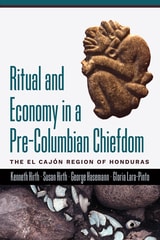
Ritual and Economy in a Pre-Columbian Chiefdom
The El Cajón Region of HondurasKenneth Hirth
University Press of Colorado, 2023
As part of the ritual economy, a large quantity of jade and marble artifacts were deposited as offerings in the ritual architecture of the El Cajón region’s central community of Salitrón Viejo. Over 2,800 of these high-value items were recovered from their original ritual contexts, making Salitrón Viejo one of the largest in situ collections of these materials ever recovered in the New World. These materials are well dated and tremendously varied and provide a cross-section of all jade-carving lapidary traditions in use across eastern Mesoamerica between AD 250 and 350.
With a complementary website providing extensive additional description, visualization, and analysis (https://journals.psu.edu/opa/issue/view/3127), Ritual and Economy in a Pre-Columbian Chiefdom is a new and original contribution that employs an “economy of ritual approach” to the study of chiefdom societies in the Americas. It is a foundational reference point for any scholar working in Mesoamerica and Central America, especially those engaged in Maya research, as well as archaeologists working with societies at this scale of complexity in Latin America and around the world.
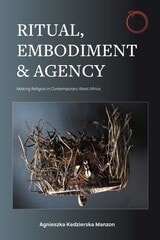
Ritual, Embodiment, and Agency
Making Religion in Contemporary West AfricaAgnieszka Kedzierska Manzon
HAU, 2026
Ritual, Embodiment, and Agency shows through rich ethnographic analysis how Mande people in West Africa resort to multiple ritual practices to address an “episteme of doubt.” In the context of armed conflicts and terrorist attacks, climate disruptions, financial crises, and illness, members of “hunter societies," experts who handle certain agentive artifacts, and adepts in a spiritual possession cult deal with a complex past and uncertain future through creative embodied engagement. Formed within and partially against a predominantly Islamic context and the spread of charismatic Christianities, such embodied ways of acting enable these religious specialists to become “virtuous subjects” to change their relations to the world and to themselves. This is an English translation of Corps rituels. La fabrique du religieux en pays mandingue (Mali, Guinée, Côte d'Ivoire).