Results by title
5448 books match the query 'History and criticism' and 301 start with r
Rivers in Russian Literature
Margaret Ziolkowski
University of Delaware Press, 2011
Published by University of Delaware Press. Distributed worldwide by Rutgers University Press.

Road-Book America
Contemporary Culture and the New PicaresqueRowland A. Sherrill
University of Illinois Press, 2000
Road-Book America discloses how the old picaresque tradition, embodied in such novels as Henry Fielding's Tom Jones and Daniel Defoe's Moll Flanders, opens to include a number of new American texts, both fiction and nonfiction, that decisively share the characterizing form. Sherrill's discussion encompasses hundreds of American narratives published in the past four decades, including such examples of the genre as William Least Heat-Moon's Blue Highways, John Steinbeck's Travels with Charley, James Leo Herlihy's Midnight Cowboy, Bill Moyers's Listening to America, and E. L. Doctorow's Billy Bathgate.
Sketching the socially marginal, ingenuous, traveling characters common to both old and new versions, Sherrill shows how the "new American picaresque" transforms the satirical aims of the original into an effort to map and catalog the immensity and variety of America.
Open, resilient, perennially hopeful, and endowed with a protean adaptability, the protagonist of the new American picaresque follows a therapeutic path for the alienated modern self. Mining the relevance of the reformulated picaresque for American life, Road-Book America shows how this old form, adaptable as the picaro himself, lays the groundwork for spiritual renewal and a restoration of cultural confidence in some old ways of being American.
Roadrunner
A Song by Jonathan Richman and the Modern LoversJoshua Clover
Duke University Press, 2021
Robert Ashley
Kyle Gann
University of Illinois Press, 2012

Robert E. Howard
The Life and Times of a Texas AuthorWillard P. Oliver
University of North Texas Press, 2025
Robert Frost and Feminine Literary Tradition
Karen L. Kilcup
University of Michigan Press, 1998
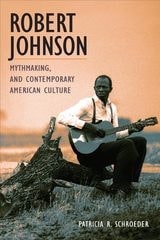
Robert Johnson, Mythmaking, and Contemporary American Culture
Patricia R. Schroeder
University of Illinois Press, 2004
Merging literary analysis with cultural criticism and biographical study, Patricia R. Schroeder explores Johnson's ongoing role as a cultural icon. Schroeder's detailed analysis engages key images and myths about the blues musician (such as the Faustian crossroads exchange of his soul for guitar virtuosity). Navigating the many competing interpretations that swirl around him, Schroeder reveals the cultural purposes served by the stories and the storytellers. The result is a fascinating examination of the relationships among Johnson's life, its subsequent portrayals, and the forces that drove the representations.
Offering penetrating insights into both Johnson and the society that perpetuates him, Robert Johnson, Mythmaking, and Contemporary American Culture is essential reading for blues fans and cultural critics interested in a foundational musical figure.
Robo Sacer
Necroliberalism and Cyborg Resistance in Mexican and Chicanx DystopiasDavid S. Dalton
Vanderbilt University Press, 2023
Harvey L. Johnson Publication Award, Southwest Council of Latin American Studies, 2026
Premio Alambique, Alambique: Revista Académica de Ciencia Ficción y Fantasía, 2025
Robo Sacer engages the digital humanities, critical race theory, border studies, biopolitical theory, and necropolitical theory to interrogate how technology has been used to oppress people of Mexican descent—both within Mexico and in the United States—since the advent of the North American Free Trade Agreement (NAFTA) in 1994. As the book argues, robo-sacer identity emerges as transnational flows of bodies, capital, and technology become an institutionalized state of exception that relegates people from marginalized communities to the periphery.
And yet the same technology can be utilized by the oppressed in the service of resistance. The texts studied here represent speculative stories about this technological empowerment. These texts theorize different means of techno-resistance to key realities that have emerged within Mexican and Chicano/a/x communities under the rise and reign of neoliberalism. The first three chapters deal with dehumanization, the trafficking of death, and unbalanced access to technology. The final two chapters deal with the major forms of violence—feminicide and drug-related violence—that have grown exponentially in Mexico with the rise of neoliberalism. These stories theorize the role of technology both in oppressing and in providing the subaltern with necessary tools for resistance.
Robo Sacer builds on the previous studies of Sayak Valencia, Irmgard Emmelhainz, Guy Emerson, Achille Mbembe, and of course Giorgio Agamben, but it differentiates itself from them through its theorization on how technology—and particularly cyborg subjectivity—can amend the reigning biopolitical and necropolitical structures of power in potentially liberatory ways. Robo Sacer shows how the cyborg can denaturalize constructs of zoē by providing an outlet through which the oppressed can tell their stories, thus imbuing the oppressed with the power to combat imperialist forces.
Robot Ghosts and Wired Dreams
Japanese Science Fiction from Origins to AnimeChristopher Bolton
University of Minnesota Press, 2007
Since the end of the Second World War—and particularly over the last decade—Japanese science fiction has strongly influenced global popular culture. Unlike American and British science fiction, its most popular examples have been visual—from Gojira (Godzilla) and Astro Boy in the 1950s and 1960s to the anime masterpieces Akira and Ghost in the Shell of the 1980s and 1990s—while little attention has been paid to a vibrant tradition of prose science fiction in Japan.
Robot Ghosts and Wired Dreams remedies this neglect with a rich exploration of the genre that connects prose science fiction to contemporary anime. Bringing together Western scholars and leading Japanese critics, this groundbreaking work traces the beginnings, evolution, and future direction of science fiction in Japan, its major schools and authors, cultural origins and relationship to its Western counterparts, the role of the genre in the formation of Japan’s national and political identity, and its unique fan culture.
Covering a remarkable range of texts—from the 1930s fantastic detective fiction of Yumeno Kyûsaku to the cross-culturally produced and marketed film and video game franchise Final Fantasy—this book firmly establishes Japanese science fiction as a vital and exciting genre.
Contributors: Hiroki Azuma; Hiroko Chiba, DePauw U; Naoki Chiba; William O. Gardner, Swarthmore College; Mari Kotani; Livia Monnet, U of Montreal; Miri Nakamura, Stanford U; Susan Napier, Tufts U; Sharalyn Orbaugh, U of British Columbia; Tamaki Saitô; Thomas Schnellbächer, Berlin Free U.
Christopher Bolton is assistant professor of Japanese at Williams College.
Istvan Csicsery-Ronay Jr. is professor of English at DePauw University.
Takayuki Tatsumi is professor of English at Keio University.
Rock Eras
Interpretations of Music and Society, 1954-1984Jim Curtis
University of Wisconsin Press, 1987
Paper is temporarily out of stock, Cloth (0-87972-368-8) is available at the paper price until further notice.
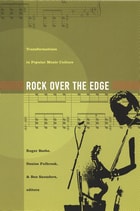
Rock Over the Edge
Transformations in Popular Music CultureRoger Beebe, Denise Fulbrook, and Ben Saunders, eds.
Duke University Press, 2002
Bridging the disciplines of musicology and cultural studies, the collection has two primary goals: to seek out a language for talking about music culture and to look at the relationship of music to culture in general. The editors’ introduction provides a backward glance at recent rock criticism and also looks to the future of the rapidly expanding discipline of popular music studies. Taking seriously the implications of critical theory for the study of non-literary aesthetic endeavors, the volume also addresses such issues as the affective power of popular music and the psychic construction of fandom.
Rock Over the Edge will appeal to scholars and students in popular music studies and American Studies as well as general readers interested in popular music.
Contributors. Ian Balfour, Roger Beebe, Michael Coyle, Robert Fink, Denise Fulbrook, Tony Grajeda, Lawrence Grossberg, Trent Hill, Josh Kun, Jason Middleton, Lisa Ann Parks, Ben Saunders, John J. Sheinbaum, Gayle Wald, Warren Zanes
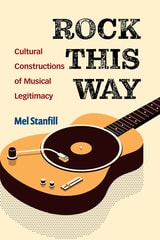
Rock This Way
Cultural Constructions of Musical LegitimacyMel Stanfill
University of Michigan Press, 2023
Any and all songs are capable of being remixed. But not all remixes are treated equally. Rock This Way examines transformative musical works—cover songs, remixes, mash-ups, parodies, and soundalike songs—to discover what contemporary American culture sees as legitimate when it comes to making music that builds upon other songs. Through examples of how popular discussion talked about such songs between 2009 and 2018, Mel Stanfill uses a combination of discourse analysis and digital humanities methods to interrogate our broader understanding of transformative works and where they converge at the legal, economic, and cultural ownership levels.
Rock This Way provides a new way of thinking about what it means to re-create and borrow music, how the racial identity of both the reusing artist and the reused artist matters, and the ways in which the law polices artists and their works. Ultimately, Stanfill demonstrates that the extent to which a work is seen as having new expression or meaning is contingent upon notions of creativity, legitimacy, and law, all of which are shaped by white supremacy.
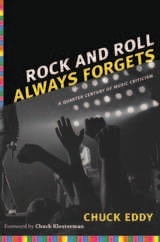
Rock and Roll Always Forgets
A Quarter Century of Music CriticismChuck Eddy
Duke University Press, 2011
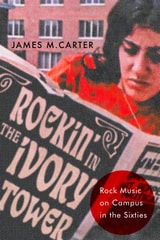
Rockin' in the Ivory Tower
Rock Music on Campus in the SixtiesJames M. Carter
Rutgers University Press, 2023
Histories of American rock music and the 1960s counterculture typically focus on the same few places: Woodstock, Monterey, Altamont. Yet there was also a very active college circuit that brought edgy acts like the Jefferson Airplane and the Velvet Underground to different metropolitan regions and smaller towns all over the country. These campus concerts were often programmed, promoted, and reviewed by students themselves, and their diverse tastes challenged narrow definitions of rock music.
Rockin’ in the Ivory Tower takes a close look at two smaller universities, Drew in New Jersey and Stony Brook on Long Island, to see how the culture of rock music played an integral role in student life in the late 1960s. Analyzing campus archives and college newspapers, historian James Carter traces connections between rock fandom and the civil rights protests, free speech activism, radical ideas, lifestyle transformations, and anti-war movements that revolutionized universities in the 1960s. Furthermore, he finds that these progressive students refused to segregate genres like folk, R&B, hard rock, and pop. Rockin’ in the Ivory Tower gives readers a front-row seat to a dynamic time for the music industry, countercultural politics, and youth culture.
Rocking My Life Away
Writing about Music and Other MattersAnthony DeCurtis
Duke University Press, 1998
Roger Zelazny
F. Brett Cox
University of Illinois Press, 2021
Roger Zelazny combined poetic prose with fearless literary ambition to become one of the most influential science fiction writers of the 1960s. Yet many critics found his later novels underachieving and his turn to fantasy a disappointment. F. Brett Cox surveys the landscape of Zelazny's creative life and contradictions. Launched by the classic 1963 short story "A Rose for Ecclesiastes," Zelazny soon won the Hugo Award for Best Novel with …And Call Me Conrad and two years later won again for Lord of Light. Cox looks at the author's overnight success and follows Zelazny into a period of continued formal experimentation, the commercial triumph of the Amber sword and sorcery novels, and renewed acclaim for Hugo-winning novellas such as "Home Is the Hangman" and "24 Views of Mt. Fuji, by Hokusai." Throughout, Cox analyzes aspects of Zelazny's art, from his preference for poetically alienated protagonists to the ways his plots reflected his determined individualism.
Clear-eyed and detailed, Roger Zelazny provides an up-to-date reconsideration of an often-misunderstood SF maverick.
Rogues and Early Modern English Culture
Craig Dionne and Steve Mentz, Editors
University of Michigan Press, 2004
-Jonathan Dollimore, York University
"Rogues and Early Modern English Culture is an up-to-date and suggestive collection on a subject that all scholars of the early modern period have encountered but few have studied in the range and depth represented here."
-Lawrence Manley, Yale University
"A model of cross-disciplinary exchange, Rogues and Early Modern English Culture foregrounds the figure of the rogue in a nexus of early modern cultural inscriptions that reveals the provocation a seemingly marginal figure offers to authorities and various forms of authoritative understanding, then and now. The new and recent work gathered here is an exciting contribution to early modern studies, for both scholars and students."
-Alexandra W. Halasz, Dartmouth College
Rogues and Early Modern English Culture is a definitive collection of critical essays on the literary and cultural impact of the early modern rogue. Under various names-rogues, vagrants, molls, doxies, vagabonds, cony-catchers, masterless men, caterpillars of the commonwealth-this group of marginal figures, poor men and women with no clear social place or identity, exploded onto the scene in sixteenth-century English history and culture. Early modern representations of the rogue or moll in pamphlets, plays, poems, ballads, historical records, and the infamous Tudor Poor Laws treated these characters as harbingers of emerging social, economic, and cultural changes.
Images of the early modern rogue reflected historical developments but also created cultural icons for mobility, change, and social adaptation. The underclass rogue in many ways inverts the familiar image of the self-fashioned gentleman, traditionally seen as the literary focus and exemplar of the age, but the two characters have more in common than courtiers or humanists would have admitted. Both relied on linguistic prowess and social dexterity to manage their careers, whether exploiting the politics of privilege at court or surviving by their wits on urban streets.
Deftly edited by Craig Dionne and Steve Mentz, this anthology features essays from prominent and emerging critics in the field of Renaissance studies and promises to attract considerable attention from a broad range of readers and scholars in literary studies and social history.
Roman Holidays
American Writers and Artists in Nineteenth-Century ItalyRobert K. Martin
University of Iowa Press, 2001
Roman Propertius and the Reinvention of Elegy
Jeri Blair DeBrohun
University of Michigan Press, 2003
DeBrohun finds the most striking element of Book 4 to be the apparent polarity of the poems, whose themes are split between new, aetiological subjects of Roman national significance and amatory affairs that evoke the themes of Propertius' first three books. In her compelling reassessment of Propertius' aspirations in Book 4, DeBrohun identifies the conflict between his new ambitions to produce Roman aetiological elegy and his traditional, exclusive devotion to erotic concerns as the central dynamic of his collection. Roman Propertius and the Reinvention of Elegy reveals how the poet came to find in the subcodes of the elegiac genre a medium of interaction between the opposing values of the two themes.
Roman Propertius will interest not only scholars and students of Greek and Roman Poetry but also students of later traditions who are interested in the questions of genre and the relationship between poetry and wider cultural discourses.
Jeri Blair DeBrohun is Associate Professor of Classics, Brown University.
Roman Theater and Society
E. Togo Salmon Papers IWilliam J. Slater, Editor
University of Michigan Press, 1996
William Slater's new volume Roman Theater and Society brings an important perspective to the much-maligned status of the Roman theater, which has only recently been reappraised and appreciated as uniquely Roman rather than criticized for not being Greek. From this point of embarkation, William Slater and the nine contributors discuss theater in Rome and the Greek east with a definition of performance incorporating not only stage performances but also dinnertime entertainment, sporting events, and political events. Contributors are T. D. Barnes, K. M. Coleman, J. C. Edmonson, E. R. Gebhard, J. R. Green, E. J. Jory, W. D. Lebek, and D. S. Potter.
Individual chapters combine literary evidence with archaeological, thereby engendering a deeper appreciation for the social and political roles of Roman theater. It becomes clear that these roles were of great influence in giving voice to the popular demands of the average Roman. In examining the roles of theater the contributors turn to the players and audience themselves for deeper understanding.
Roman Theater and Society will be of great interest to classicists, theater specialists, and anyone interested in the interplay among plays, theaters, and the people on stage and in the audience.
William J. Slater is Professor of Classics, McMaster University.
Roman Tragedy
Theatre to TheatricalityBy Mario Erasmo
University of Texas Press, 2004
Roman tragedies were written for over three hundred years, but only fragments remain of plays that predate the works of Seneca in the mid-first century C.E., making it difficult to define the role of tragedy in ancient Roman culture. Nevertheless, in this pioneering book, Mario Erasmo draws on all the available evidence to trace the evolution of Roman tragedy from the earliest tragedians to the dramatist Seneca and to explore the role played by Roman culture in shaping the perception of theatricality on and off the stage.
Performing a philological analysis of texts informed by semiotic theory and audience reception, Erasmo pursues two main questions in this study: how does Roman tragedy become metatragedy, and how did off-stage theatricality come to compete with the theatre? Working chronologically, he looks at how plays began to incorporate a rhetoricized reality on stage, thus pointing to their own theatricality. And he shows how this theatricality, in turn, came to permeate society, so that real events such as the assassination of Julius Caesar took on theatrical overtones, while Pompey's theatre opening and the lavish spectacles of the emperor Nero deliberately blurred the lines between reality and theatre. Tragedy eventually declined as a force in Roman culture, Erasmo suggests, because off-stage reality became so theatrical that on-stage tragedy could no longer compete.
Romance Of The Road
Literature Of The American HighwayRonald Primeau
University of Wisconsin Press, 1996
Writers examined include Jack Kerouac, Jim Dodge, Ralph Waldo Emerson, William Least Heat Moon, Robert M. Pirsig, Henry Miller, Joan Didion, Mona Simpson, and Walt Whitman.
Romance and the Erotics of Property
Mass-Market Fiction for WomenJan Cohn
Duke University Press, 1988
Cohn argues that a full understanding of the contemporary romance requires an investigation of its literary and historical sources and analogues. Three principal sources are examined in the context of women's history in bourgeois society. Pride and Prejudice, Jane Erye, and Gone With the Wind demonstrate the development of romance fiction's themes, yet in all three the central love story is complicated by issues of property, the sign of male power. Jan Cohn further considers the development of the genre n the fictions of Harriet Lewis and May Agnes Fleming, prolific and popular American romance writers of the late nineteenth century who developed the role of the villain, thereby bringing into focus the sexual and economic struggles faced by the heroine.
Romance and the Erotics of Property sets romance fiction against a historic and literary background, arguing that contemporary romance disguises as tales of love the subversive fantasies of female appropriation and male property and power.
Romances of the White Man's Burden
Race, Empire, and the Plantation in American Literature, 1880-1936Jeremy Wells
Vanderbilt University Press, 2011
Romances of the White Man's Burden takes on works in American literature in which the proverbial "old plantation" is made to seem not a relic but a harbinger, a sign that the South had arrived at a multiracial modernity and harmony before the rest of the United States. Focusing on writers such as Joel Chandler Harris, Thomas Nelson Page, Henry W. Grady, Thomas Dixon, and William Faulkner, Jeremy Wells reveals their shared fixation on the figure of the white southern man as specially burdened by history. Each of these writers, in his own way, presented the plantation South as an emblem, not an aberration, of America.
Romantic Automata
Exhibitions, Figures, OrganismsMichael Demson
Bucknell University Press, 2020
Recent scholarship in post-humanism, post-colonialism, disability studies, post-modern feminism, eco-criticism, and radical Orientalism has significantly affected the critical discourse on this topic. In engaging with the work and thought of Coleridge, Poe, Hoffmann, Mary Shelley, and other Romantic luminaries, the contributors to this collection open new methodological approaches to understanding human interaction with technology that strives to simulate, supplement, or supplant organic life.
Published by Bucknell University Press. Distributed worldwide by Rutgers University Press.
Romantic Beasts
Pervasion, Eccentricity, ExhibitionMichael Demson
Bucknell University Press, 2025
Published by Bucknell University Press. Distributed worldwide by Rutgers University Press.
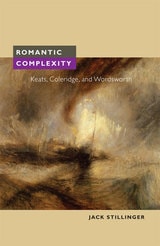
Romantic Complexity
Keats, Coleridge, and WordsworthJack Stillinger
University of Illinois Press, 2005
In Romantic Complexity, Jack Stillinger examines three of the most admired poets of English Romanticism--Keats, Coleridge, and Wordsworth--with a focus on the complexity that results from the multiple authorship, the multiple textual representation, and the multiple reading and interpretation of their best works.
Specific topics include the joint authorship of Wordsworth and Coleridge in the Lyrical Ballads, an experiment of 1798 that established the most essential characteristics of modern poetry; Coleridge's creation of eighteen or more different versions of The Ancient Mariner and how this textual multiplicity affects interpretation; the historical collaboration between Keats and his readers to produce fifty-nine separate but entirely legitimate readings of The Eve of St. Agnes; and a number of practical and theoretical matters bearing on the relationships among these writers and their influences on one another.
Stillinger shows his deep understanding of the poets' lives, works, and the history of their reception, in chapters rich with intriguing questions and answers sure to engage students and teachers of the world's greatest poetry.

Romantic Conventions
Anne K. Kaler
University of Wisconsin Press, 1999
Traditionally, romance novels have a reputation as being no more than trashy, sex-filled fantasy escapes for frustrated housewives. But books in this genre account for nearly half of the paperbacks published. Contributors examine the patterns used by the romance authors to tell their stories.

Romantic Globalism
British Literature and Modern World Order, 1750–1830Evan Gottlieb
The Ohio State University Press, 2014
Although modern media tend to represent globalization as an essentially contemporary phenomenon, many scholars now agree that its fundamental dynamics—especially its characteristic annulment of spatial and temporal differences—have been present for several centuries. Moreover, the last decades of the eighteenth century and the first of the nineteenth century saw the convergence of a number of world-changing socio-political developments in the Western world. Romantic Globalism is significant because it is the first extended scholarly study that brings together these lines of inquiry. In so doing, Romantic Globalism not only charts a new course of study for British Romanticism but also suggests how the Romantics’ visions of globality might still be valuable to us today.
Romantic Poetry
Recent Revisionary CriticismKroeber, Karl
Rutgers University Press, 1993
Romantic Women Writers
Voices and CountervoicesPaula R. Feldman and Theresa M. Kelley
Brandeis University Press, 1995
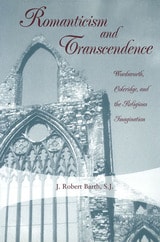
Romanticism and Transcendence
Wordsworth, Coleridge, and the Religious ImaginationJ. Robert Barth, S.J.
University of Missouri Press, 2003
Romanticism and the Question of the Stranger
David Simpson
University of Chicago Press, 2012
Romanticism, Nationalism, and the Revolt against Theory
David Simpson
University of Chicago Press, 1993
Simpson demonstrates the close association between "theory" and "method" and shows that by the mid-eighteenth century, "method" had acquired distinctly subversive associations in England. Attributed increasingly to the French and the Germans, "method" paradoxically evoked images both of inhuman rationality and unbridled sentimentality; in either incarnation, it was seen as a threat to what was claimed to be authentically British. Simpson develops these paradigms in relation to feminism, the gendering of Anglo-American culture, and the emergence of literature and literary criticism as antitheoretical discourses. He then looks at the Romantic poets' response to this confining ideology of the cultural role of literature. Finally, Simpson considers postmodern theory's claims for the radical energy of nonrational or antirationalist positions.
This is an essential book not only for students of the Romantic period and intellectual historians concerned with the idea of "method," but for anyone interested in the historical background of today's debates over the excesses and possibilities of "theory."
Romanticism’s Other Minds
Poetry, Cognition, and the Science of SociabilityJohn Savarese
The Ohio State University Press, 2020

Rome's Visceral Reactions
Politics and Poetics in Flesh and BloodCaitlin Hines
University of Michigan Press, 2026
Caitlin Hines follows the history of viscera from its earliest attestations through the end of the Julio-Claudian period and considers the works of Lucretius, Cicero, Vergil, Livy, Ovid, Seneca, and Lucan. Applying theories of embodied cognition and semantic change, Hines demonstrates how Roman authors influenced the development of their language through the invention, reception, and affirmation of innovative meanings and how pressing political and cultural crises could shape, and be shaped in return, by the sophisticated linguistic games of the Roman literary elite.
Ronald Harwood's Tragic Vision
A Critical Analysis of His Novels, Plays, and ScreenplaysAnn C. Hall
University of Iowa Press, 2024
Ronald Harwood’s Tragic Vision offers the first critical analysis of prolific and award-winning British author Ronald Harwood (1934–2020). Though he received an Oscar for The Pianist, a knighthood, and numerous other awards and nominations, Harwood worked as a ghostwriter, script doctor, and veritable unknown for many years. As he became successful, many critics still misread his works and positioned him as a less-fashionable counterpart to his lifelong friend Harold Pinter. This study proposes a conceptual framework to approach his, and others’, work based on the genre of tragedy, offering a greater appreciation for and understanding of the Harwood canon.
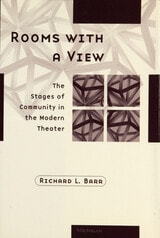
Rooms with a View
The Stages of Community in the Modern TheaterRichard L. Barr
University of Michigan Press, 1998
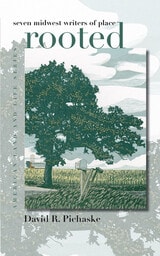
Rooted
Seven Midwest Writers of PlaceDavid R. Pichaske
University of Iowa Press, 2006
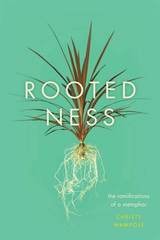
Rootedness
The Ramifications of a MetaphorChristy Wampole
University of Chicago Press, 2016
Wampole examines both the philosophical implications of this metaphor and its political evolution. From the root as home to the root as genealogical origin to the root as the past itself, rootedness has survived in part through its ability to subsume other compelling metaphors, such as the foundation, the source, and the seed. With a focus on this concept’s history in France and Germany, Wampole traces its influence in diverse areas such as the search for the mystical origins of words, land worship, and nationalist rhetoric, including the disturbing portrayal of the Jews as an unrooted, and thus unrighteous, people. Exploring the works of Martin Heidegger, Simone Weil, Jean-Paul Sartre, Paul Celan, and many more, Rootedness is a groundbreaking study of a figure of speech that has had wide-reaching—and at times dire—political and social consequences.
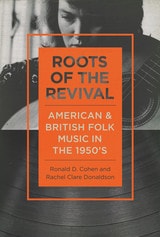
Roots of the Revival
American and British Folk Music in the 1950sRonald D. Cohen and Rachel Clare Donaldson
University of Illinois Press, 2014
After setting the stage with the work of music collectors in the nineteenth century, the authors explore the so-called recovery of folk music practices and performers by Alan Lomax and others, including journeys to and within the British Isles that allowed artists and folk music advocates to absorb native forms and facilitate the music's transatlantic exchange. Cohen and Donaldson place the musical and cultural connections of the twin revivals within the decade's social and musical milieu and grapple with the performers' leftist political agendas and artistic challenges, including the fierce debates over "authenticity" in practice and repertoire that erupted when artists like Harry Belafonte and the Kingston Trio carried folk into the popular music mainstream.
From work songs to skiffle, from the Weavers in Greenwich Village to Burl Ives on the BBC, Roots of the Revival offers a frank and wide-ranging consideration of a time, a movement, and a transformative period in American and British pop culture.
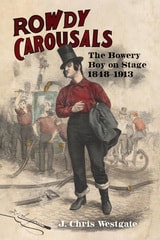
Rowdy Carousals
The Bowery Boy on Stage, 1848-1913J. Chris Westgate
University of Iowa Press, 2024
The book’s examination of working-class whiteness on stage, in the theatre, and in print culture invites theatre historians and critics to check the impulse to downplay or ignore questions about race and ethnicity in discussion of the Bowery Boy. J. Chris Westgate further explores links between the Bowery Boy’s rowdyism in the nineteenth century and the resurgence of white supremacy in the early twenty-first century.
Roy Orbison
Invention Of An Alternative Rock MasculinityPeter Lehman
Temple University Press, 2003
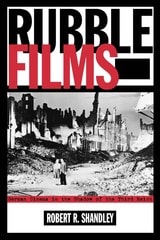
Rubble Films
German Cinema In Shadow Of 3Rd ReichRobert R. Shandley
Temple University Press, 2001
Rubble Films is a close look at German cinema in the immediate postwar era, and a careful examination of its relationship to Allied occupation. Shandley reveals how German film borrowed -- both literally and figuratively -- from its Nazi past, and how the occupied powers (specifically the US) used its position as victor to open Europe to Hollywood movie products and aesthetics.
Incorporating a careful reading of several important postwar films, Shandley also discusses how the German studio system operated immediately after the war, in the east and the west, giving special focus on DEFA, the east German studio that rose during Soviet occupation.
Pathbreaking in its research, Rubble Films sheds new light on a significant moment of German cultural rebirth, and adds a new dimension to the study of the history of film.
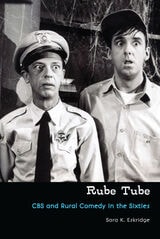
Rube Tube
CBS and Rural Comedy in the SixtiesSara K. Eskridge
University of Missouri Press, 2022
Ruin and Restitution
Reinterpreting Romanticism in SpainPhilip W. Silver
Vanderbilt University Press, 1997
Russia Reads Rousseau, 1762-1825
Thomas Barran
Northwestern University Press, 2002
Russia's Legal Fictions
Harriet Murav
University of Michigan Press, 1998
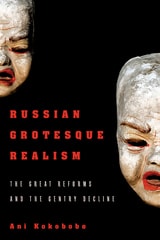
Russian Grotesque Realism
The Great Reforms and the Gentry DeclineAni Kokobobo
The Ohio State University Press, 2018
Russian Grotesque Realism: The Great Reforms and the Gentry Decline offers a comprehensive reevaluation of the Russian realist novel and proposes that a composite style, “grotesque realism,” developed in response to social upheaval during the post-Reform era. In this compelling new study, Ani Kokobobo argues that if the realism of pre-Reform Russia could not depict socioeconomic change directly, the grotesque provided an indirect means for Russian writers to capture the instability of the times and the decline of the gentry. While realism historically represented the psychological depth of characters, the grotesque focused more on the body, materialism, and categorical confusions in order to depict characters whose humanity had eroded.
With original readings of some of Russian realism’s greatest novels, Anna Karenina, Demons, and Brothers Karamazov, as well as lesser known novels like The Family Golovlev, The Precipice, Resurrection, and Cathedral Folk, Russian Grotesque Realism traces the transformation of gentry representation from spiritual strivers and thinkers to more materialist beings. By the end of the nineteenth century, the gentry, originally seen as society’s preservers, were represented as grotesque, reflecting a broader societal breakdown that would eventually precipitate the end of the novel genre itself.
Russian Minimalism
From the Prose Poem to the Anti-StoryAdrian Wanner
Northwestern University Press, 2003
The paradoxical genre of the prose poem, developed by the French poet Charles Baudelaire, provides Wanner with an overarching theoretical rubric for a variety of works of Russian literature, ranging from Ivan Turgenev's "Poems in Prose" to a host of decadent, symbolist, realist, and futurist miniatures, including Fedor Sologub's "Little Fairy Tales," Aleksei Remizov's dreams, Vasilii Kandinskii's prose poems, and Daniil Kharms' absurdist ministories. His book demonstrates how the negativity inherent in the form of the prose poem transformed the overwrought lyricism of fin de siècle prose into the ascetic starkness of the twentieth-century minimalist anti-story.