Results by title
22279 books match the query 'Social Science' and 1072 start with r
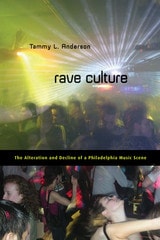
Rave Culture
The Alteration and Decline of a Philadelphia Music SceneTammy L. Anderson
Temple University Press, 2009
It used to be that raves were grassroots organized, anti-establishment, unlicensed all-night drug-fueled dance parties held in abandoned warehouses or an open field. These days, you pay $40 for a branded party at popular riverfront nightclubs where age and status, rather than DJ expertise and dancing, shape your experience.
In Rave Culture, sociologist Tammy Anderson explores the dance music, drug use and social deviance that are part of the pulsing dynamics of this collective. Her ethnographic study compares the Philadelphia rave scene with other rave scenes in London and Ibiza. She chronicles how generational change, commercialization, law enforcement, hedonism, and genre fragmentation fundamentally altered electronic dance music parties. Her analysis calls attention to issues of personal and collective identity in helping to explain such social change and what the decline of the rave scene means for the future of youth culture and electronic dance music.
Raving
McKenzie Wark
Duke University Press, 2023
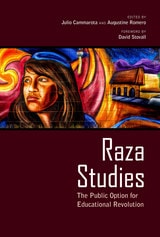
Raza Studies
The Public Option for Educational RevolutionEdited by Julio Cammarota and Augustine Romero; Foreword by David Stovall
University of Arizona Press, 2014
Inspired by Paulo Freire’s vision for critical pedagogy and Chicano activists of the 1960s, the designers of the program believed their program would encourage academic achievement and engagement by Mexican American students. With chapters by leading scholars, this volume explains how the program used “critically compassionate intellectualism” to help students become “transformative intellectuals” who successfully worked to improve their level of academic achievement, as well as create social change in their schools and communities.
Despite its popularity and success inverting the achievement gap, in 2010 Arizona state legislators introduced and passed legislation with the intent of banning MAS or any similar curriculum in public schools. Raza Studies is a passionate defense of the program in the face of heated local and national attention. It recounts how one program dared to venture to a world of possibility, hope, and struggle, and offers compelling evidence of success for social justice education programs.
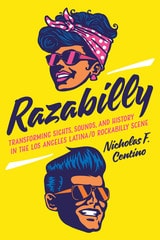
Razabilly
Transforming Sights, Sounds, and History in the Los Angeles Latina/o Rockabilly SceneBy Nicholas F. Centino
University of Texas Press, 2021
Vocals tinged with pain and desperation. The deep thuds of an upright bass. Women with short bangs and men in cuffed jeans. These elements and others are the unmistakable signatures of rockabilly, a musical genre normally associated with white male musicians of the 1950s. But in Los Angeles today, rockabilly's primary producers and consumers are Latinos and Latinas. Why are these "Razabillies" partaking in a visibly "un-Latino" subculture that's thought of as a white person's fixation everywhere else?
As a Los Angeles Rockabilly insider, Nicholas F. Centino is the right person to answer this question. Pairing a decade of participant observation with interviews and historical research, Centino explores the reasons behind a Rockabilly renaissance in 1990s Los Angeles and demonstrates how, as a form of working-class leisure, this scene provides Razabillies with spaces of respite and conviviality within the alienating landscape of the urban metropolis. A nuanced account revealing how and why Los Angeles Latinas/os have turned to and transformed the music and aesthetic style of 1950s rockabilly, Razabilly offers rare insight into this musical subculture, its place in rock and roll history, and its passionate practitioners.
Re-Creating Primordial Time
Foundation Rituals and Mythology in the Postclassic Maya CodicesGabrielle Vail and Christine Hernández
University Press of Colorado, 2013
Remarkable similarities exist within the Maya tradition, even as new mythologies were introduced through contact with the Gulf Coast region and highland central Mexico. Vail and Hernández analyze the extant Maya codices within the context of later literary sources such as the Books of Chilam Balam, the Popol Vuh, and the Códice Chimalpopoca to present numerous examples highlighting the relationship among creation mythology, rituals, and lore. Compiling and comparing Maya creation mythology with that of the Borgia codices from highland central Mexico, Re-Creating Primordial Time is a significant contribution to the field of Mesoamerican studies and will be of interest to scholars of archaeology, linguistics, epigraphy, and comparative religions alike.
Re-Enchanted
The Rise of Children's Fantasy Literature in the Twentieth CenturyMaria Sachiko Cecire
University of Minnesota Press, 2019
Why are so many people drawn to fantasy set in medieval, British-looking lands? This question has immediate significance for millions around the world: from fans of Lord of the Rings, Narnia, Harry Potter, and Game of Thrones to those who avoid fantasy because of the racist, sexist, and escapist tendencies they have found there. Drawing on the history and power of children’s fantasy literature, Re-Enchanted argues that magic, medievalism, and childhood hold the paradoxical ability to re-enchant modern life.
Focusing on works by authors such as J. R. R. Tolkien, C. S. Lewis, Susan Cooper, Philip Pullman, J. K. Rowling, and Nnedi Okorafor, Re-Enchanted uncovers a new genealogy for medievalist fantasy—one that reveals the genre to be as important to the history of English studies and literary modernism as it is to shaping beliefs across geographies and generations. Maria Sachiko Cecire follows children’s fantasy as it transforms over the twentieth and twenty-first centuries—including the rise of diverse counternarratives and fantasy’s move into “high-brow” literary fiction. Grounded in a combination of archival scholarship and literary and cultural analysis, Re-Enchanted argues that medievalist fantasy has become a psychologized landscape for contemporary explorations of what it means to grow up, live well, and belong. The influential “Oxford School” of children’s fantasy connects to key issues throughout this book, from the legacies of empire and racial exclusion in children’s literature to what Christmas magic tells us about the roles of childhood and enchantment in Anglo-American culture.
Re-Enchanted engages with critical debates around what constitutes high and low culture during moments of crisis in the humanities, political and affective uses of childhood and the mythological past, the anxieties of modernity, and the social impact of racially charged origin stories.
Re-Enchanting the World
Maya Protestantism in the Guatemalan HighlandsC. Mathews Samson
University of Alabama Press, 2007
Christian evangelicals among native people in Latin America.
What does it mean to be both Maya and Protestant in Guatemala? Burgeoning religious pluralism in Mesoamerica and throughout Latin America is evident as Protestantism permeates a region that had been overwhelmingly Catholic for nearly five centuries.
In considering the interplay between contemporary Protestant practice and native cultural traditions among Maya evangelicals, Samson documents the processes whereby some Maya have converted to new forms of Christianity and the ways in which the Maya are incorporating Christianity for their own purposes. At the intersection of religion and cultural pluralism, contemporary evangelicals focus on easing the tension between Maya identity and the Protestant insistence that old ways must be left behind in the conversion process.
Against the backdrop of the 36-year civil war that ended in 1996 and the rise of the indigenous Maya Movement in the late 1980s, this work provides a unique portrait of social movements, cultural and human rights, and the role that religion plays in relation to the nation-state in post-conflict political processes. Re-enchanting the World fills a niche within the anthropological literature on evangelicals in Latin America during a time of significant social change.

Re-Imagining the City
Art, Globalization and Urban SpacesEdited by Elizabeth Grierson and Kristen Sharp
Intellect Books, 2013
Re-Membering and Surviving
African American Fiction of the Vietnam WarShirley A. James Hanshaw
Michigan State University Press, 2020
Re-Understanding Media
Feminist Extensions of Marshall McLuhanSarah Sharma and Rianka Singha, editors
Duke University Press, 2022
Contributors. Nasma Ahmed, Morehshin Allahyari, Sarah Banet-Weiser, Wendy Hui Kyong Chun, Brooke Erin Duffy, Ganaele Langlois, Sara Martel, Shannon Mattern, Cait McKinney, Jeremy Packer, Craig Robertson, Sarah Sharma, Ladan Siad, Rianka Singh, Nicholas Taylor, Armond R. Towns, and Jennifer Wemigwans
Re-enchanting Modernity
Ritual Economy and Society in Wenzhou, ChinaMayfair Yang
Duke University Press, 2020
Re-living the American Frontier
Western Fandoms, Reenactment, and Historical Hobbyists in Germany and America Since 1900Nancy Reagin
University of Iowa Press, 2021
But the Old West (like all visions of the past) proved to be shifting cultural terrain. In both Germany and the U. S., Western narratives of white settlement were once seen as “apolitical” and were widely accepted by white people. But during the Nazi period in Germany and in East Germany after 1945, the American West was reevaluated and politically repurposed. Then, during the late twentieth century, understandings of the West changed in the U. S. as well, while the violence of white settler colonialism and the displacement of Indigenous peoples became a flashpoint in the culture wars between right and left. Reagin shows that the past that fans seek to recreate is shaped by the changing present, as each new generation adapts and relives their own West.
Re-membering Culture
Erasure and Renewal in Hmong American EducationBic Ngo
University of Minnesota Press, 2024
The untold stories of resilience in Hmong American education
Re-membering Culture is a deep exploration of the intricate dynamics of cultural memory and education, centering the experiences of Hmong American students and educators. Arguing that the school, as a product of coloniality, perpetuates the marginalization and erasure of non-Western epistemologies, author Bic Ngo sheds light on the subtle yet impactful process of structured forgetting within the American education system. This politics of forgetting, in turn, contributes to the fragmentation of Hmong cultural heritage, identity, and community.
Based on a high school in an urban center with a considerable Hmong immigrant community, Ngo’s work draws on extensive ethnographic research with Hmong American community leaders, school administrators, parents, teachers, staff, and high school students to understand how they navigate the terrain of Western pedagogy while attempting to retain and preserve Hmong knowledge systems. Exploring a range of school experiences, Ngo traverses students’ challenges in balancing school with family life and the everyday cultural racism encountered in the classroom as well as grassroots efforts to preserve culture, including the establishment of a Hmong Cultural Club.
Highlighting these experiences and voices, Ngo provides a nuanced understanding of the challenges Hmong Americans face within an assimilationist society while contesting the dominant anti-immigrant narratives of refugee suffering and poverty. Through these practices of (re)storytelling, resurgence, and refusal, she underscores the agency of the Hmong American community, illuminating how the critical consciousness fostered by re-membering serves as a powerful tool in confronting white hegemonic ideologies in education.
Retail e-book files for this title are screen-reader friendly.
Re-reading Cultural Geography
Edited by Kenneth E. Foote, Peter J. Hugill, Kent Mathewson, and Jonathan M. Smith
University of Texas Press, 1994
The geography of culture has held a sustained attraction for some of the most distinguished and promising geographers of the twentieth century. These notable voices have now been brought together to explore the cultural landscape in this fresh, encompassing survey of one of geography's most vital research areas.
In Re-reading Cultural Geography, a worthy successor to the original and now classic Readings in Cultural Geography (1962), the editors have gathered articles, essays, and new commentaries, as well as extensive annotated reading lists and a comprehensive bibliography, into a book that will be ideal for undergraduate and graduate courses of all levels.
Assessing an intellectual world far different from the one defined in the earlier volume, Re-reading Cultural Geography uncovers the common themes of a vibrant, often clamorous discipline. Broadly defined, these include "how the world looks"—the patternings of cultural traits and material artifacts; "how the world works"—the dynamics of human organizations in interaction with the environment; and "what the world means"—the systems of shared values and beliefs that shape communities.
Re-takes
Postcoloniality and Foreign Film LanguagesJohn Mowitt
University of Minnesota Press, 2005
Reaching Audiences
Distribution and Promotion of Alternative Moving ImageJulia Knight and Peter Thomas
Intellect Books, 2011
From Hollywood blockbusters to art films, distributors play an important role in getting films in front of audiences and thus in shaping the nature of film culture. Of central concern to Reaching Audiences are the distribution practices developed to counter Hollywood’s dominance of the marketplace, designed to ensure audiences have access to a more diverse moving image culture. Through a series of case studies, the book tracks the inventive distribution and exhibition initiatives developed over the last forty years by small companies on the periphery of the United Kingdom’s film industry—practices now being replicated by a new generation of digital distributors. Although largely invisible to outsiders, the importance of distribution networks is widely recognized in the industry, and this book is a key contribution to our understanding of the role they play.
Reaching for a New Deal
Ambitious Governance, Economic Meltdown, and Polarized Politics in Obama's First Two YearsTheda Skocpol
Russell Sage Foundation, 2011
Reactivating Elements
Chemistry, Ecology, PracticeDimitris Papadopoulos, María Puig del la Bellacasa, and Natasha Myers, editors
Duke University Press, 2021
Contributors. Patrick Bresnihan, Tim Choy, Joseph Dumit, Cori Hayden, Stefan Helmreich, Joseph Masco, Michelle Murphy, Natasha Myers, Dimitris Papadopoulos, María Puig de la Bellacasa, Astrid Schrader, Isabelle Stengers

Reading Akkadian Prayers and Hymns
An IntroductionAlan Lenzi
SBL Press, 2011
A thorough text for students of ancient Mesopotamian religion and the Hebrew Bible
Alan Lenzi places Akkadian prayers and hymns within both a religious studies perspective and a Mesopotamian studies perspective. Complete with vocabulary glosses, grammatical notes, literary commentary, and comparative suggestions to biblical material, this book provides a crucial tool for accessing ancient texts related to our understanding of the Hebrew Bible.
Features:
- Background essays
- Discussion of classes of Mesopotamian prayers and their comparative use in biblical studies
- Akkadian text, transliteration, translation, and commentary
- Notes on vocabulary and grammar
Alan Lenziis Associate Professor of Hebrew Bible and Ancient Near East at University of the Pacific. He is the author of Secrecy and the Gods: Secret Knowledge in Ancient Mesopotamia and Biblical Israel (Neo-Assyrian Text Corpus Project).
Reading Bangkok
Ross King
National University of Singapore Press, 2011
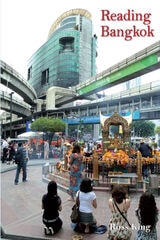
The author structures the book around external intrusions and local resistance. Geographically, this process is seen in movement from centre to periphery (Thonburi, Rattanakosin, Ratchadamnoen, Sukhumvit, Ratchadapisek, Khlong Toei, the universities). Chronologically, the city underwent various forms of colonization: incorporation of the periphery, which in turn colonized Bangkok; the economic colonization of the 19th and 20th centuries; colonization by consumption brought on in large part by globalized tourism; colonization by the "better" ideas of others (typically from the West); and finally colonization by "better" ways of thinking - notably the intrusions of the universities and of popular democracy.
This exceptionally innovative study draws on urban planning and development, history, anthropology, and political economy, and a rich body of empirical data to provide insights into the maze of power relations, inequalities and global influences that is normally hidden from view. Reading Bangkok is that rare thing, a study that genuinely changes the way its subject is seen and understood.

Reading Behind Bars
Alan Tansman
Prickly Paradigm Press, 2027
A reflection on how literature can function as a medium of lived experience rather than intellectual abstraction under conditions of radical constraint.
Drawing on the experience of teaching at Mt. Tam College at the San Quentin Correctional Facility, literary scholar Alan Tansman traces the extraordinary seriousness with which incarcerated students engage literary works form many times and places; Natsume Soseki's Kokoro, Toni Morrison's The Bluest Eye, Jorge Luis Borges's "Funes the Memorious," and Jean Améry's "On Torture." The heart of the book lies not in these canonical works themselves but in the students' responses—writing and discussion that is spare, precise, and emotionally exacting. These students are not merely powerful witnesses to suffering; they are careful, committed readers. Their interpretations are alert to ethical stakes and formal detail, shaped by firsthand knowledge of trauma, isolation, guilt, and the struggle with living in a painful present looking toward a hard future. What kind of refuge can literature offer from pain, guilt, and the weight of the past? Can that refuge also offer a guide for living behind bars?
Reading Books
Essays on the Material Text and Literature in AmericaMichele Moylan
University of Massachusetts Press, 1996
This collection takes as its point of departure the proposition that one can, in fact, tell a book by its cover. The contributors examine the ways in which the material qualities of books—including typography, paper, bindings, layout , and promotional copy—as well as their editing, production, and distribution profoundly affect how they have been read and understood.
The volume includes essays on the publishing history of Melville's early novels, Twain's The Innocents Abroad, the Tauchnitz edition of Hawthornes's The Marble Faun, and Jackson's Romona. Other chapters examine the reception of Dante's works in America, Houghton Mifflin's biographical series, the binding styles of Ticknor and Fields, and the packaging of literature for American high schools.
Reading Death in Ancient Rome
Mario Erasmo
The Ohio State University Press, 2008
Reading Embodied Citizenship
Disability, Narrative, and the Body PoliticRussell, Emily
Rutgers University Press, 2011
Liberal individualism, a foundational concept of American politics, assumes an essentially homogeneous population of independent citizens. When confronted with physical disability and the contradiction of seemingly unruly bodies, however, the public searches for a story that can make sense of the difference. The narrative that ensues makes "abnormality" an important part of the dialogue about what a genuine citizen is, though its role is concealed as an exception to the rule of individuality rather than a defining difference. Reading Embodied Citizenship brings disability to the forefront, illuminating its role in constituting what counts as U.S. citizenship.
Drawing from major figures in American literature, including Mark Twain, Flannery O'Connor, Carson McCullers, and David Foster Wallace, as well as introducing texts from the emerging canon of disability studies, Emily Russell demonstrates the place of disability at the core of American ideals. The narratives prompted by the encounter between physical difference and the body politic require a new understanding of embodiment as a necessary conjunction of physical, textual, and social bodies. Russell examines literature to explore and unsettle long-held assumptions about American citizenship.
Reading Emily Dickinson's Letters
Critical EssaysJane Donahue Eberwein
University of Massachusetts Press, 2009
Emily Dickinson, who regarded a letter as “a joy of Earth,” was herself a gifted epistolary artist—cryptic and allusive in style, dazzling in verbal effects, and sensitively attuned to the recipients of her many letters. In this volume, distinguished literary scholars focus intensively on Dickinson's letter-writing and what her letters reveal about her poetics, her personal associations, and her self-awareness as a writer.
Although Dickinson's letters have provided invaluable perspective for biographers and lovers of poetry since Mabel Loomis Todd published the first selection in 1894, today's scholarly climate opens potential for fresh insights drawn from new theoretical approaches, informed cultural contextualizations, and rigorous examination of manuscript evidence. Essays in this collection explore ways that Emily Dickinson adapted nineteenth-century epistolary conventions of women's culture, as well as how she directed her writing to particular readers, providing subtly tactful guidance to ways of approaching her poetics.
Close examination of her letters reveals the conscious artistry of Dickinson's writing, from her auditory effects to her experiments with form and tone. Her well-known correspondences with Thomas Wentworth Higginson, Susan Dickinson, Helen Hunt Jackson, and Otis Phillips Lord are examined here, but so too are previously neglected family communications with her aunt Kate Sweetser and cousin Eugenia Montague. Contributors find in these various letters evidence of Dickinson's enthusiastic participation in a sort of epistolary book club involving multiple friends, as well as her loving attentiveness to individuals in times of both suffering and joy. These inquiries highlight her thoughts on love, marriage, gender roles, art, and death, while unraveling mysteries ranging from legal discourse to Etruscan smiles.
In addition to a foreword by Marietta Messmer, the volume includes essays by Paul Crumbley, Karen Dandurand, Jane Donahue Eberwein, Judith Farr, James Guthrie, Ellen Louise Hart, Eleanor Heginbotham, Cindy MacKenzie, Martha Nell Smith, and Stephanie Tingley.
Reading History Sideways
The Fallacy and Enduring Impact of the Developmental Paradigm on Family LifeArland Thornton
University of Chicago Press, 2005
In Reading History Sideways, leading family scholar Arland Thornton demonstrates how this approach, though long since discredited, has permeated Western ideas and values about the family. Further, its domination of social science for centuries caused the misinterpretation of Western trends in family structure, marriage, fertility, and parent-child relations. Revisiting the "developmental fallacy," Thornton here traces its central role in changes in the Western world, from marriage to gender roles to adolescent sexuality. Through public policies, aid programs, and colonialism, it continues to reshape families in non-Western societies as well.
Reading Inca History
Catherine Julien
University of Iowa Press, 2002
At the heart of this book is the controversy over whether Inca history can and should be read as history. Did the Incas narrate a true reflection of their past, and did the Spaniards capture these narratives in a way that can be meaningfully reconstructed? In Reading Inca History,Catherine Julien finds that the Incas did indeed create detectable life histories.
The two historical genres that contributed most to sixteenth- and seventeenth-century Spanish narratives about the Incas were an official account of Inca dynastic genealogy and a series of life histories of Inca rulers. Rather than take for granted that there was an Inca historical consciousness, Julien begins by establishing an Inca purpose for keeping this dynastic genealogy. She then compares Spanish narratives of the Inca past to identify the structure of underlying Inca genres and establish the dependency on oral sources. Once the genealogical genre can be identified, the life histories can also be detected.
By carefully studying the composition of Spanish narratives and their underlying sources, Julien provides an informed and convincing reading of these complex texts. By disentangling the sources of their meaning, she reaches across time, language, and cultural barriers to achieve a rewarding understanding of the dynamics of Inca and colonial political history.
Reading Marx
On Transcendental MaterialismReiner Schürmann
Diaphanes, 2020
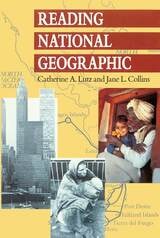
Reading National Geographic
Catherine A. Lutz and Jane L. Collins
University of Chicago Press, 1993
Lutz and Collins take us inside the National Geographic Society to investigate how its photographers, editors, and designers select images and text to produce representations of Third World cultures. Through interviews with the editors, they describe the process as one of negotiating standards of "balance" and "objectivity," informational content and visual beauty. Then, in a close reading of some six hundred photographs, they examine issues of race, gender, privilege, progress, and modernity through an analysis of the way such things as color, pose, framing, and vantage point are used in representations of non-Western peoples. Finally, through extensive interviews with readers, the authors assess how the cultural narratives of the magazine are received and interpreted, and identify a tension between the desire to know about other peoples and their ways and the wish to validate middle-class American values.
The result is a complex portrait of an institution and its role in promoting a kind of conservative humanism that acknowledges universal values and celebrates diversity while it allows readers to relegate non-Western peoples to an earlier stage of progress. We see the magazine and the Society as a key middlebrow arbiter of taste, wealth, and power in America, and we get a telling glimpse into middle-class American culture and all the wishes, assumptions, and fears it brings to bear on our armchair explorations of the world.
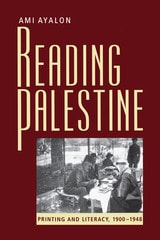
Reading Palestine
Printing and Literacy, 1900-1948By Ami Ayalon
University of Texas Press, 2004
Prior to the twentieth century, Arab society in Palestine was predominantly illiterate, with most social and political activities conducted through oral communication. There were no printing presses, no book or periodical production, and no written signs in public places. But a groundswell of change rapidly raised the region's literacy rates, a fascinating transformation explored for the first time in Reading Palestine.
Addressing an exciting aspect of Middle Eastern history as well as the power of the printed word itself, Reading Palestine describes how this hurried process intensified the role of literacy in every sphere of community life. Ami Ayalon examines Palestine's development of a modern educational system in conjunction with the emergence of a print industry, libraries and reading clubs, and the impact of print media on urban and rural populations. Drawn from extensive archival sources, official reports, autobiographies, and a rich trove of early Palestinian journalism, Reading Palestine provides crucial insight into the dynamic rise of literacy that revolutionized the way Palestinians navigated turbulent political waters.
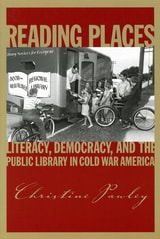
Reading Places
Literacy, Democracy, and the Public Library in Cold War AmericaChristine Pawley
University of Massachusetts Press, 2010
Central to the experiment were well-stocked bookmobiles that brought books to rural districts and the one-room schools that dotted the region. Three years after the project began, state officials and local librarians judged it an overwhelming success. Library circulation figures soared to two-and-a-half times their previous level. Over 90 percent of grade-school children in the rural schools used the bookmobile service, and their reading scores improved beyond expectation.
Despite these successes, however, local communities displayed deeply divided reactions. Some welcomed the book-mobiles and new library services wholeheartedly, valuing print and reading as essential to the exercise of democracy, and keen to widen educational opportunities for children growing up on hardscrabble farms where books and magazines were rare. Others feared the intrusion of govern- ment into their homes and communities, resented the tax increases that library services entailed, and complained about the subversive or immoral nature of some books.
Analyzing the history of tensions between various community groups, Pawley delineates the long-standing antagonisms arising from class, gender, and ethnic differences which contributed to a suspicion of official projects to expand education. Relating a seemingly small story of library policy, she teases out the complex interaction of reading, locality, and cultural difference. In so doing, she illuminates broader questions regarding libraries, literacy, and citizenship, reaching back to the nineteenth century and forward to the present day.
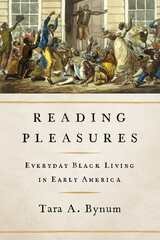
Reading Pleasures
Everyday Black Living in Early AmericaTara A. Bynum
University of Illinois Press, 2023
A daring assertion of Black people’s humanity, Reading Pleasures reveals how four Black writers experienced positive feelings and analyzes the ways these emotions served creative, political, and racialized ends.
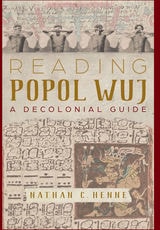
Reading Popol Wuj
A Decolonial GuideNathan C. Henne
University of Arizona Press, 2020
Popol Wujis considered one of the oldest books in the Americas. Various elements of Popol Wuj have appeared in different written forms over the last two millennia and several parts of Popol Wuj likely coalesced in hieroglyphic book form a few centuries before contact with Europeans. Popol Wuj offers a unique interpretation of the Maya world and ways of being from a Maya perspective. However, that perspective is often occluded since the extant Popol Wuj is likely a copy of a copy of a precontact Indigenous text that has been translated many times since the fifteenth century.
Reading Popol Wujoffers readers a path to look beyond Western constructions of literature to engage with this text through the philosophical foundation of Maya thought and culture. This guide deconstructs various translations to ask readers to break out of the colonial mold in approaching this seminal Maya text.
Popol Wuj, or Popol Vuh, in its modern form, can be divided thematically into three parts: cosmogony (the formation of the world), tales of the beings who inhabited the Earth before the coming of people, and chronicles of different ethnic Maya groups in the Guatemala area. Examining thirteen translations of the K’iche’ text, Henne offers a decolonial framework to read between what translations offer via specific practice exercises for reading, studying, and teaching. Each chapter provides a close reading and analysis of a different critical scene based on a comparison of several translations (English and Spanish) of a key K’iche’ word or phrase in order to uncover important philosophical elements of Maya worldviews that resist precise expression in Indo-European languages.
Charts and passages are frontloaded in each chapter so the reader engages in the comparative process before reading any leading arguments. This approach challenges traditional Western reading practices and enables scholars and students to read Popol Wuj—and other Indigenous texts—from within the worldview that created them.
Reading Prisoners
Literature, Literacy, and the Transformation of American Punishment, 1700–1845Schorb, Jodi
Rutgers University Press, 2014
Reading Public Opinion
How Political Actors View the Democratic ProcessSusan Herbst
University of Chicago Press, 1998
Herbst draws on ideas from political science, sociology, and psychology to explore how three sets of political participants—legislative staffers, political activists, and journalists—actually evaluate and assess public opinion. She concludes that many political actors reject "the voice of the people" as uninformed and nebulous, relying instead on interest groups and the media for representations of public opinion. Her important and original book forces us to rethink our assumptions about the meaning and place of public opinion in the realm of contemporary democratic politics.
Reading Sedgwick
Lauren Berlant, editor
Duke University Press, 2019
Contributors. Lauren Berlant, Kathryn Bond Stockton, Judith Butler, Lee Edelman, Jason Edwards, Ramzi Fawaz, Denis Flannery, Jane Gallop, Jonathan Goldberg, Meridith Kruse, Michael Moon, José Esteban Muñoz, Chris Nealon, Andrew Parker, H. A. Sedgwick, Karin Sellberg, Michael D. Snediker, Melissa Solomon, Robyn Wiegman
Reading Sounds
Closed-Captioned Media and Popular CultureSean Zdenek
University of Chicago Press, 2015
These are the choices closed captioners face every day. Captioners must decide whether and how to describe background noises, accents, laughter, musical cues, and even silences. When captioners describe a sound—or choose to ignore it—they are applying their own subjective interpretations to otherwise objective noises, creating meaning that does not necessarily exist in the soundtrack or the script.
Reading Sounds looks at closed-captioning as a potent source of meaning in rhetorical analysis. Through nine engrossing chapters, Sean Zdenek demonstrates how the choices captioners make affect the way deaf and hard of hearing viewers experience media. He draws on hundreds of real-life examples, as well as interviews with both professional captioners and regular viewers of closed captioning. Zdenek’s analysis is an engrossing look at how we make the audible visible, one that proves that better standards for closed captioning create a better entertainment experience for all viewers.
Reading Today
Edited by Heta Pyrhönen and Janna Kantola
University College London, 2018
With Reading Today, Heta Pyrhönen and Janna Kantola have assembled contributions that respond to these questions and many more. The contributors unpack emerging strategies of reading. They consider, for example, how paying attention to our emotional reactions while reading can significantly affect how we experience the process. Other chapters consider the impacts of technology on reading through such topics as experimental literature, the contemporary encyclopedic novel, and the healing power of books.
Reading Together, Reading Apart
Identity, Belonging, and South Asian American CommunityTamara Bhalla
University of Illinois Press, 2016
Tamara Bhalla blends a case study with literary and textual analysis to illuminate this phenomenon. Her fascinating investigation considers institutions from literary reviews to the marketplace to social media and other technologies, as well as traditional forms of literary discussion like book clubs and academic criticism. Throughout, Bhalla questions how her subjects' circumstances, desires, and shared race and class, limit the values they ascribe to reading. She also examines how ideology circulating around a body of literature or a self-selected, imagined community of readers shapes reading itself and influences South Asians' powerful, if contradictory, relationship with ideals of cultural authenticity.
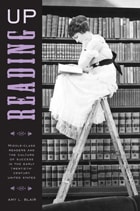
Reading Up
Middle-Class Readers and the Culture of Success in the Early Twentieth-Century United StatesAmy Blair
Temple University Press, 2011
A person who reads a book for self-improvement rather than aesthetic pleasure is “reading up.” Reading Up is Amy Blair's engaging study of popular literary critics who promoted reading generally and specific books as vehicles for acquiring cultural competence and economic mobility. Combining methodologies from the history of the book and the history of reading, to mass-cultural studies, reader-response criticism, reception studies, and formalist literary analysis, Blair shows how such critics influenced the choices of striving readers and popularized some elite writers.
Framed by an analysis of Hamilton Wright Mabie's role promoting the concept of “reading up” during his ten-year stint as the cultivator of literary taste for the highly popular Ladies' Home Journal, Reading Up reveals how readers flocked to literary works that they would be expected to dislike. Blair shows that while readers could be led to certain books by a trusted adviser, they frequently followed their own path in interpreting them in unexpected ways.
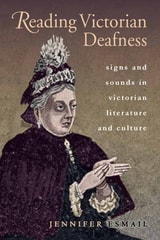
Reading Victorian Deafness
Signs and Sounds in Victorian Literature and CultureJennifer Esmail
Ohio University Press, 2013
Winner of the 2013 Sonya Rudikoff Award for best first book in Victorian Studies
Short-listed for the 2013 British Society for Literature and Science Book Prize.
Reading Victorian Deafness is the first book to address the crucial role that deaf people, and their unique language of signs, played in Victorian culture. Drawing on a range of works, from fiction by Charles Dickens and Wilkie Collins, to poetry by deaf poets and life writing by deaf memoirists Harriet Martineau and John Kitto, to scientific treatises by Alexander Graham Bell and Francis Galton, Reading Victorian Deafness argues that deaf people’s language use was a public, influential, and contentious issue in Victorian Britain.
The Victorians understood signed languages in multiple, and often contradictory, ways: they were objects of fascination and revulsion, were of scientific import and literary interest, and were considered both a unique mode of human communication and a vestige of a bestial heritage. Over the course of the nineteenth century, deaf people were increasingly stripped of their linguistic and cultural rights by a widespread pedagogical and cultural movement known as “oralism,” comprising mainly hearing educators, physicians, and parents.
Engaging with a group of human beings who used signs instead of speech challenged the Victorian understanding of humans as “the speaking animal” and the widespread understanding of “language” as a product of the voice. It is here that Reading Victorian Deafness offers substantial contributions to the fields of Victorian studies and disability studies. This book expands current scholarly conversations around orality, textuality, and sound while demonstrating how understandings of disability contributed to Victorian constructions of normalcy. Reading Victorian Deafness argues that deaf people were used as material test subjects for the Victorian process of understanding human language and, by extension, the definition of the human.
Reading Women in the New Testament Letters
Korinna Zamfir
SBL Press, 2024
Reading and Writing the Ambiente
Queer Sexualities in Latino, Latin American, and Spanish CultureSusana Chávez-Silverman
University of Wisconsin Press, 2000
In this dynamic collection of essays, many leading literary scholars trace gay and lesbian themes in Latin American, Hispanic, and U.S. Latino literary and cultural texts. Reading and Writing the Ambiente is consciously ambitious and far-ranging, historically as well as geographically. It includes discussions of texts from as early as the seventeenth century to writings of the late twentieth century.
Reading and Writing the Ambiente also underscores the ways in which lesbian and gay self-representation in Hispanic texts differs from representations in Anglo-American texts. The contributors demonstrate that—unlike the emphasis on the individual in Anglo- American sexual identity—Latino, Spanish, and Latin American sexual identity is produced in the surrounding culture and community, in the ambiente. As one of the first collections of its kind, Reading and Writing the Ambiente is expressive of the next wave of gay Hispanic and Latin scholarship.
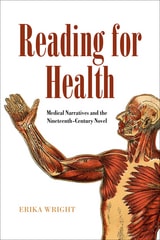
Reading for Health
Medical Narratives and the Nineteenth-Century NovelErika Wright
Ohio University Press, 2016
In Reading for Health: Medical Narratives and the Nineteenth-Century Novel, Erika Wright argues that the emphasis in Victorian Studies on disease as the primary source of narrative conflict that must be resolved has obscured the complex reading practices that emerge around the concept of health. By shifting attention to the ways that prevention of illness and the preservation of well-being operate in fiction, both thematically and structurally, Wright offers a new approach to reading character and voice, order and temporality, setting and metaphor. As Wright reveals, while canonical works by Austen, Brontë, Dickens, Martineau, and Gaskell register the pervasiveness of a conventional “therapeutic” form of action and mode of reading, they demonstrate as well an equally powerful investment in the achievement and maintenance of “health”—what Wright refers to as a “hygienic” narrative—both in personal and domestic conduct and in social interaction of the individual within the community.
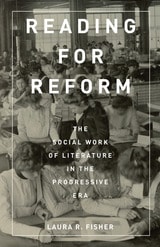
Reading for Reform
The Social Work of Literature in the Progressive EraLaura R. Fisher
University of Minnesota Press, 2019
An unprecedented examination of class-bridging reform and U.S. literary history at the turn of the twentieth century
Reading for Reform rewrites the literary history of late nineteenth and early twentieth century America by putting social reform institutions at the center of literary and cultural analysis. Examining the vibrant, often fractious literary cultures that developed as part of the Progressive mandate to uplift the socially disadvantaged, it shows that in these years reformers saw literature as a way to combat the myriad social problems that plagued modern U.S. society. As they developed distinctly literary methods for Americanizing immigrants, uplifting and refining wage-earning women, and educating black students, their institutions gave rise to a new social purpose for literature.
Class-bridging reform institutions—the urban settlement house, working girls’ club, and African American college—are rarely addressed in literary history. Yet, Laura R. Fisher argues, they engendered important experiments in the form and social utility of American literature, from minor texts of Yiddish drama and little-known periodical and reform writers to the fiction of Edith Wharton and Nella Larsen. Fisher delves into reform’s vast and largely unexplored institutional archives to show how dynamic sites of modern literary culture developed at the margins of social power.
Fisher reveals how reformist approaches to race, class, religion, and gender formation shaped American literature between the 1880s and the 1920s. In doing so, she tells a new story about the fate of literary practice, and the idea of literature’s practical value, during the very years that modernist authors were proclaiming art’s autonomy from concepts of social utility.
Reading for the Planet
Toward a GeomethodologyChristian Moraru
University of Michigan Press, 2015
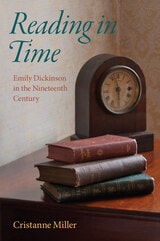
Reading in Time
Emily Dickinson in the Nineteenth CenturyCristanne Miller
University of Massachusetts Press, 2012
Before 1865, Dickinson at least ambivalently considered publication, circulated relatively few poems, and saved almost everything she wrote in organized booklets. After this date, she wrote far fewer poems, circulated many poems without retaining them, and took less interest in formally preserving her work. Yet, Miller argues, even when circulating relatively few poems, Dickinson was vitally engaged with the literary and political culture of her day and, in effect, wrote to her contemporaries. Unlike previous accounts placing Dickinson in her era, Reading in Time demonstrates the extent to which formal properties of her poems borrow from the short-lined verse she read in schoolbooks, periodicals, and single-authored volumes. Miller presents Dickinson's writing in relation to contemporary experiments with the lyric, the ballad, and free verse, explores her responses to American Orientalism, presents the dramatic lyric as one of her preferred modes for responding to the Civil War, and gives us new ways to understand the patterns of her composition and practice of poetry.
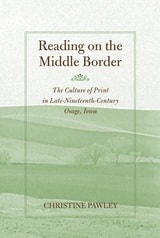
Reading on the Middle Border
The Culture of Print in Late-Nineteenth-Century Osage, IowaChristine Pawley
University of Massachusetts Press, 2009
Christine Pawley investigates the use of print by "ordinary" Americans in the small, rural community of Osage, Iowa—the town that shaped Hamlin Garland—analyzing primary source material on education, religious life, a reading club, and business affairs. A major section of her study focuses on the public library, an institution that provides a valuable window into the reading practices of men and women of various ages, classes, ethnicities, and religions. An extensive database of library circulation and accessions information, combined with federal and state census data, sheds light on the elusive issue of "Who read what?"
Pawley explores the ways print confirmed or challenged people's economic, social, and religious world, and asks what values print expressed or confronted. She also raises questions relating to modes and contexts of reading, distinguishing between groups and individuals. The picture of print in Osage is complex and defies reduction, but by placing print in a community context and viewing printed materials as an expression of activities, not mere artifacts, Pawley enhances our understanding of the role of reading in American culture.
Reading the Figural, or, Philosophy after the New Media
D. N. Rodowick
Duke University Press, 2001
To fully comprehend the emergence of the figural requires a genealogical critique of the aesthetic, Rodowick claims. Seeking allies in this effort to deconstruct the opposition of word and image and to create new concepts for comprehending the figural, he journeys through a range of philosophical writings: Thierry Kuntzel and Marie-Claire Ropars-Wuilleumier on film theory; Jacques Derrida on the deconstruction of the aesthetic; Siegfried Kracauer and Walter Benjamin on the historical image as a utopian force in photography and film; and Gilles Deleuze and Michel Foucault on the emergence of the figural as both a semiotic regime and a new stratagem of power coincident with the appearance of digital phenomena and of societies of control.
Scholars of philosophy, film theory, cultural criticism, new media, and art history will be interested in the original and sophisticated insights found in this book.
Reading the Illegible
Indigenous Writing and the Limits of Colonial Hegemony in the AndesLaura Leon Llerena
University of Arizona Press, 2023
The concept of legibility allows us to reconsider this unique manuscript within the intertwined histories of literacy, knowledge, and colonialism. Reading the Illegible shows that the anonymous author(s) of the Huarochirí Manuscript, along with two contemporaneous Andean-authored texts by Joan de Santa Cruz Pachacuti and Felipe Guaman Poma de Ayala, rewrote the history of writing and the notion of Christianity by deploying the colonizers’ technology of alphabetic writing.
Reading the Illegible weaves together the story of the peoples, places, objects, and media that surrounded the creation of the anonymous Huarochirí Manuscript to demonstrate how Andean people endowed the European technology of writing with a new social role in the context of a multimedia society.