Results by title
18284 books match the query 'United States' and 833 start with r

Rebellion or Revolution?
Harold Cruse
University of Minnesota Press, 2009
A classic work of African American cultural, social, and political thought by a forerunner of the Black Power movement
One of the leading writers of African American intellectual life in the second half of the twentieth century, Harold Cruse first came to international attention in 1967 with the publication of his influential and inflammatory book, The Crisis of the Negro Intellectual. This fiercely opinionated and deeply informed critique of both integrationism and black nationalism established Cruse as a bold new voice on race and resistance in America.
First published in the wake of The Crisis of the Negro Intellectual’s success, Rebellion or Revolution? collects reviews and essays Cruse wrote between 1950 and 1966, examining the relevance of such figures as James Baldwin, Booker T. Washington, Albert Camus, and Josephine Baker, as well as such subjects as Marxism and the African American community, the economics of black nationalism, and the emerging Black Power movement. Rebellion or Revolution? contains a number of significant writings not available elsewhere.Now, with a new foreword by Cedric Johnson, this work finally emerges as both an essential document from a crucial moment in African American history and a road map to the origins and evolution of Cruse’s critical thought, asserting its importance in today’s debates on race in America.
Rebellious Bodies
Stardom, Citizenship, and the New Body PoliticsBy Russell Meeuf
University of Texas Press, 2017
Celebrity culture today teems with stars who challenge long-held ideas about a “normal” body. Plus-size and older actresses are rebelling against the cultural obsession with slender bodies and youth. Physically disabled actors and actresses are moving beyond the stock roles and stereotypes that once constrained their opportunities. Stars of various races and ethnicities are crafting new narratives about cultural belonging, while transgender performers are challenging our culture’s assumptions about gender and identity. But do these new players in contemporary entertainment media truly signal a new acceptance of body diversity in popular culture?
Focusing on six key examples—Melissa McCarthy, Gabourey Sidibe, Peter Dinklage, Danny Trejo, Betty White, and Laverne Cox—Rebellious Bodies examines the new body politics of stardom, situating each star against a prominent cultural anxiety about bodies and inclusion, evoking issues ranging from the obesity epidemic and the rise of postracial rhetoric to disability rights, Latino/a immigration, an aging population, and transgender activism. Using a wide variety of sources featuring these celebrities—films, TV shows, entertainment journalism, and more—to analyze each one’s media persona, Russell Meeuf demonstrates that while these stars are promoted as examples of a supposedly more inclusive industry, the reality is far more complex. Revealing how their bodies have become sites for negotiating the still-contested boundaries of cultural citizenship, he uncovers the stark limitations of inclusion in a deeply unequal world.

Rebels Against War
The American Peace Movement, 1933-1983Lawrence Wittner
Temple University Press, 1984
Rebels All!
Rebels All! A Short History of the Conservative Mind in Postwar AmericaMattson, Kevin
Rutgers University Press, 2008
Outstanding Academic Title of 2008
Do you ever wonder why conservative pundits drop the word “faggot” or talk about killing and then Christianizing Muslims abroad? Do you wonder why the right’s spokespeople seem so confrontational, rude, and over-the-top recently? Does it seem strange that conservative books have such apocalyptic titles? Do you marvel at why conservative writers trumpeted the “rebel” qualities of George W. Bush just a few years back?
There is no doubt that the style of the political right today is tough, brash, and by many accounts, not very conservative sounding. After all, isn’t conservatism supposed to be about maintaining standards, upholding civility, and frowning upon rebellion? Historian Kevin Mattson explains the apparent contradictions of the party in this fresh examination of the postwar conservative mind. Examining a big cast of characters that includes William F. Buckley, Whittaker Chambers, Norman Podhoretz, Irving Kristol, Kevin Phillips, David Brooks, and others, Mattson shows how right-wing intellectuals have always, but in different ways, played to the populist and rowdy tendencies in America’s political culture. He boldly compares the conservative intellectual movement to the radical utopians among the New Left of the 1960s and he explains how conservatism has ingested central features of American culture, including a distrust of sophistication and intellectualism and a love of popular culture, sensation, shock, and celebrity.
Both a work of history and political criticism, Rebels All! shows how the conservative mind made itself appealing, but also points to its endemic problems. Mattson’s conclusion outlines how a recast liberalism should respond to the conservative ascendancy that has marked our politics for the last thirty years.

Rebels and Outliers
Real Stories of the American WestJohn M Glionna
University of Nevada Press, 2025
This vibrant collection invites readers to journey through the rugged landscapes and tight-knit communities that define the American West. Along the way, you’ll meet individuals whose grit, resilience, and pioneering spirit embody the heart of this region’s legacy.
A captivating follow-up to Glionna’s 2022 book, Outback Nevada: Real Stories of the Silver State, Rebels and Outliers is a testament to the untamed, enduring character of the people who call the West home.
Rebels and Runaways
Slave Resistance in Nineteenth-Century FloridaLarry Eugene Rivers
University of Illinois Press, 2013
Against a smoldering backdrop of violence, this study analyzes the various degrees of slave resistance--from the perspectives of both slave and master--and how they differed in various regions of antebellum Florida. In particular, Rivers demonstrates how the Atlantic world view of some enslaved blacks successfully aided their escape to freedom, a path that did not always lead North but sometimes farther South to the Bahama Islands and Caribbean. Identifying more commonly known slave rebellions such as the Stono, Louisiana, Denmark (Telemaque) Vesey, Gabriel, and the Nat Turner insurrections, Rivers argues persuasively that the size, scope, and intensity of black resistance in the Second Seminole War makes it the largest sustained slave insurrection ever to occur in American history.
Meticulously researched, Rebels and Runaways offers a detailed account of resistance, protest, and violence as enslaved blacks fought for freedom.
Rebels in Law
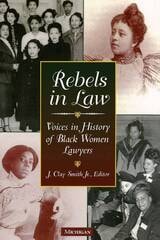
Voices in History of Black Women LawyersJ. Clay Smith, Jr., Editor
University of Michigan Press, 2000
The essays demonstrate the involvement of black women lawyers in important public issues of our time and show them addressing the sensitive subjects of race, equality, justice and freedom. Drawing together many writings that have never been published or have been published in obscure journals or newspapers, Rebels in Law is a groundbreaking study. In addition, it offers historical background information on each writer and on the history of black women lawyers. Providing an opportunity to study the origins of black women as professionals, community leaders, wives, mothers, and feminists, it will be of interest to scholars in the fields of law, history, political science, sociology, black studies and women's studies.
J. Clay Smith, Jr., is Professor of Law, Howard University Law School. He was formerly a member of the United States Equal Employment Opportunity Commission, Dean of Howard University Law School, and President of the Washington Bar Association. He is the author of Emancipation: The Making of the Black Lawyer, 1844-1944 and numerous articles.
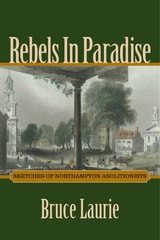
Rebels in Paradise
Sketches of Northampton AbolitionistsBruce Laurie
University of Massachusetts Press, 2014
Long ago dubbed the “Paradise of America,” Northampton, Massachusetts, is also known as the home of visionaries—from the Reverend Jonathan Edwards, father of the First Great Awakening, to George W. Benson, brother-in-law of William Lloyd Garrison and a founder of the utopian Northampton Association for Education and Industry. During the mid-nineteenth century the town became a center of political abolitionism and a hub in the Underground Railroad. In this book, Bruce Laurie profiles five rebellious figures who launched Northampton's abolitionist movement—Sylvester Judd Jr., John Payson Williston, David Ruggles, Henry Sherwood Gere, and Erastus Hopkins. Through their individual stories he traces the evolution of the antislavery movement in western Massachusetts and links it to broader developments in economics, civil life, and political affairs.
Northampton's abolitionists were a heterodox group, yet most were intrepid devotees of democracy and racial equality, idealists who enjoyed genuine friendships and political alliances with African Americans. Several even took the bold step of hiring African Americans in their businesses. They avoided the doctrinal rivalries that sometimes troubled the antislavery movement in other places, skillfully steering clear of the xenophobic nativism that infected Massachusetts politics in the mid–1850s and divided the Republican Party at large. Although a prohibitionist faction disrupted the Northampton abolitionist movement for a time, the leaders prevailed on the strength of their personal prestige and political experience, making the seat of Hampshire County what one of them called an abolitionist “stronghold.”
Rebels
Youth and the Cold War Origins of IdentityLeerom Medovoi
Duke University Press, 2005
Alongside the young rebel, the contemporary concept of identity emerged in the 1950s. It was in that decade that “identity” was first used to define collective selves in the politicized manner that is recognizable today: in terms such as “national identity” and “racial identity.” Medovoi traces the rapid absorption of identity themes across many facets of postwar American culture, including beat literature, the young adult novel, the Hollywood teen film, early rock ‘n’ roll, black drama, and “bad girl” narratives. He demonstrates that youth culture especially began to exhibit telltale motifs of teen, racial, sexual, gender, and generational revolt that would burst into political prominence during the ensuing decades, bequeathing to the progressive wing of contemporary American political culture a potent but ambiguous legacy of identity politics.
Reborn in America
French Exiles and Refugees in the United States and the Vine and Olive Adventure, 1815-1865Eric Saugera, translated by Madeleine Velguth
University of Alabama Press, 2011
Rebuilding Native Nations
Strategies for Governance and DevelopmentEdited by Miriam Jorgensen; Foreword by Oren Lyons; Afterword by Satsan (Herb George)
University of Arizona Press, 2007
Produced by the Native Nations Institute for Leadership, Management, and Policy at the University of Arizona and the Harvard Project on American Indian Economic Development, this book traces the contours of that revolution as Native nations turn the dream of self-determination into a practical reality. Part report, part analysis, part how-to manual for Native leaders, it discusses strategies for governance and community and economic development being employed by American Indian nations and First Nations in Canada as they move to assert greater control over their own affairs.
Rebuilding Native Nations provides guidelines for creating new governance structures, rewriting constitutions, building justice systems, launching nation-owned enterprises, encouraging citizen entrepreneurs, developing new relationships with non-Native governments, and confronting the crippling legacies of colonialism. For nations that wish to join that revolution or for those who simply want to understand the transformation now underway across Indigenous North America, this book is a critical resource.
CONTENTS
Foreword by Oren Lyons
Editor's Introduction
Part 1
Starting Points
1. Two Approaches to the Development of Native Nations: One Works, the Other Doesn't
Stephen Cornell and Joseph P. Kalt
2. Development, Governance, Culture: What Are They and What Do They Have to Do with Rebuilding Native Nations?
Manley A. Begay, Jr., Stephen Cornell, Miriam Jorgensen, and Joseph P. Kalt
Part 2
Rebuilding the Foundations
3. Remaking the Tools of Governance: Colonial Legacies, Indigenous Solutions
Stephen Cornell
4. The Role of Constitutions in Native Nation Building: Laying a Firm Foundation
Joseph P. Kalt
5 . Native Nation Courts: Key Players in Nation Rebuilding
Joseph Thomas Flies-Away, Carrie Garrow, and Miriam Jorgensen
6. Getting Things Done for the Nation: The Challenge of Tribal Administration
Stephen Cornell and Miriam Jorgensen
Part 3
Reconceiving Key Functions
7. Managing the Boundary between Business and Politics: Strategies for Improving the Chances for Success in Tribally Owned Enterprises
Kenneth Grant and Jonathan Taylor
8. Citizen Entrepreneurship: An Underutilized Development Resource
Stephen Cornell, Miriam Jorgensen, Ian Wilson Record, and Joan Timeche
9. Governmental Services and Programs: Meeting Citizens' Needs
Alyce S. Adams, Andrew J. Lee, and Michael Lipsky
10. Intergovernmental Relationships: Expressions of Tribal Sovereignty
Sarah L. Hicks
Part 4
Making It Happen
11. Rebuilding Native Nations: What Do Leaders Do?
Manley A. Begay, Jr., Stephen Cornell, Miriam Jorgensen, and Nathan Pryor
12. Seizing the Future: Why Some Native Nations Do and Others Don't
Stephen Cornell, Miriam Jorgensen, Joseph P. Kalt, and Katherine Spilde Contreras
Afterword by Satsan (Herb George)
References
About the Contributors
Index
Rebuilding Trust
Clergy Morale in the Wake of the Abuse CrisisBrandon Vaidyanathan
Catholic University of America Press, 2025
Recasting America
Culture and Politics in the Age of Cold WarEdited by Lary May
University of Chicago Press, 1989
Recasting a Craft
St. Louis Typefounders Respond to IndustrializationRobert A. Mullen
Southern Illinois University Press, 2005
In the nineteenth and early twentieth centuries, type for newspapers and books was set one letter at a time, and the manufacturers of the metal type used in the printing trade were called typefounders. This prominent yet rarely documented industry was essential to the development of modern American publishing and was particularly prevalent in St. Louis. In Recasting a Craft: St. Louis Typefounders Respond to Industrialization, Robert A. Mullen recognizes the city’s significant contributions to typefounding and details how the craft fundamentally changed through mechanization, growth, and the creation of a large conglomerate.
Like many trades of the nineteenth and early twentieth centuries that were eventually lost to industrialization, the typefoundries of St. Louis grew from small shops to factories with organized labor. Mullen describes three distinct periods of the industry that emerged in St. Louis’s typefounding trade: the early struggles in establishing the industry there, the period of intense competition and creative enterprise, and the proliferation of new companies that appealed to those customers who felt alienated by the monopolizing older companies.
Mullen discusses at length the technological, social, and demographic foundations of the immense growth of the trade in the nineteenth century, identifying the changes in typographical design and the demand for it in the new era of advertising. He also profiles the workers, working conditions, and labor issues—such as the failed industry-wide strike of 1903—that emerged as the craft of typefounding entered the industrial age. More than two hundred type designs that originated with the St. Louis firms are listed in an appendix with examples of each face. The volume also contains a list of the catalogs of the St. Louis typefoundries known to exist in the public and academic libraries of the United States.
Recasting the Machine Age
Henry Ford's Village IndustriesHoward P. Segal
University of Massachusetts Press, 2005
Recasting the Machine Age recounts the history of Henry Ford's efforts to shift the production of Ford cars and trucks from the large-scale factories he had pioneered in the Detroit area to nineteen decentralized, small-scale plants within sixty miles of Ford headquarters in Dearborn. The visionary who had become famous in the early twentieth century for his huge and technologically advanced Highland Park and River Rouge complexes gradually changed his focus beginning in the teens and continuing until his death in 1947.
Ford may well have been motivated to spend great sums on the village industries in part to prevent the unionization of his company. But these industrial experiments represented much more than “union busting.” They were significant examples of profound social, cultural, and ideological shifts in America between the World Wars as reflected in the thought and practice of one notable industrialist.
Howard P. Segal recounts the development of the plants, their fate after Ford's death, their recent revival as part of Michigan's renewed appreciation of its industrial heritage, and their connections to contemporary efforts to decentralize high-tech working and living arrangements.
Recharging Judaism
How Civic Engagement Is Good for Synagogues, Jews, and AmericaRabbi Judith Schindler and Judy Seldin-Cohen
Central Conference of American Rabbis, 2018
Recharging Judaism is the essential and timely guide for every synagogue and community seeking to strengthen the bonds of Jewish communal life through advocating for social justice. This volume delves into the enriching civic engagement and acts of righteousness already undertaken by Jews and Jewish communities across the country, and further explores the positive differences we can all affect upon the future of America. There are a myriad of ways in which advocating for social justice and participating in civic engagement can create lasting change. Those inspired to affect such change will find new meaning in the texts and history of our tradition. Using real examples from both small and large congregations across the country, Recharging Judaism offers a framework to guide us through our journey of civic responsibility and social duty and into a brighter future for our country.
Reckless Legislation
How Legislators Ignore the ConsitutionBamberger, Michael A.
Rutgers University Press, 1999
Article 6 of the U.S. Constitution requires that every U.S. Senator and Representative, as well as all members of any state legislature, take an oath or affirmation to support the Constitution. Legislators, after all, must accept the basic principles embodied in the Constitution and Bill of Rights when interpreting questions of law. The only way to change these principles is through amendments to the Constitution. But in an increasing number of cases, contends Michael A, Bamberger, our legislators are knowingly abdicating their responsibility to uphold the Constitution. Instead of considering the constitutionality of legislation, they vote for what is politically expedient and popular, leaving it to the courts to determine the legality of their actions. Bamberger argues that legislators have a duty to consider constitutionality and not “pass the buck” to the judiciary regardless of political pressures or even well-meaning intentions to achieve desirable policy objectives.
Reckless Legislation examines legislative consideration and avoidance of issues of constitutionality through a number of examples: the regulation of the Internet by Congress and two state legislatures; the reliance by legislatures of Minneapolis, Indianapolis, and Tennessee on “experts” to justify passage of unconstitutional laws; the repeated passage of unconstitutional laws in New York and Missouri relating, respectively, to religion and abortion to wear down the courts and the opposition; and the efforts by Congress to reverse Supreme Court decisions believed by it to be incorrect or harmful.
Bamberger urges legislators to avoid the political motives that lead to “reckless legislation,” recommending that they “make full use of the full panoply of available support services . . . for a better and deeper knowledge of the issues raised.”

Reckon
Logan Phillips
University of Arizona Press, 2026
In Reckon, artist Logan Phillips returns to the fabled town to face the history he was raised on as a boy—gunfights, outlaws, and Hollywood cowboys—for a new, personal confrontation with the West’s foundational mythology. This hybrid memoir also explores sexuality, masculinity, parenting, and what it means to love a land rife with contradiction and “slathered in murder.”
As innovative as it is moving, this memoir is constructed of essays, photography, poetry, newspaper clippings from the Tombstone Epitaph Local Edition, and of course, movie screenplays. As he writes the characters of his past––including Youngfather and Teenme––Phillips finds the real history to be much more complex than the stories he was told. This is Tombstone in the 1980s and 90s, a century after the West’s most famous gunfight––a fifteen-second event still performed every day in historical reenactments––where Phillips’s father works as a historical exhibit designer at the Courthouse Museum and his uncle as a stuntman at Old Tucson Studios.
With an original, searing voice, Reckon is an essential answer to the tough questions of past and future, inheritance and reinvention, all from the perspective of a boy stuck in the middle.
Reckoning Day
Race, Place, and the Atom Bomb in Postwar AmericaJacqueline Foertsch
Vanderbilt University Press, 2013
Foertsch also examines the location of African American characters in novels, science fiction, and survivalist nonfiction such as government-sponsored forecasts regarding post-nuclear survival. In these, black characters are often displaced or absented entirely: in doomsday narratives they are excluded from executive decision-making and the stories' often triumphant conclusions; in the nonfiction, they are rarely envisioned amongst the "typical American" survivors charged with rebuilding US society. Throughout Reckoning Day, issues of placement and positioning provide the conceptual framework: abandoned at "ground zero" (America's inner cities) during the height of the atomic threat, African Americans were figured in white-authored survival fiction as compliant servants aiding white victory over atomic adversity, while as historical figures they were often perceived as "elsewhere" (indifferent) to the atomic threat. In fact, African Americans' "position" on the bomb was rarely one of silence or indifference. Ranging from appreciation to disdain to vigorous opposition, atomic-era African Americans developed diverse and meaningful positions on the bomb and made essential contributions to a remarkably American dialogue.

Reckoning at Eagle Creek
The Secret Legacy of Coal in the HeartlandJeff Biggers
Southern Illinois University Press, 2010
Set in the ruins of his family’s strip-mined homestead in the Shawnee National Forest in southern Illinois, award-winning journalist and historian Jeff Biggers delivers a deeply personal portrait of the overlooked human and environmental costs of our nation’s dirty energy policy. Beginning with the policies of Thomas Jefferson and Andrew Jackson, chronicling the removal of Native Americans and the hidden story of legally sanctioned black slavery in the land of Lincoln, Reckoning at Eagle Creek vividly describes the mining wars for union recognition and workplace safety, and the devastating consequences of industrial strip-mining. At the heart of our national debate over climate change and the crucial transition toward clean energy, Biggers exposes the fallacy of “clean coal” and shatters the marketing myth that southern Illinois represents the “Saudi Arabia of coal.”
Reckoning at Eagle Creek is ultimately an exposé of “historicide,” one that traces coal’s harrowing legacy through the great American family saga of sacrifice and resiliency and the extraordinary process of recovering our nation’s memory.
Reckoning with Slavery
Gender, Kinship, and Capitalism in the Early Black AtlanticJennifer L. Morgan
Duke University Press, 2021

Reckoning
The American West on EdgeWalter R. Borneman
University of Utah Press, 2027
Reclaiming Accountability
Transparency, Executive Power, and the U.S. ConstitutionHeidi Kitrosser
University of Chicago Press, 2014
In Reclaiming Accountability, Kitrosser traces presidentialism from its start as part of a decades-old legal movement through its appearance during the Bush and Obama administrations, demonstrating its effects on secrecy throughout. Taking readers through the key presidentialist arguments—including “supremacy” and “unitary executive theory”—she explains how these arguments misread the Constitution in a way that is profoundly at odds with democratic principles. Kitrosser’s own reading offers a powerful corrective, showing how the Constitution provides myriad tools, including the power of Congress and the courts to enforce checks on presidential power, through which we could reclaim government accountability.
Reclaiming American Cities
The Struggle for People, Place, and Nature since 1900Rutherford H. Platt
University of Massachusetts Press, 2014
For most of the past century, urban America was dominated by top-down policies serving the white business and cultural elite, the suburbs, and the automobile. At times these approaches were fiercely challenged by reformers such as Jane Addams and Jane Jacobs. Yet by the 1980s, mainstream policies had resulted in a nation of ravaged central cities, sprawling suburbs, social and economic polarization, and incalculable environmental damage.
In the 1990s, this entrenched model finally yielded to change as local citizens, neighborhood groups, and other stakeholders, empowered by a spate of new laws and policies, began asserting their own needs and priorities. Though hampered by fiscal crises and internal disagreements, these popular initiatives launched what the author terms a new era of “humane urbanism” marked by a determination to make cities and suburbs greener, healthier, safer, more equitable, more efficient, and generally more people-friendly. In the process, the mayors, architects, engineers, and bureaucrats who had previously dominated urban policy found themselves relegated to supporting roles.
As Rutherford H. Platt points out, humane urbanism can take many forms, from affordable housing and networks of bike paths to refurbished waterfronts and urban farms. Often spontaneous, low-tech, and self-sustaining programs, their shared goal is to connect people to one another and to bring nature back into the city. Reclaiming American Cities examines both sides of this historic transformation: the long struggle against patricians and technocrats of earlier decades and the recent sprouting of grassroots efforts to make metropolitan America more humane and sustainable.
Reclaiming Class
Women, Poverty, And The Promiseedited by Vivyan C. Adair and Sandra L. Dahlberg
Temple University Press, 2003
Reclaiming Fair Use
How to Put Balance Back in CopyrightPatricia Aufderheide and Peter Jaszi
University of Chicago Press, 2011

Reclaiming Fair Use
How to Put Balance Back in Copyright, Second EditionPatricia Aufderheide and Peter Jaszi
University of Chicago Press, 2018
Originally published in 2011, Reclaiming Fair Use challenged the widely held notion that copyright law is obsolete in an age of digital technologies. Beginning with a survey of the contemporary landscape of copyright law, Aufderheide and Jaszi drew on their years of experience advising documentary filmmakers, English teachers, performing arts scholars, and other creative professionals to lay out in detail how the principles of fair-use can be employed to avoid copyright violation. Taking stock of the vibrant remix culture that has only burgeoned since the book’s original publication, this new edition addresses the expanded reach of fair use—tracking the Twitter hashtag #WTFU (where’s the fair use?), the maturing of the transformativeness measure in legal disputes, the ongoing fight against automatic detection software, and the progress and delays of digitization initiatives around the country.
Full of no-nonsense advice and practical examples, Reclaiming Fair Use remains essential reading for anyone interested in law, creativity, and the ever-broadening realm of new media.
Reclaiming Indigenous Governance
Reflections and Insights from Australia, Canada, New Zealand, and the United StatesEdited by William Nikolakis, Stephen Cornell, and Harry W. Nelson; Foreword by Sophie Pierre and Gwen Phillips
University of Arizona Press, 2019
Indigenous governance is dynamic, an ongoing relationship between Indigenous peoples and settler-states. The relationship may be vigorously contested, but it is often fragile—one that ebbs and flows, where hard-won gains can be swiftly lost by the policy reversals of central governments. The legacy of colonial relationships continues to limit advances in self-government.
Yet Indigenous peoples in the CANZUS countries are no strangers to setbacks, and their growing movement provides ample evidence of resilience, resourcefulness, and determination to take back control of their own destiny. Demonstrating the struggles and achievements of Indigenous peoples, the chapter authors draw on the wisdom of Indigenous leaders and others involved in rebuilding institutions for governance, strategic issues, and managing lands and resources.
This volume brings together the experiences, reflections, and insights of practitioners confronting the challenges of governing, as well as researchers seeking to learn what Indigenous governing involves in these contexts. Three things emerge: the enormity of the Indigenous governance task, the creative agency of Indigenous peoples determined to pursue their own objectives, and the diverse paths they choose to reach their goal.
Reclaiming Modernity
Essays on a Paradoxical NostalgiaLarry Bennett
University of Illinois Press, 2025
Larry Bennett explores the complexities of nostalgia with considerations of the historic preservation of brutalist architecture, specifically Bertrand Goldberg’s Prentice Women’s Hospital in Chicago; the memoirs and recollections of early and mid-twentieth-century Brooklyn and Detroit; and the turntable’s rebirth as a musical instrument alongside the vinyl LP’s resurgence as a prized way of consuming music. Bennett tracks modernity as expressed through ideas, artistic products, and widespread social practices. His consideration of nostalgia focuses on our inclination to rediscover value in people, places, and social habits diminished by the passage of time.
Provocative and multidisciplinary, Reclaiming Modernity delves into the paradox of how we feel nostalgia for ideas and times that emerged from an impulse to shun nostalgia.
Reclaiming Queer
Activist and Academic Rhetorics of ResistanceErin J. Rand
University of Alabama Press, 2014
An examination of the rhetorical linkage of queer theory in the academy with street-level queer activism in the 1980s and early 1990s
The late 1980s and early 1990s were a defining historical moment for both queer activism and queer theory in the United States. LGBTQ communities, confronted with the fatal indifference and homophobia of the AIDS crisis, often responded with angry, militant forms of activism designed not merely to promote acceptance or tolerance, but to forge identity and strength from victimization and assert loudly and forcefully their rights to safety and humanity. The activist reclamation of the word “queer” is one marker of this shift in ideology and practice, and it was mirrored in academic circles by the concurrent emergence of the new field of “queer theory.” That is, as queer activists were mobilizing in the streets, queer theorists were producing a similar foment in the halls and publications of academia, questioning regulatory categories of gender and sexuality, and attempting to illuminate the heteronormative foundations of Western thought. Notably, the narrative of queer theory’s development often describes it as arising from or being inspired by queer activism.
In Reclaiming Queer, Erin J. Rand examines both queer activist and academic practices during this period, taking as her primary object the rhetorical linkage of queer theory in the academy with street-level queer activism. Through this strategic conjuncture of activism and academia, Rand grapples with the specific conditions for and constraints on rhetorical agency in each context. She examines the early texts that inaugurated the field of queer theory, Queer Nation’s infamous “Queers Read This” manifesto, Larry Kramer’s polemic speeches and editorials, the Lesbian Avengers’ humorous and outrageous antics, the history of ACT UP, and the more recent appearance of Gay Shame activism. From these activist and academic discourses, Rand builds a theory of rhetorical agency that posits queerness as the very condition from which agency emerges.
Reclaiming Queer thus offers a critical look at the rhetoric of queer activism, engages the history of queer theory’s institutionalization and the politics of its proliferation, suggests a radically contextual understanding of rhetorical agency and form, and argues for the centrality of queerness to all rhetorical action.
Reclaiming Time
Race, Temporality, and Black Expressive CultureIsaiah Matthew Wooden
Northwestern University Press, 2025
Showing how twenty-first-century Black theater and media arts challenge dominant conceptualizations of time
Reclaiming Time: Race, Temporality, and Black Expressive Culture examines works by contemporary Black artists in multiple media—drama, film, performance art, and photography—that trouble dominant conceptualizations and normative configurations of time in relation to race in the twenty-first century. Isaiah Matthew Wooden explores the ways in which an intentional and sometimes ludic engagement with time and temporality has enabled these artists to probe urgent questions and themes concerning the conditions of contemporary Black life.
Wooden surveys a diverse array of performance-based and visual texts to explore the rich practices of contemporary Black expressive culture: dramatic works by playwrights Eisa Davis, Tarell Alvin McCraney, and Robert O’Hara; performance art and photography by visual artists Jefferson Pinder and LaToya Ruby Frazier; and feature-length cinema by director-producer Tanya Hamilton. These works expose normative time as specious and evidence the transformative potential in honing practices of Black temporal experimentation and intervention. By putting this cross-disciplinary set of texts in conversation with each other, Wooden sheds new light on the shrewd ways that they each reflect an investment in unbinding time from the exigencies of normativity and teleology, as well as on their shared commitments to reclaiming time to reimagine and represent Blackness in all its multiplicities.
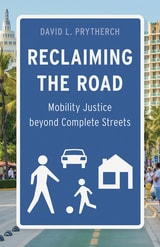
Reclaiming the Road
Mobility Justice beyond Complete StreetsDavid L Prytherch
University of Minnesota Press, 2025
Imagining equitable streets for all
For the past century, our roadways have been engineered as pipes for cars, but they offer vast potential as public spaces. From New York and Boston to Portland and Los Angeles, cities are rethinking their streets, going beyond sidewalks and bike lanes to welcome nonmotorists to share the asphalt roadway. Reclaiming the Road traces the historical evolution of America’s streets and explores contemporary movements to retake them from cars—temporarily and permanently—for diverse forms of mobility and community life. To share the street raises important questions of equity, in transportation and beyond. David L. Prytherch proposes a bold, intersectional vision of a more just street.
Reclaiming the Road connects cutting-edge theory, policy analysis, and firsthand accounts from those leading the charge in transforming our streets to advocate for changing how we think about and design roads. Prytherch features case studies of nine major cities in the United States to show how experiments in reclaiming streets accelerated during the Covid-19 pandemic to become lasting changes. Through in-depth interviews, he shares stories of how planners, transportation advocates, and community leaders have implemented innovative programs for slowing neighborhood streets, opening roads for walking and biking, and reconstructing roadways with public parklets and street plazas as social spaces for curbside conversation.
Examining movements to transform streets through the lenses of equity and justice, Reclaiming the Road tackles the conceptual challenge of defining mobility justice and the practicalities of planning a more just public street, offering a compelling vision for the future of America’s public spaces.
Retail e-book files for this title are screen-reader friendly with images accompanied by short alt text and/or extended descriptions.
Reclaiming the Rural
Essays on Literacy, Rhetoric, and PedagogyEdited by Kim Donehower, Charlotte Hogg, and Eileen E. Schell
Southern Illinois University Press, 2012
In Reclaiming the Rural: Essays on Literacy, Rhetoric, and Pedagogy, editors Kim Donehower, Charlotte Hogg, and Eileen E. Schell bring together a diverse collection of essays that consider literacy, rhetoric, and pedagogy in the United States, Canada, and Mexico. The essays move beyond the typical arguments for preserving, abandoning, or modernizing by analyzing how rural communities sustain themselves through literate action. The contributors explore the rhetorics of water disputes in the western United States, the histories and influences of religious rhetorics in Mexico, agricultural and rural literacy curricula, the literacies of organizations such as 4-H and Academia de la Nueva Raza, and neoliberal rhetorics. Central to these examinations are the rural populations themselves, which include indigenous peoples in the rural United States, Canada, and Mexico, as well as those of European or other backgrounds.
The strength of the anthology lies in its multiple perspectives, various research sites, and the range of methodologies employed, including rhetorical analyses of economies and environments, media, and public spaces; classroom-based research; historical analysis and archival work; and qualitative research. The researchers engage the duality between the practices of everyday life in rural communities and the practices of reflecting on and making meaning.
Reclaiming the Rural reflects the continually changing, nuanced, context-dependent realities of rural life while acknowledging the complex histories, power struggles, and governmental actions that have affected and continue to affect the lives of rural citizens. This thought-provoking collection demonstrates the value in reclaiming the rural for scholarly and pedagogical analysis.
Recollecting Early Asian America
Essays In Cultural HistoryJosephine Lee
Temple University Press, 2002
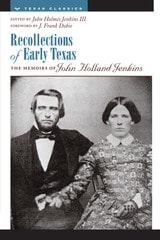
Recollections of Early Texas
Memoirs of John Holland JenkinsEdited by John Holmes Jenkins III
University of Texas Press, 1958
“[These reminiscences] light up for whoever will read the earliest days of early English-speaking Texas.” —J. Frank Dobie, from the foreword
A firsthand account of pioneer life in east Texas.

Recollections of Life on the Prison Ship Jersey
Thomas Dring
Westholme Publishing, 2010
“Among the many events which took place during the Revolutionary War from its commencement to its termination [are] the cruelties inflicted upon that unfortunate class of men who had the misfortune to be numbered among the prisoners [of the British] and more particularly those whom the dreadful chance of war had placed on board their prison ships at New York.” So begins the remarkable narrative of Thomas Dring. In 1824, Dring was an aging man of 65, retired in his native state of Rhode Island. Forty-two years before, he, like thousands of other young men, had been caught up in the American cause. In 1782, he had been captured by the British and sentenced to the infamous prison ship Jersey, a demasted hulk anchored in the East River off New York City. It is estimated that more than 11,000 men perished on the British prison ships over the course of the war, and their bones regularly washed up on the shore long after hostilities ceased. Dring survived to tell the tale, and in 1824, he decided to do just that. He was motivated partly because the fate of the prisoners was beginning to be doubted, that their hardships were thought to have been grossly exaggerated, and even that the entire experience had never occurred.
This book publishes for the first time the complete text of Dring’s handwritten manuscript, a major primary-source document, in which he describes the horrible conditions, treatment by guards, and experiences that he and others endured during captivity. Recollections of Life on the Prison Ship Jersey is a plea not to forget but instead to remember the inhumanity of the captors and the sacrifices of the captives—a message that continues to resonate today. Editor David Swain has provided an introductory essay and extensive notes that contain background information and historical documentation to accompany and illuminate the original manuscript.
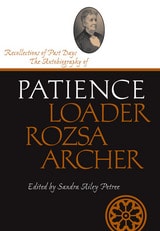
Recollections of Past Days
The Autobiography of Patience Loader Rozsa Archeredited by Sandra Ailey Petree
Utah State University Press, 2006
For visitors to the Martin's Cove historic site in Wyoming, Patience Loader has become an icon of the disastrous winter entrapment of the Martin and Willie handcart companies. Her record of those events is important, but there is much else of interest in her autobiography. In fact, it is a bit unusual that someone such as her would have left such an engaging record of her life.
The daughter of an English gardener, Patience Loader became a boarding house servant, domestic maid, and seamstress. Converted to Mormonism, she shipped with her parents to America. They joined the ill-fated Martin company, which because of poor planning and a late start west, was caught poorly prepared by severe high plains snowstorms in October and November 1856. The combined fatalities of the Martin and Willie companies made this the worst disaster in the history of overland travel. Patience = s father was one of those who died. After reaching Utah, Patience took the unusual step for a Mormon of marrying a soldier, John Rozsa, stationed at Camp Floyd. The troops there had made up the Utah Expedition, sent to ensure federal authority over the Mormons. Rozsa was a Hungarian immigrant and Mormon convert. When the Utah troops were recalled for the Civil War, Patience accompanied her husband, as an army laundress, to Washington, D.C., running a boarding house while Rozsa fought. After the war, he died at Fort Leavenworth of consumption, and Patience returned alone to Utah, where she became a cook at a mining camp in American Fork Canyon. Her autobiography ends there in 1872, though she lived till 1922.
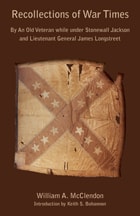
Recollections of War Times
By An Old Veteran while under Stonewall Jackson and Lieutenant General James LongstreetWilliam A. McClendon, with an introduction by Keith S. Bohannon
University of Alabama Press, 2010
"Gus" McClendon joined the 15th Alabama Infantry Regiment, and served in many of the Eastern Theater engagements. More than fifty years later, he sent down his reminiscences, still an unreconstructed Southern patriot, although able to look back with some amusement on his younger self.

Recollections of a Tejano Life
Antonio Menchaca in Texas HistoryEdited by Timothy Matovina and Jesús F. de la Teja
University of Texas Press, 2013
San Antonio native, military veteran, merchant, and mayor pro tem José Antonio Menchaca (1800–1879) was one of only a few Tejano leaders to leave behind an extensive manuscript of recollections. Portions of the document were published in 1907, followed by a “corrected” edition in 1937, but the complete work could not be published without painstaking reconstruction. At last available in its entirety, Menchaca’s book of reminiscences captures the social life, people, and events that shaped the history of Texas’s tumultuous transformation during his lifetime. Highlighting not only Menchaca’s acclaimed military service but also his vigorous defense of Tejanos’ rights, dignity, and heritage, Recollections of a Tejano Life charts a remarkable legacy while incorporating scholarly commentary to separate fact from fiction.
Revealing how Tejanos perceived themselves and the revolutionary events that defined them, this wonderfully edited volume presents Menchaca’s remembrances of such diverse figures as Antonio López de Santa Anna, Jim Bowie, Davy Crockett, Sam Houston, General Adrián Woll, Comanche chief “Casamiro,” and Texas Ranger Jack Hays. Menchaca and his fellow Tejanos were actively engaged in local struggles as Mexico won her independence from Spain; later many joined the fight to establish the Republic of Texas, only to see it annexed to the United States nine years after the Battle of San Jacinto. This first-person account corrects important misconceptions and brings previously unspoken truths vividly to life.
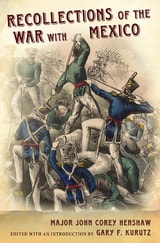
Recollections of the War with Mexico
Major John Corey Henshaw & Edited by Gary F. Kurutz
University of Missouri Press, 2008
Major John Henshaw, a dutiful regimental officer in the American invasion of Mexico, was one of only a handful of eyewitnesses to describe the two major theaters of that war from start to finish. But unlike most of his peers, he did not see himself as a conquering warrior and took pride in never having taken a life. He even wrote, “If I were alone, no earthly power could induce me to lend a helping hand in this base and infamous war.”
This book presents Henshaw’s recollections for the first time, covering all the action from the first skirmish in southern Texas to the collapse of Mexico City. As a member of the Seventh Infantry Regiment, this pugnacious line officer from New England served under both of the war’s principal generals, Zachary Taylor and Winfield Scott, and survived seven major battles. His writings constitute a virtual “minority opinion” report on the Mexican War.
Henshaw’s recollections include a rare and highly descriptive account of the siege of Fort Texas (later Fort Brown), plus rich new details of the storming of the Bishop’s Palace at Monterrey, the bombardment of Veracruz, the assault on Cerro Gordo, and the savage fighting outside the capital. His records of battles, marches, and maneuvers greatly augment what is already known about the campaign, but in addition to reporting daily occurrences and describing combat in graphic detail, Henshaw also reflected on the strategies and tactics—and what he saw as shortcomings—of officers on both sides.
Bitingly critical of those in command, of American volunteers, and of the war’s glory hounds, Henshaw admired the valor of ordinary soldiers on both sides of the fighting. And in the midst of the carnage, he also found time to describe Mexico’s cities and scenery in rhapsodic prose and express considerable empathy for its people. In addition to the “Recollections,” the volume includes vivid passages from letters Henshaw sent back to his wife, which supply additional details of the campaign. Editor Gary Kurutz provides an extensive biography of Henshaw, as well as comprehensive annotations to the text.
What Henshaw may have lacked as an unquestioning officer he more than made up for as an astute observer. Offering a decidedly different view of this war of American expansion, these writings with their balanced approach lend a fresh perspective among other primary sources and paint a startlingly honest picture of both Americans fighting abroad and those they fought.
Recommended Principles to Guide Academy-Industry Relationships
American Association of University Professors
University of Illinois Press, 2014
• Preserving the integrity of research and public respect for higher education
• Eliminating and managing individual and institutional financial conflicts of interest
• Maintaining unbiased hiring and recruitment policies
• Establishing grievance procedures and due process rights for faculty, graduate students, and academic professionals
• Mastering the complications of negotiations over patents and copyright
• Assuring the ethics of research involving human subjects.
In a time of dynamic change Recommended Principles to Guide Academy-Industry Relationships offers an indispensable and authoritative guide to sustaining integrity and tradition while achieving great things in twenty-first century academia.
Reconceiving Decision-Making in Democratic Politics
Attention, Choice, and Public PolicyBryan D. Jones
University of Chicago Press, 1994
Individuals and political systems alike, Jones argues, tend to be attentive to only one issue at a time. Using numerous examples from elections, public opinion polls, congressional deliberations, and of bureaucratic decision-making, he shows how shifting attentiveness can and does alter choices and political outcomes—even when underlying preferences remain relatively fixed. An individual, for example, may initially decide to vote for a candidate because of her stand on spending but change his vote when he learns of her position on abortion, never really balancing the two options.
Reconciliation in a Michigan Watershed
Restoring Ken-O-ShaGail Gunst Heffner
Michigan State University Press, 2024

Reconnaissance in Sonora
Charles D. Poston’s 1854 Exploration of Mexico and the Gadsden PurchaseC. Gilbert Storms
University of Arizona Press, 2015
Poston led his party through Sonora and the territory of the 1854 Gadsden Purchase, which today encompasses southern Arizona and a portion of southern New Mexico. The syndicate’s charge to the young adventurer was to acquire land in Mexico in anticipation of the Gadsden Purchase and the building of the transcontinental railroad. Reconnaissance in Sonora details Poston’s expedition, including the founding of the town of Colorado City at the site of present-day Yuma, Arizona.
C. Gilbert Storms explores the American ideas of territorial expansion and Manifest Destiny, the national debate over a route for a transcontinental railroad, the legends of rich gold and silver mines in northern Mexico, and the French and American filibusters that plagued northern Mexico in the early 1850s.

Reconsidering Gender, Violence, and the State
Lisa Arellano, Erica L. Ball and Amanda Frisken, special issue editors
Duke University Press, 2016
Contributors: Lisa Arellano, Erica L. Ball, Josh Cerretti, Jonathan Culleton, Amanda Frisken, Raphael Ginsberg, Deana Heath, Efeoghene Igor, Catherine Jacquet, Jessie Kindig, Benjamin N. Lawrance, Jen Manion, Xhercis Méndez, Luis Morán, Claudia Salamanca, Tomoko Seto, Carla Tsampiras, Jennifer Yeager
Reconsidering No Man Knows My History
edited by Newell G. Bringhurst
Utah State University Press, 1996
Reconsidering Parties and Partisanship
Edited by Christopher F. Karpowitz and Jeremy C. Pope
University of Michigan Press, 2026
The scholars here approach parties from the standpoint of partisan and social identities, polarization, the prevalence of independents (and pseudo-independents), political campaigns, and more. In linking the different faces or levels—party-in-the-electorate, party-in-government, and party-as-an-organization—the chapters provide a wide-ranging set of theories and ideas to consider. Through this exploration, Reconsidering Parties and Partisanship provides a valuable road map for partisanship in our current era.
Readers will learn
- How conditional party government seems to work in this highly partisan era
- How donors and pressure groups have taken ownership over campaigns
- How independents are often undercover partisans, but who also feel repelled by the existing parties—even the one they typically support
- How various identities converge to produce partisan affection (when that exists)
- How partisanship relates to ideology.
Reconsidering Roosevelt on Race
How the Presidency Paved the Road to BrownKevin J. McMahon
University of Chicago Press, 2003
McMahon shows how FDR's attempt to strengthen the presidency and undermine the power of conservative Southern Democrats dovetailed with his efforts to seek racial equality through the federal courts. By appointing a majority of rights-based liberals deferential to presidential power, Roosevelt ensured that the Supreme Court would be receptive to civil rights claims, especially when those claims had the support of the executive branch.
Reconstituting Whiteness
The Mississippi State Sovereignty CommissionJenny Irons
Vanderbilt University Press, 2010
Going far beyond a mere institutional history, however, Irons uses the commission as a tool to explore the intersection of state-organized defense of white supremacy and the dramatically shifting racial constructs of the civil rights era. Ultimately, the commission failed to protect segregation, but as a state entity, it adapted racism in new terms.
Reconstituting Whiteness is an insightful study of the methods Mississippi state government used to move the goal posts of what was considered "decent" and "acceptable" white supremacy and racism, as it raced against time to define whiteness while the boundaries of segregation fell all around it.
Reconstituting the American Renaissance
Emerson, Whitman, and the Politics of RepresentationJay Grossman
Duke University Press, 2003
Reconstituting the American Renaissance describes how Emerson and Whitman came into the period of their greatest productivity with different conceptions of the functions and political efficacy of the word in the world. It challenges Emerson’s position as Whitman’s necessary precursor and offers a cultural history that emphasizes the two writers’ differences in social class, cultural experience, and political perspective. In their writings between 1830 and 1855, the book finds contrasting conceptions of the relations between the “representative man” and the constituencies to whom, and for whom, he speaks. Reconstituting the American Renaissance opens up the canonical relationship between Emerson and Whitman and multiplies the historical and discursive contexts for understanding their published and unpublished works.