Results by title
8812 books match the query 'Political Science' and 436 start with r
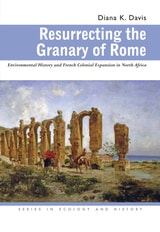
Resurrecting the Granary of Rome
Environmental History and French Colonial Expansion in North AfricaDiana K. Davis
Ohio University Press, 2007
Tales of deforestation and desertification in North Africa have been told from the Roman period to the present. Such stories of environmental decline in the Maghreb are still recounted by experts and are widely accepted without question today. International organizations such as the United Nations frequently invoke these inaccurate stories to justify environmental conservation and development projects in the arid and semiarid lands in North Africa and around the Mediterranean basin. Recent research in arid lands ecology and new paleoecological evidence, however, do not support many claims of deforestation, overgrazing, and desertification in this region.
Diana K. Davis’s pioneering analysis reveals the critical influence of French scientists and administrators who established much of the purported scientific basis of these stories during the colonial period in Algeria, Morocco, and Tunisia, illustrating the key role of environmental narratives in imperial expansion. The processes set in place by the use of this narrative not only systematically disadvantaged the majority of North Africans but also led to profound changes in the landscape, some of which produced the land degradation that continues to plague the Maghreb today.
Resurrecting the Granary of Rome exposes many of the political, economic, and ideological goals of the French colonial project in these arid lands and the resulting definition of desertification that continues to inform global environmental and development projects. The first book on the environmental history of the Maghreb, this volume reframes much conventional thinking about the North African environment. Davis’s book is essential reading for those interested in global environmental history.
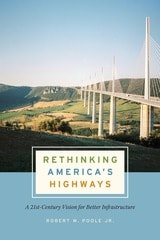
Rethinking America's Highways
A 21st-Century Vision for Better InfrastructureRobert W. Poole Jr.
University of Chicago Press, 2018
In Rethinking America’s Highways, Poole examines how our current model of state-owned highways came about and why it is failing to satisfy its customers. He argues for a new model that treats highways themselves as public utilities—like electricity, telephones, and water supply. If highways were provided commercially, Poole argues, people would pay for highways based on how much they used, and the companies would issue revenue bonds to invest in facilities people were willing to pay for. Arguing for highway investments to be motivated by economic rather than political factors, this book makes a carefully-reasoned and well-documented case for a new approach to highways that is sure to inform future decisions and policies for U.S. infrastructure.
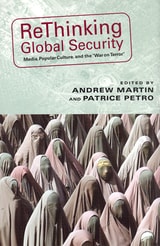
Rethinking Global Security
Media, Popular Culture, and the "War on Terror"Martin, Andrew
Rutgers University Press, 2006
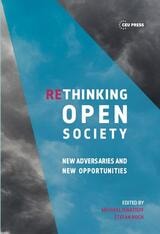
Rethinking Open Society
CONTRIBUTORS: Anne Applebaum • Erica Benner• Dorothee Bohle • Thomas Christiano • Tim Crane • Niall Ferguson • Timothy Garton Ash • Béla Greskovits • Michael Ignatieff • Robert D. Kaplan • János Kis • Ivan Krastev • Mark Lilla • Margaret MacMillan • Jan-Werner Müller • Alina Mungiu-Pippidi • Stefan Roch • Pierre Rosanvallon • Jacques Rupnik • András Sajó • Daniela Schwarzer • Sir Roger Scruton • Stephen M. Walt
Central European University Press, 2018
Rethinking Rights
Historical, Political, and Philosophical PerspectivesEdited by Bruce P. Frohnen and Kenneth L. Grasso
University of Missouri Press, 2008
Rethinking Sustainability
Power, Knowledge, and InstitutionsJonathan Harris, Editor
University of Michigan Press, 2003
Any theory of sustainable development must take into account economic, social, and environmental dimensions. Until recently, the question "What is development?" was often answered predominantly from the economist's perspective, with high priority being assigned to expansion of economic output. Social, political, institutional, and ethical aspects have often been neglected. But now that sustainable development has become a broadly accepted concept, it is impossible to maintain a narrowly economistic view of development. For this reason, the varied perspectives offered by the contributors to this volume are crucial to understanding the process of development as it relates to environmental sustainability and human well-being.
The selection of articles is meant to be stimulating and provocative rather than comp-rehensive. They are roughly divided between those dealing with broad theoretical issues concerning the economic, political, and social aspects of development (Part I) and those presenting more applied analysis (Part II). The common thread is a concern for examining which factors contribute to making development socially just and environmentally sound.
Rethinking Sustainability will be of interest to economists and social scientists, development professionals, and instructors seeking to offer their students a broad perspective on development issues.
Jonathan Harris is Senior Research Associate, Global Development and Environment Institute at Tufts University, as well as Adjunct Associate Professor of International Economics at Tufts University Fletcher School of Law.

Rethinking Urban Entrepreneurialism
A grounded view from ChinaEdited by Fulong Wu and Fangzhu Zhang
University College London, 2026
Circumventing historical binaries between authoritarianism and entrepreneurialism, this study presents a grounded view of urban governance in China.
China’s urban governance demonstrates perplexing and contradictory features. Despite market-oriented reform, the role of the state remains salient. What is the logic behind governing urban China? Chinese scholars provide a grounded view. Rethinking Urban Entrepreneurialism challenges the conventional understanding of urban entrepreneurialism and argues that Chinese urban governance comprises two interrelated aspects: entrepreneurial governance and innovative statecraft. The first refers to the deployment of market-based approaches to urban development, and the second refers to versatile techniques. Urban entrepreneurialism encompasses both market-oriented approaches and administrative innovations. The state upholds its strategic and extra-economic objectives by deploying and mobilizing the market and society. Urban entrepreneurialism also demonstrates a strong state intentionality rather than following the market logic. The book reveals the challenges to urban entrepreneurialism, the limits of entrepreneurial governance, and multiple managerial practices in China.
By examining entrepreneurial urban development and governance experiments, it paints a comprehensive picture of contemporary urban governance in China. It transcends the binary view of authoritarianism versus urban entrepreneurialism, showcasing a wide spectrum of entrepreneurial and managerial governance features. To rethink urban entrepreneurialism, the book suggests that it extends public-private partnerships into a broader form of statecraft known as “state entrepreneurialism.”
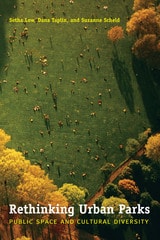
Rethinking Urban Parks
Public Space and Cultural DiversityBy Setha Low, Dana Taplin, and Suzanne Scheld
University of Texas Press, 2005
Urban parks such as New York City's Central Park provide vital public spaces where city dwellers of all races and classes can mingle safely while enjoying a variety of recreations. By coming together in these relaxed settings, different groups become comfortable with each other, thereby strengthening their communities and the democratic fabric of society. But just the opposite happens when, by design or in ignorance, parks are made inhospitable to certain groups of people.
This pathfinding book argues that cultural diversity should be a key goal in designing and maintaining urban parks. Using case studies of New York City's Prospect Park, Orchard Beach in Pelham Bay Park, and Jacob Riis Park in the Gateway National Recreation Area, as well as New York's Ellis Island Bridge Proposal and Philadelphia's Independence National Historical Park, the authors identify specific ways to promote, maintain, and manage cultural diversity in urban parks. They also uncover the factors that can limit park use, including historical interpretive materials that ignore the contributions of different ethnic groups, high entrance or access fees, park usage rules that restrict ethnic activities, and park "restorations" that focus only on historical or aesthetic values. With the wealth of data in this book, urban planners, park professionals, and all concerned citizens will have the tools to create and maintain public parks that serve the needs and interests of all the public.
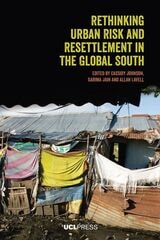
Rethinking Urban Risk and Resettlement in the Global South
Edited by Cassidy Johnson, Garima Jain, and Allan Lavell
University College London, 2021
Environmental changes impact everyone, but the burden is especially heavy upon the lives and livelihoods of the urban poor and those living in informal settlements. In an effort to reduce urban residents’ exposure to climate change and natural disasters, resettlement programs are becoming widespread across the Global South. Yet, while resettlement may reduce a region’s future climate-related disaster risk, it can also often increase poverty and vulnerability. This volume collates the findings from a research project that examined urban areas across the globe, including case studies from India, Uganda, Peru, Colombia, Mexico, Cambodia, and the Philippines. The book offers a unique approach to resettlement, providing an opportunity for urban planners to re-think how disaster risk management can better address the accumulation of urban risks in the era of climate change.

Rethinking War and Peace
Diana Francis
Pluto Press, 2004
Rethinking the Political
Gender, Resistance, and the StateEdited by Barbara Laslett, Johanna Brenner, and Yesim Arat
University of Chicago Press, 1995
Section One, "Gender, Citizenship, and Collectivity," includes Nancy Frazer and Linda Gordon's critique of dependency and citizenship; Iris Young on women as a social collective; Ruth Bloch on the feminization of public virtue in revolutionary America; Trisha Franzen on feminism and lesbian community, and Sonia Kruks on de Beauvoir and contemporary feminism.
"Collective Action and Women's Resistance," Section Two, features Louis Tilly's "Paths of Proletarianization"; Temma Kaplan's "Female Consciousness and Collective Action"; and five assessments of women's collective action worldwide: Samira Haj on Palestine, Arlene McLeod on Egypt, Gay Seidman on South Africa, Nancy Sternbach et al. on Latin America, and Anne Walthall on Japan.
Concluding with a section on gender and the state, Rethinking the Political also features Bronwyn Winter on the law and cultural relativism; Sherene Razack on sexual violence; Wendy Luttrell on educational institutions; Patricia Stamp on ethnic conflict in postcolonial Kenya; Elizabeth Schmidt on patriarchy and capitalism in Zimbabwe; and Muriel Nazzari on the "woman question" in post-revolutionary Cuba.
Rethinking the Rule of Law after Communism
Wojciech Sadurski
Central European University Press, 2005

Reticulations
Jean-Luc Nancy and the Networks of the PoliticalPhilip Armstrong
University of Minnesota Press, 2009
Revealing how networks reopen our understanding of political discourse today
Significantly advancing our notion of what constitutes a network, Philip Armstrong proposes a rethinking of political public space that specifically separates networks from the current popular discussion of globalization and information technology.
Analyzing a wide range of Jean-Luc Nancy’s works, Reticulations shows how his project of articulating the political in terms of singularities, pluralities, and multiplicities can deepen our understanding of networks and how they influence community and politics. Even more striking is the way Armstrong associates this general complex in Nancy’s writing with his concern for what Nancy calls the retreat of the political. Armstrong highlights what Nancy’s perspective on networks reveals about movement politics as seen in the 1999 protests in Seattle against the World Trade Organization, the impact of technology on citizenship, and finally how this perspective critiques the model of networked communism constructed by Hardt and Negri. Contesting the exclusive link between technology and networks, Reticulations ultimately demonstrates how network society creates an entirely new politics, one surprisingly rooted in community.
Revenant Ecologies
Defying the Violence of Extinction and ConservationAudra Mitchell
University of Minnesota Press, 2024
Engaging a broad spectrum of ecological thought to articulate the ethical scale of global extinction
As global rates of plant and animal extinctions mount, anxieties about the future of the earth’s ecosystems are fueling ever more ambitious efforts at conservation, which draw on Western scientific principles to manage species and biodiversity. In Revenant Ecologies, Audra Mitchell argues that these responses not only ignore but also magnify powerful forms of structural violence like colonialism, racism, genocide, extractivism, ableism, and heteronormativity, ultimately contributing to the destruction of unique life forms and ecosystems.
Critiquing the Western discourse of global extinction and biodiversity through the lens of diverse Indigenous philosophies and other marginalized knowledge systems, Revenant Ecologies promotes new ways of articulating the ethical enormity of global extinction. Mitchell offers an ambitious framework—(bio)plurality—that focuses on nurturing unique, irreplaceable worlds, relations, and ecosystems, aiming to transform global ecological–political relations, including through processes of land return and critically confronting discourses on “human extinction.”
Highlighting the deep violence that underpins ideas of “extinction,” “conservation,” and “biodiversity,” Revenant Ecologies fuses political ecology, global ethics, and violence studies to offer concrete, practical alternatives. It also foregrounds the ways that multi-life-form worlds are actively defying the forms of violence that drive extinction—and that shape global efforts to manage it.
Retail e-book files for this title are screen-reader friendly with images accompanied by short alt text and/or extended descriptions.
Revenge Capitalism
The Ghosts of Empire, the Demons of Capital, and the Settling of Unpayable DebtsMax Haiven
Pluto Press, 2020
In Revenge Capitalism, Max Haiven argues that this economic vengeance helps us explain the culture and politics of revenge we see in society more broadly. Moving from the history of colonialism and its continuing effects today, he examines the opioid crisis in the US, the growth of 'surplus populations' worldwide and unpacks the central paradigm of unpayable debts - both as reparations owed, and as a methodology of oppression.
Revenge Capitalism offers no easy answers, but is a powerful call to the radical imagination.
Reversing Course
Carter's Foreign Policy, Domestic Politics, and the Failure of ReformDavid Skidmore
Vanderbilt University Press, 1996
In Reversing Course, David Skidmore argues that President Carter's initial foreign policy agenda required a scaling back of U.S. commitments abroad, reflecting a decline in resources, as well as influence, in a world developing in ways necessarily reducing U.S. hegemony. By probing beneath the obvious and carefully sifting the abundant but poorly understood evidence, Skidmore finds at the root of Carter's failed effort an irresistible pressure to reverse a liberal foreign-policy agenda in order to address the effect at home of well-organized conservative criticism. For Skidmore, Carter's course "reversed" toward a traditional containment strategy vis-a-vis the Soviet Union not because of Soviet intransigence or faulty idealism but because Cold War politics sold better in the polls.
While offering significant theoretical arguments, Skidmore carefully anchors his thesis in the day-to-day political give and take among those personalities and events that provoked headlines and commentaries long before they were the stuff of history. Among the telling factors and events analyzed in this book are the Vance/Brzezinski conflict, the support and opposition of Howard Baker, the SALT II Treaty, the Panama Canal Treaties, and the Soviet occupation of Afghanistan, to mention only a few.
Although Skidmore draws conclusions that apply to the Reagan, Bush, and Clinton administrations as well, his focus is not on personality but on theory and underlying structures. He provides a demonstration that this structural approach can "be helpful not only in unraveling the mysteries of policy change under Carter but also in specifying the underlying sources of policy vacillation over much of the past two decades." .
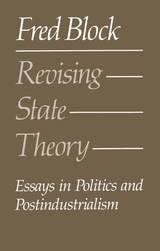
Revising State Theory
Essays in Politics and PostindustrialismFred Block
Temple University Press, 1987

Revisionary Interventions into the Americanist Canon
Donald E. Pease
Duke University Press, 1994
Originally published as a special issue of boundary 2, the essays gathered here discuss writers as diverse as Kate Chopin, Frederick Douglass, Emerson, Melville, W. D. Howells, Henry James, W. E. B. DuBois, and Mark Twain, plus the historical figure John Brown. Two major sections devoted to the theory of romance and to cultural-historical analyses emphasize the political perspective of "New Americanist" literary and cultural study.
Contributors. William E. Cain, Wai-chee Dimock, Howard Horwitz, Gregory S. Jay, Steven Mailloux, John McWilliams, Susan Mizruchi, Donald E. Pease, Ivy Schweitzer, Priscilla Wald, Michael Warner, Robert Weimann
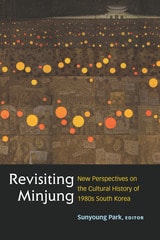
Revisiting Minjung
New Perspectives on the Cultural History of 1980s South KoreaSunyoung Park, Editor
University of Michigan Press, 2019
Revisiting Minjung brings new themes, new subjectivities, and new theoretical perspectives to the study of the rich ecosystem of 1980s Korean culture. Treated here is a wide array of topics, including the origins of minjung ideology, its critique by the right wing, minjung art and music, workers’ literary culture, women writers and the resurgence of feminism, erotic cinema, science fiction, transnational political travels, and the representations of race and queerness in 1980s popular culture. The book thus details the origins and development of some of the movements that shape cultural life in South Korea today, and it does so through analyses that engage some of the most pressing debates in current scholarship in Korea and abroad.
Revisiting U.S. Trade Policy
Decisions in PerspectiveAlfred E. Eckes Jr.
Ohio University Press, 2000
In trade policy, as in many other areas of public policy, decision makers often confront present and future problems with little understanding of how similar disputes were resolved in the past. Too often, busy public officials had no time to write or record negotiating histories. Revisiting U.S. Trade Policy, which is certain to become a classic in the literature of trade negotiations, is just such a record.
Built on the oral histories of thirty-five former U.S. trade policymakers—including Michael Blumenthal, Alonzo McDonald, William Roth, and Robert S. Strauss—this unique record, prepared for publication by Alfred E. Eckes, revisits some of the most important moments of America’s trade liberalization program in the years after World War II.
From GATT to the World Trade Organization, these major players look back in candid hindsight at their decisions concerning trade policy and the effects that those decisions had on shaping the new international economic order.

Revisiting the Falklands-Malvinas Question
Transnational and Interdisciplinary PerspectivesEdited by Guillermo Mira and Fernando Pedrosa
University of London Press, 2020
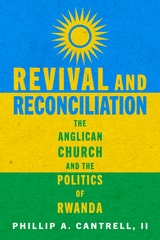
Revival and Reconciliation
The Anglican Church and the Politics of RwandaPhillip A. Cantrell II
University of Wisconsin Press, 2022
Drawing from new archival materials as well as on-the-ground field research, Revival and Reconciliation is a Rwanda-centered account of the country's ecclesiastical and national historiography. Cantrell calls attention to the harms the postgenocide church risks doing should it continue to support false narratives about Rwanda's colonial and postcolonial past—with dangerous consequences for the future.
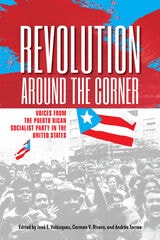
Revolution Around the Corner
Voices from the Puerto Rican Socialist Party in the U.S.Edited by José E. Velázquez, Carmen V. Rivera, and Andrés Torres
Temple University Press, 2021
Active from the late 1960s until the mid-1990s, the U.S. branch of the Puerto Rican Socialist Party (PSP) worked simultaneously to build support for Puerto Rican independence and to engage in radical social change within the United States.
Revolution Around the Corner chronicles this unique social movement, describing various mass campaigns and the inner workings of the organization. The editors and contributors—all former members, leaders, and supporters of the PSP—offer a range of views and interpretations of their experience.
Combining historical accounts, personal stories, interviews, and retrospective analysis, Revolution Around the Corner examines specific actions such as the National Day of Solidarity (El Acto Nacional), the Bicentennial without Colonies, the Save Hostos struggle, and the Vieques campaign. Testimonies recount the pros and cons of membership diversity, as well as issues of loyalty and compañerismo. In addition, essays describe the PSP’s participation in coalitions and alliances with Left and progressive movements. The book concludes with the editors’ reflections on the PSP’s achievements, mistakes, and contributions.
Revolution By Love
Emerging Arab Youth VoicesDala Ghandour
Temple University Press, 0
Beginning in Tunisia and spreading across the Middle East and North Africa, everyday citizens stepped into the streets, staking their claim to a democratic future. The image of these protests captured the imagination of the world. Revolution by Love takes you inside these protests, onto those streets, and shares with you the stories of the individuals who made this historic moment possible. The book's contributors bear witness to the bravery of Libyans who faced down troops as they secured satellite technology to share with the world what was happening in Tripoli; the courage of doctors, facing gunfire, as they treated patients in Bahrain; and the everyday struggles of families in Gaza. At each moment, within every story shared, there is also a continual return to the love shared with friends and within families--a love that served as the foundation for the protests that changed the world.
Contributors include: Ahmed Abdelhakim Hachelaf, Raghda Abushahla, Muna Abbas Ali AlBuloushi, Shatha Al-Harazi, Samah Elmeri, Dala Ghandour, Mirelle Karam Halim, Shadin Hamaideh, Mohammed Masbah, Amal Matar, Salma Nazzal, Ibrahim Yousif Shebani, and Emna Ben Yedder.
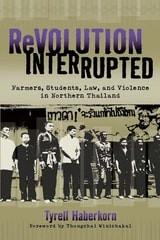
Revolution Interrupted
Farmers, Students, Law, and Violence in Northern ThailandTyrell Haberkorn; Foreword by Thongchai Winichakul
University of Wisconsin Press, 2011
In October 1973 a mass movement forced Thailand’s prime minister to step down and leave the country, ending nearly forty years of dictatorship. Three years later, in a brutal reassertion of authoritarian rule, Thai state and para-state forces quashed a demonstration at Thammasat University in Bangkok. In Revolution Interrupted, Tyrell Haberkorn focuses on this period when political activism briefly opened up the possibility for meaningful social change. Tenant farmers and their student allies fomented revolution, she shows, not by picking up guns but by invoking laws—laws that the Thai state ultimately proved unwilling to enforce.
In choosing the law as their tool to fight unjust tenancy practices, farmers and students departed from the tactics of their ancestors and from the insurgent methods of the Communist Party of Thailand. To first imagine and then create a more just future, they drew on their own lived experience and the writings of Thai Marxian radicals of an earlier generation, as well as New Left, socialist, and other progressive thinkers from around the world. Yet their efforts were quickly met with harassment, intimidation, and assassinations of farmer leaders. More than thirty years later, the assassins remain unnamed.
Drawing on hundreds of newspaper articles, cremation volumes, activist and state documents, and oral histories, Haberkorn reveals the ways in which the established order was undone and then reconsolidated. Examining this turbulent period through a new optic—interrupted revolution—she shows how the still unnameable violence continues to constrict political opportunity and to silence dissent in present-day Thailand.
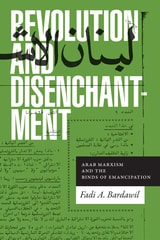
Revolution and Disenchantment
Arab Marxism and the Binds of EmancipationFadi A. Bardawil
Duke University Press, 2020

Revolution and World Politics
The Rise and Fall of the Sixth Great PowerFred Halliday
Duke University Press, 1999
Halliday begins by tracing the origins and evolution of the modern concept of “revolution” and placing it in historical context. Arguing that revolution is central to any understanding of international relations, he examines the internationalist ideology of revolutionaries who are committed to promoting change elsewhere by exposing revolution. In contrast with the claims of revolutionaries and counterrevolutionaries alike, he sees revolutions both as part of an internationalist social conflict and as a challenge to the system of states. Chapters on the distinct foreign policies of revolutionary states are followed by discussions of war, counterrevolution, and postrevolutionary transformation. The study concludes with a reassessment of the place of revolution within international relations theory and in modern history, drawing out implications for their incidence and character in the twenty-first century.
Students and scholars of international relations, political science, sociology, and history will value this major contribution to understanding worldwide developments in government and society.
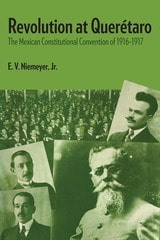
Revolution at Querétaro
The Mexican Constitutional Convention of 1916–1917By E. V. Niemeyer, Jr.
University of Texas Press, 1974
In two of the most fateful months of Mexican history, the delegates to the Constitutional Convention of 1916–1917 came to grips with the basic problem of twentieth-century Mexico. They hammered out pragmatic solutions to establish the legal foundations of the Mexican Revolution, the definitive break between the old Mexico and the new, the constitutional bases for the socioeconomic changes from 1917 onward. Honored and obeyed, dishonored and disobeyed, many times amended, the constitution they wrote still serves as the instrument for achieving the national purpose.
Revolution at Querétaro is the first book in English to study in depth the remarkable convention that produced the Constitution of 1917. It chronicles the unfolding of ideas expressed in the debates on the most significant articles of the constitution, those that have given it a revolutionary flavor and have served the groundwork for the emergence of Mexico as a modern nation. These articles concern the Catholic church and its role in the sphere of education (Article 3); the relationship of the church to the state (Articles 24 and 130); the attack on vested interest and the establishment of guidelines for agrarian reform (Article 27); the drafting of a detailed labor code (Article 123); and attempts to implement municipal reform (Article 114). Other debates described in the book concern unsuccessful attempts to institute prohibition, outlaw bullfights, abolish capital punishment, and grant suffrage to women.
This study also sheds light on the delegates themselves, who they were and where they came from, their idiosyncrasies and attitudes, and their individual contributions to the writing of the constitution. Much material is taken from unpublished albums in which the delegates recorded their sentiments during the convention.
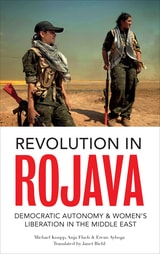
Revolution in Rojava
Democratic Autonomy and Women's Liberation in the Syrian KurdistanMichael Knapp, Ercan Ayboga, and Anja Flach
Pluto Press, 2016
Revolution in Rojava tells the story of Rojava's groundbreaking experiment in what they call democratic confederalism, a communally organized democracy that is fiercely anti-capitalist and committed to female equality, while rejecting reactionary nationalist ideologies.
Rooted in the ideas of imprisoned Kurdish leader Abdullah Ocalan, the system is built on effective gender quotas, bottom-up democratic structures, far-sighted ecological policies, and a powerful militancy that has allowed the region to keep ISIS at bay.
Given the widespread violence and suffering in Syria, it's not unreasonable that outsiders look at the situation as unrelentingly awful. And while the reality of the devastation is undeniable, there is reason for hope in at least one small pocket of the nation: the cantons of Rojava in Syrian Kurdistan, where in the wake of war people are quietly building one of the most progressive societies in the world today. Chapters here include:
*Rojava's Diverse Cultures
*Democratic Confederalism
*The Liberation
*A Women's Revolution
*Democratic Autonomy in Rojava
*Civil Society Associations
*The Theory of the Rose: Defense
*The New Justice System
*Democratization of Education
*Health Care
*The Social Economy
*Ecological Challenges
This first full-length study of democratic developments in Rojava tells an extraordinary and powerfully hopeful story of a little-known battle for true freedom in dark times. With excellent first-hand background information about this important, but little understood struggle, Revolution in Rojava will educate and inspire the reader to learn more about Rojava, Syria, and the fight for change in one of the world’s most dangerous regions.
Revolution, Democracy, Socialism
Selected Writings of V.I. LeninV. I. Lenin
Pluto Press, 2008
This is an entirely new collection of Lenin's writing. For the first time it brings together crucial shorter works, to show that Lenin held a life-long commitment to freedom and democracy. Le Blanc has written a comprehensive introduction, which gives an accessible overview of Lenin's life and work, and explains his relevance to political thought today.
Lenin has been much maligned in the mainstream, accused of viewing 'man as modeling clay' and of 'social engineering of the most radical kind.' However, in contrast to today's world leaders, who happily turn to violence to achieve their objectives, Lenin believed it impossible to reach his goals 'by any other path than that of political democracy.'
This collection will be of immense value to students encountering Lenin for the first time, and those looking for a new interpretation of one of the 20th century's most inspiring figures.
Revolution
Structure and Meaning in World HistorySaïd Amir Arjomand
University of Chicago Press, 2019
In this authoritative new book, Saïd Amir Arjomand reaches back to antiquity to propose a unified theory of revolution. Revolution illuminates the stories of premodern rebellions from the ancient world, as well as medieval European revolts and more recent events, up to the Arab Spring of 2011. Arjomand categorizes revolutions in two groups: ones that expand the existing body politic and power structure, and ones that aim to erode—but paradoxically augment—their authority. The revolutions of the past, he tells us, can shed light on the causes of those of the present and future: as long as centralized states remain powerful, there will be room for greater, and perhaps forceful, integration of the politically disenfranchised.
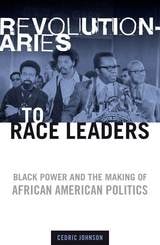
Revolutionaries to Race Leaders
Black Power and the Making of African American PoliticsCedric Johnson
University of Minnesota Press, 2007
The Black Power movement represented a key turning point in American politics. Disenchanted by the hollow progress of federal desegregation during the 1960s, many black citizens and leaders across the United States demanded meaningful self-determination. The popular movement they created was marked by a vigorous artistic renaissance, militant political action, and fierce ideological debate.
Exploring the major political and intellectual currents from the Black Power era to the present, Cedric Johnson reveals how black political life gradually conformed to liberal democratic capitalism and how the movement’s most radical aims—the rejection of white aesthetic standards, redefinition of black identity, solidarity with the Third World, and anticapitalist revolution—were gradually eclipsed by more moderate aspirations. Although Black Power activists transformed the face of American government, Johnson contends that the evolution of the movement as a form of ethnic politics restricted the struggle for social justice to the world of formal politics.
Johnson offers a compelling and theoretically sophisticated critique of the rhetoric and strategies that emerged in this period. Drawing on extensive archival research, he reinterprets the place of key intellectual figures, such as Harold Cruse and Amiri Baraka, and influential organizations, including the African Liberation Support Committee, the National Black Political Assembly, and the National Black Independent Political Party in postsegregation black politics, while at the same time identifying the contradictions of Black Power radicalism itself.
Documenting the historical retreat from radical, democratic struggle, Revolutionaries to Race Leaders ultimately calls for the renewal of popular struggle and class-conscious politics.
Cedric Johnson is assistant professor of political science at Hobart and William Smith Colleges.
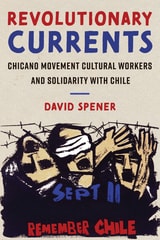
Revolutionary Currents
Chicano Movement Cultural Workers and Solidarity with ChileDavid Spener
University of Arizona Press, 2027
On September 11, 1973, General Augusto Pinochet led a bloody military coup in Chile that overthrew Salvador Allende’s democratically elected socialist government. The coup ushered in a cruelly repressive dictatorship that would govern the country for the next seventeen years, constituting a watershed moment in Cold War history.
This book recounts the untold story of how Chicano Movement poets, artists, musicians, and theater groups in the United States used their work to express solidarity with the international campaign to restore democracy in Chile. Such expressions of solidarity were especially prominent in the San Francisco Bay Area, where hundreds of Chilean exiles settled following the coup. Upon arrival, they joined a diverse Latinx population that was home to a Chicanx arts community whose members’ political orientations primed them to lend their talents to anti-imperialist causes. These Chicanxs were also drawn to the campaign against the dictatorship through friendship and acquaintance with members of the Chilean exile community.
David Spener shows how the Bay Area’s unique cosmopolitan social context offered Chicanxs and Chileans meaningful opportunities for dialogue and collaboration with each other as well as with Latinxs of other national origins. Chicanxs often adopted a pan-ethnic raza identity that they could share with Chilean, Nicaraguan, Puerto Rican, Salvadoran, and other Latinx activists. This did not mean, however, that they abandoned the political identities that they had gained from the Chicano Movement. Instead, many came to see themselves as uniting with other Latinxs, first Chileans and then Nicaraguans and Salvadorans, in a struggle against U.S. imperialism throughout the Americas.
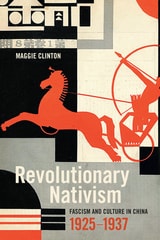
Revolutionary Nativism
Fascism and Culture in China, 1925-1937Maggie Clinton
Duke University Press, 2017

Revolutionary News
The Press in France, 1789–1799Jeremy D. Popkin
Duke University Press, 1990
Revolutionary Social Change in Colombia
The Origin and Direction of the FARC-EPJames J. Brittain
Pluto Press, 2010
This book presents an insider's account of Columbia's internal conflict. At the forefront are the Revolutionary Armed Forces of Colombia-People's Army (FARC-EP).
Although they are one of the most powerful military forces in Latin American history, little is known about the FARC-EP. James J. Brittain explains where and why this political military movement came into existence and assesses whether the methods employed by the insurgency have the potential to free those marginalised in Colombia.
As democratic socialism develops in Venezuela and Bolivia, Brittain's fascinating study assesses the relevance of armed struggle to 21st century Latin American politics. This is an essential title for those wishing to develop a full understanding of the continent.
By evaluating the FARC-EP's actions, ideological construction, and their theoretical placement, the book gauges how this guerrilla movement relates to revolutionary theory and practice and through what tangible mechanisms, if any, they are creating a new Colombia.
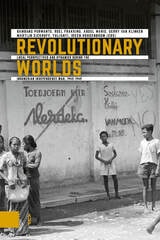
Revolutionary Worlds
Local Perspectives and Dynamics during the Indonesian Independence War, 1945-1949Bambang Purwanto
Amsterdam University Press, 2023
Bringing together two national historiographical traditions which have long remained largely separate, Revolutionary Worlds is the result of a collaboration between the Indonesian research project Proklamasi Kemerdekaan, Revolusi dan Perang di Indonesia ('Proclamation of Independence, Revolution and War in Indonesia', Universitas Gadjah Mada, Yogyakarta) and the Dutch research group of the Regional Studies project, under the umbrella of the research programme Independence, Decolonization, Violence and War in Indonesia, 1945-1950.
The authors of this book – Taufik Ahmad, Galuh Ambar Sasi, Maarten van der Bent, Martijn Eickhoff, Farabi Fakih, Roel Frakking, Apriani Harahap, Anne-Lot Hoek, Sarkawi B. Husain, Julianto Ibrahim, Gerry van Klinken, Erniwati, Mawardi Umar, Anne van der Veer, Abdul Wahid, Tri Wahyuning M. Irsyam, and Muhammad Yuanda Zara – work with various universities and research institutes in Indonesia and the Netherlands.
Revolutionizing Repertoires
The Rise of Populist Mobilization in PeruRobert S. Jansen
University of Chicago Press, 2017
Drawing on pragmatist theories of social action, Revolutionizing Repertoires sets out to examine what happens when the repertoire of practices available to political actors is dramatically reconfigured. Taking as his case study the development of a distinctively Latin American style of populist mobilization, Robert S. Jansen analyzes the Peruvian presidential election of 1931. He finds that, ultimately, populist mobilization emerged in the country at this time because newly empowered outsiders recognized the limitations of routine political practice and understood how to modify, transpose, invent, and recombine practices in a whole new way. Suggesting striking parallels to the recent populist turn in global politics, Revolutionizing Repertoires offers new insights not only to historians of Peru but also to scholars of historical sociology and comparative politics, and to anyone interested in the social and political origins of populism.
Revolutions of Capitalism
The Politics of the EventMaurizio Lazzarato. Translated by Brian Whitener and Geo Maher.
Duke University Press, 2026
Rhetoric and Resistance
The Literary Arts of Dissent in Nineteenth-Century BritainMaeve Adams
Ohio University Press, 2025
A fresh perspective on the enduring relationship between literature, democracy, and dissent
Rhetoric and Resistance explores the transformative role of nineteenth-century literature in shaping modern concepts and practices of democratic dissent. By examining the works of Romantic and Victorian novelists, poets, and journalists, Maeve Adams identifies origins of modern theories and practices of resistance in nineteenth-century literary forms. Offering a literary history of dissent, the book recovers the intertwined development of democracy and aesthetics, revealing how narrative form became a potent tool for challenging authority.
Tracing the lineage of dissent from the radical fiction and journalism of the 1800s to contemporary movements like #MeToo, Adams offers a genealogy that highlights how literary texts experimented with political power, granting new and consequential voices to working-class individuals, women, colonized peoples, and other marginalized groups.
Adams takes an interdisciplinary approach, weaving together close readings of works by Thomas De Quincey, Walter Scott, Elizabeth Gaskell, and H. G. Wells, as well as lesser-known journalists, with insights from modern moral and political philosophy. Drawing on theories of democratic ethics and justice from scholars such as Miranda Fricker, Sharon Krause, Martha Nussbaum, and Philip Pettit, the book bridges literary history and contemporary debates about political agency and expression.

Rhetorical Questions
Studies of Public DiscourseEdwin Black
University of Chicago Press, 1992
Locating rhetorical studies at the confluence of literature and politics, Black focuses on the ideological component of seemingly literary texts and the use of literary devices to advance political advocacy. The essays collected here range in subject matter from nineteenth-century oratory to New York Times editorials to the rhetoric of Richard Nixon. Unifying the collection are the concerns of secrecy and disclosure, identity, opposition, the scope of argument in public persuasion, and the historical mutability of rhetorical forms.
Rhetorics of Exile
Emergent Cartographies of LiberationKate Siegfried
The Ohio State University Press, 2027
Rhetorics of Exile forwards the concept of rhetorical cartographies of liberation to offer an alternative history of the Cold War period. Exile, Kate Siegfried argues, is used as a powerful rhetorical practice that reveals alternative maps of power, resistance, and liberation. Drawing on archival research, she reveals how political insurgents from Paul Robeson to Gerry Adams leveraged experiences of exile and containment to advocate for the eradication of colonialism, imperialism, racialization, and global capitalism and to advance a vision of transnational solidarity that defied the hegemonic political and geographic binaries of the time. Examining movements and political figures across the globe, from Cuba to the American Black Belt, through southern Africa’s colonial borders, to China, Ireland, and elsewhere, Rhetorics of Exile reveals how seemingly disparate political ruptures during the second half of the twentieth century shaped an emergent world system. Siegfried not only broadens our view of Cold War–era social movements but also adapts rhetorical cartography to better account for racialized power dynamics—showing its applicability to understanding activism today.
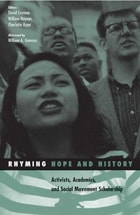
Rhyming Hope and History
Activists, Academics, and Social Movement ScholarshipDavid Croteau
University of Minnesota Press, 2005
Contributors: Kevin M. Carragee, Suffolk U; Catherine Corrigall-Brown, U of California, Irvine; Myra Marx Ferree, U of Wisconsin, Madison; Richard Flacks, U of California, Santa Barbara; Adria D. Goodson; Richard Healy and Sandra Hinson, Grassroots Policy Project; David Meyer, U of California, Irvine; Cynthia Peters, Worker Education Program of the Service Employees International Union, Local 2020; Barbara Risman, North Carolina State U; Robert J. S. Ross, Clark U; Leila J. Rupp, U of California, Santa Barbara; Cassie Schwerner, Schott Foundation; Valerie Sperling, Clark U; David A. Snow, U of California, Irvine; Verta Taylor, U of California, Santa Barbara.
David Croteau is formerly associate professor of sociology and anthropology at Virginia Commonwealth University. William Hoynes is professor of sociology and director of media studies at Vassar College. Charlotte Ryan is codirector of the Media Research and Action Project at Boston College. William A. Gamson is professor of sociology at Boston College.
Rhythms of Resistance
African Musical Heritage in BrazilPeter Fryer
Pluto Press, 2000
Acclaimed author Peter Fryer describes how slaves, mariners and merchants brought African music from Angola and the ports of East Africa to Latin America. In particular, they brought it to Brazil – today the country with the largest black population of any outside Africa. Fryer examines how the rhythms and beats of Africa were combined with European popular music to create a unique sound and dance tradition. Fryer focuses on the political nature of this musical crossover and the role of an African heritage in the cultural identity of Brazilian blacks today.
Rhythms of Resistance is an absorbing account of a theme in global music and is rich in fascinating historical detail.

Ridge Stories
Herding Hens, Powdering Pigs, and Other Recollections from a Boyhood in the DriftlessGary Jones
Wisconsin Historical Society Press, 2019
Raised on a small dairy farm in the Driftless Area in the mid-twentieth century, Gary Jones gets real about his rural roots. In this collection of interrelated stories, Jones writes with plainspoken warmth and irreverence about farm, family, and folks on the ridge. Readers will meet Gramp Jones, whose oversized overalls saved him from losing a chunk of flesh to an irate sow; the young one-room-school teacher who helped the kids make sled jumps at recess; Charlotte, the lawn-mowing sheep who once ended up in the living room; Victor the pig-cutter, who learned his trade from folk tradition rather than vet school; and other colorful characters of the ridge. Often humorous and occasionally touching, Jones’s essays paint a vivid picture that will entertain city and country folk alike.

Right On?
Political Change and Continuity in George W. Bush's AmericaEdited by Iwan Morgan, Philip D. Davies
University of London Press, 2006
Contributors include John Dumbrell (University of Leicester, UK), Martin Durham (University of Wolverhampton, UK), Godfrey Hodgson (Rothermere American Institute, Oxford University, UK), Steven Hurst (Manchester Metropolitan University, UK), Klaus Larres (Royal Holloway College, University of London, UK), Bob McKeever (University of Reading, UK), John Owens (University of Westminster, UK), Rob Singh (Birkbeck College, University of London, UK), and Alex Waddan (University of Sunderland, UK).

Right in Michigan's Grassroots
From the KKK to the Michigan MilitiaJoEllen McNergney Vinyard
University of Michigan Press, 2011
"A real contribution to Michigan history that gets to the root of the movements in twentieth-century American history that upon reflection can bring a certain discomfort and unease."
---Francis X. Blouin, Director of the Bentley Historical Library, University of Michigan
Throughout the twentieth century, Michigan became home to nearly every political movement in America that emerged from the grassroots. Citizens organized on behalf of concerns on the "left," on the "right," and in the "middle of the road." Right in Michigan's Grassroots: From the KKK to the Michigan Militia is about the people who supported movements that others, then and later, would denounce as disgraceful---members of the Ku Klux Klan during the 1920s, the followers of Father Charles Coughlin in the 1930s, anti-Communists and the John Birch Society in the post–World War II era, and the members of the Michigan Militia who first appeared in the 1990s.
The book explores the complex historical circumstances in Michigan that prompted the emergence of these organizations and led everyday men and women to head off, despite ridicule or condemnation, with plans unsanctioned and tactics unorthodox, variously brandishing weapons of intimidation, discrimination, fearmongering, and terror. Drawing heavily on primary sources, including the organizations' files and interviews with some of their leaders and surviving members, JoEllen Vinyard provides a far more complete portrait of these well-known extremist groups than has ever been available.
Right to Counsel in American Courts
William M. Beaney
University of Michigan Press, 1955
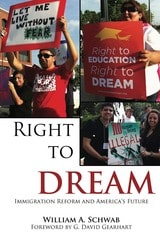
Right to DREAM
Immigration Reform and America’s FutureWilliam A. Schwab
University of Arkansas Press, 2013
Righteous Revolutionaries
Morality, Mobilization, and Violence in the Making of the Chinese StateJeffrey A. Javed
University of Michigan Press, 2022
Righteous Revolutionaries argues that the Chinese Party-state simultaneously removed perceived threats to its authority at the grassroots and bolstered its legitimacy through a process called moral mobilization. This mobilization process created a moral boundary that designated a virtuous ingroup of “the masses” and a demonized outgroup of “class enemies,” mobilized the masses to participate in violence against this broadly defined outgroup, and strengthened this symbolic boundary by making the masses complicit in state violence. Righteous Revolutionaries shows how we can find traces of moral mobilization in China today under Xi Jinping’s rule. In an era where states and politicians regularly weaponize moral emotions to foment intergroup conflict and violence, understanding the dynamics of violent mobilization and state authority are more relevant than ever before.