Results by title
28164 books match the query 'History' and 1206 start with r
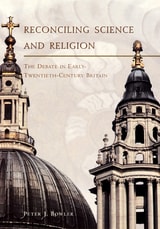
Reconciling Science and Religion
The Debate in Early-Twentieth-Century BritainPeter J. Bowler
University of Chicago Press, 2001
Peter J. Bowler argues that unlike the United States, where a strong fundamentalist opposition to evolutionism developed in the 1920s (most famously expressed in the Scopes "monkey trial" of 1925), in Britain there was a concerted effort to reconcile science and religion. Intellectually conservative scientists championed the reconciliation and were supported by liberal theologians in the Free Churches and the Church of England, especially the Anglican "Modernists." Popular writers such as Julian Huxley and George Bernard Shaw sought to create a non-Christian religion similar in some respects to the Modernist position. Younger scientists and secularists—including Rationalists such as H. G. Wells and the Marxists—tended to oppose these efforts, as did conservative Christians, who saw the liberal position as a betrayal of the true spirit of their religion. With the increased social tensions of the 1930s, as the churches moved toward a neo-orthodoxy unfriendly to natural theology and biologists adopted the "Modern Synthesis" of genetics and evolutionary theory, the proposed reconciliation fell apart.
Because the tensions between science and religion—and efforts at reconciling the two—are still very much with us today, Bowler's book will be important for everyone interested in these issues.

Reconnaissance in Sonora
Charles D. Poston’s 1854 Exploration of Mexico and the Gadsden PurchaseC. Gilbert Storms
University of Arizona Press, 2015
Poston led his party through Sonora and the territory of the 1854 Gadsden Purchase, which today encompasses southern Arizona and a portion of southern New Mexico. The syndicate’s charge to the young adventurer was to acquire land in Mexico in anticipation of the Gadsden Purchase and the building of the transcontinental railroad. Reconnaissance in Sonora details Poston’s expedition, including the founding of the town of Colorado City at the site of present-day Yuma, Arizona.
C. Gilbert Storms explores the American ideas of territorial expansion and Manifest Destiny, the national debate over a route for a transcontinental railroad, the legends of rich gold and silver mines in northern Mexico, and the French and American filibusters that plagued northern Mexico in the early 1850s.
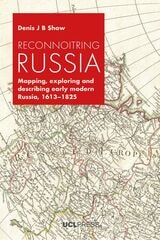
Reconnoitring Russia
Mapping, Exploring and Describing Early Modern Russia, 1613–1825Denis J. B. Shaw
University College London, 2024
Focusing on geographical practices—such as exploring, observing, describing, and mapping—Reconnoitring Russia explains how Russia’s rulers and public came to understand the expanse of their territory. It adopts a broad chronological framework and compares the Russian experience to the concurrent realities of other European countries between 1613, the emergence of the Romanov dynasty, and 1825, the conclusion of Alexander I’s reign.

Reconsidering Gender, Violence, and the State
Lisa Arellano, Erica L. Ball and Amanda Frisken, special issue editors
Duke University Press, 2016
Contributors: Lisa Arellano, Erica L. Ball, Josh Cerretti, Jonathan Culleton, Amanda Frisken, Raphael Ginsberg, Deana Heath, Efeoghene Igor, Catherine Jacquet, Jessie Kindig, Benjamin N. Lawrance, Jen Manion, Xhercis Méndez, Luis Morán, Claudia Salamanca, Tomoko Seto, Carla Tsampiras, Jennifer Yeager
Reconsidering Mississippian Communities and Households
Edited by Elizabeth Watts Malouchos and Alleen Betzenhauser
University of Alabama Press, 2021
Advancing the study of Mississippian societies through innovative archaeological theory and method.
Published in 1995, Mississippian Communities and Households, edited by J. Daniel Rogers and Bruce D. Smith, was a foundational text that advanced southeastern archaeology in significant ways and brought household-level archaeology to the forefront of the field. Reconsidering Mississippian Communities and Households revisits and builds on what has been learned in the years since the Rogers and Smith volume, advancing the field further with the diverse perspectives of current social theory and methods and big data as applied to communities in Native America from the AD 900s to 1700s and from northeast Florida to southwest Arkansas.
Watts Malouchos and Betzenhauser bring together scholars researching diverse Mississippian Southeast and Midwest sites to investigate aspects of community and household construction, maintenance, and dissolution. Thirteen original case studies prove that community can be enacted and expressed in various ways, including in feasting, pottery styles, war and conflict, and mortuary treatments.
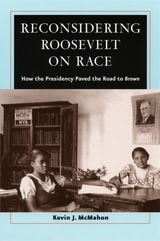
Reconsidering Roosevelt on Race
How the Presidency Paved the Road to BrownKevin J. McMahon
University of Chicago Press, 2003
McMahon shows how FDR's attempt to strengthen the presidency and undermine the power of conservative Southern Democrats dovetailed with his efforts to seek racial equality through the federal courts. By appointing a majority of rights-based liberals deferential to presidential power, Roosevelt ensured that the Supreme Court would be receptive to civil rights claims, especially when those claims had the support of the executive branch.
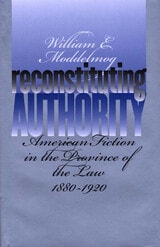
Reconstituting Authority
American Fiction in the Province of the Law, 1880-1920William E. Moddelmog
University of Iowa Press, 2000
The second half of the book turns from the rule of law to the issue of property, specifically the Lockean version of the self that tied identity to legal conceptions of property and economic value. In separate discussions of Charles Chesnutt, Edith Wharton, and Theodore Dreiser, Reconstituting Authority reveals authors as closely engaged with those changing perspectives on property and identity, in ways that challenged the racial, gendered, and economic consequences of America's possessive individualism.
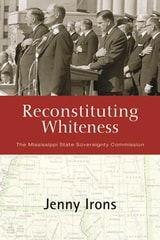
Reconstituting Whiteness
The Mississippi State Sovereignty CommissionJenny Irons
Vanderbilt University Press, 2010
Going far beyond a mere institutional history, however, Irons uses the commission as a tool to explore the intersection of state-organized defense of white supremacy and the dramatically shifting racial constructs of the civil rights era. Ultimately, the commission failed to protect segregation, but as a state entity, it adapted racism in new terms.
Reconstituting Whiteness is an insightful study of the methods Mississippi state government used to move the goal posts of what was considered "decent" and "acceptable" white supremacy and racism, as it raced against time to define whiteness while the boundaries of segregation fell all around it.
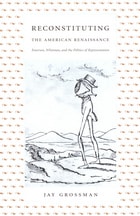
Reconstituting the American Renaissance
Emerson, Whitman, and the Politics of RepresentationJay Grossman
Duke University Press, 2003
Reconstituting the American Renaissance describes how Emerson and Whitman came into the period of their greatest productivity with different conceptions of the functions and political efficacy of the word in the world. It challenges Emerson’s position as Whitman’s necessary precursor and offers a cultural history that emphasizes the two writers’ differences in social class, cultural experience, and political perspective. In their writings between 1830 and 1855, the book finds contrasting conceptions of the relations between the “representative man” and the constituencies to whom, and for whom, he speaks. Reconstituting the American Renaissance opens up the canonical relationship between Emerson and Whitman and multiplies the historical and discursive contexts for understanding their published and unpublished works.
Reconstructing Ancient Maya Diet
Christine White
University of Utah Press, 1999
The collapse of classic Maya civilization at the end of the eighth century A.D. is still an enigma, but the story behind it is likely more than a clash of warring city-states. New research indicates that ecological degradation and nutritional deficiency may be as important to our understanding of Maya cultural processes as deciphering the rise and fall of kings.
Reconstructing Ancient Maya Diet integrates recent data from bone-chemistry research, paleopathology, paleobotany, zooarchaeology, and ethnobotany to show what the ancient Maya actually ate at various periods (as opposed to archaeological suppositions) and how it affected the quality of their lives. It is now evident that to feed a burgeoning population the Maya relied on increasingly intensive forms of agriculture.
Exploring the relationship between these practices, ecological degradation, and social collapse, this book uses dietary data to investigate the rise of agricultural systems and class structure; the characterization of social relationships along lines of gender and age (i.e., who ate what); and the later effects of the Spanish conquest on diet and extant modes of agriculture.
Maya subsistence has been investigated intensively for the past two decades, but this is the first volume that unites work across the spectrum of Maya bioarchaeology.

Reconstructing Architecture
Critical Discourses and Social PracticesThomas A. Dutton and Lian Hurst Mann, Editors
University of Minnesota Press, 1996
Reconstructing Architecture was first published in 1996. Minnesota Archive Editions uses digital technology to make long-unavailable books once again accessible, and are published unaltered from the original University of Minnesota Press editions.
To create architecture is an inherently political act, yet its nature as a social practice is often obscured beneath layers of wealth and privilege. The contributors to this volume question architecture's complicity with the status quo, moving beyond critique to outline the part architects are playing in building radical social movements and challenging dominant forms of power.
The making of architecture is instrumental in the construction of our identities, our differences, the world around us-much of what we know of institutions, the distribution of power, social relations, and cultural values is mediated by the built environment. Historically, architecture has constructed the environments that house the dominant culture. Yet, as the essays in Reconstructing Architecture demonstrate, there exists a strong tradition of critical practice in the field, one that attempts to alter existing social power relations. Engaging the gap between modernism and postmodernism, each chapter addresses an oppositional discourse that has developed within the field and then reconstructs it in terms of a new social project: feminism, social theory, environmentalism, cultural studies, race and ethnic studies, and critical theory.
The activists and scholars writing here provide a clarion call to architects and other producers of culture, challenging them to renegotiate their political allegiances and to help reconstruct a viable democratic life in the face of inexorable forces driving economic growth, destroying global ecology, homogenizing culture, and privatizing the public realm. Reconstructing Architecture reformulates the role of architecture in society as well as its capacity to further a progressive social transformation.
Contributors: Sherry Ahrentzen, U of Wisconsin, Milwaukee; Bradford C. Grant, California Polytechnic State U, San Luis Obispo; Richard Ingersoll, Rice U; Margaret Soltan, George Washington U; Anthony Ward, U of Auckland, New Zealand.
Thomas A. Dutton is an architect and professor of architecture at Miami University, Ohio. He is editor of Voices in Architectural Education (1991) and is associate editor of the Journal of Architectural Education.
Lian Hurst Mann is an architect and editor of Architecture California. A founding member of the Labor/Community Strategy Center in Los Angeles, she is editor of its bilingual quarterly Ahora Now and a coauthor of Reconstructing Los Angeles from the Bottom Up (1993).
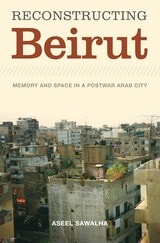
Reconstructing Beirut
Memory and Space in a Postwar Arab CityBy Aseel Sawalha
University of Texas Press, 2010
Once the cosmopolitan center of the Middle East, Beirut was devastated by the civil war that ran from 1975 to 1991, which dislocated many residents, disrupted normal municipal functions, and destroyed the vibrant downtown district. The aftermath of the war was an unstable situation Sawalha considers "a postwar state of emergency," even as the state strove to restore normalcy. This ethnography centers on various groups' responses to Beirut's large, privatized urban-renewal project that unfolded during this turbulent moment.
At the core of the study is the theme of remembering space. The official process of rebuilding the city as a node in the global economy collided with local day-to-day concerns, and all arguments invariably inspired narratives of what happened before and during the war. Sawalha explains how Beirutis invoked their past experiences of specific sites to vie for the power to shape those sites in the future. Rather than focus on a single site, the ethnography crosses multiple urban sites and social groups, to survey varied groups with interests in particular spaces. The book contextualizes these spatial conflicts within the discourses of the city's historical accounts and the much-debated concept of heritage, voiced in academic writing, politics, and journalism. In the afterword, Sawalha links these conflicts to the social and political crises of early twenty-first-century Beirut.
Reconstructing Dixie
Race, Gender, and Nostalgia in the Imagined SouthTara McPherson
Duke University Press, 2003
Illuminating crucial connections between understandings of race, gender, and place on the one hand and narrative and images on the other, McPherson reads a number of representations of the South produced from the 1930s to the present. These are drawn from fiction, film, television, southern studies scholarship, popular journalism, music, tourist sites, the internet, and autobiography. She examines modes of affect or ways of "feeling southern" to reveal how these feelings, along with the narratives and images she discusses, sanction particular racial logics. A wide-ranging cultural studies critique, Reconstructing Dixie calls for vibrant new ways of thinking about the South and for a revamped and reinvigorated southern studies.
Reconstructing Dixie will appeal to scholars in American, southern, and cultural studies, and to those in African American, media, and women’s studies.

Reconstructing Europe's Trade and Payments
The European Payments UnionBarry Eichengreen
University of Michigan Press, 1993
Reconstructing Reconstruction
The Supreme Court and the Production of Historical TruthPamela Brandwein
Duke University Press, 1999
Delving into the circumstances, assumptions, and rhetoric that shaped the “official” story of Reconstruction, Brandwein describes precisely how a dominant interpretation of events ultimately emerged and what its implications have been for twentieth-century judicial decisions, particularly for Supreme Court rulings on civil rights. While analyzing interpretive disputes about slavery, Brandwein offers a detailed rescoring of post–Civil War legislative and constitutional history, including analysis of the original understanding of the Fourteenth Amendment. She identifies the perspectives on Reconstruction that were endorsed or rejected by the Supreme Court. Explaining what it meant—theoretically and practically—to resolve Reconstruction debates with a particular definition of slavery, Brandwein recounts how the Northern Democratic definition of “ending” slavery was not the only definition, just the one that prevailed. Using a familiar historical moment to do new interpretive work, she outlines a sociology of constitutional law, showing how subjective narrative construction can solidify into opaque institutional memory.
Reconstructing Tascalusa's Chiefdom
Pottery Styles and the Social Composition of Late Mississippian Communities along the Alabama RiverAmanda L. Regnier
University of Alabama Press, 2014
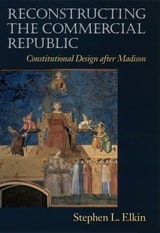
Reconstructing the Commercial Republic
Constitutional Design after MadisonStephen L. Elkin
University of Chicago Press, 2006
The deficiencies Elkin points out provide the starting point for his own constitutional theory of the republic—a theory that, unlike Madison’s, lays out a substantive conception of the public interest that emphasizes the power of institutions to shape our political, economic, and civic lives. Elkin argues that his theory should guide us toward building a commercial republic that is rooted in a politics of the public interest and the self-interest of the middle class. He then recommends specific reforms to create this kind of republic, asserting that Americans today can still have the lives a commercial republic is intended to promote: lives with real opportunities for economic prosperity, republican political self-government, and individual liberty.
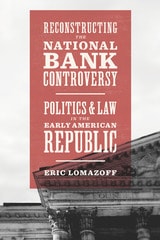
Reconstructing the National Bank Controversy
Politics and Law in the Early American RepublicEric Lomazoff
University of Chicago Press, 2018
With Reconstructing the National Bank Controversy, Eric Lomazoff offers a far more robust account of the constitutional politics of national banking between 1791 and 1832. During that time, three forces—changes within the Bank itself, growing tension over federal power within the Republican coalition, and the endurance of monetary turmoil beyond the War of 1812 —drove the development of our first major debate over the scope of federal power at least as much as the formal dimensions of the Constitution or the absence of a shared legal definition for the word “necessary.” These three forces—sometimes alone, sometimes in combination—repeatedly reshaped the terms on which the Bank’s constitutionality was contested. Lomazoff documents how these three dimensions of the polity changed over time and traces the manner in which they periodically led federal officials to adjust their claims about the Bank’s constitutionality. This includes the emergence of the Coinage Clause—which gives Congress power to “coin money, regulate the value thereof”—as a novel justification for the institution. He concludes the book by explaining why a more robust account of the national bank controversy can help us understand the constitutional basis for modern American monetary politics.
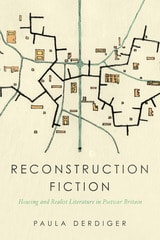
Reconstruction Fiction
Housing and Realist Literature in Postwar BritainPaula Derdiger
The Ohio State University Press, 2020
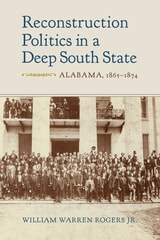
Reconstruction Politics in a Deep South State
Alabama, 1865–1874William Warren Rogers Jr.
University of Alabama Press, 2021
The battle for democracy in reconstruction-era Alabama.
Following the end of the Civil War, white Southerners were forced to concede equal rights to those who had been enslaved, ushering in a new and ruthless brand of politics. Suddenly, the status and place of some four million former slaves dominated the national and regional political dialogue. In Alabama, the Republican Party established itself quickly and powerfully with the participation of a newly freed constituency, firmly aligned against the Democratic Party that had long dictated the governance of the state. Well-heeled planters, merchants, and bankers, joined by yeoman farmers, staged a counterrevolution by gravitating strongly to the Democratic Party and its unabashedly white supremacist measures. The ensuing power struggle in the birthplace of the Confederacy is at the heart of Reconstruction Politics in a Deep South State: Alabama, 1865–1874.
What emerges in William Warren Rogers Jr.’s comprehensive study of the era is a detailed examination of Reconstruction politics, particularly in Alabama. This book explores an explosive and unpredictable political environment that a few years earlier would have been inconceivable. A vivid picture emerges of courthouse rallies and bitter infighting in legislative circles. Rogers’s narrative ventures into darker places as well: to the Tennessee Valley and the Black Belt regions of Alabama, where Klan nightriders used violence against an enemy and ideology they could not abide.
The attempt to capture and account for the unforgiving political landscape created by the extraordinary circumstances of Reconstruction constitutes this study’s most central contribution. Rogers often quotes black and white citizens, Democrats and Republicans. Drawn from newspapers, correspondence, and various federal investigations, these firsthand voices are passionate, unvarnished, and filled with conviction. They offer a startling immediacy and illustrate the temper—or distemper—of the times. Readers are treated to a panoramic unveiling of Reconstruction Alabama politics that provides a sense of what was truly at stake: the values by which a region and the nation as a whole would chart its future for the century to come.
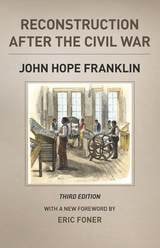
Reconstruction after the Civil War, Third Edition
John Hope Franklin
University of Chicago Press, 2012
Reconstruction after the Civil War explores the role of former slaves during this period in American history. Looking past popular myths and controversial scholarship, John Hope Franklin uses his astute insight and careful research to provide an accurate, comprehensive portrait of the era. His arguments concerning the brevity of the North’s occupation, the limited power wielded by former slaves, the influence of moderate southerners, the flawed constitutions of the radical state governments, and the downfall of Reconstruction remain compelling today. This new edition of Reconstruction after the Civil War also includes a foreword by Eric Foner and a perceptive essay by Michael W. Fitzgerald.
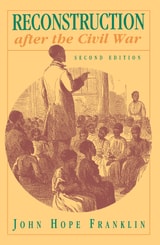
Reconstruction after the Civil War
Second EditionJohn Hope Franklin
University of Chicago Press, 1994
Now Franklin has updated his work to acknowledge the enormous body of research and scholarship that followed in the wake of the first edition. New are Franklin’s references to important, later texts that enrich the original narrative. In addition, the extensive bibliography has been thoroughly revised.
What has not changed, however, is the foundation Franklin has laid. Still compelling are his arguments concerning the brevity of the North’s military occupation of the South, the limited amount of power wielded by former slaves, the influence of moderate southerners, the flaws of the constitutions drawn up by the Radical state governments, and the reasons for the downfall of Reconstruction.
Reconstruction in Texas
By Charles William Ramsdell
University of Texas Press, 1970
A reprint of the 1910 study, Reconstruction in Texas examines the events that still impact upon Texas and the South.
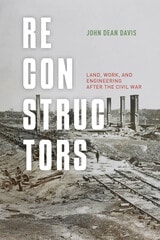
Reconstructors
Land, Work, and Engineering After the Civil WarJohn Dean Davis
University of Chicago Press, 2026
Explores the institutional and environmental transformations that occurred during the Reconstruction Era.
While the Reconstruction Era in America saw a paradigmatic realignment of the country’s core institutions and values, there was a physical quality to Reconstruction as well: the country was not only rebuilding the South after the Civil War, but flat-out building as it expanded westward.
In Reconstructors, John Dean Davis details how the Army Corps of Engineers and its subcontractors designed and redesigned the infrastructural landscape to support the republic’s rebirth. The Corps’ projects not only transformed the landscape; they created markets, fostered a distinctive expansionist culture, and—for a time—enacted a less discriminatory economic and social agenda across the South and West. Davis aims to bring federal power, environmentalism, and capitalism into a frame that reveals the landscape's power to further ideology.
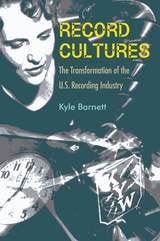
Record Cultures
The Transformation of the U.S. Recording IndustryKyle Barnett
University of Michigan Press, 2020
Through an interdisciplinary and intermedial approach to recording industry history, Record Cultures creates new connections between different strands of media research. It will be of interest to scholars of popular music, media studies, sound studies, American culture, and the history of film, television, and radio.

Record Makers and Breakers
Voices of the Independent Rock 'n' Roll PioneersJohn Broven
University of Illinois Press, 2009

Recording Village Life
A Coptic Scribe in Early Islamic EgyptJennifer A. Cromwell
University of Michigan Press, 2017
Papyrological analysis of Aristophanes’ documents, within the context of the textual record of the village, shows a new and divergent scribal practice that reflects broader trends among his contemporaries: Aristophanes was part of a larger, national system of administrative changes, enacted by the country’s Arab rulers in order to better control administrative practices and fiscal policies within the country. Yet Aristophanes’ dossier shows him not just as an administrator, revealing details about his life, his role in the community, and the elite networks within which he operated. This unique perspective provides new insights into both the micro-history of an individual’s experience of eighth-century Theban village life, and its reflection in the macro social, economic, and political trends in Egypt at this time.
This book will prove valuable to scholars of late antique studies, papyrology, philology, early Islamic history, social and economic history, and Egyptology.

Records Ruin the Landscape
John Cage, the Sixties, and Sound RecordingDavid Grubbs
Duke University Press, 2014
In their day, few of these works circulated in recorded form. By contrast, contemporary listeners can encounter this music not only through a flood of LP and CD releases of archival recordings but also in even greater volume through Internet file sharing and online resources. Present-day listeners are coming to know that era's experimental music through the recorded artifacts of composers and musicians who largely disavowed recordings. In Records Ruin the Landscape, Grubbs surveys a musical landscape marked by altered listening practices.
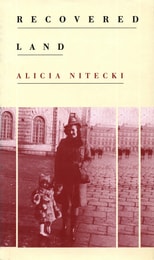
Recovered Land
Alicia Nitecki
University of Massachusetts Press, 1995
Alicia Nitecki was born in Warsaw to a Catholic family that was active in the resistance movement. Following the Nazi conquest of Poland, she and her relatives were dispersed to German prisoner-of-war, labor, and concentration camps. In this book, she revisits the places that have formed her and confronts a past that has haunted her: Warsaw during the 1944 uprising, the Black Forest village where she and the women in her family were taken as slaves in the last months of the war, and Buchenwald and Flossenbürg, the concentration camps where her grandfather was imprisoned.
Nitecki's private odyssey coincided with the collapse of communism in Poland and the reunification of Germany. These essays mark her movement from fear and rage toward fuller knowledge and reconciliation.
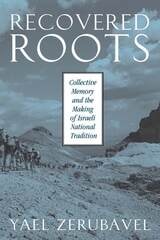
Recovered Roots
Collective Memory and the Making of Israeli National TraditionYael Zerubavel
University of Chicago Press, 1995
In the years leading to the birth of Israel, Zerubavel shows, Zionist settlers in Palestine consciously sought to rewrite Jewish history by reshaping Jewish memory. Zerubavel focuses on the nationalist reinterpretation of the defense of Masada against the Romans in 73 C.E. and the Bar Kokhba revolt of 133-135; and on the transformation of the 1920 defense of a new Jewish settlement in Tel Hai into a national myth. Zerubavel demonstrates how, in each case, Israeli memory transforms events that ended in death and defeat into heroic myths and symbols of national revival.
Drawing on a broad range of official and popular sources and original interviews, Zerubavel shows that the construction of a new national tradition is not necessarily the product of government policy but a creative collaboration between politicans, writers, and educators. Her discussion of the politics of commemoration demonstrates how rival groups can turn the past into an arena of conflict as they posit competing interpretations of history and opposing moral claims on the use of the past. Zerubavel analyzes the emergence of counter-memories within the reality of Israel's frequent wars, the ensuing debates about the future of the occupied territories, and the embattled relations with Palestinians.
A fascinating examination of the interplay between history and memory, this book will appeal to historians, sociologists, anthropologists, political scientists, and folklorists, as well as to scholars of cultural studies, literature, and communication.
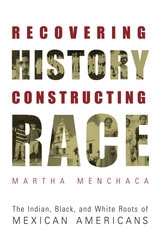
Recovering History, Constructing Race
The Indian, Black, and White Roots of Mexican AmericansBy Martha Menchaca
University of Texas Press, 2002
A CHOICE Outstanding Academic Book, 2002
The history of Mexican Americans is a history of the intermingling of races—Indian, White, and Black. This racial history underlies a legacy of racial discrimination against Mexican Americans and their Mexican ancestors that stretches from the Spanish conquest to current battles over ending affirmative action and other assistance programs for ethnic minorities. Asserting the centrality of race in Mexican American history, Martha Menchaca here offers the first interpretive racial history of Mexican Americans, focusing on racial foundations and race relations from prehispanic times to the present.
Menchaca uses the concept of racialization to describe the process through which Spanish, Mexican, and U.S. authorities constructed racial status hierarchies that marginalized Mexicans of color and restricted their rights of land ownership. She traces this process from the Spanish colonial period and the introduction of slavery through racial laws affecting Mexican Americans into the late twentieth-century. This re-viewing of familiar history through the lens of race recovers Blacks as important historical actors, links Indians and the mission system in the Southwest to the Mexican American present, and reveals the legal and illegal means by which Mexican Americans lost their land grants.
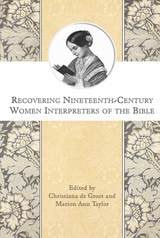
Recovering Nineteenth-Century Women Interpreters of the Bible
Christiana de Groot
SBL Press, 2007
Women have been thoughtful readers and interpreters of scripture throughout the ages, yet the usual history of biblical interpretation includes few women’s voices. To introduce readers to this untapped source for the history of biblical interpretation, this volume presents forgotten works from the nineteenth century written by women—including Grace Aguilar, Florence Nightingale, and Harriet Beecher Stowe, among others—from various faith backgrounds, countries, and social classes engaging contemporary biblical scholarship. Due to their exclusion from the academy, women’s interpretive writings addressed primarily a nonscholarly audience and were written in a variety of genres: novels and poetry, catechisms, manuals for Bible study, and commentaries on the books of the Bible. To recover these nineteenth-century women interpreters of the Bible, each essay in this volume locates a female author in her historical, ecclesiastical, and interpretive context, focusing on particular biblical passages to clarify an author’s contributions as well as to explore how her reading of the text was shaped by her experience as a woman.

Recovering Touch
Raised Print and Its Readers in the Nineteenth-Century United StatesAmanda Stuckey
University of Massachusetts Press, 2027
Constructing a disability history of reading through the embossed books that shaped and constrained it
When the Maryland Institution for the Instruction of the Blind opened in 1853, its charter defined blindness as the inability to read ink. Embedded in that same document was a small rectangle of embossed roman letters—a “specimen of printing” that encapsulated decades of experimentation and a central contradiction: that a form of print designed to liberate visually impaired readers also asked them to read like sighted ones.
In Recovering Touch, Amanda Stuckey traces raised print developments from the first embossed book in the United States—the Gospel of St. Mark, embossed in 1833—through the late nineteenth-century War of the Dots, the contested debates among educators and administrators over which type system visually impaired readers should use. Focusing predominantly on raised roman letter systems, Stuckey brings visually impaired readers into nineteenth-century histories of reading, connecting individual acts of touch-based reading to broader histories of disability, schooling, and print culture. Embossed books promised to open the world of the printed word to readers marginalized from inked text. Yet educators often deployed these materials as tools to assimilate visually impaired students into the reading, learning, and labor standards of the sighted world.
Recovering Touch constructs a disability history of reading that centers the material conditions of touch-based reading: the paper that had to be felt rather than seen, the types that dulled over time, and the readers who adapted, repurposed, and at times defied the assimilationist expectations built into the books beneath their fingertips.

Recovering the Margins of American Religious History
The Legacy of David Edwin Harrell Jr.B. Dwain Waldrep
University of Alabama Press, 2012
Red Against Blue
The Liberal Party in Colombian Politics, 1863 - 1899Helen Delpar
University of Alabama Press, 1981
A landmark study of Liberalism, political conflict, and nation-building in Colombia.
Red Against Blue: The Liberal Party in Colombian Politics, 1863–1899 is a seminal study of the political forces that shaped modern Colombia during the nineteenth century. In this carefully researched work, historian Helen Delpar traces the rise, dominance, decline, and transformation of the Colombian Liberal Party, offering readers a deeper understanding of one of Latin America's most influential political movements. Through extensive use of political writings, personal papers, electoral records, and contemporary sources, Delpar reconstructs the complex world of Colombian politics during an era marked by ideological conflict, regional division, constitutional experimentation, and recurring civil unrest.
The book examines the period from the adoption of the federal Constitution of 1863 through the end of the nineteenth century, when Liberal leaders sought to shape Colombia's political future while confronting growing opposition from Conservative rivals. Delpar explores the origins of Colombian Liberalism, the development of party ideology, the regional bases of political support, and the personalities who guided the party through both triumph and defeat. Her analysis reveals a political movement that was far more diverse and dynamic than conventional interpretations have suggested.
As Liberal influence declined in the 1880s and Conservatives consolidated power under the Regeneration movement, political tensions intensified. Delpar shows how these struggles helped lay the groundwork for the devastating War of the Thousand Days at the century's close, one of the most significant conflicts in Colombian history.
Combining narrative history with insightful political analysis, Red Against Blue remains an indispensable resource for students and scholars of Latin American history, political development, democracy, and nation-building. It offers a compelling portrait of a society grappling with questions of power, ideology, regional identity, and the meaning of political participation in a rapidly changing world.

Red Arrow across the Pacific
The Thirty-Second Infantry Division during World War IIMark D. Van Ells
Wisconsin Historical Society Press, 2024
Red Arrow across the Pacific reveals the long-overdue story of the renowned Thirty-Second "Red Arrow" Infantry Division. Discover how this National Guard unit—which originated in Wisconsin and Michigan but soon evolved to include soldiers from California to New England—became one of the first US military units deployed overseas in World War II, eventually logging more combat hours than any other US Army division.
Far more than a traditional battle narrative, Red Arrow across the Pacific offers a cultural history of the Red Arrow's wartime experience, from its mobilization in 1940, to its deployment across New Guinea, Australia, and the Philippines, to its postwar occupation of Japan. Drawing from letters, memoirs, and interviews, author Mark D. Van Ells lets the soldiers speak for themselves, describing in their own words the terror of combat, their impressions of foreign lands, the struggle to maintain their own humanity, and the many ways the war profoundly changed them.
Nuanced and remarkably thorough, this book explores the dramatic evolution of the Thirty-Second Infantry Division and reveals how the story of the Red Arrow reflects the experience of the US military during World War II.
“Exceptionally well researched and engagingly written. This book is a must read for any student of military history.”
—Capt. Florian L. Waitl, Command Historian, Wisconsin Army National Guard
“A superb divisional history. . . . Highly recommended for a general audience, as well as readers interested in the Second World War.”
—Mary Louise Roberts, Lucie Aubrac Distinguished Professor Emerita of History, University of Wisconsin–Madison, and author of Sheer Misery: Soldiers in Battle in WWII
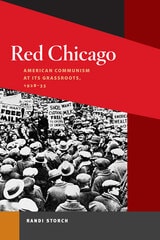
Red Chicago
American Communism at Its Grassroots, 1928-35Randi Storch
University of Illinois Press, 2007
Red Chicago is a social history of American Communism set within the context of Chicago's neighborhoods, industries, and radical traditions. Using local party records, oral histories, union records, party newspapers, and government documents, Randi Storch fills the gap between Leninist principles and the day-to-day activities of Chicago's rank-and-file Communists.
Uncovering rich new evidence from Moscow's former party archive, Storch argues that although the American Communist Party was an international organization strongly influenced by the Soviet Union, at the city level it was a more vibrant and flexible organization responsible to local needs and concerns. Thus, while working for a better welfare system, fairer unions, and racial equality, Chicago's Communists created a movement that at times departed from international party leaders' intentions. By focusing on the experience of Chicago's Communists, who included a large working-class, African American, and ethnic population, this study reexamines party members' actions as an integral part of the communities and industries in which they lived and worked.

Red Creative
Culture and Modernity in ChinaJustin O'Connor and Xin Gu
Intellect Books, 2020
Red Creative is an exploration of China’s cultural economy over the last twenty years, particularly through the lens of its creative hub of Shanghai. The research presented here raises questions about the nature of contemporary ‘creative’ capitalism and the universal claims of Western modernity, offering new ways of thinking about cultural policy in China.
Taking a long-term historical perspective, Justin O’Connor and Xin Gu analyze the ongoing development of China’s cultural industries, examining the institutions, regulations, interests, and markets that underpin the Chinese cultural economy and the strategic position of Shanghai within it. Further, the authors explore cultural policy reforms in post-colonial China and articulate Shanghai’s significance in paving China’s path to modernity and entry to global capitalism. In-depth and illuminating, Red Creative carefully situates China’s contemporary cultural economy in its larger global and historical context, revealing the limits of Western thought in understanding Chinese history, culture, and society.

Red Desert
History of a PlaceEdited by Annie Proulx
University of Texas Press, 2008
Finalist, ForeWord Magazine Book of the Year Awards, Environment Category, 2008
A vast expanse of rock formations, sand dunes, and sagebrush in central and southwest Wyoming, the little-known Red Desert is one of the last undeveloped landscapes in the United States, as well as one of the most endangered. It is a last refuge for many species of wildlife. Sitting atop one of North America's largest untapped reservoirs of natural gas, the Red Desert is a magnet for energy producers who are damaging its complex and fragile ecosystem in a headlong race to open a new domestic source of energy and reap the profits.
To capture and preserve what makes the Red Desert both valuable and scientifically and historically interesting, writer Annie Proulx and photographer Martin Stupich enlisted a team of scientists and scholars to join them in exploring the Red Desert through many disciplines—geology, hydrology, paleontology, ornithology, zoology, entomology, botany, climatology, anthropology, archaeology, sociology, and history. Their essays reveal many fascinating, often previously unknown facts about the Red Desert—everything from the rich pocket habitats that support an amazing diversity of life to engrossing stories of the transcontinental migrations that began in prehistory and continue today on I-80, which bisects the Red Desert.
Complemented by Martin Stupich's photo-essay, which portrays both the beauty and the devastation that characterize the region today, Red Desert bears eloquent witness to a unique landscape in its final years as a wild place.

Red Diapers
GROWING UP IN THE COMMUNIST LEFTEdited by Judy Kaplan and Linn Shapiro
University of Illinois Press, 1998
Red Diapers is the
first anthology of autobiographical writings by the children of American
communists. These memoirs, short stories, and poems reflect the joys and
perils of growing up in a subculture defined by its opposition to some
of society's most deeply held values. How red diaper babies have come
to terms with their political inheritance is the theme of this compelling
anthology.
Some contributors have fond
memories of family activism; others recall the past with ambivalence or
even pain. The authors range in age from their twenties to their eighties.
Some, such as Watergate reporter Carl Bernstein and sixties activist Bettina
Aptheker, are widely known themselves; some are the children of well-known
American leftists, including Jeff Lawson, son of blacklisted screenwriter
John Howard Lawson, and Robert Meeropol, son of Ethel and Julius Rosenberg.
In disparate voices, the contributors elaborate on how their parents attempted
to pass on to them the torch of radical politics.

Red Eagle's Children
Weatherford vs. Weatherford et al.Edited by J. Anthony Paredes and Judith Knight
University of Alabama Press, 2012
Tracing identity, law, and legacy in an inheritance dispute that reveals the intersection of two cultural and legal systems: Creek Indian and Euro-American.
In 1846, in the Chancery Court of Mobile, Alabama, William “Red Eagle” Weatherford’s son, by the Indian woman Supalamy, sued his half siblings fathered by Weatherford with two other Creek women, Polly Moniac and Mary Stiggins, for a greater share of Weatherford’s estate. While the court recognized William Jr. as the son of William Sr., he nevertheless lost his petition for inheritance due to the lack of legal evidence concerning the marriage of his biological mother to William Sr. The case, which went to the Alabama Supreme Court in 1851, provides a record of an attempt to interrelate and, perhaps, manipulate differences in cultures as they played out within the ritualized, arcane world of antebellum Alabama jurisprudence.
Although the case has value in the classic mold of salvage ethnography of Creek Indian culture, Red Eagle’s Children, edited by J. Anthony Paredes and Judith Knight, shows that its more enduring value lies in being a source for historical ethnography—that is, for anthropological analyses of cultural dynamics of the past events that complement the narratives of professional historians.
CONTRIBUTORS: David I. Durham / Robbie Ethridge / Judith Knight / J. Anthony Paredes / Paul M. Pruitt Jr. / Nina Gail Thrower / Robert Thrower / Gregory A. Waselkov
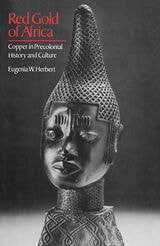
Red Gold of Africa
Copper in Precolonial History and CultureEugenia W. Herbert
University of Wisconsin Press, 1984
A finalist for the 1985 Herskovits Prize
First Paperback Edition

Red Hangover
Legacies of Twentieth-Century CommunismKristen Ghodsee
Duke University Press, 2017
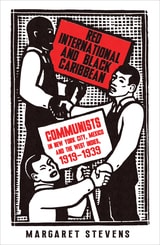
Red International and Black Caribbean
Communists in New York City, Mexico and the West Indies, 1919-1939Margaret Stevens
Pluto Press, 2017
Challenging dominant accounts, Red International and Black Caribbean debunks the “great men” narrative, emphasizes the role of women in their capacity as laborers, and paints the true struggles of black peasants and workers in Communist parties.

Red Leviathan
The Secret History of Soviet WhalingRyan Tucker Jones
University of Chicago Press, 2022
The Soviet Union killed over six hundred thousand whales in the twentieth century, many of them illegally and secretly. That catch helped bring many whale species to near extinction by the 1970s, and the impacts of this loss of life still ripple through today’s oceans. In this new account, based on formerly secret Soviet archives and interviews with ex-whalers, environmental historian Ryan Tucker Jones offers a complete history of the role the Soviet Union played in the whales’ destruction. As other countries—especially the United States, Great Britain, Japan, and Norway—expanded their pursuit of whales to all corners of the globe, Stalin determined that the Soviet Union needed to join the hunt. What followed was a spectacularly prodigious, and often wasteful, destruction of humpback, fin, sei, right, and sperm whales in the Antarctic and the North Pacific, done in knowing violation of the International Whaling Commission’s rules. Cold War intrigue encouraged this destruction, but, as Jones shows, there is a more complex history behind this tragic Soviet experiment. Jones compellingly describes the ultimate scientific irony: today’s cetacean studies benefited from Soviet whaling, as Russian scientists on whaling vessels made key breakthroughs in understanding whale natural history and behavior. And in a final twist, Red Leviathan reveals how the Soviet public began turning against their own country’s whaling industry, working in parallel with Western environmental organizations like Greenpeace to help end industrial whaling—not long before the world’s whales might have disappeared altogether.

Red Lights
The Lives of Sex Workers in Postsocialist ChinaTiantian Zheng
University of Minnesota Press, 2009
Zheng embarked on two years of intensely embedded ethnographic fieldwork in her birthplace, Dalian, a large northeastern Chinese seaport of over six million people. During this time, Zheng lived and worked with a group of hostesses in a karaoke bar, facing many of the same dangers that they did and forming strong, intimate bonds with them. The result is an especially engaging, moving story of young, rural women struggling to find meaning, develop a modern and autonomous identity, and, ultimately, survive within an oppressively patriarchal state system.
Moving from her case studies to broader theories of sex, gender, and power, Zheng connects a growth in capitalist entrepreneurialism to the emergence of an urban sex industry, brilliantly illuminating the ways in which hostesses, their clients, and the state are mutually created in postsocialist China.

Red Man's America
A History of Indians in the United StatesRuth Murray Underhill
University of Chicago Press, 1971
The material Professor Underhill has gathered from the fields of archaeology, ethnology, and history, together with that drawn from her own experience in the United States Indian Service, produces a fascinating narrative. Red Man's America is an important contribution to our heritage of Indian life and lore.
"A work for which both sociologist and historian will be forever grateful. The author has combined a long period of study with actual field work in the service of the Indian to produce a work that gives a brief, but well written and accurate, sketch of the origins, backgrounds, and customs of the various North American tribes. . . . There is no other modern single volume that contains as much information on the subject."—E.R. Vollmar, The Historical Bulletin
"Liveliness in style and illustration, together with perspicacity in content, makes this book a useful introduction to the civilization of the original inhabitants of the land."—Pacific Historical Review

Red Man's Religion
Beliefs and Practices of the Indians North of MexicoRuth Murray Underhill
University of Chicago Press, 1965
"The distinctive contribution of [Red Man's Religion] is the treatment of topics, the insight and the perspective of the author, and her ability to transmit these to the reader. . . . Trais and aspects of religion are not treated as abstract entitites, to be enumerated and summated, assigned a geographic distribution, and then abandoned. No page is a dry recital; each is an illumination. Insight and wisdom are framed in poetic prose. An offering of information in such a medium merits gratitude."—American Anthropologist

Red Revolution, Green Revolution
Scientific Farming in Socialist ChinaSigrid Schmalzer
University of Chicago Press, 2016
In Red Revolution, Green Revolution, Sigrid Schmalzer explores the intersection of politics and agriculture in socialist China through the diverse experiences of scientists, peasants, state agents, and “educated youth.” The environmental costs of chemical-intensive agriculture and the human costs of emphasizing increasing production over equitable distribution of food and labor have been felt as strongly in China as anywhere—and yet, as Schmalzer shows, Mao-era challenges to technocracy laid important groundwork for today’s sustainability and food justice movements. This history of “scientific farming” in China offers us a unique opportunity not only to explore the consequences of modern agricultural technologies but also to engage in a necessary rethinking of fundamental assumptions about science and society.

Red Rock and Rawhide
Ranching in the Grand Staircase, Escalante Canyons, and Arizona Strip CountryJerry D. Spangler and Mark E. DeGiovanni Miller
University of Utah Press, 2024
Today, the relatively few cattle ranchers who continue to operate in southern Utah are part of a complex political and social mix of peoples and interests, as Indigenous nations, environmentalists, politicians, and tourists all have differing positions on land use in the region. In Red Rock and Rawhide, Jerry D. Spangler and Mark E. DeGiovanni Miller provide the first comprehensive examination of the history of livestock grazing in the Grand Staircase-Escalante National Monument and surrounding areas, drawing on years of research to show how the culture and industry have changed and continue to evolve.