Results by title
8812 books match the query 'Political Science' and 436 start with r
Righteous Sisterhood
The Politics and Power of an All-Women's Motorcycle ClubSarah L. Hoiland
Temple University Press, 2025
Granted unprecedented access to the MC’s initiation rituals, annual ceremonies, and the extensive socialization process, Hoiland investigates this fascinating subculture, why women choose to join, and why, in some cases, they exit or become exiled.
Righteous Sisterhood also reveals complex and contradictory gender and political dynamics within the club and within the larger subculture. The MC provides a unique, liberatory, womanist space within the larger male-dominated MC social world, but these women remain outsiders, with political voices that are lost in the misogyny of alt-right spaces. As Hoiland emphasizes, the quest for righteous sisterhood is about finding individual excellence and camaraderie while seeking recognition and immortality within the MC.
Righting the American Dream
How the Media Mainstreamed Reagan's Evangelical VisionDiane Winston
University of Chicago Press, 2023
After two years in the White House, an aging and increasingly unpopular Ronald Reagan looked like a one-term president, but in 1983 something changed. Reagan spoke of his embattled agenda as a spiritual rather than a political project and cast his vision for limited government and market economics as the natural outworking of religious conviction. The news media broadcast this message with enthusiasm, and white evangelicals rallied to the president’s cause. With their support, Reagan won reelection and continued to dismantle the welfare state, unraveling a political consensus that stood for half a century.
In Righting the American Dream, Diane Winston reveals how support for Reagan emerged from a new religious vision of American identity circulating in the popular press. Through four key events—the “evil empire” speech, AIDS outbreak, invasion of Grenada, and rise in American poverty rates—Winston shows that many journalists uncritically adopted Reagan’s religious rhetoric and ultimately mainstreamed otherwise unpopular evangelical ideas about individual responsibility. The result is a provocative new account of how Reagan together with the press turned America to the right and initiated a social revolution that continues today.
Rights Enabled
The Disability Revolution, from the US, to Germany and Japan, to the United NationsKatharina Heyer
University of Michigan Press, 2015
Rights and Goods
Justifying Social ActionVirginia Held
University of Chicago Press, 1989
Seeking a morality based on actual experience, Held offers a method of inquiry with which to deal with the specific moral problems encountered in daily life. She argues that the division between public and private morality is misleading and shows convincingly that moral judgment should be contextual. She maps out different approaches and positions for various types of issues, including membership in a state, legal decisions, political activities, economic transactions, interpersonal relations, diplomacy, journalism, and determining our obligation to future generations. Issues such as these provide the true test of moral theory, since its success is seen in the willingness of conscientious persons to commit themselves to it by acting on it in their daily lives.
Rights and Wrongs of Children's Work
Bourdillon, Michael
Rutgers University Press, 2010
This groundbreaking book considers international policies governing children's work and the complexity of assessing the various effects of their work. The authors question current child labor policies and interventions, which, even though pursued with the best intentions, too often fail to protect children against harm or promote their access to education and other opportunities for decent futures. They argue for the need to re-think the assumptions that underlie current policies on the basis of empirical evidence, and they recommend new approaches to advance working children's well-being and guarantee their human rights.
Rights and Wrongs of Children's Work condemns the exploitation and abuse of child workers and supports the right of all children to the best quality, free education that society can afford. At the same time, the authors recognize the value, and sometimes the necessity, of work in growing up, and the reality that a "workless" childhood, without responsibilities, is not good preparation for adult life in any environment.
Rights at Work
Pay Equity Reform and the Politics of Legal MobilizationMichael W. McCann
University of Chicago Press, 1994
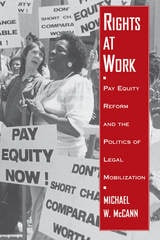
Rights at Work explores the political strategies in more than a dozen pay equity struggles since the late 1970s, including battles of state employees in Washington and Connecticut, as well as city employees in San Jose and Los Angeles. Relying on interviews with over 140 union and feminist activists, McCann shows that, even when the courts failed to correct wage discrimination, litigation and other forms of legal advocacy provided reformers with the legal discourse—the understanding of legal rights and their constraints—for defining and advancing their cause.
Rights at Work offers new insight into the relation between law and social change—the ways in which grass roots social movements work within legal rights traditions to promote progressive reform.

Rights or Self-Government?
Recovering the Meaning of Citizenship in an Age of RightsThomas E. Schneider
St. Augustine's Press, 2026
Rio as Method
Collective Resistance for a New GenerationPaul Amar, editor
Duke University Press, 2024
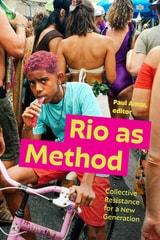
Contributors. Rosiane Rodrigues de Almeida, José Claudio Souza Alves, Tamires Maria Alves, Paul Amar, Marcelo Caetano Andreoli, Beatriz Bissio, Thaddeus Gregory Blanchette, Fernando Brancoli, Thayane Brêtas, Victoria Broadus, Fatima Cecchetto, Leonard Cortana, Marcos Coutinho, Monica Cunha, Luiz Henrique Eloy Amado, Marielle Franco, Cristiane Gomes Julião, Benjamin Lessing, Roberto Kant de Lima, Amanda De Lisio, Bryan McCann, Flávia Medeiros, Ana Paula Mendes de Miranda, Sean T. Mitchell, Rodrigo Monteiro, Vitória Moreira, Jacqueline de Oliveira Muniz, Laura Rebecca Murray, Cesar Pinheiro Teixeira, Osmundo Pinho, Paulo Pinto, María Victoria Pita, João Gabriel Rabello Sodré, Luciane Rocha, Marcos Alexandre dos Santos Albuquerque, Ana Paula da Silva, Denise Ferreira da Silva, Soraya Simões, Indianare Siqueira, Antonio Carlos de Souza Lima, Leonardo Vieira Silva
Riot Zone
Chicago 1919Christopher Lamberti, completed and edited by Sean Dinces
Temple University Press, 2027
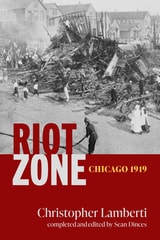
Riot Zone presents a compelling forensic microhistory of the racial violence that exploded in Chicago starting on July 27, 1919, when a Black teenager named Eugene Williams drowned in Lake Michigan after white beachgoers attacked him as he swam with friends. In the days that followed, white gang members terrorized African Americans on the city’s South Side and Black Chicagoans armed and defended themselves in response. By the end of the first week of August, when the rioting finally ended, thirty-eight Chicagoans lay dead and hundreds nursed injuries as a result of what became known as America’s “Red Summer.”
The late Christopher Lamberti, with the help of editor Sean Dinces, recounts this sobering history using GIS software to map what occurred. The authors revisit and debunk ideas about the role race and ethnicity played in the riot and its aftermath, showing how the politics of housing and racial conflicts over residential space set the stage for the riots that ensued.
With insights that echo in today’s conflicts, Riot Zone proves that there is still plenty to learn about the history of America’s ongoing struggle with urban and racial violence.

Riot!
Civil Insurrection From Peterloo to the Present DayIan Hernon
Pluto Press, 2006
Riot! covers, with a reporter's eye, almost 200 years of civil disturbance on mainland Britain, and gives a voice to some of the remarkable men and women involved. Ian Hernon shows that resistance played a part, not always beneficially, in the creation of proper parliamentary democracy, the welfare state, the trade union movement, the rights of immigrants and civil liberties. All of these, it can be argued, are under renewed attack today.
Hernon tells the story of a largely unacknowledged tradition of violent protest in Britain, from the martyrs of Peterloo to the drug-fuelled street violence of today. Riot! charts how the struggles of individual groups of workers turned into a broader campaign for electoral reform and justice; how excessive use of state force failed to extinguish the fires; how the trade unions pressed for wider social justice; how Thatcherism reversed decades of gradual reform and sparked social turmoil; and how a "good" riot played a part in her downfall. Finishing with an account of the anti-globalisation movement and G8 protests, this lively book shows how the ugly roar of a mob has perhaps done more to change society than measured parliamentary debate.
Rise Up!
Activism as EducationAmalia Dache
Michigan State University Press, 2019
Rising Powers and Foreign Policy Revisionism
Understanding BRICS Identity and Behavior Through TimeCameron G. Thies and Mark David Nieman
University of Michigan Press, 2017
State identity is investigated qualitatively through the use of role theory and the identification of national role conceptions. Both economic and militarized conflict behavior are examined using Bayesian change-point modeling, which identifies structural breaks in time series data, revealing potential wholesale revision of foreign policy. Using this innovative approach to show that the behavior of rising powers is governed not simply by the structural dynamics of power but also by the roles that these rising powers define for themselves, they assert that this process will likely lead to a much more evolutionary approach to foreign policy and will not necessarily generate international conflict.
Rising Star
The Meaning of Nikki Haley, Trump’s Unlikely AmbassadorJason A. Kirk
University of Arkansas Press, 2021
Rising Up, Living On
Re-Existences, Sowings, and Decolonial CracksCatherine E. Walsh
Duke University Press, 2023
Risk Aspects of Investment-Based Social Security Reform
Edited by John Y. Campbell and Martin Feldstein
University of Chicago Press, 2001
Risk Management and Political Culture
Sheila Jasanoff
Russell Sage Foundation, 1986
Risk Revisited
Pat Caplan
Pluto Press, 2000
Risk-Taking in International Politics
Prospect Theory in American Foreign PolicyRose McDermott
University of Michigan Press, 1998
Risk plays a dramatic role in international relations as leaders make decisions about such issues as war and peace, disarmament, and about lowering economic barriers to trade and investment. How a country's leaders think about risk in making foreign policy decisions is important in understanding why and how they make decisions. Rose McDermott applies prospect theory, a theory developed by psychologists to understand decisionmaking under conditions of risk, to four cases in American foreign policy. Prospect theory suggests that decisionmakers who are confronting losses are more likely to take risks than are those decisionmakers who are satisfied with the status quo. The cases used to demonstrate this dynamic include: the Suez Crisis, the U-2 affair, the decisions surrounding the admission of the Shah of Iran to the United States in 1979, and the attempted rescue of the American hostages in Iran in 1980. McDermott shows how prospect theory enables us to understand cases that are otherwise inexplicable. Risk Taking in International Relations offers a unique application of a sophisticated psychological model to international relations theory. The book will be of interest to political scientists and psychologists interested in decision making, in international relations and in American foreign policy.
Risky Cities
The Physical and Fiscal Nature of Disaster CapitalismAlbert S. Fu
Rutgers University Press, 2022
Risqué Business
Breastaurants in American CultureTy Matejowsky
University of Alabama Press, 2025
Risqué Business serves up the breastaurant industry, where food service, sex appeal, identity, and gender politics mix.
Risqué Business explores the rise and ongoing cultural reckoning of “breastaurants”: sports bar–style restaurants like Hooters and Twin Peaks, which have long relied on the sexualized presentation of female servers to attract a mostly straight, male clientele. Ty Matejowsky, professor of anthropology at the University of Central Florida, is uniquely positioned in America’s foundational, breastaurant-saturated landscape. From this vantage, he offers a well-balanced account that draws on pop culture, media analysis, and contemporary gender politics. He delivers a smart, layered analysis of how breastaurants commodify youth and femininity, uphold retrograde masculinity, and serve as symbolic battlegrounds in today's highly charged political environments including America's deeply polarized Red State/Blue State divide.
With case studies, cultural critique, and a critical lens on labor and sexuality, Matejowsky reveals how these restaurants are more than just risqué marketing gimmicks. They reflect deeper anxieties about gender, identity, and the uneasy fusion of sex and service in American consumer culture. Risqué Business is a high-spirited study of an industry that thrives at the intersection of appetite and identity.
Rituals Of Mediation
International Politics And Social MeaningFrancois Debrix
University of Minnesota Press, 2003
A timely consideration of the meaning of transnational cultural interactions today
In an era of increasing globalization, the cultural and the international have borders as permeable as most nations’s—and an understanding of one requires making sense of the other. Foregrounding the role of mediation—understood here as a site of representation, transformation, and pluralization—the authors engage two specific questions: How might we make theoretical and practical sense of transnational cultural interactions? And how are we to understand the ways in which the sites of mediation represent, transform, and remediate internationals? Accordingly, the authors consider international issues like security, development, political activism, and the war against terrorism through the lens of cultural practices such as traveling through airports, exhibiting art and photography, logging on to the Internet, and spinning news stories.
Contributors: Robin Brown, U of Leeds; David Campbell, U of Newcastle upon Tyne; Michael Dillon, U of Lancaster; Debbie Lisle, Queen’s U, Belfast; Moya Lloyd, Queen’s U, Belfast; Timothy W. Luke, Virginia Polytechnic Institute and State U; Patricia L. Price, Florida International U; Jayne Rodgers, U of Leeds; Marysia Zalewski, Queen’s U, Belfast.
Rival Claims
Ethnic Violence and Territorial Autonomy under Indian FederalismBethany Lacina
University of Michigan Press, 2017
Using new data on ethnicity and sub-national discrimination in India, national and state archives, parliamentary records, cross-national analysis and her original fieldwork, Lacina explains ethnoterritorial politics as a three-sided interaction of the center and rival interests in the periphery. Ethnic entrepreneurs use militancy to create national political pressure in favor of their goals when the prime minister lacks clear electoral reasons to court one regional group over another. Second, ethnic groups rarely win autonomy or mobilize for violence in regions home to electorally influential anti-autonomy interests. Third, when a regional ethnic majority is politically important to the prime minister, its leaders can deter autonomy demands within their borders, while actively discriminating against minorities.
Rival Claims challenges the conventional beliefs that territorial autonomy demands are a reaction to centralized power and that governments resist autonomy to preserve central prerogatives. The center has allegiances in regional politics, and ethnoterritorial violence reflects the center’s entanglement with rival interests in the periphery.
Rivalry and Reform
Presidents, Social Movements, and the Transformation of American PoliticsSidney M. Milkis and Daniel J. Tichenor
University of Chicago Press, 2019
Rivalry and Reform explores the relationship between presidents and social movements throughout history and into the present day, revealing the patterns that emerge from the epic battles and uneasy partnerships that have profoundly shaped reform. Through a series of case studies, including Abraham Lincoln and abolitionism, Lyndon Johnson and the civil rights movement, and Ronald Reagan and the religious right, Sidney M. Milkis and Daniel J. Tichenor argue persuasively that major political change usually reflects neither a top-down nor bottom-up strategy but a crucial interplay between the two. Savvy leaders, the authors show, use social movements to support their policy goals. At the same time, the most successful social movements target the president as either a source of powerful support or the center of opposition. The book concludes with a consideration of Barack Obama’s approach to contemporary social movements such as Black Lives Matter, United We Dream, and Marriage Equality.
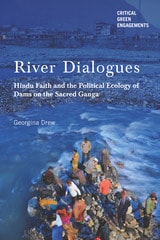
River Dialogues
Hindu Faith and the Political Ecology of Dams on the Sacred GangaGeorgina Drew
University of Arizona Press, 2017
India’s sacred Ganga River is arguably one of the most iconic sites for worship, with a continuity of rituals for the living and the dead that span over two millennia. Along the river, from high in the Himalaya to the vast plains below, people gather daily to worship the Ganga through prayer and song. But large government-sponsored dams threaten to upend these practices.
In River Dialogues, Georgina Drew offers a detailed ethnographic engagement with the social movements contesting hydroelectric development on the Ganga. The book examines the complexity of the cultural politics that, on the one hand, succeeded in influencing an unprecedented reversal of government plans for three contested hydroelectric projects, and how, on the other hand, this decision sparked ripples of discontent after being paired with the declaration of a conservation zone where the projects were situated.
The book follows the work of women who were initially involved in efforts to stop the disputed projects. After looking to their discourses and actions, Drew argues for the use of a political ecology analysis that incorporates the everyday practice and everyday religious connections that animated the cultural politics of development. Drew offers a nuanced understanding of the struggles that communities enact to assert their ways of knowing and caring for resources that serves as an example for others critically engaging with the growing global advocacy of the “green economy” model for environmental stewardship.
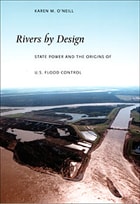
Rivers by Design
State Power and the Origins of U.S. Flood ControlKaren M. O Neill
Duke University Press, 2006
O’Neill focuses on the creation of flood control programs along the lower Mississippi River and the Sacramento River, the first two rivers to receive federal flood control aid. She describes how, in the early to mid-nineteenth century, planters, shippers, and merchants from both regions campaigned for federal assistance with flood control efforts. She explains how the federal government was slowly and reluctantly drawn into water management to the extent that, over time, nearly every river in the United States was reengineered. Her narrative culminates in the passage of the national Flood Control Act of 1936, which empowered the Army Corps of Engineers to build projects for all navigable rivers in conjunction with local authorities, effectively ending nationwide, comprehensive planning for the protection of water resources.
Rivers on Fire and Corporate Liars
The Monitoring and Sanctioning of U.S. Water Pollution CrimesJoshua Ozymy
Rutgers University Press, 2026
For over four decades, the US federal government has undertaken efforts to police and prosecute environmental crimes to protect public health and the natural environment. Yet, we still know very little about how US federal agencies have monitored and sanctioned water pollution violations and if these actions actually deter crime. In Rivers on Fire and Corporate Liars, Joshua Ozymy and Melissa Jarrell Ozymy examined over one thousand federal water pollution investigations and prosecutions undertaken by the US EPA and Department of Justice from 1983 to 2023 to answer these questions. Their analysis provides the most comprehensive empirical examination to date of how the criminal enforcement of water pollution has evolved over time, patterns in prosecutions, and how criminals were sanctioned.
Roads, Runways and Resistance
From the Newbury Bypass to Extinction RebellionSteve Melia
Pluto Press, 2021
'As a movement for social change it is important that we understand our own history. This is a compelling read.'
From the anti-roads protests of the 1990s to HS2 and Extinction Rebellion, conflict and protest have shaped the politics of transport. In 1989, Margaret Thatcher's government announced 'the biggest road-building programme since the Romans.' This is the inside story of the thirty tumultuous years that have followed.
Roads, Runways and Resistance draws on over 50 interviews with government ministers, advisors and protestors - many of whom, including 'Swampy', speak here for the first time about the events they describe. It is a story of transport ministers undermined by their own Prime Ministers, protestors attacked or quietly supported by the police, and smartly-dressed protestors who found a way onto the roof of the Houses of Parliament.
Today, as a new wave of road building and airport expansion threatens to bust Britain's carbon budgets, climate change protestors find themselves on a collision course with the government. Melia asks, what difference did the protests of the past make? And what impacts might today's protest movements have on the transport of the future?
Robert B. Heilman and Eric Voegelin
A Friendship in Letters, 1944-1984Edited & Intro by Charles R. Embry & Foreword by Champlin B. Heilman
University of Missouri Press, 2004
Heilman and Voegelin first became acquainted around 1941, when Voegelin delivered a guest lecture for the political science department at Louisiana State University. At that time, Heilman was teaching in the English department at LSU along with Robert Penn Warren and Cleanth Brooks. What began as simple exchanges after Voegelin moved to LSU soon grew into full-fledged correspondence—beginning with an eight-page letter by Voegelin commenting on Heilman’s manuscripton Shakespeare’s King Lear. Their correspondence lasted until four months before Voegelin’s death in January 1985.
These letters represent Voegelin’s most prolonged correspondence with a native-born American scholar and provide readers with an insight into Voegelin as a literary critic. While Voegelin’s analysis of Henry James’s The Turn of the Screw is well known, these letters reveal the context from which the analysis grew. Additional comments by Voegelin on Mann, Eliot, Shakespeare, Homer, Proust, Flaubert, and other significant writers are uncovered throughout his exchanges with Heilman.
Readers will appreciate not only Heilman’s elegant style but also his efforts to clarify for himself the meaning and implications of Voegelin’s developing philosophy. Heilman’s questions are often ones that readers of Voegelin continue to ask today. In his queries, as well as in the exposition of his theories of tragedy and melodrama, human nature, and expressionist drama, Heilman displays a canny perception of the philosophical issues and problems of modernity that sustained their interdisciplinary discussion. The letters exchanged by Robert B. Heilman and Eric Voegelin demonstrate the warm friendship these two scholars shared and illuminate many of the turns and transformations in their work as they developed as thinkers.
Rock of Ages
Subcultural Religious Identity and Public Opinion among Young EvangelicalsJeremiah J. Castle
Temple University Press, 2019
Evangelicals and Republicans have been powerful—and active—allies in American politics since the 1970s. But as public opinions have changed, are young evangelicals’ political identities and attitudes on key issues changing too? And if so, why? In Rock of Ages, Jeremiah Castle answers these questions to understand their important implications for American politics and society.
Castle develops his own theory of public opinion among young evangelicals to predict and explain their political attitudes and voting behavior. Relying on both survey data and his own interviews with evangelical college students, he shows that while some young evangelicals may be more liberal in their attitudes on some issues, most are just as firmly Republican, conservative, and pro-life on abortion as the previous generation.
Rock of Ages considers not only what makes young evangelicals different from the previous generation, but also what that means for both the church and American politics.
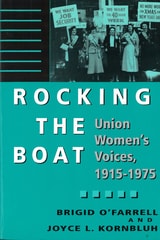
Rocking the Boat
Union Women's Voices, 1915-1975O'Farrell, Brigid
Rutgers University Press, 1996
Rocking the Boat is a celebration of strong, committed women who helped to build the American labor movement. Through the stories of eleven women from a wide range of backgrounds, we experience the turmoil, hardships, and accomplishments of thousands of other union women activists through the period spanning the Great Depression, the New Deal, World War II, the McCarthy era, the civil rights movement, and the women's movement. These women tell powerful stories that highlight and detail women's many roles as workers, trade unionists, and family members. They all faced difficulties in their personal lives, overcame challenges in their unions, and individually and collectively helped improve women's everyday working lives.
Maida Springer-Kemp came from New York City's Harlem, Local 22 of the International Ladies' Garment Workers' Union, to represent the AFL-CIO in Africa. In Chicago, Alice Peurala fought for her job in the steel mill and her place in the steel workers' union. Jessie De La Cruz organized farm workers in California. Esther Peterson, organizer, educator, and lobbyist, became an advisor to four U.S. presidents. In chapters based on oral history interviews, these women and others provide new perspectives and practical advice for today's working women. They share an idealistic and practical commitment to the labor movement. As Dorothy Haener of the United Auto Workers and a founding member of the National Organization of Women said, "You have to take a look at how to rock the boat. You don't want to spill yourself out if you can avoid it, but sometimes you have to rock the boat." From these women we, too, learn how to rock the boat.
Rojava
Revolution, War and the Future of Syria's KurdsThomas Schmidinger
Pluto Press, 2018
Rolling Transition and the Role of Intellectuals
The Case of HungaryAndrás Bozóki
Central European University Press, 2022
Utilizing a new and original framework for examining the role of intellectuals in countries transitioning to democracy, Bozóki analyses the rise and fall of dissident intellectuals in Hungary in the late 20th century. He shows how that framework is applicable to other countries too as he forensically examines their activities.
Bozóki argues that the Hungarian intellectuals did not become a ‘New Class’. By rolling transition, he means an incremental, non-violent, elite driven political transformation which is based on the rotation of agency, and it results in a new regime. This is led mainly by different groups of intellectuals who do not construct a vanguard movement but create an open network which might transform itself into different political parties. Their roles changed from dissidents to reformers, to movement organizers and negotiators through the periods of dissidence, open network building, roundtable negotiations, parliamentary activities, and new movement politics.
Through the prism of political sociology, the author focuses on the following questions: Who were the dissident intellectuals and what did they want? Under what conditions do intellectuals rebel and what are the patterns of their protest? This book will be of interest to students, researchers, and public intellectuals around the world aiming to promote human rights and democracy.
Roman Political Ideas and Practice
F. E. Adcock
University of Michigan Press, 1964
Romancing the Sperm
Shifting Biopolitics and the Making of Modern FamiliesDiane Tober
Rutgers University Press, 2019
In Romancing the Sperm, Diane Tober explores the intersections between sperm donation and the broader social and political environment in which “modern families” are created and regulated. Through tangible and intimate stories, this book provides a captivating read for anyone interested in family and kinship, genetics and eugenics, and how ever-expanding assisted reproductive technologies continue to redefine what it means to be human.
Ronald Reagan and the House Democrats
Gridlock, Partisanship, and the Fiscal CrisisKarl Gerard Brandt
University of Missouri Press, 2009
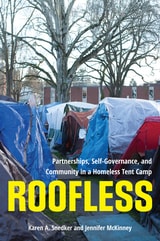
Roofless
Partnerships, Self-Governance, and Community in a Homeless Tent CampKaren A. Snedker
Rutgers University Press, 2027
Roofless critically examines homelessness and responses to it in the United States through the growing practice of forming tent camps. Karen A. Snedker and Jennifer McKinney position Seattle's "Tent City 3," (the US city with the third-largest homeless population), as an organizational model for other local governments to consider implementing in addressing their homelessness crises. Snedker and McKinney document this tent city's development through a census they conducted from 2019 to 2020, though the efforts behind Tent City 3 have a history dating back two decades. Through such an examination, the authors reveal surprising points of view and outcomes, including grassroots partnerships between city agencies, nonprofits, religious organizations, and educational institutions. In the context of rising homelessness in the US, understanding and having insight into the residents' experience of sanctioned unsheltered homelessness, compared to instances of unsanctioned encampments, allows readers to acquire a complete, nuanced picture of tent-based homelessness. As such, Roofless provides valuable insight to audiences ranging from scholars of sociology and social work, policymakers, homelessness advocates, and politicians.
Roosevelt the Reformer
Theodore Roosevelt as Civil Service Commissioner, 1889-1895Richard D. White Jr
University of Alabama Press, 2003
Discover the overlooked years that forged Theodore Roosevelt’s reforming spirit, revealing how bureaucratic battles shaped a future president and transformed American government forever
Roosevelt the Reformer is a compelling scholarly biography that uncovers a neglected chapter of Theodore Roosevelt’s life: his six-year tenure as U.S. Civil Service Commissioner from 1889 to 1895. Rather than focusing on his presidency or battlefield exploits, the book reveals how Roosevelt’s administrative work shaped his reformist zeal, political skills, and enduring impact on American governance. Through vivid narrative and careful analysis, it shows how this “quiet” period contributed directly to the modernization of the federal government and the emergence of the merit-based civil service.
Structured chronologically, the book traces each year of Roosevelt’s commissionership while weaving together political events, personal life, and broader social context. It draws on rich primary sources—letters, speeches, and contemporary accounts—and includes scholarly features such as notes, bibliography, and index. Richard D. White Jr., a historian of American political development, combines narrative storytelling with rigorous research to illuminate Roosevelt’s battles with patronage politics, his reform strategies, and his growing administrative expertise.
This book will appeal to historians, political scientists, and general readers interested in the Gilded Age, the Progressive Era, and the origins of modern government. It is especially valuable for readers seeking fresh perspectives on Theodore Roosevelt, public administration, or reform movements, offering both an engaging biography and a nuanced study of how institutions and leaders are transformed.
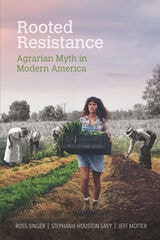
Rooted Resistance
Agrarian Myth in Modern AmericaNorie R. Singer
University of Arkansas Press, 2020
Through a careful examination of several case studies, Rooted Resistance traverses the ground of agrarian myth in modern America. The authors investigate key figures and movements in the history of modern agrarianism, including the World War I victory garden efforts, the postwar Country Life movement for the vindication of farmers’ rights, the Southern Agrarian critique of industrialism, and the practical and spiritual prophecy of organic farming put forth by J. I. Rodale. This critical history is then brought up to date with recent examples such as the contested South Central Farm in urban Los Angeles and the spectacular rise and fall of the Chipotle “Food with Integrity” branding campaign.
By examining a range of case studies, Singer, Grey, and Motter aim for a deeper critical understanding of the many applications of agrarian myth and reveal why it can help provide a pathway for positive systemic change in the food system.
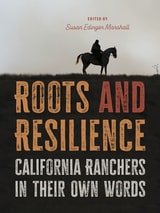
Roots and Resilience
California Ranchers in Their Own WordsSusan Edinger Marshall
University of Nevada Press, 2024
The editors have drawn together these stories, poems, and musings from ranchers across the state, calling upon real people to share their experiences, and beckoning readers to find a shared understanding concerning often divisive land-use topics. Many perspectives are considered, including those of transplanted suburbanites to seventh-generation heirs. Notably, many women’s writings are including in the book, offering unique and valuable perspectives on ranching culture.
Roots and Resilience gives voice to California’s Indigenous, Mexican American, Basque and other European American ranchers, asking the reader to find common ground in the name of land stewardship and conservation.
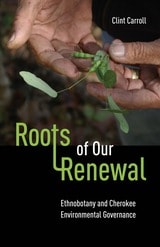
Roots of Our Renewal
Ethnobotany and Cherokee Environmental GovernanceClint Carroll
University of Minnesota Press, 2015
Honorable Mention: Labriola Center American Indian National Book Award
In Roots of Our Renewal, Clint Carroll tells how Cherokee people have developed material, spiritual, and political ties with the lands they have inhabited since removal from their homelands in the southeastern United States. Although the forced relocation of the late 1830s had devastating consequences for Cherokee society, Carroll shows that the reconstituted Cherokee Nation west of the Mississippi eventually cultivated a special connection to the new land—a connection that is reflected in its management of natural resources.
Until now, scant attention has been paid to the interplay between tribal natural resource management programs and governance models. Carroll is particularly interested in indigenous environmental governance along the continuum of resource-based and relationship-based practices and relates how the Cherokee Nation, while protecting tribal lands, is also incorporating associations with the nonhuman world. Carroll describes how the work of an elders’ advisory group has been instrumental to this goal since its formation in 2008.
An enrolled citizen of the Cherokee Nation, Carroll draws from his ethnographic observations of Cherokee government–community partnerships during the past ten years. He argues that indigenous appropriations of modern state forms can articulate alternative ways of interacting with and “governing” the environment.
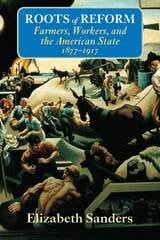
Roots of Reform
Farmers, Workers, and the American State, 1877-1917Elizabeth Sanders
University of Chicago Press, 1999
Based on new evidence from legislative records and other sources, Sanders shows that this tenuous alliance of "producers versus plutocrats" shaped early regulatory legislation, remained powerful through the populist and progressive eras, and developed a characteristic method of democratic state expansion with continued relevance for subsequent reform movements.
Roots of Reform is essential reading for anyone interested in this crucial period of American political development.
Rosa Luxemburg, Women's Liberation, and Marx's Philosophy of Revolution
Raya Dunayevskaya
University of Illinois Press, 1991
In this important and wide-ranging critique of Rosa Luxemburg (1871-1919) Raya Dunayevskaya examines the life, political thought, and action of one of the most critical revolutionary figures of our time. Dunayevskaya sheds new light on the questions of socialist democracy after the revolution, disclosing both the unprobed feminist dimension of Rosa Luxemburg and the previously unrecognized new moments in Marx's last decade concerning the role of women and the peasantry. As the founder of Marxist-Humanism in the United States, Dunayevskaya (1910-87) was an internationally respected writer, philosopher, and revolutionary. This new and expanded edition includes two previously unpublished articles by Dunayevskaya, including her "Challenge to all Post-Marx Marxists."
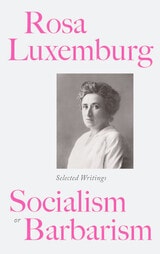
Rosa Luxemburg
Socialism or Barbarism: Selected WritingsRosa Luxemburg
Pluto Press, 2010
Rosa Luxemburg (1871-1919) was one of the most brilliant and passionate minds drawn to the revolutionary socialist movement. An outstanding social and economic theorist of the twentieth century, and a dedicated political activist, she proved willing to go to prison and even give her life for her beliefs.
Providing an extensive overview of her writings, this volume contains a number of items never before anthologised. Her work was broad in scope tackling capitalism and socialism; globalisation and imperialism; history; war and peace; social struggles, trade unions, political parties; class, gender, race; the interconnection of humanity with the natural environment. The editors provide an extensive and informative introduction outlining and evaluating her life and thought.
This is the most comprehensive introduction to the range of Rosa Luxemburg’s thought.
Rotten Boroughs, Political Thickets, and Legislative Donnybrooks
Redistricting in TexasEdited by Gary A. Keith
University of Texas Press, 2013
Every ten years, the Texas legislature redistricts itself and the state’s congressional districts in an attempt to ensure equality in representation. With a richly textured cultural fabric, Texas often experiences redistricting battles that are heated enough to gain national attention. Collecting a variety of voices, including legislators themselves, in addition to lawyers, community organizers, political historians, and political scientists, Rotten Boroughs, Political Thickets, and Legislative Donnybrooks delivers a multidimensional picture of how redistricting works in Texas today, and how the process evolved.
In addition to editor Gary Keith’s historical narrative, which emphasizes the aftermath of the Warren Court’s redistricting decisions, longtime litigators David Richards and J. D. Pauerstein describe the contentious lines drawn from the 1970s into the 2000s. Former state legislator and congressman Craig Washington provides an insider’s view, while redistricting attorney and grassroots organizer Jose Garza describes the repercussions for Mexican Americans in Texas. Balancing these essays with a quantitative perspective, political scientists Seth McKee and Mark McKenzie analyze the voting data for the 2000 decade to describe the outcomes of redistricting. The result is a timely tour that provides up-to-date context, particularly on the role of the Voting Rights Act in the twenty-first century. From local community engagement to the halls of the Capitol, this is the definitive portrait of redistricting and its repercussions for all Texans.
Rotten States?
Corruption, Post-Communism, and NeoliberalismLeslie Holmes
Duke University Press, 2006
Drawing on data including surveys commissioned especially for this study, Holmes examines the causes and consequences of official corruption as well as ways of combating it. He focuses particular attention on the timing of the recent increase in reports of corruption, the relationship between post-communism and corruption, and the interplay between corruption and the delegitimation and weakening of the state. Holmes argues that the global turn toward neoliberalism—with its focus on ends over means, flexibility, and a reduced role for the state—has generated much of the corruption in post-communist states. At the same time, he points out that neoliberalism is perhaps the single most powerful tool for overcoming the communist legacy, which is an even more significant cause of corruption. Among the conclusions that Holmes draws is that a strong democratic state is needed in the early stages of the transition from communism in order to prevent corruption from taking hold.
Rousseau's God
Theology, Religion, and the Natural Goodness of ManJohn T. Scott
University of Chicago Press, 2023
John T. Scott offers a comprehensive interpretation of Rousseau’s theological and religious thought, both in its own right and in relation to Rousseau’s broader oeuvre. In chapters focused on different key writings, Scott reveals recurrent themes in Rousseau’s views on the subject and traces their evolution over time. He shows that two concepts—truth and utility—are integral to Rousseau’s writings on religion. Doing so helps to explain some of Rousseau’s disagreements with his contemporaries: their different views on religion and theology stem from different understandings of human nature and the proper role of science in human life. Rousseau emphasizes not just what is true, but also what is useful—psychologically, morally, and politically—for human beings. Comprehensive and nuanced, Rousseau’s God is vital to understanding key categories of Rousseau’s thought.
Rousseau's Reader
Strategies of Persuasion and EducationJohn T. Scott
University of Chicago Press, 2020
In Rousseau’s Reader, John T. Scott looks at the different strategies Rousseau used to engage and persuade the readers of his major philosophical works, including the Social Contract, Discourse on Inequality, and Emile. Considering choice of genre; textual structure; frontispieces and illustrations; shifting authorial and narrative voice; addresses to readers that alternately invite and challenge; apostrophe, metaphor, and other literary devices; and, of course, paradox, Scott explores how the form of Rousseau’s writing relates to the content of his thought and vice versa. Through this skillful interplay of form and content, Rousseau engages in a profoundly transformative dialogue with his readers.
While most political philosophers have focused, understandably, on Rousseau’s ideas, Scott shows convincingly that the way he conveyed them is also of vital importance, especially given Rousseau’s enduring interest in education. Giving readers the key to Rousseau’s style, Scott offers fresh and original insights into the relationship between the substance of his thought and his literary and rhetorical techniques, which enhance our understanding of Rousseau’s project and the audiences he intended to reach.
Rousseau, Nietzsche, and the Image of the Human
Paul Franco
University of Chicago Press, 2021
In Rousseau, Nietzsche, and the Image of the Human, Paul Franco examines the relationship between Jean-Jacques Rousseau and Friedrich Nietzsche, arguably the two most influential shapers and explorers of the moral and cultural imagination of late modernity. Both thinkers leveled radical critiques of modern life, but those critiques differed in important respects. Whereas Rousseau focused on the growing inequality of modern society and the hypocrisy, self-division, and loss of civic virtue it spawned, Nietzsche decried the democratic equality he identified with Rousseau and the loss of individual and cultural greatness it entailed. Franco argues, however, that Rousseau and Nietzsche are more than mere critics; they both put forward powerful alternative visions of how we ought to live. Franco focuses specifically on their views of the self and its realization, their understandings of women and the relation between the sexes, and their speculative conceptions of politics. While there are many similarities in their positive visions, Franco argues that it is the differences between them from which we have most to learn.
Routing the Opposition
Social Movements, Public Policy, and DemocracyDavid S. Meyer
University of Minnesota Press, 2005
Row by Row
Talking with Kentucky GardenersKatherine J. Black
Ohio University Press, 2015
For two and a half years, Katherine J. Black crisscrossed Kentucky, interviewing home vegetable gardeners from a rich variety of backgrounds. Row by Row: Talking with Kentucky Gardeners is the result, a powerful compilation of testimonies on the connections between land, people, culture, and home.
The people profiled here share a Kentucky backdrop, but their life stories, as well as their gardens, have as many colors, shapes, and tastes as heirloom tomatoes do. Black interviewed those who grow in city backyards, who carve out gardens from farmland, and who have sprawling plots in creek bottoms and former pastures. Many of the gardeners in Row by Row speak eloquently about our industrialized food system’s injuries to the land, water, and health of people. But more often they talk about what they are doing in their gardens to reverse this course.
Row by Row is as sure to appeal to historians, food studies scholars, and sustainability advocates as it is to gardeners and local food enthusiasts. These eloquent portraits, drawn from oral histories and supplemented by Deirdre Scaggs’ color photographs, form a meditation on how gardeners make sense of their lives through what they grow and how they grow it.