Results by title
313 books match the query 'Administration' and 18 start with s
Saving Alma Mater
A Rescue Plan for America's Public UniversitiesJames C. Garland
University of Chicago Press, 2009
America’s public universities educate 80% of our nation’s college students. But in the wake of rising demands on state treasuries, changing demographics, growing income inequality, and legislative indifference, many of these institutions have fallen into decline. Tuition costs have skyrocketed, class sizes have gone up, the number of courses offered has gone down, and the overall quality of education has decreased significantly.
Here James C. Garland draws on more than thirty years of experience as a professor, administrator, and university president to argue that a new compact between state government and public universities is needed to make these schools more affordable and financially secure. Saving Alma Mater challenges a change-resistant culture in academia that places too low a premium on efficiency and productivity. Seeing a crisis of campus leadership, Garland takes state legislators to task for perpetuating the decay of their public university systems and calls for reforms in the way university presidents and governing boards are selected. He concludes that the era is long past when state appropriations can enable public universities to keep their fees low and affordable. Saving Alma Mater thus calls for the partial deregulation of public universities and a phase-out of their state appropriations. Garland’s plan would tie university revenues to their performance and exploit the competitive pressures of the academic marketplace to control costs, rein in tuition, and make schools more responsive to student needs.
A much-needed blueprint for reform based on Garland’s real-life successes as the head of Miami University of Ohio, Saving Alma Mater will be essential for anyone concerned with the costs and quality of higher education in America today.

School Principal
Managing in PublicDan C. Lortie
University of Chicago Press, 2009
When we think about school principals, most of us imagine a figure of vague, yet intimidating authority—for an elementary school student, being sent to the principal’s office is roughly on par with a trip to Orwell’s Room 101. But with School Principal, Dan C. Lortie aims to change that. Much as he did for teachers with his groundbreaking book Schoolteacher, Lortie offers here an intensive and detailed look at principals, painting a compelling portrait of what they do, how they do it, and why.
Lortie begins with a brief history of the job before turning to the daily work of a principal. These men and women, he finds, stand at the center of a constellation of competing interests around and within the school. School district officials, teachers, parents, and students all have needs and demands that frequently clash, and it is the principal’s job to manage these conflicting expectations to best serve the public. Unsurprisingly then, Lortie records his subjects’ professional dissatisfactions, but he also vividly depicts the pleasures of their work and the pride they take in their accomplishments. Finally, School Principal offers a glimpse of the future with an analysis of current issues and trends in education, including the increasing presence of women in the role and the effects of widespread testing mandated by the government.
Lortie’s scope is both broad and deep, offering an eminently useful range of perspectives on his subject. From the day-to-day toil to the long-term course of an entire career, from finding out just what goes on inside that office to mapping out the larger social and organizational context of the job, School Principal is a truly comprehensive account of a little-understood profession.
Schooled and Sorted
How Educational Categories Create InequalityThurston Domina
Russell Sage Foundation, 2023
Some educational categories have broadly egalitarian consequences. Indeed, Domina, Penner, and Penner argue that when societies enroll young people in school, making them students, they mark them as individuals who are worthy of rights. But other educational categories reinforce powerful social categories—including race, gender, and class—and ultimately reproduce social and economic inequality in society. Elite colleges, tracked high schools, and elementary school gifted programs provide not only different educational experiences, but also create merit and inequality by sorting students into categories that are defined by the students who are excluded.
Schooled & Sorted highlights that many of the decisions that define educational categories occur in school-based committee meetings and other relatively local settings. The local nature of these decisions provides many opportunities to define educational categories differently, and for school communities to bring about change.
Schooled & Sorted is an illuminating investigation into the ways sorting within schools translates into inequality in the larger world. While some educational categorization may be unavoidable, the authors suggest ways to build a more equitable system—and thus a more equitable society.
Schools Under Surveillance
Cultures of Control in Public EducationMonahan, Torin
Rutgers University Press, 2009
Sensemaking for Writing Programs and Writing Centers
Rita Malenczyk
Utah State University Press, 2023
The book is divided into two sections: Sensemaking with Tutors and Teachers, and Sensemaking and Institutional Structures. Chapter authors employ several theoretical approaches to sensemaking, ranging from individual experience to institutional history to document design, providing readers with ideas for how to administer and teach within their programs more effectively; how to advocate for their programs within larger university contexts; and how to positively influence the lives and careers of those they work with.
Sensemaking for Writing Programs and Writing Centers theorizes daily experiences from working lives and suggests problem-solving strategies. Writing program administrators, writing department chairs, and writing center directors, tutors, and staff will find value in its pages.

Small Public Library Management
Jane Pearlmutter
American Library Association, 2012
Small Public Library Management, Second Edition
Cindy Fesemyer and Christina Jones
American Library Association, 2025
- benefit from this handbook’s up-to-date perspectives on what it takes to run your library in today’s post-pandemic, politically polarized, technologically advanced, socially isolated world;
- receive to-the-point advice on governance, strategic planning, human resources, policy development, facilities, services and programs, and other foundational tasks;
- become informed on how to safeguard intellectual freedom, handle challenges to materials and programming, and protect patron privacy;
- get pointers on broadening their personal network, understanding what outside resources are available, and spearheading effective advocacy and community engagement;
- learn from real-life “Success Stories” and “On the Job” words of wisdom sprinkled throughout the text; and
- find adaptable templates, self-enrichment activities, and other tools to facilitate ongoing professional development.
So You Want to Be an Academic Library Director
Colleen S. Harris
American Library Association, 2017
Space-Time Perspectives on Early Colonial Moquegua
Prudence M. Rice
University Press of Colorado, 2024
Space-Time Perspectives on Early Colonial Moquegua looks at the encounters between existing populations and newcomers from successive waves of colonization, from indigenous expansion states (Wari, Tiwanaku, and Inka) to the foreign Spaniards, and the way each group “re-spatialized” the landscape according to its own political and economic ends. Viewing these spatializations from political, economic, and religious perspectives, Rice considers both the ideological and material occurrences.
Concluding with a special focus on the multiple space-time considerations involved in Spanish-inspired ceramics from the region, Space-Time Perspectives on Early Colonial Moquegua integrates the local and rural with the global and urban in analyzing the events and processes of colonialism. It is a vital contribution to the literature of Andean studies and will appeal to students and scholars of archaeology, historical archaeology, history, ethnohistory, and globalization.
Speaking of Duke
Leading the Twenty-First-Century UniversityRichard H. Brodhead
Duke University Press, 2017
In these essays, Brodhead shows a university thinking its way forward through challenges all institutes of higher education have faced in the twenty-first century, including an expanding global horizon, an economic downturn that has left a diminished sense of opportunity and a shaken faith in the value of liberal arts education, and pressure to think more deeply about issues of equity and inclusion. His audiences range from newly arrived freshmen and new graduates—both facing uncertainty about how to build their future lives—to seasoned faculty members. On other occasions, he makes the case to the general public for the enduring importance of the humanities.
What results is a portrait of Duke University in its modern chapter and the social and political climate that it shapes and is shaped by. While these speeches were given on official occasions, they are not impersonal official pronouncements; they are often quite personal and written with grace, humor, and an unwavering belief in the power of education to shape a changing world for the better.
Brodhead notes that it is an underappreciated fact that a great deal of the exercise of power by a university leader is done through speaking: by articulating the aspirations of the school and the reasons for its choices, and by voicing the shared sense of mission that gives a learning community its reality. Speaking of Duke accomplishes each of those and demonstrates Brodhead's conviction that higher education is more valuable now than ever.
Starting, Strengthening and Managing Institutional Repositories
Jonathan A. Nabe
American Library Association, 2010
Stepping Away
Returning to the Faculty After Senior Academic LeadershipLisa Jasinski
Rutgers University Press, 2023
Strategic Planning for Results
Sandra Nelson
American Library Association, 2008
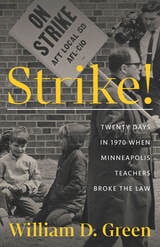
Strike!
Twenty Days in 1970 When Minneapolis Teachers Broke the LawWilliam D. Green
University of Minnesota Press, 2022
When viewed from our turbulent times, the Minneapolis of fifty years ago might seem serene, but Minneapolis schoolteachers of the day remember it quite differently. It was, author William D. Green said of their recollections, as if they’d been through war. This book recreates twenty days in April 1970 when a then-illegal strike by Minneapolis’s public school teachers marked a singular moment of cultural upheaval—and forever changed the city’s politics, labor law, educational climate, and the right to collective bargaining.
Since the inception of public education in Minnesota, teachers were expected to pursue their vocation out of civic spirit, with low wages, no benefits, and no job security. Strike! describes the history and circumstances leading to the teachers’ extraordinary action, which pitted the progressive and conservative teachers’ unions against each other—and both against the all-powerful school district, a hostile governor and state legislature, and a draconian Minnesota law. Capturing the intense emotions and heated rivalries of the strike, Green profiles the many actors involved, the personal and professional stakes, and the issues of politics, law, and the business of education.
Informed by interviews, firsthand accounts, news reports, and written records, Strike! brings to life a pivotal moment not just for Minneapolis’s teachers but for the city itself, whose government, school system, and culture would, in a complex but inexorable way, change course for good.

Structures of Indifference
An Indigenous Life and Death in a Canadian CityMary Jane Logan McCallum
University of Manitoba Press, 2018
Struggle For Academic Democr
Abraham Edel
Temple University Press, 1990

Students Lead The Library
The Importance Of StudentCarissa Tomlinson
Assoc of College & Research Libraries, 2016
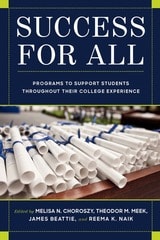
Success for All
Programs to Support Students Throughout Their College ExperienceMelisa N. Choroszy
University of Nevada Press, 2019
Success for All is a strategic guide for administrators and educators that offers methods for advising students through the myriad of challenges they face. Every bit of success contributes to the accomplishment of a larger goal, and this book highlights success at every level. It provides a specific roadmap to the research, services, and programs at the University of Nevada, Reno and Truckee Meadows Community College that support student success in undergraduate and graduate programs regardless of a student’s social, emotional, or prior academic experiences. Contributors discuss how to make students feel welcome in their social and educational environments and how to directly assist them with the timely completion of their degree. Administrators and educators demonstrate how these programs help make a positive contribution to the students and the institutions they serve while implementing practical solutions to increase graduation rates.