Results by title
157 books match the query 'African Americans in literature' and 14 start with s

SOS-Calling All Black People
A Black Arts Movement ReaderBracey John H.
University of Massachusetts Press, 0
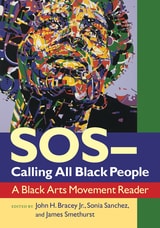
SOS—Calling All Black People
A Black Arts Movement ReaderJohn H. Bracey
University of Massachusetts Press, 2014
Many of the movement's leading artists, including Ed Bullins, Nikki Giovanni, Woodie King, Haki Madhubuti, Sonia Sanchez, Askia Touré, and Val Gray Ward remain artistically productive today. Its influence can also be seen in the work of later artists, from the writers Toni Morrison, John Edgar Wideman, and August Wilson to actors Avery Brooks, Danny Glover, and Samuel L. Jackson, to hip hop artists Mos Def, Talib Kweli, and Chuck D.
SOS—Calling All Black People includes works of fiction, poetry, and drama in addition to critical writings on issues of politics, aesthetics, and gender. It covers topics ranging from the legacy of Malcolm X and the impact of John Coltrane's jazz to the tenets of the Black Panther Party and the music of Motown. The editors have provided a substantial introduction outlining the nature, history, and legacy of the Black Arts Movement as well as the principles by which the anthology was assembled.
Satire or Evasion?
Black Perspectives on Huckleberry FinnJames S. Leonard, Thomas A. Tenney and Thadious M. Davis, eds.
Duke University Press, 1992
Ranging from the laudatory to the openly hostile, these essays include personal impressions of Huckleberry Finn, descriptions of classroom experience with the book, evaluations of its ironic and allegorical aspects, explorations of its nineteenth-century context, and appraisal of its effects on twentieth-century African American writers. Among the issues the authors contend with are Twain’s pervasive use of the word “nigger,” his portrayal of the slave Jim according to the conventions of the minstrel show “darky,” and the thematic chaos created by the “evasion” depicted in the novel’s final chapters.
Sure to provoke thought and stir debate, Satire or Evasion? provides a variety of new perspectives on one of this country’s most troubling classics.
Contributors. Richard K. Barksdale, Bernard W. Bell, Mary Kemp Davis, Peaches M. Henry, Betty Harris Jones, Rhett S. Jones, Julius Lester, Donnarae MacCann, Charles H. Nichols, Charles H. Nilon, Arnold Rampersad, David L. Smith, Carmen Dubryan, John H. Wallace, Kenny Jackson Williams, Fredrick Woodard
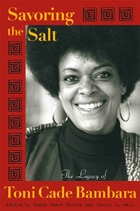
Savoring the Salt
The Legacy of Toni Cade Bambaraedited by Linda Janet Holmes and Cheryl A. Wall
Temple University Press, 2007
Admiring readers have kept Bambara's fiction in print since her first collection of stories, Gorilla, My Love, was published in 1972. She continued to write -- and her audience and reputation continued to grow -- until her untimely death in 1995. Savoring the Salt includes excerpts from her published and unpublished writings, along with interviews and photos of Bambara. The mix of poets and scholars, novelists and critics, political activists and filmmakers represented here testifies to the ongoing importance and enduring appeal of her work.

Scarring the Black Body
Race and Representation in African American LiteratureCarol E. Henderson
University of Missouri Press, 2002

Shakin' Up Race and Gender
Intercultural Connections in Puerto Rican, African American, and Chicano Narratives and Culture (1965–1995)By Marta E. Sánchez
University of Texas Press, 2006
The second phase of the civil rights movement (1965-1973) was a pivotal period in the development of ethnic groups in the United States. In the years since then, new generations have asked new questions to cast light on this watershed era. No longer is it productive to consider only the differences between ethnic groups; we must also study them in relation to one another and to U.S. mainstream society.
In "Shakin' Up" Race and Gender, Marta E. Sánchez creates an intercultural frame to study the historical and cultural connections among Puerto Ricans, African Americans, and Chicanos/as since the 1960s. Her frame opens up the black/white binary that dominated the 1960s and 1970s. It reveals the hidden yet real ties that connected ethnics of color and "white" ethnics in a shared intercultural history. By using key literary works published during this time, Sánchez reassesses and refutes the unflattering portrayals of ethnics by three leading intellectuals (Octavio Paz, Daniel Patrick Moynihan, and Oscar Lewis) who wrote about Chicanos, African Americans, and Puerto Ricans. She links their implicit misogyny to the trope of La Malinche from Chicano culture and shows how specific characteristics of this trope—enslavement, alleged betrayal, and cultural negotiation—are also present in African American and Puerto Rican cultures. Sánchez employs the trope to restore the agency denied to these groups. Intercultural contact—encounters between peoples of distinct ethnic groups—is the theme of this book.
Signs and Cities
Black Literary PostmodernismMadhu Dubey
University of Chicago Press, 2003
Dubey shows how black novelists from the last three decades have reconsidered the modern urban legacy and thus articulated a distinctly African-American strain of postmodernism. She argues that novelists such as Octavia Butler, Samuel Delany, Toni Morrison, Gloria Naylor, Ishmael Reed, Sapphire, and John Edgar Wideman probe the disillusionment of urban modernity through repeated recourse to tropes of the book and scenes of reading and writing. Ultimately, she demonstrates that these writers view the book with profound ambivalence, construing it as an urban medium that cannot recapture the face-to-face communities assumed by oral and folk forms of expression.
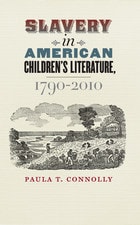
Slavery in American Children's Literature, 1790-2010
Paula T. Connolly
University of Iowa Press, 2013
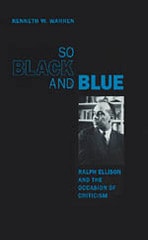
So Black and Blue
Ralph Ellison and the Occasion of CriticismKenneth W. Warren
University of Chicago Press, 2003
What would it mean to read Invisible Man as a document of Jim Crow America? Using Ralph Ellison's classic novel and many of his essays as starting points, Kenneth W. Warren illuminates the peculiar interrelation of politics, culture, and social scientific inquiry that arose during the post-Reconstruction era and persisted through the Civil Rights movement. Warren argues that Ellison's novel expresses the problem of who or what could represent and speak for the Negro in an age of limited political representation.
So Black and Blue shows that Ellison's successful transformation of these limits into possibilities has also, paradoxically, cast a shadow on the postsegregation world. What can be the direction of African American culture once the limits that have shaped it are stricken down? Here Warren takes up the recent, ongoing, and often contradictory veneration of Ellison's artistry by black writers and intellectuals to reveal the impoverished terms often used in discussions about the political and cultural future of African Americans. Ultimately, by showing what it would mean to take seriously the idea of American novels as creatures of their moment, Warren questions whether there can be anything that deserves the label of classic American literature.
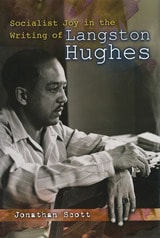
Socialist Joy in the Writing of Langston Hughes
Jonathan Scott
University of Missouri Press, 2007
Jonathan Scott has written the first book-length study to analyze the extraordinary range of Hughes’s creative output, showing that his unassailable reputation as one of America’s finest “folk poets” barely scratches the surface of his oeuvre. Scott offers a robust account of the relations between Hughes and political activism to show that Hughes’s direct involvement with the U.S. socialist movement of the 1920s and 1930s was largely responsible for the variety of his writing. Scott also contends that the goal of overthrowing white oppression produced a “socialist joy” that would express itself repeatedly in Hughes’s work during the anticommunist crusades of the 1950s and 1960s.
In his provocative study, Scott explores four areas of Hughes’s intellectual work: his relationship with Afro-Caribbean arts, Soviet Russia, and the Harlem Renaissance; his postwar newspaper writing for the African American press; his extensive cultural work as an anthologist; and his writings for young people. Through these analyses, Scott proposes the concept of “red, white, and black” as an alternative paradigm for appreciating Hughes in particular and the American scene in general.
Scott views Hughes not simply as a great author but as an American working-class intellectual trickster whose eccentric projects require a redefinition of the very concept of authorship. By focusing on Hughes’s intellectual method, Scott also contests the notion of reducing all African Americans to one undifferentiated social status beneath that of any class within the white oppressing group—a hallmark of racial oppression that has diminished, in the U.S. academy, Hughes’s international status.
As Scott persuasively argues, it is only through an understanding of Hughes’s literary method that we can undertake a thorough account of his prolific production during the cold war era. His book situates Hughes’s life and work in their proper contexts, both reconfirming Hughes’s reputation as an intellectual of the American Left and establishing his long-denied place in American studies as the most well-rounded writer of his time.
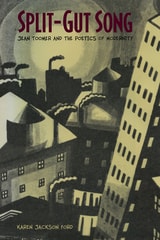
Split-Gut Song
Jean Toomer and the Poetics of ModernityKaren Jackson Ford
University of Alabama Press, 2005
Reclaiming Jean Toomer as a radical innovator of African American modernist poetics.
In Split-Gut Song, Karen Jackson Ford looks at what it means to be African American, free, and creative by analyzing Jean Toomer's main body of work, specifically, his groundbreaking creation Cane. When first published in 1923, this pivotal work of modernism was widely hailed as inaugurating a truly artistic African American literary tradition. Yet Toomer's experiments in literary form are consistently read in terms of political radicalism—protest and uplift—rather than literary radicalism.
Ford contextualizes Toomer's poetry, letters, and essays in the literary culture of his period and, through close readings of the poems, shows how they negotiate formal experimentation (imagism, fragmentation, dialect) and traditional African American forms (slave songs, field hollers, call-and-response sermons, lyric poetry). At the heart of Toomer's work is the paradox that poetry is both the saving grace of African American culture and that poetry cannot survive modernity. This contradiction, Ford argues, structures Cane, wherein traditional lyric poetry first flourishes, then falters, then falls silent.
The Toomer that Ford discovers in Split-Gut Song is a complicated, contradictory poet who brings his vexed experience and ideas of racial identity to both conventional lyric and experimental forms. Although Toomer has been labelled a political radical, Ford argues that politics is peripheral in his experimental, stream-of-consciousness work. Rather Toomer exhibits a literary radicalism as he struggles to articulate his perplexed understanding of race and art in 20th-century America.
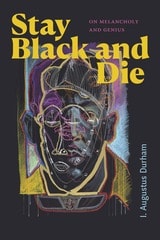
Stay Black and Die
On Melancholy and GeniusI. Augustus Durham
Duke University Press, 2023
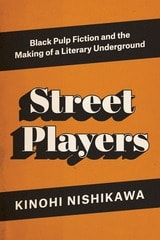
Street Players
Black Pulp Fiction and the Making of a Literary UndergroundKinohi Nishikawa
University of Chicago Press, 2018
Kinohi Nishikawa contends that black pulp fiction was built on white readers’ fears of the feminization of society—and the appeal of black masculinity as a way to counter it. In essence, it was the original form of blaxploitation: a strategy of mass-marketing race to suit the reactionary fantasies of a white audience. But while chauvinism and misogyny remained troubling yet constitutive aspects of this literature, from 1973 onward, Holloway House moved away from publishing sleaze for a white audience to publishing solely for black readers. The standard account of this literary phenomenon is based almost entirely on where this literature ended up: in the hands of black, male, working-class readers. When it closed, Holloway House was synonymous with genre fiction written by black authors for black readers—a field of cultural production that Nishikawa terms the black literary underground. But as Street Players demonstrates, this cultural authenticity had to be created, promoted, and in some cases made up, and there is a story of exploitation at the heart of black pulp fiction’s origins that cannot be ignored.
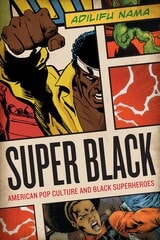
Super Black
American Pop Culture and Black SuperheroesBy Adilifu Nama
University of Texas Press, 2011
Winner, American Book Award, Before Columbus Foundation, 2012
Super Black places the appearance of black superheroes alongside broad and sweeping cultural trends in American politics and pop culture, which reveals how black superheroes are not disposable pop products, but rather a fascinating racial phenomenon through which futuristic expressions and fantastic visions of black racial identity and symbolic political meaning are presented. Adilifu Nama sees the value—and finds new avenues for exploring racial identity—in black superheroes who are often dismissed as sidekicks, imitators of established white heroes, or are accused of having no role outside of blaxploitation film contexts.
Nama examines seminal black comic book superheroes such as Black Panther, Black Lightning, Storm, Luke Cage, Blade, the Falcon, Nubia, and others, some of whom also appear on the small and large screens, as well as how the imaginary black superhero has come to life in the image of President Barack Obama. Super Black explores how black superheroes are a powerful source of racial meaning, narrative, and imagination in American society that express a myriad of racial assumptions, political perspectives, and fantastic (re)imaginings of black identity. The book also demonstrates how these figures overtly represent or implicitly signify social discourse and accepted wisdom concerning notions of racial reciprocity, equality, forgiveness, and ultimately, racial justice.